
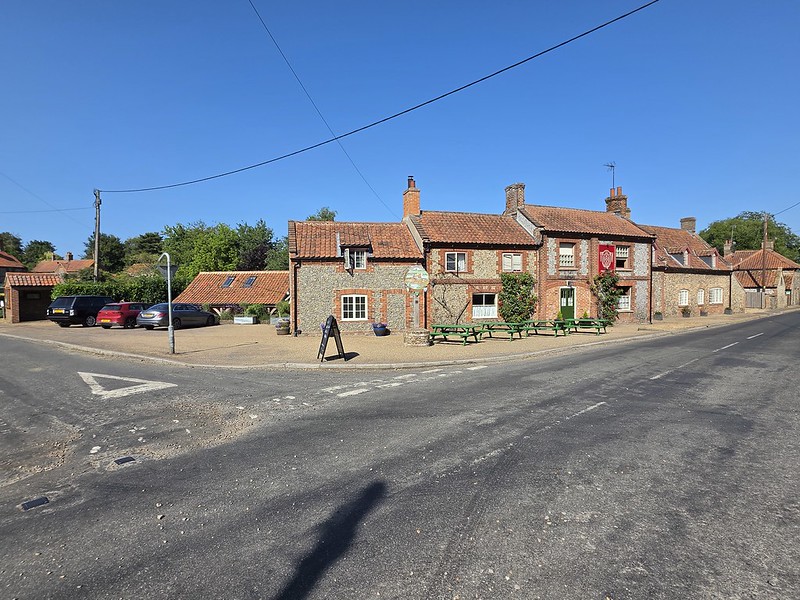
The next pub on my day out with Jen and Roy was in Warham, a village that I’m not entirely sure that I’d ever heard of before. It seems to be an interesting village, it still has two medieval churches (of which I managed to visit one quickly) and it used to have a third, but that was pulled down. It also has a railway station, well railway stop, as part of the Wells and Walsingham Light Railway, but this is a relatively new innovation from 1982 and there wasn’t historically a station here.
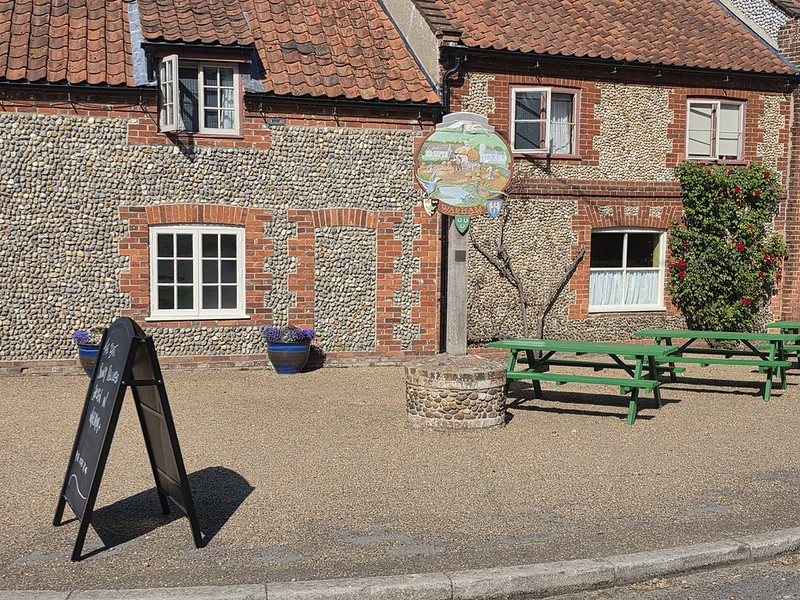
The pub has been a licensed premises since the late eighteenth century and it is now something of a sizeable building. The Three Horseshoes was once part of the Steward & Patteson estate, but has long since been free trade and that might be a reason that it’s actually survived.
As an aside, this traditional pub name is associated with blacksmiths and farriers, whose historic emblem depicts three horseshoes. One explanation for the apparently sub-optimal total is that the fourth shoe was being repaired or replaced while its owner waited nearby drinking a beer. It feels like an early roadside recovery scheme, providing refreshment for horse and owner.
There was some excitement in the Downham Market Gazette in November 1919 when it reported that the landlord, Herbert Barker, was summoned to the court in Fakenham charged with working a mare in an unfit state. There was a long argument about whether there had been cruelty or not, mainly relating to whether the horse had warts or sores, which sounds a glamorous debate but it was decided in the end that Barker was not a troublemaker and the case was dismissed.
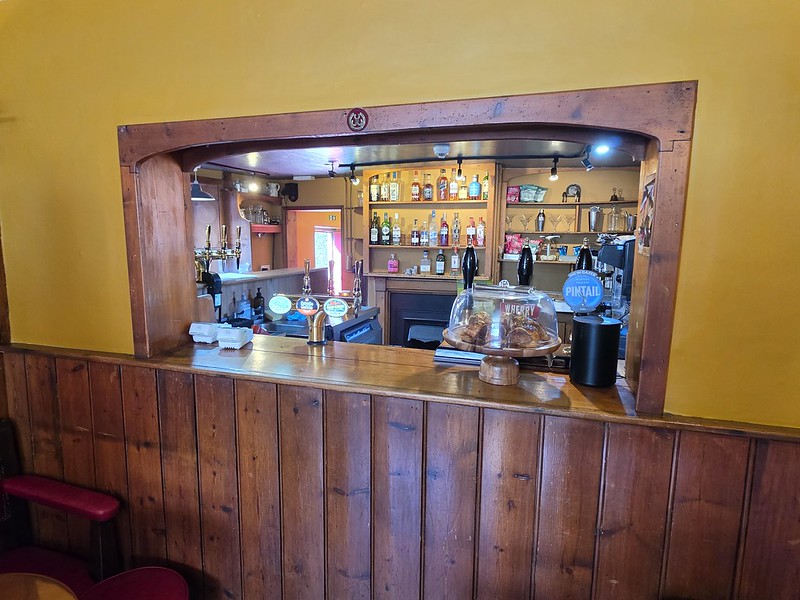
I didn’t know what to expect when we entered, but there was a lovely old bar, a choice of real ales and a friendly welcome from the member of bar staff. It’s fair to say that I was surprised and delighted.
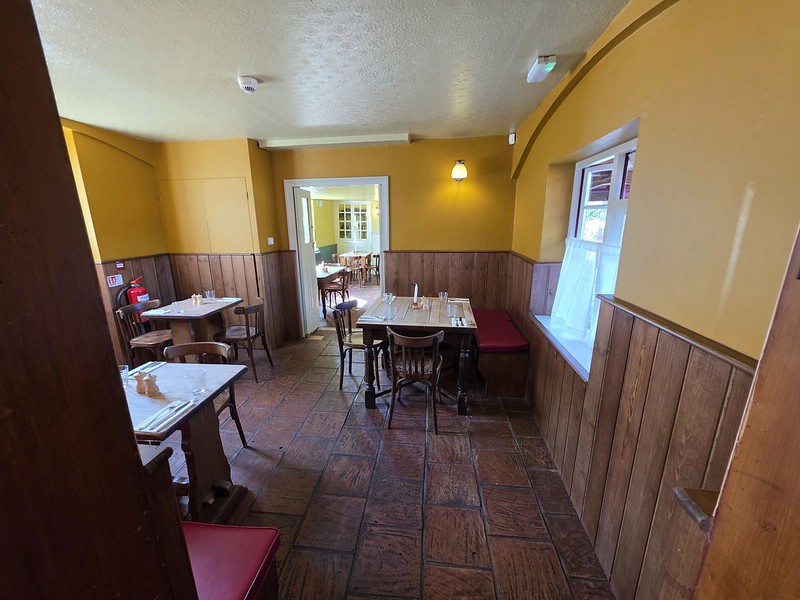
The interior is impressive as it hasn’t been knocked about or needlessly opened up, so it feels clean and tidy, but it hasn’t lost its heritage. Looking at the online reviews, the pub is very well reviewed, although one customer was outraged that a high chair was not immediately available. The pub has survived since the eighteenth century, but this was evidently its sternest test yet.
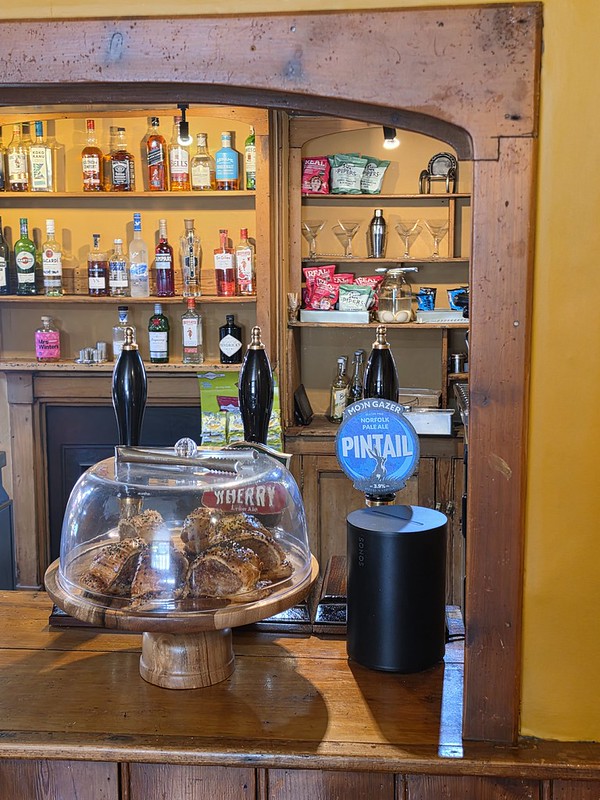
Some tempting sausage rolls, but we had started to debate going to an Indian soon afterwards and so I managed to restrain myself.
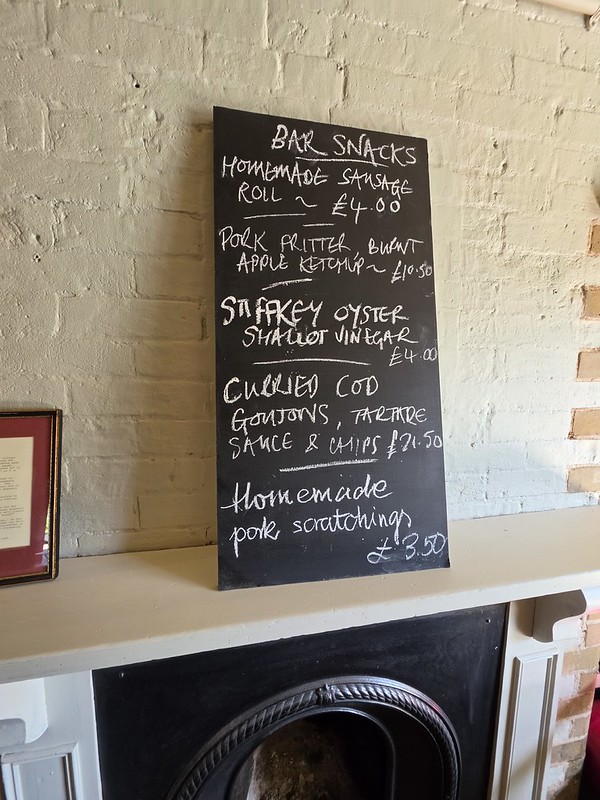
There were some other food options which certainly cut across the price range, from a sausage roll costing £4 to curried cod goujons costing £21.50.
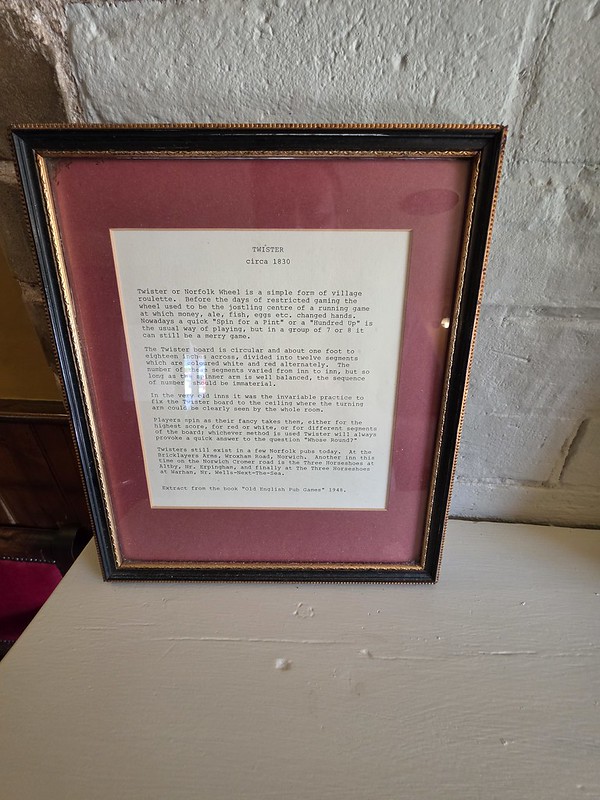
And a little bit of history about pub games in the dark days before bar billiards was more commonplace….. Although I managed not to take a photo of the Twister board on the ceiling, this reads:
“TWISTER circa 1830
Twister or Norfolk Wheel is a simple form of village roulette. Before the days of restricted gaming the wheel used to be the jolling centre of a running game at which money, ale, fish, eggs etc. changed hands. Nowadays a quick “spin for a pint” or a “hundred up” is the usual way of playing, but in a group of 7 or 8 it can still be a merry game.
The Twister board is circular and about one foot to eighteen inches across, divided into twelve segments which are coloured white and red alternately. The number of the segments varied from two to ten, but so long as the turning arm is well balanced, the sequence of numbers should be irregular.
In the very old inns it was the invariable practice to fix the Twister board to the ceiling where the turning arm could be clearly seen by the whole room.
Players spin as their fancy takes them, either for the highest score, for red or white, or for different segments of the board; whichever method is used Twister will always provide a quick answer to the question “Whose Round?”
Twisters still exist in a few Norfolk pubs today. At the Blickling Arms, Wroxham Road, Norwich. Another inn this time on the Ipswich–Cromer road is the Three Horseshoes at Alby, nr. Aylsham, and finally at the Three Horseshoes at Warham, nr. Snetterton–Thetford.
Extract from the book “Old English Pub Games”, 1949.”
It’s probably not the Twister game that some kids might be expecting though.
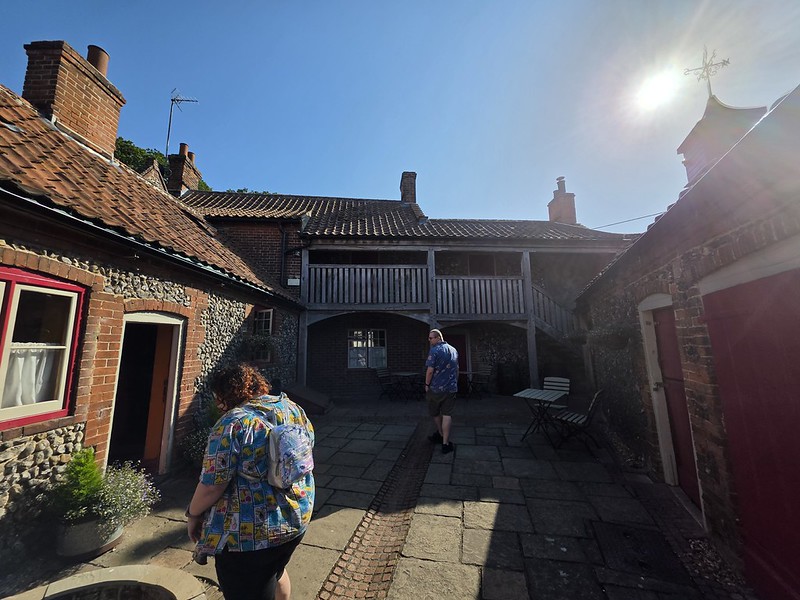
There were numerous outbuildings and those steps up to the lodgings reminded me of how many of the old coaching inns used to look. There is still accommodation available today, which is perhaps what is supporting the pub financially in these trying times.
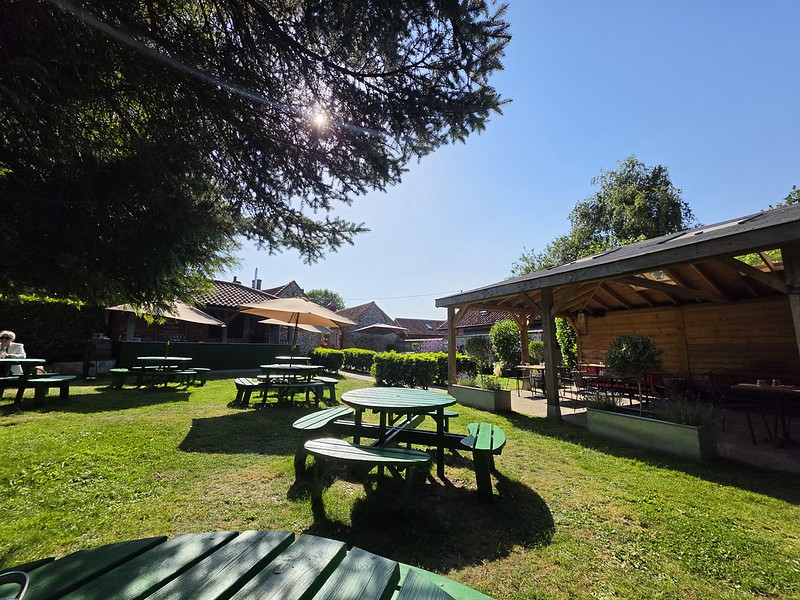
The beer garden was substantial and there is a large covered area as well. There’s an outside bar and I imagine that this would make a fine space for a wedding or family gathering.
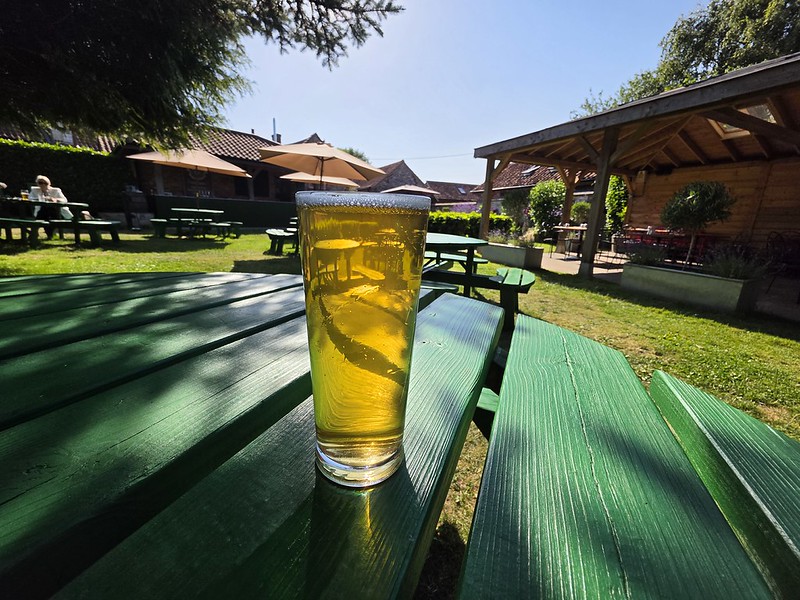
I found a shady spot in the garden as I didn’t want to overdo it. The beer is Pintail from the marvellous Moon Gazer brewery and it was clean, light, hoppy and well kept. There was also Woodforde’s Wherry available and the prices were reasonable.
I very much liked this country pub, it’s doing well to keep going and it is offering food, real ale, accommodation and keeping open for long hours, so this is a proper little community asset. I’m a little surprised that it hasn’t managed to get into the Good Beer Guide, but maybe there’s a lot of competition locally. The pub was quiet when we were there, but I hope the locals support it to ensure that it lasts for at least a few more generations and it’s also one that I’d pro-actively look to return to.