
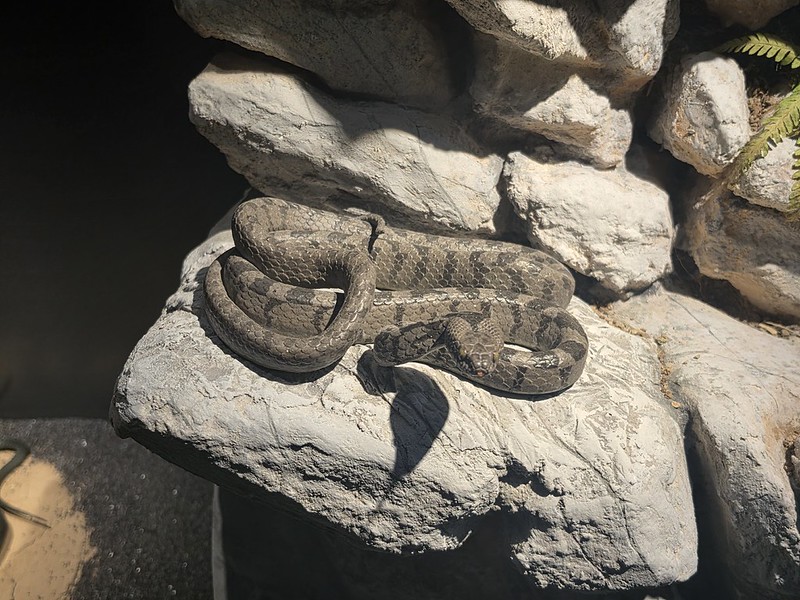

I don’t like snakes. It’s nothing personal, it’s just that they seem very scary to me, so I do my best to stay well away from them. Unless they’re in zoos or dead ones in museums, then I’m quite intrigued by them. The National Museum of Bosnia and Herzegovina had quite a collection of them, so, for the sake of completeness, I thought that I’d take a photo of them all.
Here are a couple of grass snakes playing. Grass snakes are strong swimmers and the name of their genus, Natrix, comes from the Latin for a water snake, probably influenced by the word natare, meaning to swim so this means that even entering the water is no guarantee of escaping them, which seems like a serious design flaw.

A dice snake. Its scientific name, Natrix tessellata, means something like tiled or mosaic-patterned, referring to the square markings which give the snake its dice-like appearance. It spends much of its time in or near water and feeds mainly on fish.

Two Balkan whip snakes. The word whip refers to their long, slender bodies and considerable speed rather than any tendency to whip passing museum visitors. They are non-venomous, which is a modest source of reassurance.

A Caspian whip snake playing with a mouse. This is one of Europe’s largest snakes and particularly substantial individuals can exceed two metres in length. The mouse appears to be having a less enjoyable game.

A Dahl’s whip snake. Its name honours the Austrian naturalist Georg Dahl, who collected the specimen used to describe it in Dalmatia in 1824.

Two smooth snakes which take this name because their scales lack the raised central ridges found on many other snakes. Their scientific name, Coronella, means little crown and probably refers to the dark marking on the top of the head.

An Aesculapian snake which is named after Aesculapius, or Asclepius, the ancient god of medicine whose staff entwined by a snake remains a medical symbol today. These snakes are also excellent climbers so the bloody things can lunge off trees if necessary.

A European rat snake which is also known as the leopard snake because of its blotched markings. It is non venomous and feeds on rodents, hence its name.

A four-lined snake and the name comes from the four dark stripes running along the bodies of adults, although younger snakes begin life with blotches.

A European cat snake and this takes its name from its vertical pupils, which resemble those of a cat. It is rear fanged and mildly venomous, because having unsettling eyes was evidently not considered enough.

An eastern Montpellier snake. The Montpellier part of the name was inherited from its western relative, whose scientific name refers to the French city. It is another rear fanged snake, although serious encounters with humans are uncommon when both parties behave sensibly.

Two nose-horned vipers and the horn is made from soft scales and is not a weapon, although the rest of the venomous snake remains quite sufficient.

Two European adders. The name developed when the old expression ‘a nadder’ was gradually redivided into ‘an adder’. It is the only venomous snake native to Britain, although Bosnia appears to offer a considerably wider selection for anyone dissatisfied with that.

A meadow viper and its scientific name, Vipera ursinii, honours the Italian naturalist Antonio Orsini. Unlike many vipers, it feeds heavily on insects such as grasshoppers and crickets, making it slightly less alarming provided that you are not a grasshopper.
There seem to be an awful lot of snakes in this region and I’m glad that I only visited the museum after walking around the countryside, where it appears that all these reptiles are slithering about without supervision. I accept that most snakes are probably perfectly well behaved, but it is the troublesome minority that concerns me.