Tag: Central London

  • London – Central London – Punch Tavern

    London – Central London – Punch Tavern

    This is some frontage for a pub and it’s the Punch Tavern located on Fleet Street, operated by Urban Pubs and Bars. I’m trying to visit some of the pubs in London city centre that I haven’t been to before, traditionally because they’re too busy.

    Once a gin palace, and it still has plenty of gins to choose from, it took its current name not from the dreadful Pubco, but from when Punch Magazine staff used to drink here. Every newspaper and major magazine on Fleet Street had its own pub their staff used and they must have drunk a lot at Punch as they had only been publishing for a couple of years when the pub named themselves after them.

    CAMRA have added it to their list of historic pub interiors, noting:

    “Rebuilt in two phases by Saville and Martin, first the main part of the pub and the Fleet Street frontage in 1894-5 and then the Bride Lane frontage with a Luncheon Bar behind in 1896-7.”

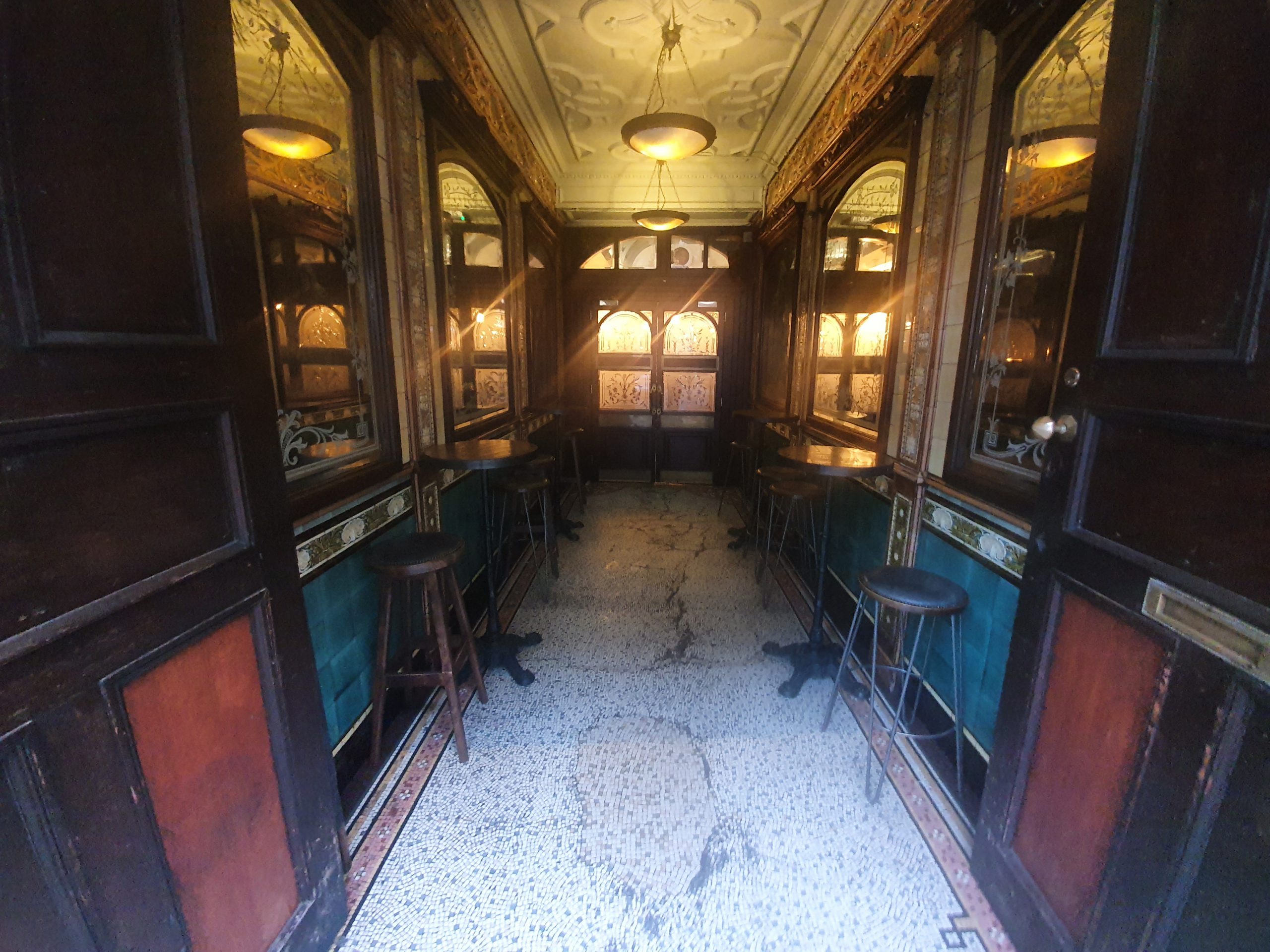
    A nicely decorated corridor into the pub, necessitated by the shopfronts on either side of this narrow entrance.

    It wasn’t packed with the customers in the pub, although a group on some sort of tour did pop in later on.

    The Hophead from Dark Star Brewing, which is a perfectly acceptable beer and it was well kept here, and at the appropriate temperature. It was also the only real ale available, so it was fortunate that they had a reasonable one and not Greene King IPA or similar. When things return to some form of normality a pub like this is going to need more choice than this though, it’s not ideal at the moment.

    This pub has a much stronger selection of gins, but there are some bottled beers (clicking on the image makes it bigger).

    The service in the pub was friendly and engaging, so it felt like a welcoming and comfortable place to visit. It’s also a very large venue, there’s a room at the back and additional space for private groups. The reviews are generally positive on-line and the manager answers them politely and professionally, which is usually a good sign. Anyway, everything felt well managed enough, but the beer options aren’t sufficient to want to tempt me back, even though I liked the environment.
  • London – Central London – Ye Olde Cock Tavern

    London – Central London – Ye Olde Cock Tavern

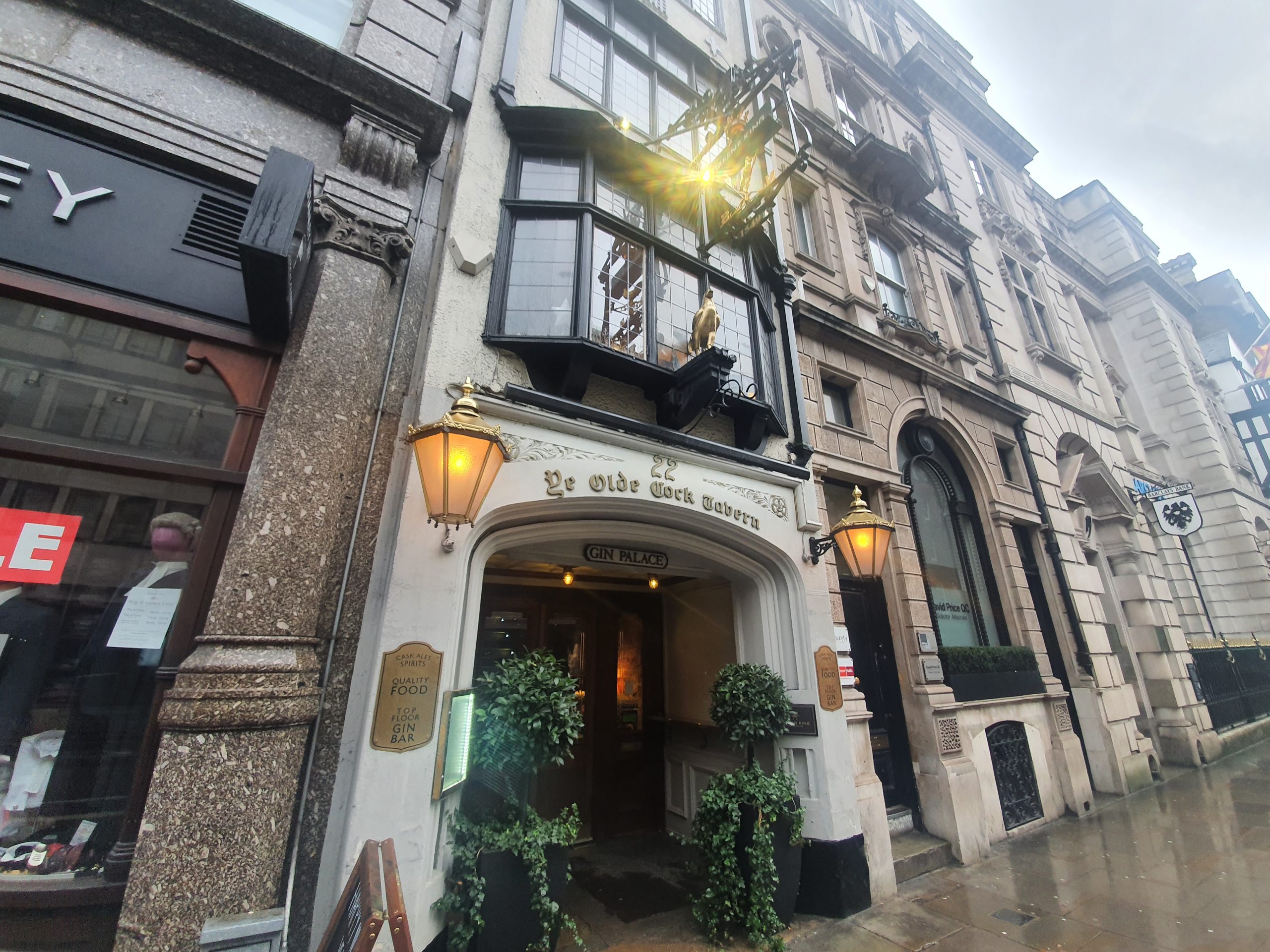
    I’ve meant to visit this historic pub on Fleet Street on numerous occasions in the past, but it’s operated by Greene King and that’s always put me off. However, it’s important to support the hospitality industry and so I thought I’d have a little visit since I was walking by.

    Indeed inspirational, but a slightly odd quote for a family pub, but there we go. Although to be fair, they can hardly advertise their beers given the choice they have inside.

    Slightly hard to read from this angle (I was avoiding my reflection being in the photo) but it reads:

    “The Cock was opened in 1888 with the original fittings from the original tavern on the site of the branch of the Bank of England opposite. The records of the tavern go back to the early seventeenth century. Pepys says “April 23 1668, to the Cock Alehouse and drink and eat a lobster, and sand and…. and then Knipp and I to the Temple again, and took boat, it being darkish. And to Foxhall, alas there are now no Vauxhall Gardens where we can take our Knipp but there is still the Cock.”

    The pub was visited by men like Pepys, Samuel Johnson and Charles Dickens, but they visited the pub that had stood since 1546 on the other side of the road. And the historic fittings brought across in the late nineteenth century were mostly destroyed by a fire in 1990. There’s still a depth of heritage here, but it’s a bit tenuous in places.

    Another history of the pub.

    As for the pub itself, this is a mess. The toilets had no hand-dryer, just a sign saying it was broken, but there was no thought to an alternative provision of hand towels or the like. There was no acknowledgement at the bar which didn’t concern me, but is unusual at the moment given how quiet pubs are. However, it was seeing the ‘exciting’ beer selection of Greene King IPA and bloody Rocking Rudolph which they were trying to discount at £2.50 per pint (I added the bloody BTW, that isn’t the beer name) that made me give up. These are not interesting beers (to me at least, and indeed to few people judging by their Untappd scores) and although there are some generic cask options, I lost heart at this effort from Greene King. There are so many good beers in the world, why do Greene King keep insisting on shying away from quality?

    Anyway, if Greene King don’t care about their pub, then nor do I, so I went to find another venue for a quick drink. I will say that there was a wide selection of gins, which would have once been one of their staple products so there’s some continuation of history there. Greene King make little effort to explain the history of the pub on their web-site and it’s a shame that another operator isn’t in control here. Mainstream as Nicholson’s might be, they’d put a touch of elegance into proceedings, and even JD Wetherspoon would do a far better job although the venue is a little too small for them. Maybe one day a pub like this will be independent and have owners that it deserves given its heritage, even if that heritage is a bit loosely defined.

    Moan over for the day.

  • London – Central London – Roman Wall at St Alphage Garden

    London – Central London – Roman Wall at St Alphage Garden

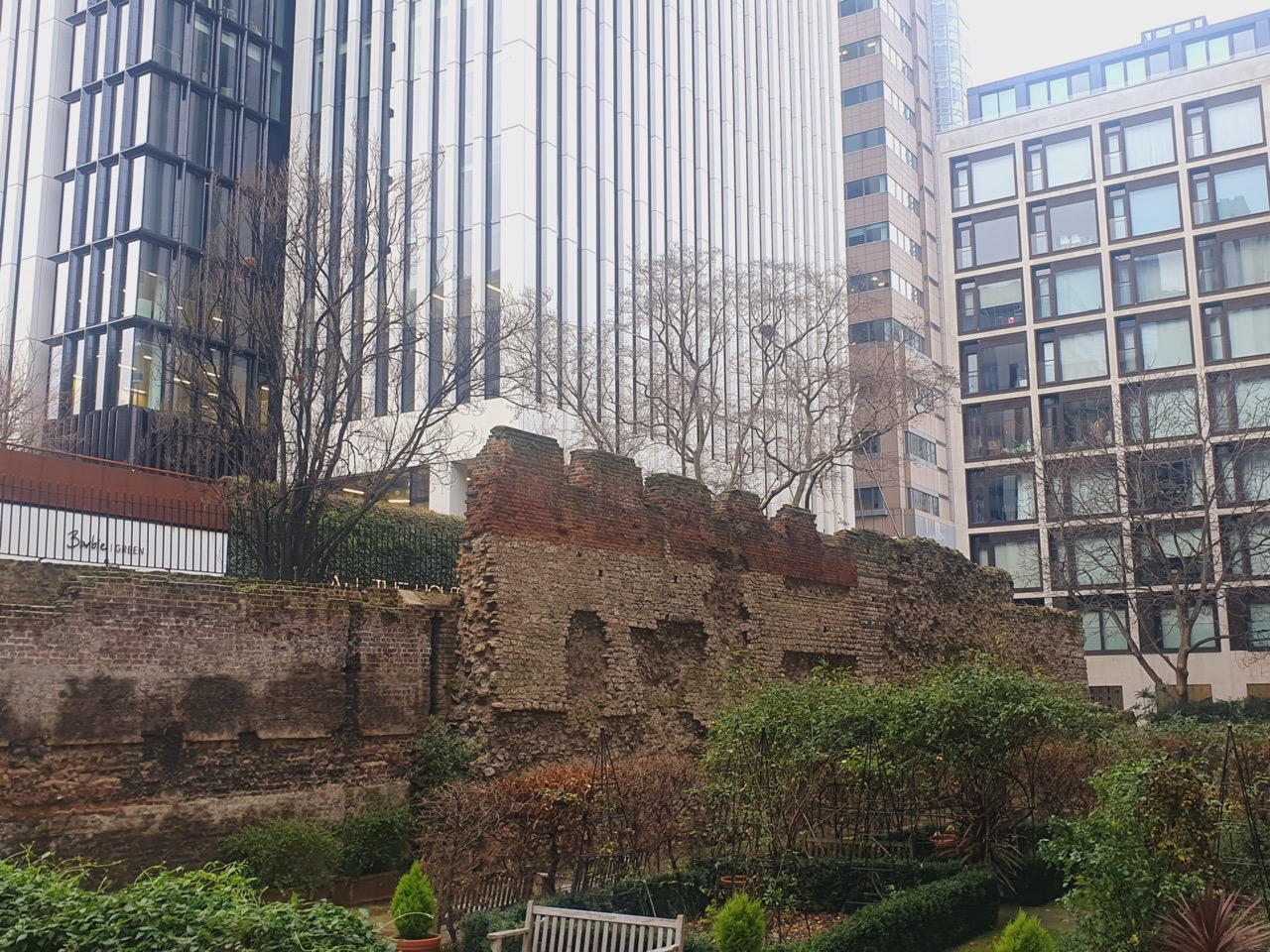
    This stretch of Roman Wall is located next to the Tower of Elsing Spital, by what is now the road named London Wall.

    This is the listed building map of historic buildings in London, with the red line being the scheduling of the remains of Roman Wall that still stand (or where foundations are known to survive), a series of large and small fragments which show the size of early Londinium. This section of Roman Wall is near to the top of the image, a little closer to the Blackfriars end rather than the Tower of London end.

    Looking down from the aerial walkway, this would be a much busier scene in summer months with people eating their lunches or just taking some time to get outside in the relative peace and quiet of the surroundings.

    That’s Salter’s Hall in the background, now a large charitable institution, but previously one of the Livery Companies of the city. It’s a modernist style building which is in keeping with the nearby Barbican development in its post-war contemporary architecture, although it doesn’t fit quite as easily with the Roman wall.

    The plaque is now harder to read, but notes when this area was laid out as a public garden in 1872.

    Much of what is visible isn’t part of the Roman wall, although the foundations of the original structure are still there, but they were built on during the medieval period when it was being strengthened. The brick section on the far right of this photo is from 1477 when Ralph Jocelyn ordered substantial repairs to the wall, at that stage in a bad state in some sections, during the War of the Roses. He bravely raised taxes to fund this endeavour, as well as purchasing large quantities of bricks and lime.

    There was also a church, St Alphage, which backed onto this site and the former wall lines are marked on the ground. This church was constructed in the eleventh century, but was knocked down during the Dissolution of the Monasteries.

    Another Victorian stone, but it’s now nearly entirely unreadable, damaged by the decades of London smog, pollution and not helped by the bombing of the area during the Second World War.

    The medieval putlog holes are still visible where the wooden scaffolding was once placed against the structure.

    The rear of the wall is visible from the gardens of Salter’s Hall which are sometimes open to the public, but which were closed when I visited. The medieval brick additions, and the only stretch of crenellations along the wall which survive, are much more easily seen from this side. The reason that so much of this wall survived was due to it being incorporated into later buildings, although it was only after the bombing of the Second World War that it became quite so visible.

  • London – City of London – The Ship Pub

    London – City of London – The Ship Pub

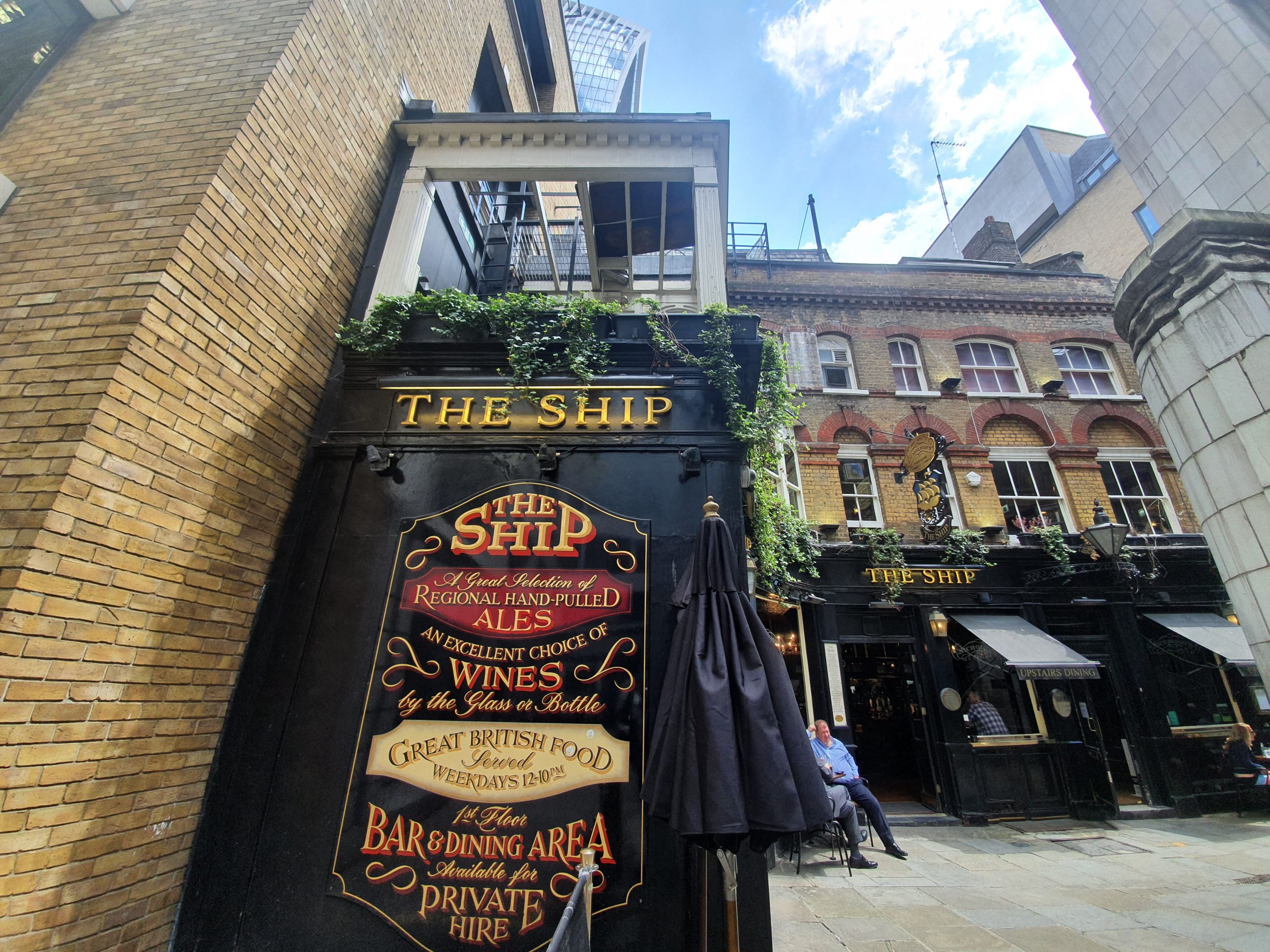
    This is the Nicholsons operated pub in the city of London, a short walk from Greggs and Monument station. As an aside, and not that I’m one to moan (but yet here we are as someone used to say…..) but it’d be nice if Nicholsons didn’t just say on their web-site that their pubs were historic, but actually said why. Fortunately, CAMRA have something to add on this, namely “on the site of the Talbot which was destroyed in the Great Fire of London”. The former name of the pub, and the current name of the court, is named after the breed of hunting dog, known as the Talbot.

    Also, if anyone has a Good Beer Guide book from the last couple of years (but not last years), let me know, as I think that this pub was listed, but it seems to have been removed from the latest edition. As I have the app, I can only see currently listed pubs and not ones that are no longer listed. There’s another pub called the Ship nearby as well, to add some extra confusion to arrangements.

    I was welcomed by a friendly member of staff who was standing near to the door to meet the Covid requirements. It was quiet inside, but there are some tables outside (apparently something that they’ve only recently been allowed to do) which I studiously ignored on the way in as I was quite happy to sit inside in the cold. The staff member offered to take my order, but I mentioned I’d use the app, as then I can automatically get the 25p off my half pint without having to ask for it and look stingy. Anyway, although it was agreed it’d probably be easier for the staff member to take the order (and I’ve discovered they can apply the 25p themselves now), they also wanted to test the app as they’ve had problems. So I ordered via the app. Fortunately, it went through, although the staff member had already brought my drink over before I’d finished paying using the app.

    There are five real ales available here, perhaps none exceptional, but the Timothy Taylor’s Landlord was well kept and tasted fine, and indeed better than I remember it. I do like the element of history in this pub, although there’s a touch of the generic in what is a very distinctive building. That’s not the fault of the very capable staff, just the whole Nicholson’s vibe doesn’t really offer anything particularly unique for individuals to rush there. It’s a decent pub through, a comfortable evening and they serve traditional pub food. For tourists to the nearby Tower of London, this isn’t a bad location to walk to for a British pub experience.

  • London (Central) – Duck and Waffle

    Our breakfast location on the Hike Norfolk day trip to London was a little shrouded in mystery as Steve was keeping it a surprise. We discovered, and I think the view was that we were impressed, to find out that we were going to the fortieth floor of Heron Tower (now formally known as 110 Bishopgate).

    The view looking up in the lift.

    The lights in the bar area of the restaurant. We were running a little early so we had a wait in this area for the table to become available, with another customer looking a little the worse for wear. Although this is a 24 hour operation, and indeed the highest 24 hour restaurant and bar in London, so perhaps that is a little inevitable.

    The views from the restaurant.

    A morning latte, which was excellent with its rich flavour and it was served at a drinkable temperature.

    I went, after much deliberation, for the spiced dahl which had two poached hen’s eggs, fresh coriander, flat bread and sumac sprinkled over the top. This was way above average, with the eggs being runny and brightly coloured, the sumac added flavour, the flat bread was lightly toasted and moist and the chickpeas were perfectly cooked. The sauce had a deep flavour and the dish was well seasoned, with everything being at the appropriate hot temperature. The portion size was also larger than I had expected, so this was a perfectly adequate breakfast meal.

    The pricing wasn’t the cheapest, but there was inevitably an element of paying for the location, with the drink being £4, the breakfast £10 and there was a compulsory service charge of around £2. The service was efficient and professional, but not particularly engaging. However, the efficiency was useful as we had an hour slot for the table and this proved to be entirely sufficient for our needs.

    We had booked across two tables so that we didn’t have to order from a set menu, which is required from larger groups. However, the staff seated us at neighbouring tables, so we could still hear what Dave was talking about.

    Overall, I thought this location offered better value than I had anticipated when we entered, although there is perhaps a need for a refresh of the interior as some of the seating was looking a bit worn.