Category: UK

  • Birmingham – Back to Backs National Trust Property

    Birmingham – Back to Backs National Trust Property

    20240904_144229

    All the previous times that I’ve stumbled my way into Birmingham, I’ve promptly remembered that I should have booked in advance to visit this National Trust property, the ‘Backs to Backs’. It requires some forward planning, and in a bid to surprise and delight myself, I actually managed last week to book to visit this week. I’m a National Trust member as I aspire to be at least lower middle class, although I sometimes wonder whether I shall reach such pinnacles of sophistication any time soon. Anyway, this tour is one of the best rated in the city and it’s one of the best reviewed National Trust sites in the country. I’m very slightly nervous to write that I didn’t feel entirely engaged with proceedings, but that feels a rather pompous thing to say given the keen and generous volunteers who support this venue. I had better fall back on Jay Rayner’s line of “if someone wants to call me pompous or condescending, they can go right ahead” here…..

    20240904_135435

    I can’t illustrate this riveting post with many photographs as they were banned inside the buildings, although that seemed to be the policy of the guide today rather than a general policy. Having noted that, our tour was quite busy and it’s not an unreasonable request from the guide. The tour is ninety minutes long, which did rather stretch my interest somewhat. I have to add a rider here that I’m generally boring, I read everything possible in museums, spend hours in them and frequently find myself on Google searching something new that I’ve learned during my meanderings. There was a lot of entering rooms, which in the case of the residences, were full of items that weren’t original to the properties, then listening to stories from other people on the tour about their mangles from the 1950s. Now, I have no complaint here, this is exactly the visitor that the National Trust gets and it’s the engagement that they want. I’m a life member of the National Trust (I drop that in for the reasons mentioned earlier about being aspirational), it would be ridiculous for me to be disappointed at that and it was rather pleasant to be by far the youngest on the tour. I like being the youngest, so a special award to the National Trust here for arranging this for me and also for the other tour participants for sharing their stories of how they had baths in tins around 70 years ago. One of the beauties of the tours is that over half the attendees stated that they had been brought up in houses similar to these, so of course they wanted to share their memories.

    I’ll have to phrase this carefully, but I haven’t quite reached the higher levels of being ‘woke’ yet, but the tour guide did meander into discussion areas, shall we say, that the National Trust themselves might not have been entirely happy with. It’s too easy to be critical, but I suspect there’s quite a difference in style between the different tour guides, so experiences will likely differ. Anyway, back to the very many positives and that was the enthusiasm of the guide, but there was also one standout room which was on the top floor and was left in an unrestored condition. This clever idea showed more architectural history, which is very much my thing, such as the divide which was put in during the nineteenth century when the house was split, the staircase that was added and the layers of paint on the walls. I thought, just for my interest levels, that most of the other rooms were a little over-restored and stripped of some of their architectural relevance, although one room did contain an interesting photo of how it looked before restoration. I would have quite liked that to have been the case for all of the rooms, just to see how they ended up before they were tidied up. There were a few original traces though, such as stencilling on the walls and some original wallpaper.

    20240904_143939

    Photos of the toilets were permitted. Here’s an early toilet before sanitation was added, they were only connected to the sewerage network in the early twentieth century and none of the properties ever had bathrooms fitted.

    I’m pleased that I went on this tour, not least because more urban sites such as these are exactly what the National Trust need to reach out to a new audience. The story of working class people is often overlooked and the National Trust of course inevitably have to focus on their country houses. They’ve ensured that these properties survive, some of the very few ‘back to back’ houses to still be standing, so they tell an important story. I also understand why the National Trust have restored the rooms to three different periods of history and they’ve certainly spent a lot of money making these structures accessible to visitors. The awkward nature of the buildings is why they can’t easily allow visitors to walk around on their own, although they’ve got a lot of space that’s closed off at the moment (they were holiday lets for a long time, but it seems they closed during Covid) and there’s no access to any of the cellars. The old sweet shop on the corner has also closed, although has been turned into a little waiting area for visitors.

    Being pre-prepared, I had read the visitor guide book in advance of my visit, and that is very well written and provides the sort of architectural information that I was interested in. As an observation rather than as a complaint, there were numerous slight inconsistencies with the guide book and the tour guide, the former notes that, unusually, there was a gas lamp in the courtyard that ensured it wasn’t dreary, whereas the tour guide mentioned that there was minimal light entering the properties. The guide book says that there were four toilets, the guide said that there were three, the guide book says that this wasn’t a Jewish court, the tour guide said it was.  It’s all minor, but I sort of like a little bit of accuracy in the story telling and so I did rather glazed over some of the guide’s little facts that seemed quite odd to me. It’s thought that there were over 500 different families who lived in the houses during their 200 years of occupancy, although the National Trust have strongly focused on three families and that’s what the guide spoke about.

    The guide book goes into plenty of detail about the slum clearances and the almost random nature of why these properties weren’t demolished in the 1960s. It appears that it’s simply because the ground floors were being used as shops and the council never quite got around to demolishing them. They were listed in the 1980s and then thanks to funding from the Heritage Lottery Fund and the European Regional Development Fund they were saved and then placed in the hands of the National Trust.

    This is a fascinating location to visit for anyone and I’d merrily recommend it, it’s a piece of history that could have easily been lost. There isn’t actually anything particularly special about these houses and their yard in terms of saving them, it’s just that they represent where tens of thousands of people once lived. Many former residents of yards such as this were never that impressed about the tower blocks that they were moved to, but the survival of these units is a credit to the National Trust and those who funded their restoration, including many members of the public who sent their own donations in to help. The volunteers are doing a marvellous job in their story telling and it’s clear that their efforts are resonating positively with the vast majority of visitors. So, they don’t really need to change anything, although speaking just personally, there was a bit too much social history here for me and not enough architectural and building history. But, different things for different people and it’s clear that the National Trust have got the balance right judging by the reviews. All rather lovely and it’s just over £10 for the tour, or free for National Trust members. They don’t advertise it, but apparently it’s always worth wandering in when the tours are meant to start just in case they have any no shows.

  • 200 Years Ago in Norwich : Vine Destroyer in King’s Lynn

    200 Years Ago in Norwich : Vine Destroyer in King’s Lynn

    This article was published in the Norfolk Chronicle and Norwich Gazette 200 years ago, in late July 1824. The text reads:

    “The Sessions for this borough commenced on Monday last, before J. M. ALLEN, Esq. Mayor, M. J. WEST, Esq. Recorder, and other Justices. Anthony Blackster was indicted for maliciously destroying two vines in the hot-house, and several shrubs and trees in the garden, of Edm. Elsden, Esq. during the night of Wednesday, the 7th inst. The prisoner had entered the garden by scaling a wall which separated it from a yard at the back of Mr. Elsden’s premises. The vines had been trained with much care, and were loaded with the finest fruit, but the prisoner had broken and destroyed them so effectually as to prevent the possibility of their ever being restored to their previously flourishing state. He was sentenced to seven years’ transportation. There was no other business of public interest.”

    It’s not clear to me whether this destruction was wanton vandalism, which wasn’t rare at the time, or whether it was someone so hungry that they were seeking food. The punishment was a sign of the times though, a seven year transportation sentence, it’s just a little fierce. Despite these sentences being handed out regularly, they didn’t seem to be much of a deterrent to people.

    One benefit about being a criminal in the early nineteenth century, or at least if you could call it a benefit, is that you continue to exist in records. So many people lived a quiet life and they have entirely disappeared from the record, nothing known about their lives. It’s known that Anthony Blackster was held at the ship Justilla moored at Woolwich until he could be sent to Australia. The transportation record remains for Anthony, who had been born in King’s Lynn in 1797, he was put on the Royal Charlotte which sailed to New South Wales and which arrived on 29 April 1825. As an aside, the Royal Charlotte had been used from 1819 for transportation and it ran aground in Frederick Reefs, near to Australia, on 11 June 1825. Around ten years ago, the wreck was found, so the ship that transported Anthony is still in existence, albeit slightly wet and dented.

    He remained in Australia when his sentence had been completed, he married and had one child, Marian Blackster. Unfortunately, what else happened to Anthony I don’t know, that information will be held by Australian archives and I’m not particularly well versed in their archive history. But, it’s a moment of interest to me that someone’s life could change so much just because of the vandalism that they did one night back on 7 July 1824…..

  • Gainsborough – Town Centre and Slightly Down at Heel Market Square

    Gainsborough – Town Centre and Slightly Down at Heel Market Square

    20240717_144415

    I was a little surprised at the state of the main market square in Gainsborough, it looked a bit sub-optimal with the closed and derelict buildings dotted all around. It was also surprising quiet during the evening, not a bustling hub of activity, it more harked back to the period of Covid when town and city centres felt oddly empty.

    20240717_131810

    This is a listed building, so seeing it like this doesn’t seem ideal.

    20240715_184144

    The closure of some former grand bank buildings, like the one on the left, certainly hasn’t helped matters. There are numerous grand structures once owned by the banks, but they’re falling into disrepair and it’s not entirely clear who will rent them at the moment.

    20240715_184055

    There is hope though, with the Townscape Heritage Initiative having been set up to help with the economic development of the heart of Gainsborough. There has been a market held here since 1281 and since the eighteenth century, it’s taken place twice a week.

    20240715_184110

    The Savoy cinema is coming soon, part of a £9 million investment project. Not only will there be a four screen cinema, but there will also be a restaurant, retail units and yet another car park.

    If improved somewhat, this is a really quite grand town centre market place, so maybe the future is bright.

  • Gainsborough – Elach Indian Restaurant

    Gainsborough – Elach Indian Restaurant

    20240716_170636

    Before meandering off to watch the football, I thought I’d pop into the top rated Indian restaurant in the town as part of my vague quest to visit as many Indian dining venues as possible. I entered just after a few members of a larger group had come in, leaving the staff member the slight question of whether to sit me next to that table on a table for two, or to sacrifice a larger table for four in the other part of the restaurant where it might be quieter. She seemed to think the larger table was a bit more sensible, but the manager didn’t want the risk of a hoard of hungry people coming in and not being able to seat them. That was perhaps somewhat aspirational, but anyway, I was seated next to the large group of what transpired to be school teachers who ultimately proved quite entertaining. I wouldn’t dream of breaking any confidences, especially those I wasn’t involved with in the first place, but who would have thought school teaching could be so exotic?

    20240716_171127

    Before commenting on this, back to the other table, they had ordered spicy poppadoms but had done so by calling them hot. The staff member obliged by making the standard poppadoms hot, with the table of teachers getting ever more confused as non spicy poppadoms kept appearing. It took quite a lot of poppadoms being delivered to the table before they got their spicy poppadoms when the staff member realised what they were referring to when saying hot. They were adequate, a little soft for my liking. The lime pickle had a bit of a kick which was pleasing, the mint sauce was moreish and the cucumber was, well, cucumbery.

    20240716_173611

    I usually order mango lassi to drink at Indian restaurants even if alcohol is available. However, my choices were more limited here as they’re not licensed, so I went with the old reliable. Creamy, not much mango, but pleasant tasting.

    20240716_173912

    The generous portion sizes were the most notable element of this arrangement, although I liked the coconut rice. The Peshwari naan was light, but needed more almonds and coconut for my personal taste. The curry itself didn’t have much depth of flavour and quite genuinely must have contained an entire onion that had been cut up into it. Ploughing through an entire onion isn’t entirely the experience I’d want before going to a football match, especially as the curry flavour didn’t add much excitement to proceedings. The chicken was tender and plentiful, but it hadn’t picked up the flavour of the sauce, so although it was all perfectly edible, it wasn’t as decadent as even the chicken jalfrezi I had purchased the evening before in JD Wetherspoons. I rather hope that doesn’t sound too negative, as I think highlighting the best elements is important for any small business, but it wasn’t quite what I’d hoped for.

    The service was always polite, the surroundings were clean, the ambience was inviting and so it wasn’t a negative experience by any means, but it wasn’t quite the taste sensation that I would have ideally wanted with regards to the main event of the curry. The prices were reasonable, although I can’t recall the exact amounts as the receipt was seized back by the staff member. There was an After Eight mint provided at the end which tasted stale, I’m not sure what they’d done with that as they must get through a fair few of them. It’s possible it’s one of those substitute After Eights sold by discount stores. That makes me sound really rather snobby, demanding an authentic top tier After Eight and not an Aldi equivalent, but a little slice of decadence at the end of the meal is never a bad thing. Anyway, the experience was all acceptable and enjoyable, especially with the anticipation of seeing Gainsborough Trinity play, but it wasn’t quite at the level that I’d merrily start recommending it to everyone. Thanks also to the teachers for keeping me amused and entertained, even though they weren’t aware of it.
  • Gainsborough – Elm Cottage

    Gainsborough – Elm Cottage

    20240717_180957

    I meandered to this pub near to the football ground as it’s listed in the Good Beer Guide, and is a former CAMRA branch pub of the year. Unfortunately, I suspect that this will be their last year in the Good Beer Guide as they’ve abandoned real ale entirely and the venue appears to be under new management. The last real ale checked in on Untappd was in November 2023, so it seems to have disappeared some time ago.

    20240717_180725

    It might be cheaper to rent one….

    20240717_180947

    The team member said that she wasn’t sure how to pour a Guinness, but it’s all theatre anyway in my rather irrelevant opinion. Priced at £5 which is reasonable, it tasted as expected.

    The listed building record notes about this venue:

    “The Elm Cottage public house is located at the junction of Chruch Street and Morton Terrace in Gainsborough. It has a long history as an inn. It originally had a thatched roof and whitewashed walls and probably started life as a mud and stud cottage in the eighteenth century. This was refronted with a mock Tudor half-timbered exterior covering in the 1930s. A granite horse water trough use to stand outside the pub, but this now sits in the grounds of Richmond House and it being used as a planter.”

    The venue appears to be pivoting from real ale and traditional atmosphere into a vibrant events led pub which seems to focus on lager, which was by far the biggest seller when I was there. The service was friendly, the atmosphere relaxed, but it’s not really a pub that is aimed for me now.

  • Gainsborough – The White Horse

    Gainsborough – The White Horse

    20240717_131801

    The White Horse is another Stonegate pub, part of their Craft Union pub which are little to do with craft products and far more to do with venues with a strong community feel and cheaper drinks prices.  I’m not sure how long it has been a pub (although I suspect it’s from the mid-Victorian period) and it’s also not a listed building, although the bricked up property on the left is. The pub used to be owned and operated by Hewitt Brothers of Grimsby, although they had operated the Trent Brewery on Silver Street in Gainsborough. The brewery ended up in a series of mergers and takeovers and it ended up being owned by Bass, who soon shut it.

    20240717_133127

    The drinks range was typical for Craft Union, although just one real ale which was the Black Sheep best bitter. I can’t complain at the pricing of this, it was £2.10, which must be in the territory of making them very little money. It’s open long hours, usually around 10:00 until 23:00 for most days of the week, with the community element being evident. The service here was timely and polite, although it was evidently a pub where most customers already knew each other.

    20240717_132049

    The head dissipated quickly, I think that’s likely soap residue on the side of the glass, but it was not the freshest ale that I’ve had although it remained drinkable. At £2.10 a pint though, it’s hard to find much to complain about.

    For someone new to Gainsborough who wanted to meet people, this is likely a very good candidate pub as it’s laid-back and welcoming. I’m not sure that anyone wanting a range of real ales and craft beers would particularly rush here, but that market is likely covered by the JD Wetherspoon literally opposite to them. Craft Union pubs do offer some very keen pricing and I’m guessing that this is allowing more people to go out to the pub and is helping these venues remain open, so there’s a very real need for locations such as this.

  • Gainsborough – The Sweyn Forkbeard

    Gainsborough – The Sweyn Forkbeard

    20240716_101933

    This JD Wetherspoon pub is listed in the Good Beer Guide, so that’s another one ticked off my list of trying to visit every one in the country. The pub is named after Sweyn Forkbeard and occupies what was formerly two shops, opening in around 2001.

    20240716_093621

    The inside of the pub, all suitably modern and functional. I appreciate the amount of high seating as well, my personal preference in pubs. The gaming machines are on silent to retain the quiet pub atmosphere that JD Wetherspoon are aiming for. I also like the considerable efforts that they go to with the local history boards around the pub, I didn’t notice anywhere else in the town doing that.

    20240715_193527

    The chicken jalfrezi and large bottle of Elvis Juice which came in at just over £10, all very reasonable. For the price point, the quality was perfectly adequate and everything was at the appropriate temperature.

    20240716_090223

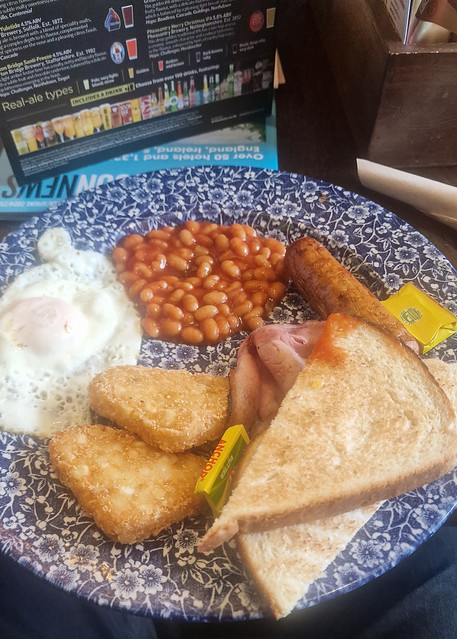
    And the next morning I felt that I should return for breakfast. Being quite picky, I like that the egg is runny and there’s no fat of note on the bacon. I could have gone to the Canute next door to try somewhere different, but they had annoyed me by offering 33% off to groups of two or more, so I didn’t.  It’s consistent, reliable and affordable at just over £5 for the traditional breakfast and coffee.

    20240716_095915

    And the carpet, with every JD Wetherspoons having a unique carpet design. There were also plenty of power points available for customers.

    This pub has six real ales and the one that I had, the Lincoln Tank Ale from Pheasantry Brewery, was well-kept and priced at £1.99 a pint. The pub’s craft beer range is excellent, including a few regional cans that were of interest such as the Brownie Hunter from Wilde Child Brewing Company and the Tropical Assassin from Roosters. The prices across the board were low, the venue was clean, the staff were friendly and the ordering process efficient. It was by far the busiest pub in the town and it all felt well-managed and organised. A rightful entrant into the Good Beer Guide in my view.

  • Gainsborough – Former Town Hall

    Gainsborough – Former Town Hall

    20240717_144456

    Located in the heart of the Market Place is the former town hall, a Grade II listed building which was constructed in 1892. There was a former moot hall, or meeting hall, in the same place previous to this which had dated to around 1750 but wasn’t seen as substantial enough for the growing town. Gainsborough wasn’t much troubled by the air raids during the Second World War, but the one that there was caused damaged to the town hall and the replacement section of the structure wasn’t as ornate.

    George Lansbury, the then Leader of the Labour Party, came to visit the building in December 1933. In a situation that was far from ideal, he managed to fall and break his thigh, leading him to have to return to Hampstead to recover. He had been quite vocal on his thoughts about the Tories in a speech he made before falling over, saying:

    “The Tories are fascist, both in spirit and in action. They wish to reform the House of Lords in order to be able to frustrate the nation’s will when a mandate is given for socialism. Any such attempt is foredoomed.”

    Don’t hold back….

    Getting back on topic though. Perhaps sadly, the building was turned into an entertainment centre and has been left in a poor state of repair. An angry resident wrote to the local press in June 1981 complaining about the sale, stating:

    “In connection with the proposed sale of the Town Hall. I challenge the people of Gainsborough to fight. Are you afraid of the councillors that represent you? Are you a Lincolnshire Yellow belly, too afraid to stand and be counted, but then the Town Hall is sold, have a lot to say?”

    They evidently didn’t fight, but the letter writer was right to be concerned. The future might be better as part of the town’s regeneration plans includes restoring the structure and the scaffolding up suggests that this is happening. You can rent the building for £25,000 a year if you so desire, the details are at https://pph-commercial.co.uk/view-property/old-town-hall-lord-street-gainsborough-lincolnshire-dn21-2db-18048/. Hopefully the next couple of decades will be a little more auspicious for the building than the last couple of decades, it’s an odd way for a former public building to end up.

  • Gainsborough – Cooplands

    Gainsborough – Cooplands

    20240717_144415

    I accept that I’m not Jay Rayner, but I feel an obligation to report back on any regional bakery that might be in competition with Greggs. Cooplands is the second largest bakery chain in the country, with only Greggs being larger, and their outlets are mainly in the Midlands and north of the country.

    20240717_144342

    There was very little choice (unless you love cheese straws) when I went in during the afternoon, although I’m sure they would have prepared something for me on request. They had five sausage rolls for £1.80, so that seemed a very good deal even though I wasn’t sure that I actually needed five sausage rolls. However, value is the key and all that. The service was friendly and everything seemed clean and organised, albeit quiet. They did have a steak and ale pie that I was briefly tempted by, but I’m not very good with fatty bits of steak and I couldn’t be dealing with my high levels of awkwardness in picking the bits of fat off the steak. I understand that food connoisseurs like fat, but I don’t.

    20240717_144549

    Here they are in the bag.

    20240717_145944

    And here they are in my luxury hotel. I say luxury hotel, but I mean Travelodge. I accidentally ate one between Cooplands and the hotel. They had a pleasant aftertaste, although were slightly mushy in texture and I would have liked a little bit more of a peppery taste to proceedings. Let’s be honest here, they’re not Greggs sort of quality, but I liked the pricing. I’d go here again and they were far better than the Pound Bakery, who gave me a highly sub-optimal experience a few months ago in Crewe with their pasties.

    Right, that’s the end of another riveting food review. I think I need to get out more.

  • Gainsborough – Canute Pub

    Gainsborough – Canute Pub

    20240717_094245

    The Canute pub is operated by Stonegate so I expected a hugely overly refurbished pub and minimal effort made with real ale or craft beer. It’s fair to say that they delivered on that and they’ve evidently spent a lot of money on the interior to make it look modern and comfortable. It was also clean and tidy, so the staff seem to be on top of the whole arrangement.

    20240716_125104

    The service was friendly, but there were only two other customers in the pub and so this clearly isn’t a venue making Stonegate a fortune during lunchtimes if my visit was anything to go by. No-one was eating despite the low prices they were charging. A number of reviews have suggested that they are closing before their scheduled closing time, not something which bodes entirely well for any venue.

    20240716_124535

    The Wainwrights seemed slightly tainted and wasn’t at its best, but it was the only real ale available and there were no craft beers on offer. The price at least was reasonable at £3.10, although I forgot that I could have used one of my 50p off CAMRA discount vouchers until after the event. I like the Wainwright glasses incidentally for what it’s worth…

    For reasons unknown, you can get 33% off the bill if you book in advance and you’re not a group of one. I suspect desperation has sunk in here from Stonegate, but there was a slight irony in the arrangement that if they had extended the offer to groups of one, they might have actually made a food sale from me as the food here seemed well reviewed. They are inevitably going to suffer from the JD Wetherspoon that is next door and has no shortage of lunchtime customers (and real ale, craft beer and sensible pricing which isn’t dependent on the group size). But, this pub seems as if it would cope with parties well and I think their target audience is older teenagers with their party nights, so I’m in entirely the wrong demographic now I’m aged over 26.