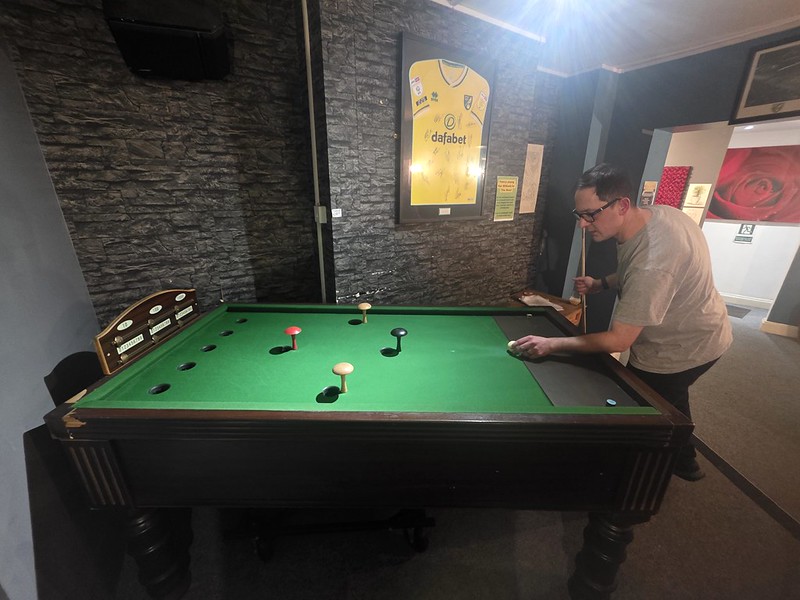
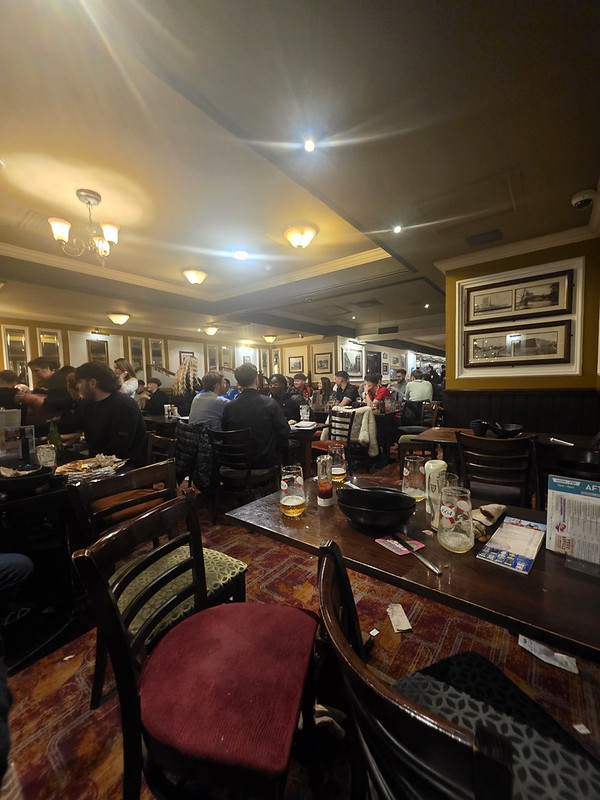
This is the final bar billiards table in the Norwich league that I haven’t played on, with the exception of the table out in South Walsham. It’s the table at the Rose and since Zak was planning to practice and Nick had a game from the singles competition at the pub, this felt the ideal time to try it.
Before Nick’s match, we had time for one game, and it transpired that neither of us had ever played at the table. He won, but not by many.
I did have a couple of victories in the evening and here’s Nick after beating his opponent 3-0. He now gets to play Oscar, who annoyingly beat me a few days ago…. Sub-optimal, I could have beaten Nick and I might have mentioned that to him 🙂
This was the second singles tournament game I’ve refereed in a week, I’m hoping that some of the talent will come to me via some form of osmosis.
Anyway, back to the table, it’s a robust arrangement and it’s quite fast off the back cushion. The pockets aren’t very forgiving, it requires some accuracy to get them in. It feels like a relatively low scoring table, I think it’s hard to build big breaks, but it’s nicely looked after. It’s the only table that’s £1 a play in the league, although I suspect the others will catch up at some point.
And, the Rose is a really lovely pub, a suitable range of cask and keg beers, friendly staff and it was also good to see my friend Emma over there, now back brewing Boudicca again.
This is a court case from 21 July 1886, when John Gayford, a 19-year old labourer, was tried in the Guildhall in Norwich with the judge being Baron Pollock.
The crime was sexually assaulting a six year old girl for which he was found guilty and sentenced to six months hard labour for his offences. This seems unduly lenient to me from today’s standards, but one substantial change is that they were merrily naming the poor girl who had been assaulted. To give some context, and although it was a repeat offender, the court the same week gave a criminal twelve months hard labour for stealing 14lbs of plums.
The victim was Nellie Baldwin and in an earlier hearing it was decided that although the only witness to the crime was a five year old boy, the courts accepted that they would take his evidence into account. Nellie, aged six, her five year old friend and a baby in a pram all went out together for the day. When the group returned home, Nellie explained what had happened and a police doctor was called. Some of the case relied upon it must have happened as she was physically hurt and how else would a little girl be able to describe what had happened.
John Gayford went on to become a self-employed gardener, he married Rosanna and they had two children, Rosa and Florence. Someone guilty of his crime today would have likely left the area after they were released, but at the 1921 census he was living at 20 Northumberland Street in Norwich, just a short walk from where the crime took place. He lived there until his death in 1942 and I imagine that just about everyone not directly impacted by the crime had forgotten about it, in those days when searching for information was somewhat harder.
Richard and I were walking down the road whilst he was busy gossiping on the phone and I saw this Indian and Nepali restaurant, quickly taking the positive action that we should go in it. I might have also got myself seated inside before he even got off the phone, but he was very pleased with my decision.
Incidentally, I wasn’t sure whether it was Nepalese or Nepali, but it seems that the latter is now preferred but the restaurant uses the former.
The restaurant has only opened relatively recently and it’s got some very positive reviews. And here’s the menu, which looked interesting with numerous tempting options.
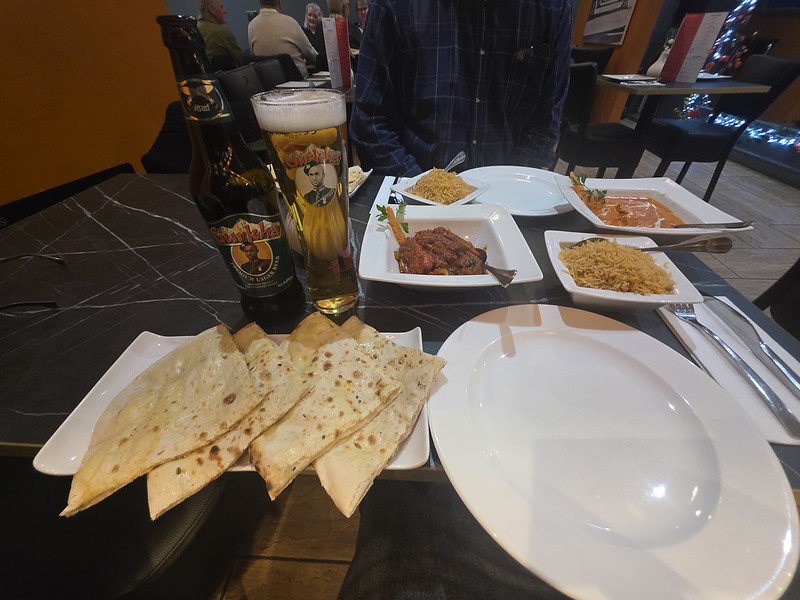
I opted for the Gurkha beer, which was actually about as good as a lager like this was going to be.
The poppadoms were brought over two short, but that was soon rectified, with the dips and chutneys being suitably tasty but they were quite hard to get out of the very flat plate they’d used.
And here’s my little arrangement of Bhuteko Kukhra, pilau rice and a peshwari naan. The curry was Nepalese fried chicken in a sauce with aromatic ginger, garlic and a robust masala sauce, with a chunk of carrot to act as a decoration. The curry had a depth of flavour, a certain amount of spice and the chicken was tender. The naan and rice both added positively to the main dish, all being filling and Richard was happy with the butter paneer that he had ordered.
The service was always polite and attentive, with a welcoming atmosphere and personable staff members. I liked that they placed us at a table for four rather than fitting us on a table for two, which ensured that we had plenty of space. It’s clearly a popular venue as well, they were getting quite full by the time we left and they had a steady stream of delivery and collection orders.
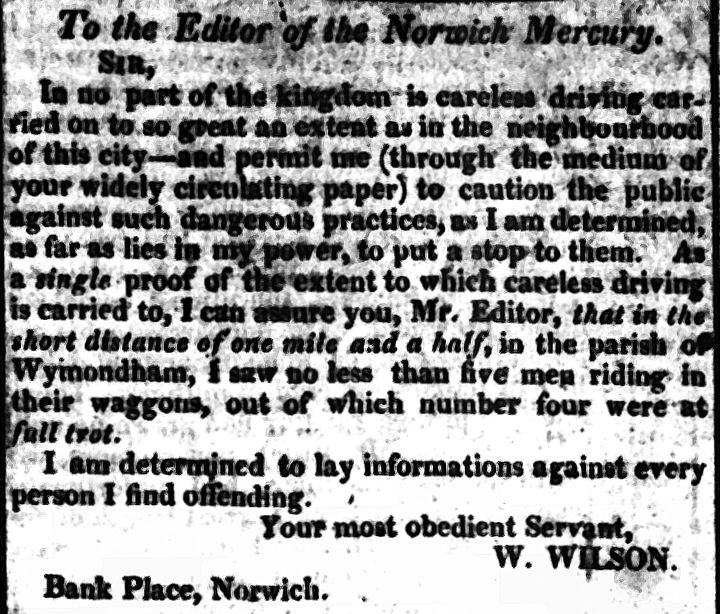
Another another article from 200 years ago this week in the Norwich Mercury from 1826.
“Sir, In no part of the kingdom is careless driving carried on to so great an extent as in the neighbourhood of this city—and permit me (through the medium of your widely circulating paper) to caution the public against such dangerous practices, as I am determined, as far as lies in my power, to put a stop to them. As a single proof of the extent to which careless driving is carried to, I can assure you, Mr. Editor, that in the short distance of one mile and a half, in the parish of Wymondham, I saw no less than five men riding in their waggons, out of which number four were at full trot. I am determined to lay informations against every person I find offending.
Your most obedient Servant, W. WILSON.
Bank Place, Norwich.”
Some things never change, whether men have access to carts or cars, some will speed…..
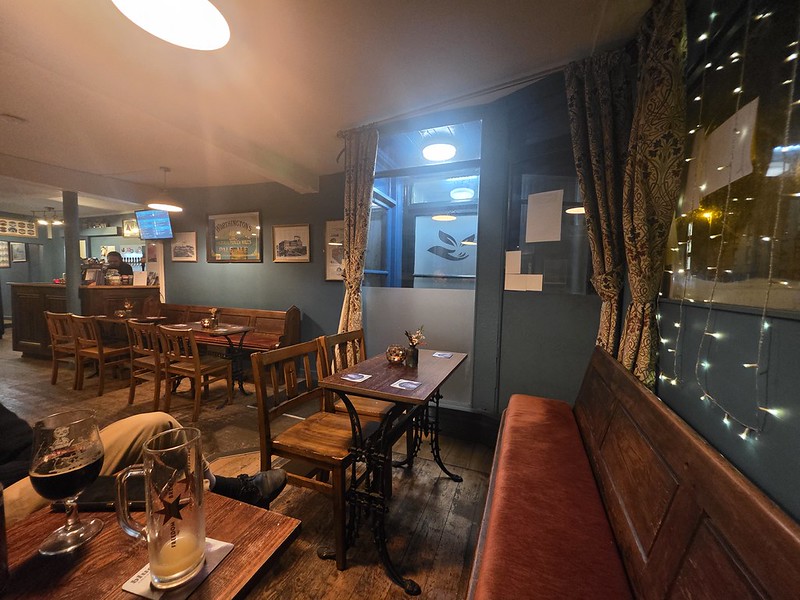
After the vibrant excitement of the JD Wetherspoon pub in the town, Richard and I meandered to a rather calmer micropub. This one also has the advantage of being in the Good Beer Guide, so that’s another one ticked off.
The bar set-up, with the beer list being displayed on the screen and also on Untappd. There was a friendly and immediate welcome, with the staff member trying to find a beer that Richard would like.
The beer fridge had more delights.
The Patrons Project from Northern Monk, a very hoppy, grape flavoured, hazy delight. Quite a punchy little arrangement.
The Raspberry Ripple from Fierce Beer, this has nice chocolate flavours, it was a bit boozy and was like a decadent chocolate liqueur.
The Le Bleu from Fierce & Noble, a quite tart beer with lots of blueberry and lingering smooth flavours.
The surroundings were clean, comfortable and welcoming. It all had an on-trend feel, but with a traditional air to it as well.
I always like a bit of Titanic.
Richard decided we had to stand right outside the shop before calling an Uber rather than sit on the other side of the window. We always have to wait a while as his Uber score is so low there aren’t many drivers that will pick him up. But I didn’t say anything.
Anyway, this was a delightful pub, a friendly welcome, decent choice of cask and keg, along with some bottles to add to the mix. The pricing was reasonable, the surroundings were comfortable and it very much deserves to be in the Good Beer Guide in my humble view.
A few years ago, my friend Nathan and I tried to get into this JD Wetherspoon but it was too full, so we visited most of the other pubs in the town instead. Last month, Richard and I were in the town and we decided to make a quick visit.
Using the pub’s own history to explain the name:
“This pub is named after the first Lord Burton, Michael Arthur Bass, a member of the famous brewing family whose company has its headquarters in Burton.”
I think it would be a fair comment to say that the venue was struggling just a little to maintain order and the door staff were certainly challenged. It probably wouldn’t be much of a stretch to suggest that the door staff couldn’t really take control, there was smoking inside and drug use, which isn’t really where JD Wetherspoon would probably want to be. And, at the same time, on a Saturday night, the delivery turns up.
But, I like a pub with a bit of vibrancy, it all adds to the excitement and I don’t think any customers were ever in danger in the sense of a pub that is unsafe, there were just a few licensing issues for the venue to deal with.
Most of the rear of the pub’s carpet looked like this, with menus, glasses, napkins and food lying on the floor. The team members didn’t get chance to clear it during our visit.
This was the cleanest piece of carpet that I could find for my obligatory carpet photo.
We were initially seated at the rear, but it was quite loud (and as someone who has run a venue that was effectively a nightclub, I set the bar at a reasonable level here) so we decided to move when our drinks arrived.
After fifteen minutes our drinks hadn’t arrived, so I went to recover them from the bar. The team members here were doing a really decent job, they were friendly, working hard and I think just short-staffed. I didn’t query the wait, but a helpful team member said they had a lot of away fans in after football.
The beer is the Auld Acquaintance from Loch Lomond Brewery, hoppy, light and inoffensive.
This is the home of brewing after all…. (the town, not the pub).
The front of the pub was quieter and after a while we got a seat. We had decided that there was a micro-pub nearby that needed our attention, but it was much calmer down this end. Although they didn’t have any tables where everyone was downing wine from the bottle at this end of the pub, so I was tempted to go back.
Anyway, back to reviews as I like reading them, with this venue towards the lower end of the scale for the chain.
“Absolutely awful 😖 asked 4 times to get the table cleaned!!!! When the food arrived I asked again for it to be cleaned before they put the food down….he wiped half of it and slammed the plates down…won’t be going back”
There are tens of reviews like this, but I like a bit of staff attitude to add to the mix.
“Awful experience, had a great time until Nicola left us with a very bitter taste in our mouths (and not just from the mushy peas). Two groups of our friends sat on separate tables and ordered each other food. When the waiter came out she asked us to “stop prating about” and that we were “messing up their orders” however we all ate the food and caused no trouble. We sent it to celebrate our lovely friends birthday to treat him and were told that they will take both tables away from us if we carry on, how dare we treat our friends? This is awful customer service and completely unacceptable from Nicola. She then took the cutlery away from us when we had payed for the food, ordered it to a table when we couldn’t even eat it. We had to go and ask at the bar for some. I think this is appalling customer service and shall be going to the crossing or the prince of brewers from now on.”
Let me guess, they were sending each other milk and peas….. No excuse to treat team members like this by ordering food to each other’s tables and then confusion when the team members are annoyed.
“Because we put our hands up (next to be served) the young girl clearly didn’t like it and made us walk to her.”
Seems reasonable to me.
The pub is on the chain’s cheapest price band and I remember from the choice of venues in the town that they must have a lot of competition which would explain that. I suspect it would have been a rather more relaxed visit if we had popped in earlier, but I do like a bit of drama. We were pleased that we had gone to an Indian to eat though before, it was all much busier than I had expected.
200 years ago there was a lot of crime in Norfolk and until 1823, there were 200 different crimes that could lead to execution if found guilty. The policy didn’t work and so was scrapped in 1823 to start to allow more prison sentences rather than executions. This wave of liberalism didn’t please everyone.
The newspaper reported this serious crime:
“On Saturday evening as Mr. Caddiwold, of Kimberley, was returning home from our market, he was stopped and robbed near the Forehoe Wood by three men, who to accomplish their diabolical object, fixed a rope across the road, and as soon as Mr. C. came in contact with it, one of the villains jumped up behind his gig and passed over Mr. C.’s head a piece of wood, with a joint in the middle, so as to form a gripe, in the shape of a pair of compasses; between which the robber held his head so fast that he was unable to stir, and at the same time demanded his money. Mr. C. alarmed at being thus suddenly placed in a situation where it was impossible for him either to escape or resist, begged to be let at liberty, and said he would give them what money he had. Upon which, another of the fellows who was standing at the horse’s head, called out “let a little looser,” which being done, Mr. C. gave them his pocket book, containing five pounds, and was then suffered to proceed home.—These daring villains made an attempt the same evening to stop Mr. J. Smith, of Kimberley, in the same way, but the rope fortunately was placed rather too high, and caught his hat, which flew off, and he escaped.—A man has been taken into custody, in whose possession this new invented apparatus was found, and has since been discharged.”
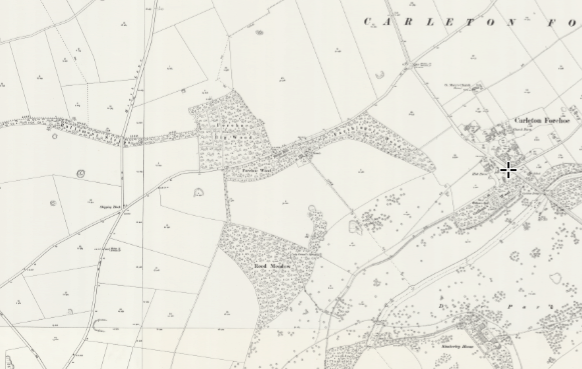
The incident took place at Forehoe Wood which is on the Norwich Road towards Kimberley, near to Carleton Forehoe. This area had seen incidents similar to this from the 1780s and so there must have been some terror for those travelling in this area.
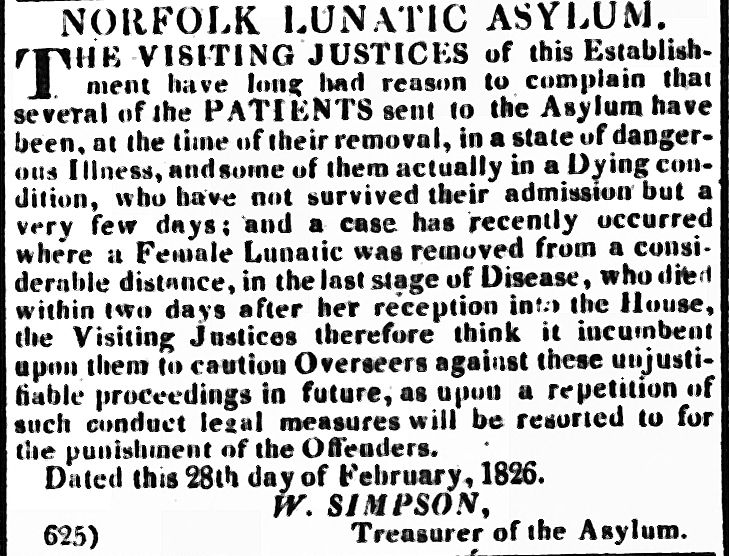
“NORFOLK LUNATIC ASYLUM : The Visiting Justices of this Establishment have long had reason to complain that several of the PATIENTS sent to the Asylum have been, at the time of their removal, in a state of dangerous Illness, and some of them actually in a Dying condition, who have not survived their admission but a very few days; and a case has recently occurred where a Female Lunatic was removed from a considerable distance, in the last stage of Disease, who died within two days after her reception into the House, the Visiting Justices therefore think it incumbent upon them to caution Overseers against these unjustifiable proceedings in future, as upon a repetition of such conduct legal measures will be resorted to for the punishment of the Offenders.
Dated this 28th day of February, 1826.
W. SIMPSON, Treasurer of the Asylum.”
And here’s the early welfare state system in action, where money has been raised to look after those with mental health issues at an asylum, but local parishes have been sending whoever they can to stop them being a problem to them.
The overseers in these parishes were tasked with managing the poor laws, although there wasn’t a great deal of money around and there was already some tension about who should be funding this. And there were extreme financial pressures as unemployment was rising, populations were rising and suffering was increasing. The joining together of parishes to provide workhouses was a handy way of hiding poverty, but I can imagine the keenness of the overseers to use the county asylum as a way of removing people from their parish.
I’ve posted numerous times before about just how bad mental health must have been at this time, they were very regular articles in the press in the 1820s about suicide and self-harm, but in the main, there must have been a lot of people struggling that had nowhere to go for help.
As an aside, the building is what became known as St. Andrew’s Hospital, although it opened in May 1814 as the Norfolk County Asylum. It remained in use as a mental health facility, later becoming part of the NHS in the 1940s, but closed in the 1990s following a move towards care in the community.
Catching up now with my visits from mid-January when I walked to Morley to investigate the pub arrangements there. This pub is situated in a little collection of mostly micro-pubs and it was worth the relatively lengthy meander from the hotel to visit.
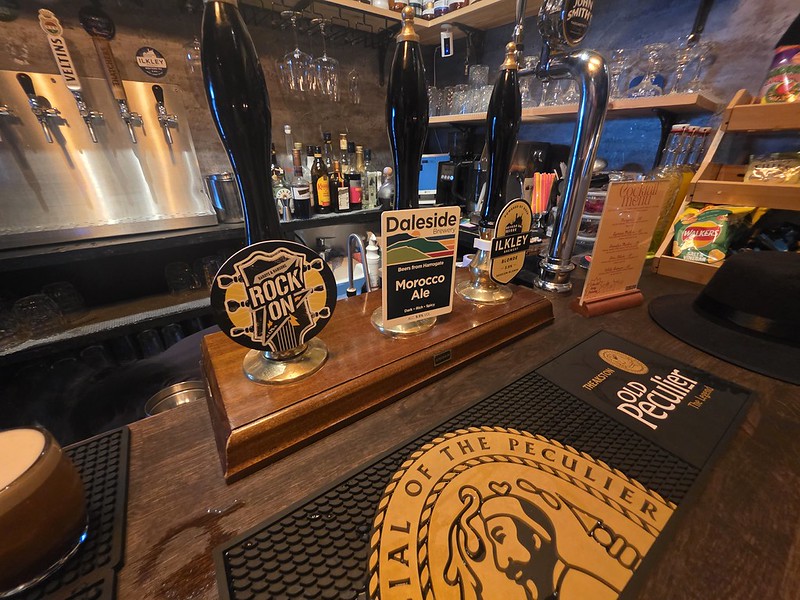
The cask options. There was a friendly atmosphere when I entered, even though I nearly knocked the staff member out when opening the door, but that’s a different story.
The keg options and for the relatively small size of the venue, there was plenty of choice.
The interior of the pub and I was fortunate to get a seat, it was the only table that was free. It’s got plenty of atmosphere and it was all rather refined and welcoming.
Some of the past beers and it’s clear they’ve gone through a fair few over the years.
The beer fridge and it’s always good to see some variety in can and bottle form.
My first half pint was the Morocco Ale from Daleside Brewery, a spiced quite punchy beer with plenty of flavour.
My second half pint was the Westend IPA from Ilkley Brewery Co, which was slightly piney, dank and interesting.
The venue is well reviewed online and it’s this mix of on-trend micro-pub alongside a traditional interior. It’s been used as a micro-pub since 2021 having previously been left effectively derelict for around fifteen years. It’s a marvellous example of how a building can be brought back into use and it seemed like a very competently run micro-pub.
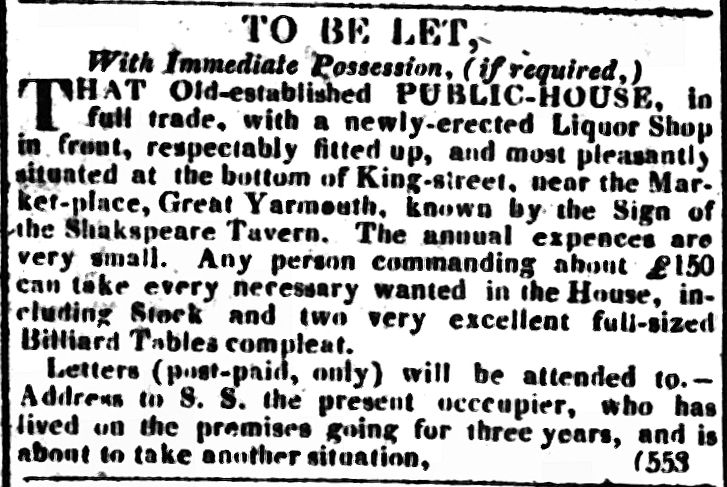
In the Norwich Mercury 200 years ago this week, it was advertised that the Shakespeare Tavern in Great Yarmouth was for let.
The advert read:
“THAT Old-established PUBLIC-HOUSE, in full trade, with a newly-erected Liquor Shop in front, respectably fitted up, and most pleasantly situated at the bottom of King-street, near the Market-place, Great Yarmouth, known by the Sign of the Shakspeare Tavern. The annual expences are very small. Any person commanding about £150 can take every necessary wanted in the House, including Stock and two very excellent full-sized Billiard Tables complete.
Letters (post-paid, only) will be attended to.— Address to S. S. the present occupier, who has lived on the premises going for three years, and is about to take another situation”
The SS referred to here was Samuel Smith, although I don’t know where he went from here. The pub had opened in around 1800, but it closed in the mid 1860s and was turned into a shop.