I am that dull that I not only have a favourite encyclopaedia, I have a favourite edition….. So, I’m always surprised and delighted to see them in the wild so to speak. Although the National Trust has split this collection at Ickworth House between two rooms which I managed not to be too traumatised about, although I had a strong urge for Liam to put them all together in one place. I don’t have a physical copy of the book at the moment, but there is a free version on-line and here’s just one random section from the complete set of books that Project Gutenburg has transcribed. I can’t remember if I’ve mentioned, but I had some e-mail conversations with Michael Hart, the founder of Project Gutenberg, in what must have been around 1995. Unfortunately, my e-mail archive doesn’t go back that far to read what riveting things I asked him about….. Anyway, I appear to have digressed once again.
Category: UK
-

Food from Every Stall on Norwich Market (2025 Edition) – Week 5 and Falafel and Friends
This week’s visit in the project that James and I have to dine at every food stall at Norwich Market (2025 edition) was to Falafel and Friends.
The menu is extensive and is displayed across two boards. The stall is one of the larger ones at the market as it takes up four units and it’s clearly signed so customers know where to order. The stall takes cards and cash, with everything being clean and tidy. There was a friendly and immediate welcome from the team member, with the ordering process being efficient and well managed. I was given a little slip with my order number, although the team member brought it over around six minutes later without needing to be reminded what I had ordered.
I took a seat in the small dining area which overlooks the servery and the waiting customers, although it was quiet for the half an hour we were there with just a couple of customers. James had to hide from the staff at Lucy’s Chips, once again, as they will wonder why he’s defected away from them. When seated James excitedly told me his latest joke, which was as funny as usual, but was at least not offensive to anyone in the surrounding area.
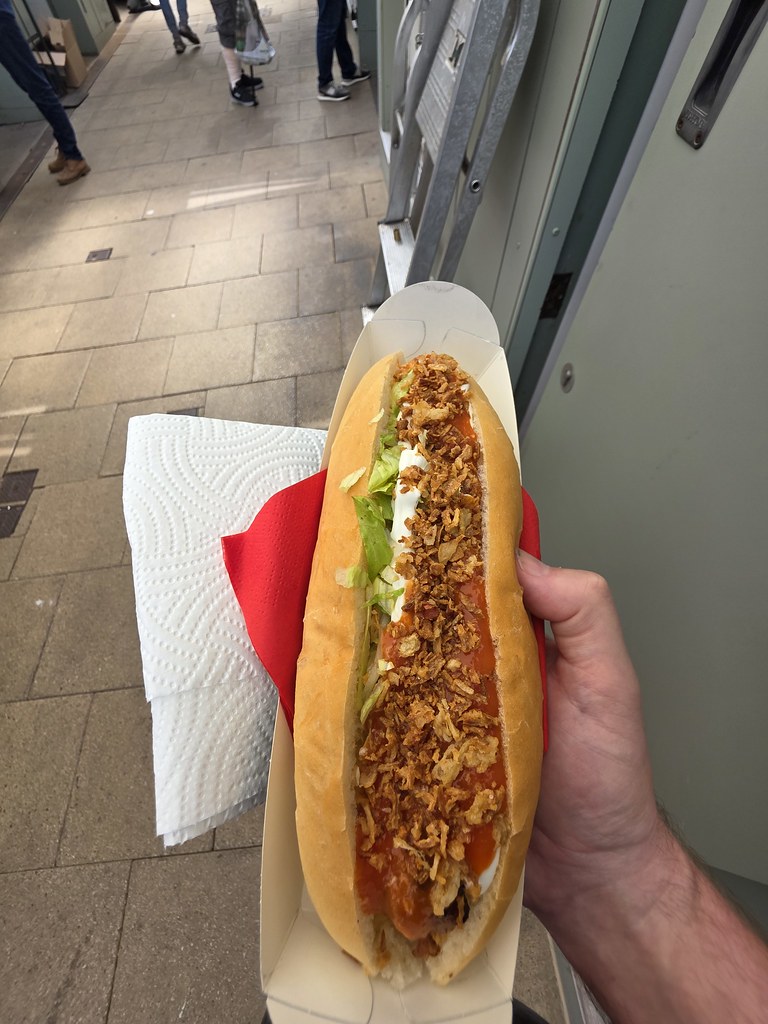
I went for the Kimchi Dog, which is what I had tried to order when we visited in 2023 but they weren’t available at the time. This was decent, the roll was lightly toasted and the falafel sausage was firm on the exterior and yielded when cut to a softer interior with the falafel having a depth of flavour. I liked the homemade kimchi element under the sausage, although I thought that it could have been a little more powerful in flavour. The Cajun potatoes were crispy and tasted rather pleasant with some lingering heat, whilst the sauce added some extra piquancy to the whole arrangement. The elements worked well together, with the blend of spices and ingredients being thoughtful.
James had pancakes and I asked him what he thought, which was something like (and he’ll forgive me if I’ve got his words slightly wrong):
“The culinary endeavour presented by these Kimchi Pancakes offered a fascinating exploration of flavour and texture. Anchored by a foundation of meticulously homemade kimchi, whose inherent piquant undertones provided a nuanced savour, the pancakes were skillfully crafted with gluten-free flour, resulting in a commendably tender consistency. Visually appealing with a scattering of verdant spring onions and an artful drizzle of vibrant sriracha, the initial gustatory apprehension revealed a complex interplay of umami and spice. While the anticipated savoury notes were indeed present, an unexpected yet intriguing sweetness emerged, creating a paradoxical harmony that, though not entirely conventional, proved to be a noteworthy characteristic.
Despite this subtle saccharine inclination, the Kimchi Pancakes were ultimately a satisfying and substantial offering. The inherent density and the fibrous nature of the kimchi contributed to a pronounced sense of satiety, rendering them a decidedly filling option. The thoughtful integration of high-quality ingredients, from the homemade kimchi to the gluten-free base, alongside the considered garnishes, elevated this dish beyond mere simplicity. Though the sweetness introduced a minor divergence from typical expectations, the overall experience was one of sophisticated flavour and considerable substance, marking it as a commendable and intellectually stimulating culinary encounter. Oh, and it was a bit sickly.”
So, that’s all rather lovely. I really enjoyed my Kimchi Dog which was filling and had a range of tastes and flavours. The challenge is that two years this was £7.50 and it’s now £9 for understandable inflationary reasons, but it’s now at a very punchy price point. I can understand their cost base and I’d still come back here again, as the quality of the food is definitely one of the best in the market. I mentioned in 2023 that this isn’t one of the stalls that James and I would have thought to go to before (we are a bit chips based), but it has surprised and delighted once again.
-

Ickworth House – Library
The library at Ickworth House, the largest of the property’s grand rooms and it is located adjoining the dining room. The name feels slightly misleading, as there are books all over the house and this room doesn’t have that many of them. It’s located at the heart of the Rotunda and is a large and expansive space that was also used as a ballroom. The fireplace was brought from Italy and installed by John Field, all part of the Grand Tour influence.
A lot of the books were rebound by Theodora, Lady Bristol, which has rather hidden their true beauty. I don’t like this uniformity, it’s a shame that the original bindings were lost. That’s what happens when books are seen as aesthetic things rather than beautiful in their own damaged right.
These great pillars are giant scagliola columns which cost £332 back when the room was laid out in the 1820s. It’s fair to say, that was a lot of money, somewhere around £35,000 in today’s money. At the same time, the bookshelves were installed, designed by the royal furniture makers Banting, France & Co who also supplied some of the other furniture in the room.
Anyway, onto one of my judgemental comments…. This room was significant in 2015 when the National Trust, under the leadership of Helen Ghosh, made a decision that they wanted people to linger in the room longer and to do that they would take the furniture out and put in bean bags. The mind process is just ridiculous, it’s easy to get people to linger in a room but it’s just as illogical to turn it into a waiting room as it is to fill it with clutter and force visitors to spend longer there as they can’t get around. At the time, the former head curator at the National Trust called the whole thing “misguided” and he seems right to me. After much hilarity from some observers, the National Trust scrapped the new vision after realising it was a bloody stupid one.
A lot of the blame appears to have been dumped by the National Trust onto Sue Borges, and there’s a photo of the bean bag project at Art History News. Borges claimed none of the 9,500 visitors who had gone through that weekend had criticised the arrangement, but the room guides apparently had a different take according to that article and it’s odd that out of such a large audience no-one had a differing view. Normally the Daily Telegraph have an entirely different view on the National Trust to me, as I’ve apparently gone a bit woke, but I’m pleased that wiser heads prevailed. Right, that’s that complaint out of the way and I very much like that they’re taken the historic items they bought back out of storage and restored them to the room.
-

Ickworth House – Dining Room
This is the decadent dining room at Ickworth House, one of the major state rooms in the property which was used for grand dining and located next to the library.
The room is located on the ground floor of the imposing Rotunda and occupies a central position in the property. The whole Rotunda arrangement was initially conceived by its progenitor, Frederick Hervey, the Earl Bishop, as a magnificent gallery, a ‘kunsthaus’ designed primarily to showcase the vast collection of art and antiquities he amassed during his extensive European travels. However, much of this collection was confiscated by Napoleonic troops which was a bit sub-optimal for the whole arrangement. His son, Frederick William, the 5th Earl and later 1st Marquess, inherited the unfinished project and he decided to mostly live in the East Wing, turning this room into one used only for formal entertaining to surprise and delight visitors.
Until 1910, the food was brought up from the East Wing kitchens which were located around 300 feet away, so meals turned up on trolleys rather colder than ideal, so a new kitchen was built underneath this room when the property was reworked and a dumb waiter installed to link them. The family were still living in the East Wing, so these kitchens remained the day to day ones, meaning the new one was designed to just be a Finishing Kitchen used occasionally when these big formal entertaining dinners were needed.
-

Ickworth House – West Corridor and William Pitt the Younger
This sculpture of William Pitt the Younger is located in the West Corridor at Ickworth House, standing next to the sculpture of the 2nd Earl of Liverpool. And, for anyone who remembers (or cares) from that blog post, this sculpture is on a red porphyry scagliola column with a white marble base. Very technical of me…. I don’t much need to write about William Pitt the Younger as he’s hardly an anonymous person.
Joseph Nollekens (1737-1823) was one of the best known British sculptors during the late eighteenth and early nineteenth centuries. He was born in London to Flemish immigrant parents (his father was a painter) and he trained under the sculptor Peter Scheemakers the Younger and later spent several years in Rome, where he studied classical sculpture and worked for the renowned antiquarian Gavin Hamilton.
Incidentally, the West Corridor was only completed in 1879 and the Pompeian Room lies at the end of the corridor. The Edwardians painted out all the Victorian artwork on the walls, but much was put back again in 1995.
-

Ickworth House – West Corridor and the Earl of Liverpool
This sculpture of the 2nd Earl of Liverpool is located in the West Corridor of Ickworth House and it was created by the sculptor B.F. Hardenburg in 1816 who had a studio was located near that of the Rome-trained sculptor Sir Richard Westmacott. I’m not an expert in rock, but apparently:
“The bust is mounted on a white marble socle (a low pedestal) which then sits on a more substantial porphyry scagliola column. Scagliola is a technique for producing imitation marble, and porphyry is a type of hard, purplish-red rock often associated with royalty and antiquity, suggesting the Earl’s high status”
I’m not sure I’ll remember some of the more complex words in that sentence, something akin to how I struggle to remember the Polish words I try to learn, but there we go.
Robert Banks Jenkinson, 2nd Earl of Liverpool (1770-1828), has the connection to the property that he was the brother-in-law of the 1st Marquess as he married Louisa Jenkinson, Countess of Liverpool (nee Hervey). And he was also quite good at politics as he became Prime Minister between 1812 and 1827 which is a lengthy spell surpassed only by Sir Robert Walpole and William Pitt the Younger meaning no-one following him has lasted longer in the role. Incidentally, he was the first Prime Minister to wear trousers rather than breeches, so there’s a fun fact. OK, I accept ‘fun fact’ is a bit relative here…. Incidentally, there’s some irony to me that he is known for this fashion statement, but in the sculpture at Ickworth they’ve dressed him up as a Roman wearing a toga.
-

Ickworth House – Pompeian Room
The Pompeian Room at Ickworth House was completed in 1879 and this wasn’t in the original design conceived by the Earl-Bishop, even though he was inspired by Italian elements during his Grand Tour. Instead, it was the concept of Frederick William John Hervey, the 3rd Marquess of Bristol (1834-1907), who inherited the estate and title long after the initial Neoclassical vision had been established. In 1879, the 3rd Marquess engaged the architect Francis Cranmer Penrose (F.C. Penrose) to undertake works aimed at improving the internal layout of Ickworth. Penrose, a notable and quite decadent figure who held the prestigious position of Surveyor of St Paul’s Cathedral, was specifically tasked with creating both the Pompeian Room and its counterpart, the Smoking Room, within the projecting bays of the linking corridors to the main house.

While Penrose handled the architectural modifications, the room’s defining characteristic – its elaborate decoration – was entrusted to John Diblee Crace (J.D. Crace) of the renowned Crace decorating firm. J.D. Crace was a leading figure in 19th-century interior decoration, particularly skilled in historical revival styles, making him something of an apt choice for realising a Pompeian scheme. Despite the name of the room, they copied the design from Roman wall paintings found at the Villa Negroni in Rome, rather than using anything that had been found in Pompeii.
Much of the Earl-Bishop’s collections of Italian archaeological treasures were seized by Napoleon, which rather limited his initial intention to create a substantial art gallery and museum at the house. That meant that when Hervey came along decades later, he had to use imitation designs when he built this room. The Victorians, or at least the Victorians who owned large houses, liked to have rooms for specific reasons, such as the smoking room that was built at the same time. This room was used for rather advanced leisure gatherings, it must have all been quite sophisticated and intellectual in here…..
-

Ickworth House – Nothing but Feed, Feed, Feed
Liam noticed this when we were at Ickworth House and I rather liked it. It sounds like some of the challenge events I go to when I mention that I’m hungry….
-

Ickworth House – Painting of Catherine Poley, Mrs Edward Barker
This painting is located within the collections of Ickworth House and the sitter is Catherine Poley, Mrs Edward Barker (1600-1665). It was painted at some point between 1630 and 1669 and the artwork was acquired by the National Trust in 1956 having been accepted by HM Treasury in lieu of tax. On the back of the painting it apparently states “My Ladie Harvis picter when I am dead” which I assume to mean “My Lady Harvis’s picture when I am dead”, or please keep this portrait after she died. The front states “Mrs Barker, Sister to Lady May” and I assume that’s Isabella May (1625-1686) who married Sir Thomas Hervey and it’s the Hervey family who owned Ickworth.
I rather like the formality of it all, this wasn’t a time to show joviality and excitement, instead it’s formal, rigid and stiff. And that lace wouldn’t have come cheap, might as well show that off to anyone who might see. It’s so severe that perhaps there’s an element of the Puritans about it, although the Hervey family were pro-Monarchy during the Civil war and they even raised a regiment of men to fight against the Parliamentarians.