Category: UK

  • London – Tower Hamlets (Borough of) – Mikkeller Bar

    London – Tower Hamlets (Borough of) – Mikkeller Bar

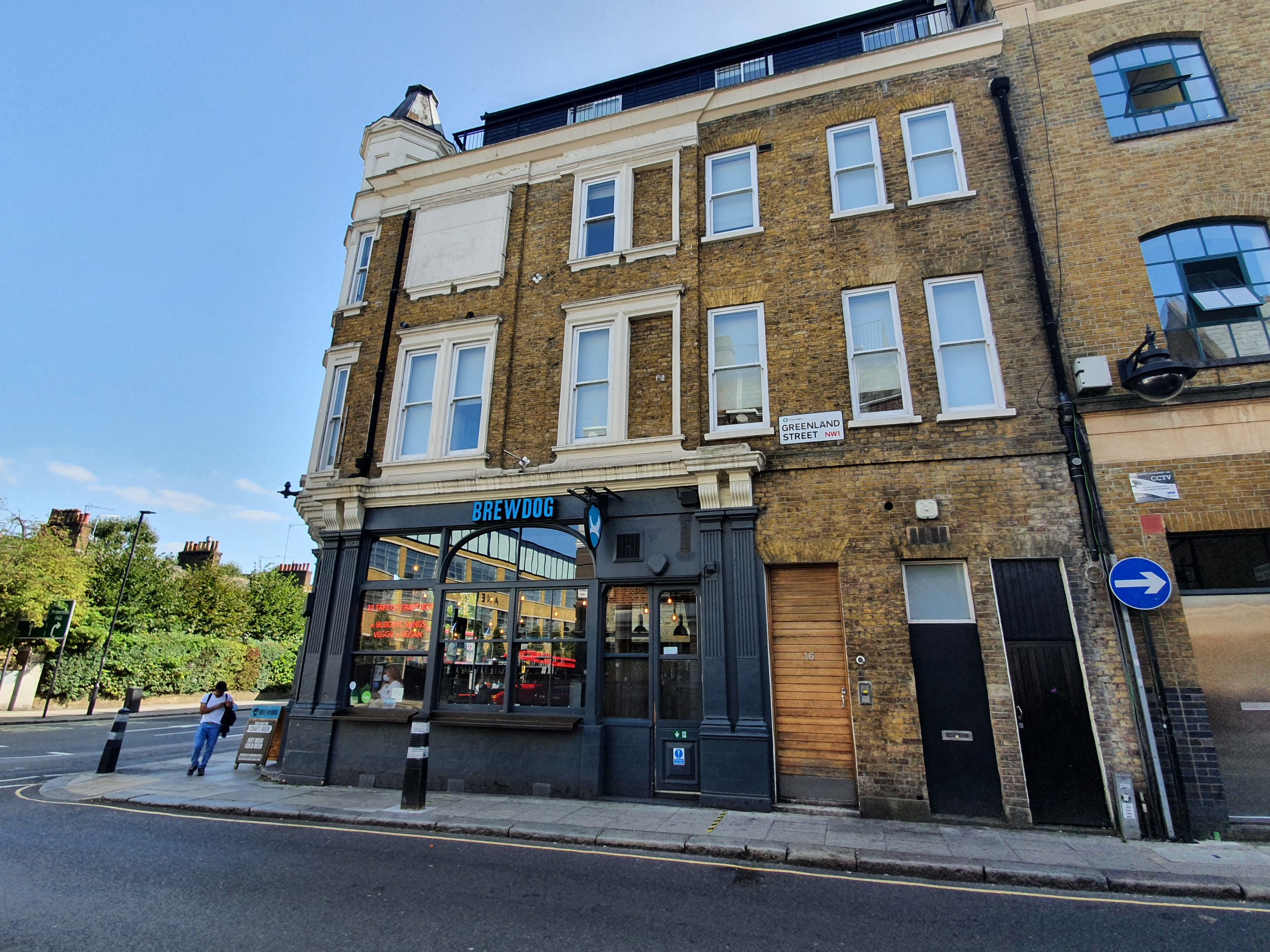
    This is the UK outpost of Mikkeller, a Danish brewer who have become all rather on-trend. They’re located in what was the George & Dragon pub (although it was turned into a shop before Mikkeller took it over) which was rather smaller than I had expected.

    The selection of beers, beautifully well balanced to ensure something for most tastes. They’re not the cheapest pub going, but the quality of the beers is high and there are some interesting options. The service was friendly, engaging and welcoming, with the staff members being knowledgeable about the beers.

    Part of the pub’s interior, it was otherwise busy and I was trying to avoid getting too many people in a photo that they might not have wanted to be in. I mentioned that my phone was low on charge (I’ve managed to forget to bring my battery pack with me this week) and I was hopefully shown a table which had a power socket by it, so that was a relief as I’d find it a little hard to cope without my phone….. (perhaps I need to get out more). The decor is just a little bit harsh and utilitarian, probably not conducive to people staying for a long time.

    My two beer choices were the Dry Stout Centennial Mosaic from the Kernel Brewery and the Hallo Ich Bin Berliner Weisse Raspberry from Mikkeller. No prizes for anyone who guesses correctly which one the above photo is of. The stout is made by a small local brewery in London and had a smokiness and bitterness to it. The raspberry sour was piquant and flavoursome (that sounds pretentious I think, but there we go), both beers being very drinkable.

    Anyway, all very lovely, although the bar was full soon after they opened, so I’m wondering whether they might be tempted to return to their more normal hours rather than the slightly more limited ones they’re operating with at the moment. The pub also has pizzas which are supplied from Yard Sale Pizza, a third party company, which did sound tempting and it’s a clever way of providing a food offering.

  • London – Westminster (Borough of) – National Gallery (Saint Mary Magdalene and Saint Peter)

    London – Westminster (Borough of) – National Gallery (Saint Mary Magdalene and Saint Peter)

    These two Saints (NG4491 and NG4492) are in the collections of the National Gallery, donated in 1930 in honour of Charles D Cumming. The two separate pieces are part of a larger altarpiece which has since been broken up, with other sections in the Palazzo Barberini in Rome and also in private collections. They date from around 1350 and it isn’t known where the altarpiece was from, or when it was broken up.

    The Mary Magdalene image is notable for, and I’ve taken this from the National Gallery web-site (I hardly knew this):

    “The artist has taken great care to paint the ointment jar so that it resembles white marble with pink and blue veins. Its surface has a soft luminosity, an effect achieved by painting a thin layer of white paint over a base of layer of bright colours. This technique is known as scumbling.”

    I’m not sure what look for Mary that the artist was intending, although it appears more grumpy than pensive. Anyway, that’s my contribution to the commentary on these artworks…

    They think that there was a main panel with the Virgin Mary in the centre, with the two pieces in the gallery’s collections having once been positioned to the right of that. The arched panels at the top are more recent, as they were at some stage turned into rectangular artworks, so they could be displayed on a wall.

    Although it’s not ideal from an artistic perspective, I quite like that the individual items that once formed part of a larger artwork are dotted around the world. It makes it more of a treasure hunt to locate them.

  • London – Westminster (Borough of) – National Gallery (Saint Sabinus by Pietro Lorenzetti)

    London – Westminster (Borough of) – National Gallery (Saint Sabinus by Pietro Lorenzetti)

    This artwork (reference NG1113) is in the National Gallery in London and they’ve had it in their collections since 1882, when it was presented to them by Charles Fairfax Murray. The full title of the painting is “Saint Sabinus before the Roman Governor of Tuscany” and the gallery thinks that it was painted between 1335 and 1342. Murray was an artist who spent some time living and working in Siena, in Italy, and it’s thought very likely that this might have been designed originally as part of an altarpiece for the city’s cathedral.

    The gallery’s web-site, which is gloriously detailed, has no end of information about this painting, but I like that there was once one central panel and four altarpieces, of which this is one. The central panel is today at the Cathedral Museum in Siena, two of the panels are at the Uffizi (so, I may or may not have seen them earlier this year) and the other is lost.

    The Roman Governor in the image is Venustianus and he’s sitting down on the seat with the strange-looking lions, demanding that Sabinus sacrifice one of his companions. Sabinus offered a statue, which seemingly wasn’t sufficient as Venustianus ordered his hands to be cut off. Now more commonly referred to as Saint Sabinus of Spoleto, he was later executed by Lucius, the Roman elected official. So, not exactly ideal.

    Pietro Lorenzetti (?1280-1348) is apparently (I’m reading this bit on an art site, I don’t know as I’m not an art historian) an influential forerunner of the Italian Renaissance movement and he was well-known in Siena. Given that he was painting 700 years ago, a surprising number of his works are still in museums and galleries around the world today.

  • London – Westminster (Borough of) – National Gallery

    London – Westminster (Borough of) – National Gallery

    I wasn’t enormously thrilled about how the British Museum handled their visitor flow yesterday, with people clustered together. However, the National Gallery, to quote a phrase of someone I know, surprised and delighted me with their arrangements.

    Visitors go to the Sainsbury Wing Entrance and the time of the ticket is clear, turn up no more than fifteen minutes before. There was a staff member guiding visitors and he was helpful, giving clear instructions to everyone and there was plenty of space for people to wait. I liked this, he was chatty and welcomed visitors with a smile and those without tickets were dealt with politely.

    The member of security staff was humorous, engaged and keen to welcome visitors. I admit that mine was the first bag of the day that he had to check, but nonetheless, he smiled and made conversation. And, the staff at the gallery were all engaging and they looked like they wanted to be there. Two staff were talking to each other about a painting, a moment which it occurred to me that I’ve never seen before. The staff were pro-active and welcoming visitors, giving the impression that their role was that of aiding the visit of someone new to the gallery (or someone experienced wanting help), rather than just being there for security.
    The gallery has information about every one of its artworks on-line, and this is useful and accessible. It added an extra dimension to the artworks, although that had the disadvantage that I stayed for three hours and still didn’t even get half-way round. I’ve booked another ticket on-line for in two weeks, but this experience reminded me that the National Gallery is, along with the Met in New York, perhaps the best gallery in the world.

    Impeccable and a perfect example of how to handle visitors during these uncertain times. And below, some photos of the galleries…

  • London – Camden – British Museum (South Metopes)

    London – Camden – British Museum (South Metopes)

    I have no in-depth knowledge of these, but there’s plenty of information at https://en.wikipedia.org/wiki/Metopes_of_the_Parthenon about these metopes. They were carved in around 446BC and have had quite the adventure over the centuries.

    But, the bizarre situation now, and without getting political, is that the main sections of some of them are in the British Museum and the heads of these figures are still in Athens (and some are dotted around other parts of Europe).

    This is South Metope VI (SM7) and the catalogue description for this reads as follows, split into three different sections.

    Parthenon SM.7 (Acropolis)
    Title: Parthenon, South Metope 7
    Collection: Athens, Acropolis Museum
    Subject: Centaur head

    Parthenon SM.7 (Paris)
    Title: Parthenon, South Metope 7
    Collection: Paris, Musee du Louvre
    Subject: Head of Lapith
    Subject Description:
    The head of a young Lapith belongs to metope S7, now in the British Museum. He has short hair, large eyes rimmed with thick lids, a mouth with a full lower lip and no beard. The head is represented in an almost frontal view, though the left side is not completely finished.
    Condition Description:
    Head in relief, broken across back. Nose in broken and worn. Heavily weathered

    Parthenon SM.7 (London)
    Title: Parthenon, South Metope 7
    Collection: London, British Museum
    Subject: Lapith and Centaur
    Subject Description:
    Centauromachy: Lapith (left) charges against Centaur with left arm forward, mantle clasped at right shoulder. Centaur (right) rears up, his left foreleg against stomach and groin of Lapith, his cloak flying out to right.
    Form and Style:
    Note veins in left arm of Lapith — a Severe Style trait.
    Condition Description:
    Missing: upper right corner of slab, most of right leg, left foot, right hand, and lower mantle of Lapith, left rear foreleg and left arm of Centaur. Heads in Athens and Paris (Louvre Ma 737). Surface abraded.

    So, anyone who wants to see study this metope will have to pop along to the Louvre, the British Museum and the Acropolis Museum. It’s not ideal….

  • London – Camden – British Museum (Re-opened)

    London – Camden – British Museum (Re-opened)

    The British Museum has taken a little longer to open that some other historic attractions in London, but I was able to pre-book a ticket to visit today. The facade of the building is under repair and is expected to open next year, the first restoration of this since it was damaged during the Second World War.

    There’s some muddled logic about the entire opening and I’m surprised that the British Museum were struggling with this, although perhaps the professionalism of some other museums has made it look too easy in what are different circumstances. The British Museum limit entrance to the complex ten minutes before the time on the ticket, which isn’t clearly signed anywhere. It’s not illogical, it just means that people then hang around outside the entrance to the museum in a beautiful small crowd. Which isn’t ideal.

    As for bags, they’re letting in some enormous backpacks, something which I was slightly surprised about. I suspect they’d be better limiting this to some degree, although the security process was quick to go through.

    The inside of the British Museum’s Great Court, where there was plenty of space for visitors to walk around. The cafes and shops are also open, although the seating capacity of the former is quite limited.

    And the beautiful old reading room, now unused for its original purpose as the British Library has its own premises at St. Pancras.

    As for the interior, the museum had made what I considered to be a bizarre decision to funnel everyone together when they entered. So, they ended up with relatively crowded areas, which isn’t really an ideal situation given what is going on at the moment. I suspect that the staff are meant to restrict entrance, but there’s a limited amount they can do. The photo above isn’t of the busiest areas, but I didn’t entirely like their one-way system. None of the other museums I’ve visited over the last few weeks has tried to operate with a one-way system, sometimes it’s best to get people away from each other. If visitors see a nice quiet area, then they can go and visit that, rather than have to stand around together in an area where they might not feel entirely safe.

    These photos were taken in order and what ended up happening was that there was a clump of people at the start of the one-way process and then nearly no-one hanging around as they reached the end to their visit and perhaps rushed through. The one-way system is in places difficult to follow, a chunk of people walk against it and that’s not through any fault of theirs, as in some places I found it illogical.

    Anyway, it was nice to see the British Museum open again, I usually visit every few months and look around a certain section each time. There’s lots closed off at the moment, but there’s still a reasonable amount to see. Definitely some thought needs to be put into the flow of visitors though and letting them self-regulate to a degree so they can feel safer and less crowded.

  • Swadlincote – Sir Nigel Gresley

    Swadlincote – Sir Nigel Gresley

    To provide a little context, we visited this pub in Swadlincote whilst on our sixth LDWA 100 training walk.

    This was the final pub of the day, the JD Wetherspoon operated outlet in Swadlincote, named after the famous railway engineer who lived nearby in Netherseal. It was a pub, albeit a bit run-down, before JD Wetherspoon took it over in 2001, previously known as the Granville Arms.

    I took this photo with the hope of identifying the real ale that I ordered, but I didn’t take it clearly enough and I’ve since forgotten. Anyway, I know that it tasted fine and seemed well-kept. Not that this information is of use to anyone, but it’s the best I’ve got here….

    The interior of the pub, quieter on a Saturday night that I had anticipated.

    The chicken vindaloo curry, which they clearly hadn’t sold out of on Thursday’s Curry Club, but it was £3.99 and tasted fine. It was probably just a bit too spicy a thing to order on a Saturday night, but it was hot and everything was cooked appropriately.

    And, I had a little at the pub reviews, which aren’t generally the best in the chain shall we say.

    “I have used the disabled toilet in the pub as I have a radar key. I find really helpful as you have room to move around and it’s private, or at least I thought it was. Someone tried to come in while I was inside and I carried on, but to my amazement and shock they managed to get in with their key.”

    I’m surprised that this doesn’t happen more often, but I’ve seen this a few times in different Wetherspoons. The staff often knock on the door, wait about two seconds and then open the door. It’s admittedly exciting drama, but not for the person inside the toilet….

    That’s about as notable as the reviews get, although more seem to complain about other customers than the actual pub itself. Anyway, this was a perfectly comfortable and welcoming pub, with it being rather handy that they were still serving food so late. And, other than the few miles walk back to the accommodation, it marked the end of what had been a long and exciting (well, what I call exciting) day….

  • Kettering – Marketplace Timeline

    Kettering – Marketplace Timeline

    I like this idea of having a timeline made out of stones in the market place of Kettering, encouraging people to be reminded about the town’s history. This stone, where the wording was apparently a little botched by the local council, told the interesting story of Geoff Perry and Derek Slater with their remarkable efforts at Kettering Grammar School to launch a successful Satellite Tracking Group.

    The borough council has decided that nothing sufficiently exciting happened between 1966 and the space exploration story until 1991, when the A14 opened. I’m sure this was important in improving transport in the area, and reducing congestion in the town centre, but perhaps more other stories could have been found.

    The most recent addition by the council is from 2014, marking when the Anglian Regiment was presented with the Freedom of the Borough of Kettering, which is a rather nice gesture. Quite why nothing has been added in honour to James Acaster is a different matter, but hopefully the council will reflect on this in years to come.

  • London – Rush Hour at Canary Wharf

    London – Rush Hour at Canary Wharf

    There was a grand plan to get office workers back into London today, with the Evening Standard having a full-page editorial saying that some sort of normality is now required.

    This was the 17:00 underground service from Canary Wharf…..

  • Aylsham – Gate of India

    Aylsham – Gate of India

    I’ve certainly had my fair share of discounts from the Government’s ‘eat out to help out’ and this was the last meal of the month, on Monday 31 August 2020. Richard and I had been meandering around some churches in North Norfolk and this was one of the few food options available to us, since we hadn’t bothered to book anything (or more precisely, most places we wanted to book at the last minute were full).

    The menu at the Gate of India in Aylsham.

    I have to temper my expectations here a little, I wasn’t back in India (which I miss very much) and I wasn’t at the on-trend Indian restaurants in London that I’ve been fortunate enough to try recently. As poppadoms and chutneys go, these were OK but weren’t particularly inventive or exciting. The drinks were also expensive, a pint of Coke was £3.75 and I’m not exactly sure what brand they were using.

    The Peshwari naan bread was again OK, but lacking in any depth of flavour and they were reliant on some sort of paste that didn’t have any texture. That’s the chicken biryani, again lacking any particular depth of flavour, although the chicken was well cooked and tender. There was some texture to the rice, with everything properly cooked and at the appropriate temperature, but it needed something more exotic in terms of the taste.

    This came with the biryani, again lacking any depth of flavour, which is not entirely usual for an Indian restaurant or any variation thereof.

    Service was efficient if not engaging, but it was timely and we were never left waiting. I was, shall we say, surprised that the restaurant forgot to apply the ‘eat out to help out’ 50% discount. The bill was though immediately corrected and I can’t much complain here because mine came to £10 after the discount was applied and I paid using Amex and shop small kicked in, meaning that I paid £5 for the entire evening’s food and drink. For that price, I was entirely happy, so this proved to be a marvellous choice for Richard and me.

    I’m not sure that there was anything exceptional enough for me to want to return though. The restaurant is reasonably well-reviewed (although not quite as good on TripAdvisor), somewhere in the middle of restaurants in the area, and so I don’t think there’s anything particularly bad, but perhaps standards in Indian cuisine have just moved so much in the last couple of years that there are better options out there.