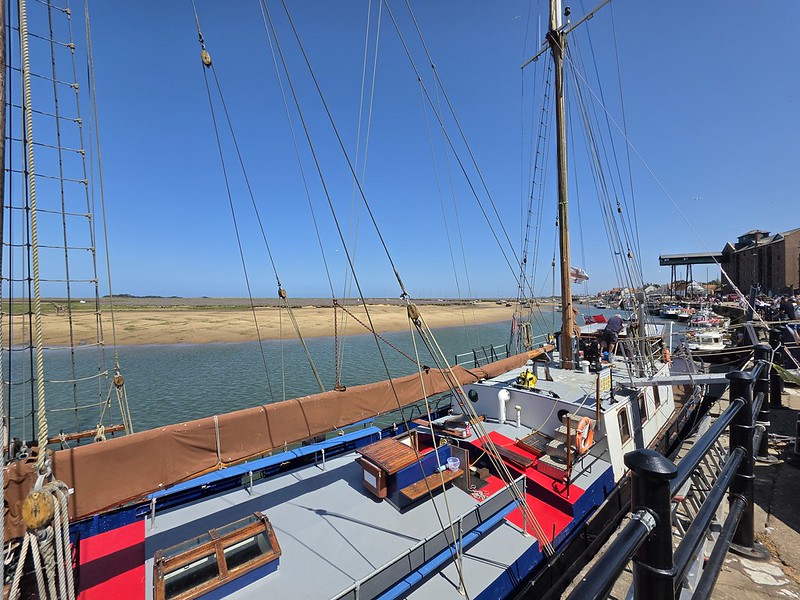
Moored alongside the quay at Wells-next-the-Sea, the Albatros is rather more interesting than the average boat parked in the harbour. The Dutch North Sea clipper was built in 1899 at Capelle aan den IJssel, near Rotterdam, and spent much of its working life carrying cargo around northern Europe. Between 1990 and 1996 it became a regular visitor to Wells, bringing more than 100 cargoes of soya bean meal from the Continent. In September 1996 it sailed from Wells after delivering 100 tonnes from Rotterdam, marking the end of its career as a freight carrier and, remarkably, the final commercial voyage of a sail-driven cargo ship in Europe.
The Albatros later returned to Wells and acquired a rather gentler existence, becoming a floating bar, restaurant, music venue and accommodation, particularly known for Dutch pancakes and real ale. It left the town in 2020 for an extensive restoration at Maldon in Essex, finally returning to Wells in July 2023 after three years of work. As I know from Charters in Peterborough, there’s something rather exciting about having a real ale on a floating boat. For some years it was listed in the Good Beer Guide and was known for stocking a selection of beers from Woodfordes brewery.
Quite what’s happening now, I’m not sure. Jen offered to try and go and talk to the people on the boat, but Roy and I recoiled at that ridiculous level of social interaction so we meandered off quickly. It means this post ends without the benefit of investigative journalism, but with considerably less risk of having to introduce ourselves to strangers.
The next pub on our meanderings around Norfolk was the Globe in Wells-next-the-Sea which is one of a growing number operated by the Chestnut Group. It has been a licensed premises since around the 1830s and was a locally owned venue before Greene King acquired it in the late 1960s, but they sold it in around 2010 which is probably for the best.
In 1947, Graham Cawdron (who I think was the same landlord as Herbert Graham Cawdron) who was a former Flight Lieutenant in the RAF who had won the DFC announced that he planned changes to the venue. His family owned the pub and they proposed demolishing the original bar to give more space for the entrance, adding rooms to the rear and also adding a balcony to the first floor giving access to the billiards room and a lounge. As a side note, the landlord applied for a special licence to open until 23:30 on a Saturday evening to host the annual dinner dance of the Royal Air Forces Association. There doesn’t seem much decadence in the opening hours that were normally allowed if they had to get special permission to open until 23:30, the nightlife of Wells was evidently operating under fairly strict constitutional arrangements.
All nice and clear signage with details of some future events. There’s a front bar to the arrangement, with a restaurant area to the rear and there are also rooms available, priced at a level which suggested I would not be conducting further research.
The interior which all seemed welcoming and comfortable, with a sizeable beer garden outside. The venue was much busier than these images suggest, I took the opportunity to take these photos when customers had just left.
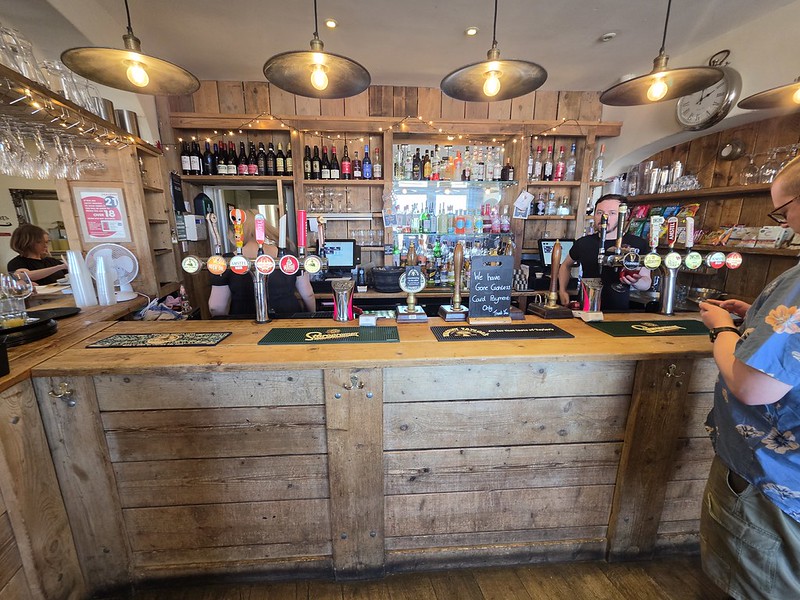
The bar area and there were three real ales, with two from Barsham. The venue is very well reviewed online and although the food prices were towards the higher end of the scale, the drinks prices were reasonable. The team members at the bar were friendly and served us promptly enough despite there being quite a queue when we arrived.
I went for the Eastern Gold from Barsham Brewery which had a fruity edge and was nicely rounded in terms of the flavour. It was also at the appropriate slightly chilled temperature, despite the extremely hot weather outside which I hardly mentioned, so this pleased me. And I also got some free tap water infused with cucumber or something adding an unexpected spa element to proceedings. I’m not sure that’s what actually happens at spas, but I’ve never been so I’m just guessing.
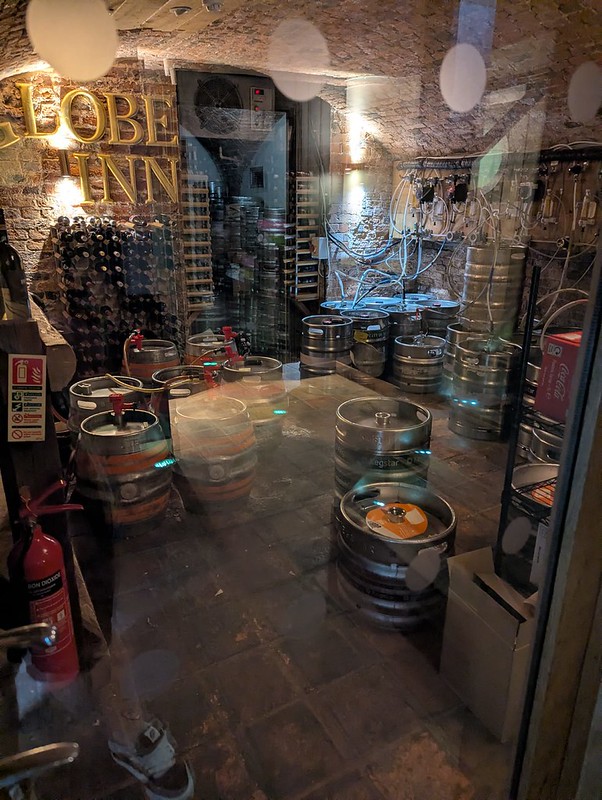
I wanted to take a photo of the cellar but there was a team member working in it when I walked by. Fortunately, Jen took a photo, so I’ve used that one as I rather like seeing open cellars.
I’d note at this stage that there are no Good Beer Guide pubs in the town, which feels a little sub-optimal, but I’d say that this one must have been a close contender. There was a friendly welcome, it had an upbeat atmosphere, the beer was well-kept and there was an air of style about it. All really rather lovely.
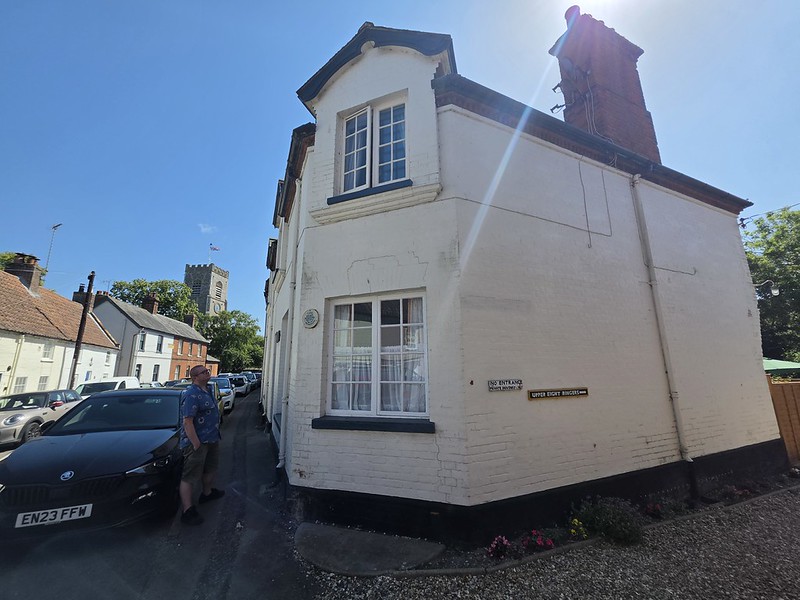
This was once the Eight Ringers pub in Wells which was a licensed premises between the late eighteenth century and 1971 when it finally closed. It was initially a free trade pub before becoming part of Bullards and then Watney Mann, but they didn’t feel that the venue was viable and it is now split up into flats.
It came up for sale in 1904 and it was advertised as being:
“A fully licensed public house with large yard, good stable and outbuildings, suitable for any trade”.
The landlord between 1905 and 1909 was Frederick Powell and he seems to have been something of a character. He was charged of being drunk in his own licensed premises and then using bad language to a police officer who was investigating the matter, with the fine for the bad language alone being 9 shillings including the costs.
The pub seems to have struggled with their landlords as the long-standing Eleanor Cross was at the premises for over thirty years and was found guilty of adding water to whiskey. The situation seems complex, she claims that the inspector made her open a bottle which she never tried to serve from and she claimed that was her own whiskey as “her heart was bad” but the court didn’t believe it.
The landlord between 1947 and 1961 was Frank Moore and then his wife managed the house between 1961 and 1966. She attracted the interest of the national newspapers in 1962 when her 40 year old cactus bloomed with nine buds. She was so excited that she moved it to the bar and customers could see the buds blooming in front of them. They then all died overnight, so that was the end of that excitement.
There’s a plaque on the building from a local history group, otherwise I would have known that this used to be a pub. As for the name, a traditional English ring of church bells can consist of eight bells, each with its own ringer, which presumably explains the Eight Ringers. There were periods in the pub’s early history when it was instead known as the Six Ringers, so goodness knows what happened to the other two. Perhaps they had been barred.
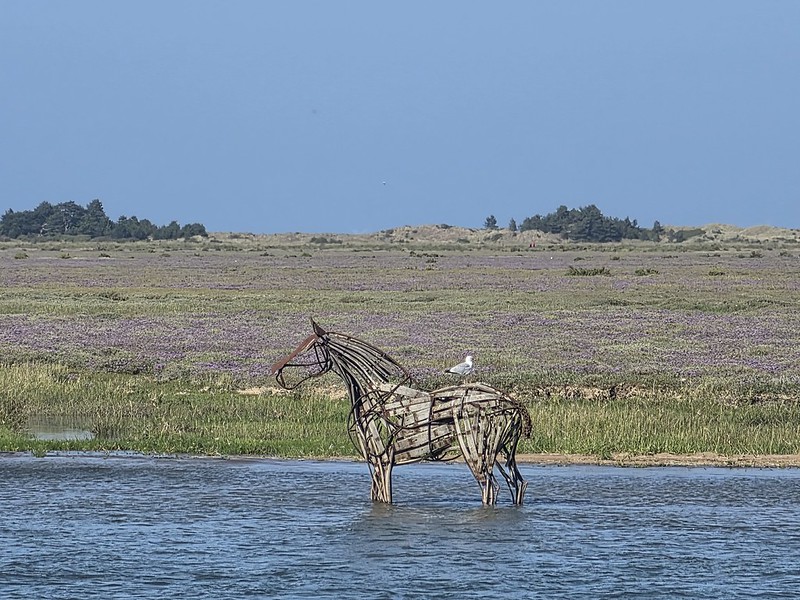
Shortly after we arrived in Wells I noticed this sculpture before we meandered to our first pub in the town. It transpired to be one of the more distinctive sights in Wells Harbour and it’s known as the Lifeboat Horse, a three-metre-high sculpture standing out on the sandbank opposite the harbour. It was created by Norfolk artist Rachael Long for the Wells Heritage Art Trail in 2018 and commemorates the working horses that once helped launch the town’s lifeboats.
The inspiration for this arrangement came from an old photograph shown to Long by Wells Harbour Master Robert Smith, depicting the lifeboat being hauled by five pairs of heavy horses. During the nineteenth century, the horses could be called upon to pull the 33-foot lifeboat around two and a half miles from the quay to Holkham Gap for launching. The horses weren’t kept solely in reserve for maritime emergencies either, as they normally earned their keep by hauling heavy cargo around the harbour.
The sculpture is made from steel bars and pieces of whisky barrel and is secured to the seabed with substantial metal pins, which seems sensible given that leaving a three-metre metal horse casually unsecured in the North Sea would introduce an unnecessary element of excitement. Its position also means that the appearance changes considerably with the tide. At low water the whole horse stands exposed on the sand, while as the tide rises its legs disappear and it starts to look as though it is standing, or perhaps wading, in the harbour. And fortunately for the increasingly demanding photographic requirements of this riveting blog, by the time we returned later the tide had come in.
I rather liked the whole changing relationship with the water, as it stops the sculpture simply becoming another static piece of public art. I photographed it at different stages of the tide and it looked quite different on both occasions and I hadn’t expected that. And as is visible in the photo, a seagull had also taken up position on its back. The horse wasn’t originally intended to become a permanent feature. It formed part of the 2018 Wells Heritage Art Trail, which included 17 works by 26 Norfolk artists, but it proved sufficiently popular that a campaign was launched to keep it. The local community subsequently raised the £15,000 needed to buy and reinstall the sculpture, with donations coming from businesses, residents and even local children so it returned to the harbour in May 2019.
It isn’t quite permanent in the literal sense, as the Lifeboat Horse is removed during the winter to protect it from the harsher weather and returned in spring. Moving it requires a boat with a crane so it all sounds like a bit of a hassle, although its secondary role as a £15,000 seagull perch should not be underestimated.
The next pub on my little day out in Norfolk with Roy and Jen was to the Bowling Green pub in Wells. I had dragged them both to St. Nicholas church in the town, but more about that rather lovely building in another post. Well, possibly. My queue of things to blog about is now expanding considerably faster than my ability to write any of them. At the present rate, the church should appear on the blog sometime before 2034.
The venue has a long history and has been a licensed premises since perhaps as early as the late eighteenth century, so it might be the oldest in the town that is still open. Norfolk Pubs notes that it was owned by the Dereham Brewery, then Steward & Patteson, Watney Mann, Brent Walker and then Pubmaster before it became a freehouse. Planning permission was granted in 1999 to turn the venue into two houses, but fortunately it survived as Wells already has houses and historic pubs are rather harder to manufacture.
I liked all the clear signage and this felt like a traditional pub with some events going on. There was something of a rustic feel, but it was carefully designed and there was also a separate dining area which all looked like someone had thought about rather than assembled together a heap of random furniture over thirty years or something. I like the mixture of high and lower seating and there was a garden area as well for those who like sitting with wasps and pretending this constitutes relaxation.
The interior with its stone floor and although this would have no doubt made a lovely house, it’s definitely better as a pub.
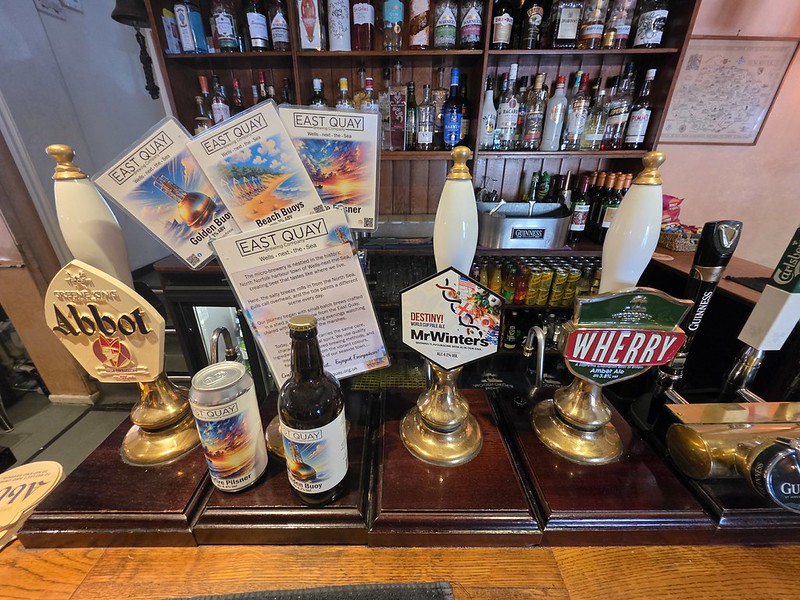
There were three real ales available and also some bottle conditioned beers from East Quay brewery.
I like the clarity of this as it isn’t always obvious where those going into a pub just for a drink are actually meant to sit. A sign saying ‘drinking table’ makes this process much easier and I like precision.
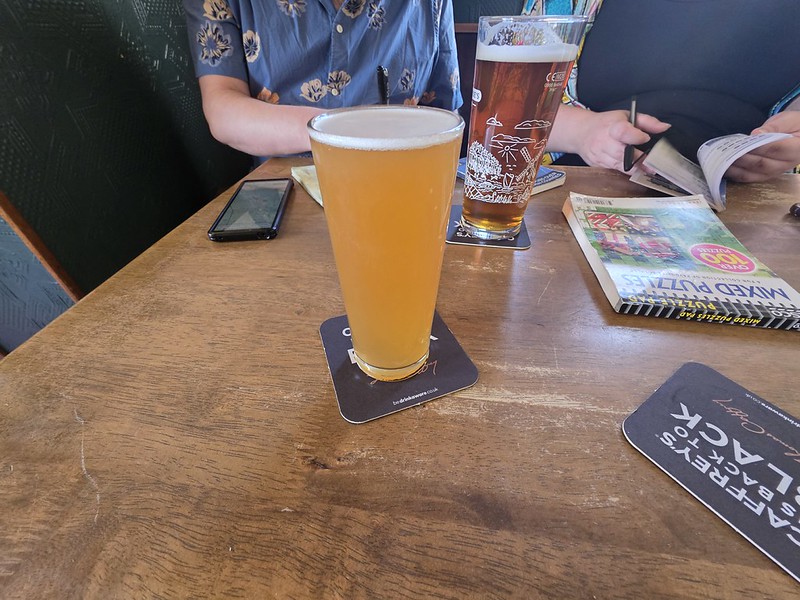
This is the Destiny from the ever reliable Mr Winter’s Brewery and it was clean tasting, hoppy and agreeable. This appears to be a rebrand of another Mr Winter’s beer which makes the process of putting it on Untappd rather more complex than I’d ideally like.
I liked this pub as it clearly served the local community whether they wanted food or drinks, with everything clean, well managed and organised. The venue is well reviewed online and seems a reliable option for food, with rooms also available here for those wanting to stay overnight. It has managed to broaden what it offers without losing the feeling that it is fundamentally still a proper pub, which is not always as straightforward as it might appear.
The next venue on our list was the Edinburgh pub in Wells, which has been a licensed premises since the late eighteenth century. Originally known as the Fighting Cocks, it took the name of the Leicester Arms until 1887 when it was renamed by the Scottish landlord James Alexander Davidson as something he felt to be more agreeable. And that name has stuck since.
Apologies for the lack of real ale photo, but the landlord was standing right behind those pumps most of the time and I didn’t want to be too intrusive. Anyway, they had a choice of three real ales available.
The interior felt reassuringly traditional, with carpet, wood and the sort of layout that still unmistakably feels like a pub. It was all entirely agreeable. The far end of the pub is a restaurant, named Ollies, which seems to be sub-contracted out, so it’s a different operation but still firmly in the same building. That meant this end of the pub is for drinkers and I liked the clarity of the arrangement.
And I liked the nod towards heritage, a bit of local history is good for the soul. Less spiritually nourishing, although potentially more immediately useful, was the bar snack range listed nearby to tempt those of weaker resolve.
I rather like a wheat beer and I went for the Blue Moon, although it’s the first time in a long while that it hasn’t been served with a slice of orange. I managed to contain my disappointment with considerable dignity. Roy went for a Woodforde’s Wherry and I understand that it was well kept and at the appropriate temperature and all that.
I liked this venue and it had a feel of being a proper pub for locals whilst still being welcoming to everyone. It’s a little walk from the quay, but I think it’s worth the little meander.
I’ve decided to write about this pub as Roy did get a drink here, but I think it’s fair to say that this venue isn’t really targeted at me. That’s not necessarily a criticism in itself, as pubs have to appeal to rather more people than just me, inconvenient though that may be for them.
There are decent views over the quay and the venue has a prominent location in the town. The venue has a long history, it has been a licensed premises since the middle of the eighteenth century and in more recent times it became part of the Bullards, then Watney Mann, then Pubmaster and then Punch Pubs estate. The listed building notes mention:
“Early C18, much modernised. Brick and pantiled. Front, pebbled and plastered. 2 storey and attics. 3 casement dormers. Eaves cornice. 2 sash windows with glazing bars remain at 1st floor, altered centre window with casement. Rusticated quoins. Dutch gable. Interior: oak open stair well said to be included.”
So it seems much has been lost internally, likely a long time ago, and it did feel a little soulless inside.
Jen had disappeared at some point and returned with what can only reasonably be described as an enormous ice cream from somewhere nearby. She then stood peering through the pub window while eating it. Roy and I decided that asking questions would probably only encourage matters, so we left her to it and didn’t say anything.
I was marginally amused that the menus on the tables advertise these bar snacks. A customer tried to order them and was told in quite a direct manner:
“It’s Sunday, you can’t order bar snacks”
I’m afraid I’m with the customer, it’s a little sub-optimal to be dismissive of someone trying to order food as it doesn’t say anything that they can’t be ordered on a Sunday.
The beer range was fairly generic and there wasn’t anything that particularly excited and delighted me, so I decided against ordering a drink myself. It does feel a shame that there’s no attempt at localisation here at all, even the real ale that they didn’t have is a generic national offering. CAMRA notes that real ale is often unavailable and it’s only ever Timothy Taylor’s Landlord when it is available. It’s also card only, which I have no view on, but I’d say that’s quite brave for a venue of this size.
Ultimately, it’s positive that the pub remains open in such a prominent location and is contributing to the life of the town. It was busy enough to suggest that plenty of people appreciate what it offers, which is considerably more important to its future than whether I personally felt an overwhelming urge to move in. Roy got his drink, Jen had acquired an ice cream of almost architectural proportions from somewhere and I had obtained another blog post, so everyone emerged from the experience with something.
Next on our tour was the Norfolk Bottle Shop, located near to Wells-next-the-Sea and pretty much in the middle of nowhere. It’s great if you want to get away from it all, but as someone who likes “all”, it’s not my natural habitat. My first concern as we were driving into a farm was that I wouldn’t have a mobile signal for Untappd, but, fortunately, it transpired it was better than the signal that I get in Norwich.
There were plenty of bottles available from a range of different breweries.
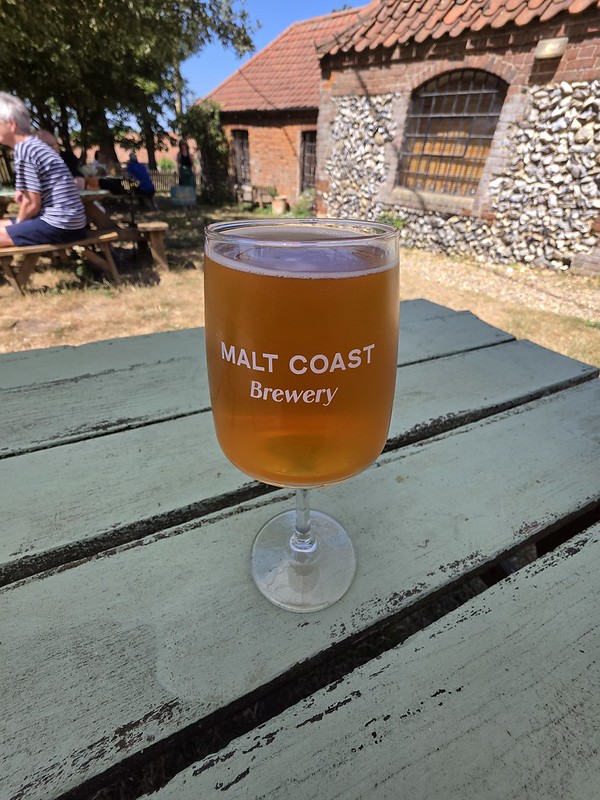
I don’t like differential pricing like this, I’d rather half a pint was half the price of a full pint. If it had been, I would have tried halves of two different beers. Anyway, I don’t want to sound like a CAMRA obsessive with this and so I won’t digress far as otherwise this is exactly the sort of minor pricing issue that can occupy me for considerably longer than would be considered healthy by most normal people. There were four beers from the Malt Coast Brewery and this is effectively their taproom, with the service being friendly and welcoming.
I went for half a pint of the Malt Coast IPA and it was piney and bitter, although I’m not sure that it was entirely well rounded. Incidentally, my drink was considerably over-poured so I was surprised and delighted.
The indoors seating areas and there is an apology for the swallows’ nest which has meant that the table area isn’t the cleanest. But, it was the middle of summer, very few people would have been opting to sit inside. Well, I would, but that’s a different matter. Anyway, the squatters seemed quite happy with their nest and this is their natural habitat, so I can’t begrudge them that.
There are six glamping tents on the site and there’s pizza available during the summer weekends. The pizzas that were being served looked rather delicious, but it was still early on in the day although I was a little tempted.
It was an interesting location and I hadn’t heard of it, but Roy seems to have heard of most drinking places, whether they are obscure or not, in Norfolk so that’s always useful. I was pleased to find a shady spot outside in the beer garden, the team member was friendly and there were lots of beers to drink in or takeaway. They’re also proud of their locally grown barley, so it ticks all the local sourcing boxes which is rather lovely.
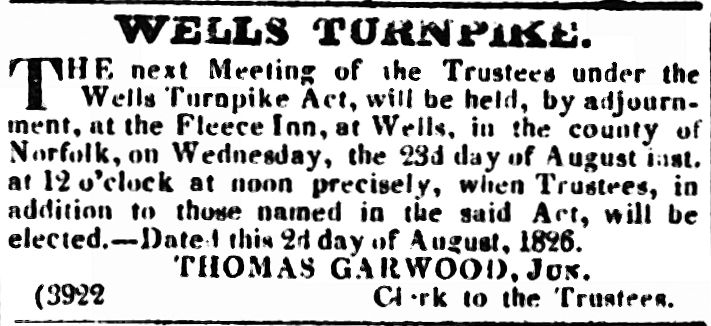
This notice was posted in the Norwich Mercury 200 years ago this week and it relates to the newly established turnpike road between Wells-next-the-Sea and Fakenham. This notice relates to a regular meeting of the trust, but the turnpike was new having been created by an Act of Parliament earlier in 1826, and this belonged to the final generation of turnpike trusts established in England. The period often described as ‘turnpike mania’ had largely taken place between the 1750s and the 1770s, while the last completely new English turnpike trusts would be authorised in the 1830s. In other words, Wells was something of a latecomer to a transport revolution that had already transformed much of the country, which perhaps seems fitting for this quieter corner of Norfolk.
The trust was more complicated than its name suggests. Rather than simply improving a single road between Wells and Fakenham, it administered a small network of connected highways. There were two principal routes from Fakenham to Wells, the western road passing through Egmere and the eastern route through Little Walsingham. A further branch ran from Walsingham through Great Snoring to Langor Bridge, where it joined the existing Norwich to Fakenham Turnpike. Early mapping also shows a branch westwards from Fakenham towards Hillington via Sculthorpe, although this appears never to have become an important part of the trust and later largely disappeared from its records. I’ve resisted vanishing completely down this rabbit hole, although I suspect there’s an entire series of blog posts waiting to be written about the trust.
Like every turnpike trust, its powers came from Parliament. The trustees could levy tolls, improve existing highways, acquire land where necessary and borrow money against future toll income. Unlike parish-maintained roads, which depended upon local labour obligations that varied enormously in quality, turnpikes introduced a more centralised and professional system of highway management. The trustees themselves were unpaid local gentlemen, merchants and landowners, but they appointed paid officers including surveyors, clerks and treasurers to administer the roads.
One particularly fascinating aspect of the Wells trust is that its minute books survive from the very first meeting. These reveal that deciding where to place tollgates proved surprisingly contentious. Bryant’s 1826 map shows the initial gates at Wells, Warham, Kettlestone and on the Sculthorpe road approaching Fakenham, broadly reflecting the trustees’ original decisions. However, almost as soon as toll collection began in the spring of 1827, travellers demonstrated an impressive enthusiasm for avoiding payment and that was considered most sub-optimal. By July the trustees were recording “very frequent evasions” and they were busy ordering additional gates across side roads to block alternative routes around the toll bars. Human ingenuity, it would appear, has always been remarkably effective when faced with paying road charges and judging by the repeated attempts to stop people avoiding the tolls, the trustees probably spent rather more time discussing human inventiveness than road engineering.
The arrival of the railways gradually undermined the economic justification for many turnpike trusts across Britain, and Wells was no exception. As traffic patterns changed during the second half of the nineteenth century, the toll system became increasingly difficult to justify. The Wells to Fakenham Turnpike Trust was finally wound up in 1881, ending fifty-five years of independent management. Responsibility for the roads returned to public authorities, while the tollgates disappeared into history.
Today, the milestones remain the easiest evidence that the trust ever existed and I wouldn’t at all be surprised if I decide that I need a friend to drive me to them to have a look. But they tell only a small part of the story. Behind them lay decades of meetings, arguments over gate locations, complaints about toll evasion, financial management and continual maintenance of roads that were vital to the economy of north west Norfolk. I’m fairly sure that these meetings would have been quite vibrant, but a bit of drama is good for the soul.
As an aside, I won’t say any more about the Fleece Inn in Wells, where the turnpike meeting was held, as it was one of the ten pubs that Roy, Jen and I visited a couple of weeks ago and those posts remain in the increasingly well-populated unwritten post blog queue.