Category: Norfolk

  • Hainford – Hainford War Memorial

    Hainford – Hainford War Memorial

    The village of Hainford’s war memorial is located in front of All Saints Church, commemorating the 25 local men who died during the First World War. A number of local men also died during the Second World War, but their names haven’t been added to this memorial.

    The calvary cross with canopy was unveiled in the early 1920s, although this is the first memorial that I haven’t been able to find the exact date for. One of the sides had the names restored recently as they had become hard to read, although the base of the memorial does perhaps still need a little further attention.

  • Hainford – All Saints Church (the old one) – William Garrod + Amy Garrod

    Hainford – All Saints Church (the old one) – William Garrod + Amy Garrod

    This is the tomb of William Garrod and his wife Amy Garrod, once located under the nave of All Saints Church in Hainford. The church was partly demolished during the period around 1840, meaning that this tomb suddenly found itself out in the graveyard.

    I don’t much about this husband and wife, other than William died on 24 April 1681 and Amy died on 20 February 1681. Slightly amazingly, the burial records from this period have survived and are in the care of Norfolk Record Office, although there’s no information I can see on them which adds to the story. So, although I can find out nothing exciting about the Garrod family from the seventeenth century, it’s an interesting reminder of the church that was once here.

  • Hainford – All Saints Church (the old one) – John Thomas Coleman

    Hainford – All Saints Church (the old one) – John Thomas Coleman

    This grave is located to the side of the old All Saints Church in Hainford, next to the fenced off tower. It commemorates the life of John Thomas Coleman, who served in the 36th Battalion of the Australian Infantry. Normally, I’d spend ages faffing around with censuses and newspaper reports to work out what has happened for this Australian man to be buried here.

    However, a lady called Cathy Sedgwick has already gone into some considerable detail with what she has found, with her information about John located at https://ww1austburialsuk.weebly.com/hainford.html. In short, John had been born and raised in the area, with his parents Charles and Maria running the general shop in Hainford. John went to Australia when he was 18 years old and remained there until he was called up to fight in the First World War. He never fought on the front line, as he sadly contracted pneumonia en route to the UK and he died on 9 January 1917, at the age of 26.

    The National Archives of Australia have John’s service records freely available here.

  • Hainford – All Saints Church (the old one)

    Hainford – All Saints Church (the old one)

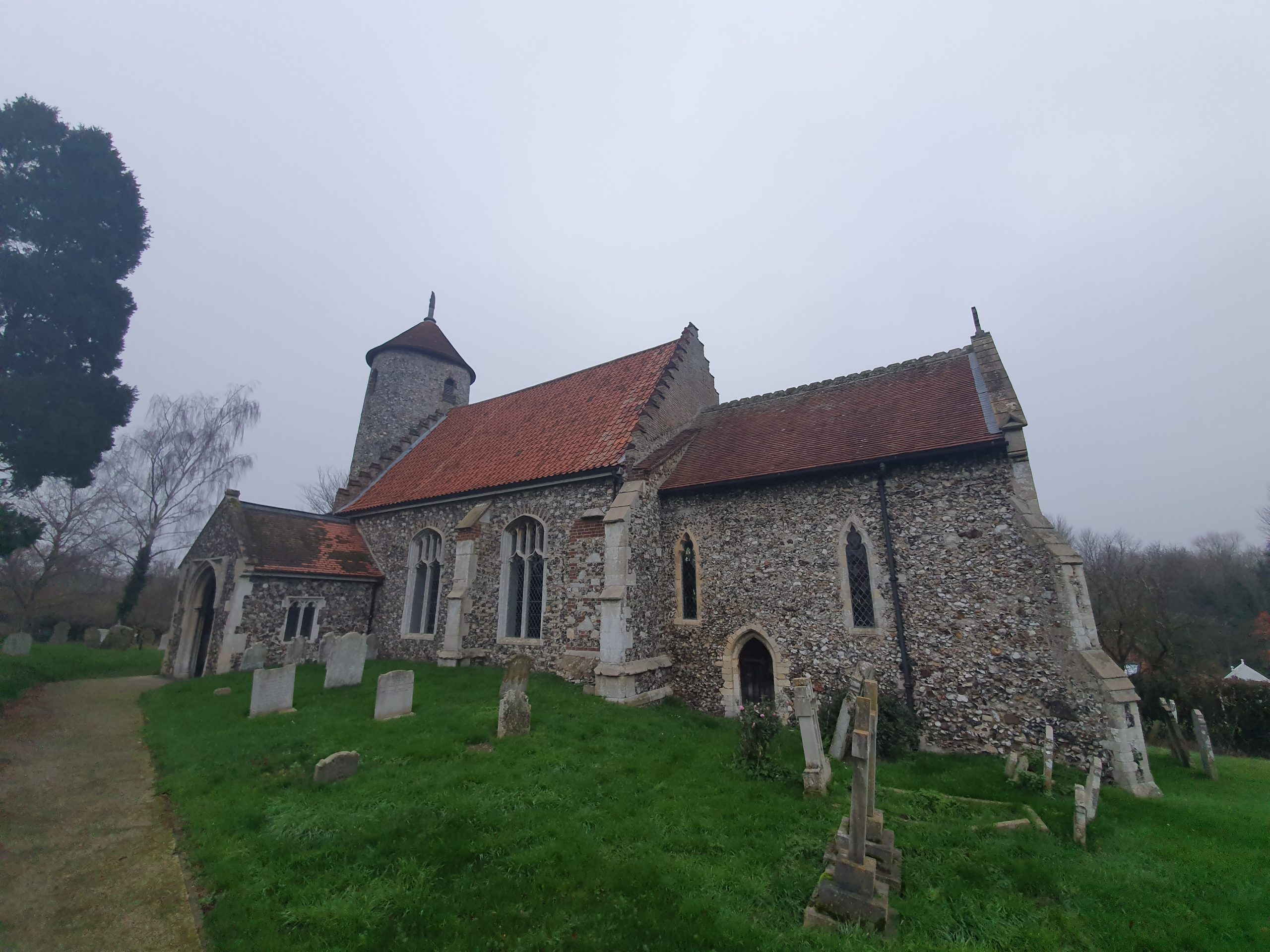
    This is the old All Saints church in Hainford, with a replacement new building having opened in 1840 about half a mile away, nearer to where the new community was located. There was a fear that congregations might flock to alternative Christian churches and indeed, near to the new church the Wesleyan Methodist Chapel was being built. So, this old church was abandoned.

    This ivy and tree foliage means that this glorious church is likely now in its death throes, it’ll last for some time yet, but the damage being done here will eventually be fatal for the structure of the tower.

    The damage being done to the building is evident, with missing stones and foliage which is firmly attached to the church.

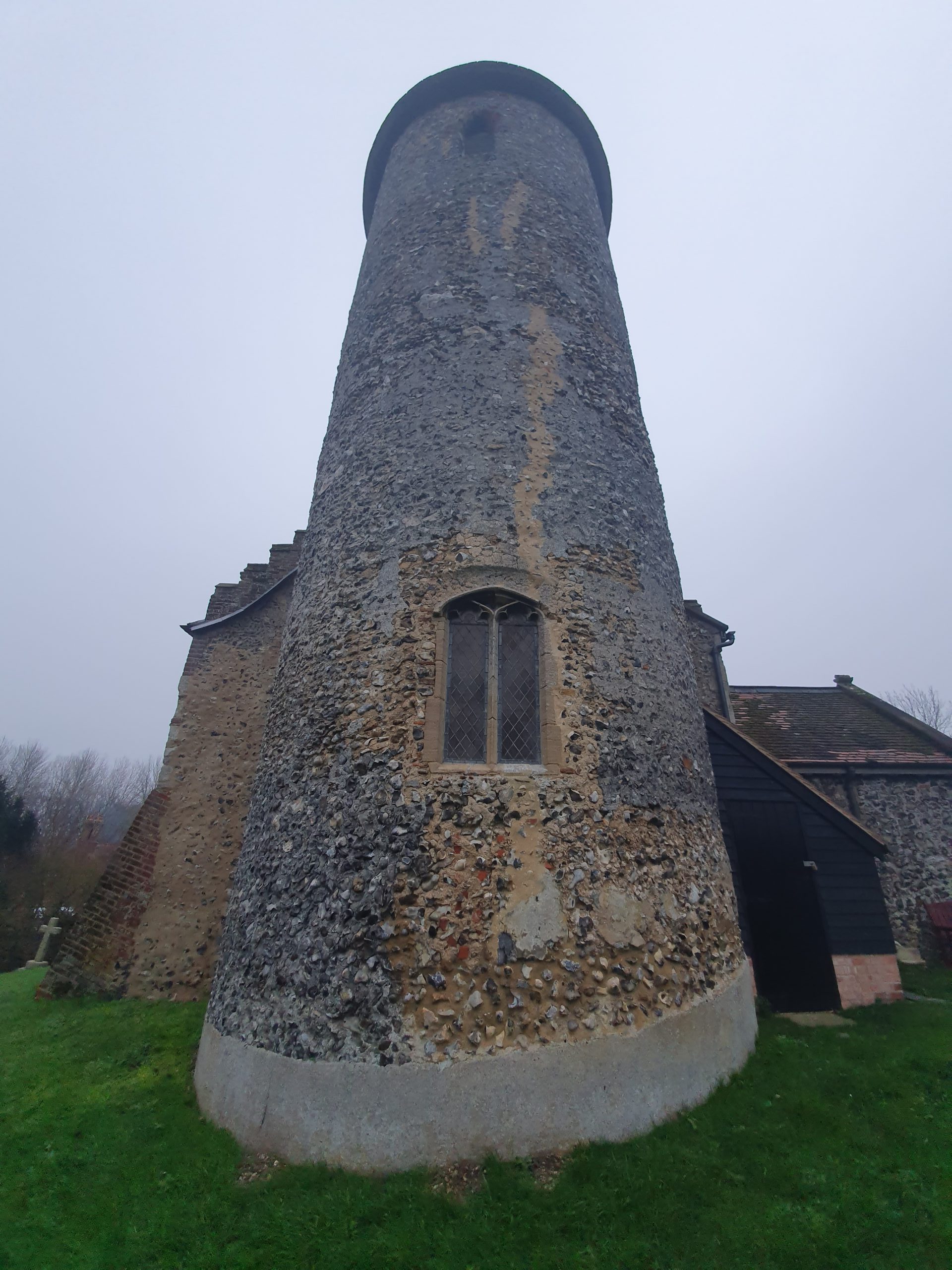
    And the tower, which dates to the late fifteenth century, is also slowly starting to fall down. The old line of the nave roof is still visible and underneath that is where the Victorian mortuary chapel was added after the former section of nave was removed.

    This tombstone is from the seventeenth century and this is an incredibly rare sight in a Norfolk graveyard, as even eighteenth century gravestones are relatively rare. But, this stone was once inside the church and is lined up with where the nave of the church once stood. I’m not sure what William would have thought of this, he was likely a rich benefactor who thought his body would remain inside the church forever, not end up like this.

    All around the tower is foliage, it hides the mortuary chapel which John Brown added here. It’s not clear exactly when the nave and chancel were removed, but I imagine that it was removed around 1840 under the supervision of Brown, if it’s correct that he was in charge of adding the mortuary chapel. It also seems that some nearby buildings use stone from the old church, so this must have been flogged off at the time (or recycled, whichever word you prefer).

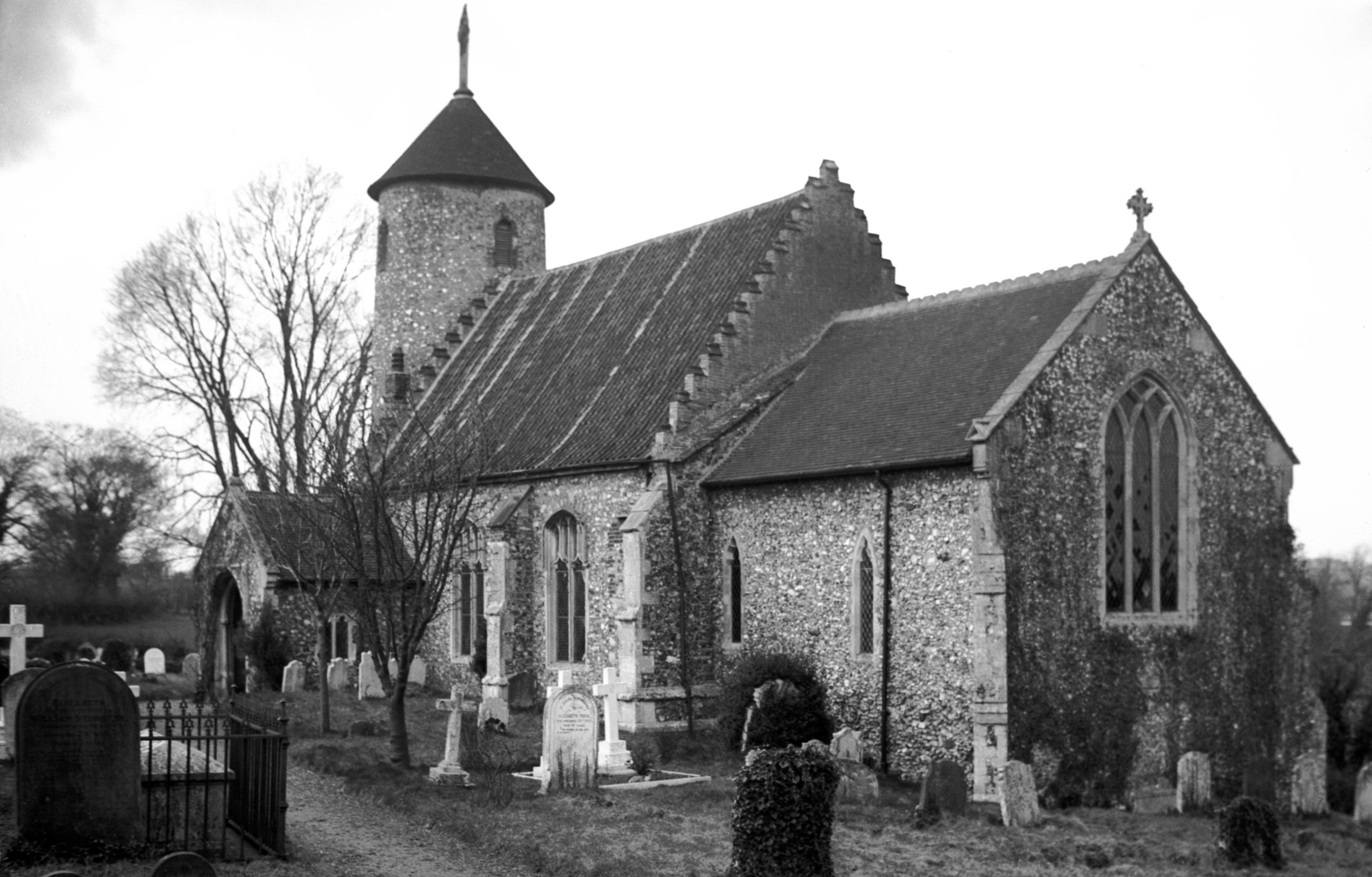
    This church remained in use until the new one was opened in 1840 and the graveyard here is still in situ. There’s a better photo of the mortuary chapel, by the wonderful George Plunkett, which was taken in 1965.

    The comments from the internal report by the Church of England, noting Brown’s mortuary chapel which was added on to where the nave once stood. This internal note also mentions something else interesting, relating to the foundations of St. Mary’s Church in Hainford, which was once in the same location. At a quick glance, I can’t find out anything about this (and the old tithe maps give no clues), but it might solve a mystery about why the churchyard is so large.

    I usually like the idea of restoring churches, although the Church of England seems to have muddled views on this. It’ll spend a fortune fiddling about with using the exact stones on a window repair, but then abandon a building a few years later if it suits them to do so. I’m thinking about Bixley Church here….. The collapse of churches such as Bixley and Sco Ruston is recent though, the damage done at Hainford is getting on for two centuries ago. It would be ludicrously expensive for this church to be repaired, even restored to the basic tower that there is at Panxworth, so this will always be a ruin. But, it’s still beautiful and I very much like it, and although it’s not ideal that nature is overtaking the structure, it does give it even more character.

  • Hainford – All Saints Church (the new one)

    Hainford – All Saints Church (the new one)

    On the church spotting mission that Richard and I are undertaking, this looked confusing to me as it was clearly Victorian and almost felt like a Catholic church. It is though one of the early Victorian churches, designed by John Brown (there’s a plan from 1837 of this church here) built between 1838 and 1840. The old church is around half a mile down the road, but more on that in another post.

    The intention of building this church was to have one nearer to where people actually lived in Hainford, as the older church had become a little detached from the community that it served. And, it was also falling down and that’s not ideal.

    One thing that I’d like to know is what the parishioners thought at the time. I can’t engage with this building, even though it’s 180 years old and is perfectly well-built, it lacks character to me. There are no burials in the churchyard, as they’re still at the old church, so it’s more of a chapel at ease in many ways. A correspondent to the Norfolk Chronicle wrote in 1908 about some churches in the area, adding about this one:

    “There is not much of interest at Hainford, the church only dating from 1840, when it was erected at a cost of £1,200 in place of an older building of which only a part now remains”.

    Most of the money for the building of the new church was funded by the Incorporated Church Building Society, but other contributors included the Norwich Diocesan Church Building Association, the Rev. WAW Keppel (the rector) and the Rev. J L’Oste. Indeed, the rector donated a large sum of money, suggesting he was very much in favour of the plan.

    This is from the files of the Church of England, from the 1960s, giving information about the two churches. I’m not sure that the author was that engaged with the new church either, it’s a very technical description of the church. More on what was written about the old church in another post though.

    One element I find slightly strange is that I can’t find much (indeed, I can’t find anything) in the newspapers of the time that is particularly excited about the new church. There’s no mention of fund-raisers, bazaars and the like, which I’d usually expect, it’s just lists of who donated money to fund it.

    Anyway, the new church is no doubt very much part of the community and much loved, but perhaps it will architecturally much more interesting to future generations…..

  • Norwich – Rosary Cemetery (Isaac Brett & Lucy Brett)

    Norwich – Rosary Cemetery (Isaac Brett & Lucy Brett)

    Since I’ve been grounded again by the Government, I thought I’d meander around the Rosary Cemetery located near to me in Norwich, in an attempt to see what stories lie there. It might not be the most fascinating blog content, but it’ll keep me quiet for a few weeks….

    This isn’t entirely ideal in terms of reading the inscription on the grave, and I’m not going to fiddle about with shrubbery on a gravestone. I can just imagine half the stone will come off in my hand, probably with a gaggle of people happening to walk by when that’s happening. So, the easiest alternative is to hack around on findagrave, a web-site which has many names already listed.

    Although the details aren’t entirely accurate on findagrave (which is understandable – look at the state of that ivy….), it was enough to work out that this is the joint grave of Isaac Brett and Lucy Brett.

    Isaac Brett was born in Caston, a village located near to Attleborough, and he was baptised on 12 July 1798. He was the son of George Brett and Mary Brett, and he remained in the area as in the 1841 census he was living nearby with his wife at Gap Farm at Rockland St. Peter.

    His wife was Lucy Howell and he married at Caston church, the same place where he had been baptised, on 7 January 1828. Lucy had been born in Norwich in 1802 and had seemingly moved to be nearer to where her husband lived.

    At the 1851 census, Isaac and Lucy had moved and were living alone at Upper King Street in Norwich, with the enumerator noting that Isaac was a shoe maker and he employed six men. They were living at the same address at the 1861 census, this time living with their 11-year old grandson, John Page, who was already working as a banker’s clerk.

    Isaac died on 15 January 1863 at the age of 64, leaving effects valued at just under £450 (around £30,000 in today’s money) to his wife. At the 1871 census, Lucy was living with another one of her grandsons, George Page, who was aged 13. By 1881, Lucy had moved in with her grand-daughter, 33-year old Lucy Raven, who was living with her family near Mulbarton, having married Benjamin Raven who was 23 years older than her.

    Lucy was still living with her grand-daughter at the 1891 census, but they had now moved to Stratton St. Mary (as an aside, this, alongside Stratton St. Michael were merged to become Long Stratton) and Lucy died shortly after the census was taken, on 10 April 1891 at the age of 89.

    There’s not an amazing story here that I’ve yet found, just a family which seemed to stick together, but I’m intrigued as to the work that Isaac Brett did. He looks like he was a hard-working shoemaker, especially as he was employing several men, but I’ve yet to find out much more about him. Hopefully, I’ll return to this in the future…..

  • Norwich – Rosary Cemetery (Henry Brett)

    Norwich – Rosary Cemetery (Henry Brett)

    Since I’ve been grounded again by the Government, I thought I’d meander around the Rosary Cemetery located near to me in Norwich, in an attempt to see what stories lie there. It might not be the most fascinating blog content, but it’ll keep me quiet for a few weeks….

    henrybrett

    Unfortunately, there’s not much story to be told here. But, on the grounds that I might find something else in the future, or someone might tell me more in the years to come, this is what I know so far.

    Henry was baptised on 27 October 1797 in Swaffham, the son of William Brett and Elizabeth Brett.

    He was probably married (by probably, I mean I’m not sure it’s the right person, rather than this being some kind of half marriage) to Ann Reynolds in Plumstead by Holt church on 19 October 1819. If this is the correct couple, neither of them could read or write, which wasn’t uncommon, but suggests a background of limited money in the families.

    In the 1841 census, he’s listed as living on Mousehold Heath, along with his wife Ann, their daughter Elizabeth and two 15-year olds who I don’t know the link to, Ann Royall and Edward Fake (I think the transcriber might be wrong on that name, but I can’t read it either to improve on it).

    Henry passed away on 4 May 1844, at the age of 47 years old. The Norfolk Chronicle duly reported this, adding that he was a farmer in Thorpe Hamlet. The gravestone has been attacked by foliage or weeds over the decades, so the bottom half is too hard to read.

    So, annoyingly, that’s it for the moment, but I’m intrigued by who this farmer was on Mousehold Heath and where exactly he lived.

  • Micro-Adventures (Norwich)

    Micro-Adventures (Norwich)

    Unfortunately, the whole lockdown thing has meant that Nathan and I haven’t made much progress with our GeoGuessr project. That’s picking a random place using GeoGuessr and then just going there using public transport, wherever in the UK that place might be. The aim is less the destination, more the journey. We’ve only done two, but the idea of finding a story anywhere has worked out so far.

    Since I can’t go very far at the moment, that reminds me that I should try something vaguely similar by walking (no needless travel during lockdown….) to some places that I’ve been meaning to go for a while. And then seeing if I can possibly find a story from the journey there, which might be pushing it, but we’ll see how we go. If I can’t, the story will entirely be about the destination.

    With the help of the listed building map, I’ve found these scheduled monuments and/or listed buildings. My plan is to walk to these separately over the next few weeks, so:

    (i) Old Lakenham Parish Church (hence why there’s a screenshot of Lakenham as the image….)

    (ii) Earlham Cemetery

    (iii) Remains of St. Bartholomew’s Church

    (iv) Boundary Cross on Drayton Road + Standing Cross at St. Mary’s, Hellesdon

    (v) Intwood Church

    (vi) Cringleford Bridge

    (vii) Tumuli at Eaton Heath

    I had wanted to visit a Saxon cemetery, Second World War listening post and other sites that were scheduled monuments, but they seem inaccessible without straying off footpaths. And I don’t want to be doing that just at the moment…

    I’ll come back to this page and link these walks in when I’ve done them (and they may be incredibly boring, but there we go…..).

  • Scottow – Scottow Cemetery (Alan Towle)

    Scottow – Scottow Cemetery (Alan Towle)

    This grave at Scottow Cemetery commemorates the life of Flying Officer Alan Towle. His address is listed as St. George’s Avenue in Bridlington, but he was married to Barbara Towle, who lived at Fern Cottage, Lower Street in Horning.

    Towle died at the age of 24 on 29 December 1953, when his aircraft crashed at a location between Darlton and Tuxford in Nottinghamshire. He was flying in a De Havilland Venom Jet, a relatively new aircraft that was still being launched across the RAF, replacing the Vampire Jet.

    The Yorkshire Post reported an eye-witness who said:

    “I was half a mile away on the top of a hill when I saw the plane flying low. The pilot appeared to be trying to make a forced landing. The plane, however, suddenly lifted sharply and rocked, and having lost flying speed crashed and burst into flames”.

    The newspaper added:

    “Another eye-witness, Mr. H Murdock, a farmer, of Darlton, said ‘the pilot was thrown clear of the blazing portion of the plane, but still trapped in some wreckage. One of our men, Reg Turner, ran up and pulled the pilot clear, but he was already dead”.

    The Aviation Safety web-site has more information on what went wrong on that night:

    “DH.112 Venom NF.2 WL829 was first flown at De Havilland’s at Chester on 11/08/53. On 29/12/53 the aircraft had been collected from 48 MU at RAF Hawarden, Chester, for delivery to 23 Squadron at RAF Coltishall, Norfolk. While en route on the delivery flight, the pilot reported that he was experiencing difficulty with the engine and could not get more than 5,000 rpm from the engine, with consequent reduced power. The pilot therefore decided to divert to RAF Worksop in Nottinghamshire.

    He then next reported that the engine problems were getting worse, and he would not be able to make RAF Worksop. He then decided to attempt a forced landing into a field 2.5 miles north-east of Tuxford, Nottinghamshire. On final approach, during this attempted emergency landing, the nose of the Venom lifted, the aircraft stalled and crashed, diving into the ground at a low altitude and killing the pilot.”

  • Norwich – Rosary Cemetery (William Ford + Emily Ford)

    Norwich – Rosary Cemetery (William Ford + Emily Ford)

    Since I’ve been grounded again by the Government, I thought I’d meander around the Rosary Cemetery located near to me in Norwich, in an attempt to see what stories lie there. It might not be the most fascinating blog content, but it’ll keep me quiet for a few weeks….

    I nearly gave up with my researches into this family, as I was struggling to find anything of much interest relating to William Ford and his wife Mary Ford. That is, except from the very sad nature of the lives mentioned on the gravestone. Mary Ford, William’s wife, died in 1845 at the age of 58, having already lost their daughter Lucy in infancy, but then their children Hannah and Marianne both died in 1846, at the ages of 18 and 17 respectively.

    I also struggled to work out where this couple lived in 1841, as I found a census record, but Mary was listed as Lucy, so I assumed it was a different family as there were no children and they only lived with their housemaid Emily Stacey. Although, everything else fitted together. William Ford worked as a shoemaker in Norwich and had premises at Colegate Street, St. George’s and he lived at Heigham Cottage.

    Given the lack of obvious story, I thought I’d abandon this one, until I paid attention to the name of Emily Ford at the base of the gravestone. Emily was born in 1823, which didn’t quite make sense to anything in terms of being a child or sister of William. It then transpires that she was William’s second wife, marrying him in 1852 and living with him until he died on 23 October 1858.

    Emily died on 20 December 1881, at the age of 59, and she appeared in the 1861 and 1871 censuses with her occupation being listed as living off property income. But then, something about that strange 1841 census came back, namely I realised that William had married his much younger housemaid. That’s quite impressive, marrying someone who is thirty years younger, but I wonder what Mary Ford would have thought about this arrangement.

    Emily died when living at 32 Queen’s Road in Norwich, where by all accounts she lived a life of such comfort. Her death was reported in the local paper, noting that she was the relict (the archaic word for widow) of William Ford, but giving no more information. And, once again, I do wonder what Mary would have thought that her former housemaid would end up sharing a grave with her.