Category: Norfolk

  • Fakenham – Fakenham Junior School (Heritage Trail 19)

    Fakenham – Fakenham Junior School (Heritage Trail 19)

    Part of the Fakenham Heritage Trail that I’m working my way slowly around, this is number 19. The school was built in 1913 as a school for boys, girls and infants, with a big dividing wall between the boys and girls. This was removed in 1935 and now serves as Fakenham’s junior school.

    This is part of the marvellous railings project that was designed by the children to mark their centenary and there’s a full text of the wording at the heritage trail’s page at https://www.flht.co.uk/19-junior-school.html. As a little side, I’m a little disappointed that the school’s web-site manages to make no reference to their history and a search term of the word ‘history’ produces no results on their pages at all.

    Another event to mark the centenary was the appearance of Michael Palin, whose grandfather Dr Edward Palin was present at the opening of the school on 21 May 1913. Palin’s father was also born in Fakenham, so there something fitting about his presence at the event.

  • Fakenham – Peckover Family (Heritage Trail 9)

    Fakenham – Peckover Family (Heritage Trail 9)

    Working around Fakenham’s heritage trail, this is number 9 and it represents the Peckover family. The property that the plaque is located on is 14, Market Place and was originally known as 14, The Square. Used today by the Nationwide bank, it’s an eighteenth-century building which was owned by the Peckover family.

    The Peckover family were Quakers who became important business people in Fakenham and Wisbech and owned much property in both locations. Peckover’s Bank was created in what is today’s the town’s Boots, which later became merged with Gurney’s Bank and then in turn this became part of Barclays Bank. Some of the family moved to Wisbech to set up banking operations there, with Peckover House being a large country estate which is now managed by the National Trust.

  • Gorleston – St. Andrew’s Church

    Gorleston – St. Andrew’s Church

    There has been a church here since the Saxon period, although the current building primarily dates from between the thirteenth to fifteenth centuries.

    The church is relatively sizeable, with aisles on both sides of the building. The church is built with flint and pebbles, with an extensive Victorianisation taking place in 1872, as well as a long-needed repair to the dilapidated thatched roof, which was replaced with slates. There’s a modern-day extension to the building which is used by the parish, but it’s not particularly sensitive and it perhaps disrupts the feel of the churchyard.

    The church has put protection up on its windows, I assume due to past problems with vandalism. It’s sad to see a priest’s door with an iron grille up outside of it though, but best to be safe than sorry. On the left is the south porch, which was reconstructed in 1872. If I had visited this church 200 years ago it would have looked probably quite beautiful with its thatched roof, extensive churchyard and medieval feel, but much has changed since then.

    The three-stage church tower, which is from the thirteenth century and is quite understated with its relatively small windows.

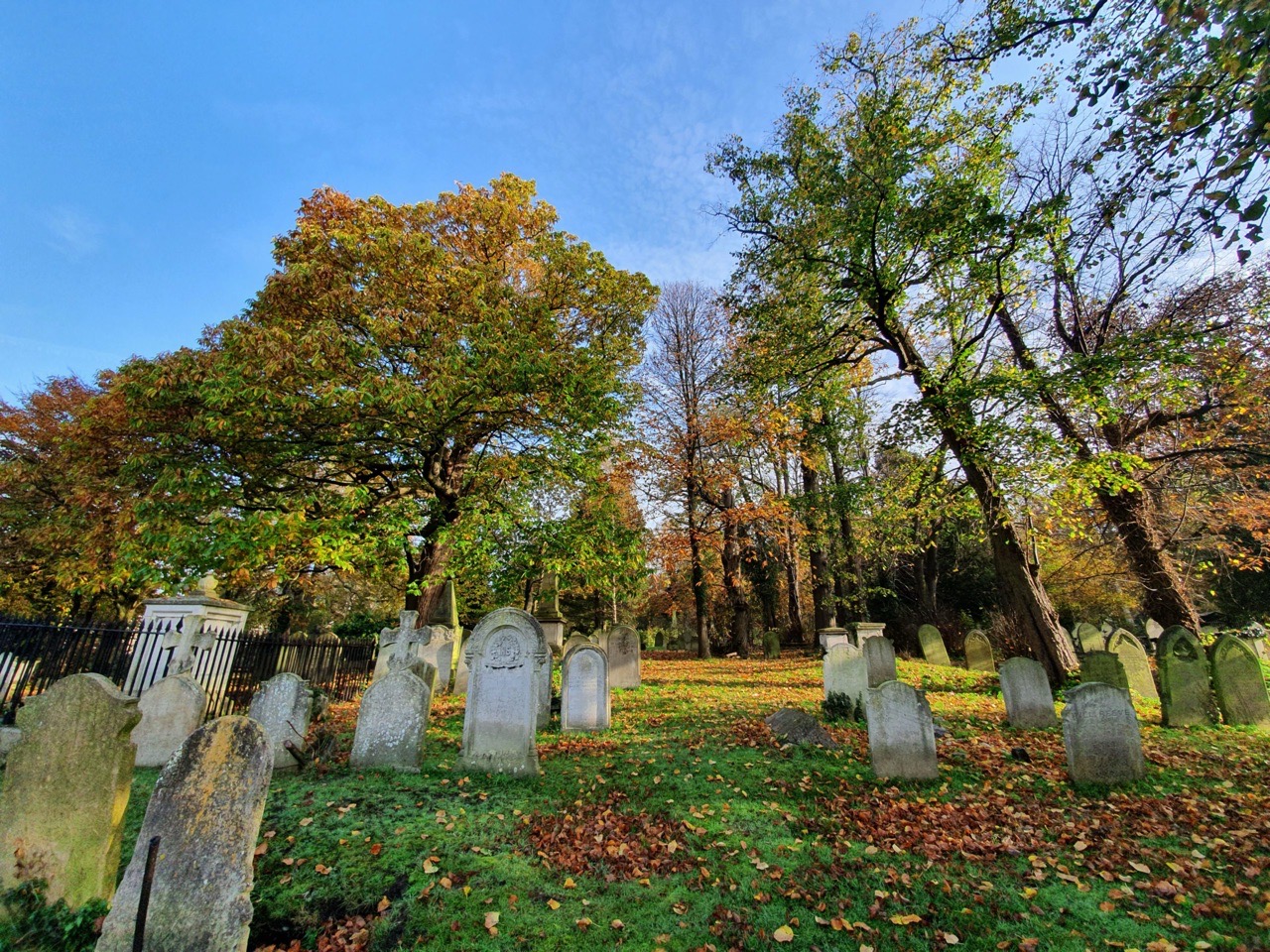
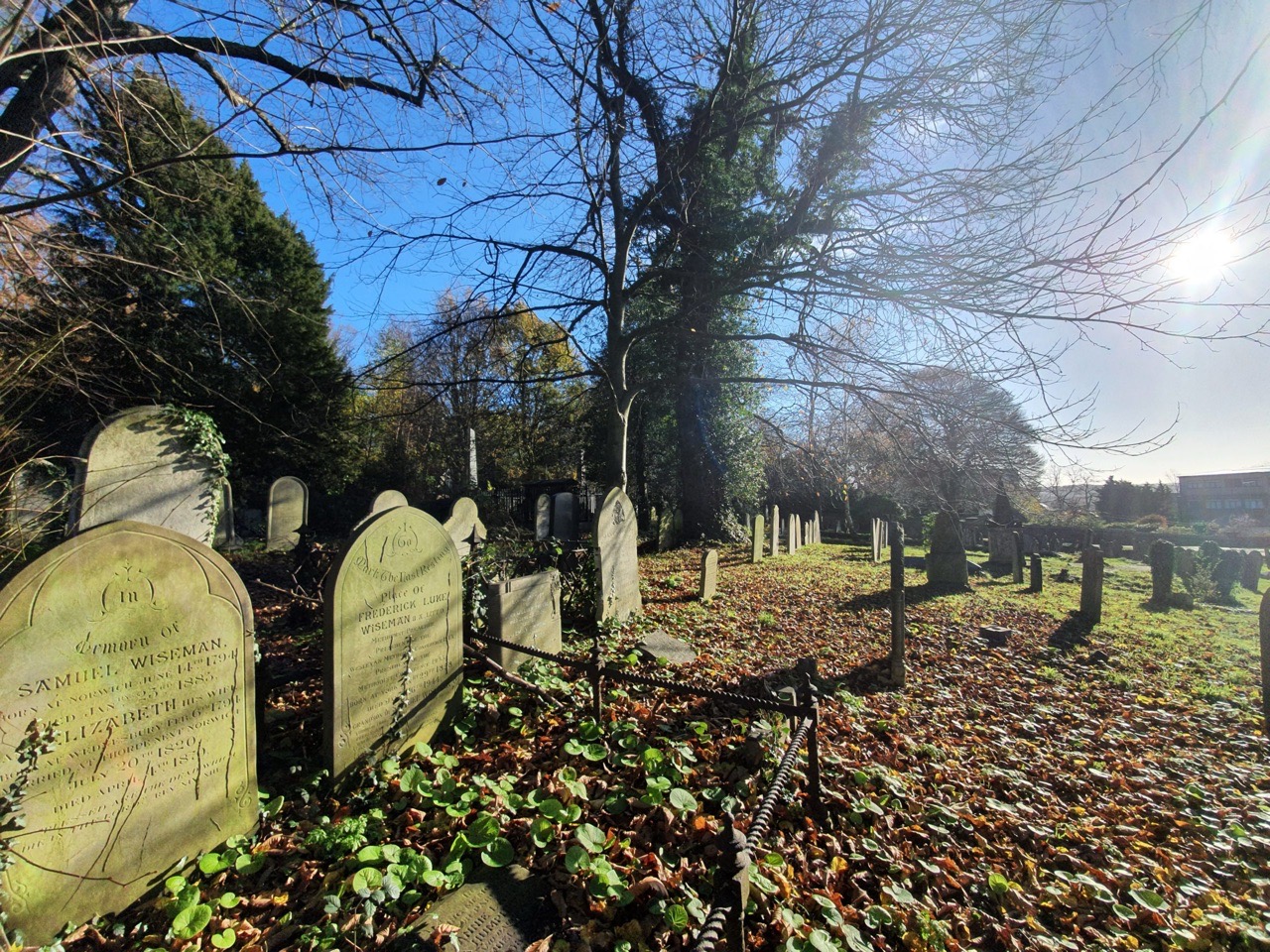
    I have no idea what is going on with the churchyard, but there is some ridiculous spacing going on of the gravestones. Normally, gravestones are vaguely near to each other, but for reasons unknown to me there are sizeable gaps between them all. I can only imagine that someone has been moving them about, or taking some out, unless for centuries they seem to think that the dead are somehow anti-social.

    There was a theft here in 1909, when Edward Lighton of 20 Nile Road in the town wrote to the press to report that his books had been stolen from the box where he placed them under one of the pews. Although his box shouldn’t have been there, he found it convenient to store his prayer and hymn books. Not wishing to become a cold case crime detective, I just get the suspicion that another parishioner didn’t like him doing that. Lighton wrote in his letter that “two wrongs don’t make one right, and although I illegally left them, it cannot justify a thief in stealing them”.

    The church was open to visitors when I meandered around it, but there was a funeral taking place and so it hardly seemed an appropriate moment to pop inside.

  • Cromer – Offences Against Decency

    Cromer – Offences Against Decency


    I liked this very Victorian letter I found on the British Newspaper Archive which was sent from an anonymous contributor in Cromer to the Norfolk Chronicle, who published it on 19 September 1863. The railway didn’t reach the town until 1877 and the contributor was clearly worried about the “profane vulgar” rushing in….

    The letter:

    “Sir, Is there no summary way of dealing with the offences against decency that visitors at the sea side are compelled to witness: or must we do nothing and consent to place among the social evils that are inevitable the practice of nude bathing at mid-day on our public promenade? I am writing this from a small and much frequented watering place, not at present accessible by railroad, and, therefore, comparatively speaking, unknown to the class commonly called the profane vulgar. The objectionable practice is, however, not the less in full force here, and ought to be remedied.

    What adds to the culpability of the local authorities is the fact that there is an almost unlimited extent of sea beach, and therefore no obstacle to a wide separation between the machines set apart for the use of the sexes. The fact is that fifty yards at furthest is the space dividing them, the piles of the breakwater running between, affording convenient seats for the lady visitors who, strange to say, select that portion of the beach as the spot most agreeable to work and to read in. The naked male figure is doubtless an interesting object of contemplation, but although we have seen the paint brush in the hands of some of the fair visitors on these occasions, we cannot suppose that they posted themselves exactly on this spot at this hour in the interests of high art. Let them be told that apart from the inconvenience caused by their proximity to the machines set apart for men, but which gentleman naturally avoid – the sober sense of English husbands and brothers revolts at the spectacle of women of all ages seated within speaking distance of naked men, disporting themselves in the water.

    Things may be, and I believe they are worse, in some parts of England, than they are here. Nearer London a certain reciprocity prevails in this species of libertinism, making the sea-beach, which is meant for all, forbidden ground to modest women. We do not want French manners and customs over here, but surely there is some safe, middle course which might be adopted in the matter of bathing. As things are it is common decency that is outraged. It is morality that is endangered. Even a New Zealander has some sense of propriety in his ablutions. If what we daily witness here were seen on the continent of Europe, the person offending would run the risk of being flogged and imprisoned. The evil with us is of long standing, so are many other abuses – but that is not the point. We must mend our bathing manners. A word from you would suffice to remedy the evil, and cause some regulations to be adopted (for there are none at all now) with regard to the placing of the machines, and the proper time and place for bathing from the beach.

    I remain, Sir, yours obediently

    A visitor.”

    The newspaper replied under the letter, saying that they agreed, adding:

    “We have ourselves witnessed with amazement the preference shown by some ladies for the break-water during bathing hours, and have been reminded often of the old usher’s shrewd remark, when ordered by the judge to clear the court of all women during the hearing of a particularly objectionable cause, and when, in spite of orders, a few still seemed inclined to “sit it out” – “My lord, all the modest women are out of court” – Editor.

  • Happisburgh – St. Mary’s Church

    Happisburgh – St. Mary’s Church

    Located on a windy hill overlooking the North Sea, the current Happisburgh church was constructed in the fourteenth century and then finances allowed in the fifteenth century for a substantial rebuilding. There has though been a church here since the early Norman times and perhaps even the late Saxon period, with a few traces of early Norman architecture in the church tower.

    The roof of the nave is slate, whilst the chancel roof is lead.

    The north side of the church, which Household Words (a journal edited by Charles Dickens) said in the 1860s was “calculated to be engulfed [by the sea] before the close of the nineteenth century”. The church has avoided a watery fate, but the erosion issue was still of great concern in the early part of the twentieth century.

    By chance, and I should try to ensure in future that this is more by design, I took a photo in nearly the same location as the marvellous George Plunkett. It’s evident that since his photo in 1977 that a few gravestones have gone missing from the churchyard, no doubt distributed around the exterior somewhere…..

    The four-stage tower isn’t leaning, that’s just my photographic skills, and it was restored following the Second World War due to bomb damage. The church perhaps made itself a bit of a target to enemy bombers as there was a military aerial placed on top of the church tower, which is one of the highest in the county. Its height has certainly given it some trouble over the centuries, it has also been hit by lightning on numerous occasions with some considerable damage caused in June 1822.

    In 1903, an architect was called as a substantial crack appeared in the tower and his report stated that the situation was “very serious”, which would certainly worry me if I was the vicar. The architect noted that “the walls consist almost entirely of flints and chalk lime mortar, and, the upper stages being comparatively thin for so lofty a structure, subject to the tremendous stress by winds and frost”. The church authorities would be pleased with his comments that a Victorian restoration of the tower likely saved it from destruction, but the architect’s suggestion of the addition of rolled steel joints in the structure that was now necessary must have been a worry financially.

    The sizeable south porch.

    The end chancel wall and this window led to a slight war of words in the local media in 1863. I moderately enjoyed going through the exchange, one reader called it “monstrous” and not holding back on his words, saying it was “a large blank space with a small window in the middle and a child would detect its glaring incongruity”. This caused John Henry Brown some problems, as he was the architect responsible for the west window and he wrote to the Norfolk Chronicle and stated that the Ecclesiastical Commissioners were responsible for the chancel end. He noted that the original reader’s comments had proved “injurious to my reputation” and wanted it clarified there were two different architects, for reasons no doubt seeming sensible to the church at the time. The original author wrote back to apologise for the lack of clarity and he compared the quality of the “beautiful restoration” of the west window and doorway to the “wretchedly mean restoration” of the chancel window, which is certainly a passionate argument to make.

    In the graveyard is a memorial to those men lost on the HMS Invincible in a shipping disaster that took place in March 1801.


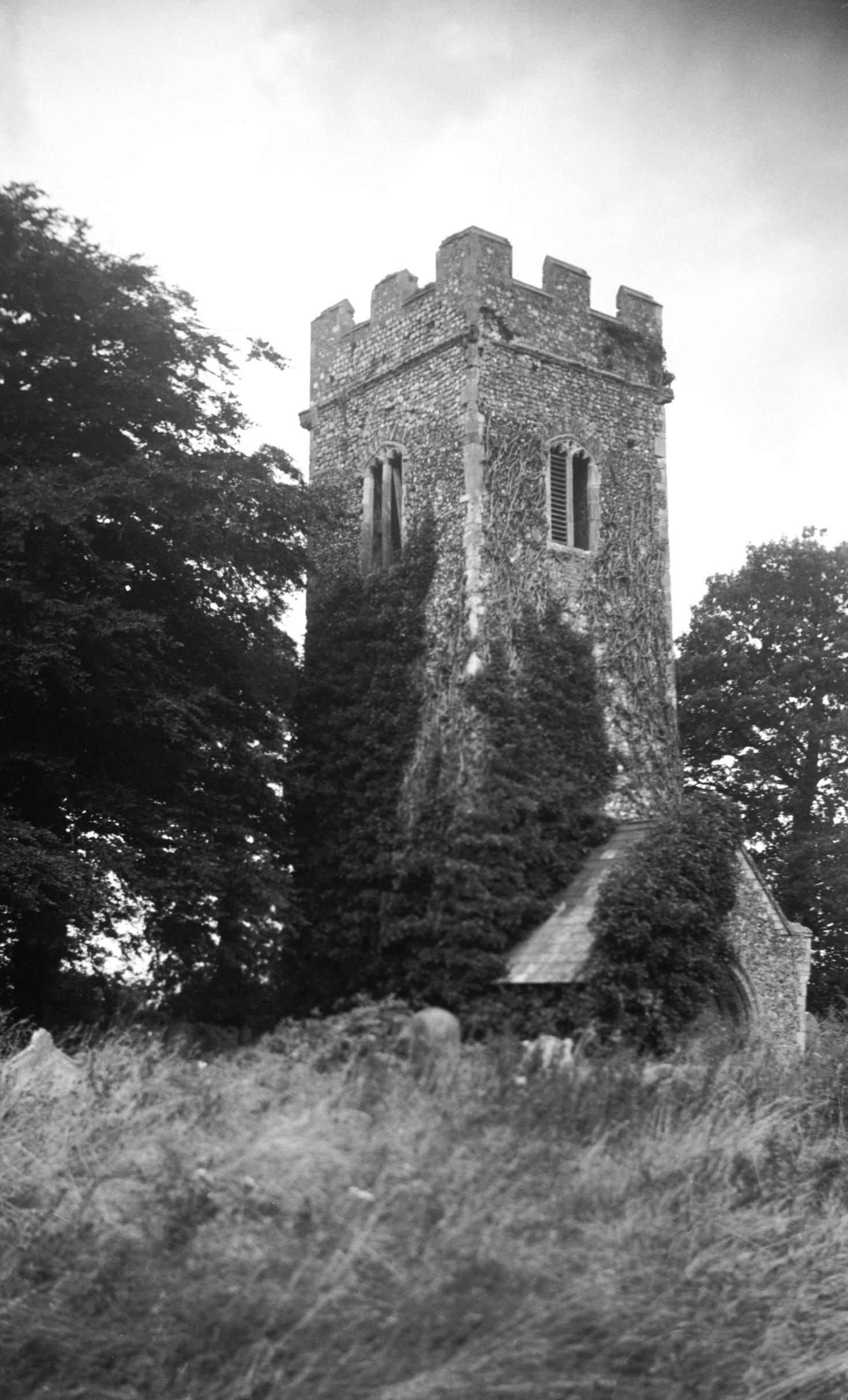
    The church in 1955.

  • Fakenham – Fakenham Mill (Heritage Trail 12)

    Fakenham – Fakenham Mill (Heritage Trail 12)

    Slowly, but surely, I’m getting around the Fakenham heritage trail by visiting a few locations on it every time I come to the town. This is Fakenham Mill and there has been a mill here since at least 1240. A new building was constructed in 1620 and the route of the River Wensum was altered to suit the new structure.

    The current building dates to 1720 and is now converted into residential properties. There’s plenty more about this mill at http://www.norfolkmills.co.uk/Watermills/fakenham.html.

    Marked as the corn mill in this 1900 map, it was nearby to the town’s now closed railway station.

  • Happisburgh – Name Origin

    Happisburgh – Name Origin

    Happisburgh is one of those Norfolk placenames that is difficult for non-locals to guess the pronunciation of, it’s something akin to ‘haze-bruh’. The Concise Oxford Dictionary Of English Placenames says about the origins of the name:

    Happisburgh, Norfolk. Hapesburc in Domesday Book, Apesburga in 1150 and Hapesburg in 1272. Happing is from Haep’s people.

    So, the settlement of Haep’s people, whoever Haep was. The contraction of ‘borough’ or ‘burgh’ into ‘bruh’ isn’t rare, it’s happened with Middlesborough, Farnborough and Hillsborough. I imagine it evolved quite quickly into ‘hap-is-bruh’ and then then ‘p’ was taken out over time to make it easier to say. Well, that’s my best explanation, so I’m going with that.

  • Happisburgh – St. Mary’s Church (Unknown Sailor)

    Happisburgh – St. Mary’s Church (Unknown Sailor)

    A body was found off Happisburgh on 23 August 1947, thought to be a sailor who had died during the Second World War. He was given a war grave and he now rests in peace “known unto God”.

  • Happisburgh – St. Mary’s Church (Derek James Harrison)

    Happisburgh – St. Mary’s Church (Derek James Harrison)

    I have very little to add about this grave, but I haven’t seen one with the RNLI insignia on it before. It’s the grave of Derek James Harrison, who was born on 31 May 1965 and died on 13 August 1984. I can’t find out much more, other than Derek was buried on 20 August 1984 and he was listed as living at Hill House Hotel in Happisburgh.

  • Happisburgh – St. Mary’s Church (HMS Invincible Memorial)

    Happisburgh – St. Mary’s Church (HMS Invincible Memorial)

    This memorial is in a prominent position in the churchyard of St. Mary’s church in the coastal town of Happisburgh.

    HMS Invincible was launched on 9 March 1765 and was used in the American War of Independence. She was sailing from Great Yarmouth on 16 March 1801 when she hit the sandbank off Happisburgh known as the Hammond Knoll Rock. Although the admiral and 195 sailors were saved, around 400 men lost their lives. The harbour pilot, who died when the ship sank, was later blamed for the incident, which was one of the worst maritime events of the eighteenth century.

    This memorial stone was added here in 1998 as by chance when digging a drainage channel in the churchyard, the bodies of many of the ship’s crew were discovered. It was known that there had been a large communal grave, with carts bringing the bodies to a section of land located just off the main churchyard, but the exact spot of the burials wasn’t previously known. They were buried just three feet under the surface, with no real order to the remains.

    This letter was written by one of the sailors on board:

    “Only two days have elapsed since I last wrote to you, and in that short space the most melancholy accident has happened, namely, the total loss of our ship. We set sail from Yarmouth on Monday morning for the Sound, to join the fleet under the command of Admiral Sir Hyde Parker; and about two o’clock in the afternoon the ship struck on a sand-bank, where she beat most violently for upwards of two hours, when her masts were cut away, and her anchor was then cast, and we all thought our selves safe; for, notwithstanding she leaked considerably, the water gained but little upon us. Our signals of distress were heard and answered by a cutter, which immediately bore down to Yarmouth, to give intelligence of our distress; and we therefore hoped, with the assistance that should arrive, to be able to save the ship as well as ourselves; but God ordained it otherwise.

    The rudder being unfortunately gone, the ship became unmanageable, and in the evening she again drove on the bank, when we all gave ourselves up for lost. Through God’s providence, however, a fishing smack, at this awful juncture, hove in sight, and the admiral; my self, and two or three more, succeeded in getting on board of her; but the rest, in endeavouring to do the same, lost all the boats they were able to get over-board. In this melancholy condition she remained till the following morning, when, shocking to relate, she entirely sunk; we being all the time spectators of the distressful scene, without any possible means of affording the sufferers the least assistance, as any attempt to that effect would only have involved ourselves in the general calamity. By God’s providence, however, the ship’s launch, full of men, at length got clear of the wreck, and by her assistance we were enabled to save some others. In the whole, about 195 are saved.

    The greater part of the officers, including the captain, have unfortunately perished.”

    The Invincible was heading towards a fleet led by Norfolk’s hero Horatio Nelson when it sank, and the great admiral himself visited Great Yarmouth to see some of the injured crew who had survived. Today, there’s a play park near the church named HMS Invincible Park, a reminder of the sad event which cost so many men their lives.