Category: Norfolk

  • Norwich – Berstrete Gates (Two Julians)

    Norwich – Berstrete Gates (Two Julians)

    20250212_153257

    Next in the Two Julians Norwich series is the Berstrete Gates which, as a disclosure, has been one of my favourite pubs for some time. I accept it’s not a craft beer haven, but many years ago a group of us used to go to the Berstrete Gates every Friday and the lovely owner, Hang Pham, merrily cooked for us every week.

    Located on Ber Street, the history of this pub is complex and long, starting with when it was known as the King’s Arms in the early eighteenth century. A few weeks ago, I found an old theatre group mention in a newspaper from nearly 300 years ago and I think they were performing here. Above is the auction details of the pub when it was put up for sale in June 1879 and it had also been auctioned in January 1867 when it was known as “the old King’s Arms”. There have been twelve pubs in Norwich city centre with the name King’s Arms (including another one on Ber Street), so some form of differentiation was necessary. The current building is from the mid to late nineteenth century (I think from around 1870s from maps) and it isn’t listed, with many of the interior features hidden behind some paint, although it retains some charm. Although Nikolaus Pevsner said that the building was “uninteresting”, so don’t come here expecting beautiful pub architecture.

    The pub took its current name of Berstrete Gates in June 1937 as it’s very near to the site of where the Ber Strete Gates entrance to the city was located. The gate had been pulled down in 1808, although it dated from the early twelfth century, as part of the destruction of the walls and gates in the city. There’s more about the history of the gate at https://www.norwich.gov.uk/site/custom_scripts/citywalls/29/29.html.

    20250212_153321

    The beer board which is visible when entering the pub and it tells its own story. This is a cheap and cheerful venue, the beer comes in cans and bottles, the product range is limited and the service is exquisite. In more recent history, this was taken over just before Covid by Gary Harvey and I think the timing of his taking over was all a bit unfortunate with a global pandemic ongoing. My friend James and I did go there in that period and the welcome was friendly, personable and immediate. I remember we were offered sausage casserole they had left over from a wake and we promptly then went about four times in that week as they were closing relatively soon after. The furniture layout was unusual to say the least, everything was based around a large central table that looked a little bit more meeting-like than pub-like. I think that the plan was to create a pub where people would talk to others when they entered, but on our final visit there a number of rather young looking girls were scrawling on the walls and so it felt best to retreat back to an adult’s pub. Since January 2024, Hang Pham has taken over behind the bar once again.

    20250212_153725

    The Guinness cost £2.50, a perfectly reasonable price. To add some variety to our visit, Julian went for a can of Holsten Pils, also priced at £2.50. Does beer drinking get much more decadent?

    20250212_154912

    The bar. In not trying to be on-trend, I think it’s strangely become more authentic. It’s quite a stark design and the back room doesn’t seem much used, but it is what it is.

    20250212_161233

    The signage outside and it’s fair to say that it could do with a little of bit of exterior repair work.

    20250212_161244

    The mural was created by John Moray-Smith (1889–1958) in 1938 when the pub was owned by Morgans Brewery. They had purchased it in the 1920s from George May brewery and through acquisition it became part of Bullards, Watney Mann, Brent Walker, Pubmaster and then finally free trade in 2002. George Plunkett, a photographer who has recorded so much of Norwich’s history which might otherwise have been lost, took a photo of it soon after the mural was installed.

    This is not a destination pub, it feels much more like an estate pub that just happens to be relatively near to the city centre. It’s got some considerable charm to it and although there’s a chance that it’ll end up as an on-trend craft beer bar in a few years if it doesn’t work out in its current iteration, I rather like what it currently is and the little bit of a local institution that it has become.

  • Food from Every Stall on Norwich Market (2025 Edition) – Week 1 and Indian Feast

    Food from Every Stall on Norwich Market (2025 Edition) – Week 1 and Indian Feast

    20250212_130716

    Thanks to James agreeing to help with this project, here we go again with the 2025 edition of eating food from every stall at Norwich Market and first up was the vegan Indian stall, Indian Feast. And here’s what happened when we visited in 2023.

    20250212_125428

    The menu board. My plan is to always have something different compared to last time, although it required some quick checking at the market stall to remember what we had last time. I quite fancied the samosa chat, but that’s what I went for last time (this is going to happen a lot this year I suspect), so this time it was the Aloo Tikki Chat. There’s no real change to the menu other than the addition of the vegan chicken curry, with the price increases being £1 on all the meals and 50p on all the snacks. One element that will be evident this year is how much food price inflation has gone on at the market and whether or not that is likely to put customers off going to stalls.

    20250212_125608

    One of the food displays which doesn’t necessarily look overly appetising in terms of the presentation, but there we go. What is more important is that the service was timely and friendly, the payment process was efficient and the stall accepts cash and card.

    20250212_125743

    The Aloo Tikki Chat and I went with all the options that came with it including the coriander, the mint chutney and the tamarind sauce. The mixed vegetable cake added texture to the dish and there was plenty of chickpeas in the whole arrangement which bulked matters out. There was some spice to it and the pieces of onion also added texture with the food having a depth of flavour to it.

    20250212_125810

    There’s a seating area which overlooks the kitchen. Only a limited number of the stalls at the market have a seating area and it’s always helpful so that I don’t have to worry about a seagull swooping down and stealing my vegetable cake.

    20250212_130359

    The Covid sign is still visible saying that the track and trace is in operation. That felt something of a throwback.

    IMG-20250212-WA0001

    Eagle eyed readers might guess that this is the photo that James took given he’s got an eye for this sort of thing and I accept this does look better than mine. James went for the Aloo Gobi, which he enjoyed but thought was a bit wet. I think that was the summary of the matter.

    It’s a light and tasty meal, the stall was clean and the service was friendly, with the prices seeming reasonable for the quality and quantity.

  • Norwich Market Food – Let’s Do It Again in 2025

    Norwich Market Food – Let’s Do It Again in 2025

    ****** 2025 NOW FINISHED – Here are the results *****

    Thanks to all the stall holders for so much marvellous food and drink throughout 2025. We got it down to six stalls (with great difficulty) and they’re listed in the above link.


    One of my more popular series of blog posts, often attracting extra visitors beyond my two loyal readers, was when I visited every food stall at Norwich market across 2023. Given that, my friend James and I have decided that we’ll do it all again. The excitement of it all! Last time the top three we decided were:

    3rd : Cocina Mia

    2nd : Lucy’s Fish and Chips

    1st : Bodega (in photo above)

    The rules are the same, the visit will be randomly drawn and we’ll work through all of the market stalls. I will attempt to have something different food wise to what I had before, to make a vague attempt at variety. It’s positively scientific this…. There have been some changes since 2023 with some stalls closing and some opening, but that all adds to the excitement. There are still, I think, 29 locations to visit, but we’ll also add a Toby’s visit at some stage as they’re the beer stall supplying craft beer options. They might get multiple visits and we’ll likely pop to Brick as well. It will be a challenge to get around 29 locations in 2025 (NB – it transpired to be 32), but where there’s a will then there’s a way.

    2025 VISITS

    A Taste of Punjab (Week 19)
    And Eat It (Week 31)
    B’s T’s (Week 28)
    Bodega (Week 25)
    Bread Source (Week 15)
    Buka Street (Permanently closed)
    Bun Box (Week 13)
    China Wok (Week 7)
    Cocina Mia (Permanently closed)
    Chocolate Bar Baker (Week 29)
    Churros for the People (Week 17)
    City Taco (Week 18)
    Coral Bay (Week 6)
    Crunch (Week 20)
    Deb’s (Week 10)
    Falafel and Friends (Week 5)
    Go Crepes (Week 11)
    Henry’s Hog Roast (Week 8)
    Indian Feast (Week 1)
    Italian Street Food (Week 16)
    Jacket Spuds & More (Week 9)
    Little Red Roaster (Week 30)
    Lucy’s Chips (Week 2)
    Lucy’s Fish and Chips (Week 12)
    Norwich Fresh (Week 4)
    Papa Mombassa (Week 22)
    Rabbits Salad Bar (Week 32)
    Reggies (Week 24)
    Ron’s Chips (Week 3)
    Ruby’s (Week 26)
    Taste of Shanghai (Week 21)
    Tasty House South East Asian Street Food Emporium (Week 27)
    Thai Bubble (Week 14)
    The All Electric Banger Stop (Week 23)
    Walsingham Farm Shop (Permanently closed)


    2023 VISITS

    A Taste of Punjab (Week 4)
    And Eat It (Week 18)
    Bodega (Week 15)
    Bread Source (Week 27)
    Bun Box (Week 16)
    Chimneys (Week 3) [now closed]
    China Wok (Week 1)
    Churros for the People (Week 7)
    Cocina Mia (Week 12)
    Coral Bay (Week 20)
    Deb’s (Week 17)
    Delight (Week 9)
    Falafel and Friends (Week 25)
    Feast (Permanently closed)
    Go Crepes (Week 29)
    Henry’s Hog Roast (Week 5)
    Indian Feast (Week 13)
    Italian Street Food (Week 24)
    Jacket Spuds & More (Week 14)
    Lucy’s Chips (Week 22)
    Lucy’s Fish and Chips (Week 26)
    Meat and Co (Permanently closed)
    Norwich Fresh (Week 10)
    Reggie’s (Week 19)
    Ron’s Fish and Chips (Week 2)
    Ruby’s (Week 6)
    Taste of Shanghai (Week 8)
    Tasty House South East Asian Street Food Emporium (Week 21)
    Thai Bubble (Week 23)
    The All Electric Banger Stop (Week 11)
    Walsingham Farm Shop (Week 28)

  • Briningham – St Maurice’s Church : Grave of John Frankpitt Woolway

    Briningham – St Maurice’s Church : Grave of John Frankpitt Woolway

    20250202_154015

    This is the Commonwealth War Grave of John Frankpitt Woolway, located in the graveyard of St. Maurice’s Church in Briningham.

    John was born in around 1889 and he got married to Clara Beatrice Laycock in Colchester on 8 June 1911 and at that point he lived at 68 Paris Street in Exeter. At the 1911 census, image above, he lived at 3 Water Tower Cottages, Kirby, Frinton On Sea, Essex where he was a boarder and working as a bookstall manager.

    John signed up on 9 December 1915 and at that time he still worked as a bookseller. He served in the 7th Battalion of the Royal West Kent Regiment, soldier number 241352 and his military record is one that survives. He was stationed in the UK between 29 April 1916 and 11 September 1917 before being sent overseas with the British Expeditionary Forces (BEF) from 12 September 1917 until 11 October 1918. He had a period back in the UK on leave between 12 October 1918 and 24 October 1918, before being sent back out to the BEF on 25 October 1918 and then back to the UK once more on Armistice Day, 11 November 1918. For those who like this sort of thing, the battalion’s military diaries are on-line, it’s sobering to see the officers writing down the battles and troop movements they were having, it makes it feel rather real.

    John died on 26 November 1918, likely as a result of his war injuries as he’s been given a war grave. His next of kin was his widow who lived at 9 Clifton Terrace on Manchester Street in Southampton and they didn’t have any children. John’s parents were James William Woolway and Alice Woolway who at the 1891 census were both running the Post Office in Briningham. On the night of the census, John was at his grand-parent’s house down the road in Burgh Parva. This then explains why he’s buried here, he’s buried with his parents. His widow married Harold Snook in early 1920 and she was living with him in Woolwich at the 1939 register and she died in 1957.

    This really is a life lost to the war. It seems likely that he might have had children if he had survived, or at least stayed with his wife for some decades to build a career and life together. Instead, she had to find someone else to live her life with, but at least John came home and is laid to rest with his parents.

  • Briningham – St Maurice’s Church (1903 Newspaper Article)

    Briningham – St Maurice’s Church (1903 Newspaper Article)

    This article was published in the local newspaper in 1903 and I rather liked the little snapshot into the history of the village, although it gives details of the work which had been done to St. Maurice’s Church.

    “BRININGHAM.

    The ancient church of St. Maurice has during the past decade been undergoing a gradual process of restoration in perfect conformity with its time-worn architecture. A few years ago, chiefly through the munificence of the lay Rector, the late Captain S. H. Brereton, R.A., the walls were strengthened, the nave and chancel re-roofed, and the windows re-glazed with stained glass. During the incumbency of the present Vicar, the Rev. Herbert J. Foyster, strenuous efforts have been made to beautify and make commodious the interior. The church has been heated and lighted by the fixing of a large tortoise stove and handsome cathedral lamps. Some eighteen months ago it was discovered that the tower was unsafe; so critical indeed was the condition found to be that it was deemed advisable that the bell should remain silent. The Vicar set to work, and, by means of subscriptions and donations from friends far and near, raised the sum of £71 3s., and the work has been completed. The entire cost, with incidentals, will be about £140, so that there is an approximate deficiency of about £70. For the reduction of this debt, the Vicar and his co-workers determined upon holding a bazaar. Mrs. Henry S. Brereton placed the grounds of Briningham House at the Vicar’s disposal. The following is a list of stalls with vendors:—

    Fancy Stall—Mrs. H. Brereton-Foyster, Miss Foyster, and the Misses Constance and Edith Foyster, the Misses Maroon and Martin.

    Tea Stall (indoor)—Mrs. Henry Brereton and Mrs. Parkinson.

    Tea Stall (outdoors)—Mrs. Alfred Clarke, Miss Kate Colman, Mrs. Groom, the Misses A. E. and M. Groom, Mrs. Jarrett, Miss A. Jones, E. Oliver, Mrs. and Miss Smorthwaite.

    Jumble Stall—Mesdames Clements, Dewing, Everett, Kaye, E. Matthews, F. Matthews, H. Sheringham, and Watling.

    Provision Stall—Mrs. B. Burwick, Brereton.

    Bran Pie—W. Henry Beane, jun.

    The Briston and Melton Constable Band played popular airs. In addition to the bazaar, there was a horticultural show, with exhibits from the labourers and workmen on the Briningham estate. The following is a list of the successful competitors, the judge being Mr. Samuel Dewing, of Swanton Novers:—

    Collection of vegetables—1 William Daplyn, 2 Benjamin Colman, 3 Jacob Colman. Potatoes—1 William Daplyn, 2 Jacob Colman, 3 Thomas Dack. Cabbages—1 William Daplyn, 2 Jacob Colman, 3 Thomas Dack. Onions—1 William Daplyn, 2 John Watling, 3 Benjamin Colman. Bread—1 Mrs. George Quinan, 2 Mrs. Jacob Colman, 3 Mrs. Clements. Cottage gardens—1 William Daplyn, 2 Benjamin Colman, 3 Jacob Colman and Thomas Dack (equal). Neatest cottage—1 Mrs. William Daplyn and Mrs. David Watling (equal), 2 Mrs. Benjamin Colman, and highly commended, Mrs. Jacob Colman.

    Notwithstanding the very unfavourable weather the proceeds amounted to nearly £50.”

  • Briningham – St Maurice’s Church

    Briningham – St Maurice’s Church

    20250202_152057

    St Maurice’s Church at Briningham is one of the rare situations where the church tower is off-set to the nave for reasons not relating to space. The reason that the church history gives is simply that it’s likely just how the architect and mason constructed it as that was their preferred style. There’s certainly no shortage of space here that would have required them to be creative with where the tower went, but no-one is entirely sure of the reason. The village dates back to the Anglo-Saxon era and its name means “the homestead of the people of Brina”, although it confuses Google as it thinks that I’ve mistyped Birmingham.

    20250202_152018

    The church is reached by walking across the garden of the neighbouring rectory, which is likely handy for the security of keeping the church safe if nothing else. There’s been a church here since at least the Norman period, with the north wall likely being a survivor from that time.

    20250202_152116

    The porch and I always wonder about all the people who have walked through this door over the last few centuries.

    20250202_152142

    The nave.

    20250202_152147

    I was pleased I didn’t have to climb this ladder arrangement. It would be the getting down that would particularly confaddle me, there’s not much to hold onto.

    20250202_152220

    The font is perhaps plain and more focused on its function, but it dates to the fourteenth century so it’s seen a fair number of births over the centuries.

    20250202_152657

    The end window in the nave is oddly oversized.

    20250202_153055

    It’s evident that this seems out of place, perhaps it was the window for the end of the chancel that never got to be put in. It seems unlikely that this would be for lack of funds, more likely a lack of labour and so perhaps that dates this to around the Black Death period.

    20250202_152712

    Looking back to the main door, it’s an airy and minimalist church, not much has changed here in the centuries and I rather liked that. Although there’s a long article from 1903 which details all the work that was done modernising the building, which I’ll post separately.

    20250202_152733

    The altar, all neat and tidy.

    20250202_152746

    20250202_152757

    The wooden figures are modern replacements for the ones that would have stood in these niches until they were destroyed in the Reformation.

    20250202_153320

    The chancel and there’s no evidence of any rood stairs, but I imagine they would have had a nice rood screen going across here at one stage. More recently, they had a plasterboard screen across here until it was removed in the late twentieth century.

    20250202_153510

    And some sweets, which I think Richard really wanted to eat, but I was able to stop him.

    20250202_153714

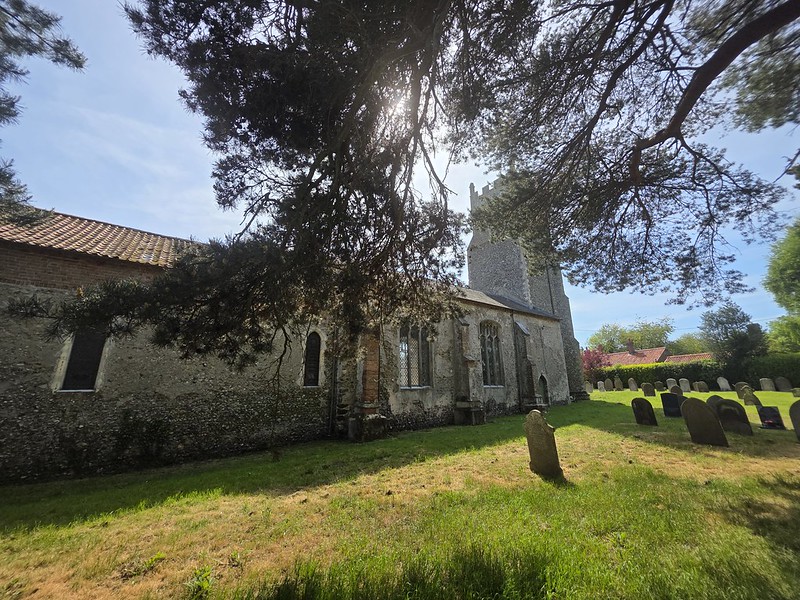
    The exterior of the church. There’s an image taken by George Plunkett from around this spot in 1986 and I’m pleased that they’re removed that foliage from the building since he took that photo.

    20250202_153801

    The outside of the chancel.

    20250202_154031

    The church from the other side, it all feels well proportioned if ignoring that shed type construction shoved on the side (or the vestry as they would probably call it). This feels like a slightly forgotten about church on-line, there aren’t the same number of photos and documents that are usually available, I can’t even find a photo of inside from before 2000 of just to look at the plasterboard arrangement.

  • Melton Constable – St. Mary’s (Burgh Parva) Old Church : Grave of Arthur Charles Gibson

    Melton Constable – St. Mary’s (Burgh Parva) Old Church : Grave of Arthur Charles Gibson

    20250202_135716

    This is the war grave of Arthur Charles Gibson who is buried at St. Mary’s church in Burgh Parva, located near to Melton Constable. I’ve never seen a war grave with the words “buried elsewhere in this churchyard” on it, but in this case it’s because Arthur wasn’t listed on the Commonwealth War Graves Commission list, but in 2015 he was added to the United Kingdom Book of Remembrance.

    Arthur’s record at the 1911 census when he lived on Gordon Road in Melton Constable. He lived with Walter Stangroom’s family, with Walter being his brother-in-law, and he worked as a telegraph operator. They also lived with Arthur’s mother, Ellen Gibson, who had been widowed. His military records note that he signed up voluntarily on 3 January 1912, but he was discharged on 19 July 1916 due to ill health. I’m not sure if he was injured abroad, or whether he was injured whilst working at the Melton Constable railway works, which was an important industry for the war effort. It seems unlikely to me that he was serving abroad, as otherwise he would have been more likely to have been listed on the Commonwealth War Graves Commission list. His military number was 1586 and he was a Private in the Norfolk Regiment, dying in London on 23 February 1917 at the age of 21, with his death certificate noting he died of empyema. He doesn’t seem to have a headstone of his own from the time, with his stone being added here in 2015.

  • Melton Constable – St. Mary’s (Burgh Parva) Old Church : Grave of HWT Stimpson

    Melton Constable – St. Mary’s (Burgh Parva) Old Church : Grave of HWT Stimpson

    20250202_135756

    Located at St. Mary’s church is the gravestone of Henry William Thomas Stimpson, the son of Henry Thomas Stimpson and Deborah Stimpson.

    Henry was born in 1891, but wasn’t baptised until 18 October 1894 when he lived in Briston. He signed up to the military in 1911 when he was 18 on a 4 year territorial force contract, when he was still living in Briston but he was working as a coach painter at the railway works. Above is the 1911 census record for the family.

    As he reached the end of his territorial contract, he was discharged from the military on 14 January 1916 when the documents note him to be 24 years old and 5’6″ tall. He lived at 5 Gordon Road in Melton Constable and he worked as a coach painter at the railway works. His character was noted to be “steady and sober”, but he wasn’t sent overseas to fight as it was noted he was serving at home from 5 August 1914 until 14 January 1916, I assume on what was defined as war work. He committed some minor offence on parade in Dereham on 30 November 1914 and was fined one day’s pay. He joined the National Union of Railwaymen in 1916 at the age of 24.

    He served as a Private in the Norfolk Regiment, with service number 1385. I’m unsure how he died, but I’m going to take a guess that it was at the railway works as his body is located here and he doesn’t seem to have travelled overseas at any stage during his military career. I might well be wrong, I often am…..

    According to his grave, he died on 13 November 1918 at the age of 28, although I’m really not sure that age is correct as it doesn’t fit in with the other dates and the death register notes him at 27 which seems correct.

  • Melton Constable – St. Mary’s (Burgh Parva) New Church

    Melton Constable – St. Mary’s (Burgh Parva) New Church

    20250202_140228

    The old church at Burgh Parva has mostly fallen down and if the village of Melton Constable hadn’t been transformed by the railways, then the remains of that building are likely all that would remain today. However, the village population increased tenfold in just a few decades and it was evident that a new church was needed.
    20250202_140422

    This building wasn’t meant to be permanent, but they’ve never quite built a new one. On 4 April 1903, the Norfolk Chronicle reported that:

    “During the process of excavating and levelling the land round the old church for the purpose of the new churchyard, the foundations of the walls of the old churchyard have been found.”

    This churchyard in the front of the image above is the newly opened section. It was reported in the local press later in 1903 that:

    “Mr Ritson Batson Woods, at the age of 97, has constructed an oak lectern and presented it to the new Burgh Parva (temporary) Church of St. Mary, to be transferred to the permanent building as soon as it has been restored.”

    There seems to have been a difference of opinion between whether to restore the old church or whether to construct an entirely new modern church instead, which is perhaps why a decision was never quite taken on what to do. There were fund raising exercises that went on for some time, but there is something quite homely about this tin construction.

  • Melton Constable – St. Mary’s (Burgh Parva) Old Church

    Melton Constable – St. Mary’s (Burgh Parva) Old Church

    20250202_135803

    This is what remains of St. Mary’s church which is located near to Melton Constable, in what was once the parish of Burgh Parva. This medieval village has long since gone and the church was always a relatively small one. It’s thought that the church was constructed during the later part of the fifteenth century and the early part of the sixteenth century. David Kennett in his Norfolk Villages book notes:

    “In 1845, White’s Directory described Melton Constable with Burgh Parva as a fertile parish of 1,700 acres. They had 114 inhabitants in 1831, but only 75 in 1841, several families having emigrated to America”.

    There’s otherwise very little historical text that I can find about this church, just guesswork about the exact building dates.

    20250202_140027

    The Norfolk Heritage web-site mentions that the church was likely ruinated in the reign of King Charles II, but the chancel had likely gone following the Reformation as some of the stone has been repurposed into the nearby hall. The tower is looking remarkably robust given how long it’s been standing, although it’s evident that there have been some repairs over recent decades. As can be seen, an advanced system to keep people out has been erected around the church.

    20250202_135944

    The door had been filled in with stone before the church mostly fell down. I accept that I wonder about strange things, but it would be interesting to know when the last person to walk through that door was (the actual door, not the new hole that has appeared).

    20250202_135359

    The church evidently wasn’t that large judging from the size and there’s no evidence of there being any aisles.

    20250202_135637

    There’s one other section of wall remaining which seems to be near the end of the former nave.

    20250202_135436

    Inside the church tower.

    20250202_135420

    The former roof line is still visible. There have been some Saxon and early Norman finds here and it’s possible that there was a church here at that time, although equally, the stone might have been moved across to this as a new site.

    Due to the substantial increase in the population of nearby Melton Constable, a temporary iron church was constructed in 1903 and it’s still there. But more on that in the next riveting instalment of this blog….