And another in my meanderings into newspapers from 200 years ago…. In February 1826, the Anchor Inn on Surrey Street was for sale at a public auction held at the Swan Inn in the city.
The auction listing said:
“An excellent freehold public house called the Anchor, with a cottage adjoining, in the parish of St. Stephen in Norwich with a frontage of thirty feet on the best side of Surrey Street. At the back of the house is a wash-house and a large yard and garden, well adapted for building.
This is now in the occupation of Messrs. Finch, Brewers and their under-tenant Robert Ramsey, and the Widow Tee. Land tax £2 2s. 0d.”
There’s the Anchor, although all of this on the north of Surrey Street has been trashed by the generic buildings (this one now known as Rosso) put up by Norwich Union and so nothing remains. It was located pretty much opposite the current entrance to the bus station.
The pub itself continued trading until 1913, having later been taken over by Steward & Patteson Brewery, although the building itself survived until after the Second World War. I think there’s only one photo surviving of the entrance to Anchor Yard, named after the pub, which is at http://georgeplunkett.co.uk/Norwich/S/Surrey%20St%2018%20to%2020%20[1027]%201936-06-14.jpg. I assume that’s the former pub building in the photo, although this photo is from 1936, so twenty years after the pub closed.
On my series of articles from Norwich newspapers of 200 years ago, there was an advertisement posted by two surgeons, Mills and Nichols, in the Norwich Mercury in February 1825. They were planning to open an asylum for “insane people” on Mile End Road, which is just off Newmarket Road in the city. They were intending to charge 40 guineas a year for treatment based on that from the Pitié-Salpêtrière Hospital in France.
What interests me about this pair, and this is another rabbit hole I’ll likely get lost in at some point, is that later in 1826 they opened their dissecting rooms in what I assume were premises nearby. This is in the period before bodies could legally be acquired in any number, so until the 1832 Anatomy Act, they were mainly sourced by body-snatchers. And on this, I can only suspect that Mills and Nichols were sourcing bodies in such a fashion. I will endeavour to find out more…..
Back to 200 years ago, as I’ve been neglecting this series of posts….
This is an article about the “State of the City” from the Norwich Mercury from February 1825, which I’ve pasted below. It shows just how tense matters were in the city, as the weavers in Norwich were upset by work being sent out to countryside where they suspected it was being completed for lower wages.
The manufacturer on Elm Hill found that their stock was destroyed, their premises smashed up and the rioters then ran amok damaging other locations in the city. The authorities acted in a robust manner to try and take back control, but manufacturers also decided to make a promise not to send any more work outside the city to try and calm the situation.
The magistrates took action anyway, they didn’t want a repeat of such occurrences in the city and they promised to take the firmest action possible against the rioters. And they were right to be concerned, the weaving trade was in a state of continued decline in Norwich and ultimately much work ended up being shipped out to Yorkshire in the 1830s. The 12,000 or so looms in Norwich in 1800 fell to under half that level by 1830, it was the beginning of the end of the trade that had led to so much wealth in the city.
“During the last few years, while the manufactures of the city have been in great and constantly increasing demand, the masters have been necessitated, notwithstanding the vast emigrations that have taken place from the country to the city, to send a large quantity of work into the country, where it has been manufactured. Great jealousy has existed for some time past between the city and country weavers, not only on this account, but because it was generally reported and as generally believed, that the wages were much less. The almost entire want of employment pervading the weaving population has turned the attention of the weavers to this point. The consequence has been, that on Tuesday evening about seven o’clock, having some suspicion, from seeing the Forncett carrier’s cart standing against the warehouse of Mr. Wright, a manufacturer, on Elm-hill, that he was about to send some work off to the country, the carrier was watched and seen to enter the warehouse with goods, but on his coming out, it was discovered that he was about to carry away a quantity of work. The weavers, who were assembled in a large body near the spot, drove away the cart, and after taking out the horse, completely destroyed it. They then as directly broke the windows in Mr. Wright’s factory.
Almost at the termination of these proceedings, Mr. Ald. Francis (the Deputy Mayor), Sheriff Brooks, J. J. Gurney, Esq. and several other gentlemen, came down to the spot, when Mr. Francis addressed the persons assembled, saying that every thing should be done for the purpose of relieving them, and requested their immediate and peaceable return to their homes. This address was received by them with loud shouts, and they quietly dispersed. On Wednesday morning a large body of weavers proceeded to almost all the public-houses from whence the carriers set out, and searched the carts. Some materials for work were found, and directly deposited in the Sword-bearer’s office, in the Hall—but we have not heard of any damage having been sustained either by carriers or innkeepers. The principal part of the day was thus passed, until between six and seven o’clock, when a large body of men came from Eaton, near this city, where they had seized some yarn. This they carried to the Hall, from whence they proceeded to Messrs. Willett’s factory, in Pottergate-street, where (these gentlemen being suspected of sending work out of the city) they demolished not only the windows, but the frames of the lower rooms.
Messrs. Bullamore and Hawkins’ warehouse, in Magdalen-street, Messrs. Bolingbroke’s, Brownfield’s, Willement’s, Herring’s, and several other houses, were visited, at each of which the proprietors were called for and questioned, both as to the quantity of work each had in the country, and as to whether they intended to send any more into the country while the citizens were unemployed. Answers to these questions having been satisfactorily given, no violence was offered. Mr. Purdy’s warehouse, in Peacock-street, was also very seriously damaged.
After the populace had been to the warehouses of the gentlemen we have mentioned, they proceeded to Mr. A. Beloe’s factory, St. John’s Timberhill, where, unfortunately Mr. Beloe being absent in London, and no person being present to address them, they immediately broke nearly all the windows of this extensive building, which is four stories high. The Deputy Mayor came about this time to the scene of tumult, where he immediately read the Riot Act. The market place then became thronged with people, where the Riot Act was again read by Mr. Francis, and a number of special constables sworn on. It was then deemed necessary to send to the barracks for the Scots Greys. Col. J. Harvey addressed the persons assembled upon the impropriety of their conduct, both at Mr. Beloe’s, in the Market, and on the Castle Ditches, and recommended their immediate return to their homes. At the Hall great discussion among the Magistrates took place upon the propriety of the Dragoons being sent for; fortunately there was no necessity to employ them. A party of special constables were sent to each of the manufactories, and the rest of the night was passed in quietude.
In the early part of the day, while very many weavers were assembled in the Market-place, they were addressed by Mr. Alderman Francis, who promised that he would call a meeting of the manufacturers, and urge the necessity of their not sending any more work out of the city while it was in its present state. Pursuant to this promise, many of the principal manufacturers met at the Hall—J. Harvey, Esq. the High Sheriff, (the chairman of the committee of manufacturers in this city) in the chair, and it was unanimously agreed that they would send no more work out of the city, and a paper was sent round for the signature of such manufacturers as were not present. After this was agreed upon, a deputation of the weavers were called in and acquainted with the fact.
The city on Thursday morning exhibited an unsettled and stormy appearance, and in the streets during the whole day were to be seen numbers of idle hands. In the morning the magistrates sent officers to summon every respectable inhabitant to the Hall for the purpose of swearing them on as special constables. A very large number were sworn in during the afternoon, and at half-past five they assembled, in case any fresh disturbance should take place. About four o’clock a part of Colonel Harvey’s Yeomanry Cavalry marched up to the Hall, where they received orders to proceed to Mulbarton, and put themselves under the direction of Dr. Beevor, the magistrate at that place, as it was surmised by the magistrates that Mr. Beloe’s factory there might be attempted. Shortly afterwards the Mayor issued the following bill:
Twenty Guineas Reward.—At a meeting of the Magistrates for the city and county of Norwich, held at the Guildhall on the 2d of February, 1826— It was unanimously resolved and ordered, that the most effectual measures should be adopted for the prevention of a repetition of the riots and tumults which have taken place in this city—and that all persons concerned in any acts of outrage and violence which have been or may be committed shall be prosecuted with the utmost rigour of the law, and that a reward of twenty guineas shall be given for the apprehension of any person who committed or assisted in any of those acts, to be paid by the High Constable on conviction.
By order of the Magistrates, DE HAGUE, Clerk of the Peace.
During the whole of the day the Magistrates were in deliberation, and their measures appear to have had the desired effect of stopping these dangerous proceedings. Although there were an immense number of persons parading the town during the greater part of the evening, yet no great bodies were congregated, and the small parties that were now and then gathered together were occasioned by the hallooing and huzzaing of a number of boys, whose delight was to hoax and frighten the peaceable and orderly. Throughout the evening we observed, that almost all the persons who were abroad consisted of youths, boys, and girls; the latter we should be inclined to think almost as numerous as the former. We were happy to see of what class the persons walking about were composed, because it only proved that however to be lamented the sufferings they were undergoing, by far the greater and better portion of the workmen did not conceive themselves justified in taking the redress into their own hands.
Two or three manufacturers issued bills, stating they would send no more work into the country until all the citizens were employed.”
It all came to a head on Saturday at 12:00 at the VR rooms in Norwich…. Oscar and I had both won two games, my first at the White Lion and then my second at the King’s Head. This surprised and delighted me since I’ve hardly played in four months, although, to be fair, I’m not sure I’m any better after playing more anyway as I play solely with muscle memory and pure delusion.
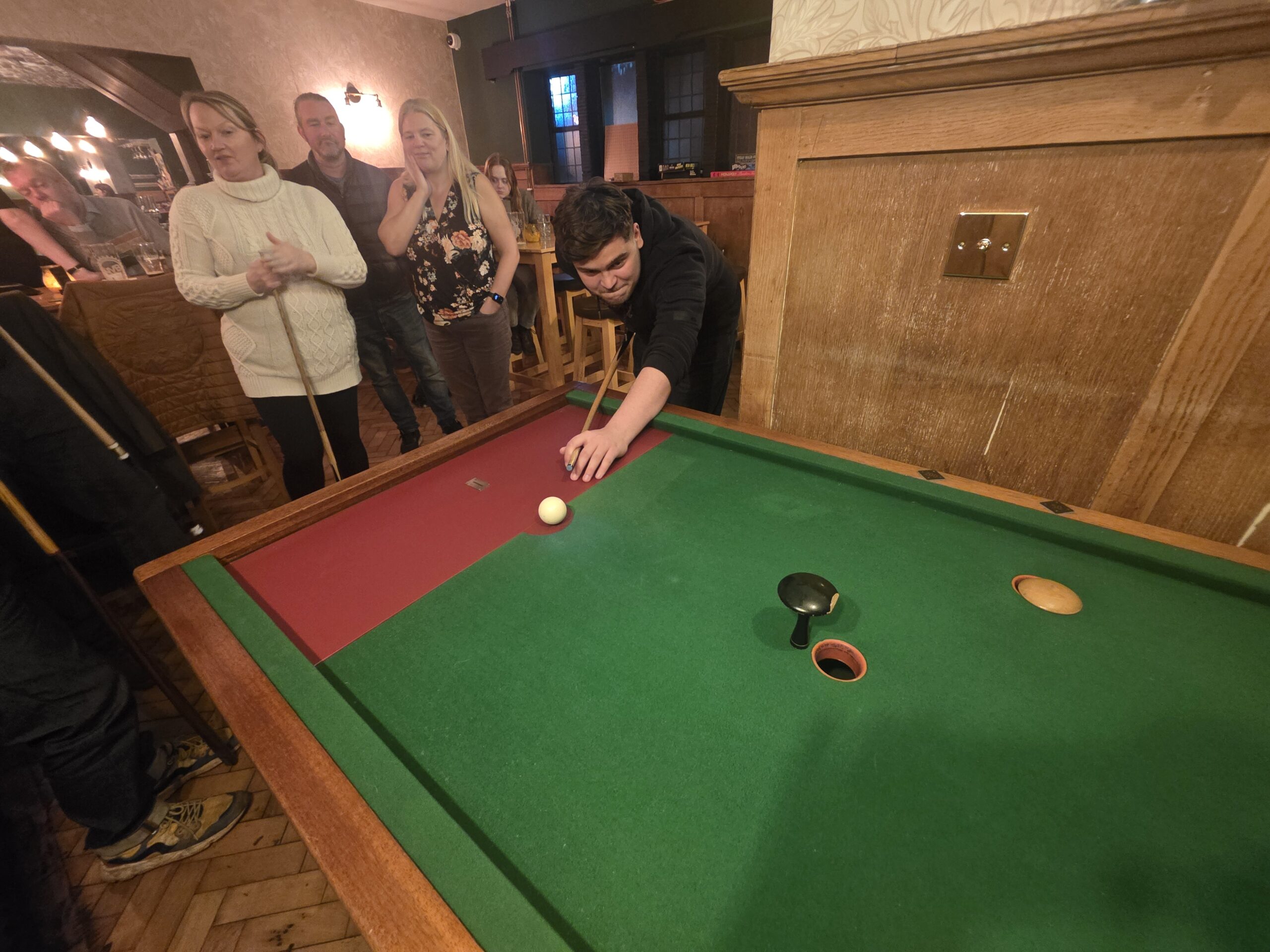
It was my first time in the VR rooms, so I wasn’t sure what to expect. Here’s the table, which is on free play, but you just buy drinks from the bar instead. I very much liked the table, it was slower off the back than I expected which meant I fell short on a few shots, but it was a bit wider than the King’s Head table which I liked. The pegs are very delicate indeed though, they blow over easily.
I don’t think that Oscar will mind me saying, but he turned up looking dead to the world as if from some zombie movie and I was secretly very pleased about that as I hoped he’d fall over or similar to distract himself from the game. However, at heart, I know that Oscar is a master at performing even when feeling terrible, so I wasn’t very confident.
We had some VR action behind us, but in the excitement of our game, I mostly forgot about them as I was locked into my own tragedy. As an aside, we had no scorer, so we had to do the adding up ourselves which was challenging as Oscar kept scoring large breaks. The first two games were relatively close, but Oscar won them both, so that was the end of that for my amazing run in the competition. I also lost the third frame, but by more, but I had rather lost the killer instinct by then….. And, let’s face it, Oscar is a very good player.
Anyway, that’s that now, I’ll just have to watch the other games to see who wins in this fine competition. And, maybe I might even get to reach the hallowed quarter finals next year. But I might need to practice more and also hope that I don’t meet Oscar in the 2027 competition.
For anyone concerned about his well-being, I’m pleased to note that Oscar was in good shape again in the pub in the evening, but I ignored his comments about victory because it’s not about the winning, it’s about the taking part. Unless I win, then I upload videos and blog posts all over the place. And, I confess, if I’d won, half of Norwich wouldn’t be able to open a social media app without seeing a slow-motion montage of my genius.
And, also, lovely people at the VR rooms, I hope to be able to play some games there in the future, a really nice set-up.
After the first round a few weeks ago, it was time for the second round of the Norwich bar billiards cup singles last night, with Oscar playing his game before it was time for my second round game. After three games, which were very well refereed I thought, Oscar was triumphant but there was a lot of surprising and delighting going on.
Then for my three games….. The first one went well for me, despite my struggling somewhat with this table as it’s narrower than the White Lion table. Quite a high scoring game, it’s positive to get the first game in.
The second game went to the final ball part of the proceedings, played differently in Norwich to some other areas. This one involves going off the side cushion into the 200 hole and I promptly missed it…. I didn’t get a second chance, so that was 1-1 on frames.
I slid behind by quite a margin on the third game and it looked all a bit forlorn. To cut a long story short, some fortune and a decision to play the second final ball concluding game quickly meant that I managed to win the final frame.
It was a really close game, so many thanks to Rufus, although it was all a bit tense for my liking, especially when there were about 12 people watching. I know that it’s not exactly the San Siro stadium with its 80,000 seats, but it felt a bit like that at times.
My third round game is against Oscar at the VR rooms….. Whatever happens now, I’ve got further than I expected. The results will go on https://www.norwichbarbilliards.co.uk/Singles at some point.
Today was the excitement of the first round of the Norwich Bar Billiards singles tournament. For anyone interested, the results will be at https://www.norwichbarbilliards.co.uk/Singles. Oscar calmed my nerves with some sensible beer selections and managed to miss all my great shots, but I didn’t say anything.
Thanks to Oli and Emma for their scoring assistance. This is an unusual cluster of balls all where I didn’t want them…. And I’m still surprised I went for a very difficult 200 shot, which went in, at a critical point in the game. As I said to Zak, I’m crediting him with teaching me how to be brave. I don’t think I’ll be being brave again for a while, I’ll go back to my 10s.
OK, I didn’t expect a 3-0 win, but I’ll take it….. My aim is to score 1,000 in each game and I was surprised and delighted to achieve that. Thanks to Katie for a great game and I am sort of looking forwards to the second round in late February.
This is an artwork by James Stark (1794-1859) which is in the collections of Norwich Castle Museum. It was purchased for the museum in 1975 with grants from the Art Fund, Watney Mann (I don’t specifically know why the brewery contributed to this) and the Victoria & Albert Museum.
Stark was a Norwich School landscape painter, best known for his big and usually windswept skies along with his slightly melancholy countryside scenes. He trained in Norwich, showed at the Royal Academy, and later taught drawing, including a spell as a master at Queen’s College, Cambridge.
In terms of this rather serene artwork, in the bottom-left of his painting there are some fishermen going about their business in what would have been a very different town. With no bus or train services at this point, this would have likely felt a rather remote destination.
Stark painted this in the mid-1830s, at a time when Cromer was starting to evolve as something of a summer tourist destination for those in Norwich and environs. The railways didn’t arrive here until the 1870s, so the town would remain relatively unchanged for some decades.
Of course, I feel the need for AI to join the party and this is what it believes the scene would look like today if painted in a similar style. I rather like this. The addition of Cromer pier, constructed in 1901, is an accurate one even if some other elements aren’t exactly perfect here.
This artwork is in the collections of Norwich Castle museum and was painted by Henry Ninham (1796-1874). The artwork was painted in the 1840s and was donated to the museum as part of the 1946 Russell James Colman bequest. Ninham nearly exclusively painted Norwich scenes and was enormously useful at recording the history of the city in the period just before photography.
The building in the painting is Fuller’s House, also known as Fuller’s Hole, which was a residential property owned by Alderman Fuller, who it is frequently mentioned was the Mayor of Norwich, but I can’t find any evidence of that in the lists.
Unfortunately, this building was pulled down amongst nearly everything else in the area as part of slum clearance in the 1930s. I’m not sure that the area is much better today in terms of architectural merit, it’s the St. Martin’s Close area of the city. If this would have somehow survived, as Elm Hill only just managed to do, it would have been full of character although the splitting of Oak Street in two by the flyover has rather broken this part of the city away.
I’ve felt the need to get AI to bring it to life a little, I think it adds a slightly interesting perspective to matters.