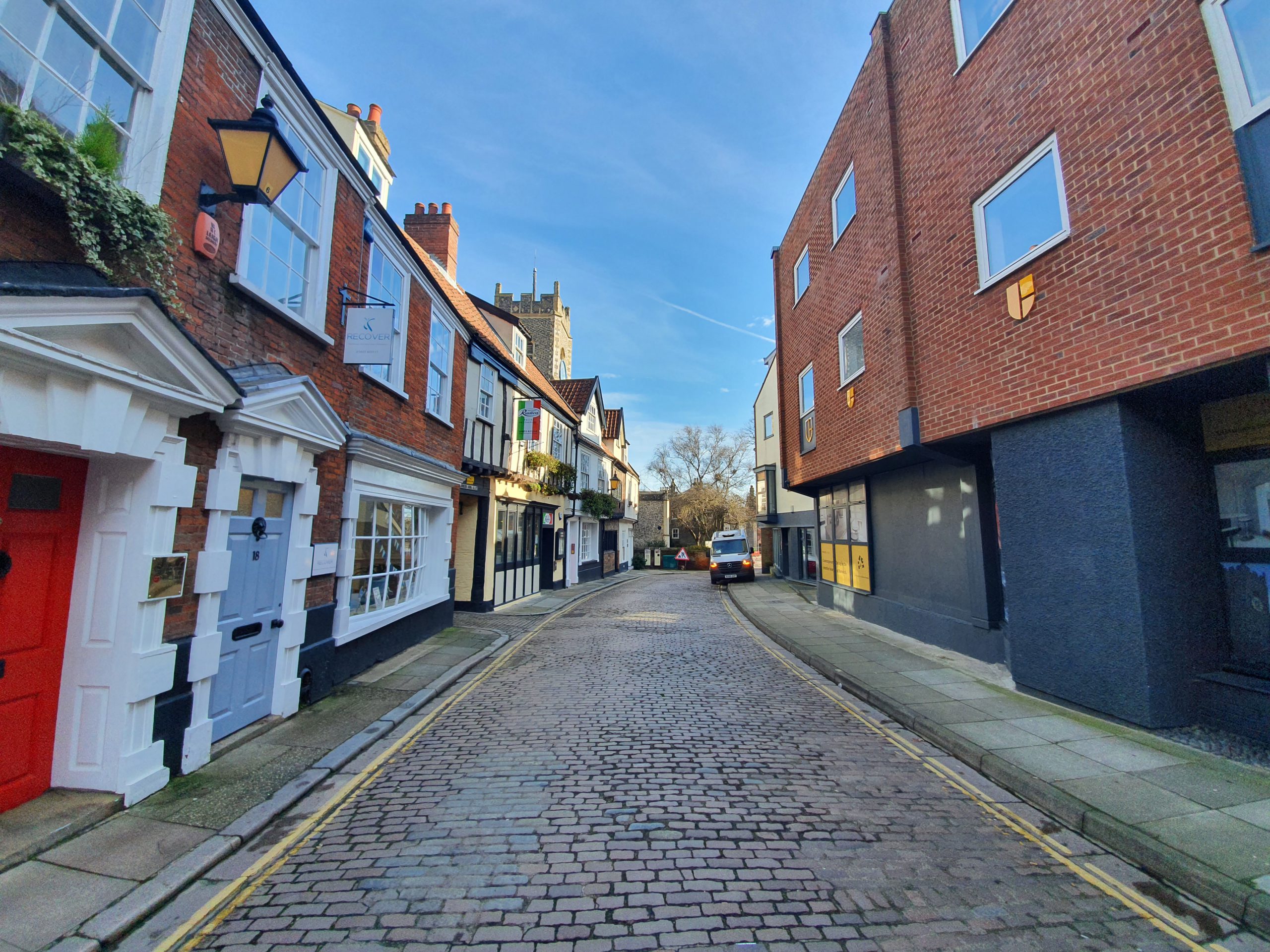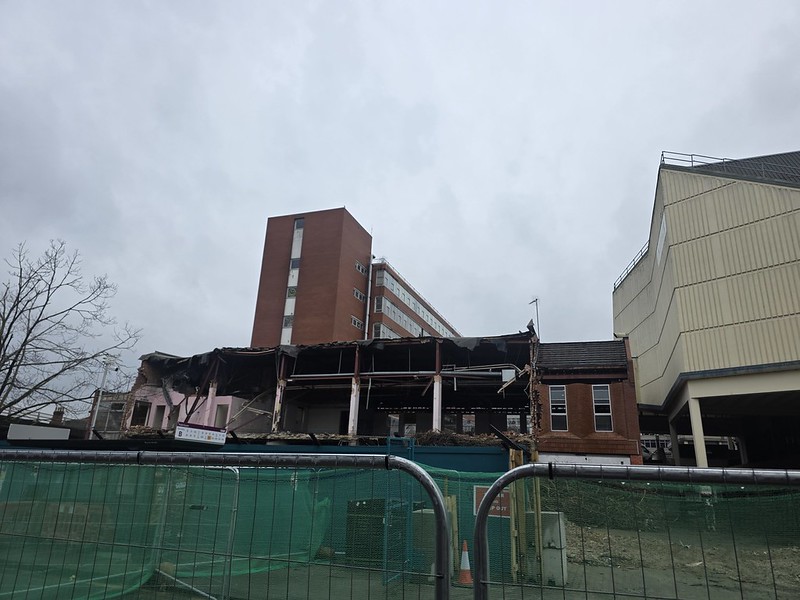
There are some people who don’t realise how hilly Norwich is, Norfolk isn’t the flat county that some expect. And this is Gas Hill Mountain, clearly impassable on its upper slopes and the road has been closed following a car accident. I mean, who would have realised that this might have been dangerous to cars…..
Incidentally, this is one of the very few streets in Norwich where the pavement has been gritted and not the road, rather than the other way around. Not that I’ve been moaning about this.
Gas Hill was named after the gas holder that was located half-way up, but that was demolished a couple of years ago. But, this is just one of the things that we have to bear in this mountain community in which we live, although I’m in the foothills rather than near to the summit.
Maybe a heap of old medieval keys in a museum isn’t at first sight very interesting, but there are certainly some stories hidden away here, even if it’s not clear exactly what they are. As a summary of the keys:
22 : From St. Martin at Palace in Norwich (dated between 1000 and 1200)
23 : Found at Castle Acre Castle (dated between 1100 and 1500). This is an iron barrel padlock key that entered the museum collections in 1984.
24 : Found at Snettisham (dated between 1200 and 1300). This is a copper alloy key that entered the museum collections in 1907.
25 : Found at Hardingham (dated between 1200 and 1500). This is a copper alloy key that entered the museum collections in 1999.
26 : Found in Old Buckenham (dated between 1200 and 1500). This is a copper alloy key that entered the museum collections in 1966.
27 : Found on Botolph Street (dated between 1200 and 1400). It is perhaps a little sub-optimal that this street has gone, I moan periodically that the street line of this could be restored with a little thought with the new Anglia Square replacement development.
28 – 30 : Found in Caistor St Edmund (dated between 1200 and 1500)
The museum appears to have put nearly all of their medieval keys on display, so perhaps it’s a little random, but at some point in history these keys would have guarded treasures and resources. There’s a fair amount of engineering that has gone on with some of these and some of them have a fair amount of styling to them.
I’m not sure that much more is known about any of them, but I rather like the snapshot of history they provide even if their stories have been lost to time. And every treasure once had a keeper….
This is certainly a rather lovely place to have a memorial tablet and it commemorates the life of Thomas Tawell (1763-1820). Tawell was born in Wymondham in 1763 and he was born into a wealthy family, although his father died when he was just ten. He went to work for his uncle, a Norwich ironmonger, and Thomas managed to build up quite a wealth for himself.
Perhaps now best known for his generosity, his turn toward charity was rooted in his own experience with sight loss. While he was a successful merchant buying and selling his iron, he became blind, a condition that lasted for several years before he partially recovered his sight. This ordeal inspired him to help those who did not have the means to support themselves in a similar situation.
In January 1805, Tawell spoke at a public meeting at the Norwich Guildhall to propose an institution for the blind. To ensure the project moved forward, he took direct action by purchasing a large house and three and a half acres of land in Magdalen Street for the cause. He also donated 1,000 guineas, which is estimated to be worth approximately £86,000 in modern terms. He was particularly adamant that the institution should not just educate the young but also care for the elderly, a requirement he made a central part of the charity’s rules.
The building on Magdalen Street was known as the Asylum and School for the Indigent Blind (I didn’t know what ‘indigent’ meant, but it’s someone who is poor and/or needy). That building has since been demolished, but the organisation lives on, later called the Norfolk and Norwich Association for the Blind and, since 2020, now the more snappy ‘Vision Norfolk’.
The text reads:
“To the Memory of THOMAS TAWELL, Esquire, late an INHABITANT of the Precinct of this Cathedral who died the fourth of June 1820, Aged 57 Years.
In the Year 1805, He purchased a spacious dwelling House, with extensive Garden Ground in St. Paul’s in this City; and settled them by legal Instruments for a perpetual Hospital and School for INDIGENT BLIND PERSONS.
This munificent Gift aided by the Patronage of other benevolent Characters hath secured an Asylum for the pitiable Objects of his Bounty; whose melancholy Situation he could but too well estimate, having himself passed many Years deprived of the Blessing of Sight.
Whilst acutely feeling for the Afflictions of others he sustained his own with Resignation and Cheerfulness.”
He sounds a really quite positive man by all accounts. Incidentally, I’m very impressed at this art collection which was sold off a couple of months following his death, the auction catalogue notes:
“ALL the valuable PICTURES, Prints, Coins, and curious Articles, of THOMAS TAWELL, Esq. deceased, at his late Dwelling-house, in the Upper Close, Norwich; comprising some fine specimens of the old Masters, Ostade, M. A. Carraveggio, Wyke, Zuccorelli, Frank Hall, Old Frank, Teniers, Rysdael, &c. &c. proofs and fine impressions from Bartolozzi, Vasseau, Wille, Earlom, Sharpe, Edelinck, Woollet, &c. Cupid in Psyche, Bacchus and Ariadne, Venus in statuary marble—Italian workmanship, very fine; a large collection of gold, silver, and copper coins, Roman urns, and a variety of curious antique articles.
In the Books will be found Jeremy Taylor’s Works, Shakspeare’s in folio, Mant’s Bible, Josephus, Clarendon’s Rebellion, Statutes at Large, Robertson’s Charles, America and Scotland, Hume’s England, Burke’s Works, Annual Register, 62 vols. Blackstone’s Commentary, Hook’s Roman History, &c. &c.”
Owning a Caravaggio is really quite exciting. Although if I owned one, I’d be stressed worrying someone would pinch it and I dread to think what the insurance cost would be. I’d worry about it every time I looked at it, so I think on that basis I won’t buy a very valuable old painting for several million pounds. Although there’s another limiting factor within that last sentence, but I digress.
At least this memorial is of a man who made a great contribution to the people of Norwich, and not a tomb to a bishop that oversaw the execution of people who had a slightly different belief to him.
This is a rather nice memorial, commemorating the life of William Inglott (1554–1621), a celebrated organist and composer at Norwich Cathedral during the Elizabethan and Jacobean eras. This image shows the memorial to William Inglott (1554–1621), a celebrated organist and composer at Norwich Cathedral during the Elizabethan and Jacobean eras. The monument is a painted mural located on a pillar near the presbytery screen with the obligatory skull located on the memorial to note the inevitability of death.
William Inglott was the son of Edmund Inglott, who was also an organist at the cathedral. William began his musical journey as a chorister under his father before eventually becoming the cathedral organist himself from 1587 to 1591. After a period working at Hereford Cathedral, he returned to Norwich in 1611 to replace the famous composer Thomas Morley.
He died on the last day of December 1621 and they had painted this within six months. This feels like a nice memorial and it’s still in excellent condition today, although the face of one of the two choristers seems to be blurred out. Maybe he wanted to be redacted.
I’ve had AI transcribe this, so it might not be entirely accurate….
“Here William Inglott Organist doth rest whose ARTE in musique this Cathrall blest for Descant most, for Voluntary all he past: on Organ, longe, and virginall. he left this life at AGE of fiftie yeares and now ’mongst angells, all sing laud in heaven his fame flies farr, his name shal not die See ART and AGE here crowne his memory
NON digitis Inglotte tuis terrestria tangis tangis nunc digitis organa celsa poli”
This is a bit niche, although I rarely let that stop me, but I rather liked this niche (I only realised what I’d done there when typing niche for a second time but I’m going to keep it) which is underneath the Bishop’s Throne at Norwich Cathedral.
This recess where the relics would have been piled up, with an information sign by this noting that “it was thought that the essence of these relics could rise up through the flue and give the Bishop divine aid and assistance” and that’s quite a nice thought. If you believed in the power of the relics, then this is a perfectly logical thing to do and I like that this hasn’t all been bricked up. These relics would have pulled out of here following the Reformation, so this has been empty for a long time now.
I understand that this isn’t a normal situation to have survived, not least as the Bishop’s Throne has usually been moved about the place in cathedrals. Although perhaps the ultimate place that this is replicated is the Chair of Saint Peter in St. Peter’s Basilica in Vatican City, where the chair is the actual relic.
I suppose that this is rather a nice place to have a tomb, right by the main pulpit so you’re not missing out on much. I don’t know, but I imagine that there was an iron cage around this, possibly stone, to make it feel a little more private.
It’s the chantry tomb of Bishop Richard Nykke (1447-1535), also known as Bishop Nix, and there would have been a fund for a priest to offer prayer and masses on their behalf, just to speed up the whole process of getting to heaven. This was inevitably just a little ridiculous, people paid a lot of money for positions such as this and the Catholic Church accepted a lot of abuses here for far too long because it was in their financial interests to do so. The Reformation came along and all this chantry tomb stuff came to an end with the Abolition of Chantries Acts.
Bishop Nykke lived through some of the Reformation and he was one of the last Catholic bishops here, although it was Bishop John Hopton (?-1558) that can claim to be the last one. Hopton, a Catholic Bishop, ordered the burning to death in Norwich of tens of Protestants because they disagreed with him. Some of the people Hopton murdered were burned at Lollards Pit, just outside the city walls, where they were walked from the Cathedral.
Back to Bishop Nykke who was present at the murder of Thomas Bilney (1495-1531) who was also executed at Lollards Pit. Nykke was found guilty by Parliament of an abuse of his powers and had property confiscated, but it’s fair to say that politics had rather taken over by then.
This whole situation is a bit unfortunate for Bishop Nykke, forced to remain in a tomb next to generations of those preaching messages which he strongly opposed. This is the slight problem when you get yourself a prime spot in a religious institution, the risk of seeing it handed over to a different denomination. But, maybe over time he’s recanted, like he tried to make the Protestants do.
Of course, I’ve used AI to try and recreate the scene of what it might have looked liked and I’d suggest this feels a very realistic mock-up.
There’s a lot of graffiti here at the side of the tomb…..
Because I don’t have enough series of posts on this blog already, here’s another one. As I’ll be visiting Norwich Castle many times this year, I thought I should make some parallel visits to its Norman counterpart, the city’s cathedral.
The cathedral notes that this is the effigy of St. Felix, a reminder that the word effigy seems to have mostly been redefined as representations of people who are normally unloved, the whole tomb effigy thing feels much less commonly here now.
Historically, it was thought that this was Herbert de Losinga, the first Bishop of Norwich, before I’m sure great academics decided that it was St. Felix, who is known for bringing Christianity to East Anglia.
This effigy was originally located above the Bishop’s Door in the north transept, before a decision was made to bring it here in 1969. A replacement copy has been made where it used to be located and that’s visible on a George Plunkett photo from 1976. This side of the cathedral can’t be visited, it’s the private access to the Bishop’s Palace (both the new one and it would have been the access from the old one too).
Obviously, I’ve gone to AI to understand what this might have originally looked like.
This is the severed head of John the Baptist, I mean what a lovely thing to pop in your living room. This was a popular image in the medieval period and it’s made of terracotta, dating from around 1380 to 1420.
It was probably once in a church at the top of an arch, but it ended up embedded in a cottage wall in the village of Barney, near to Thursford and was found in 1958 when the wall was demolished. I suppose that it’s quite inspirational in its own way.
Thanks to Norfolk Heritage Explorer (which is a really wonderful website) the exact location where it was found is marked accurately on the map (the little yellow triangle in the middle of the image), although they only got confirmation of the location in 1984 because a local man remembered where it was found.
Well, this is nice, it’s a map of Norwich which I haven’t seen before. It is showing me all manner of things that I didn’t expect to be there, so that’s a bit more time I will waste (well, maybe not waste, is any finding out about history a waste?) hours on now…..
This image should show at full resolution by clicking on it and zooming in to see the details.