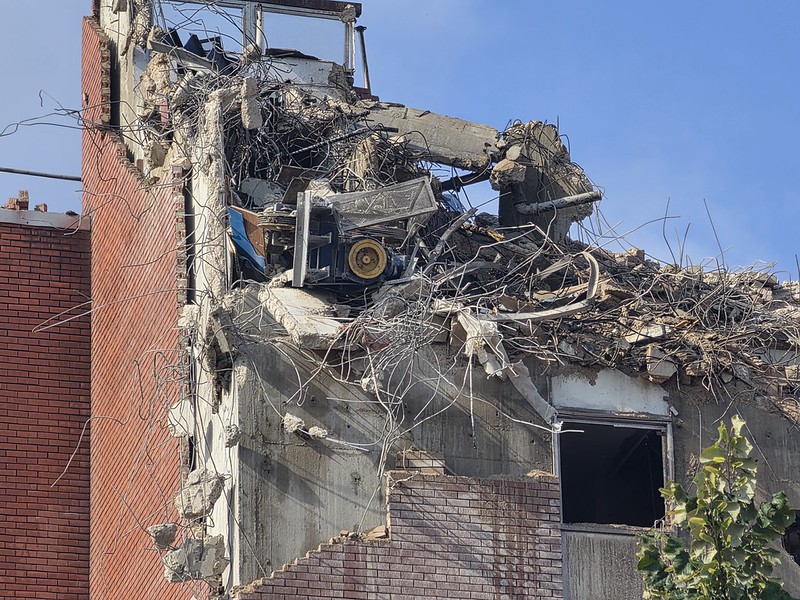
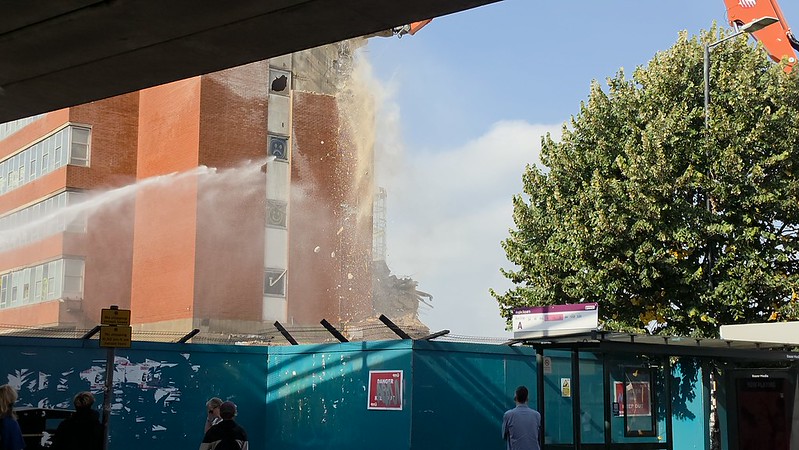
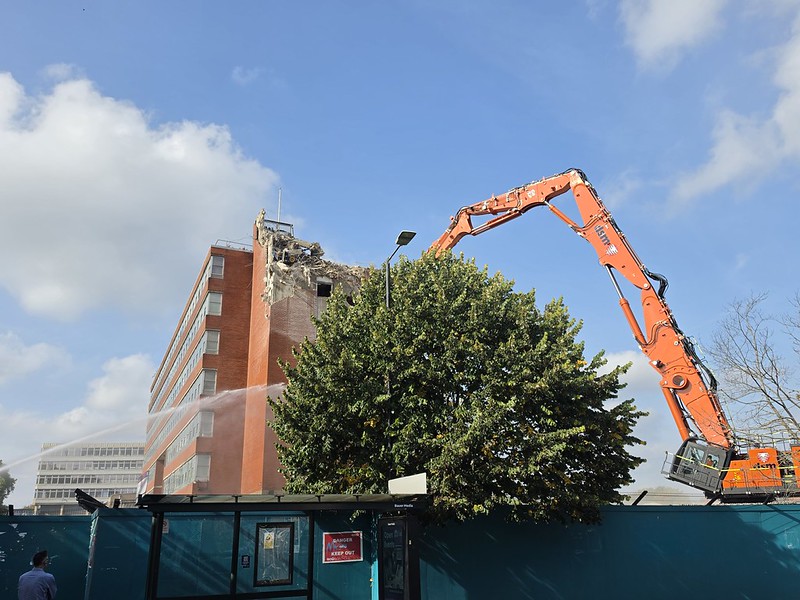
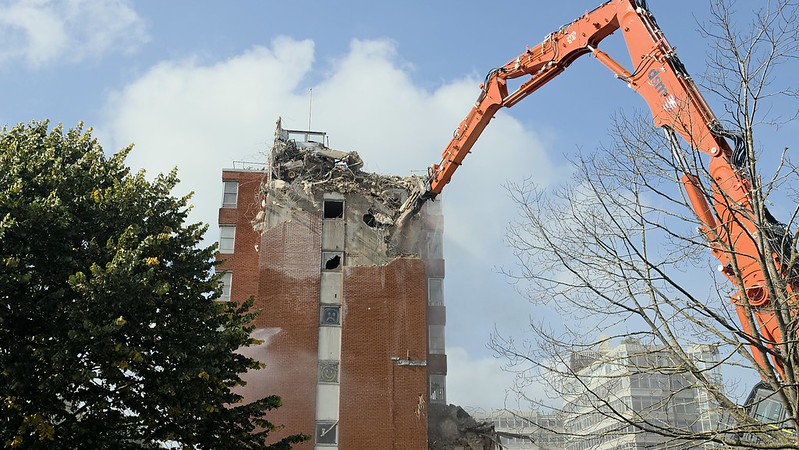
I haven’t posted much about the Anglia Square demolition recently as not much has happened. However, as I was walking by today there was finally some more action. And here are some photos of all the excitement.



HOME · LATEST 100 POSTS · BAR BILLIARDS · GOOD BEER GUIDE · NORWICH MARKET · FLIGHTS · RAILWAYS · INDIAN MEALS · CONTACT
I haven’t posted much about the Anglia Square demolition recently as not much has happened. However, as I was walking by today there was finally some more action. And here are some photos of all the excitement.
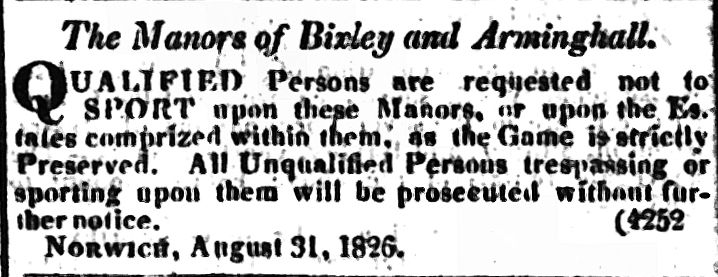
This notice appeared in the Norwich Mercury in September 1826 and relates to the manors of Bixley and Arminghall, immediately south of Norwich. It announced that game on the two estates was being strictly preserved and warned people against hunting or shooting there. In the language of the period, “sporting” meant pursuing animals such as hares, pheasants and partridges rather than participating in an especially vigorous game of bar billiards.
What makes the notice more interesting is the distinction it draws between “qualified” and “unqualified” people. Under the Game Laws then in force, the right to kill game was largely restricted to men with substantial property interests, certain long-term leaseholders and the eldest sons of esquires or men of higher social rank. Merely possessing a gun and finding a conveniently positioned pheasant was therefore insufficient in the eyes of the wealthy.
Those legally qualified to shoot were politely “requested” to stay away from the estates, while unqualified people were warned that they would be prosecuted without further notice. Being qualified did not give anyone the right to enter another person’s land, but the difference in tone is revealing. Wealthy sportsmen received a courteous announcement, while everyone else was informed that the authorities would be dealing with them and prosecution was likely.
The property qualification was abolished by the Game Act 1831, just five years after this notice appeared, although shooting still required the appropriate permission and certificate. It is a small snapshot of a different time, when hunting rights were determined by wealth, property and the apparently vital matter of whether someone’s father was sufficiently grand. You don’t get that in bar billiards.
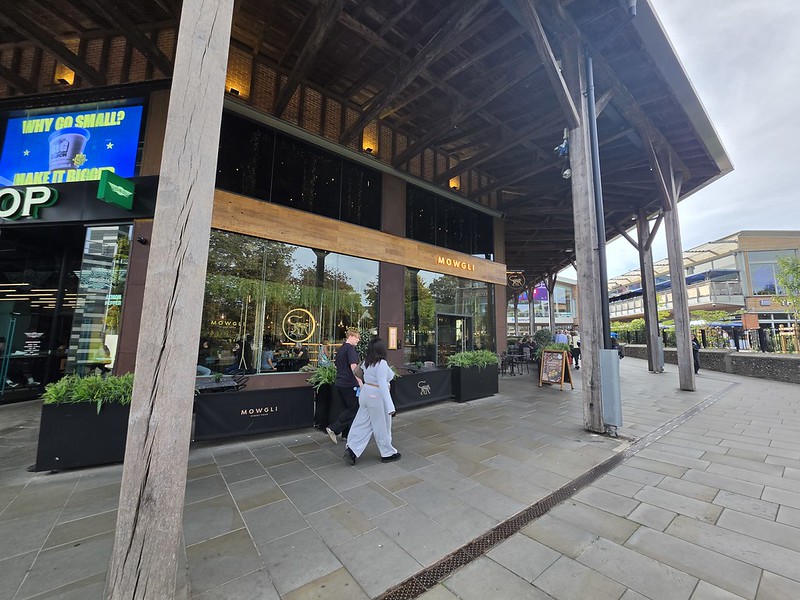
Moving away from the Balkans for a few posts, I’ve been trying to find someone to take me to Mowgli for a while. After discovering the half-price curry offer running on Mondays this month, I was able to convince my friend James to come along for one of our executive lunches. It’s good practice in advance of the 2027 Norwich market expedition and also a precursor to my new monthly Indian meal which I’m pleased to see has a decent-sized group going this week.
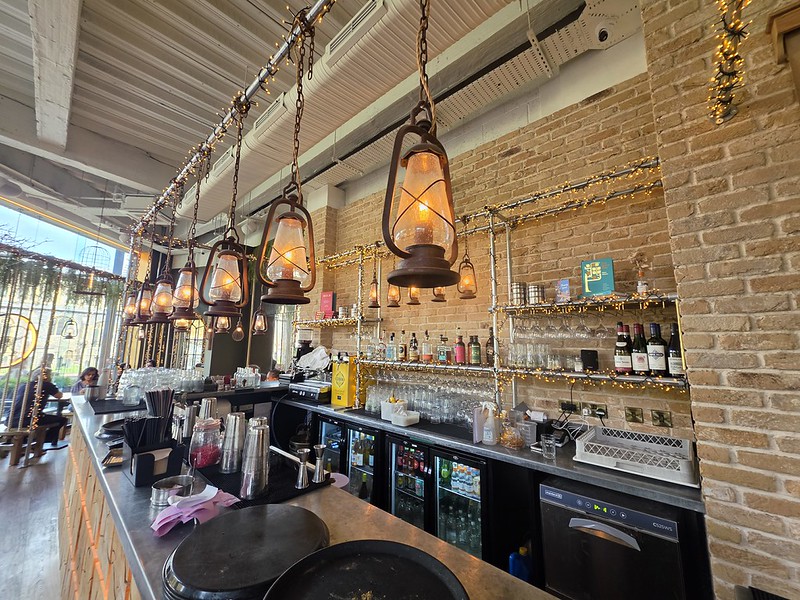
It has a smart, contemporary interior and reminded me of the Dishoom chain, which frequently surprises and delights me.
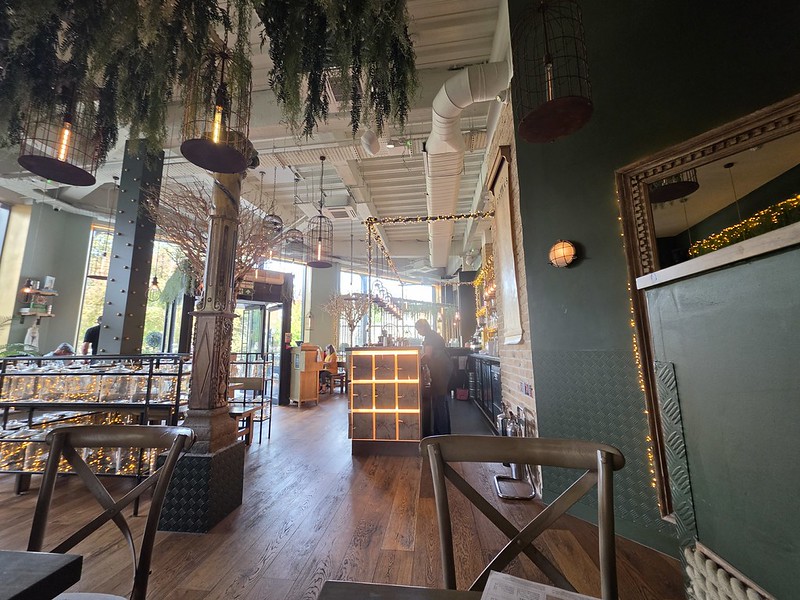
It was clean and comfortable, but the tables are perhaps a little too close to each other which does take away from the ambience a little.
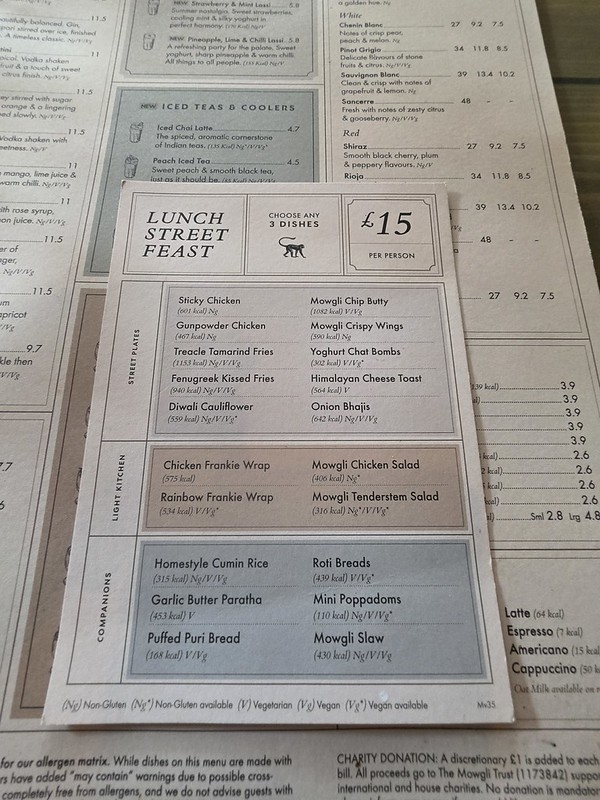
The lunchtime special menu.
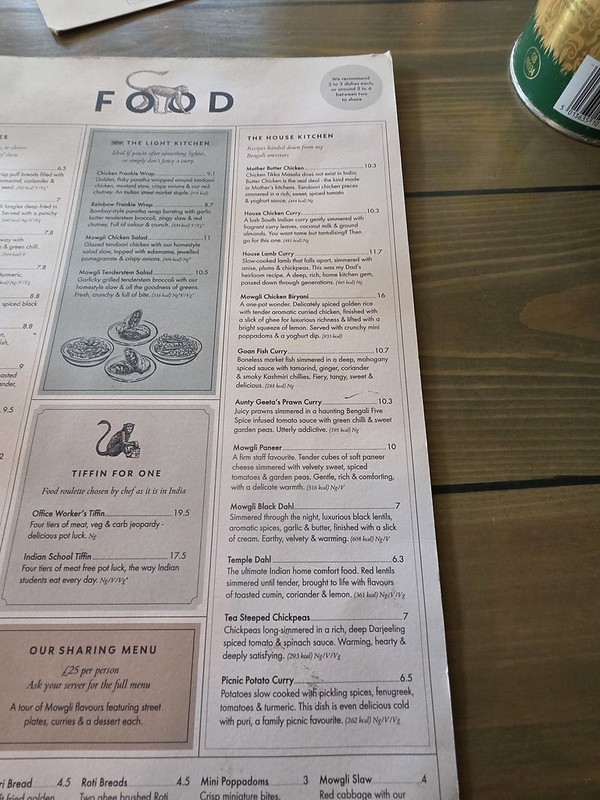
The deal was that any of the curries in this section on the right, other than the biryani, were included in the half-price offer. Unfortunately, the half-price offer was not applied automatically, meaning that customers had to know about it and ask for the reduction. I’m never especially impressed when restaurants operate promotions in this way.
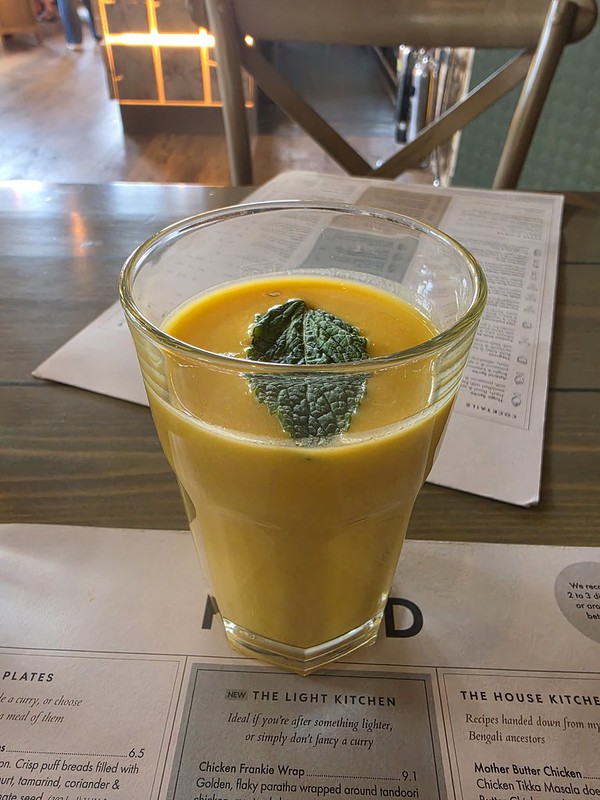
I ordered the mango lassi and it was a small serving for the price, although it looked attractive when presented. Its consistency was thinner than I had expected and neither the yoghurt nor the mango had enough presence to provide the usual richness and freshness.
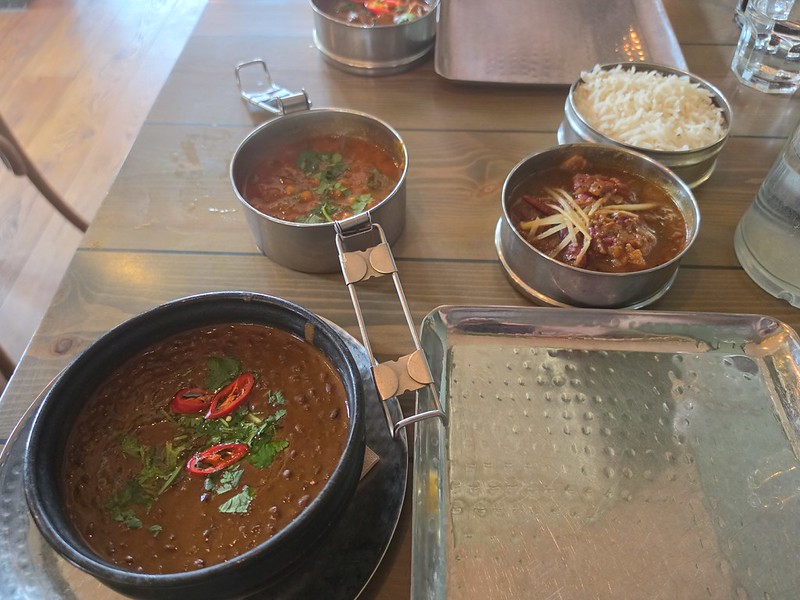
The main curry I ordered was the Goan fish curry and I opted for that as the menu stated that it was “fiery, tangy, sweet and delicious” but this was devoid of any depth of flavour that I could identify. The fish was tender and served in a generous quantity of sauce, but this element didn’t have any fiery dimension to it. I tried a bit of James’s butter chicken, just visible at the rear of the photo, and the chicken was tender but again there was no discernible complexity to the flavours. Although the two curries were different dishes, neither established a particularly distinctive flavour of its own.
The Mowgli Black Dahl was served as a generous portion, but its consistency was loose and watery rather than rich and velvety. It also lacked the slick of cream promised on the menu, which might have provided some much-needed richness. The Tea Steeped Chickpeas perhaps fared better texturally, with the chickpeas retaining a pleasant firmness, but the flavours again needed greater seasoning. I’m not necessarily expecting a huge punch in terms of spice, but I do want some complexity.
I would say that the dishes were all competent, they were well presented, hot and the server named them carefully when placing them on the table. Nothing tasted bad and I enjoyed all the food, but perhaps they had oversold the experience that I was expecting.
The service was friendly and timely, although I’m not convinced by the need to add both a charity donation and service charge automatically to the bill. The price was reasonable given the half-price main courses, but the quality wasn’t there for me. Indian food needs greater depth and complexity. Overall, it was all too mild and I felt that the food sat closer to supermarket microwave quality than to anything authentic or richly flavoured. I have mentioned before that there is something perhaps a little wrong that JD Wetherspoon, who make no claim of authenticity relating to Indian street-food, are rolling out curries that have a greater depth of taste than a restaurant that is meant to be specialising in Indian cuisine.
Having noted all that, I was pleased to have visited and it’ll be interesting to see how the chain manages its rollout of restaurants across the UK. And James, my external food consultant, who has been before and apparently ordered nearly the entire menu, deserves some praise for taking me as we planned the third biennial tour of every food stall at Norwich Market.
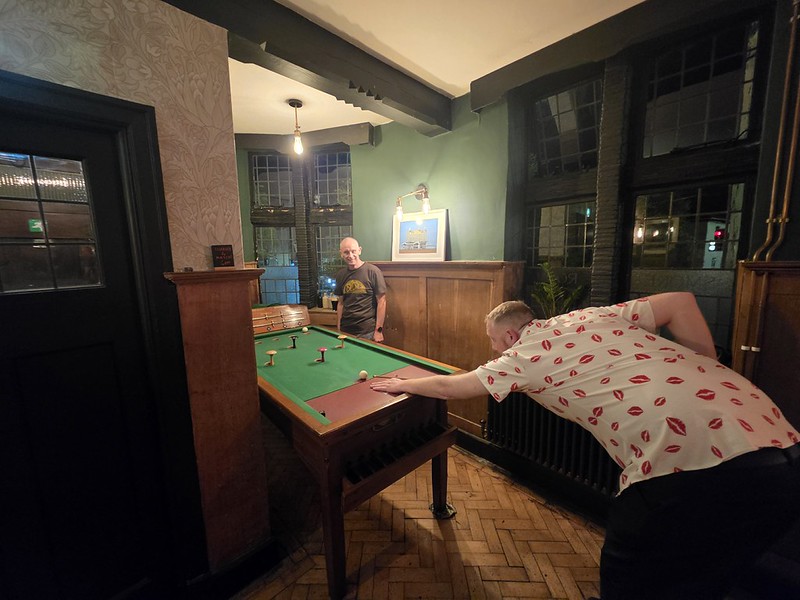
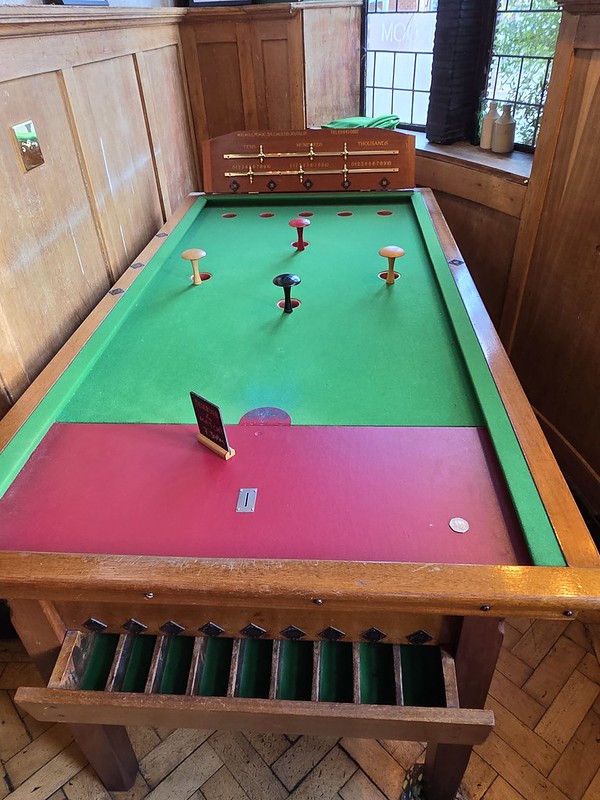
It’s only a few days left before the bar billiards tournament that I’m organising at the Artichoke pub on Saturday 22 August 2026. I say “organising”, but I really mean “delegating to everyone else” in my finest traditions. I have, however, successfully assembled 24 players, which means the tournament is now full for entrants and therefore demonstrates that I’ve done at least one thing. I think that there are players from nine different teams which is all rather lovely.
Although all of the playing places have gone, spectators are very welcome and I’d actively encourage anyone interested in bar billiards to come along. It’s intended to be a competitive tournament, but also a sociable afternoon and an opportunity for people who haven’t played before to see what the game is all about. Bar billiards is one of those sports that initially appears to consist of people standing around a wooden table drinking beer and occasionally poking things with sticks, before gradually revealing an alarming quantity of tactics, rules and emotional investment. I would add that anyone who stands around for too long might be given a little administrative task or signed up for the second Artichokes team next year.
The event will start at 14:30 and the draw is taking place just before for anyone who wants to come and watch it. Dylan from Articans is overseeing the draw, not that he’s been told this yet, but he likes surprises. He’ll also be managing the scores throughout the afternoon, which is another exciting development in his life that he is currently unaware of. I’m hoping he discovers all of this by reading the blog, which I think counts as a perfectly modern communications strategy.
The draw will determine the pairings and then we’ll work our way through the tournament during the afternoon. With 24 players involved there should be plenty of bar billiards being played, along with the traditional periods of intensive statistical analysis, tactical discussion and somebody asking when they’re playing next despite the schedule being immediately in front of them. I’m hoping I don’t hear “they’re just having a cigarette” or “I think they’re in the toilet” too often when a player is meant to be ready….
The early betting appears to have YouTube Pete and Badger as the most likely winners, although this is plainly incorrect because Luke and I are going to win. I’ve undertaken no statistical analysis to support that conclusion, but confidence has never needed evidence before and I don’t see why it should start now.
There are plenty of dangerous combinations elsewhere. Oscar will be bringing his decadent chalk to the tournament, an item of bar billiards equipment so extravagant that I’m surprised it doesn’t require its own security detail. I still don’t entirely understand how chalk became a luxury item, but bar billiards continues to reveal new economic sectors to me. And I just play with the pub cue and haven’t invested around £300 in some lightweight stick. Actually, with members of the Lionhearts team, there’s every possibility that by next year we’ll need equipment regulations and a salary cap.
Danish Pete is now playing and might be one of the finest players in the field if he’s not distracted and annoyed at something. His inclusion has though rather damaged my preferred narrative that Luke and I simply have to turn up and collect the trophy. Steady Roy from the Serengeti will be there, presumably maintaining exactly the same facial expression whether he’s 2,000 points ahead or has just knocked over every peg.
The Artichoke Hearts combination of PJ and Vaughan could also be difficult to overcome as they know the table well. Then there’s Dave Brewer, who I beat in the league this year, have I mentioned that? Playing with Phil, that means that we have rule experts should we need it. Although thanks to Luke for being the official tournament referee, a role he didn’t know he had until I discreetly popped it in the rules. Incidentally, for anyone who has somehow missed the previous seventeen references to me beating Dave this season, further reminders will be available throughout Saturday.
Then there’s the Sharp tribe from the White Lion, as well as some talent from the King’s Head, including some quite vocal talent. The Sharp tribe can’t be ruled out as they’re at the Artichoke table on Wednesday night, but fortunately I’ll be there to play some games in a little friendly just to ensure that they don’t get too much table time. I regard this not as interference with a rival team’s preparation, but as responsible tournament oversight.
YouTube Pete will be recording games during the afternoon, so we’ll hopefully have some footage of the tournament afterwards. There will also be a clearly designated non-recording area for anyone who doesn’t want to appear on camera. This is particularly important for those who might prefer not to have permanent video evidence of themselves eating 28 Flumps over the course of the afternoon. By “those”, I principally mean me. I’ve effectively created bar billiards VAR with a designated confectionery privacy zone and I’m quite proud of that. The videos should be a nice record of the event and, depending on the results, material that some competitors may subsequently demand is destroyed. Any footage of me losing comprehensively will, naturally, be subject to a rigorous editorial process before publication.
Articans and the Artichoke are sponsoring the event, many thanks to Julian the Old for providing the 50 pence coins for the games as well as some spot prizes throughout the day. The event is aiming to reach at least £50 for Big C, as well as offering prizes for the winners, runner-ups and some random players around the day. These are big prizes, the winners get £35 and the runner-ups get £20, so this is no provincial little league asking players to take part for exposure…. The random awards may reward sporting excellence or they might reward something considerably less impressive.
I have some bad news though, Ivan the Great won’t be appearing as the event filled quickly, but he’s off to a beer festival instead. This is fortunate as otherwise players might get annoyed as he shares his top tips throughout the day. I’ll miss him though. He will be a contender to win next year’s event….
And, there’s more! Luke has acquired, at great expense, some trophies for the event and I’ve seen them and they’re really rather lovely. They will be worth playing for and there’s something for the ‘worst’ team as well, because this is all about taking part and not just winning. Many thanks to Luke this and indeed planning the format of the games as my designated responsible adult.
As a final note, the plan is to run this event as a much larger affair next year so that we have an entry process that allows as many people to enter as possible. That will mean operating it across likely another couple of pubs and I have high hopes that Oscar might be a host at the White Lion if he’s not in a mood that he’s knocked out early on this weekend. Actually, the long-term vision appears to have escalated from ‘small doubles tournament’ to ‘multi-venue Norwich bar billiards infrastructure project’ remarkably quickly and I’m hoping that next year some teams from around the country might make it to the great city of Norwich. Mission creep and all that…..
And in the words of the league:
“It’s Meant To Be Fun!”
Although I’d add that I don’t want too much frivolity on Saturday and I will say in advance that I will call “timed game” if required, as that’s what Emma would want me to do. I’m hoping that things are finished, or near to completion, by 20:00 as if we’re still going at 02:00 then something has gone wrong. And if Saturday works, I’ll take full credit. If it doesn’t, this blog post contains ample documentary evidence that I delegated most of the important jobs. But I think it’ll all be very lovely.
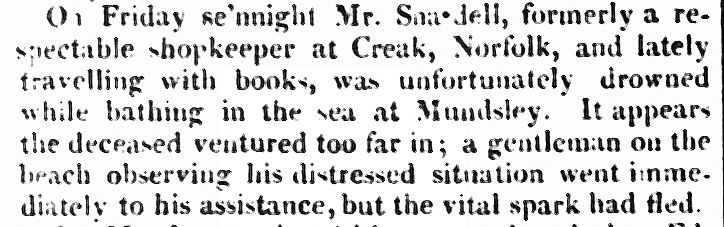
This newspaper article was in the Norwich Mercury 200 years ago this week, reporting that Mr Snasdell had died from drowning. Not only do I like the word se’nnight, meaning a seven day period, but I particularly like the “the vital spark had fled” to describe his death.
The individual was Thomas Snasdell and he was buried in Mundesley on 7 August 1826, although he lived in Norwich. He had been born in 1782 and although not mentioned in the article, he married Ann Clarke on 6 September 1824. I will have to work out how to put the phrase “the vital spark had fled” into this blog somehow, it’s a phrase that I feel needs to return.
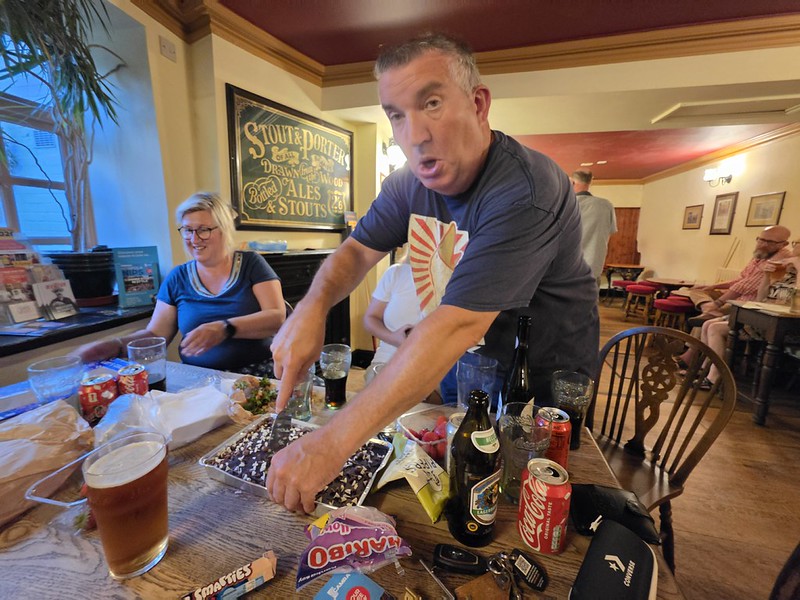
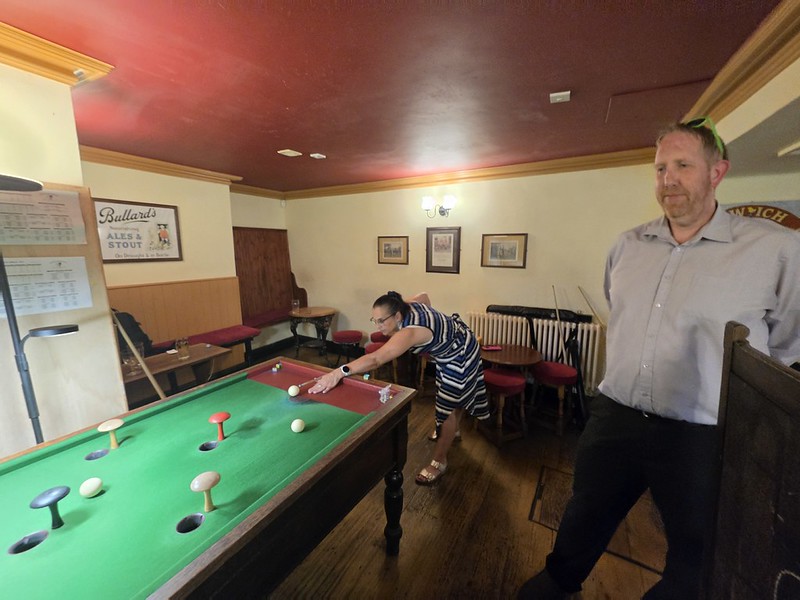
After a little break in proceedings, and I would like the pun there to be properly acknowledged, it was time for another league match and we were playing the International Brigade in the sauna area of the King’s Head. We had a new strategy that we were deploying, namely Ivan, to beat them thoroughly in practice so that their confidence was damaged. Our advanced sporting psychology is what will set us apart from the other teams in the league, although the results so far have been reluctant to support that theory.
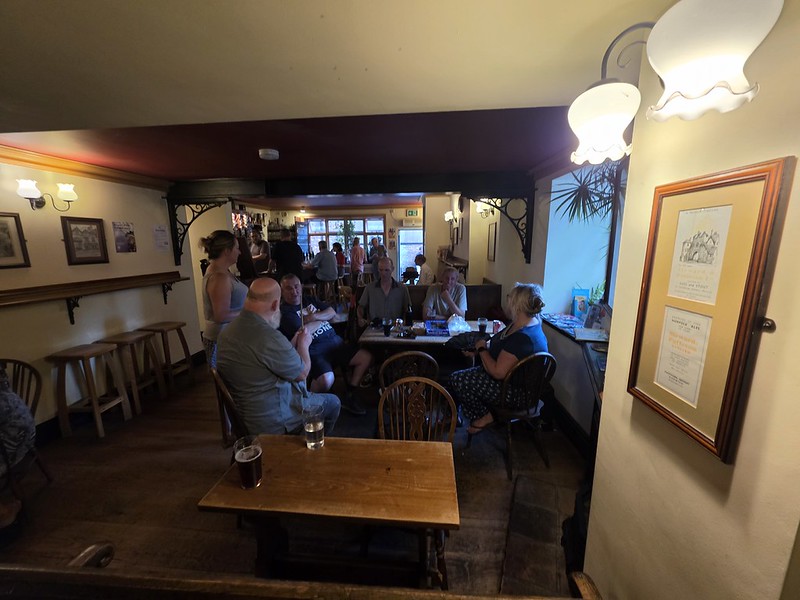
The teams had arrived, so it was time to think about doing the draw.
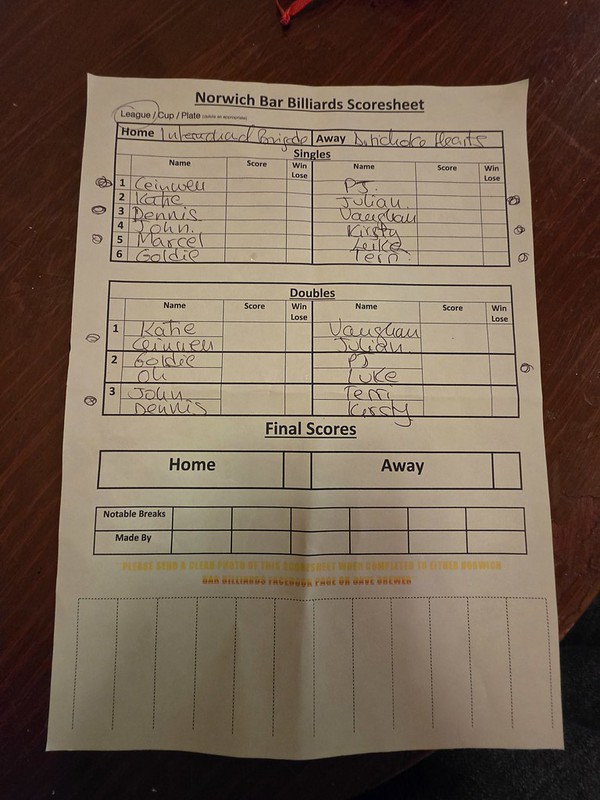
Somehow we managed to have PJ kicking off proceedings for us again, this seems to be a regular thing.
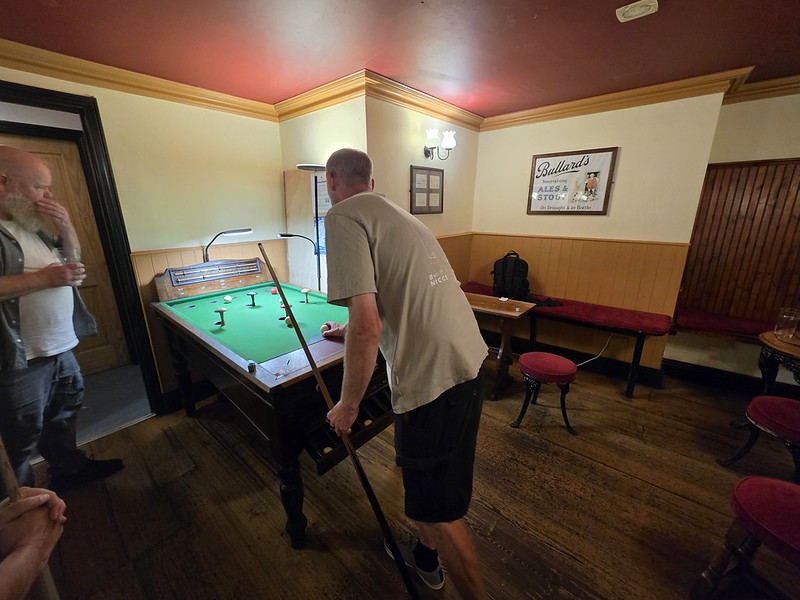
And off we go!
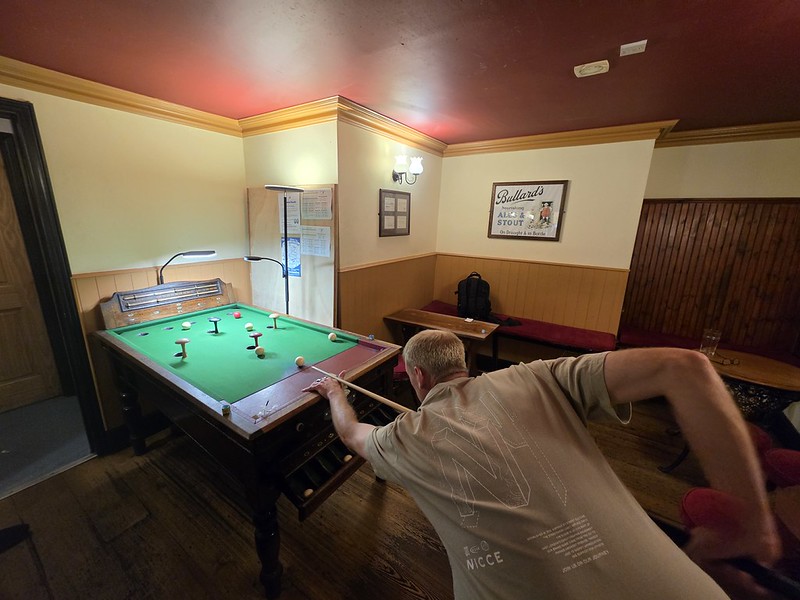
Cool, calm and confident. Anyway, we lost that game.
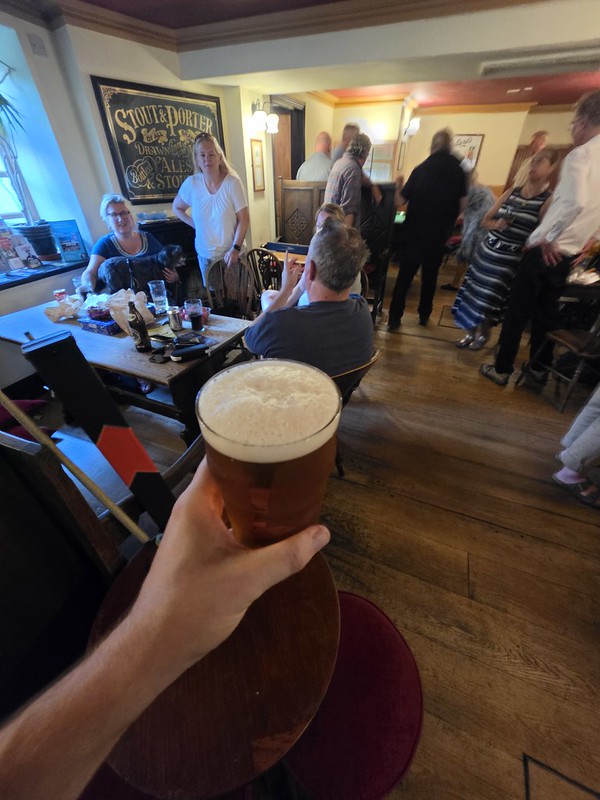
I was up second so thought I’d better get a quick pint to ensure that I was at peak performance levels in the sauna area.
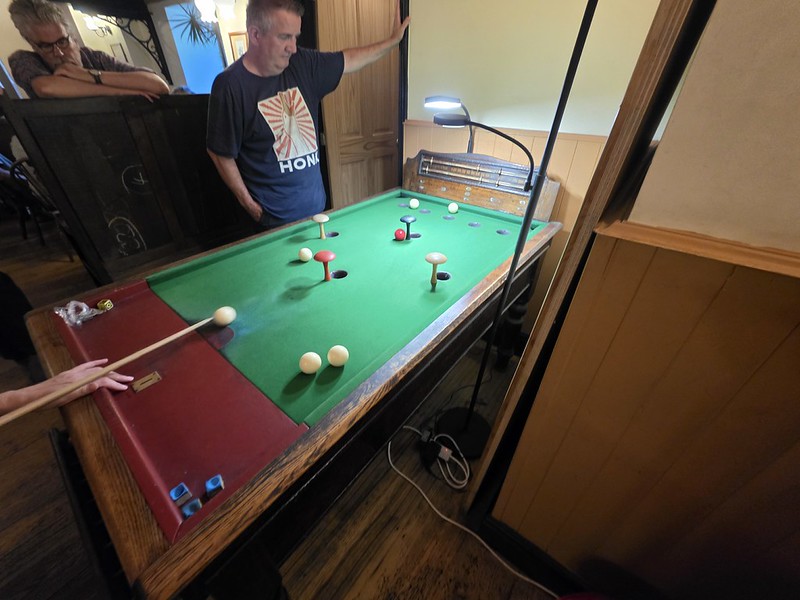
It was a close second game and I decided to do a very brave 200 shot in the middle of the game as I kept sitting just a bit behind. I saw Luke’s face of horror and that wasn’t quite the look of encouragement I had wanted. But my thunderbolt shot worked so I surprised and delighted myself, before reminding myself I would now just settle for 10s. It remained close though, going down to the final ball which I’m pleased to note I got in, but the peg wobbled just a little more than I would have liked.
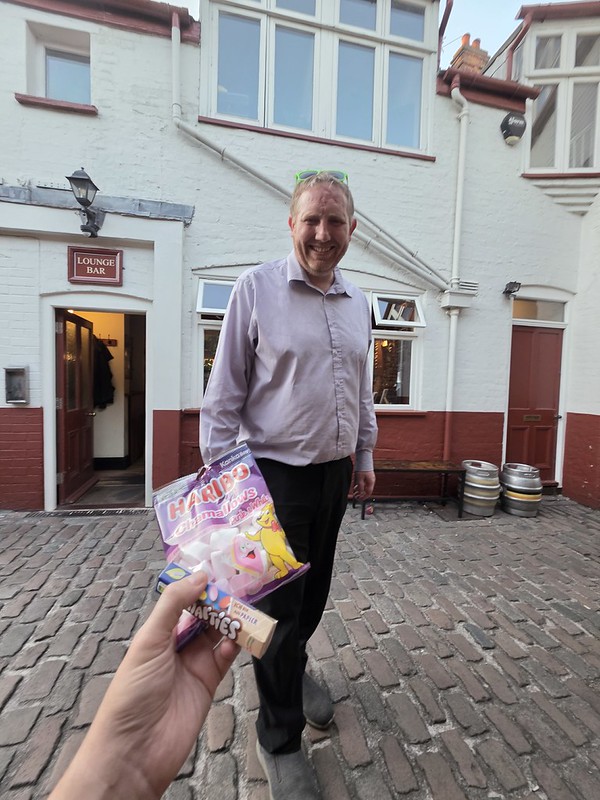
Ivan, our new head coach, came over with marshmallows that we could allocate to all the players fairly. I ate most of them if I’m being honest, but leadership sometimes requires difficult resource decisions. Ivan was also the referee for two games and he was entirely competent, not smashing up the table like he did last time he was referreeing.
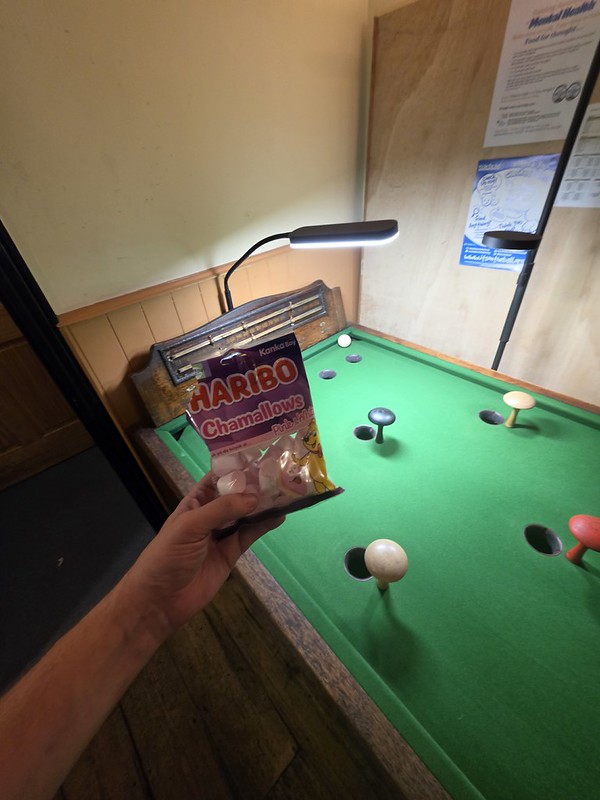
Here’s me waiting to referee whilst hoping the marshmallows didn’t melt in the extreme heat. I queried with Oli that perhaps, as a team captain, she could have made a contribution towards getting air conditioning in the King’s Head, especially as she’s one of the top four staff members that they have. She shouted back in a jovial manner that she didn’t feel obliged to pay for air conditioning. This was disappointing, although at least the pub’s climate policy is now clear.
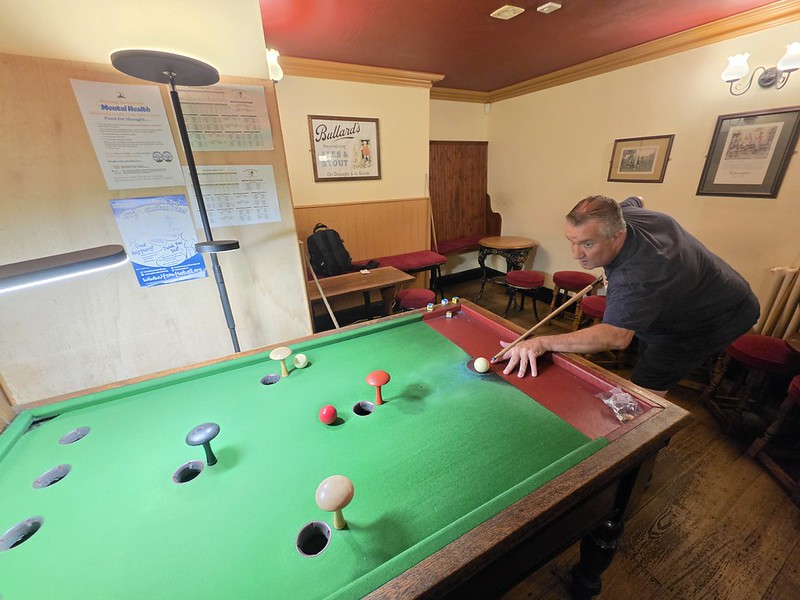
Luke found himself 900 down after the first shot, which is a sub-optimal place to be.
It was Luke’s birthday this week (the same night as Julian hit 70, although Luke didn’t fall over) and so we celebrated with cake and strawberries. We had assumed that John would arrange to throw some of the games to allow Luke to have an enjoyable birthday, but he didn’t. Luke and I didn’t say anything of course about this lack of sporting behaviour.
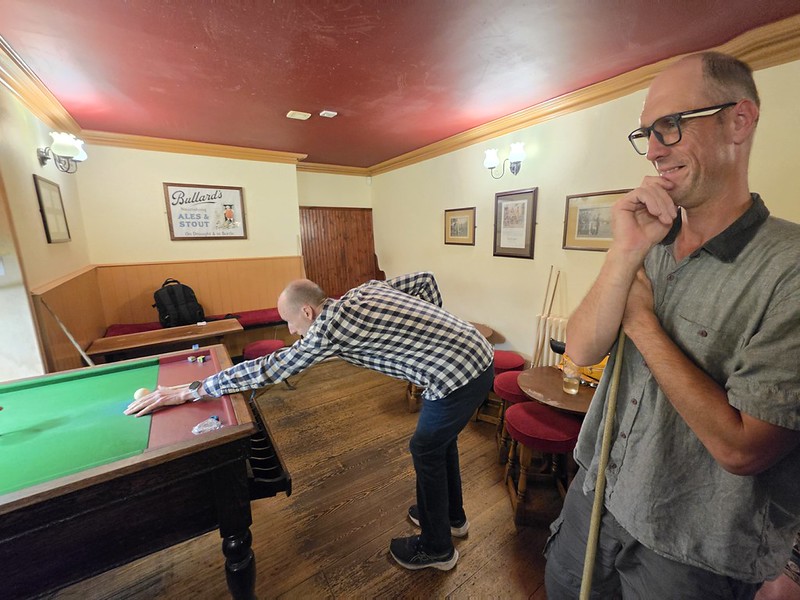
Let’s just say that we were 5-1 down after the singles, so we had lost the match. I had a little sit down outside for the fourth time to cool down and reflect on whether we just didn’t have enough chalk. There is always a technical explanation available……
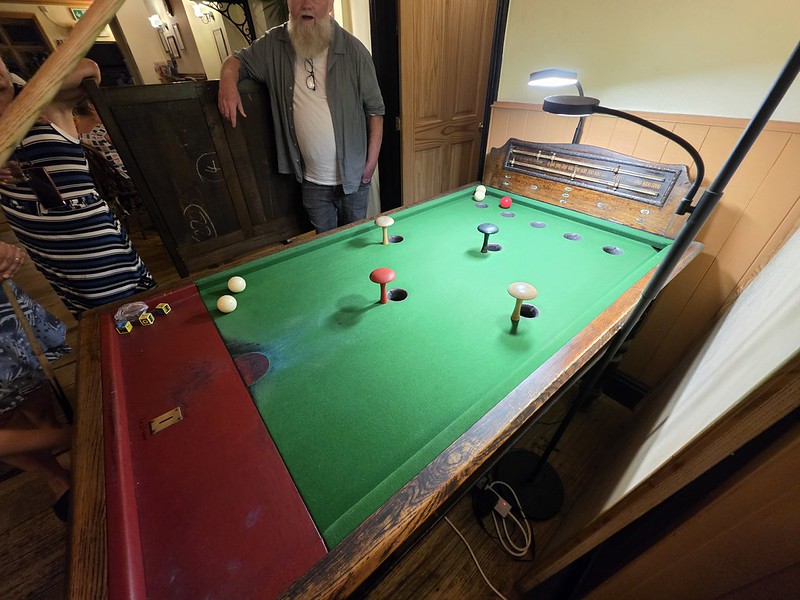
Back to the doubles, and Vaughan and I were successful in a very good game, so I was hopeful of turning this round to be a loss of just 5-4.
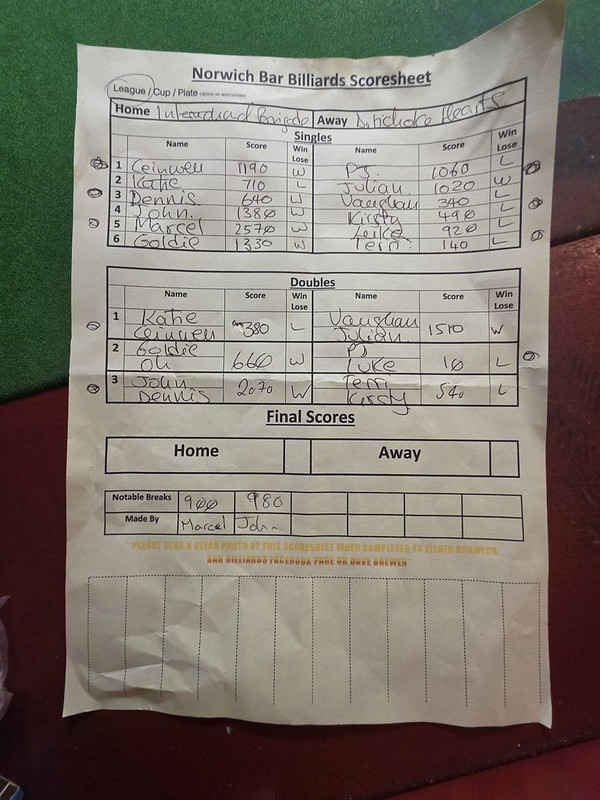
We lost 7-2, but look at those scores, but Luke put up a valiant performance against big shot Marcel, with Kirsty and Terri getting closer than their score looks. But losing 7-2 is not that bad in such hostile weather and I was saddened not to be able to take Ivan up on his offer of a game, but I had to rush to the Weaver’s to check that Julian didn’t have another fall. I’ve very much realised that bar billiards captaincy does sometimes involve wider pastoral responsibilities.
But, the main thing about all of this is having fun and it was a very enjoyable evening and the International Brigade are a lovely team. No game next week, but then we have two in a row after that in the Artichoke, so what could possibly go wrong?
And, in other news, we have our next cup game confirmed, which is against the Lionhearts. Nathan, their captain, and I would never comment on this ourselves as we’re very modest and entirely free from competitive vanity, but it is hard to deny the evidence that this will be a game featuring the two best captains in the league. Between us, we have certainly had enough experience of challenging bar billiards encounters so this is a proper battle of the titans and I know there’s a chance of it being a major motion picture on YouTube. And, I might have mentioned, I’ve beaten Dave Brewer so I’m ready to take on Oscar as I have a score to settle. But, it’s just a game obviously, although I’m hoping Nathan is bringing his worst players.
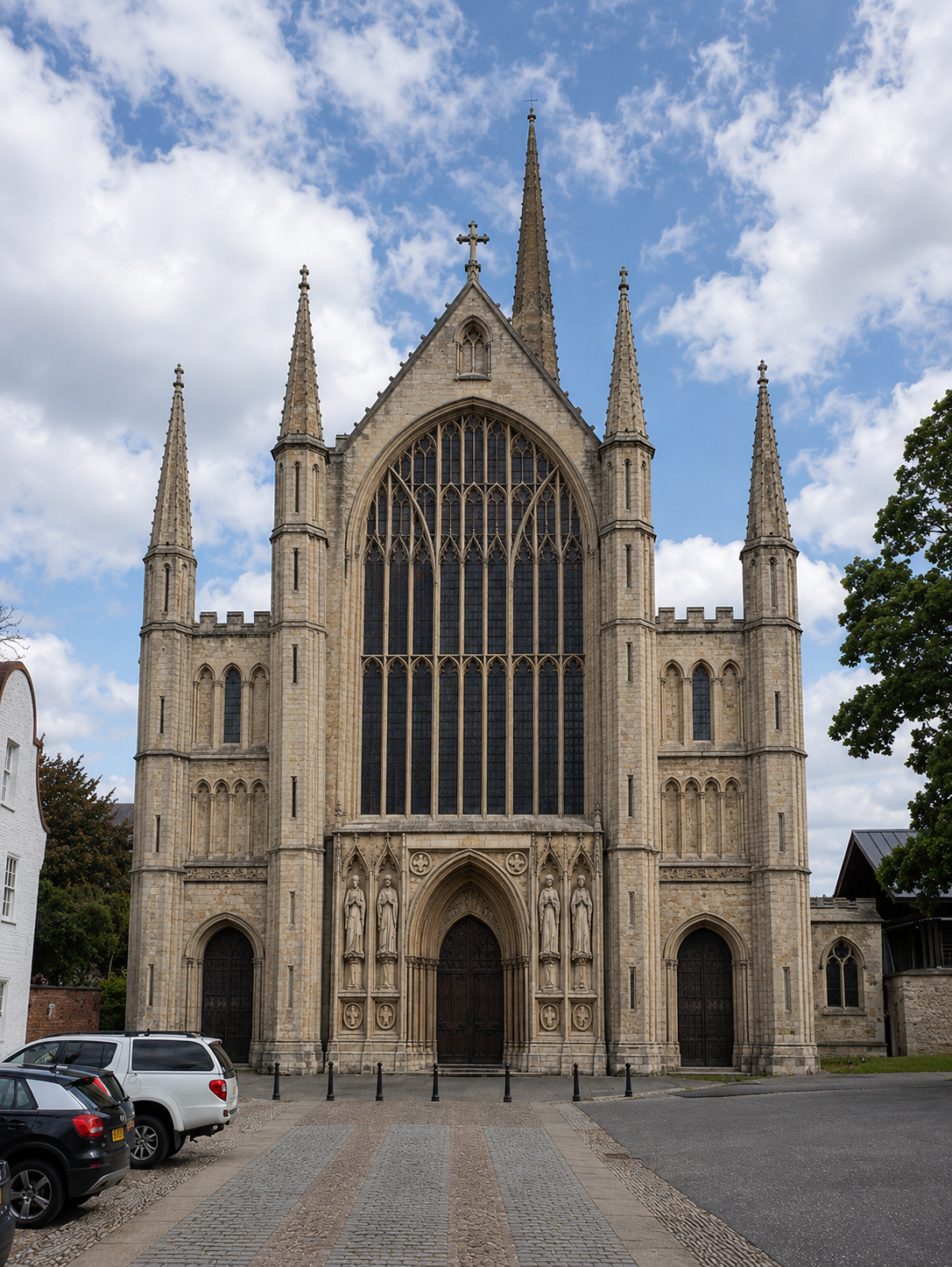
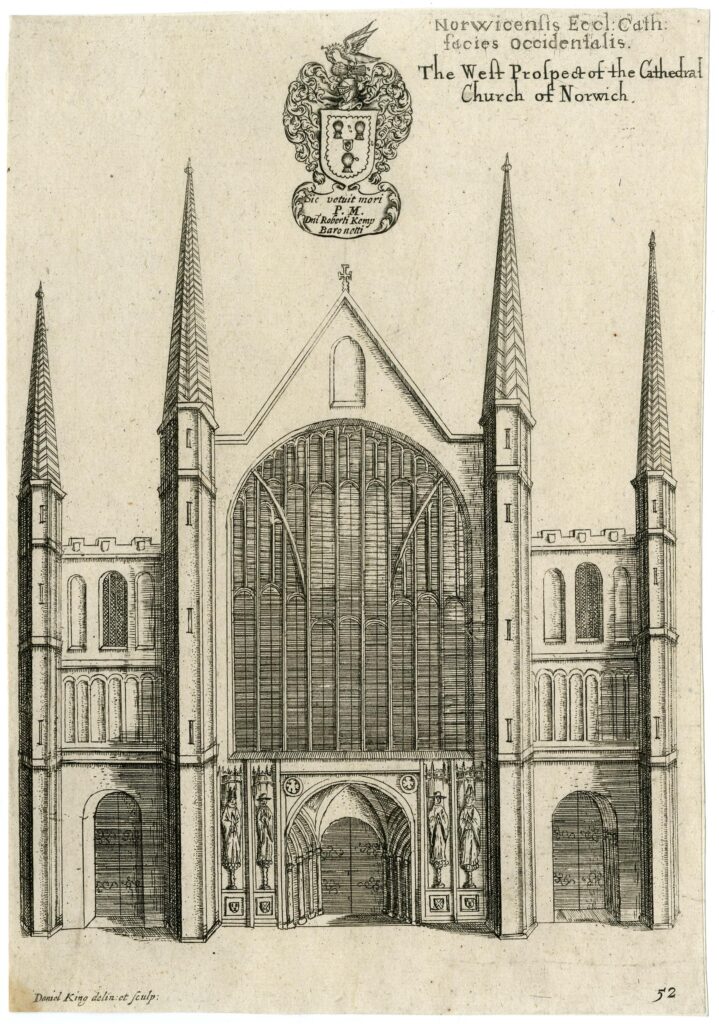
I’ve been thinking more about the west frontage of Norwich Cathedral, although I suppose there are worse things to overthink. Some people worry about careers, pensions and the long-term future of civilisation, but I have been thinking about where the spirelets of Norwich Cathedral have gone. The problem began when I found Daniel King’s seventeenth-century print of the west front, which shows a much more elegant and symmetrical arrangement than the one visible today.
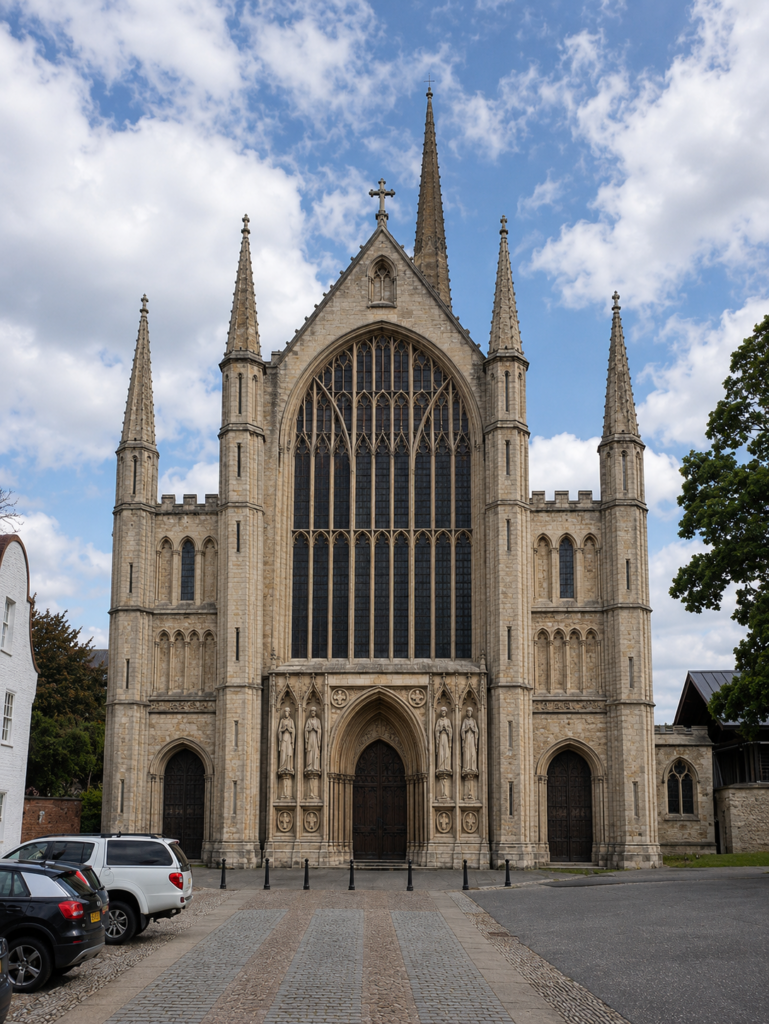
I therefore asked AI to help create a modern photographic impression of what the cathedral might look like if the frontage had retained more of the arrangement shown in King’s engraving. This took a little persuasion. AI understood “Gothic cathedral” very confidently, but was rather less enthusiastic about counting statues correctly, which is a minor drawback when the entire point is having two figures on each side of the doorway. Several attempts produced one statue either side, extra figures in odd places or something that looked like a confident cathedral that most certainly wasn’t from Norwich. It still has the main portal wrong as the door has been shrunk right down, but there’s a limit to how much time I want to spend debating the matter.
I’ve decided I definitely like it more as it was. But I feel that I’ve exhausted this line of worry now and I’ll just have to accept what’s there.
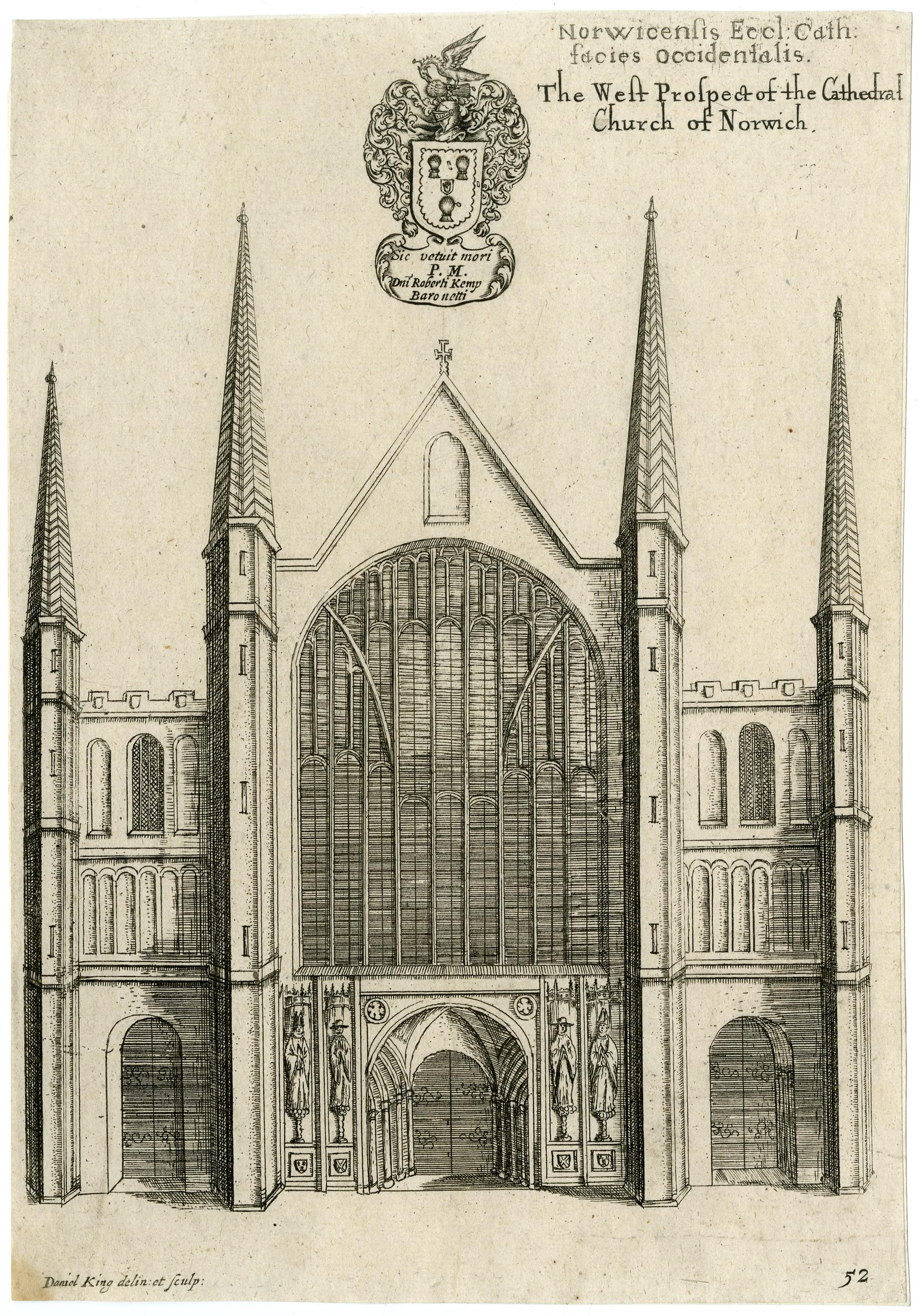
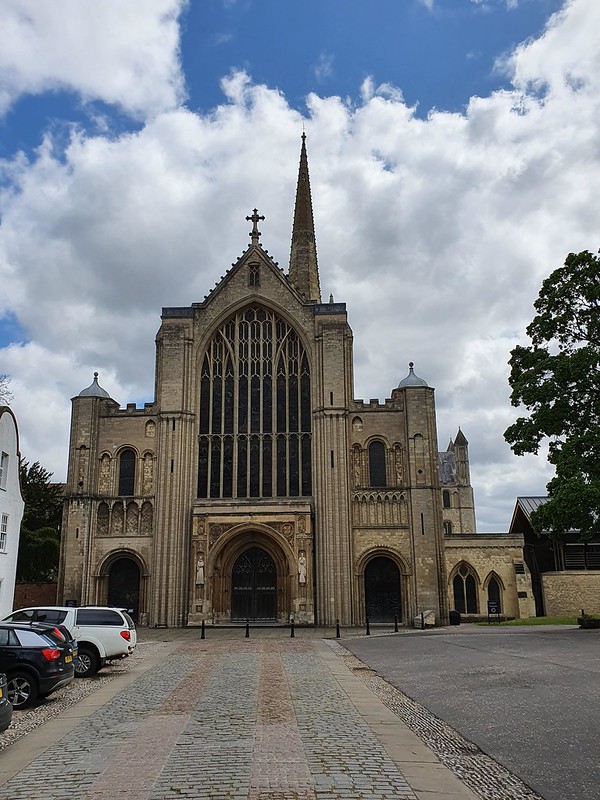
This is a photo of the west frontage of Norwich Cathedral that I took in May 2020, but it’s a view that I’ve seen thousands of times over the last few decades. And I’ve thought on many occasions that the design feels quite odd in places, but I’ve never given it much more thought than that because apparently even I have limits on how much time I can spend worrying about medieval masonry. Those limits have now been tested.
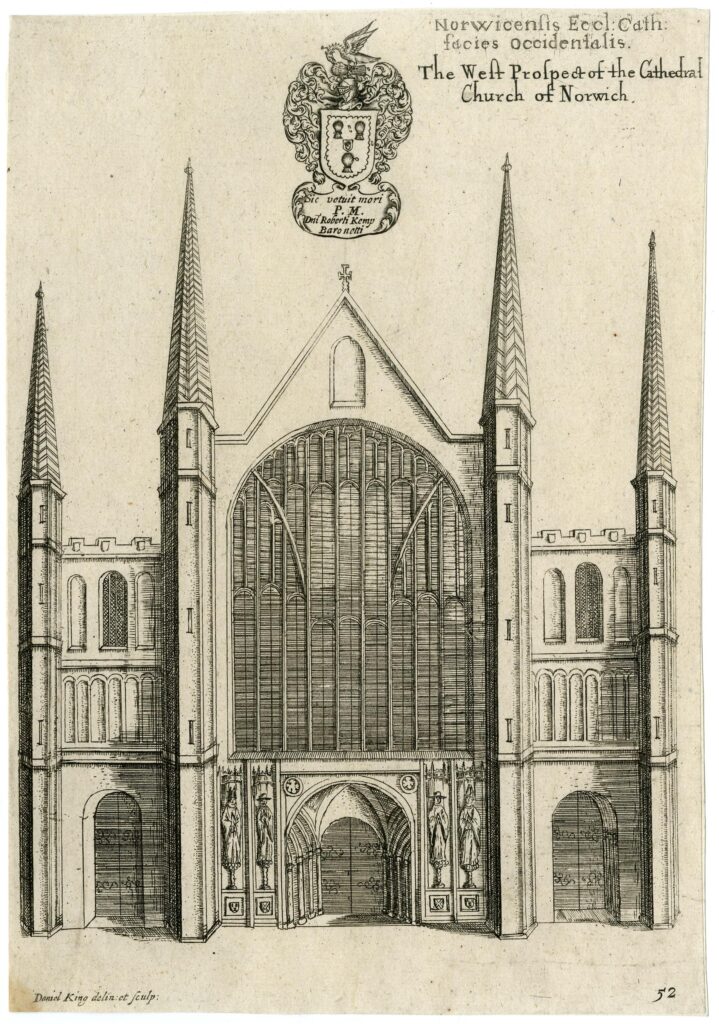
© The Trustees of the British Museum. Shared under a Creative Commons Attribution-NonCommercial-ShareAlike 4.0 International (CC BY-NC-SA 4.0) licence.
I’ve now found this image which is of the west frontage and although the date isn’t known, it’s between 1655 and 1725 and is from a print by Daniel King. This has surprised and delighted me, because this is in my view a much more beautiful frontage than what we have now.
I’ve pondered before, as I obviously don’t have enough sensible things to worry about in life, about why the windows in the flanking pillars aren’t symmetrical, but they originally were. And there were once two statues under the main window, but they knocked one of those out on each side when widening the pillar which means that the portal looks quite chunky. Inside the cathedral though, there are still two niches either side of the main door so they haven’t changed that.
And, both sides of the flanking towers were once similar designs, but they’ve faffed about with one of them. Not to mention where the nice little spirelets have gone. Probably the same way as Sheringham bus shelter, but that’s a different matter.
All told, I’m reassured that the designers of the original building had attention to detail and liked symmetry. I can’t work out exactly when they mauled the frontage about as there have been a few periods of change, but I’m going to blame the Victorians. This may not be entirely fair as some of the changes do predate that period, but I’ve found that it is often a productive starting point.

I rather liked this advertisement which was placed in the Norwich Mercury 200 years ago this month. It reads:
“TO THE LOVERS OF THE FINE ARTS.
THE Nobility, Gentry, and Public of Norwich and Norfolk, are respectfully informed, that a
Splendid Collection of ANCIENT PICTURES
Will be opened for Exhibition during the Assize Week and a short time succeeding, at the Assembly Rooms, Norwich.
The Paintings are selected from the Works of the most esteemed Masters of the Italian, Dutch, and Flemish Schools. — Among the former will be found a splendid Picture by Titian, in his early style, with others by Caracci, Pietro da Cortona, Canaletti, &c. &c. The latter will include fine Specimens of the most pleasing character, and of Cabinet size, of the following Masters: — Rubens, Rembrandt, Both, Pynacker, Netscher, Cuyp, Decker, Zorg, Schweikhart, B. Gael, P. Potter, Poelemburg, Stoik, Snyers, De Vlieger, &c. &c.
The Exhibition will be opened from Ten in the morning till Four in the afternoon.
ADMITTANCE — ONE SHILLING.”
The exhibition was aimed at “the Nobility, Gentry, and Public of Norwich and Norfolk” and I think it’s evident that they were expecting really only people from what they might have called at the time the educated and wealthy classes. And even within that the nobility came first, the gentry were safely in the middle and the public were graciously permitted to bring up the rear, provided they had a shilling and behaved themselves near the Titian.
This feels like an early art gallery type set-up, there are some quite impressive artists in that list and the Assembly Rooms would have been quite the cultural hotspot that week. A shilling would have been approximately the equivalent of £7 today. I also went to look into the etymology of the word ‘ancient’ and have ascertained that in the art world of the time, it just meant ‘Old Masters‘ as the paintings weren’t that old at the time.
The Assembly Rooms are still there and they have long been part of the city’s cultural centres, so in that respect not much has changed. It’s a shame I can’t find a list of what artworks were displayed though, it all sounds rather decadent.
The below article appeared in the Norwich Mercury 200 years ago.
“Doctrines of the New Jerusalem Church.
ON Sunday, July 9th, THREE DISCOURSES will be delivered at Crook’s Place Chapel, by the Rev. W. Mason, in which it will be shewn what are the views of the New Church in regard to the Quality of that Faith which justifies, and the true nature of Justification — Who the Lord’s Sheep are, and the Goats contrasted with them — and The Nature of the Christian’s Conquest, and the Rewards promised to the Conqueror.
Service to commence in the morning at half-past Ten, Afternoon at half-past Two, and Evening at half-past Six o’clock.”
The New Jerusalem Church was the Swedenborgianism religion and some of this story links to the St Mary the Less church on Queen Street which I’ve written about before. In short, that church was closed during the Reformation, then given to the religious refugees from the Netherlands to use as a cloth hall, with the building being used for services given in French until 1832. It was then leased to the New Jerusalem church of Swedenborgians who remained here until 1852 and they then moved to Park Lane to a building constructed for them. The church was already though in decline at this stage which is rarely the ideal moment to embark on a new building project and in the 1920s they transferred the building to the Mormons and although it was used by another religious group, it was then sold to become a private residential building. It was never fully converted into a home but is no longer used for religious purposes.
This article from 200 years ago tells a little of the story before the Swedenborgians moved to St Mary the Less, it appears that they were using Crook’s Place Chapel. This is in an area of the city that was changed heavily following the Second World War, but Crook’s Place Chapel appears to have been demolished in the 1880s. And back to the article, it’s an interesting look back that there would have been three services held that day for those interested in finding out more about the church. Those attending would have been no doubt fascinated by the discussions about faith, sheep, goats and conquest, but they probably got to have a nice little sit down.
There were concerns nationally about the stability of the Church of England, with the Church Building Acts of 1818 and 1824 trying to fund new Anglican churches. The Norwich Mercury article captures quite nicely this period of religious competition and general anxiety about picking the right religion.