Category: Norwich

  • Norwich – M&S Easter Eggs

    Norwich – M&S Easter Eggs

    Well, this is very lovely. 20p each…..

    Very restrained of me I thought.

  • London – British Museum (1787 Print of Norwich Cathedral by John Sanders)

    London – British Museum (1787 Print of Norwich Cathedral by John Sanders)

    I usually visit the British Museum three or four times a year, something which is a little difficult to do with the current virus situation, primarily because it’s shut. However, they’ve placed hundreds of thousands of images on their web-site, so this will have to do me for the moment. The images can be used non-commercially, as long as the British Museum is credited. So, this is their credit.

    This plate is from 1787 and has the beautiful Norwich Cathedral at the rear, whilst a donkey chucks a boy off its back, kicks a dog and then gets whipped by its owner. Eventful to say the least…. The plate isn’t on display and was acquired by the British Museum in 1873 from George Mason, who was a bookseller.

    I’m puzzled what that wall to the right is, there’s no obvious building on any overhead map from the period. It is though the site of whether Norwich Cathedral’s bell tower once stood, but this was torn down in the late sixteenth century and the bells flogged off. The building on the left is Norwich School’s chapel, the chantry chapel and college of St John the Evangelist which was built in 1316.

    And a photo from around the same spot today. Unfortunately, no donkeys were visible to liven proceedings up.

  • Streets of Norwich – Plumbers Arms Alley

    Streets of Norwich – Plumbers Arms Alley

    Part of my Streets of Norwich project….

    Located off of Princes Street, this small alley connects to Waggon and Horses Lane, taking its name from the Plumbers Arms pub which traded between the early nineteenth century and 1881.

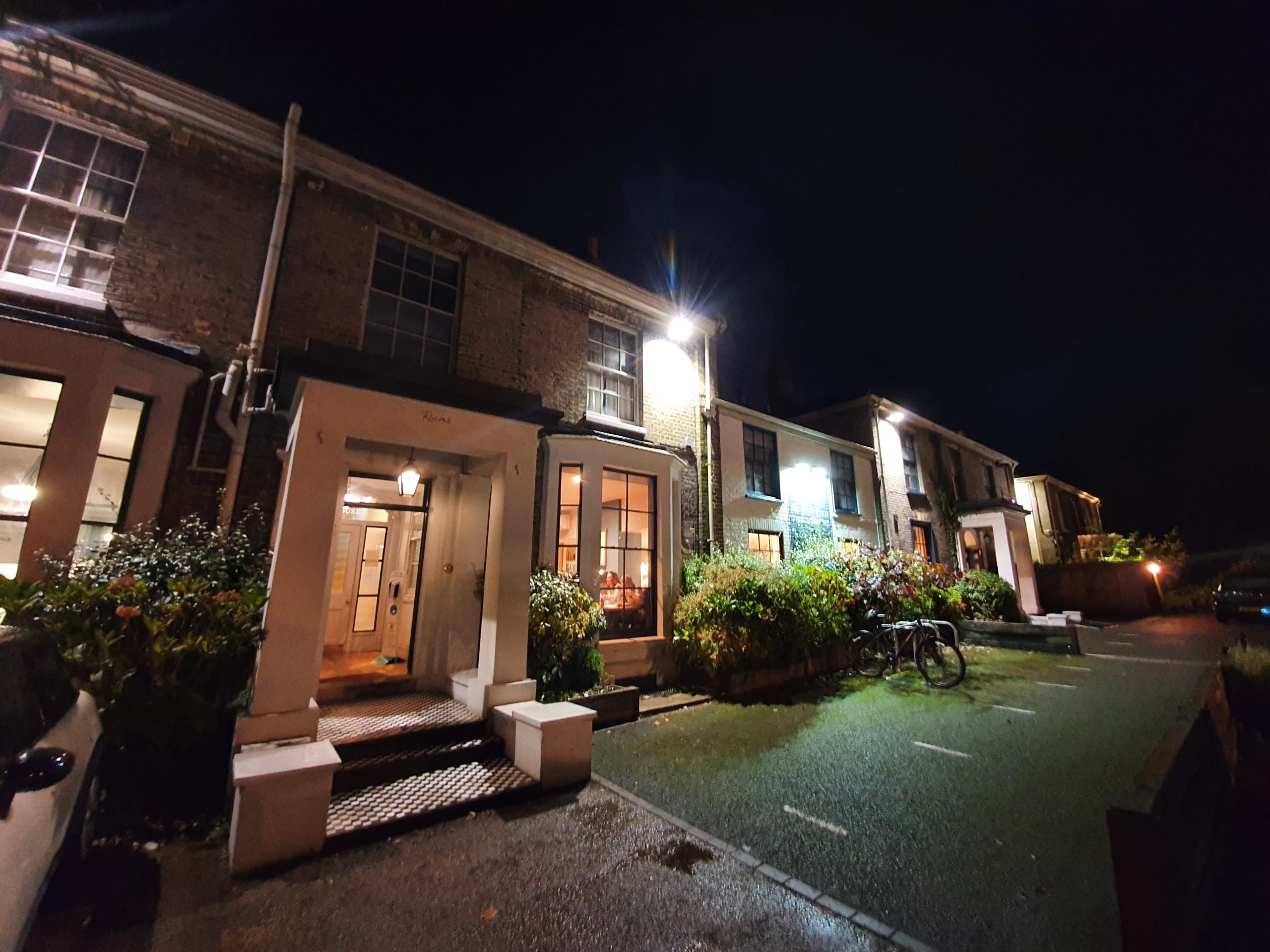
    The pub building still stands and is now trading as a restaurant, which doesn’t seem to make much of the structure’s heritage in their communications. But, the building is of importance, it has two undercrofts with one from the fifteenth and the other from the sixteenth century and it was originally constructed (albeit much changed since) in the fifteenth century as a residential property.

    Norfolk Museums Service have this drawing in their collection which was created by Percy Stimpson, looking back towards Princes Street.

  • Streets of Norwich – Barrack Street

    Streets of Norwich – Barrack Street

    Part of my Streets of Norwich project….

    Barrack Street at the beginning of the twentieth century and the road line is still there, although the junction at Cowgate is now a large roundabout. It’s named after the cavalry barracks that are still visible on the above map.

    Starting at the Cowgate / St. Crispins Road roundabout.

    St James the Less Church, which is perhaps better known today as Norwich Puppet Theatre. More on this church in another post, as I’ve been on a guided tour of the church and I have photos somewhere of that. This is pretty much all of old Norwich that has survived the mauling about of Barrack Street and the church looks a bit lost today.

    More recently, this has been a light industrial area with an ugly building facing the road. It’s now a housing development being built by Hill.

    At the moment, these buildings have been left looking rather forlorn. It’s the two white buildings at 77-79 Barrack Street that are interesting, they’re listed (which probably annoys the owners) and are terraced houses dating from the beginning of the nineteenth century. As long as no-one has nicked them, the interiors are also important, with a cast-iron hob grate within a timber surround and a rare fireplace inside them. The premises were used as a fish and chip shop until recently, they’re really not in a good state externally.

    Opposite these properties on the other side of the road is Bargate Court, but more on this in a later post.

    This is now the head office of QD.

    And the other side of the building and the paved area on the right is the entrance to what was once Pockthorpe Brewery, which was a substantial complex of buildings. When they built houses here in 1976, they did an archaeological survey and probably started with some high hopes of finding something new. The report stated “we revealed no finds or features of archaeological interest”. Thrilling. But best to check.

    A few years ago they pulled down some council housing, which was in perfectly good nick, and then left the site vacant for years. It wasn’t a good look…. It’s part of the same Hill housing development which is now finally under construction and it’ll be known as St. James’s Quay.

    Now a dentists, this was the Sportman pub from the early nineteenth century until its closure in 1995, when it was used as a solicitors. It replaced a pub of the same name which was located across the road.

    And yet more of the Hill site that will be housing in the next few years. There’s not a huge amount of history lost here, as previously it was a light industrial site for some time and before then it was a timber yard and wharf area.

    The former barracks site, now turned into generic looking housing. It’s a little unfortunate that they demolished the barracks in the 1960s, as the site would have made for an impressive museum location. Although the city council would probably only turned it into another bloody car park, so perhaps it’s better that it’s housing.

    The barrack site again, it was built on the site of Hassett House at the end of the eighteenth century and was known as Cavalry Barracks and then Nelson Barracks.

    Former barracks site on the right, there’s now a gym over on the left-hand side. Again, there wasn’t much here before, unlike the other end of Barrack Street, they haven’t demolished a load of housing.

    A pretty mundane looking wall which has been brightened, or worsened depending on your point of view, with some paint.

    This is a better looking wall, it’s from Hassett House.

    And, this was a former entrance to the barrack buildings, although it has been landscaped so there’s now nothing behind here other than soil. It’s also where the entrance to Hassett House would have been, and for a period of time, the tower over the other side of the Wensum River was known now as Cow Tower, but as Hassett Tower.

  • Streets of Norwich – Telegraph Lane West

    Streets of Norwich – Telegraph Lane West

    Part of my Streets of Norwich project….

    Leading on from Gas Hill, Telegraph Road is split into East and West, divided by Quebec Street.

    The entrance to the street from the Gas Hill end.

    St. Matthew’s Church.

    This is the only listed building, well structure, in this part of Norwich, which is the war memorial that was originally unveiled on 25 September 1921. It has been shunted about a bit as the church is new and some bloody idiot vandalised it, but it’s all been repaired and fixed up. The memorial commemorates 128 servicemen who lost their lives during the First World War.

    Like being in the countryside….

    That’s a slightly abrupt installation of a garage door onto the frontage of an older building. But, whatever works…

  • Streets of Norwich – Britannia Road

    Streets of Norwich – Britannia Road

    Part of my Streets of Norwich project….

    The first part of this road, when approaching from Kett’s Hill, consists of early twentieth century residential properties.

    Then things become a bit more exciting, with Norwich prison appearing in view. This was formerly the site of the Britannia military barracks, which is where the street takes it name from. The barracks were constructed between 1885 and 1887, with the Royal Norfolk Regiment remaining there until 1959. It was also initially built to be used as a prison and this opened in 1887, meaning that the prison at Norwich Castle could be closed and turned into a museum. When the military moved out in 1959, the prison took over those buildings as well.

    Until just a few months ago, this was the home of the Cafe Britannia, where prisoners were able to get customer service work experience. I’m not sure what happened, but the entire project collapsed, with the cafe being left empty (before Covid-19).

    The former entrance to the barracks. At this point, the road splits in two directions, one to the left and the other to the right, but both are apparently still named Britannia Road.

    The road to the left heads back down to Gurney Road, although is also where the road to the right goes to as well so it’d be hard for anyone to get too lost here. Although I can think of a couple of people I know who probably would.

    There’s quite a rural feel to this part of the road.

    As an aside, it’s worth walking down Britannia Road to get this view over the city.

    The prison from the viewpoint.

  • Streets of Norwich – St. John Maddermarket

    Streets of Norwich – St. John Maddermarket

    Part of my Streets of Norwich project….

    For some reason that I’ve never fathomed out, I’ve always liked this street, which is dominated by St. John the Baptist, Maddermarket Church and its sprawling churchyard. The name of the street is derived from the time that madder, which is a root that produced a red dye, was sold from the north end of the churchyard in the thirteenth century. From then on, the name has stuck and this street connects St. Andrew’s Street with Pottergate. More on the church in another post though…..

    The building on the left is number 21-23, two buildings constructed in the seventeenth century which have been two separate shops for some time, with the left-hand side property having once been a pub.

    I’ve been intrigued by this graveyard on the right-hand side, as it’s raised up and I know that in York and in other cities this was simply because they kept trying to put burials in the space they had, and the ground level rose. However, the church itself is also higher, because it was fitted into a limited amount of land. But, having written that, there was an archaeological dig which found bodies from the seventeenth century underneath now what is the above road, so the graveyard was once lower.

    I hadn’t noticed this until today, it’s a water pump from the nineteenth century which is made out of iron and is now missing its handle.

    A view down the street towards St. Andrew’s Street.

    Another thing that I haven’t noticed before, this notes where the Golden Lion public house was located between 1783 and 1965. It was also the location of Golden Lion yard, which was also swept away when the pub was demolished.

    This is where the pub was. Replaced by yet another bland and generic building. Although to be fair, there’s a photo of the pub here and it didn’t look that exciting either. But I prefer the look of the pub.

  • Streets of Norwich – Rigbys Court

    Streets of Norwich – Rigbys Court

    Part of my Streets of Norwich project….

    Rigby’s Court, which is the small lane which leads from Bethel Street to St. Giles Street. There’s a small plaque (below) which is on the right-hand side property.

    The lane takes its name from Dr. Edward Rigby (1717-1821) who was the Mayor of Norwich in 1805 who lived in the building. As the plaque notes, “he was associated with the Norfolk and Norwich Hospital for fifty years from its foundation in 1771, and was responsible for introducing vaccination into the city”.

    There’s an opened up area along the lane, which are numbers 4-9. Number 4 was made a listed building in 1972, although I’m unsure why, it’s marked as being an early nineteenth century residential building that is now offices, of which Norwich has many…..

    The building on the left, number 3, is an early nineteenth century residential property which became a printers and looks like it’s back to being a residential property again.

    Not much has changed since the 1880s, although before 1850, it was known as Pitt Lane.

  • Streets of Norwich – Queen Street

    Streets of Norwich – Queen Street

    Part of my Streets of Norwich project….

    Queen Street is located off of Tombland and connects with Redwell Street. I’m omitting one building of interest on this street from this post, which is the Church of St. Mary the Less, which has an intriguing story of its own.

    This is the Old Bank of England Court. The building to the right-hand side of the court is a former residential property built in the late seventeenth century, which is now used as offices. It is also where the offices of Edward Boardman were once located, a well-known (well, locally, I don’t think he was an international superstar in the nineteenth century) Norwich architect. The building to the left-hand side of the court is similar in once being residential, although was first built in the early eighteenth century.

    The name of the court is because the Bank of England had offices here between 1826 and 1852, a regional location to try and bring some stability to the country’s banks, which had gone through a period of instability. They gave up with that idea in the 1850s, which the Bank of England operations being centralised back in London.

    This is handy at the Boardman Building at the Bank of England Court (which is a different location to the nearby Boardman House), the history of a building on a panel at the front. More places should do this.

    Looking back down Queen Street towards the Ethelbert Gateway, with the Church of St. Mary the Less visible on the left-hand side.

    The building on the left is Seebohm House, the former Haldinstein’s Boot and Shoe Manufactory, which later became the Bally shoe factory.

    Another view of Seebohm House, with the large gateway.

    Norwich Brewdog, I wish it was open as usual…..

    Brewdog is at 1 Queen Street, which was built as a residential property in the late seventeenth century, although it retains its fifteenth century undercroft. It has been a licensed premises since the beginning of the twentieth century, with CAMRA noting that over the last few decades that it has traded as “Hideout, Knowhere, Noir, Indulge, Hogshead, City Ale & Wine Bar, Gundry Whites Cafe Bar, Drummonds and Whites”. And as I’ve learned to love Brewdog, so hopefully it’ll stay there for some time….

    Next to Brewdog is the Bank of Scotland at number 3 Queen Street, which also has a fifteenth century undercroft.

    This is now Revolución de Cuba, which is the sister bar to Revolution, which is located over the road. I remember this as Yates, although it has been a Slug and Lettuce.

  • Streets of Norwich – St. George’s Street (Colegate to Blackfriars Bridge)

    Streets of Norwich – St. George’s Street (Colegate to Blackfriars Bridge)

    Part of my Streets of Norwich project….

    St. George’s Street is a little complex as chunks of it have been renamed over the centuries and the route at the north has changed. And, it once wasn’t called St. George’s Street, it was instead known as Gildengate and it runs along the line of a Viking defensive ditch and bank which was constructed in around 900.

    As it’s such a long street, this post is just the section between Colegate and Blackfriars Bridge. Moderately surprisingly for such an historic street, there’s only one listed building in this section of road, suggesting how much the buildings have been mauled about and demolished over the last couple of centuries. This section of the street was probably more often known as Bridge Street in the nineteenth century, rather than St. George’s Street.

    This was historically a built-up area of the street, but is now St. George’s Green. Near to the river, the Blackfriars Tavern was a pub which traded between the mid-eighteenth century until its final closure in 1911. It was also known as the Cellar House and the Friars Tavern, and probably overlooked the river.

    Norwich Playhouse, which is housed in what was built as a nineteenth century maltings building, which became a theatre in 1995. This former building is set back a little, with the roadside section once taken by the Crown public house, which closed in 1928.

    A former shop, now used as offices. Somewhere behind these buildings there was a pub known as the Cork Cutters Arms, which was a licensed premises between around the early 1860s until 1898.

    Cafe Pure on the right-hand side.

    The Last Wine Bar on the left. Somewhere on the left-hand side of the photo was the Two Quarts pub, which traded between the 1760s and was closed down in 1907. It sounds like a pub of some considerable character and it had rooms to rent.

    The building to the left, numbers 25, 27 and 29, are the only listed properties on this section of the street. They date to the sixteenth century, which were added to in the eighteenth and nineteenth centuries, although the shopfronts are from the nineteenth and twentieth centuries. The frontages of the buildings have been heavily restored, the photos George Plunkett took in the 1930s show much more character. Although the buildings would have probably fallen down if they weren’t restored…. Number 25 was a cafe for quite a period, run by Alfred and Emily Aldridge in the late 1930s and all of 25-29 is now By Appointment, which I think was a cafe and is now a hotel.