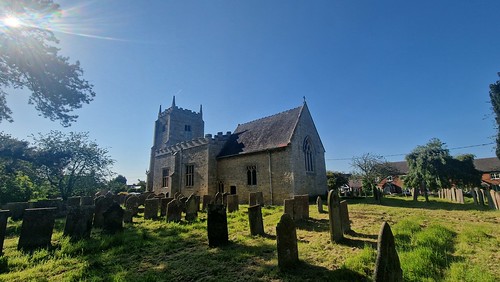
This Grade I listed church in the Lincolnshire village of Carlton-le-Moorland has elements dating from as early as the eleventh century and reference was made to it in the Domesday Book. The bulk of the structure today is from the sixteenth century rebuild and the 1890 reconstruction overseen by C Hodgson Fowler.
Being very different in design, the chancel’s roof dates from the sixteenth century and the nave’s roof dates from the nineteenth century. The church wasn’t open when we visited, but the listed building record notes that screen is from the the fifteenth century, the wooden pulpit from the eighteenth century and the pews are from the nineteenth century. There are tablets inside the church which are memorials to the Disney family, dated 1595 and 1611.
Some of the church graffiti.
The church’s lychgate was unveiled in October 1920, built at a cost of £174 to commemorate those villagers who had lost their life during the First World War.
Located outside of the church, this is one of the fountains which were placed around the local area.
At some stage of this pub’s history, although not recently, someone thought it would be a marvellous idea to brick up the frontage of the building. I’ll refrain from making comments on their design choices, but it doesn’t look the most inviting of pubs from the exterior. Or, to put it another way, it looks like it has been turned into a residential property.
The building dates from the sixteenth century, although I know little more than that, but there were once two pubs in the village. More recently, in 2016, the landlady of 21 years, Heather Richmond, retired from the venue to enable her to travel around the world which sounds a marvellous idea. Fortunately, the pub wasn’t lost to the community as it was taken over by new owners who also sensitively refurbished the interior.
I did note the lack of “day” from Monday which marginally upset my sense of order for just a brief moment. The opening hours are a little limited, but Carlton-le-Moorland is a relatively rural Lincolnshire village and this must be what works for them in terms of customer numbers.
Unsure of which door to enter from, although I don’t think it matters, we walked through a dining area and I wasn’t entirely sure that the pub was even open. When we got to the bar there was silence which made me wonder whether we were about to be asked to leave and return when they were actually open, it was a slight relief when we were politely asked what drinks we’d like.
They had a keg beer from Timothy Taylor’s, the Hopical Storm Pale, alongside two real ales, including the Lion’s Pride from Milestone Brewery and Timothy Taylor’s Landlord. Mine was the first check-in to Untappd for a year, so it’s rather difficult to tell what other ales they’ve been serving over recent months. The service was welcoming and efficient, but I suspect that this is something of a locals’ pub outside of food service times.
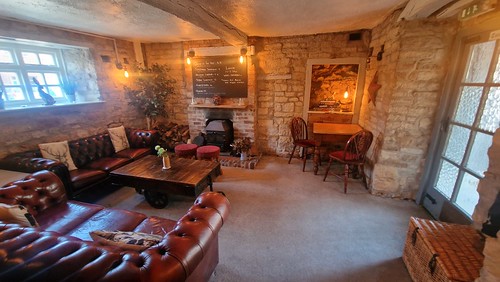
We decided to sit in the garden area, but I have to note how cosy the interior looked as we walked through it. There’s some considerable heritage here behind the bricked-up front entrance.
It was a beautiful day outside with the sun shining and the beer garden looked warm and inviting.
But, I don’t like the sun, so I made Liam sit in the sheltered bit so I didn’t overheat.
All was well with the Lion’s Pride, a local beer brewed in Newark, a well-kept session bitter.
This is very much a food pub, although drinkers are welcome and the outdoor space is relatively expansive and there’s some playground equipment for children. The venue is well reviewed and seems to surprise and delight many customers, although not quite all, with its Sunday lunches. All rather pleasant, particularly during the summer months when the garden feels an appropriate place to sit and I’m sure that it offers a cosy interior during the colder winter months.