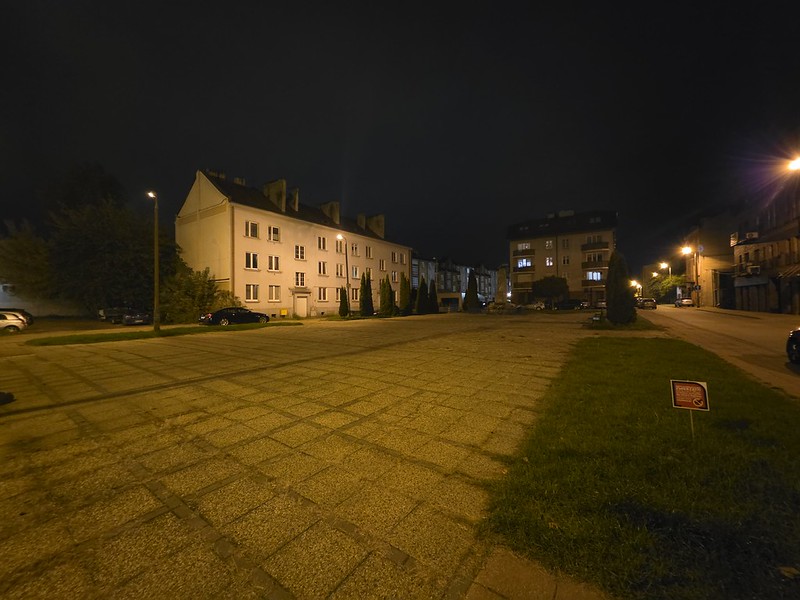
I wanted to see this square in Radom, located at Bożnicza and Podwalna streets, as it is where the city’s main synagogue once stood. Apologies for the quality of the photographs, as the lighting wasn’t particularly helpful, but I wanted to record the location and its history. Before the Second World War, Radom had a substantial Jewish community of around 30,000 people, representing approximately one-third of the city’s population. Jewish residents played an important role in local commerce, manufacturing and cultural life, with their own schools, religious institutions, political organisations and charitable societies. The synagogue, built in 1844, was at the centre of this community, serving as a place of worship and religious education. It was a substantial brick building with a central prayer hall, supported by four wooden columns beneath a raised roof structure. By the late 1930s, however, Jewish residents were also facing growing antisemitism and economic difficulties, even before the catastrophe that would follow the German invasion.
German forces occupied Radom on 8 September 1939, and persecution of the Jewish population began almost immediately. Jewish businesses and property were confiscated, residents were subjected to violence and forced labour, with restrictions being imposed on everyday life. In April 1941, the German authorities established two ghettos, one in the city centre and a smaller one in the Glinice district, confining approximately 32,000 Jewish people in overcrowded and increasingly desperate conditions. Food shortages, disease and violence became part of daily life. In August 1942, the Germans began liquidating the ghettos, deporting thousands of residents to the Treblinka extermination camp, where they were murdered. Others were killed during the deportations or forced into labour camps, with some subsequently transferred to concentration camps elsewhere in occupied Europe. By the end of the war, the Jewish community that had been such an important part of Radom for generations had been almost entirely destroyed.
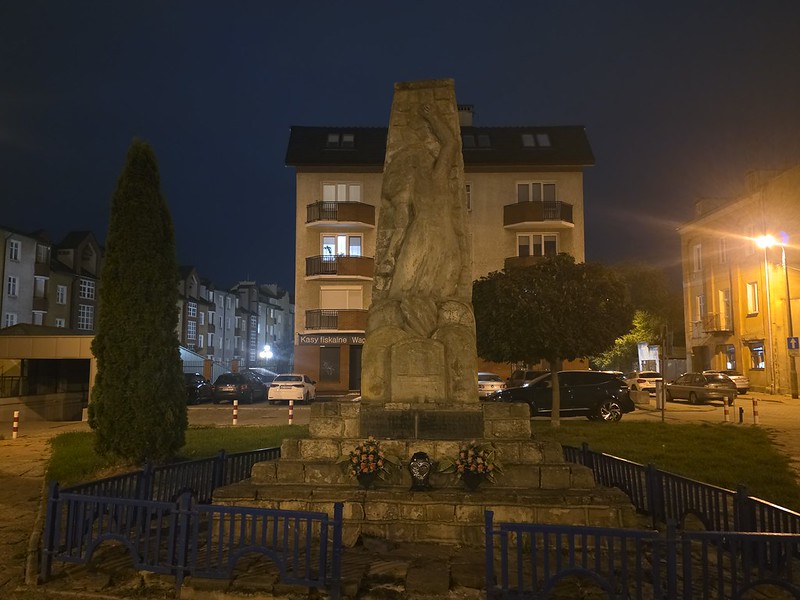
The synagogue itself was another casualty of the occupation. Following the German takeover of the city in 1939, it was closed and its interior was destroyed. During the occupation, the building was also used as a quarantine facility for people who had been exposed to typhus in the ghetto. The structure was left in ruins and demolished after the war, with the site remaining an open space rather than being redeveloped. In 1950, a memorial to Radom’s murdered Jewish population was erected here, designed by Jakub Zajdensznir, a local Jewish artist. The monument incorporates material associated with the destruction of Jewish heritage and carries an inscription commemorating the victims of Nazi crimes. It stands where the synagogue once served a thriving community, although little of the original building or the surrounding Jewish neighbourhood remains visible today.
The end of the war did not bring an uncomplicated return to normality for Radom’s surviving Jews. Some returned to the city, while others arrived after surviving concentration camps or spending the war elsewhere. During 1945, a Jewish committee was established, along with a prayer house and facilities to support those attempting to rebuild their lives. However, antisemitism and violence continued, including attacks on Jewish residents in Radom itself. The murder of four Jews in the city in August 1945, followed by the Kielce pogrom in July 1946, contributed to a growing sense that remaining in Poland was unsafe. Many survivors emigrated or moved elsewhere, and the Jewish population of Radom declined rapidly. By 1947, fewer than 100 Jewish residents remained, a remarkable and tragic change from the tens of thousands who had lived here only a decade earlier.
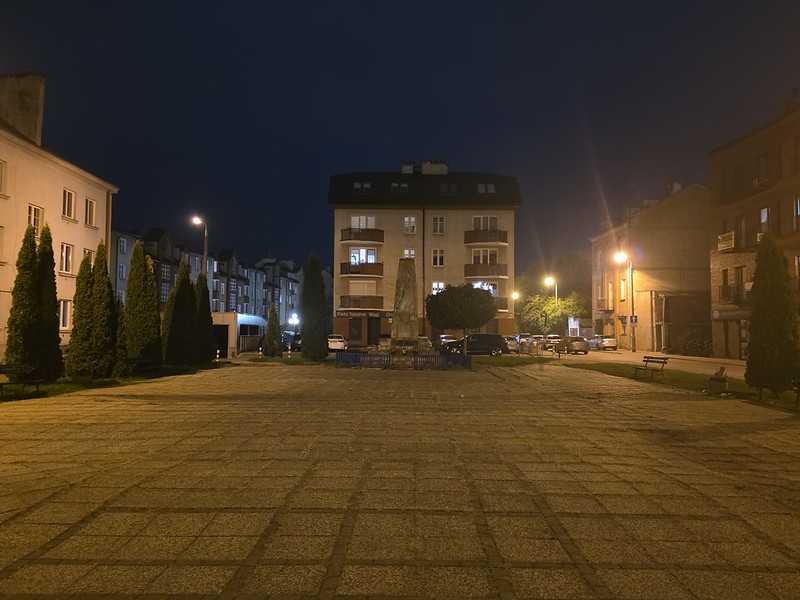
The memorial was unveiled in August 1950, with members of the remaining Jewish community attending what became one of their last significant public gatherings in Radom. The square today is a relatively ordinary urban space, surrounded by residential buildings, parked cars and streets that continue to serve the modern city. Without knowing its history, it would be easy to walk past without appreciating what once stood here or the scale of the loss it represents. I found it particularly striking that a community which had accounted for around a third of Radom’s population could disappear so comprehensively within such a short period.
I was pleased to have made time to visit this memorial, which I thought was sensitively designed. It was particularly interesting to see the four surviving column bases from the synagogue, while the monument itself incorporates rubble from the demolished building. I’m glad that the site has been left undeveloped, preserving a space in the city to remember the thousands of Jewish residents who once lived here and the community that was almost entirely destroyed.