Category: Bijelo Polje

  • Balkans Trip Day 6 – Belgrade to Podgorica Rail Journey (Part 2 to Podgorica)

    Balkans Trip Day 6 – Belgrade to Podgorica Rail Journey (Part 2 to Podgorica)

    We safely arrived at Bijelo Polje which I’ve wittered on about in my previous post and this is where we changed trains to get to Podgorica.

    It’s fair to say that this didn’t look like the most decadent train that we were switching to.

    The passengers began boarding with considerably more enthusiasm than the appearance of the train appeared to justify.

    It was a compartment train and the rail operator hadn’t really burdened themselves with cleaning it. It was quite hot, but fortunately for those of us sitting by the window there was some cooling going on, so that improved matters a little.

    The views were impressive and I should mention at this stage a little more about the Belgrade to Bar railway line. This line was conceived in 1952 as one of socialist Yugoslavia’s grand national projects, intended to connect the federal capital directly with the Adriatic coast. Serbia and Montenegro were each responsible for constructing their sections, which opened gradually between 1958 and 1976, so there was obviously no great hurry.

    The final rails were joined south of Kolašin in November 1975 and President Josip Broz Tito formally opened the completed line on 28 May 1976, with electrification following in 1977. Building its 476 kilometre route through the Dinaric Mountains required 254 tunnels and more than 400 bridges, making it Yugoslavia’s most expensive infrastructure project and it was evident from the terrain just how challenging this must have been.

    The short section passing through Bosnia and Herzegovina was the location of the Štrpci massacre in 1993, while parts of the Serbian route were badly damaged during NATO’s bombing campaign in 1999. Years of underfunding allowed the track and equipment to deteriorate, contributing to slower services and culminating in the Bioče derailment in Montenegro in 2006, which killed 47 people. Reconstruction of the Serbian section began in 2016, but trains still take substantially longer than the approximately seven hours achieved when the complete line was new. But at least it is working again and it offers some of the more beautiful views that I’ve seen from a train.

    We shared the carriage with a group of friendly young Germans who were heading off on a long walking trip. We encountered them again the following day, but more of that in another blog post as I maintain my increasingly complicated network of narrative cliffhangers.

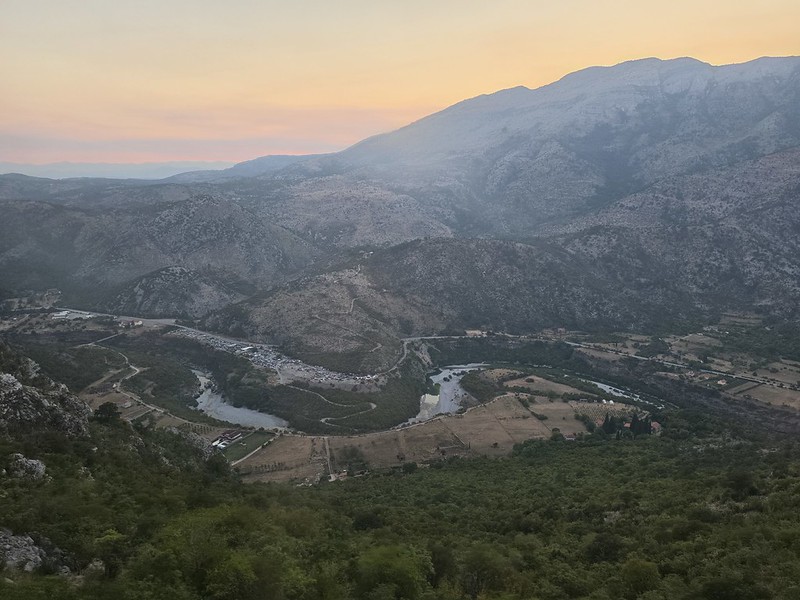
    The large window on the side of the train gave extensive views of the valley as we started to approach Podgorica, it really was quite beautiful. This sort of view went on for much of the journey, it wasn’t just for a short stretch, all something of an engineering marvel. By this time I had long since eaten all my snacks that I had acquired in the morning, but fortunately still had sufficient drinks to keep me hydrated. This train wasn’t blessed with anything like a vending machine and it was something of a clunky beast that made all manner of noises as it trundled down the track. This wasn’t a long rail journey, it took around three hours and so was shorter than the first section.

    I struggled to open the door when it was time to leave, but another passenger and Jonathan came to my assistance. It required what I considered to be an unreasonable amount of physical effort, although everyone else appeared to regard it as the routine operation of a door.

    The locomotive that got us safely to Podgorica. We were on time and I was ready to go and walk the 100 metres to my hotel before we had chance to head into the centre of the city.

    The two trains had provided a rather lovely experience and the total fare of around £20 felt exceptionally reasonable. It was my first proper visit to Montenegro and the first time I had experienced border controls taking place before the train doors were unlocked. The journey had beautiful views, fascinating history and a splendidly rickety second train that made enough noises to ensure that no-one became complacent about reaching Podgorica. A marvellous and memorable experience.
  • Balkans Trip Day 6 – Belgrade to Podgorica Rail Journey (Part 1 to Bijelo Polje)

    Balkans Trip Day 6 – Belgrade to Podgorica Rail Journey (Part 1 to Bijelo Polje)

    I’ve already written about the railway station that is now known as Belgrade Center and here’s our train arriving at the platform only ten minutes later than scheduled. The train had three carriages and Jonathan had warned me that there was no buffet car or food option on board, so I was carefully carrying my snacks. The rail service goes all the way to Bar on the coast, but we decided only to go as far as Podgorica as we didn’t want to arrive late at night.

    There were seat reservations on the tickets but websites said that they were widely ignored, so we ignored them and so did numerous other passengers. Some passengers demanded their seats from other passengers, a guard appeared and there was some movement around the train, but Jonathan and I found seats that we liked and stayed in them as no-one laid claim to them.

    It transpired that the train got quieter and so we moved down to a quieter carriage where I could eat my snacks and Jonathan could throw bread all over the floor or whatever he was doing.

    This is Valjevo, which was struck during NATO’s 1999 bombing campaign against the Federal Republic of Yugoslavia.

    This is Kosjerić and it’s an active railway station, although the building looked abandoned and appeared to have been extensively vandalised.

    The train crossed through the town of Užice. This was the centre of the short lived Republic of Užice, a large area liberated and administered by the Yugoslav Partisans during the autumn of 1941.

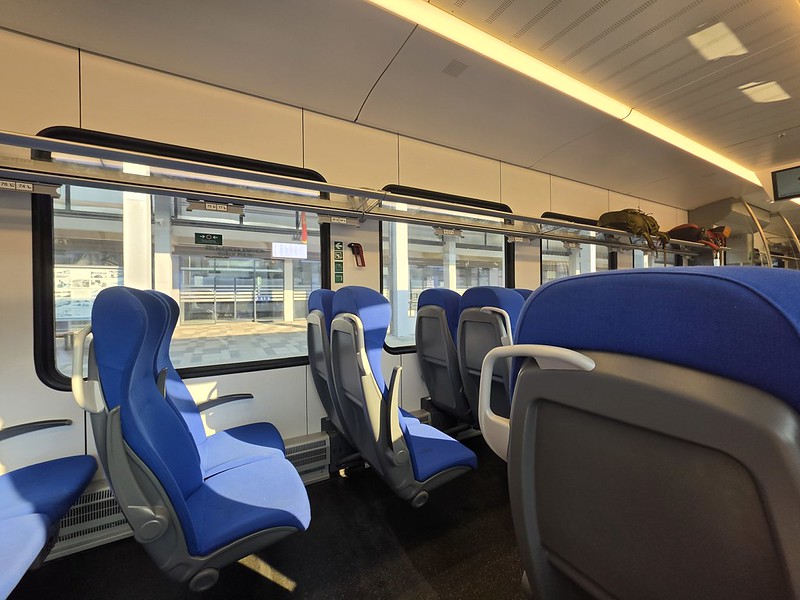
    The seats were broadly comfortable, there was power available and the train was air conditioned so that delighted me. Our tickets were checked a couple of times, but that was efficient as they just scanned the QR code and all was well. There was a vending machine on board, similar to what we had experienced on Georgian trains earlier in the year.

    Passing through the railway station at Branešci.

    This reminded me of some of my journeys across the United States on Amtrak trains in terms of the scenery and slightly slow pace.

    The scenery was already beautiful and became increasingly dramatic as the journey continued. The railway briefly passes through Bosnia and Herzegovina near Štrpci which was quite exciting as it was technically the first time that I had visited this country. However, since I was visiting the country properly later on in the trip, I decided not to count it.

    The train was nearly empty towards the end of the journey, so there was plenty of space. There was Wi-Fi during the journey, although as we crossed into Montenegro I could use roaming so matters improved somewhat.

    We arrived at Bijelo Polje railway station in Montenegro which was the end of the line for this particular train and we were greeted by a man selling cans of drink from his bag. We weren’t tempted, but another passenger was until he realised that this guy wanted €6 for a beer. He didn’t sell much.

    After that we had a passport check from Serbian border control and then their colleagues from Montenegro, with the doors of the train then being opened after the formalities were complete. I realised Jonathan’s passport is a bit dilapidated and I was excited to see if he would be arrested, but he wasn’t, although that would have made for a suitably exciting blog post. Despite another two walks through the train by the drinks seller, the €6 beer remained in the bag, suggesting that even a captive railway audience has its limits.

    It was then time to switch trains for the second part of the journey, but more of that in the next riveting instalment. I also have numerous videos of sections of these journeys, but that’s something to delight my two loyal readers with later on.