[I originally posted this in July 2018, but have reposted it to fix the broken image link]
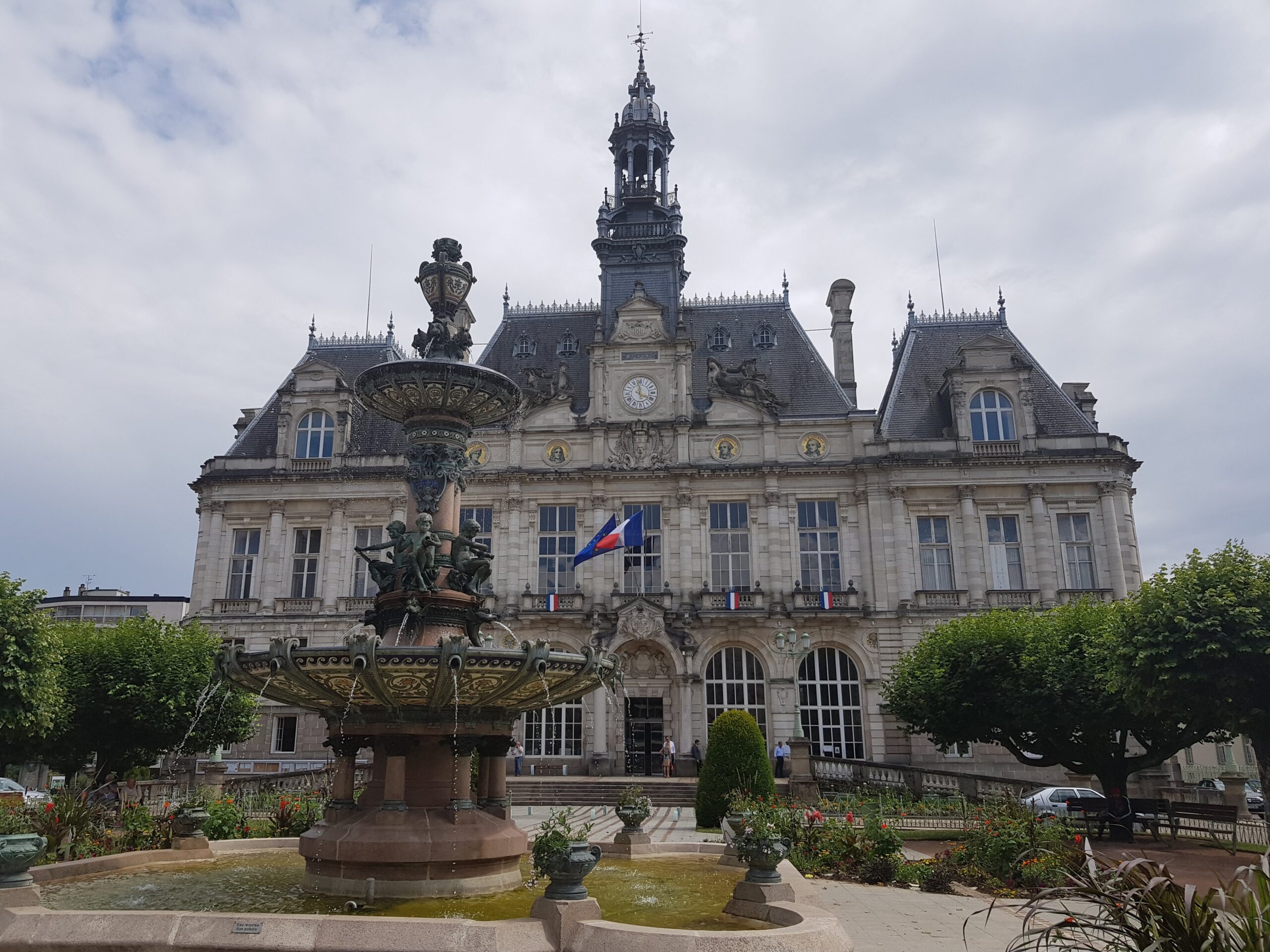
After the end of a very lovely week, it’s now time to go back to the UK (albeit rather briefly). Limoges (the above photo is of the city hall) is a beautiful place and everyone seemed friendly and helpful. My trip to Oradour sur Glane will also live with me for some time, a haunting memory of the horrors that took place there.
And on that helpful theme…. The bus service doesn’t run to the airport in the mornings, so I thought that I’d risk getting to the airport only two hours early (I consider that cutting it fine). To do that I needed to get a bus to a point around twenty minutes walk away from the airport, which seemed much better than the two hour walk that I had to get to the centre of Limoges.
Anyway, I get on the bus and the driver is exceptionally helpful, even with my English mauling the pronunciation of the French locations. So we’re sailing into near where my stop was and I press the button to get off. The driver ignores the bell and smiles at me, and the next thing I realise he’s taken me to the airport itself. I could well do without that twenty minutes walk at the moment, so that’s a real help to me. His other passengers seemed confused and he had to spend time to explain the situation, but they didn’t seem too irritated at the English person messing up their schedule. So, more smiles, lots of thanks, shaking of hands and I’m at the airport nice and early.
[I originally posted this in July 2018, but have reposted it to fix the broken image links]
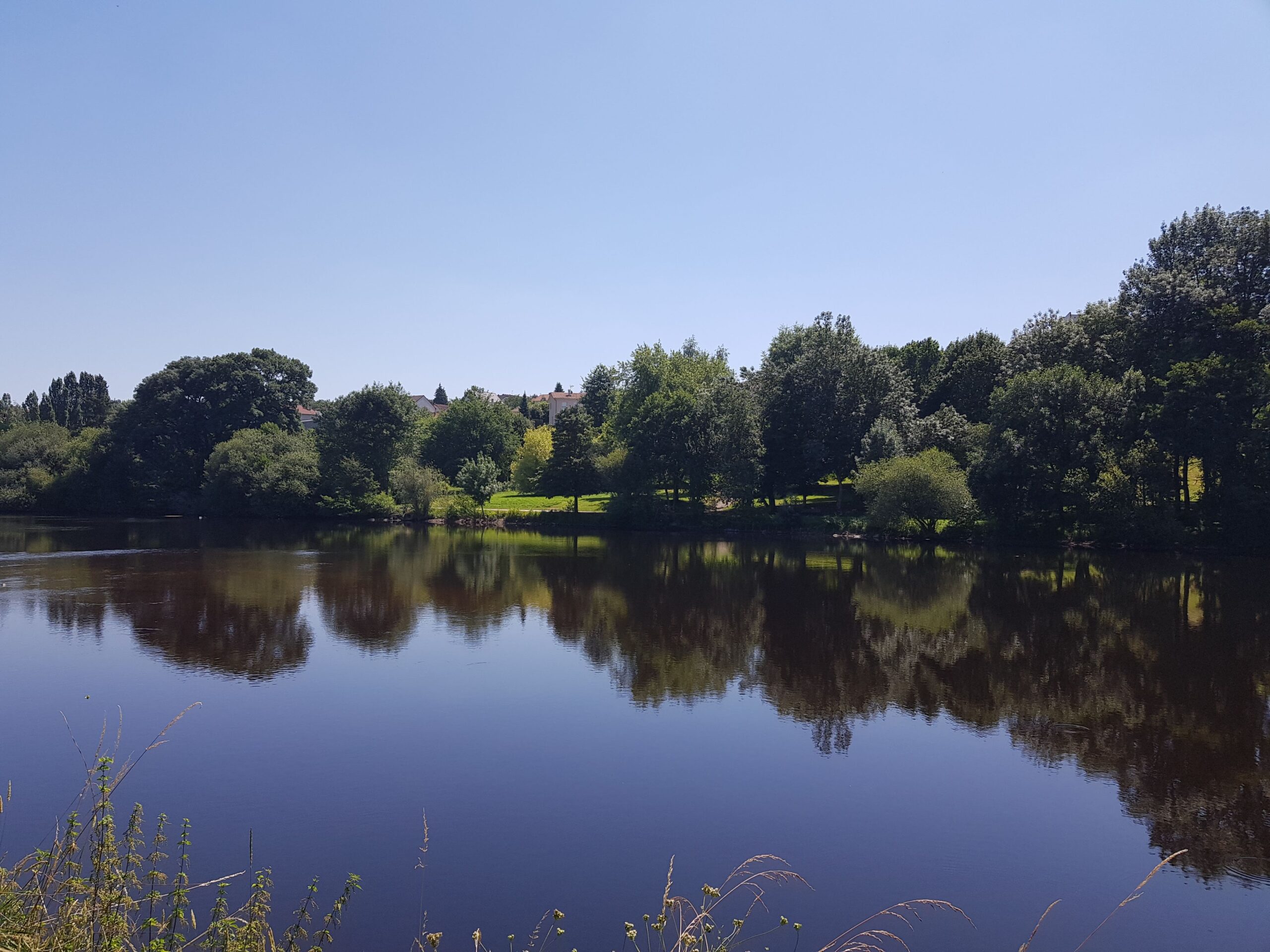
Earlier in the week I thought it’d be a nice idea to walk from Pont Saint Martial along the river. I didn’t walk very far as it was too hot, but I’m sure it would have made for a rather picturesque walk in slightly cooler weather.
There were lots of fish in the river, and fortunately I didn’t see any snakes.
Fortunately there were numerous benches to sit on and look at the view as I couldn’t walk too far at a time in the heat.
Very peaceful (and if I haven’t mentioned it, very hot).
[I originally posted this in July 2018, but have reposted it to fix some broken image links]
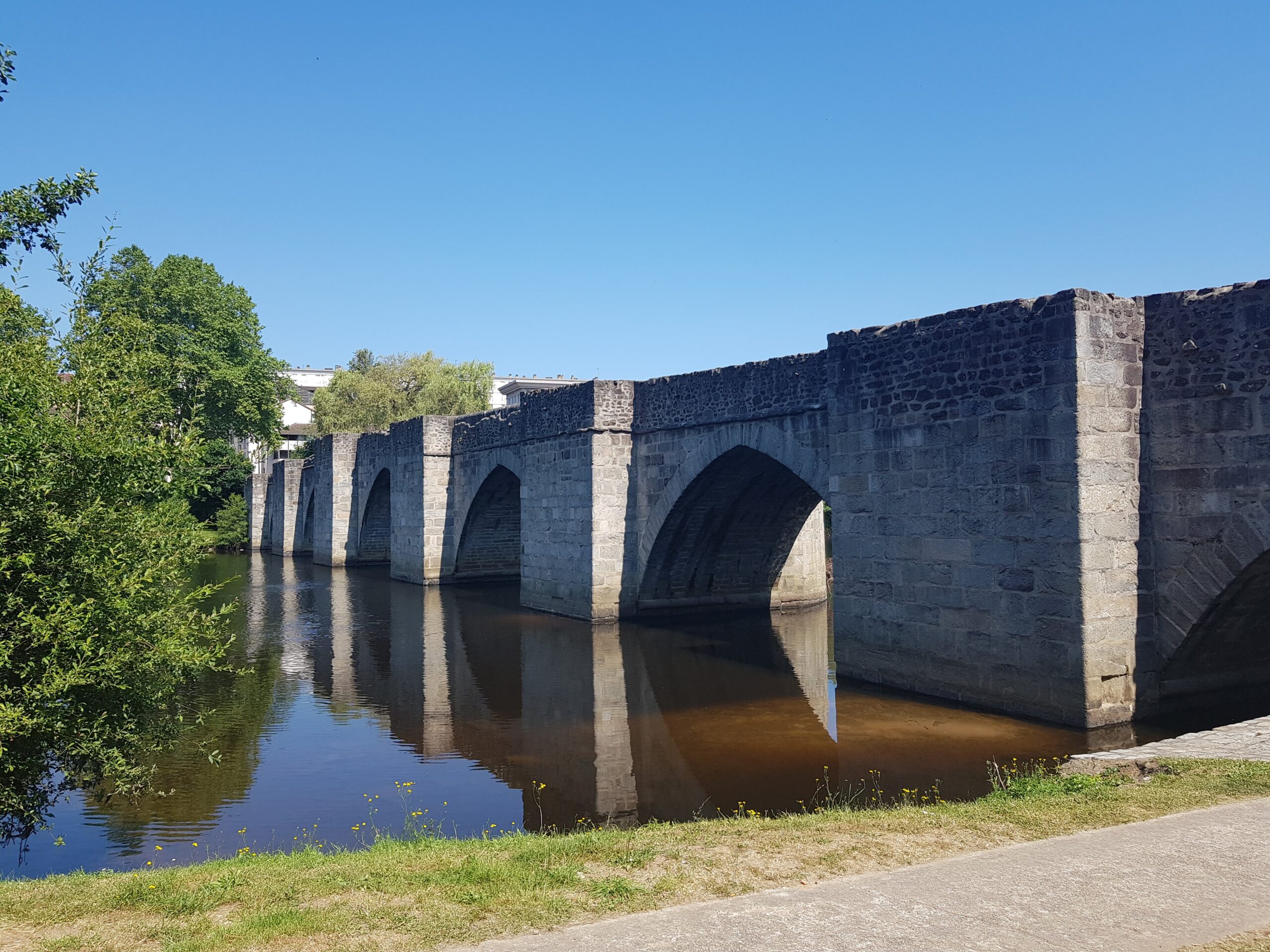
One of the most beautiful pieces of medieval architecture still remaining in Limoges is the Pont Saint-Martial, which crossed the Vienne river. The stone bridge dates to 1215 and it replaces a much earlier Gallo-Roman bridge. Sadly this was torn down on the orders of King Henry II, showing just what a long history of trouble making there has been between France and England. All now resolved of course….
A view down the river of what I think is the Pont Neuf bridge.
A view from the bridge, which today carries only pedestrians and cyclists.
The bridge is one of the few crossing points for pedestrians over the river in this area, although it’s a rather lovely walk along the river bank.
There’s a photo on the river bank of what the bridge used to look like. Which is pretty much what it looks like now….
The bridge became a listed historic monument in 1908, and it’s sort of noticeable from the photo how different the lengths of span are along the structure.
[I originally posted this in July 2018, but have reposted it to fix the broken image links]
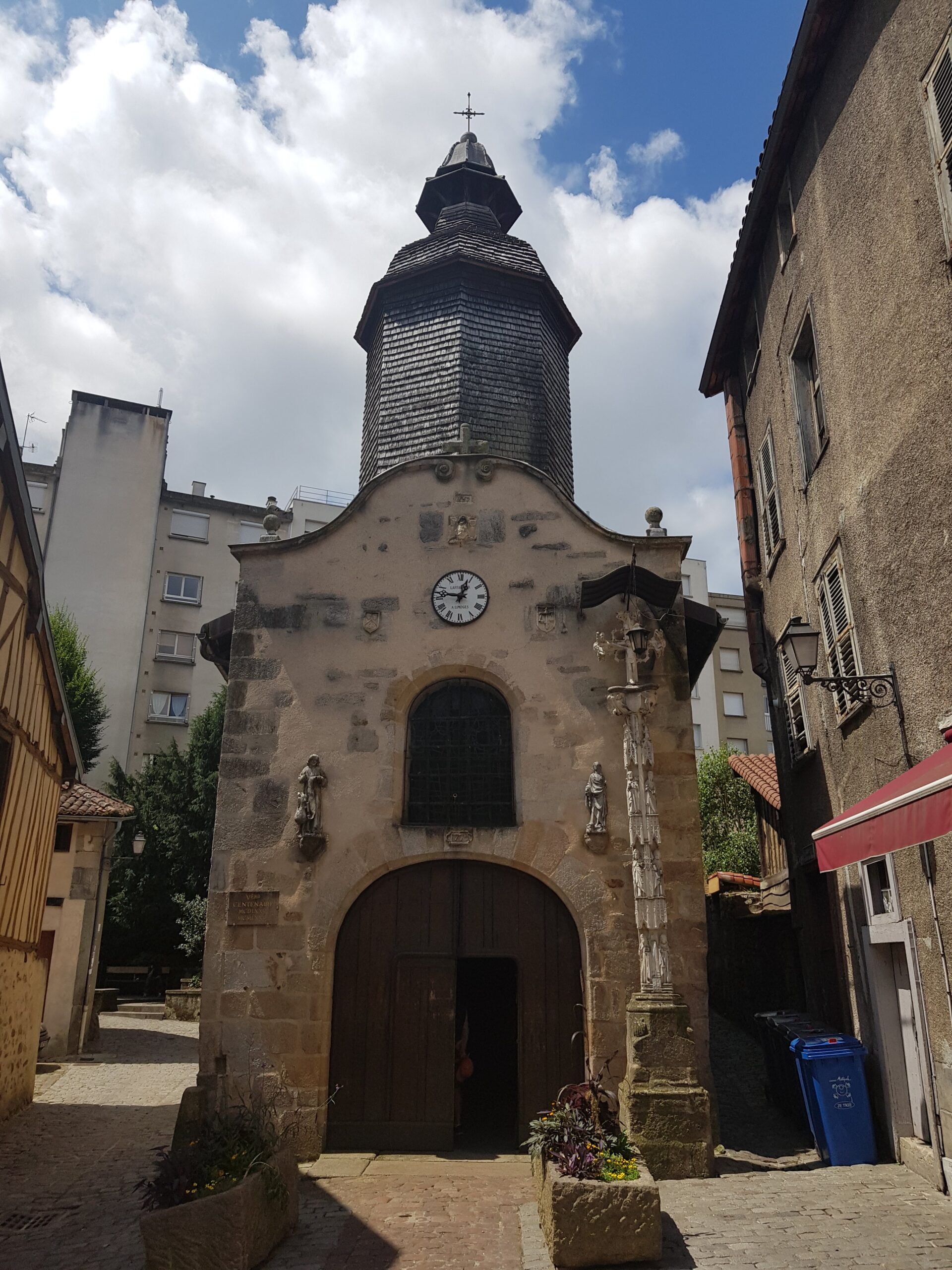
I visited the Rue de la Boucherie earlier in the week, but this chapel wasn’t open at the time. It was originally constructed in the fifteenth century to replace an earlier church nearby, which has long been lost under other buildings. It was later closed down during the French Revolution, and purchased by the guild of butchers.
The church is small, evident by that I’m actually standing in the entrance to the building to take this photo. It’s brighter than the photo suggests, although it still feels an intimate place of worship.
The altar, which is where the historic relics owned by the church are kept for safety.
Above are two of the statues in the church.
A photo taken looking back towards the entrance, with the spiral staircase on the right and the balcony above.
[I originally posted this in July 2018, but reposted it in July 2025 to fix the broken image links]
This is one of the two churches in the central part of the city, and it’s a colourful and, to me, confusing building. The cathedral is wider than the nave is long, so the internal structure feels rather different to the usual layout. Looking at an overhead photo of the cathedral, the standard church design is visible, but the aisles have just been made particularly substantial.
The church was mostly constructed between the thirteenth and sixteenth centuries in the Gothic style.
The organ at the end of the nave.
The nave cuts across the centre of this photo, with the pulpit visible on the right.
Jean Baptiste Hippolyte Delor, a local church official in the nineteenth century.
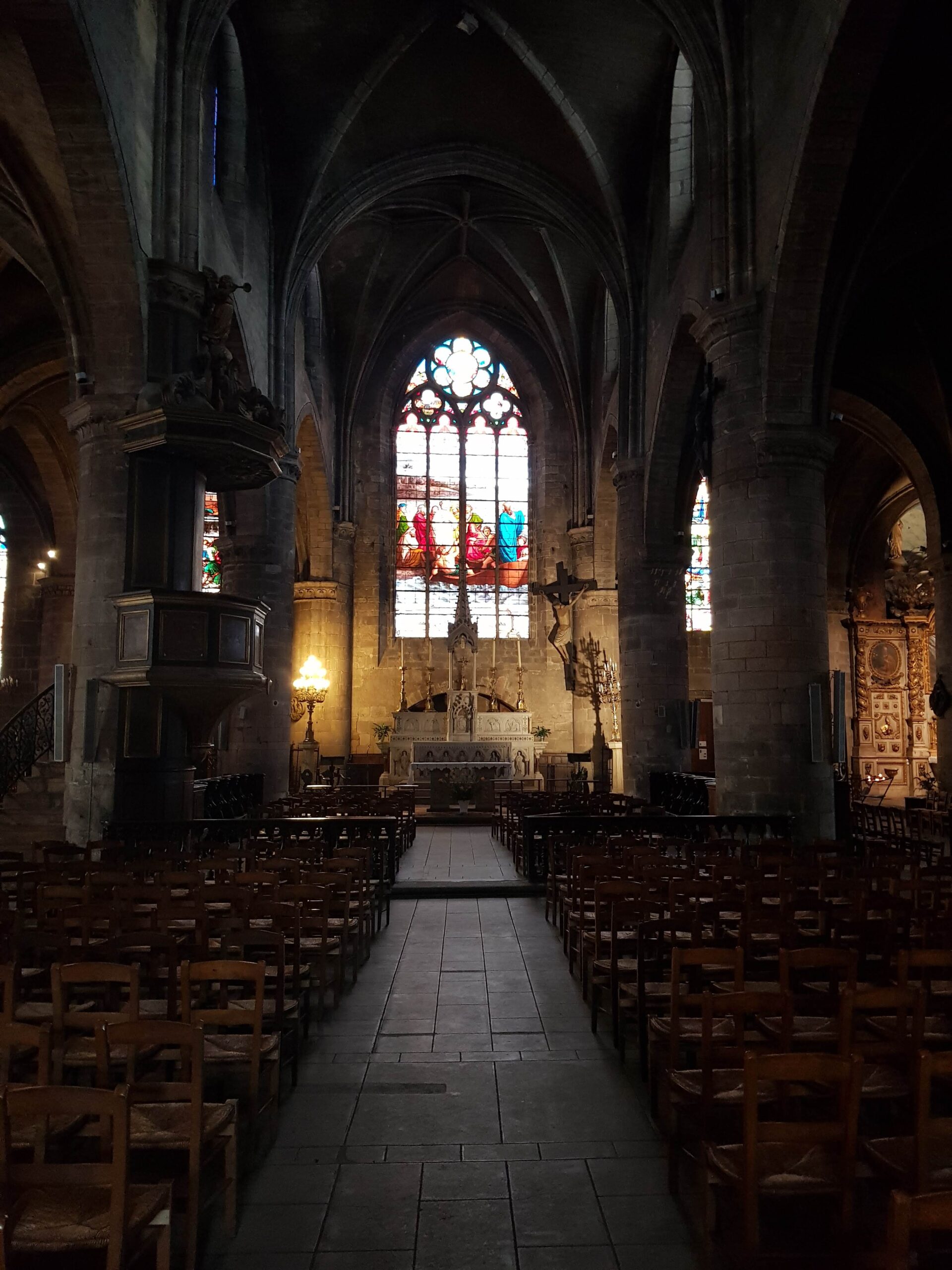
Some of the beautiful stained glass in the church. Unfortunately, since I didn’t bring my camera on this trip, the colours aren’t very vibrant in these photos.
A very beautiful church with numerous paintings, statues and decorative items which are on display. It feels much less of a touristy location than the other church and the cathedral in Limoges, making it harder for me to get an understanding of the building.
[I originally posted this in July 2018, but have reposted it to fix the broken image links]
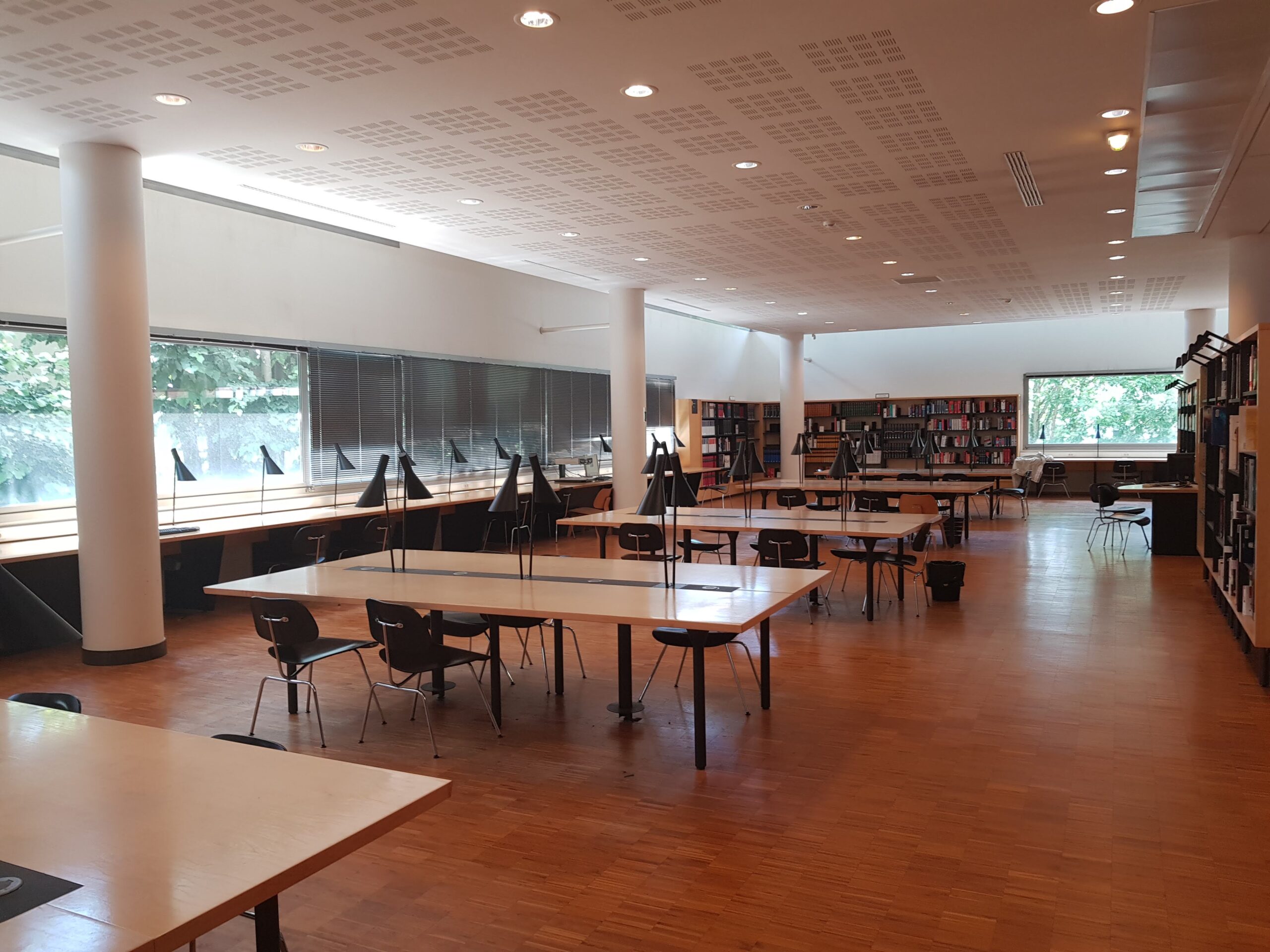
The rather beautiful Limoges library and despite the open plan nature of the building, it’s quiet and peaceful with a real feeling of space.
This is what irritates me slightly, seeing libraries overseas which are much better than those in the UK. Norwich library is one of the worst libraries I’ve experienced, it’s usually full of people shouting, there are usually examples of how users have evaded the filters on library computers and there are rarely chairs available. So, on that last point, Limoges library has no issues with having space for users.
There is a relatively large section of English books, as well a reference section for English books. In addition, there are many books in German and other languages, which is something that I haven’t seen from Norfolk Library Service.
Although of little interest to me, the music and DVD section was substantial, and was stretched across the top floor of the building. It was all neatly presented and everything seemed to be in a coherent alphabetical order.
But most of all, so many lovely books!
There was also a little exhibition that had been put together in the foyer area. It’s explaining how books are preserved.
Sometimes covers need replacing, or the book putting in a box, although mould in vellum covers is far more challenging. Having listened to the conservators at Norfolk Record Office, it is though something which can be achieved with some excellent results.
Books in need of repair.
This display was just showing the types of repair that were needed, from pasting a page back in to ensuring that the covers are secured.
[I originally posted this in July 2018, but have reposted it to fix the broken image links]
Limoges is on the route of the pilgrim route that is known as Santiago de Compostela, a path which has become much more popular in recent years. I hope to do some of this path in 2019, but for a much shorter distance than the expedition that some pilgrims, and walkers, take.
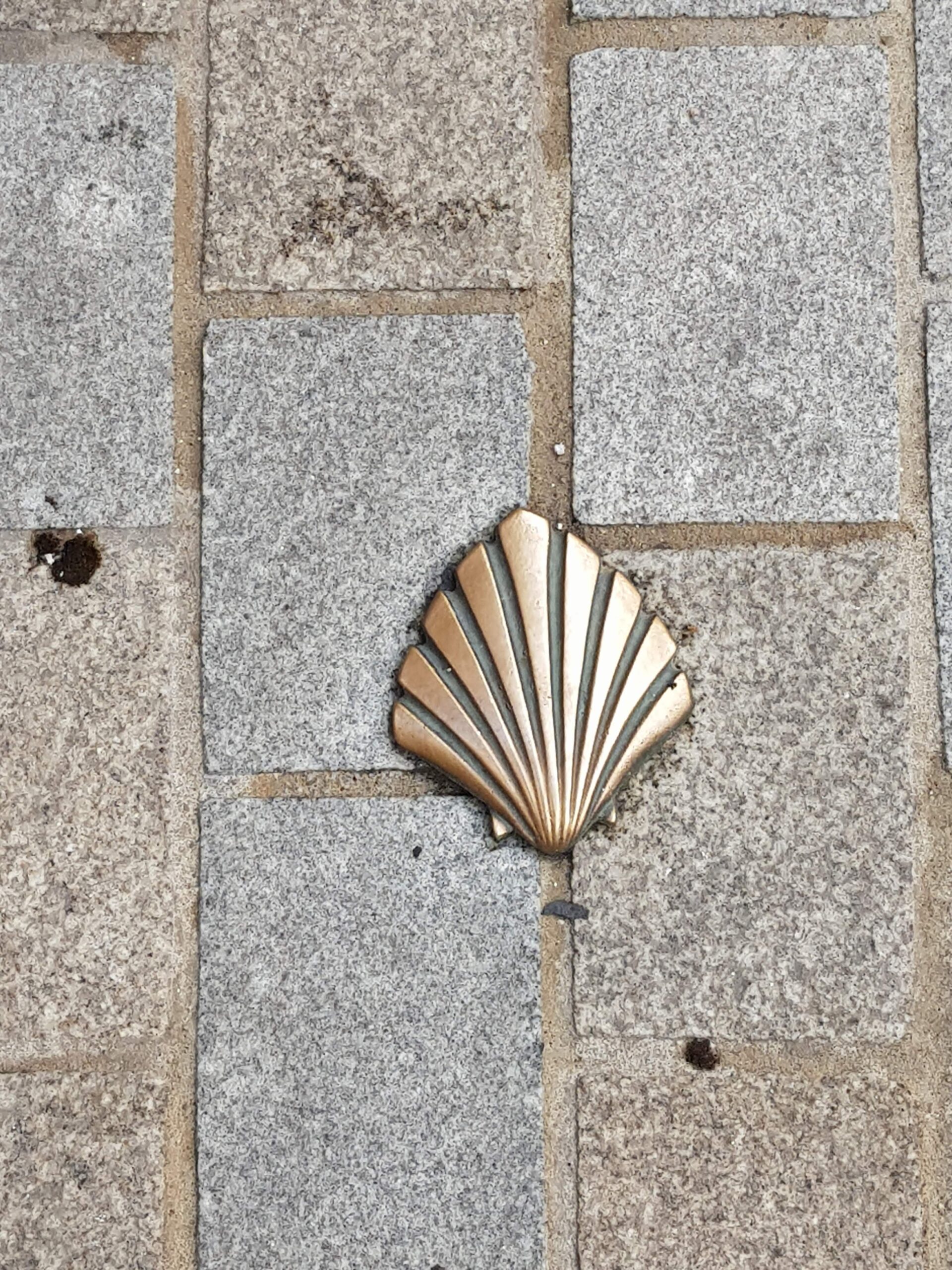
The route of the camino is marked with scallop shells and there are many of these on the streets of Limoges. The French word for scallop is ‘Coquille Saint Jacques’, it is thought because pilgrims used to collect the shells towards the end of their pilgrimage.
[I originally posted this in July 2018, but have reposted it to fix some broken image links]
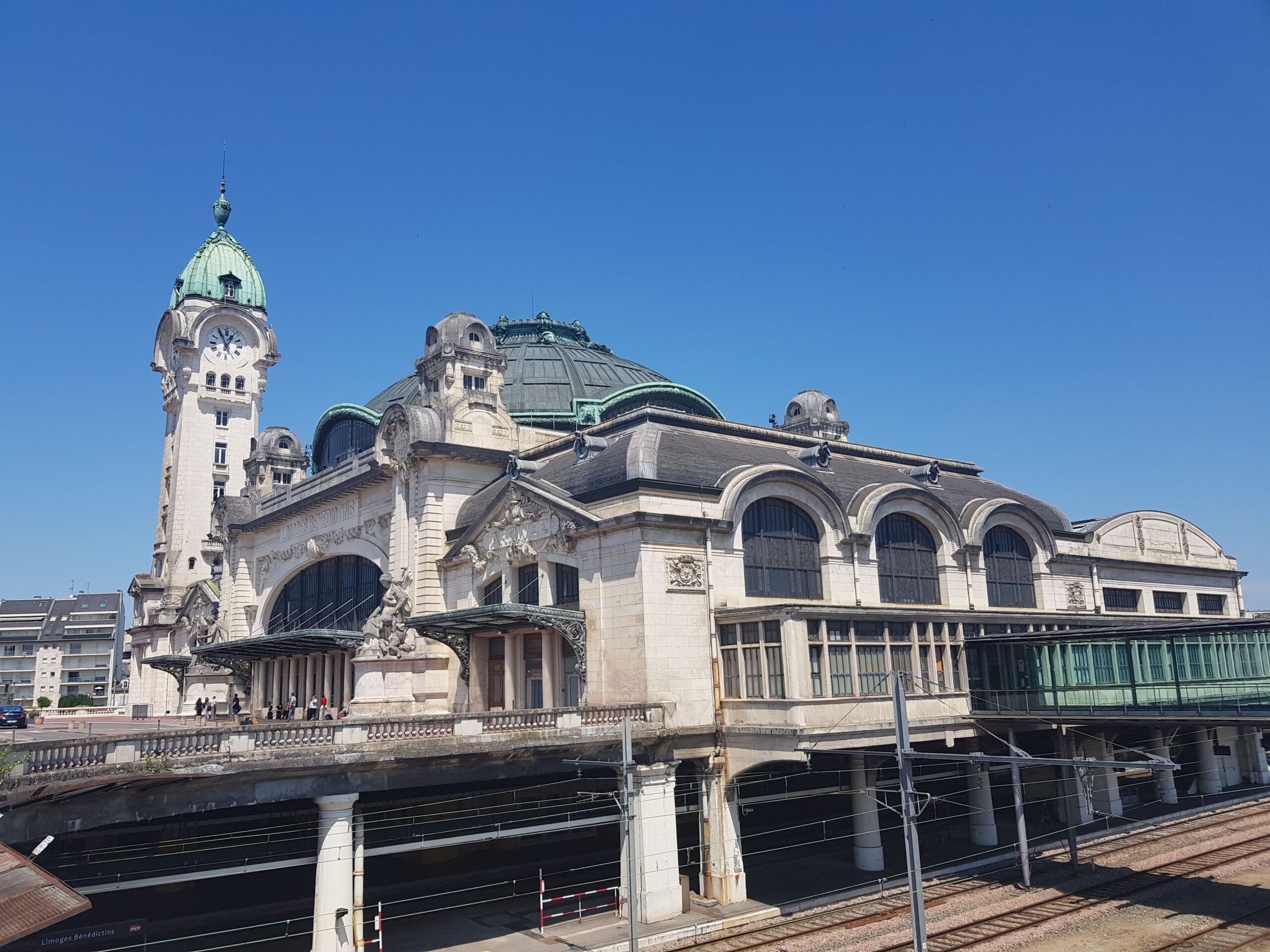
I always like visiting railway stations, just to see the array of food options they have, and of course to check the design and heritage of the building. My first impressions of approaching this railway station were positive because it looks different and interesting, although I had to climb a lot of steps to get to it, which wasn’t ideal given the hot weather (I may have mentioned that it’s too hot). The tracks for the station are underneath the concourse, so the station itself is elevated to a higher level, and hence the steps.
The side view of the city’s railway station, which is an interesting mix of architectural styles and designs. The current building dates to the 1920s, although there has been a station on this site since 1856. It takes its name from the Benedictine monastery that was located here but which was seized and closed down during the French Revolution.
The large central dome of the railway station giving it an airy and bright feel.
A photo of the grand interior, and another from the 1920s when the railway station opened. I should have had the foresight to find the original photo first before taking my one, then I could have taken them from the wrong place. But I didn’t, so they’re from different angles.
The information board, with the various destinations which are served, including Paris. Personally I think the prices for walk-up fares are too expensive for local journeys, but there are cheaper fares for longer distance journeys if pre-booked.
The railway station is known for its Art Nouveau and Art Deco designs, and the tower is one of the city’s landmarks. However, this was badly damaged in 1998 when some maintenance work went a bit wrong and they set fire to it.
The clocks on the main tower were also reportedly set two minutes in advance for some considerable time, an aid to ensure that passengers had a little more time than they might have thought. A clever trick, but they no longer offer this service to passengers….
The name of the railway station is clearly visible in stone above the central arch of the frontage.
There were once different section for departing and arriving passengers, although these entrances are no longer used.
Some decorative elements to the architecture. It’s certainly a beautiful and grand building, although the main restaurant is currently being closed down and I’m not sure what’s replacing it. At the moment there are what appear to be endless vending machines across the concourse, although these are clearly well used.
There is insufficient seating for the number of passengers using the station, or certainly, there was when I’ve walked in. It’s not the most functional of railway stations in that regard, but the signage all looked clear. There is apparently still a tunnel underneath the concourse, although now blocked off at one end, which was used by the Germans during the Second World War.
[I originally posted this in July 2018, but have reposted it to fix the broken image links]
Limoges has a museum which is dedicated to the history of the French resistance during the Second World War, so a visit here was essential for me. This was part of the free entry on the first Sunday of the month arrangement which Limoges has, which was most agreeable.
I’m not normally one for audio guides, but as I knew the entire exhibition was in French, I thought it’d be useful. It cost €2, but since entrance was free of charge, I considered that a reasonable deal. The audio guide proved really useful, the numbering system was clear to follow throughout and I would have missed out if I hadn’t have got it.
A map of the French defences in Limoges towards the beginning of the Second World War.
The next section of the museum explains how the French Government split into wanting to enter into negotiations with Germany, and those who wanted to fight to defend the country. The end result was the free zone of France and the occupied zone, with the former being known as Vichy France, led by Philippe Pétain.
This poster was produced by Charles de Gaulle and encouraged French to stand up and fight for the country. At the time the French Government, known as the government in exile, was based in London and most of the posters were distributed in England.
The agreement that Philippe Pétain made to keep part of France free is now seen as highly controversial. Philippe Pétain was imprisoned for treason after the end of the Second World War, and narrowly avoided execution. One of the concessions made by Pétain was to enact anti-Jewish legislation, and the above photo is one French Jew who was sent to a concentration camp.
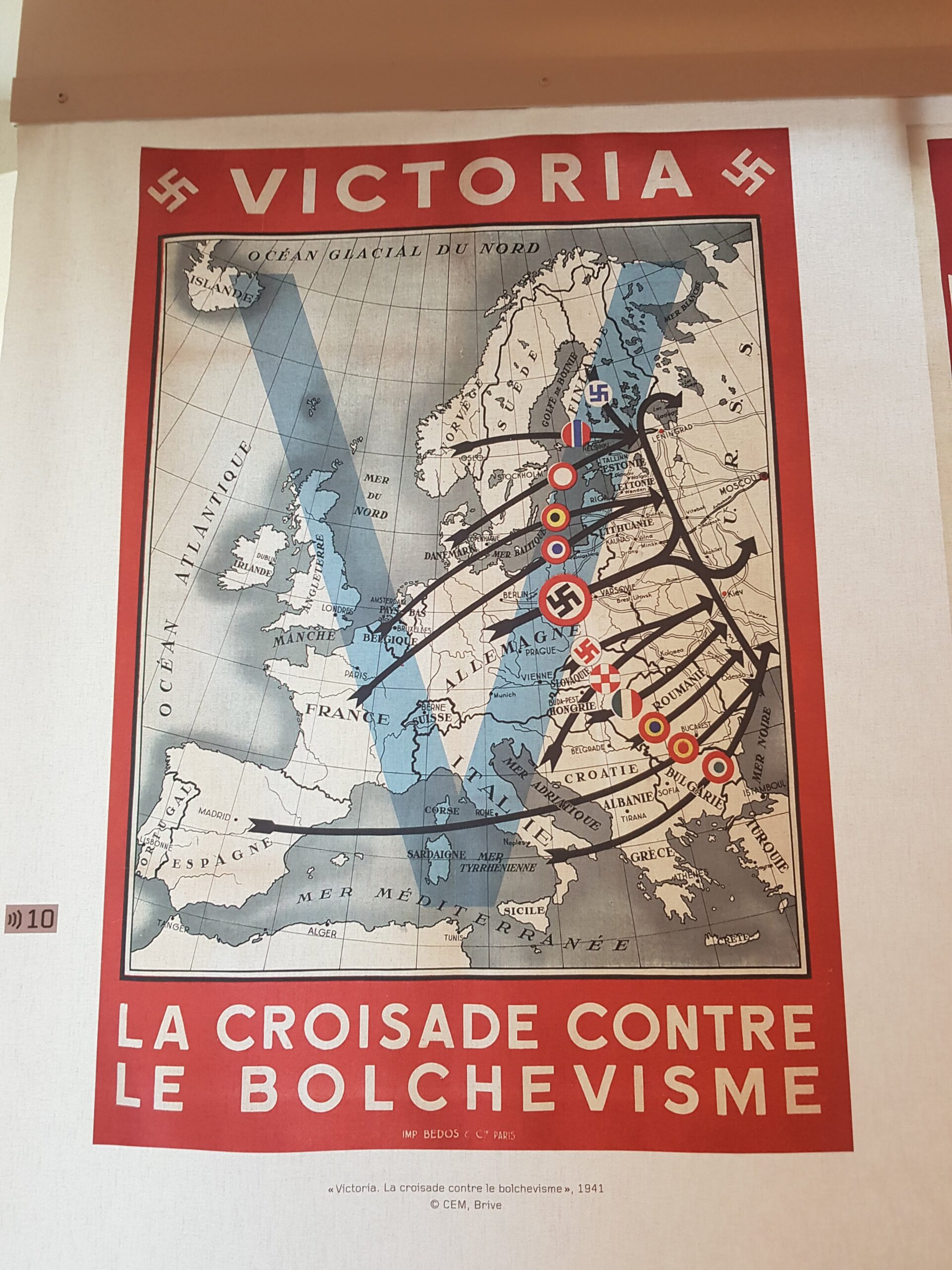
The political situation in France was inevitably very difficult to justify to the people, so there was a poster campaign to try and defend the regime. One way of doing that was to present the conflict as being a combined one against the spreading of communism from the Soviet Union.
There were numerous photos of members of the French resistance, who sought to bring down the German military forces.
Members of the French resistance were for a long time not part of a unified group, although they had a similar aim of wanting the liberation of France. They presented a real challenge to the German military, whether by attacking troops or damaging military infra-structure.
Many French men were forced by legislation to go and work in Germany for the war effort. Some of them were sent to concentration camps to do that, with nearly 10,000 Soviet and French slaves worked at the Buchenwald concentration camp.
This German plane was brought down by fire in 1944 at the town of Jumeau-le-Grand. It was placed on public display for some time, before being restored and brought to the museum when it opened in the 1980s. To do that, they had to bring it in through the roof. The second photo is of the inside of the aircraft, where the pilot once sat.
Overall, this museum took me around two hours to go through, and even though it was free of charge, there was only one other visitor. The displays were laid out chronologically and gave a really useful history of the work of the French resistance and the wider political system with which they to operate within.
[I originally posted this in July 2018, but have reposted it to fix the broken image links]
Many years ago I watched the landmark World at War series, produced in the early 1970s and at the time the most expensive documentary ever produced. The very first episode begins with some film of Oradour sur Glane, and I’ve remembered that for some time, and I’ve wanted to visit the site.
So, I decided to spend the day here and got the bus from Limoges. I’ll do another blog post about that, as it’s not the easiest bus to find, and I noted that there were no other tourists using the service.
So, back to what Oradour sur Glane is. In 1944, the German military entered the town one summer’s day and started to round everyone up. The process didn’t take that much time, the citizens were compliant and rather confused as to what was going on.
Oradour at the time was part of Vichy France, so the section of France that was self-governed, almost as a puppet state. However, it wasn’t controlled militarily to the same degree as the occupied part of France, and the local French police force were expected to keep order across the territory. So, the villagers of Oradour weren’t used to seeing Germans in the town, something limited usually to just a couple of Germans soldiers perhaps visiting a restaurant.
The men were taken to various garages and barns across the town, and the women and children were taken to the town’s church. It was said that the men were shot by machine guns in the legs, so as to harm them, but not kill them. They were then set on fire, so for most, they were burned alive.
The women and children in the church heard the shootings across the otherwise quiet town. The women did their best to comfort the children, but the Germans used a suffocating gas to try and kill those inside. They then finished their killing with machine gun fire, to catch anyone who had survived.
The Germans killed 642 people on that summer’s day in June 1944. Of those, 205 were children.
There is no questioning this chain of events, but there is much historical debate as to what happened here to cause this. It was one of the worst war crimes ever committed and it took place without warning or because of any particular reason.
The German military were, for the most part, disciplined and effective in implementing orders. There’s no doubt that there are very many war crimes throughout the German occupied territories over the period of the Second World War, but they were usually official sanctioned from senior Nazi figures. Concentration camps were used to kill millions of Jews and political prisoners, Warsaw was bombed to try and prove a point, that reprisals wouldn’t be tolerated.
So, this gives a problem as to what happened in Oradour. Adolf Diekmann was the military commander who went to Oradour, and it was he who ordered the killings of everyone in the town. Diekmann was killed just a few weeks later on Normandy, meaning that the story of what he was ordered to do was never revealed. But, senior German military officers who had given him his commands were said to have ordered him to take thirty men hostage to try and use as a ransom for the return of a German officer who had been seized by the French resistance.
So, either Diekmann entirely ignored what he was told to do, or he really had been told to kill hundreds of people to act as a warning to those involved with the French resistance. That the French resistance were a problem to the Germans in undeniable, but if Oradour was meant as a warning, then why didn’t the Germans publicise it? Instead, they covered it up as best they could. And why would Diekmann ignore orders, if he was a loyal German officer?
So, the attack remains a mystery in its intentions. It is likely that it was a response to the attacks made on the Germans by the French resistance, but it has been suggested by some historians that the Germans had the wrong facts and perhaps entirely the wrong town.
One decision was made after the end of the Second World War, which was to keep the ruins of the town undisturbed and to not repair the damage done. A new town was created, just a short distance away, and the former site was to be kept as a permanent reminder of the massacre which took place here.
That brings me to my visit. I was there at the opening of the museum and I went straight through to the former village site, instead of going to the museum section first. This meant that I had the first half hour of the site to myself, which means that I was able to take the photos that I wanted.
I did take a lot of photos today, and I also made sure that I took photos of the signs which described what each building was. I’ve just uploaded en masse some of the photos, just to give an indication of the size of the site and what’s there, with apologies for the lack of tagging in some of them. If anyone is particularly intrigued by an individual property, message me, and I’ll bore you for ages with what they all were.
The old town is now sealed off, so that visitors have to go through the visitors centre. Above is where the road used to go straight down, but it now bends off to the right.
The visitor centre, which has a museum, shop, toilets and an information desk. Visitors can just walk straight through the entrance area if they don’t want to visit the museum area. Visitors also aren’t allowed to take photos in the museum area, just in the main part of the site.
This is what visitors see when they come up from the underground passage which goes under the road from the visitor centre.
Walking around did feel very surreal, as if this was some sort of open air museum. The beautiful sunny day meant that it didn’t feel like the site of a massacre, and so coming across signs noting people died on a particular spot was always a shock. I also found it interesting to see the buildings themselves, and all of the different layers of history within them, such as when extensions had been added or there were changes in building styles.
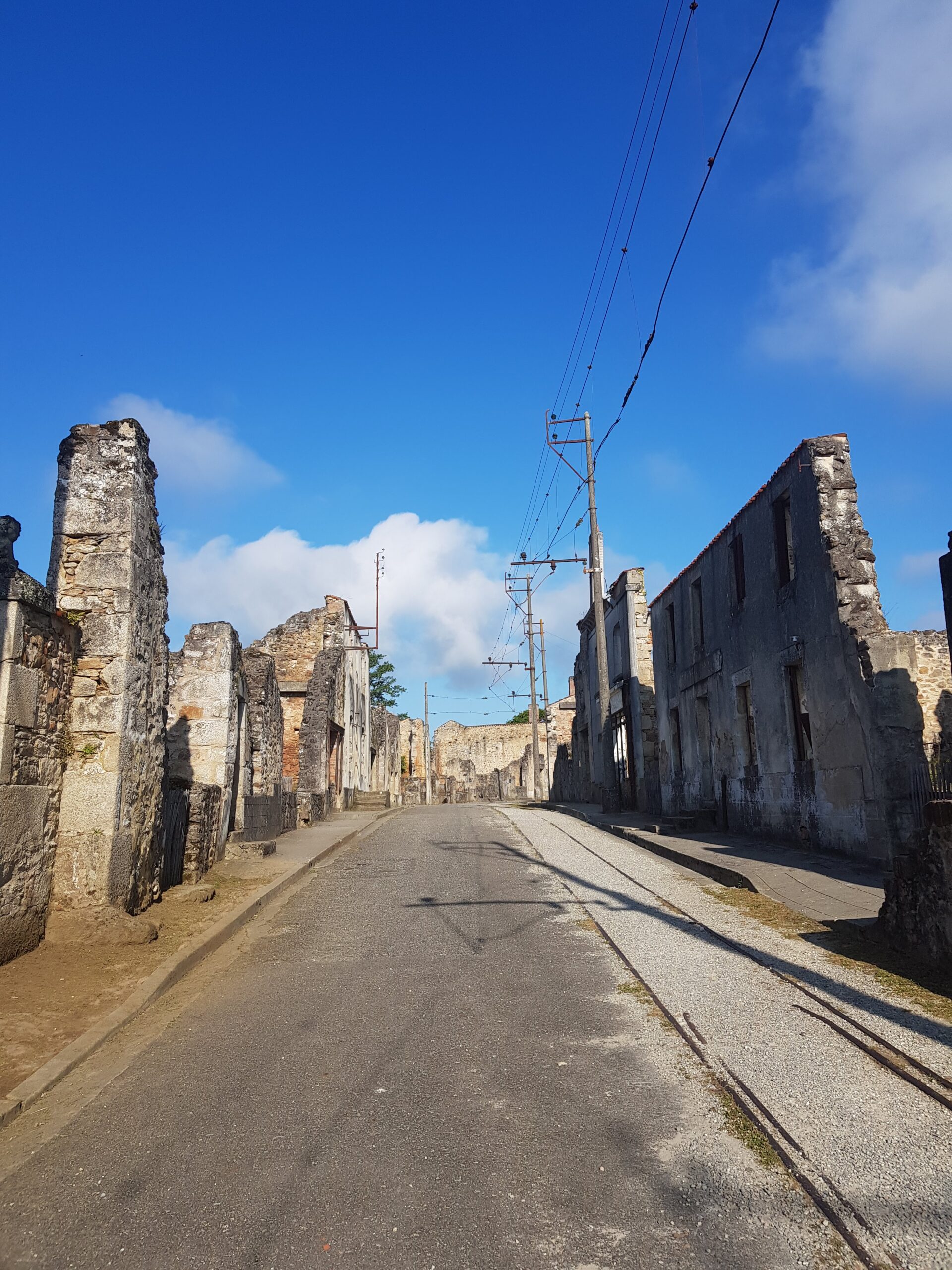
Above a number of photos along the main road of the former town, showing that it was a relatively substantial settlement. What look like power lines in the above two photos are tram lines, as there was a tram service which operated to Limoges.
On the day of the attack in 1944, a tram came into the town from Limoges, and the Germans stopped it. They shot dead the engineer and sent the tram and its driver back to Limoges, a decision that didn’t quite make sense to me. Nor did the fact that the tram then picked up more passengers and went back to Limoges, where it was stopped again. The passengers were allowed to go free, as long as they didn’t go into Oradour, but it’s another strange sequence of events which suggests that there was some considerable confusion on the day.
The above photos are of the church, where the women and children of the town were killed. The lump of metal are the bells, which melted in the heat of the fire which was started after the killings. There are also bullet marks still visible in the walls of the church.
The exterior of the former town garage.
There are several of these markers around the site, they show where the men were killed during the day.
There’s an underground memorial on the site to those who died here, although I feel it’s a slightly strange design. I’m not sure why it needs to be underground like this, but it does feel quite atmospheric.
A sign in the memorial centre.
A list of those who died in the Oradour massacre.
The above photos show the range of material which was found in the houses following the looting and destruction of them. Much of the material, particularly that relating to children, is rather emotive.
As can be seen from the above lettering, this was once the town’s tram station and I’m intrigued that the trams went such long distances.
Above are photos of the town’s graveyard, which is within the enclosed historic site. Many of those killed have graves here, and they’re all remembered at the official memorial. The coffins with bones in are another reminder of the horrors of the massacre, but the graves are well tended and dignified. Some of the graves have photos on them of those were killed, which adds a more personal feel to them.
This phone box felt out of place, and it wasn’t actually here when the Germans raided the town. It was installed shortly afterwards for the visit of Charles de Gaulle when he came to see the damage done at Oradour.
As an historical site, I’m very pleased that I got to visit Oradour sur Glane after so many years of knowing about it. It wasn’t busy, which meant that I felt that I got a fuller experience. I’d also recommend that others go if they’re interested in history and I’m sure most people would find their experience memorable.
I did though note that someone left a negative review on TripAdvisor about the site. They said that it was a bit boring, and perhaps there could be some reenactments at the site to make it more interesting. A more stupid idea I don’t think I’ve ever heard, if they ever let people dress up as Nazis to reenact a massacre then I think I’d be the first to be writing a letter of complaint. Fortunately, wiser heads have prevailed and the site is dignified, peaceful and well maintained.
A newspaper article published in the Liverpool Echo around a week after the massacre. It’s an interesting first perspective as to what was being reported at the time. It’s a little hard to read as it’s a screenshot, but it’s just readable if you click on the image and stare closely at the screen….
This sign is present on the main exits to the site. Remember.