Category: Kutaisi

  • Wizz Air Flight from Kutaisi to Katowice

    Wizz Air Flight from Kutaisi to Katowice

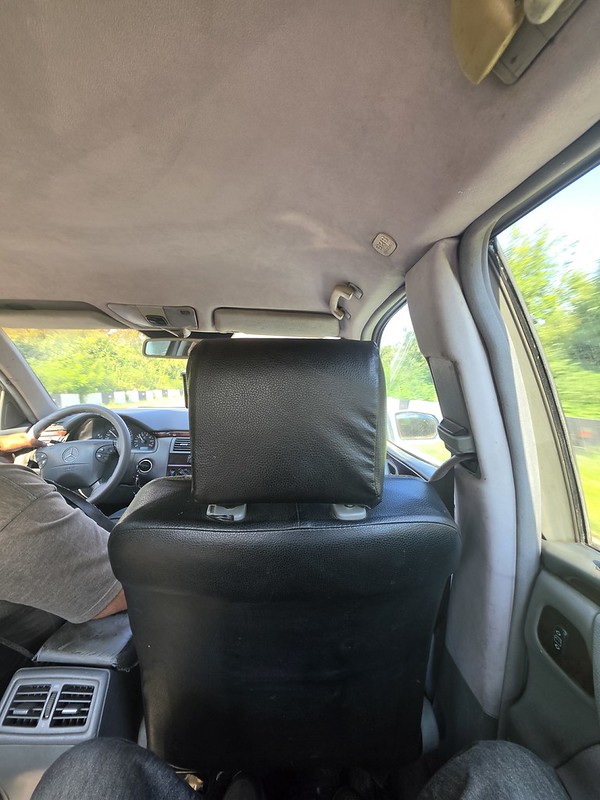
    After I discovered how cheap the fixed fare Bolt taxi was between Kutaisi airport and the city centre, I decided to do the same on the reverse trip. This was the only option I had if I wanted to get breakfast at the hotel, as the airport bus only runs once every couple of hours. The journey was therefore an easy one, with the taxi arriving only a couple of minutes after I booked it. This time, the driver didn’t feel the need to interrupt my plans to put my seat belt on and I was also pleased with his driving.

    There are some subtle signs around the airport that this is a country looking towards the European Union and away from Russia. The political process of Georgia joining the EU has stalled at the moment, but opinion polls show that more 70% of residents support joining.

    There is an airport lounge although it’s a paid one which doesn’t allow the various lounge cards access. I was aware of this in advance and so had ensured that my breakfast at the hotel was a substantial one.

    The airport itself was clean, bright, functional and there were plenty of power outlets, but despite what it might look like from the above photo, there wasn’t really enough seating. There were a couple of cafes, a shop and an external smoking area for those who felt the need.

    When the redeveloped airport opened in 2012, it handled fewer than 200,000 passengers during the following year. Wizz Air’s enthusiasm for serving Kutaisi has since helped push that figure towards two million, while expansion plans would eventually enable the airport to handle around five million passengers annually.

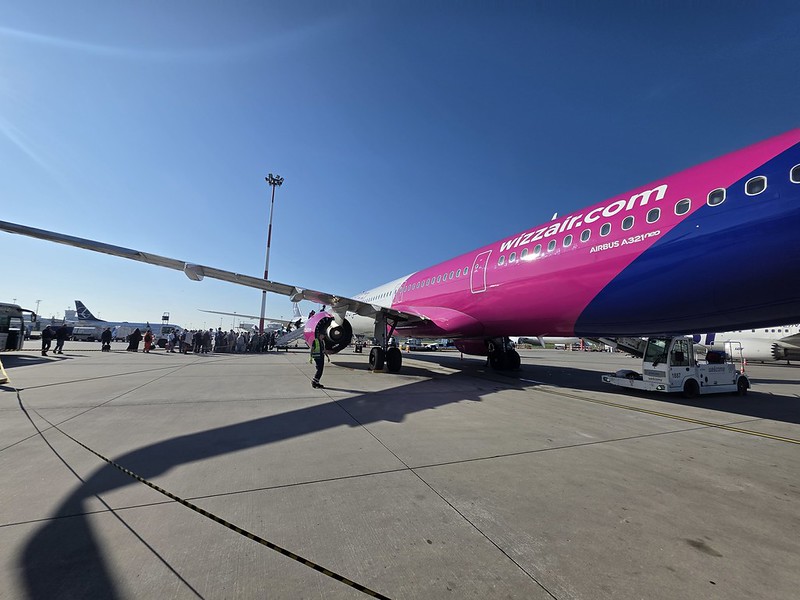
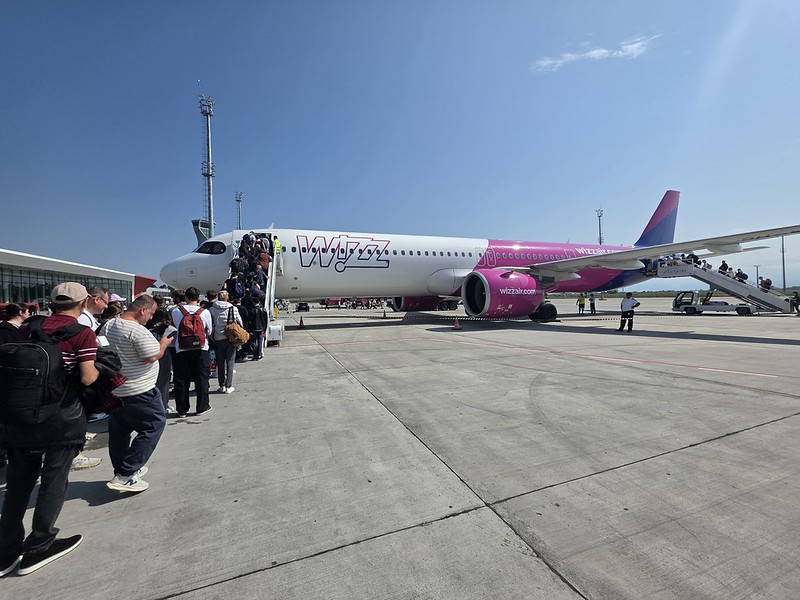
    The walk to the aircraft confirmed that Georgia remained substantially warmer than my preferred operating temperature.

    The aircraft was 9H-WDI, another new registration for me and therefore an important addition to records which nobody has yet requested to inspect.

    The seating gods gave me an aisle seat just behind the emergency exit row seats. As I’ve mentioned in previous posts, this led to the excitement of watching passengers attempt to upgrade themselves, before the Wizz Air cabin crew told them either to pay €20 or return to their allocated seats.

    The flight itself was, yet again, uneventful which pleased me greatly. It was busy on board, but the service was efficient, the pilots were clear with their announcements and nothing fell off the aircraft.

    And safely into Katowice Airport a little earlier than expected and with no incidents to report. All really rather lovely. Well, until there was a border issue, but more of that in the next post.
  • Kutaisi – The Colchis Fountain

    Kutaisi – The Colchis Fountain

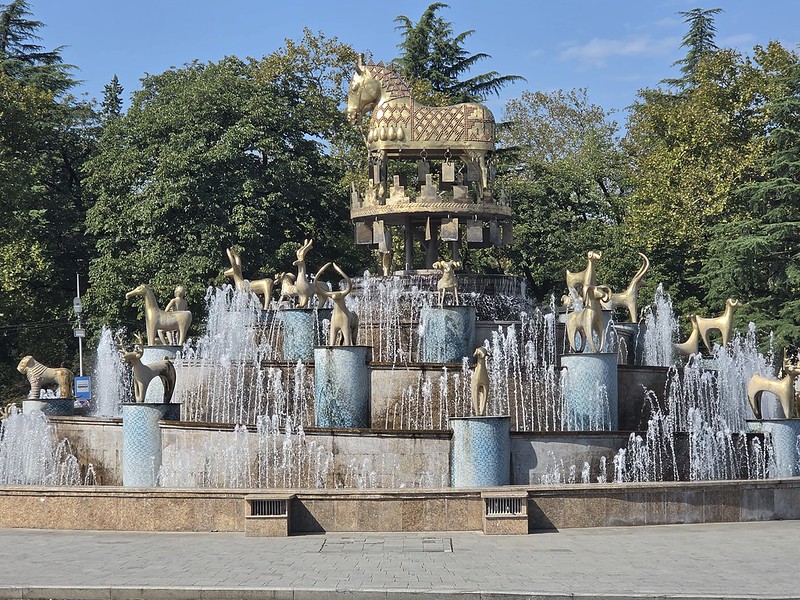
    In the middle of one of Kutaisi’s busiest roundabouts is the Colchis Fountain, a suitably restrained arrangement involving cascading water and around thirty golden animals. This is, of course, entirely reasonable. Designed by Georgian architect David Gogichaishvili and unveiled in 2011, its figures are enlarged copies of jewellery and other objects discovered at archaeological sites associated with the ancient Kingdom of Colchis. The animals include deer, rams, goats and lions, while the horses at the top are linked to King Aeëtes, the legendary ruler encountered by Jason and the Argonauts during their search for the Golden Fleece.

    It has become one of the most recognisable sights in Kutaisi, combining the city’s ancient past with something that looks unashamedly modern and theatrical. I rather liked it, although its position within a busy roundabout means that close inspection requires substantially more confidence in Georgian driving than I possessed. I therefore admired it from the pavement across the road, while wondering whether one day the city might pedestrianise the square and allow visitors to approach it without first demonstrating their commitment to Georgian road safety. Being flattened by Georgian traffic seemed an excessive price to pay for a closer photograph of a golden goat.

  • Kutaisi – Bagrati Cathedral

    Kutaisi – Bagrati Cathedral

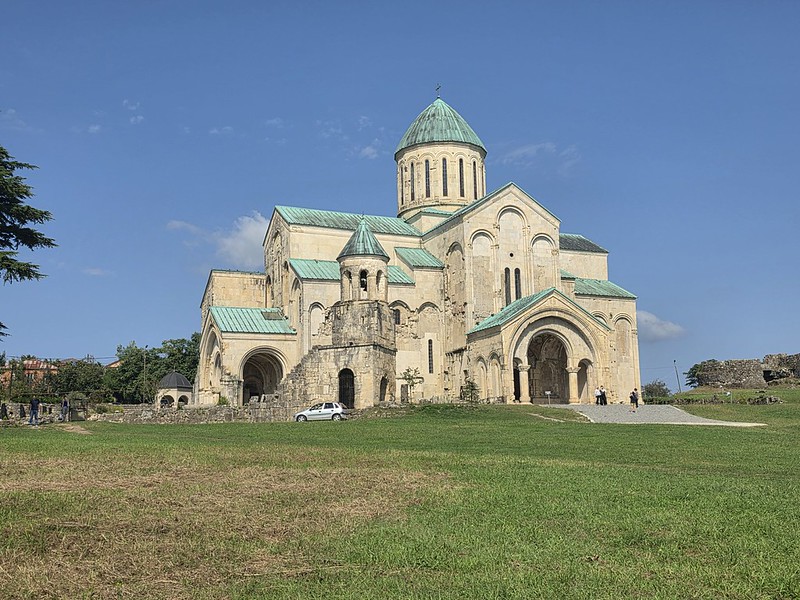
    Standing prominently on Ukimerioni Hill above Kutaisi, Bagrati Cathedral is formally dedicated to the Dormition of the Mother of God and is one of the city’s most recognisable landmarks. The site was occupied as early as the second millennium BC and its first known Christian church was built during the fourth century, long before the medieval cathedral appeared. The elevation makes it visible from much of Kutaisi, although it also requires visitors to walk up a very big hill, which is presumably how medieval architects ensured that nobody arrived without having made some physical commitment to proceedings. Fortunately, my hotel was near the cathedral so I didn’t have to make a special expedition to come here.

    This display records the cathedral’s condition and the various attempts to preserve and reconstruct it during the twentieth century. Archaeological excavations in 1940 and 1941 helped establish the original plan, while architect Vakhtang Tsintsadze prepared a reconstruction scheme in 1952. Work continued in stages over several decades, followed by further archaeological and structural investigations around the cathedral’s thousandth anniversary in 2003.

    The medieval cathedral was commissioned by King Bagrat III around the turn of the eleventh century and an inscription records that its floor was laid in 1003. Bagrat had brought most of Georgia under a single ruler, and the scale of the new episcopal church was intended to demonstrate the importance of that achievement. Representatives from across the country attended its consecration and the building subsequently became a lasting symbol of Georgian unity, which is quite a substantial burden for one collection of stonework to carry. There was a wedding taking place when I was there, so the relatively large number of tourists, as well as myself, didn’t get to see the interior.

    This side entrance is one of the quieter surviving parts of the complex. Its recessed stone arches and remaining decoration give some indication of how elaborate the medieval cathedral must have appeared before its partial destruction.

    The cathedral once stood within Kutaisi Fortress, parts of whose walls and foundations remain around the site. Both the fortress and cathedral were attacked by Ottoman forces in 1692, when an explosion caused the dome and roof to collapse. The ruined building deteriorated further during the nineteenth century and some of its stone was removed for use elsewhere, which was all a little sub-optimal. For more than two centuries, Bagrati therefore remained a roofless ruin rather than the complete cathedral seen today.

    The separate bell tower stands alongside the cathedral and provides another vertical landmark on the hill, although this one is a little overshadowed by the cathedral. Together with the surviving walls, archaeological remains and religious buildings, it helps the site feel like an historic precinct rather than simply one very large church positioned above the city.

    The cross stands near the edge of the hill and offers a suitably dramatic view across Kutaisi. The city became the capital of the unified Georgian kingdom and remained at the centre of political life until the royal capital moved to Tbilisi during the twelfth century. The view from the hill also helps explain why the site was chosen, offering visibility across the surrounding landscape and ensuring that the cathedral dominated the city both physically and symbolically. The panorama was impressive enough to justify the climb, which is not an assessment I make lightly by any means as I am absolutely not David Morgan. Incidentally, I’m making my friend David the new internationally recognised unit of willingness to climb hills. I’m at 2 out of 10 on the scale, my friend Richard is at -3 and David is at 10.

    The completed cathedral is impressive, although its modern reconstruction produced an international heritage controversy. Bagrati and Gelati Monastery were jointly added to the UNESCO World Heritage List in 1994, but major rebuilding work begun in 2009 was judged to have damaged the cathedral’s historical authenticity. The property was placed on the World Heritage in Danger list in 2010 and Bagrati was ultimately removed from the designated site in 2017, while Gelati retained its status. This is therefore the unusual story of a cathedral losing its World Heritage recognition partly because it had been made substantially less ruined and I’m sure that there’s some logic in there somewhere.

    Anyway, whatever the arguments about conservation, I thought that it remained a striking building and one of the most memorable sights in Kutaisi. It was all really rather lovely.

  • Kutaisi – Memorial to the Heroes of the 2008 Russo-Georgian War

    Kutaisi – Memorial to the Heroes of the 2008 Russo-Georgian War

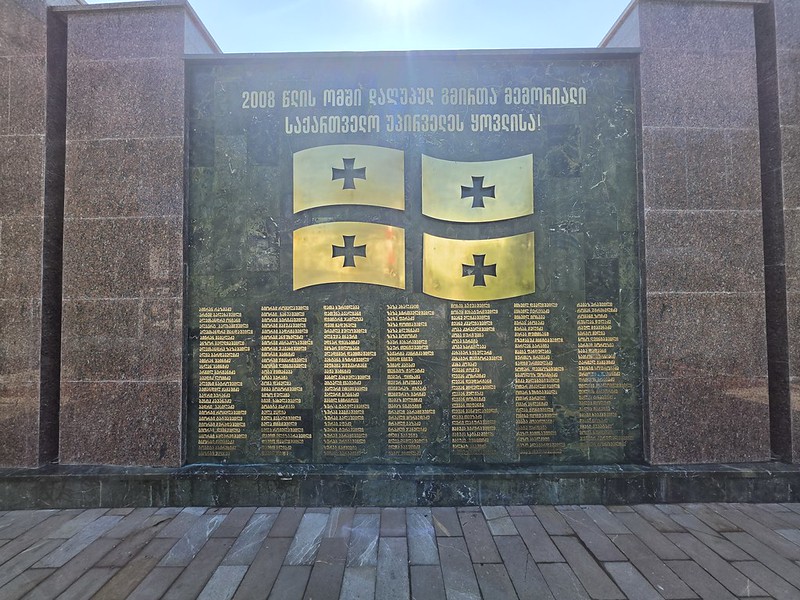
    Near Kutaisi’s National Museum of Military Glory is this memorial to the Georgian servicemen killed during the Russo-Georgian War of August 2008. The conflict lasted only five days but caused substantial destruction, with fighting centred on South Ossetia before Russian forces advanced farther into Georgia. It marked a new phase in post-Soviet Russian foreign policy and has since been viewed as an early warning of Moscow’s willingness to use military force beyond its borders, most notably in Ukraine. The memorial was fully renovated in May 2026, when the composition was altered, a new sculpture installed and the surrounding square improved.

    The new sculpture is the work of Giorgi Kikvadze and shows a soldier facing a woman in traditional dress, with the Georgian flag between them. I’m not sure whether the woman is intended to represent a mother, partner or Georgia itself, but it seemed more like a farewell or reunion than a celebration of war. Nine servicemen from Kutaisi were among the Georgians killed during the conflict.

    The central wall displays the five-cross Georgian flag above long columns of names. The inscription translates approximately as “Memorial to the heroes who died in the 2008 war. Georgia blossoms with heroes.” I couldn’t read that while I was there, which will surprise nobody familiar with my progress in Georgian, but I thought the whole memorial was simple and dignified.

  • Kutaisi – Siam Restaurant

    Kutaisi – Siam Restaurant

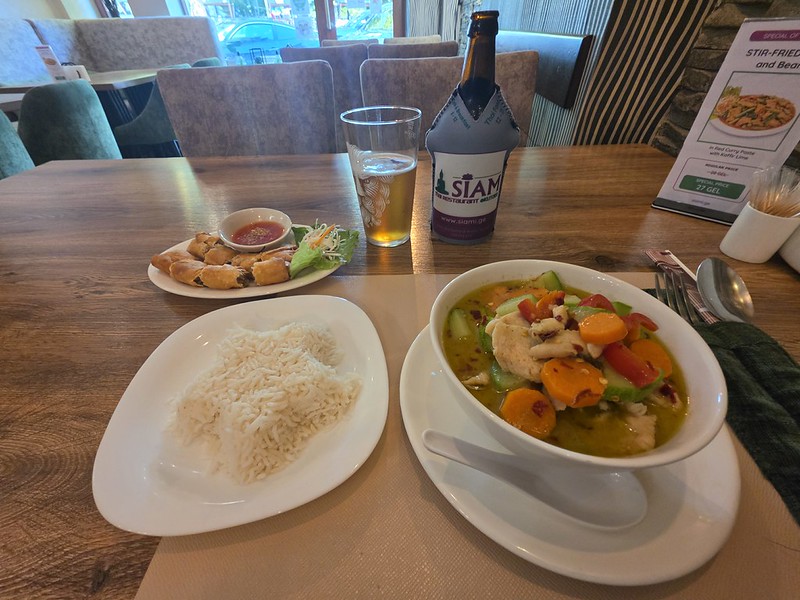
    We didn’t get much chance to have Asian food when we were travelling around the Balkans, so I was starting to crave that by the time I reached Kutaisi. This is the well-reviewed Siam Thai restaurant, located in the centre of the city near the White Bridge.

    Some of the menu options. When I ordered, the team member asked if I wanted Western levels of spice or Thai levels of spice. I always want plenty of heat and depth of flavour, so I opted for the latter option and the team member did double-check that this was entirely wise.

    The beer was, I think, the Kazbegi but the restaurant’s cooler jacket has made it a little harder to identify and I didn’t put it on Untappd at the time as I didn’t have any signal. So, that one might just have to remain a mystery, but I remember it was entirely satisfactory. I doubt that I’ll become a professional beer reviewer any time soon.

    I opted for the spring rolls, Thai green curry and steamed rice. The spring rolls appeared fresh and homemade and were well presented, although I would personally have preferred a firmer and slightly crisper exterior. The rice was cooked properly, while the curry delivered the promised heat and contained plenty of vegetables. However, the sauce was a little thin and the flavours became less distinctive as I worked my way through it. The chicken was tender, although it tasted as though it had been boiled separately rather than absorbing much of the curry’s flavour.

    I was the only customer in the restaurant throughout my visit, but the service remained timely, friendly and unobtrusive. Everything was suitably clean and the décor looked contemporary. The curry was not quite as rich or aromatic as I had hoped, but it was still a pleasant lunch and successfully dealt with my increasingly urgent requirement for Thai food. I was pleased that I was able to manage the spice level and the cost was reasonable at around £11 for everything.

  • Kutaisi – The Glory to Labour Monument

    Kutaisi – The Glory to Labour Monument

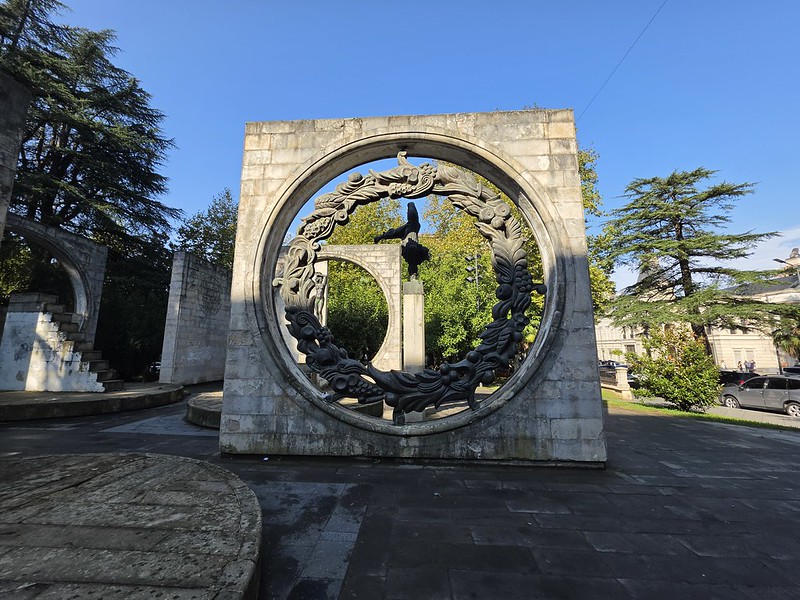
    In a small park near Kutaisi City Hall and the Opera House is the Glory to Labour Monument, one of the city’s more unusual surviving pieces of Soviet public art. Designed by the architects Vakhtang Davitaya and Shota Bostanashvili and completed in 1981, the complex celebrated the workers who powered Kutaisi’s factories and wider industrial economy.

    The monument consists of a series of circular stone frames, platforms, short staircases and bronze figures representing workers. It’s all a bit complex to the untrained eye, and mine is certainly not trained. Unlike a conventional monument with a single obvious viewpoint, this was designed to be entered and explored from different directions. There were no arrows or explanatory leaflet, so I adopted the established artistic technique of wandering around and attempting to look thoughtful.

    Another figure stands in front of a large abstract metal form, with the vertical element rising behind him and giving the sculpture an almost religious appearance. The individual workers do not seem intended as portraits of named people, but as idealised representatives of collective effort and industrial achievement. Very Soviet.

    The empty platforms and staircases are partly explained by the original idea behind the complex. It was intended to operate as a changing cultural space, with sculptures by different artists temporarily displayed before being moved into an art gallery. The architecture would remain while the statues and visitors became changing participants within it. This also explains why some of the staircases now lead nowhere, rather than this being an unusually honest representation of Soviet economic planning.

    The surviving Georgian and Russian lettering makes the monument’s purpose rather clearer, celebrating labour and the people responsible for Kutaisi’s industrial development. Parts of the complex are now stained, damaged or marked with graffiti, but enough survives to retain the scale and ambition of the original installation. Georgia has an understandably complicated relationship with its Soviet inheritance, so the survival of monuments such as this is not necessarily guaranteed.

    I rather liked the whole arrangement, partly because it was possible to walk around and through it rather than merely standing in front of a statue. I almost certainly spent longer examining it than the workers being celebrated would have considered productive, although I’m still not entirely sure that I understood what I was looking at. Fortunately, that has never prevented me from writing about anything before.

  • Kutaisi – Chain Bridge

    Kutaisi – Chain Bridge

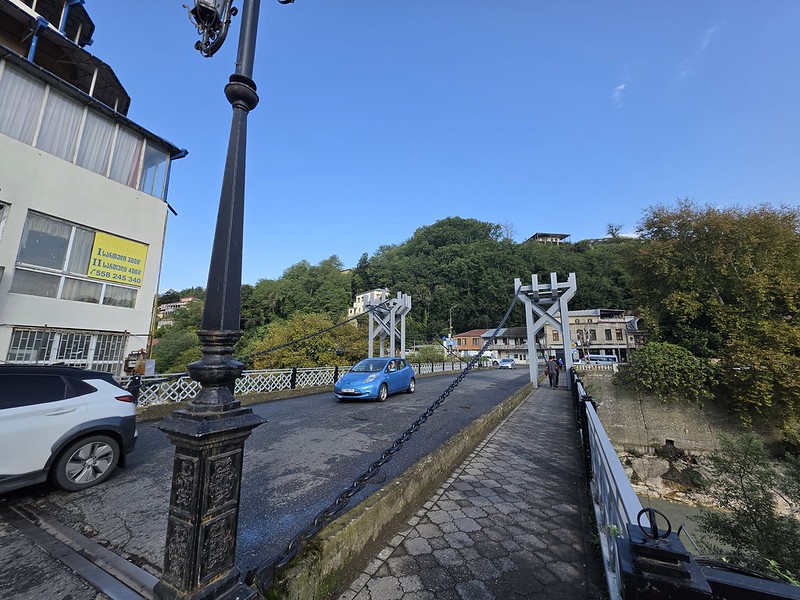
    The Chain Bridge crosses the River Rioni in Kutaisi and is regarded as the oldest of the city’s surviving bridges. It was the first thing of note that I saw after walking down the mountain from my accommodation, although local geographers may insist that it was merely a hill. Remains of a crossing dating from the fifth century have been discovered at the site, while the main supports of the later bridge date from the 1770s. A wooden bridge was constructed across them and the crossing was formerly known as the Royal Bridge and the Archieli Bridge, before chains were added during the nineteenth century, giving it its current name.

    The present bridge carries vehicles and pedestrians across the river, with the chains running along either side as a reminder of the structure which preceded it. One of the chains apparently broke during the 1860s as merchants crossed with their wagons following heavy snowfall. The explanation offered is that the accumulated snow had not been cleared during the preceding holidays, which sounds like a suitably familiar combination of infrastructure, weather and nobody quite getting around to doing anything about it. All rather sub-optimal.

    The city eventually restored the crossing between 1884 and 1885, while the bridge acquired its current form during another reconstruction in 1995. In 2006, the bridge was granted national cultural monument status, which I imagine must have pleased it. It might just now be carrying small blue cars across the Rioni, but I rather liked the amount of history that was represented here.

  • Kutaisi Airport to City Centre

    Kutaisi Airport to City Centre

    After landing in Kutaisi at a reasonable time of day, namely lunchtime, I realised that the slightly late arrival meant that I had missed the airport bus that departs every two hours. There was a wait of ninety minutes until the next one which felt a little sub-optimal as I was tired.

    Out of interest, I had a look to see how much a Bolt taxi would cost, as Uber doesn’t operate in Georgia, and I realised that it was a fixed price of £6.90. This was twice the price of the bus, but I decided to treat myself to this almost unimaginable level of financial extravagance. Given that it was a 40 minute taxi journey and I’d be taken straight to the hotel, I considered this as a reasonable option. Anyone travelling as a pair might as well take a taxi, unless they particularly enjoy waiting beside an airport to save no money whatsoever.

    The driver arrived after around ninety seconds and I realised that there is a little waiting area for them. He seemed very positive and I was pleased to discover that he spoke no English, allowing international friendship to remain within manageable limits while I looked out of the window. I had no mobile roaming in Georgia, so I was temporarily forced to observe the country I had travelled there to see.

    I tried to put my seat-belt on and the driver turned around and said “no need for that, I am a safe driver” which filled me with zero confidence. This is something that he must have learned in English to appear welcoming. The journey proceeded smoothly until he became lost in the city centre, uttered something that sounded suspiciously like a Georgian swear word and performed a brave U-turn in the road.

    I was ultimately pleased that I got a taxi as I discovered that my hotel was at the top of a substantial hill, so not only did I save myself over an hour, I also saved myself a challenging walk.

  • Wizz Air Flight from Warsaw Chopin Airport to Kutaisi

    Wizz Air Flight from Warsaw Chopin Airport to Kutaisi

    After spending the night at Warsaw Airport, sustained by lounge coffee and an increasingly theoretical sense of alertness, it was time for the 09:10 flight to Kutaisi. I wasn’t entirely excited by leaving from 3N as it’s a bus gate, but I was by this time too tired to be much concerned.

    We arrived at the aircraft and I took a photo of the registration number whilst still on the shuttle bus to save me looking it up later. Anyway, 9H-WNB was lined up to take us to Kutaisi and I was on the second shuttle bus so around half the passengers were already on board. There was some frantic waving from the ground staff, signalling that the shuttle-bus doors should remain closed, and we stayed where we were for around twenty minutes. It gradually became apparent that I probably had time for a little nap.

    It transpired that 9H-WNB had just flown in from Kutaisi, but that was the limit of what it would be doing that day as perhaps there had been a minor technical issue that they wanted to look into. It had a nice day off at Warsaw Airport and was then back in service the following day, so this remains an aircraft that I’ve never been on.

    After some faffing about we were driven to another aircraft, 9H-WNN, which has previously taken me from Warsaw to Genoa. We then had another twenty minute wait, by which point any remaining novelty associated with travelling around Warsaw Airport by bus had largely disappeared. One child felt ill and the doors were opened so he could collapse in an area with some space, although he perked up relatively quickly. No-one explained at any stage, either in English or Polish, what was going on so there was an air of surprise about what was unfolding. I don’t really like surprises when flying so I wasn’t entirely delighted.

    Meanwhile, the passengers who had already been on the other aircraft had been deplaned (this is a word I like, I don’t care if it’s seen as American) and arrived in another shuttle bus. This meant that they still had some hope of boarding the aircraft first as most of them were priority passengers who would have expected to get ahead of the non-priority people. My friend Richard would have been horrified if his priority status had failed to secure the expected seven-second advantage as he is a VIP.

    The flight itself is easy to summarise. I boarded, accepted the middle seat with which the seating gods had sub-optimally given me and fell asleep shortly after take-off. The aircraft was full, but the padded timetable absorbed most of the earlier delay and we landed in Kutaisi not long after the scheduled arrival time. I had therefore reached Georgia with remarkably little awareness of the flight itself, which is perhaps the ideal outcome when occupying a middle seat.