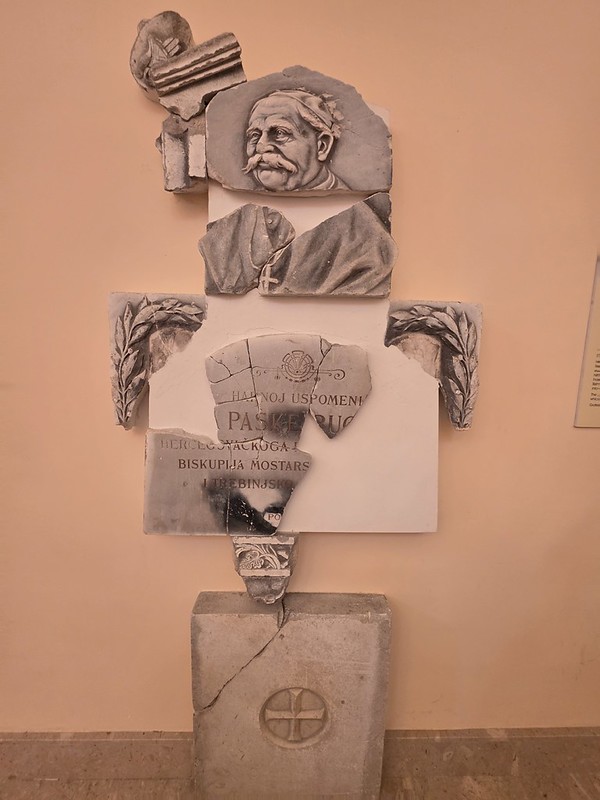
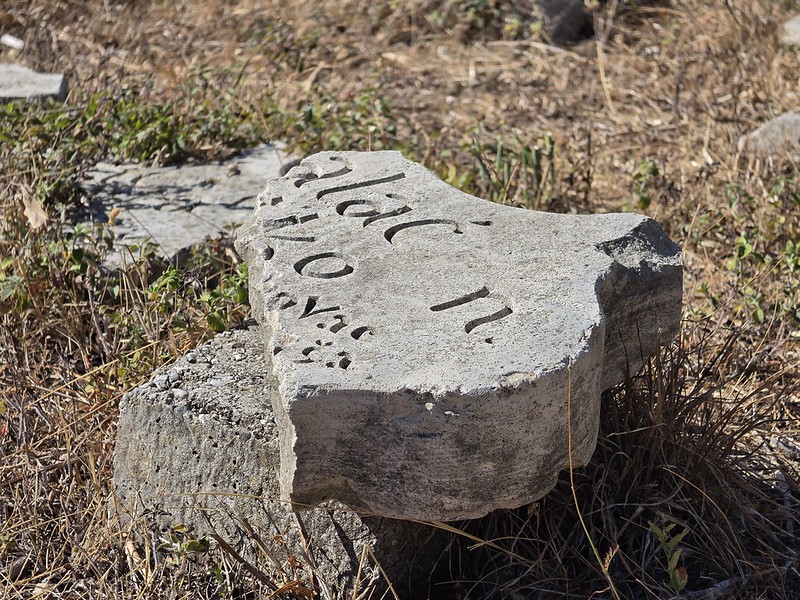
Preserved inside the Franciscan Church of Saints Peter and Paul is this shattered memorial to Paškal Buconjić, a Franciscan friar who became the first bishop of the newly established Diocese of Mostar-Duvno in 1881. Following his death in 1910, he was buried inside the church and the Croatian sculptor Ivan Rendić created a memorial incorporating a portrait relief of the bishop, an inscription and elaborate decorative stonework.
The memorial was broken apart when the original church was shelled and burned during the fighting in Mostar on 9 May 1992. Its surviving pieces have been mounted together inside the replacement church, with the large gaps and fractured edges deliberately left visible rather than disguised by reconstruction.
I liked that it had been presented in this way, with the accompanying information explaining what had happened. Within a church rebuilt after wartime destruction, the fragmented monument provides a permanent reminder of what was lost and ensures that the violence inflicted upon the original building is not entirely obscured by its replacement.
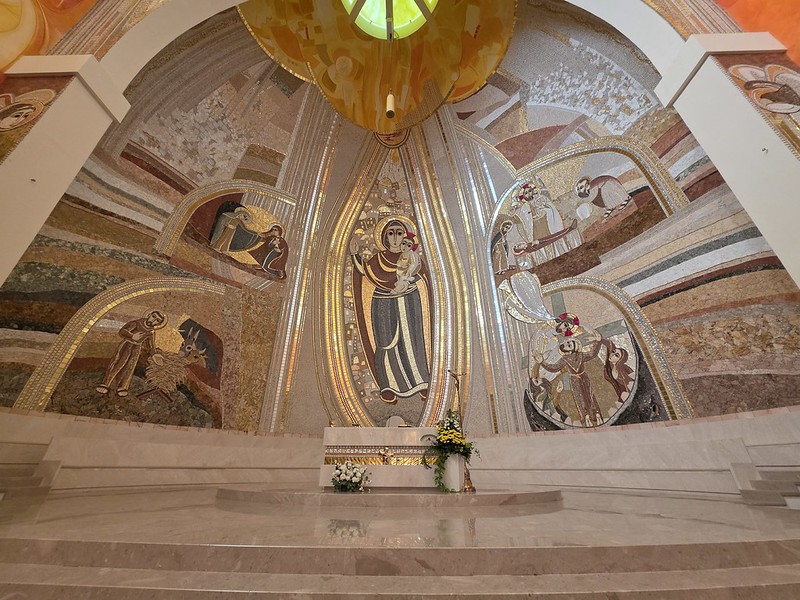
During our wanderings around Mostar, Jonathan and I visited the Franciscan Church of Saints Peter and Paul, where the modern interior proved substantially more colourful than I had expected. The enormous mosaic covering the apse was completed in 2021 and extends across more than 600 square metres. At its centre is the Virgin Mary holding the infant Jesus. The work was installed in just fourteen days by a team of 24 artists, which rather exposes my continued inability to put up a single picture successfully. I said at the time I was there that this was one of the most beautiful church installations I had ever seen, and it remains a genuinely impressive sight.
Looking back towards the entrance reveals the scale of the nave, the organ above the doors and the brighter orange artwork running beneath the upper windows. The original church was constructed under Ottoman rule, with its foundation stone laid in 1866 and the building completed six years later. A Franciscan monastery followed during the 1890s, but the church was destroyed by shelling in May 1992 during the Bosnian War. The new church has an unmistakably contemporary appearance, but its extensive biblical imagery ensures that it remains firmly connected to the traditions of the building it replaced.
The central view towards the sanctuary brings together the church’s pale stone, simple wooden seating and extensive mosaic decoration. It’s open, bright and feels functional.
The baptismal area stands near the entrance and looks directly along the nave towards the image of Mary and Jesus. Outside, the church is dominated by its 107-metre bell tower, the tallest in Bosnia and Herzegovina, but the interior was the more memorable element for me. This really was a striking church and the most memorable from our Balkans trip and even I remained quietly impressed for several minutes, which perhaps represented a minor miracle of its own. And more in the next post about a damaged memorial in the church.
While searching for craft beer in Mostar, this was one of the best reviewed venues in the city and so it seemed only polite to pop into Pub Beer ti&ja. It is next to a shopping centre and probably receives a fair amount of passing trade, but the centre was closed when we visited on Sunday, which perhaps explained why the pub was so quiet.
The bar area had the four keg options from Cooltura (the APA, the Amber, the Blonde Ale and the IPA) and there was signage about the craft beer available in cans. The welcome was immediately friendly and it felt an inviting location.
As I mentioned, it wasn’t the busiest but I still liked the atmosphere and general vibe.
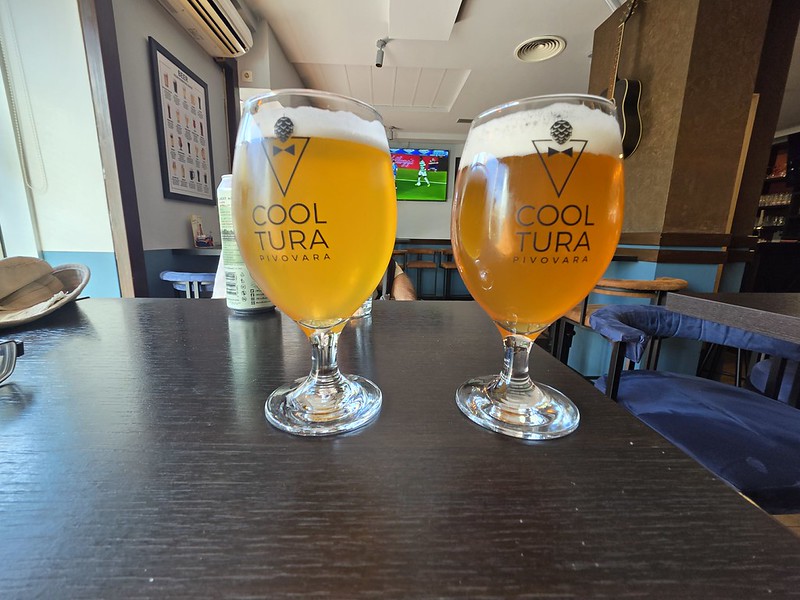
I ordered two beers from Cooltura Pivovara, whose beers appear to be brewed at the venue. On the left was Prirodna Plavuša, a malty and bready beer with light notes of honey and toffee. On the right was the APA, which I cannot describe in any detail because it transpired that I had forgotten to record it on Untappd. Sub-optimal in terms of my recording efforts, although I remember it being a decent beer.
There was also a pleasant outside area, while the staff appeared to be coping admirably with the considerable pressure of serving Jonathan and me.
I rather liked Beer ti&ja. It offered interesting local beers, friendly service and, importantly, accepted cards at a moment when neither of us had any Bosnian marks. That prevented me from visiting Craft Beer Garden Ima i Može, which accepted cash only and might otherwise have been one of my favourite bars of the trip judging by its Untappd selection. Beer ti&ja was therefore technically the alternative, although it was a thoroughly enjoyable one.
I admit that forgetting the flavour of one of only two beers does rather undermine my claim to be conducting serious international beer research. Fortunately, nobody has ever mistaken this blog for a peer reviewed academic journal, which is probably just as well.
Another day and another coach trip, so we went to the supermarket to buy some snacks for the journey and I got my usual chilled coffee to start proceedings with. This had by now become an essential part of my transport infrastructure plans.
It was around a twenty-minute walk from our accommodation to the coach station and, as usual, we arrived in good time.
I was relieved to see that it was a proper coach that pulled up to take us to Split, which was going to take over three hours and I felt I’d enjoyed enough minibus journeys on this trip. It was unclear where we were supposed to sit on the coach and we were shuffled about until taking up the rear five seats between us.
The coach swept out of Mostar and I was pleased to discover that it had both air conditioning and Wi-Fi of sorts. I didn’t have roaming in Bosnia, but I did in Croatia, so this meant that I was able to breathe easily.
This is the border town of Čapljina in Bosnia and that’s the River Neretva. I didn’t take photos of the border crossing into Croatia, but the sedate arrangements in Bosnia were informal whilst it was very much Fortress EU when arriving into Croatia. Everyone’s passport was checked in person, the Entry/Exit System was in operation and it felt secure and well managed.
Many passengers seemed delighted when we stopped for half an hour. I’m not fond of these breaks, which usually appear designed to extract money from a captive audience through an overpriced café while making the journey longer. The driver presumably needed a rest, however, so I confined my protest to buying nothing and returning to the coach to sit by myself. This was unlikely to bring the business model crashing down, but my principles had been maintained.
Here I am back on the coach enjoying my alone time.
We then passed the Baćina Lakes, a group of remarkably beautiful freshwater lakes near Ploče. Taking photographs through a moving coach window did not entirely capture the scenery, although it did produce an extensive record of reflections, roadside barriers and occasional sections of lake.
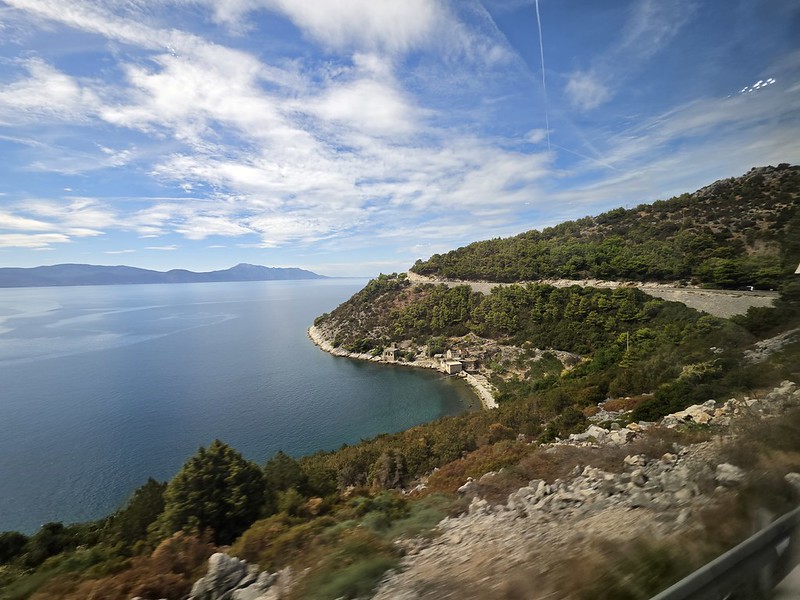
This is Drvenik and the Adriatic was looking rather lovely. I’ve been to Dubrovnik many years ago, as well as Zagreb many years ago, but this was my first time travelling along the Croatian coastline.
The church in Makarska, photographed during one of the relatively brief moments when the coach, the building and my camera were all pointing in compatible directions without me appearing in the reflection of the window.
Located near the village of Dubci, the glorious views continued and I took several videos, which will make an appearance on this blog at some point.
I remember this coach trip fondly. The route delivered one coastal view after another and, unusually for a long coach journey, I was in no particular hurry for it to end.
This is Omiš and this stretch of coastline was more built-up and was evidently popular with tourists.
The harbour a couple of miles further along the coastline.
Then into the outskirts of Split and I liked the architecture of these buildings whilst noting that we had arrived on-time. We only had one evening in Split and I was keen to see what I could of the city.
This had been one of my favourite coach journeys, as it is rare to enjoy such consistently beautiful views for so much of a route. The proper coach, functioning air conditioning and absence of collapsing seats had also established an exceptionally high standard by this stage of the trip.
The entrance to the Partisan Memorial Cemetery sits relatively discreetly along the lower western flank of Bijeli Brijeg, where a broad cobbled avenue guides visitors into a shaded area. This cemetery was near to the accommodation where Jonathan and I were staying in Mostar, and it had caught our attention as an intriguing site with a traumatic recent past
The site was commissioned in 1959 and formally dedicated in 1965, with the monument being created to honour the hundreds of citizens from Mostar who died as anti-fascist Partisans during the Second World War. It was all designed by the Belgrade architect Bogdan Bogdanović and he wanted something more organic than just another graveyard with stones lined up in rows. His intentions were noble and it doesn’t take long to see what he was trying to achieve.
Today, the whole arrangement feels a little less peaceful when arriving as the car park was pot-holed, the site has nearly no signage and it almost feels like it doesn’t want visitors. Given the lack of signage, I was fortunate to have Jonathan there who has a much better retention of historical facts to help me piece this whole complex political jigsaw together.
Passing beyond the outer gate reveals the ramps that lead visitors further into the main part of the graveyard. I didn’t understand this section which doesn’t go anywhere, but I wondered whether it was formerly some sort of water feature. I had read that there were frequent issues with graffiti and that included Nazi symbols, although I only saw one example of this. This suggests that there is some routine maintenance going on here to stop things from getting worse, but that this doesn’t extend to restoring what has already been damaged.
Walking up to the main memorial, tens of thousands of rounded river cobbles and salvaged limestone blocks were brought up from the river-bed and old ruined houses across Mostar to build these structures. Bogdanović rejected the more traditional orthodox socialist-realist monuments of the time, so there are no statues of soldiers charging with rifles or massive hammers and sickles. Although the accessibility options aren’t great here, the walk up to the site did add some grandeur and anticipation if nothing else.
The path then transitions into a narrow, dramatic stone corridor flanked by towering walls, small niches and arched openings that feel like the backstreets of a fortified medieval town. Bogdanović openly described this complex as an architectural representation of historic Mostar, designed to mirror its narrow lanes and unexpected turns. It was meant to create an element of discovery, although I found this whole section a little sinister even in the bright sun.
There are beautiful views over Mostar and in the 1970s and 1980s, this space was used as a public park. Sadly, the site’s location on the western side of Mostar placed it on the frontline during the tragic 1992–1995 war, when the city was split by brutal fighting between Croat and Bosniak forces. In the decades that followed, the monument became an ideological flashpoint in a divided city, frequently suffering from severe municipal neglect, political deadlock and repeated bouts of vandalism. There were many people who wanted this graveyard to be restored, but there were many other competing demands on resources and a rather limited system of local government available.
Emerging into the main amphitheatre reveals the sheer scale of the memorial and it is an impressive sight to look at, with its former glory not too hard to picture.
Looking across the amphitheatre from its lower boundary gives more of a clear perspective on the site’s sweeping layout, but evidence of modern political hostility is now visible. In June 2022, the memorial suffered a sad act of planned desecration when vandals entered the site overnight and smashed around seven hundred headstones with sledgehammers, reducing decades of memory to rubble.
Although the site was declared a National Monument of Bosnia and Herzegovina in 2006, securing more reliable funding, maintenance and proper perimeter security has proved to be an endless struggle. I must note that 2022 felt very recent when we were reading about this site, a reminder of how challenging the problems in this city still are, however much things are getting better.
It’s hard not to be saddened by the current state of the cemetery, with broken fragments of stone strewn everywhere and pieces of litter scattered in between. Crouching down to read these fragments didn’t feel quite as they were intended to be read.
This stone marker commemorates Borivoje D. Zubac, a Mostar native born in 1917 who died in 1942 at the Mamula concentration camp at the age of just twenty-five. Mamula, an island fortress situated at the entrance to the Bay of Kotor, was converted by fascist Italian occupation forces into a brutal prison camp where hundreds of partisans and civilians were starved, tortured and executed. There aren’t many identifiable stones left now, so this one felt important simply because it had survived.
A short distance away lies another shattered marker resting in the dry grass and what makes this cemetery historically unique is that it includes the names of fallen fighters from every community across Mostar, with Bosniaks, Serbs, Croats and Jews resting together without distinction of faith or ethnicity. Yet even smashed and half-buried in the soil, these limestone fragments stubbornly preserve the identities of the citizens who laid down their lives, backed up by photos of the markers at https://partizansko.info/en/ before they were smashed up. Certainly in adding context to the history of this site, this website really is very useful and I’m pleased that it has a record of the stones.
Fresh spring water originally welled up from the centre of this stone structure before flowing down through the terraces and winding channels to the entrance below. Though the water has long ceased to run and the stone shows decades of weathering, this does offer something of a glimpse of what was once here. I’m also not sure that it would require a huge amount of resources to be restored, but the challenge is perhaps more in ensuring that it’s not vandalised again.
Looking towards the valley from the top of the cemetery, it all tells the story of peace and hatred which has unfolded in this region over recent decades. It remains haunting and extraordinary, so I was glad to see it, but hopefully in the future it can be restored once again. Our next stop was the Bruce Lee statue, something of a contrast to this, but it had the aim of trying to unify the different communities in Mostar.
Finding lunch was slightly more challenging than anticipated, as many venues in Mostar either did not accept card payments or claimed that they did before revealing otherwise. This was all a little sub-optimal. Milo Food and Bar advertised that it accepted cards and, after checking when we arrived, all was well as they confirmed that they did. The welcome from the team member was friendly, so it seemed a sensible choice from first impressions.
It was all suitably decorative inside, which we admired briefly before abandoning it to sit outside with the insects.
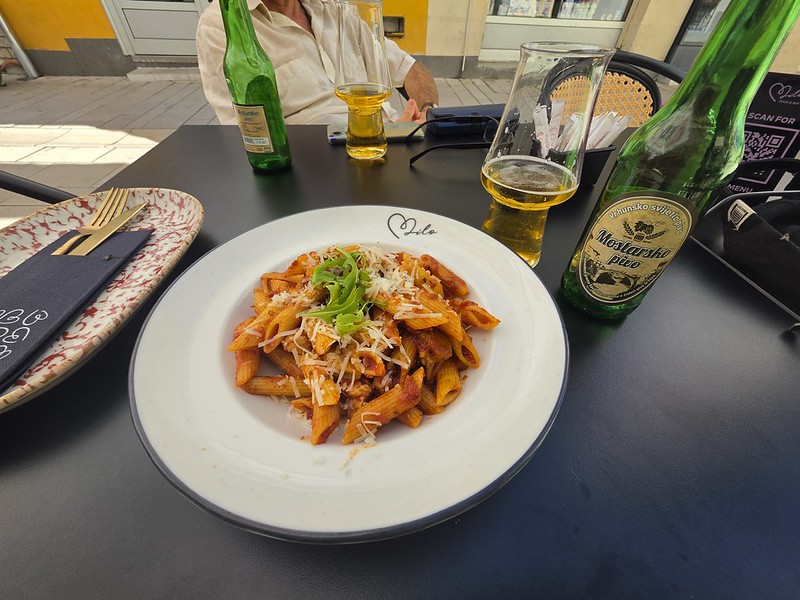
As I had been stomping around Mostar looking for food and drink, I accepted Jonathan’s request to sit outside as I can occasionally be very agreeable. Jonathan was content at this point with just a beer and some quiet, whereas I was deciding how many courses I needed. The drink was Mostarsko Pivo from Hercegovačka Pivovara. It was malty, bland and a little unexciting, but trying the local beer seemed only responsible.
I ordered the chicken pasta. It wasn’t especially complicated, but the portion was generous, it arrived properly hot and a reassuring quantity of chicken was hidden at the bottom. It was sometimes a little difficult to get the attention of the server, but we were in no rush and he was always friendly when he arrived at the table.
One of the restaurant’s specialities is their fried ice cream and although I’m not really a dessert person, this felt sufficiently tempting to give it a try. I rather liked it, the exterior was crispy giving it some bite, the ice cream was smooth and still nearly frozen and the fruit in the sauce gave it some extra flavour.
Overall, I was very pleased with the restaurant. It satisfied my need for sustenance, the welcome was friendly, the food and drink met my expectations and everything was reasonably priced. I left refreshed and ready to find new things to be annoyed about, so I regarded that as a success. I’m not sure that Jonathan obtained his quiet as I was there, but he did at least have a beer.
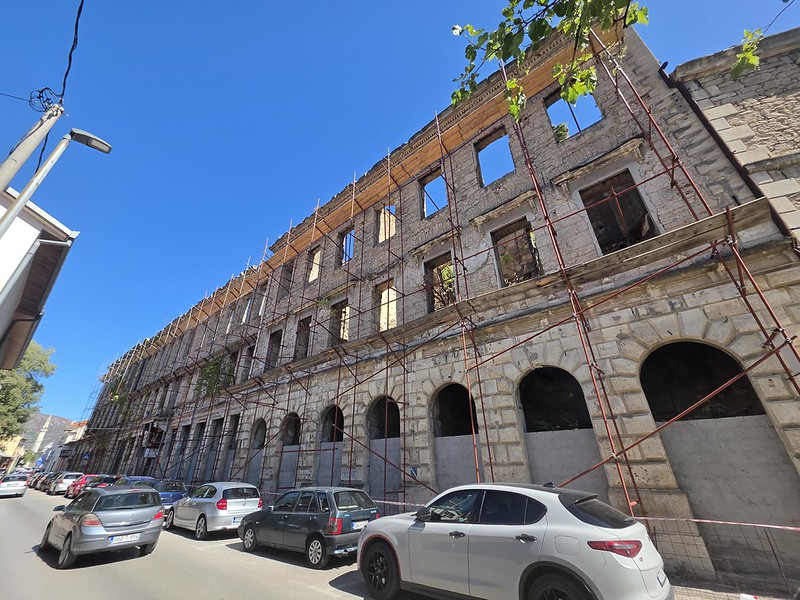
One of the most striking things about walking around Mostar is the way restored buildings stand immediately beside roofless shells, bullet marked walls and properties which appear to have been abandoned halfway through their destruction. I initially wondered why so much had been left, but it became apparent that an enormous amount has already been rebuilt. Much of that work has focused on the Old Bridge and historic centre, while many of the remaining ruins are concentrated in areas which suffered the worst fighting.
Mostar was damaged during two distinct phases of the Bosnian War. In 1992, the city was attacked by the Yugoslav People’s Army and Bosnian Serb forces, with extensive shelling damaging homes, public buildings, industries and infrastructure. Bosnian Croat and Bosniak forces initially fought together against that attack, but their alliance collapsed the following year. During 1993 and early 1994, the Croatian Defence Council and the Army of the Republic of Bosnia and Herzegovina fought one another, dividing Mostar between a predominantly Croat west and a besieged Bosniak east. Buildings around the Bulevar stood directly on the front line, while artillery, fire and close range fighting caused further devastation across the city.
The scale of destruction meant that everything could not be repaired at once. Across Bosnia and Herzegovina, more than a third of the prewar housing stock was partly or completely destroyed and over half the population had been displaced. The urgent priorities after the conflict were restoring water, electricity, roads, hospitals, schools and habitable homes. International funding also supported culturally important projects such as the reconstruction of Stari Most and the historic area around it. Those investments were enormously valuable, but inevitably left less prominent apartment blocks, offices, factories and commercial buildings waiting much longer.
Ownership has provided another obstacle, and I had seen similar evidence of these problems among the ruined buildings of Belgrade. Some private properties had owners who were killed or displaced, while others belonged to people now living abroad. Still other sites accumulated competing claims, unresolved inheritance questions or numerous co-owners who all needed to agree on what should happen. Bosnia created a substantial property restitution process after the war, but returning legal ownership did not necessarily provide people with the money required to rebuild. A ruined property with six owners, three legal disputes and no commercially viable use is not an especially tempting proposition for an investor.
Mostar’s political structure has made progress slower as well. Post-war government was divided between different administrative levels and political interests, while parallel Croat and Bosniak institutions remained influential. Disagreement over electoral rules meant that Mostar held no local elections between 2008 and 2020, leaving the city without a normally renewed council for twelve years. This was, to put it mildly, rather sub-optimal for making complicated decisions about reconstruction. Buildings along the former front line are particularly sensitive because they occupy both valuable land and contested historical space.
There is also the less dramatic problem that many of these structures are extremely expensive to save. A building which has lost its roof, windows, services and internal walls may require complete structural reinforcement before restoration can even begin, particularly when a tree is growing through the middle of it. Demolition can also be costly, particularly in a busy city centre, and the cleared site still needs an economically realistic new use to make redevelopment financially viable. It’s hard to see what can realistically be done about properties such as this without entirely demolishing them and perhaps using some of the stone in the reconstruction, but then it might just be easier to build something new elsewhere.
The future is therefore likely to involve a mixture of restoration, redevelopment, demolition and deliberate preservation. Mostar has already demonstrated through the Old Bridge, historic centre and numerous individual buildings that major reconstruction is possible when ownership, funding and political agreement come together. Some ruins may eventually become hotels, offices, housing or cultural spaces, while others could be retained as properly interpreted memorials rather than unofficial urban exploration sites. The difficult question is how much physical evidence of the war should remain. Repairing everything risks making the destruction invisible, but leaving dangerous shells throughout a living city is not a sustainable form of remembrance.
This reminded me of the Frauenkirche in Dresden, whose ruins were deliberately retained as a war memorial for decades before reconstruction began after German reunification. Cities can apparently become accustomed to living around their damaged buildings, until a later generation decides that their meaning or future should change.
On a more positive note, I found this piece of installation art inside one of the ruined buildings. It was encouraging to see an abandoned space being used creatively, even if the building itself remained some distance from troubling a conventional estate agent. We also saw several buildings which were finally being reconstructed during our meanderings, so the situation is gradually improving.
Jonathan and I ventured into the lower levels of the building generally known as Mostar’s Sniper Tower, beginning with this substantial concrete stairwell. Its less dramatic local name is the Staklena Banka, or Glass Bank, and architectural records identify it as a project for Privredna Banka Sarajevo designed by Mostar architect Dragan Bijedić. Work began during the final years of Yugoslavia, but the building had not opened before war reached the city.
It wasn’t immediately obvious whether visitors were supposed to enter. It plainly wasn’t encouraged, but a section of the wooden boarding had been moved aside, leaving a reasonably straightforward way inside. Once inside, the stairs offered an obvious route upwards, although the absence of handrails quickly established the limits of my enthusiasm for urban exploration.
The interior has been stripped back to its concrete frame, with hanging cables, missing fittings and large openings where the exterior walls and windows once stood. The original building was intended to be one of Mostar’s most striking modern developments, with approximately ten storeys enclosed by blue glass held in an aluminium frame. That sleek late Yugoslav appearance has almost entirely vanished, leaving a structure which now looks as though exposed concrete had been the architect’s rather bleak intention all along.
I must admit that I hadn’t realised it was a bank while we were walking around it. I had assumed that it was a multi-storey car park or something similar. This probably says something about my architectural knowledge, but there we go.
Its height and position beside the Bulevar made the unfinished bank militarily valuable when Mostar was divided during the Croat–Bosniak fighting. The road became part of the front line between Bosnian Croat controlled western Mostar and Bosniak controlled territory to the east. Bosnian Croat forces occupied the tower and used its upper levels as sniper positions, gaining extensive views across the surrounding streets. The building was consequently shelled and its glass exterior destroyed, leaving the concrete skeleton that survives today.
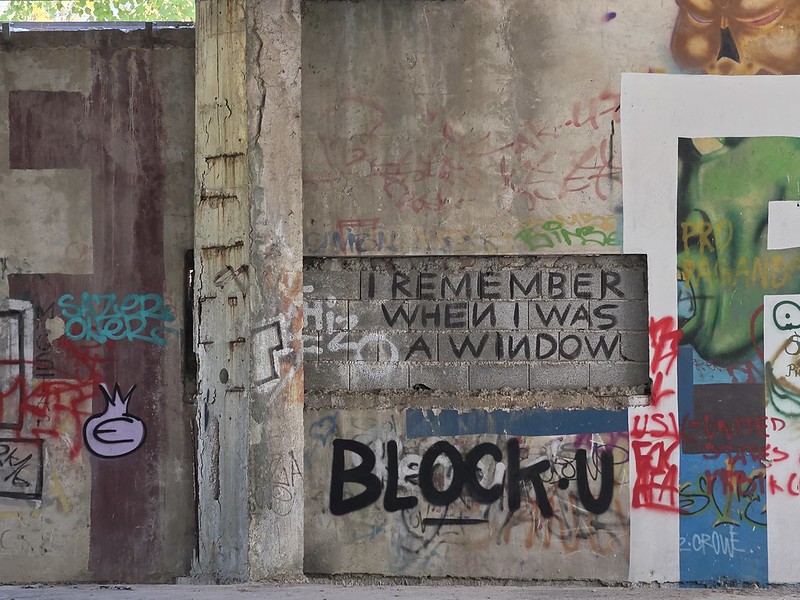
Among the layers of graffiti is the message “I remember when I was not a window”, painted across what appears to be a blocked opening. This was my favourite piece of graffiti in the building as I like a little bit directness and dry humour. Nearly everything in the tower has changed purpose, with former offices becoming firing positions, ruins becoming canvases and blocked walls remembering when they provided views across the city. There are many reminders of war in Mostar, but this one is perhaps one of the most obvious.
Since the war, the lower floors have developed into an unofficial street art gallery, with large murals competing against tags, political messages and several decades of general decay. There is no formal exhibition or historical interpretation inside, which makes the experience rather different from visiting a preserved memorial. It remains an abandoned and potentially dangerous building rather than an attraction, something I continued reminding myself whenever Jonathan appeared more confident about the whole arrangement than I was.
These dark openings appear to be where the lifts were once located. The shafts are now unprotected drops, surrounded by damaged floors, and there was no compelling evidence that anyone had recently completed a reassuring health and safety inspection. I was pleased to have explored part of the tower, but felt no pressing need to reach the roof, even though it was accessible to those with substantially greater reserves of courage.
The larger mural provides a flash of colour within an otherwise grey and hollow interior. Much of the artwork has no direct connection to the war, but collectively it has given the building another stage in its history. The tower has shifted from an ambitious modern bank to a military position, then to a ruin and finally to an unofficial creative space. Jonathan and I spent longer looking at the artwork than I had expected, although this may partly have been an elaborate way of avoiding the increasingly unsafe stairs.
Seen from outside, the scale of the tower becomes much clearer and so does its former military value. Its long horizontal openings overlook central Mostar and the former front line, while almost nothing remains of the blue glass façade which gave the building its original name. Plans to rehabilitate the structure have circulated for years, but it continues to stand as one of the city’s most visible war ruins. Our cautious exploration of the lower floors was quite sufficient for me, leaving the higher levels to people with greater courage, poorer judgement or indeed both. By my standards, I had already been exceptionally brave once again.
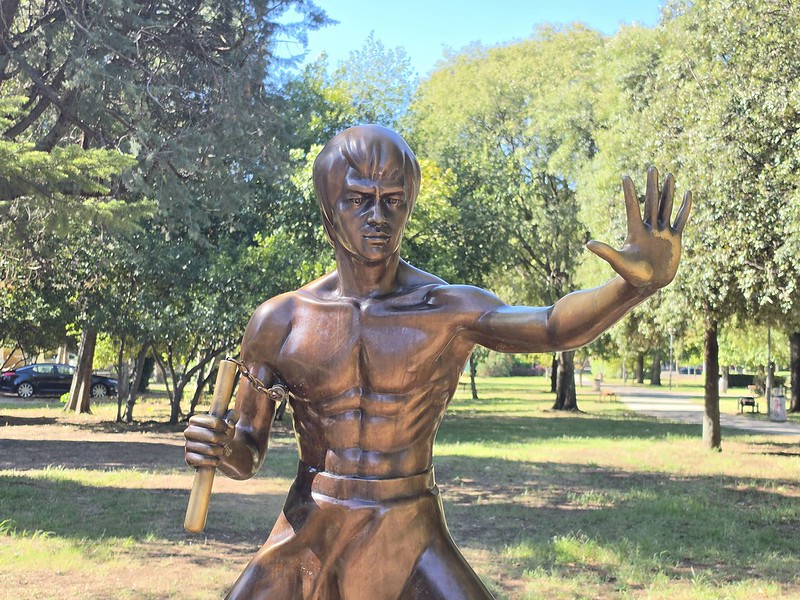
Perhaps one of Mostar’s more unexpected monuments is this bronze statue of Bruce Lee in Zrinjevac Park. I’m not sure if this was on Jonathan’s list of things to see, but it was on mine and he likes films, so that all worked out nicely. The wider view shows Lee standing above the words “Bruce Lee, Your Mostar” which is all very positive.
Created by Croatian sculptor Ivan Fijolić and unveiled on 26 November 2005, it was proposed by the Mostar Urban Movement as a shared hero for a city still divided after the war. Bruce Lee was distant from local political and ethnic arguments, while his films had been enormously popular throughout Yugoslavia. It was also the first public monument to him anywhere in the world, beating the unveiling of Hong Kong’s statue by one day and giving Mostar a victory in a competition that Hong Kong probably had not realised was taking place.
These things are never entirely easy though and even his orientation proved politically sensitive, as residents complained that his fighting stance appeared to be directed towards their side of the divided city. He was consequently positioned to face a more neutral direction, which must be one of the few occasions when municipal reconciliation has involved carefully rotating Bruce Lee.
Although a symbol of unity, his time in the park has not been entirely peaceful. The statue was vandalised soon after its original unveiling and later spent several years away being repaired. It was stolen in March 2024 and recovered after being cut into pieces for sale as scrap metal, which was all a little sub-optimal. Following extensive restoration, Bruce returned to his pedestal in December 2025, making these photographs evidence that Mostar’s unifying action hero has survived vandalism, theft and dismemberment and remains impressively difficult to defeat.
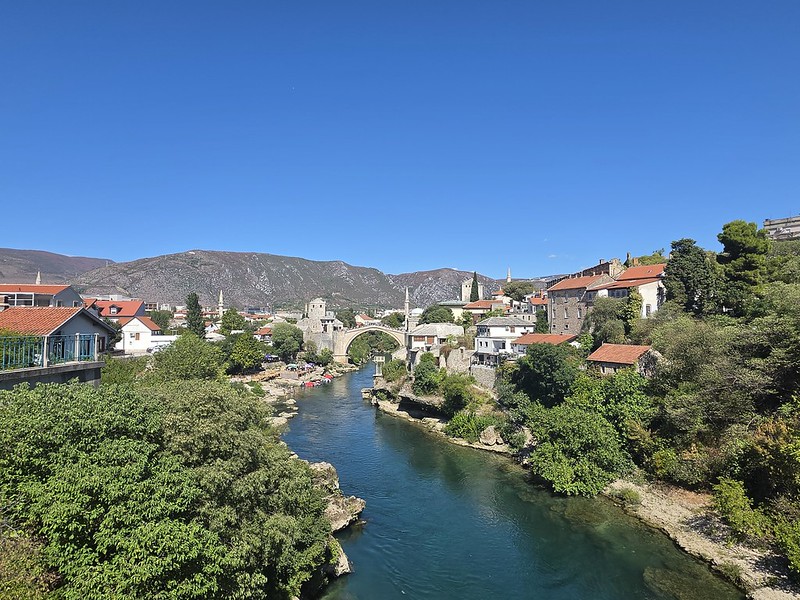
I took this photograph from farther down the River Neretva, primarily because I had forgotten to take one while walking across the bridge itself when it was extremely busy. This is the Stari Most, looking rather delicate against the surrounding mountains. The bridge was commissioned by the Ottoman sultan Suleiman the Magnificent and constructed between 1557 and 1566 under the direction of Mimar Hayruddin. Its single stone arch connected the two sides of Mostar for more than four centuries and became so closely associated with the city that Mostar itself takes its name from the mostari, the bridge keepers who guarded the crossing.
The bridge visible today is a reconstruction. The original survived earthquakes and centuries of political change before being destroyed by Bosnian Croat forces on 9 November 1993 during the Croat–Bosniak conflict. Images of the arch collapsing into the river became one of the most powerful symbols of the damage done to cultural heritage during the Bosnian War and I watched the video on YouTube of the destruction.
And since I’ve mentioned it, here’s the video.
This closer view shows the remarkable height and steeply curved profile of the bridge. The reconstruction was undertaken as an international project coordinated with UNESCO and the World Bank, using traditional building methods and locally quarried Tenelija limestone chosen to match the original masonry. Stari Most reopened on 23 July 2004 and the bridge and surrounding Old City were inscribed on UNESCO’s World Heritage List the following year. It was intended not simply as an architectural restoration, but as a symbol of reconciliation in a city that remains divided in numerous ways. More on that theme in a future blog post though, this was certainly a complex city.
The metal platform in the river belongs to Mostar’s long tradition of bridge diving. Local divers leap from the top of the arch into the exceptionally cold Neretva approximately 24 metres below, although this requires training rather than merely an excess of holiday confidence. Organised competitions have taken place for generations and the spectacle has become almost as closely associated with the bridge as the architecture itself. Jonathan and I weren’t tempted.
From this angle, the bridge can be seen with the fortified towers that once controlled access to it. The Tara Tower stands on the eastern bank and the Halebija Tower on the western side, both forming part of the historic defensive complex surrounding the crossing. The buildings climbing the riverbanks help explain why the bridge feels like part of the old town rather than an isolated monument. Its arch links two dense groups of stone buildings and narrow streets, just as the original was designed to do in the sixteenth century.
Although this is technically a twenty-first-century bridge, it has been reconstructed closely enough to restore one of Europe’s most recognisable Ottoman views. It was always busy with tourists when we walked over it and I’m not sure that I would have realised it was a modern replacement, it feels like an authentic reconstruction.