I’ve mentioned, several times (so I’ll be quiet on the matter now), that I don’t like this airport, but I will say that I like its lounge even less. This is a third rate airport lounge, poorly designed, too small and with a limited selection of food and drink. My two loyal blog readers will soon get tired of this negativity, but there we go…..
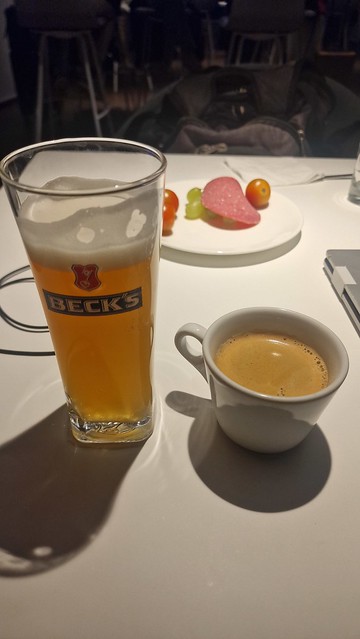
I will say that the coffee tasted OK though. The beer is the Franziskaner Premium Weissbier which is light and pleasant, slight edge of bananas and it was on self-service draft pour, I’ll give them credit for that one.
The rice and chilli, in fairness, was entirely acceptable although it wasn’t going to win many awards for the depth of taste. I took all the grapes that were left, my bunch of three grapes is visible in the background.
The rice and chilli was pretty much the entirety of the food options for those who didn’t want dried up salad or sausages.
This is the aforementioned sausage selection and some other stuff to try and take the taste of them away. I didn’t go near it.
The dessert option was apple something or other with some other stuff. I didn’t go near that either.
The second beer option was Becks on draft which is a third rate beer that tasted as I expected, like flavoured water. It’s on self-service draft and it was fobbing heavily, so the waste was quite high, although there’s a valid argument that if a beer is going to be wasted it might as well be this one.
There was one thing that I did very much like in the lounge and that was the chocolates and sweets. I put these in various places in my bag and then, like an excitable squirrel, I uncovered them over the next few days. I was quite pleased with myself with that arrangement.
I found the staff here polite and helpful, but the lounge was at near constant capacity and it’s just too small. It was hard to find somewhere to sit (and I had visited at what appeared to be a relatively quiet time for the airport) and it took me a while to find somewhere with a power point. The surfaces were sticky and dirty, the floor was dirty, the self-service area was dirty and the range of food and drinks was limited. I would have been very disappointed if I had paid the walk-in fee of €36, although the temperature was warm and once I had found a suitable seat it wasn’t uncomfortable. But there were plenty of people coming into the lounge who couldn’t find seats and I’m confused why at a new airport they’ve hamstrung the lounge by not making it that bit larger.
There are two locations at Berlin Airport that are accessible from Terminal 2 that I can use with my Priority Pass card, namely the Tegel Lounge and the NU Made With Love restaurant (there’s also a dessert option, but it’s not reachable from Terminal 2). I went to the latter first and was, to be honest, confused what to do. There’s a takeaway section and a restaurant area, but it felt like somewhere that you needed to be seated. I waited there for a while and then thought perhaps you had to order at the counter and then be seated.
The menu options, it all looked exciting and interesting.
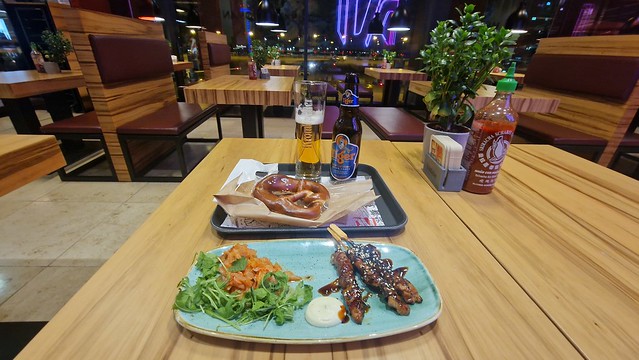
Card holders get €23 to spend here on whatever food and drinks they want. There was then something of a situation, which is that the customer in front of me was also using his Priority Pass card and was being shouted at by the team member with some force. The team member was saying “this isn’t a lounge, why don’t you understand?”, but I think the customer in front was fully aware of that, he was asking for help on how to use his card. He walked off, slightly wounded, and I did feel sorry for him as he just looked confused. The team member was pre-annoyed when I told him I had the same card, but I mentioned I wasn’t sure where to stand for the best and matters improved immediately and he was helpful and personable. I ordered the chicken skewers and a beer, but he said that I could get a pretzel as well for the money. I asked the team member if they had any power points and he helpfully walked around to show me the best place to sit, so I found him agreeable in the end. I suspect that he was feeling a little guilty for shouting at a random passenger as well, but a lot was likely lost in translation.
Served after around seven minutes, the chicken skewers had a pleasant flavour with the sauce, but the texture of the chicken itself seemed odd. The pretzel though tasted good and the Tiger Beer was served in a clean glass with the drink being at the appropriate temperature. It’s not cheap for what was just under €23, but it looked well presented and the chicken was at the appropriate hot temperature.
The surroundings felt modern and on-trend, so it was a comfortable environment. There weren’t many other customers, although the poor guy that had been shouted at obviously had another go as I saw him meekly appearing into the seating area with a beer. If I come back to Berlin again, I will likely come here again, the seating area was really peaceful and comfortable, although I might go for a different food option.
Safely back at Berlin Brandenburg Airport and I tried to be more positive about it than when I arrived. But, it’s a struggle, this is perhaps the most mocked airport in northern Europe for the delays and chaos in its building, but it also feels so badly designed and the negativity from passengers continues.
Terminals 1 and 2 are linked airside and it wasn’t clear to me why passengers have to walk in the cold to get from one to another on landside. This airport was meant to cost €2.83 billion to build, but the total was ultimately nearer to €8 billion. It surely couldn’t have cost much to link the two terminals landside? The railway station is at Terminal 1, this is the one that the airport had to pay millions in compensation to Deutsche Bahn as they opened so late.
Anyway, here’s Terminal 2.
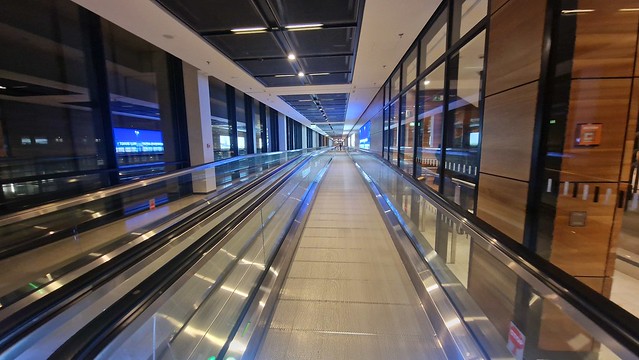
Getting between the terminals is rather nice inside. I will also say that the airport is clean and shiny.
Just jumping ahead a bit, the gate design here feels ridiculous and it’s no surprise the airport is hit by so many negative reviews. Every gate has its own set of toilets and seating, but this strikes me as a highly sub-optimal arrangement as it means that the gate can’t cope with a flow of people all at once. And, aircraft tend to bring a flow of people all at once. So there aren’t enough toilets and only half the seats they need for the typical flight, with people having to sit on the stairs. It is possible to go to the neighbouring gates, but that requires climbing stairs back to the main terminal, walking along the terminal building a bit and then going down stairs. I, and others, did that and that’s not a problem (there are also lifts for those with accessibility issues), but it means you can’t see what’s happening at the gate you’re departing from.
It comes to something that London Luton Airport can manage to provide enough toilets and seating, whereas Berlin Brandenburg which had a huge budget and almost unlimited space was unable to. I asked AI to give me a summary of the situation:
“Ongoing Complaints:
Long Security Lines: This remains a major pain point, with many experiencing excessively long waits at security checkpoints. Understaffing and inefficient procedures are often cited as the culprits.
Unfriendly Staff: A number of reviewers mention encountering rude or unhelpful staff, particularly at security and immigration. This contributes to a negative overall experience.
Poor Signage and Wayfinding: Navigating the airport can be confusing, with unclear signage leading to frustration and missed flights.
Limited Food and Beverage Options: Some find the selection of restaurants and cafes to be lacking, particularly in certain terminals.
Distance from the City Center: BER’s location outside of Berlin requires a significant commute, which can be inconvenient for travelers.
Some Positives:
Modern Facilities: The airport itself is new and modern, with generally clean and well-maintained facilities.
Improved Efficiency (Sometimes): Some reviewers report smooth and efficient experiences, particularly during off-peak hours.
Overall:
While there have been some improvements since its chaotic opening, Berlin Brandenburg Airport continues to receive a significant number of negative reviews. Long security lines, unhelpful staff, and wayfinding issues remain common complaints. It seems that BER still has a long way to go to win over travellers and live up to its potential as a major international airport.”
I’d say that’s a fair summary. The situation with signage is a mystery to me, it is sub-optimal and I don’t understand who has been put in charge of that. Anyway, I’ll go back a bit in my next post, I’ve got a lounge and airport restaurant to witter on about first.
I had something of a wait for a train, so I thought I’d pop into this shopping centre and find a coffee or similar. The photo above isn’t of the unit (it’s taken in the other direction when I was sitting down), but the food court was modern and rather comfortable for a shopping centre. I noticed that this coffee shop had a perfect Google Reviews score, something which is quite impressive to see a 5/5.
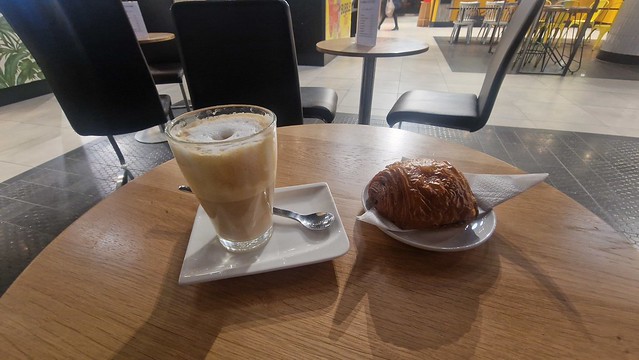
The service was impeccable, although when I ordered a latte the team member asked if I would like a German style latte or an Italian style latte. I answered the latte, but when I was sitting down it occurred to me that an Italian latte might technically be just milk, so I wondered what he’d bring over. Fortunately, he delivered a coffee and it was a light and airy drink with a depth of flavour, so all was well. I also had a rather delightful pain au chocolat, so this was a handy little snack arrangement. The surroundings were rather tranquil bearing in mind it was a busy shopping centre, with the prices also being reasonable.
I asked AI (yes, it’s true that this is my go to solution for nearly everything now) and it came up with this handy table for me.
Drink Name
Country
Description
Latte
Italy
Milk
Caffè Latte
Italy
Espresso with steamed milk
Latte
Germany
Often used to mean “Caffè Latte”
Milchkaffee
Germany
Filter coffee with hot milk (no foam)
Right, I think I have a better understanding now, although as with so many things, it’s a little complex. But, I can see why this venue is so positively reviewed, the team member was engaging, the location was clean and the food and drink was of a very good quality. All rather lovely.
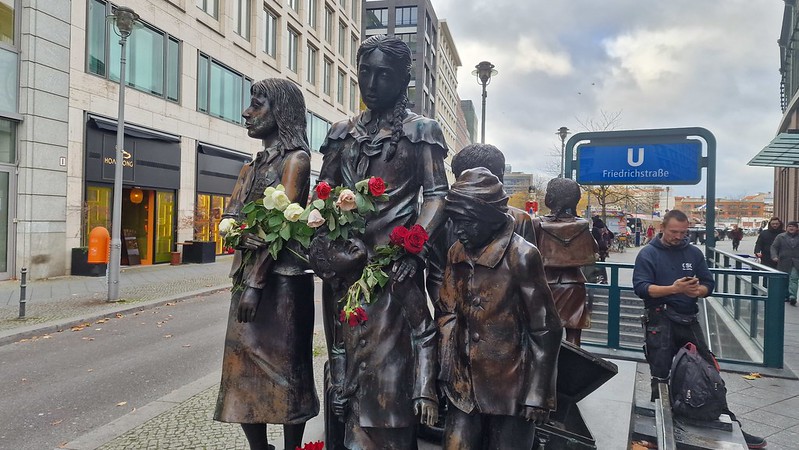
Unveiled on 30 November 2008, this powerful sculpture was designed by Frank Meisler (1925-2018) and it shows two groups of Jewish children from the 1930s, facing in different directions. Their fates hung in the balance and 10,000 children were sent from Berlin to the UK as part of the Kindertransport, using the railway lines located at this site. The children facing east symbolises those who were sent to their deaths at concentration camps, whilst the children facing west were more fortunate, their involvement with the Kindertransport and the adventure forced upon them meant their lives were saved. However, for all of the children there was uncertainty, fear and parents who struggled to know what to do for the best for their children. The sculpture stands here as a memorial to the two million children who died under Nazi rule and occupation between 1933 and 1945, many of who might still be alive today if hatred hadn’t prevailed for so many years.
The museum opened in January 1992 on the 50th anniversary of the meeting, although the media noted that the political situation was still complex.
The whole process of opening a museum had been long and complex, with the plan to use this property being controversial. Joseph Wulf, a survivor of Auschwitz and a prominent historian, was one of the proponents of the house being used and when the inept Klaus Schütz made politically explosive comments on the matter, it led to Wulf having to have protection for his own safety. Wulf committed suicide in 1974, saddened by how so many people involved in the Second World War were still free and held unaccountable for their actions, living almost normal lives.
After the Second World War, the building was used as a school and Wulf would have hopefully been delighted that his wish for the building to be used as a museum came to pass.
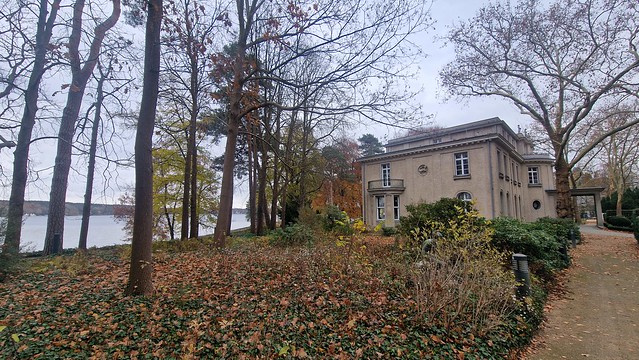
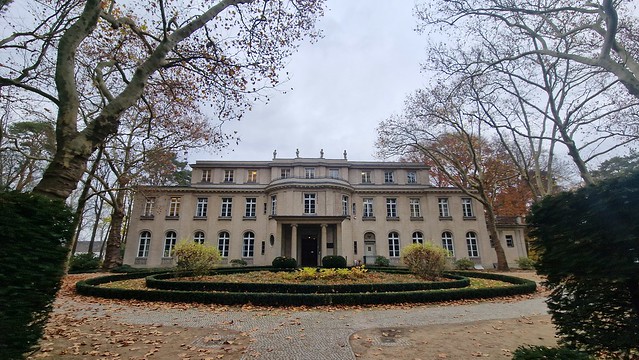
The exterior of the building.
If Heydrich hadn’t had his meeting here, or even if the single document that was found with the details of that meeting, then this would likely be a rather lovely country house with views over the lake today, the details of what happened in 1942 would have been unknown.
The exterior is calm and pristine.
The attendees of the fateful meeting were:
SS and Police Officials:
Reinhard Heydrich: Chief of the Reich Main Security Office (RSHA), chaired the meeting.
Heinrich Müller: Chief of the Gestapo (Secret State Police).
Adolf Eichmann: Head of the Jewish Affairs office, responsible for the logistics of deportation.
Eberhard Schöngarth: Commander of the Security Police in the General Government (occupied Poland).
Rudolf Lange: Commander of Einsatzkommando 2, responsible for mass killings in Latvia.
Otto Hofmann: Chief of the SS Race and Settlement Main Office.
Government Representatives:
Roland Freisler: State Secretary in the Ministry of Justice.
Wilhelm Kritzinger: Ministerial Director in the Reich Chancellery.
Alfred Meyer: State Secretary in the Ministry for the Occupied Eastern Territories.
Georg Leibbrandt: Ministerial Director in the Ministry for the Occupied Eastern Territories.
Martin Luther: Undersecretary in the Foreign Office.
Wilhelm Stuckart: State Secretary in the Ministry of the Interior.
Erich Neumann: State Secretary in the Office of the Four Year Plan.
Josef Bühler: State Secretary in the Office of the Government of the General Government.
Other:
Gerhard Klopfer: Permanent Secretary in the Nazi Party Chancellery.
They were mostly younger men, there were only two men over fifty and no women. Heydrich died during the war, as did Lange, with Müller disappearing in Berlin in 1945 and so likely suicide or killed in action. Schöngarth was executed in 1946 for killing an allied airman, whilst Hofmann was sentenced to 25 years in prison and served 10 years. Stuckart was sentenced to three years in prison and died in 1953, whilst Klopfer was arrested but died due to lack of evidence. Neumann was held in custody and died in 1951, whilst Alfred Meyer committed suicide in 1945. Luther was arrested by the Gestapo for plotting against Hitler and died in custody in 1945, whilst Eichmann escaped to Argentina but was executed in Israel in 1962. Kritzinger was arrested but released and died in 1947, whilst Leibbrandt was sentenced to three years in prison and lived until 1982. Bühler was executed in Poland in 1948 for crimes against humanity and Friesler was killed in an allied air raid in 1945. In the main, the collapse of the German regime brought nearly all of these figures down and led to early deaths or looking over their shoulders after the war.
I can’t offer much commentary on the entire Holocaust, but at the time of this meeting it looked like Germany might well win the war and that these men were seeing themselves as doing a job that needed doing whilst ensuring they and their families were well looked after. Most of these men were already senior officials that had navigated the politics of the Nazi Party so they were likely to be able to continue doing that. As for the millions they killed, I can only assume they just pictured them as enemies of the state, deserving of death as much as soldiers from other countries who were fighting Germany. By the time of this conference, it was all too late, none of those attending could really individually stop all that was happening, they were just facilitators in a sprawling officialdom. The death camps must have felt a long way from Wannsee, just numbers of pieces of paper, all just too easy to say yes to all the decisions that Heydrich made to kill millions. Hannah Arendt published a book on Eichmann titled “A Report on the Banality of Evil”, referring to how he declared himself as a functionary of the state and how he saw the German people starting to agree more with this campaign of terror and murder, but that simply made his morally responsibility further lessened.
But many of these attendees were respected by their juniors or, at least, their views were respected. If any of them had started to question Heydrich, then that would have had a trickle-down effect of more people in the German war machine starting to question the Holocaust. There is evidence of this in Denmark, where most Jews were saved because not only did the Danish population questions the Nazis, so did the junior members of the military and then even more senior ones. The orders came down to kill and arrest Jews, but the levers of power didn’t work, the orders were frequently ignored. And that could have happened with Wannsee, there seems to have still been a chance to have lessened the Holocaust even if the general direction was unstoppable, there was opportunity for any of those present to try to redefine what was happening. Anyway, I digress with my random thoughts, but I’m glad I went to Wannsee and to see where such a fateful decision was made, it’s a calm environment and the displays were thoughtfully and carefully laid out.
One of the true German heroes, Richard Stern (1899-1967) who was a German businessman who is notable for his public resistance against the Nazi boycott of Jewish businesses in the 1930s. He issued the leaflet on the right-hand side of the above photo which referred to:
– 65 million Germans being asked to treat Jews as second-class citizens
– 12,000 fallen German front-line soldiers were Jewish
– Calling for solidarity to the Jewish community
He himself was a First World War veteran himself and in the image on the left, he was wearing his Iron Cross whilst a young Nazi stands by the entrance to his shop. The photo was taken on 1 April 1933 outside his bedding store in Cologne. Stern’s strength of character is immense, he stayed in Germany for as long as he could before he needed to emigrate to the United States in 1939, just before the outbreak of the Second World War. He then, as a German, joined the US army and in 1944 was awarded the Silver Star, the third highest military decoration that can be granted. It also transpired that in 1942, there had been a drive to collect metal for the war effort and Stern put in his Iron Cross.
The highly complex system used by the German Civil Service to work out if someone was a Jew.
This is a photo of Julius Wolff, a young Jewish man, and Christine Neemann, his non-Jewish fiancé who were both paraded around Norden in Germany on 22 July 1935 because of their relationship. Wolff was forced to wear a sign that says “I am a race defiler” (“Ich bin ein Rasseschänder”).
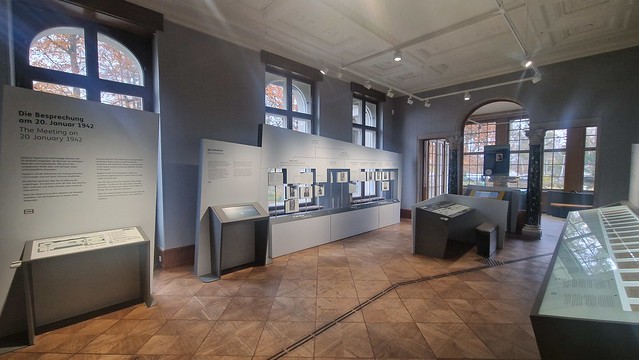
Back to the museum, this is the room where the meeting took place with a side-room visible on the right.
The side-room.
The documents from the meeting were meant to be destroyed and they all were with one exception.
The number of Jews in various parts of German territory. I understand that these were the numbers they wanted to reduce by their Final Solution plans. The exception I mentioned was that one set of documents was found almost by chance in 1947 by Robert Kempner, a U.S. prosecutor at the Nuremberg Trials. Without that find, I’m not sure that this property would now be a museum as these were the documents that revealed information about the Final Solution.
This photo is from 19 April 1945 when the Nazi documents stored by the Foreign Office were seized by US troops.
I’ve wanted to visit this building for some time, but didn’t get a chance on my previous trips to Berlin. It took longer than I would have liked to get there due to parts of the rail network being closed, but I finally got to the nearby rail station and then walked the 40 minutes to this historically important site.
As an introduction, the House of Wannsee was the site of the Wannsee Conference on 20 January 1942. During this meeting, high-ranking Nazi officials discussed and coordinated the implementation of the ‘Final Solution to the Jewish Question’ which was their plan for the genocide of the Jewish people (and others, but the main focus was Jews). The conference was significant because it formalised the plans for the systematic, industrialised murder of Jews across Nazi-occupied Europe. It brought together various Government agencies and organisations involved in the persecution and murder of Jews, ensuring their cooperation and establishing a framework for the genocide.
The Wannsee name comes from the lake that the house sits on the edge of, a tranquil and beautiful setting. The villa was built in 1914 by a wealthy pharmaceutical manufacturer named Ernst Marlier and it was designed as a decadent private residence, reflecting the affluence of the time. The financial situation changed for Marlier and he then sold the property to Friedrich Minoux, an industrialist with right-wing leanings.
I stood here for a while imagining Reinhard Heydrich arriving in his chauffeur driven car.
A plan of the property, the room where the conference was held is number 3.
All the documents at the museum are copies of originals. This one is a letter from Heydrich to Martin Luther, an Under-Secretary in the Foreign Office, sent on 29 November 1941. It delayed the planned meeting that had originally been scheduled for December, and changed the location to Wannsee.
In 1941, the Nazis had taken the building over, using it as a guest house for the Security police and Security Service of the SS. This is a bulletin from the organisation informing recipients about the opening of the guest house and informing leading members of the SS and the police that they can stay overnight when coming to Berlin on business matters. The document also talks about the modern amenities, the beautiful location, the good food and the comradely interaction.
This is a campaign poster from the German National People’s Party (DNVP) which was anti-socialist, anti-semitic and racist. What lovely people….. They were quite an important party that don’t get mentioned perhaps as much as they should in terms of history, as they were the largest right-wing party before the Nazis rose to power. They fell in behind the Nazis and initially they took senior roles within Hitler’s administration, but they soon found themselves shut out. Some of them opposed Hitler with some force, but that was generally more because they preferred their own particular brand of hatred to his.
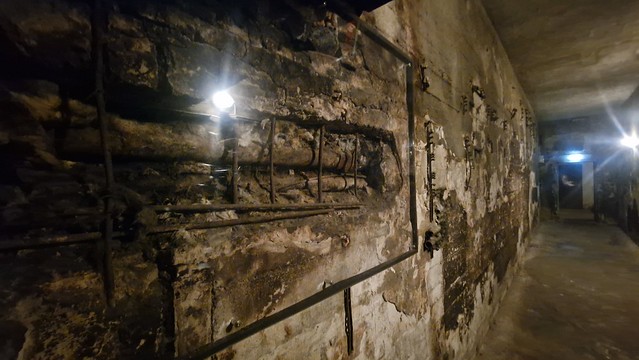
This was the final part of the tour, which are the two floors of rooms which are known as the ‘film bunker’ where film and photographs were stored during the Nazi regime.
It’s not known quite what happened here other than there was a substantial fire which destroyed everything left in them. Looking at the damage done, this was a fire of some considerable size to damage the reinforced walls and ceilings like this. Some accounts say that the Germans did this to destroy evidence and others say that the Russians did it by mistake when trying to open the locked rooms, although I don’t know either way, but the former seems most likely to me. Either way, the Russians decided that they wouldn’t do anything with these rooms after the Second World War and that’s why they’re the same now as in 1945. The joys of a building that’s so large that they could just leave bits of it untouched.
The graffiti is mostly recent, from urban explorers.
It feels sub-optimal, although in about fifty years this more modern graffiti will become part of the historical story.
There are two identical floors with a number of rooms which look like prison cells.
The rooms are located downstairs in one of the lowest levels of the entire airport complex.
That was the end of the tour and I mentioned earlier that it was one of the best that I’ve ever been on. The Dutch guide was humorous and knowledgeable, with plenty of different things to see and I was delighted that politics, history and travel were all intertwined here. The guide mentioned that parts of the building was rented out, but there are some structural issues that need expensive fixes and it will be a long time until more of the complex is rented out and used. He also mentioned that the electricity bill here is substantial and I admired the guide’s attention to detail in ensuring that the lights were always turned off after we left a room. I hope that they leave the sections alone that I visited on the tour, it’s a wonderful time capsule of some many parts of twentieth century Berlin. As for the tour, definitely recommended and it only cost around £14.
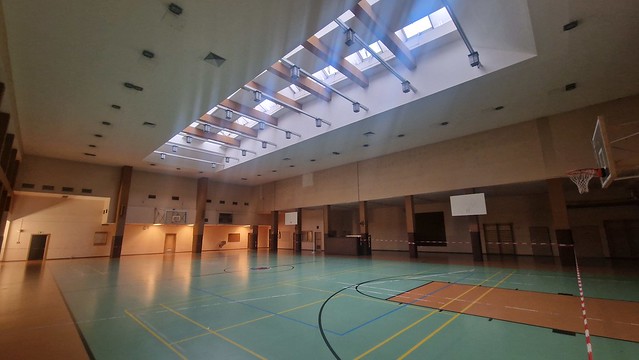
Templehof Airport was used by the US military between 1945 and 1994 and it’s fair to say that they’ve left quite a legacy in the little things that they added, not least a baseball court.
I wonder what the Nazi building designers would have thought about this little arrangement.
There are plenty of empty spaces, they use areas such as this part of the tour now.
Now mostly removed, but this is where the bowling lanes were located. There were numerous other games played in these rooms, along with a gym, showers, squash courts and all manner of other bits and pieces.
A building plan, but I’m not sure from which year.
We were shown some of the former offices used by the army. This one had a copper roof, although it’s not visible in my photo as the ceiling tiles are in the way. It’s a sprawling complex, it was hard during the tour to really understand how it all fit together as the building was just so large. The US military left the airport in August 1994 after having been in the city for 49 years and as with much of the rest of the building, it’s pretty much the same 30 years on.