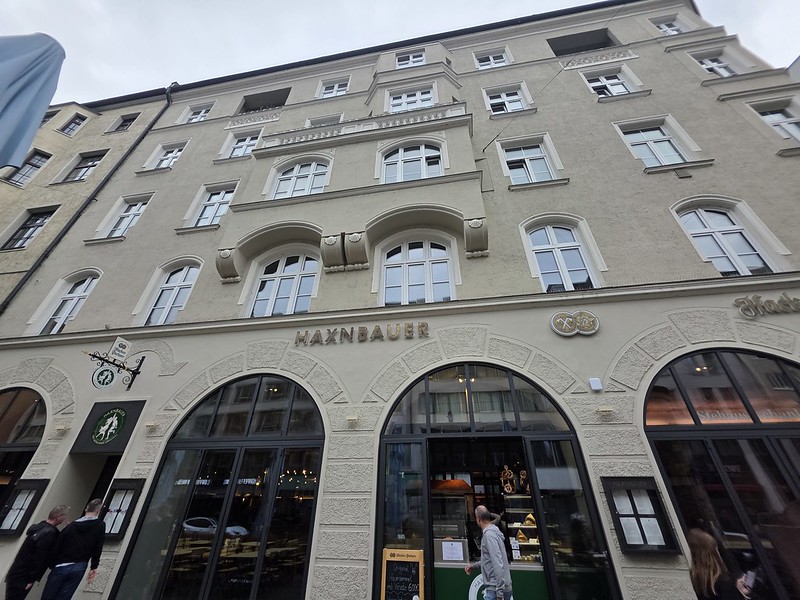
If the Germans had won the Second World War, then it’s likely that this building would now be a substantial museum. This was once a beer hall for the Sterneckerbräu Brewery who had been located on this site since perhaps as early as 1557. The brewery name comes from the Sternegger family who lived in this area in the sixteenth and seventeenth centuries.
The current building was constructed between 1901 and 1902, designed by architects Heilmann & Littmann, following the purchase of the entire site by the brewer Josef Höcherl in 1894. The large arches on the ground floor were the entrance to the beer house that was once located here.
In September 1919, Adolf Hitler came here to a meeting of the German Workers’ Party. He debated with a speaker, Adalbert Baumann, and it seems that he impressed Anton Drexler, the founder of the German Workers’ Party which was the precursor of the Nazi Party. Baumann, who married a Jew who was killed during the Holocaust, argued that Bavaria should join with Austria, a position that Churchill actually took at the end of the Second World War. Drexler, who have evaded fighting in the First World War and who later died from alcoholism, was never given any influence of note in the Nazi Party.
The Nazis wanted to celebrate Hitler’s achievements here, so in 1933, they opened a small museum above the beer hall with random artefacts from the early days of the Nazi Party, so posters, furniture and any other assorted material that they could find. The building survived the Second World War, but the museum was inevitably closed down immediately.
The building continued as a beer house until 1957 and then it was turned into commercial space downstairs for shops. In early 2025, it became the Haxnbauer, so returning to a traditional Bavarian restaurant. There is no plaque on the building and the restaurant themselves take great care with their language, noting on their website that it’s a:
“Historic building with a long hospitality tradition.”
As I mentioned earlier, if history had gone differently then I’m sure this would now be some sort of tourist site and Nazi museum. Fortunately though, it didn’t.
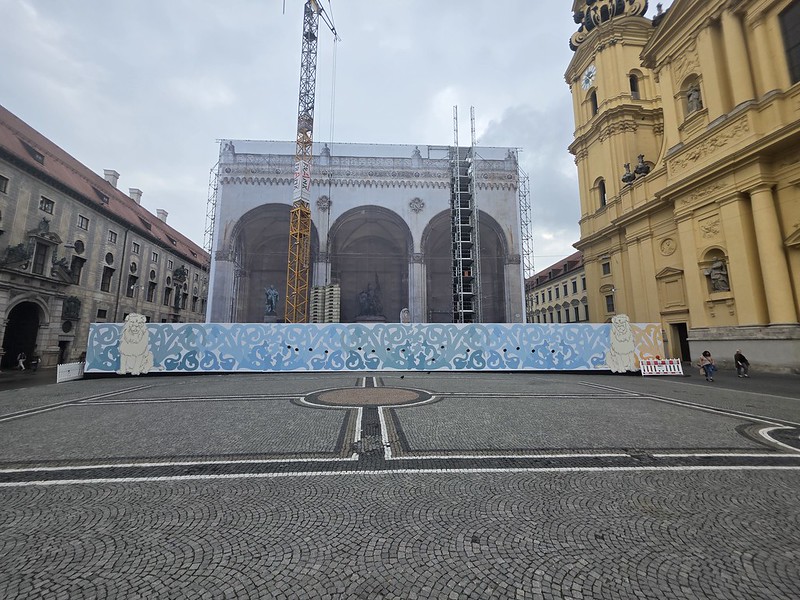
Richard and I visited the exterior of Field Marshal’s Hall (Feldherrnhalle) as part of a self-guided walking tour, but more on that in a future post. There’s actually a limited amount to see here as the building is being restored and there’s a temporary frontage on at the moment. This does at least give a representation of what the building looks like.
The hall was built between 1841 and 1844 at the behest of King Ludwig I of Bavaria, who admired the decadence and grandeur of Italian art and architecture. He wanted something in Munich that echoed the grace of Florence’s Loggia dei Lanzi, and so he entrusted Friedrich von Gärtner with creating a Bavarian version. Rather than a sombre fortress, it was conceived as a dignified and open structure, a kind of outdoor gallery honouring military greatness which is something that Bavarians rather quite like.
Inside the three arches stand bronze statues of two of Bavaria’s martial icons, Count Tilly, famed from the Thirty Years’ War, and Karl Philipp von Wrede, who battled Napoleon’s forces. These figures were cast from melted-down cannon, an aesthetic and symbolic link to war itself. Later, in 1892, a third bronze ensemble was installed in the centre, commemorating Bavaria’s role in the Franco-Prussian War. Marble lions flank the steps, one snarling at the Residenz palace, the other more demurely facing the church, added in the early 1900s.
But, the building is perhaps best known for something more sinister that happened in 1923. That was the year of the failed Beer Hall Putsch when Adolf Hitler led 2,000 followers around in his ‘revolution of the people’. They were met by Bavarian police in front of this Hall and four police officers and sixteen insurgents were killed. Hitler was arrested and imprisoned soon after, but within a decade he was leading the Nazi Party into Government.
Hitler made this into something of a memorial after 1933 and it was under permanent ceremonial guard by the SS. A monument known as the Mahnmal der Bewegung was added to recast the sixteen insurgents as heroes of the people. This memorial was smashed and destroyed by local residents on 3 June 1945, with the area soon being restored by the authorities back to its pre-1933 appearance.
It did feel a little strange standing in the location when just over 100 years ago this hatred took place. At that time it was Hitler who was the enemy of the people as far as the police were concerned, but things changed with alarming speed in that regard.
I think that Richard is a keen stamp collector, so this postal museum seemed an appropriate place to visit, especially as it was free. The museum was founded in 1930 and it has been in its current location since 1957. Note that Richard has dressed to match the colours of the museum, although despite all that effort they didn’t mention that or give him a free stamp.
A selection of cancellation stamps.
A printing plate.
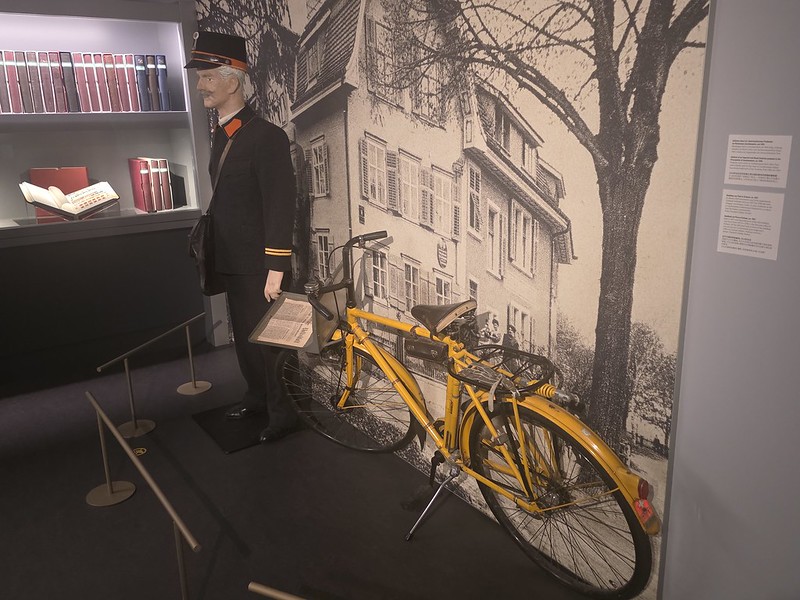
This is the uniform of an Imperial and Royal Austrian postman from 1910. The postal staff were originally paid by the State of Liechtenstein from 1864 onwards, but they became employees of the Austrian Post Office from 1905. There’s an old bike as well….
Part of the museum’s stamp collection.
The museum has a complete collection of stamps from the country, although they’re not all on display.
You can pull out any of these sliding drawers to see what stamps are located within each one.
There’s a lot of stuff that can be seen at the museum, although I was getting a bit stamped out….
As is evident here, I was surprised to see that Mandarin was the primary alternative language, testament to the strong links between China and Liechtenstein.
A Vaduz Post Office sign from 1869.
The sign dates to the 1920s and is from the Balzers Post Office.
On the left is a Hackney cab car horn and on the right is the post horn of the Imperial and Royal Austrian Post Office.
The history of the postal service in Liechtenstein is intriguing (as much as these things can be) as the Austrians were in control until 1921. Between 1921 and 1999 there was something of a change when Switzerland became responsible for post, telephone and telegraph services, before Liechtenstein decided to do things themselves from 2000.
The museum is a nicely put together arrangement and it has won numerous awards over the years. There’s a fair amount to see, it’s free of charge and I think Richard has been inspired to buy himself a new stamp album.
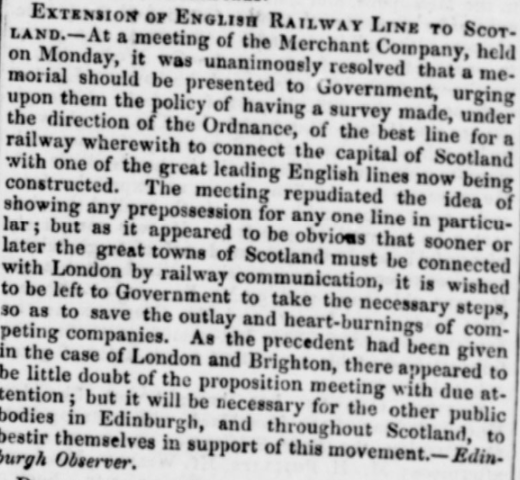
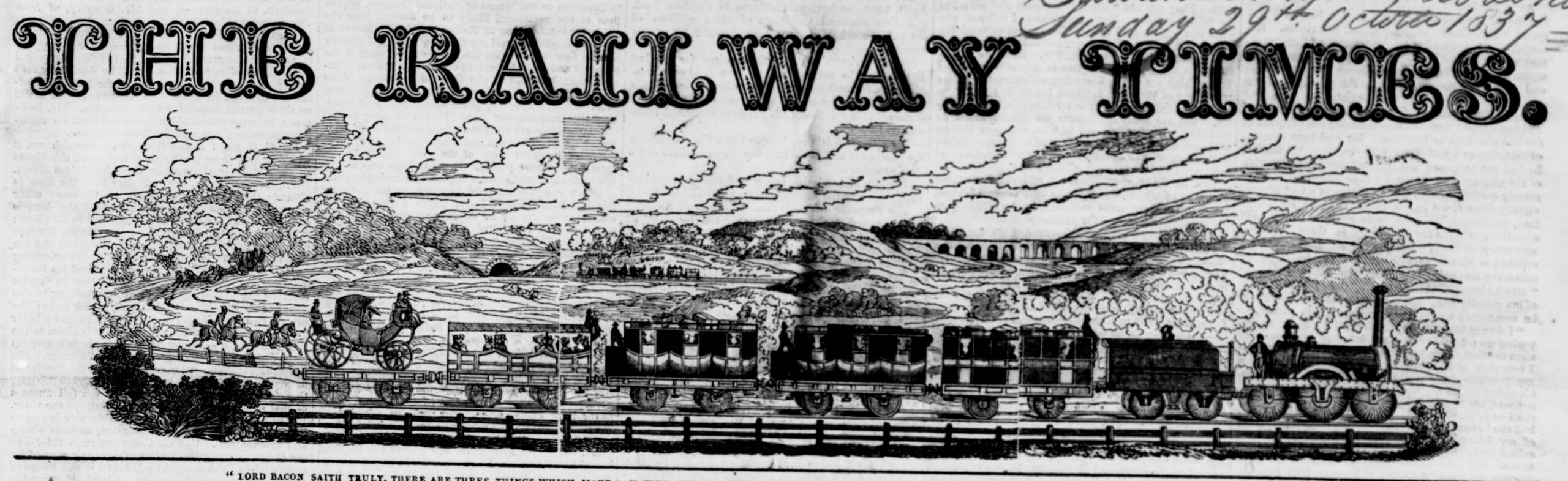
Since I’m now obsessed with this new archive, something that I hadn’t given much thought about is how in 1837 they were starting to wonder how they were going to connect England and Scotland by rail.
The businesses in Scotland were quite exercised by this, the opportunity for new trading opportunities started to become available and the initial thought was that this was all so complex and expensive that there would only be one line needed.
The very first comprehensive rail link between the English and Scottish networks wasn’t created until 1846 by the North British Railway, which opened its line from Edinburgh down to Berwick-upon-Tweed. This route connected the Scottish capital to the burgeoning English railway system, although it was not a continuous track journey into London initially, as it involved two “water breaks” which were crossings of the River Tweed at Berwick and the River Tyne at Newcastle, which necessitated road or ferry transfers. Only later, when bridges were built, did passengers finally get to stay comfortably aboard without the indignity of a ferry detour. It also transpired that the North British Railway made more of their money from transporting minerals around the place than they did from their passenger services.
A fully continuous, uninterrupted railway line between the two capitals for the first time came shortly after with the opening of the Caledonian Railway’s (and they were the big rivals of North British Railway with absolutely no love lost there at all) main line between Glasgow and Carlisle on 15 February 1848, which then linked to the English London and North Western Railway, finally establishing a complete, high-speed rail route between Glasgow and London.
I accept that this might not be very interesting to either of my two loyal readers, but I am very excited to discover that the British Newspaper Archive have just put on 3,295 issues of the Railway Times starting from 1837. The aim of their new journal was to focus on many railway related stories, but they also took a view that they should comment and report on wider news matters.
Expect a wave of quite ‘riveting’ posts of things that I find that are interesting….
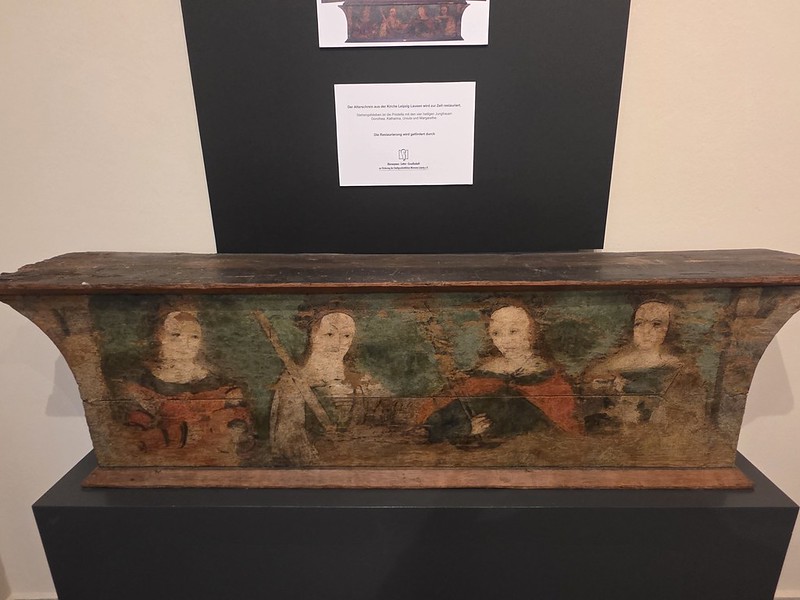
This is primarily a large winged altarpiece which is on display in the museum, although the actual large winged altarpiece bit is being restored and so only the base is on show. Formerly housed in Leipzig Lausen church, it dates to around 1500 and the full arrangement looks really quite impressive in photos.
But, I like what’s left, clearly unrestored (unless it has been restored very badly) so it feels like it retains its authenticity. There’s a photo of the whole altarpiece at https://www.stadtmuseum.leipzig.de/DE-MUS-853418/objekt=PS000136 and I’ve learned that the base (so, the bit that’s actually still on display in the museum) is called a predella.
The museum also notes that the predella has half-length portraits of the holy virgins Dorothea, Catherine, Ursula and Margaret. These seem to be along the lines of the Capital Virgin Martyrs who are usually Dorothea, Catherine, Barbara and Margaret, but this line-up seems to change a bit depending on the whims of the medieval painter. Might as well mix it up with popping Ursula in though.
I digress though. Because the main altarpiece isn’t there, it does draw more attention to this section which is rather beautiful in its own right.
I neglected to write this Good Beer Guide listed pub up when Richard and I visited in August.
The exterior is lovely. The pub seems proud of its history and notes on its website:
“The Golden Cross is the oldest pub in Coventry (One of the oldest in The Midlands). Built circa 1583, during the reign of Queen Elizabeth 1st and established as a public house circa 1661, during the reign of Charles II (The year of his coronation). The Golden Cross boasts traditional Tudor features which include: jettied upper floors with exposed beams, the pub also features a Dragon Beam which makes it possible for the jettied floors to go around the corners.”
It was fortunate to survive the Blitz which damaged so many other nearby buildings and it was extensively refurbished in 2017.
I’m less engaged about the music, but a warm welcome is always positive.
And we did receive a warm welcome from the friendly team member, although I didn’t get a chance to take a photo at the bar. I didn’t ask for a CAMRA discount but the team member pro-actively asked if we were members of CAMRA, which I suspect tied in with the Great British Beer Festival that was about to take place in the area. I realised that I had left my CAMRA card in the hotel room, but I was kindly offered the CAMRA discount anyway. Perhaps I look like a CAMRA drinker, although I’m not sure what I think about that.
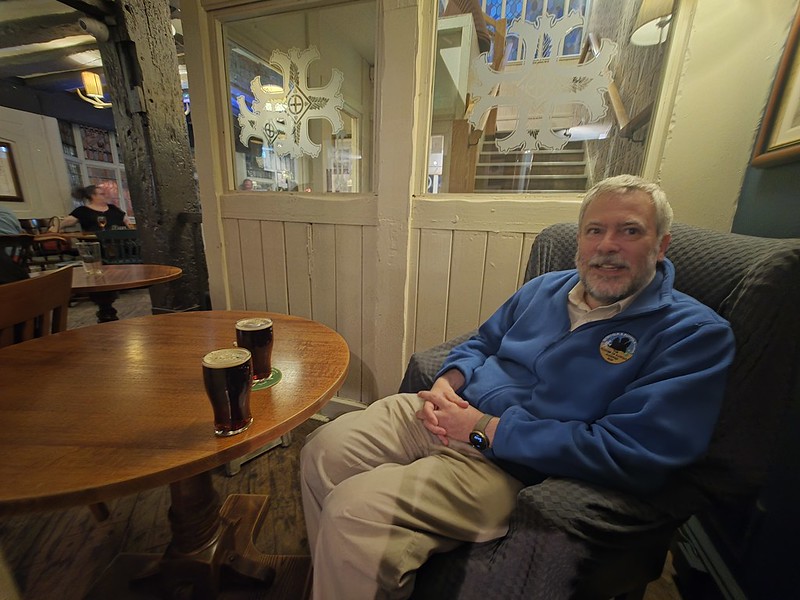
I went for a pint of Titanic Plum Porter which is always a delight, it’s smooth, fruity and luxurious. This is the period from when Richard was his new slim self and looking very healthy for it. There are usually around five real ales available and the Plum Porter tasted well kept and was at the appropriate slightly chilled temperature.
This wasn’t really a venue for me though at the time that we visited, it was quite quiet in terms of the number of customers and also very loud from the live music. It was hard to have a conversation and the lack of customers gave it a slightly odd atmosphere. However, what I didn’t realise was this:
“We have live music every Saturday downstairs from 9pm – 11pm, so those who prefer a quiet drink in Coventry’s oldest pub can enjoy a relaxing evening in comfort in the bar upstairs.”
If I had realised, I would have gone upstairs. Anyway, we decided to leave soon afterwards in the hunt for a pub where we could have a conversation and gossip about the world. Nonetheless, this is a lovely pub and I think we just visited at the wrong time as there was a friendly welcome and I enjoyed the heritage of the venue itself. They also do what appears to be a good value food offering at lunchtime and in the early evenings. Hopefully I’ll get a chance to visit again at one of those rather quieter times as I did like the building, the friendliness of the team members and the beer.
I appear to have forgotten to write about this Good Beer Guide listed pub in Coventry. It’s operated by JD Wetherspoon and is nearby to their sister pub the Flying Standard. As usual, I’ll use their history of their venue:
“This is named after Leofric, Earl of Mercia, who founded St Mary’s Priory, Coventry’s first cathedral. A larger-than-life statue of Leofric and his wife (Countess Godiva) can be seen above the main entrance to the council house, opposite this pub.”
The building on High Street opened in June 1896 as the London and Midland Bank, later becoming the Midland Bank. It was turned into a public house in the early 1990s, initially being Cassidy’s until 1994, then the Phoenix Bar until 1996 and then it became part of Lloyds which was bought out by JD Wetherspoon as their more youth focused brand. The pub was renamed its current name of the Earl and Mercia in 2001.
I haven’t taken many useful photos of the pub, but as Julian (wise) says, I’m sure we’ll all cope.
This is from my visit with Richard a few months ago, I went for the Tesseract from Black Hole Brewery which was only £1.64 for a pint after the CAMRA discount. It was better than I had expected, it was rich, smooth with lots of plums to the whole arrangement.
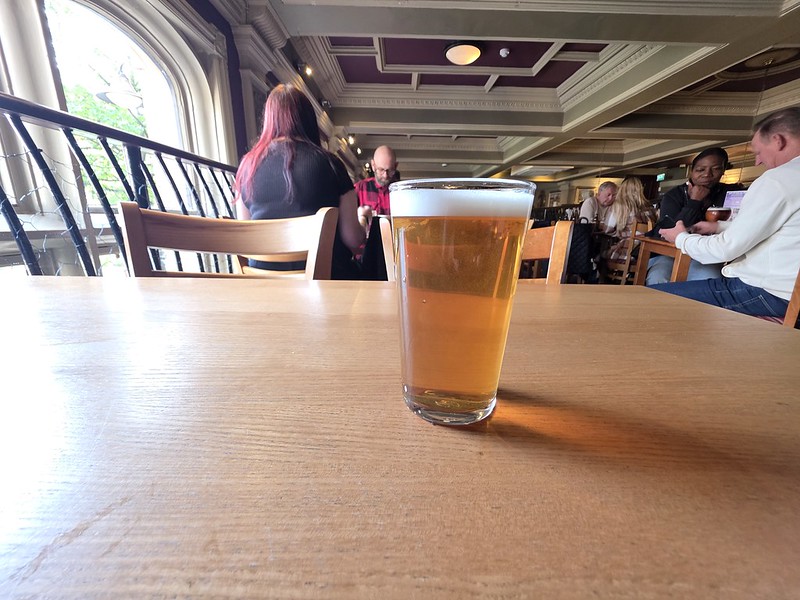
And this is the Key Lime Pale from Hogs Back Brewery which I had this weekend as part of the JD Wetherspoon October beer festival. This was just 98p for a half and it was certainly full of lime flavour, being light, soft and hoppy.
As usual, best I have a little look at the reviews for my own amusement. It’s rated very highly for a JD Wetherspoon venue and that fits in with my experiences here, which have been positive.
“First of all, the staff discriminated against Chinese people. If you’re a local, the servers will bring the drinks to your table, but we had to go downstairs to get our drinks and bring them to our table on the second floor. The entire time, they watched us through the surveillance cameras. I told them I don’t drink alcohol, and they said I didn’t need to show my ID in that case. When we brought the drinks back to our table, I smelled the dark beer out of curiosity because I had never had it before. Then, a server came up and asked us to leave, claiming that I had drunk the beer. However, I’m allergic to alcohol, so I couldn’t have drunk it in the first place. The manager insisted that I drank it, not just smelled it. This is clear discrimination against Chinese people.”
Hmmm, they bring everyone their drinks but this reminds me though of a woman in one of the London pubs in their chain that was getting frustrated that no-one was serving her at her table, but she saw others getting their drinks delivered. She stomped out in the end after the team member refused to take her order himself and insisted she use the app.
“I feel violated, we ordered two pitchers exactly the same price, mango monster mash or something
This is the difference in ice/drink
The guy who served us was rude all night, insisted they were all the same even though I showed him the difference.
Don’t order here, wetherspoons please sack the only guy working here on 28/01/20″
Please sack a team member as he served cocktails in two different shaped jugs? Yeah, that sounds reasonable…
“We were just having lunch and the guy came up to us saying that we need to leave. We politely said that wr will leave after finishing our dinner but the guy was so rude and racist that he came back again and argued with us, forcing us to leave the place which is totally not accepted. He was the shift manager for the day 20/11/2023. I never expected this kind of behaviour as we have already paid for the food and atleast accept a decent service from the employees. Please have a look at your team and recruit people who are not racist.”
I wish reviewers would give a bit more information about why a team member actually came up and asked them to leave.
“Discrimination on a young adult with SEN needs. We come to this pub as young person finds atmosphere friendly and welcoming. Not today. Bully tactics by staff. 1 day we forgot passport she is 18. We have been served lots of time by staff at wetherspoons without ID. 1 staff member followed me to the table. Hassled me about her drinking alcohol beverage. Very abrupt, unfriendly and aggressive. He watched us for 5 minute’s and came over and said she had taken another sip for a drink. He snatched all the drinks from the table. They would not accept a photo on my phone, which I’ve used previously. Young person was upset and distrraught. Went to the toilet and was physically sick. We went onto have our food dropped on the table by the disgruntled staff member. Duty Manager was unsympathetic and crude. No training given how to deal with people with disabilities. All disabilities are not visible. Shame on wetherspoons we will not be going there again. Wasted £20.00. The food was cold and disgusting. Refused a refund.”
If this story is as it’s told, it’s not clear to me what the team member could have done other than been more polite and engaged better. Someone without valid ID has seemingly been drinking alcohol, the pub’s licence is at risk if they don’t check ID.
“I came here on Saturday, had one drink with my friend and decided to go outside in the seating area as it was too hot inside. There were empty glasses on our table which we just moved to the side, and while me and my friend were talking one of the staff (man with long hair) came over and asked if the glasses were finished with, I said they weren’t ours. About 5 minutes later we realised he had put 4 shot on our table, so we were confused and asked the people next to us if they were their shots, which they weren’t. So I assumed someone had bought them for us on the Wetherspoons app, and had 1 shot out of the 4, then the man came back over shouting at me for having a shot and demanding that I pay for it. I told him that he put them on our table so we assumed they have been bought for us, which he then said I said they were mine when he took them over to us (I didn’t, I didn’t even realise he bought them over as I was having a conversation with my friend). This staff member then started arguing with me and was SO rude to me over £2.50, which I did pay. I will not be coming back, as he was so rude to me and was shouting at me.”
It might have been easier not to take one of the drinks that they hadn’t ordered.
“I didn’t go there!!”
Another helpful review.
“Another wetherspoon which is more expensive than the Gosford Arms for a pint of Stella. No good for sight seeing as all you can see are bill boards of things that won’t necessarily come true in the eye of the public.”
Probably best to go to the Gosford Arms.
“I mean as most know they dont have music so that’s one sad thing.”
At least that makes me happy 🙂
Anyway, this seemed like a a well-run and organised JD Wetherspoon venue, although it does get very busy and although it’s over two floors it’s not the largest. Keenly priced, popular with students and a decent selection of real ales.
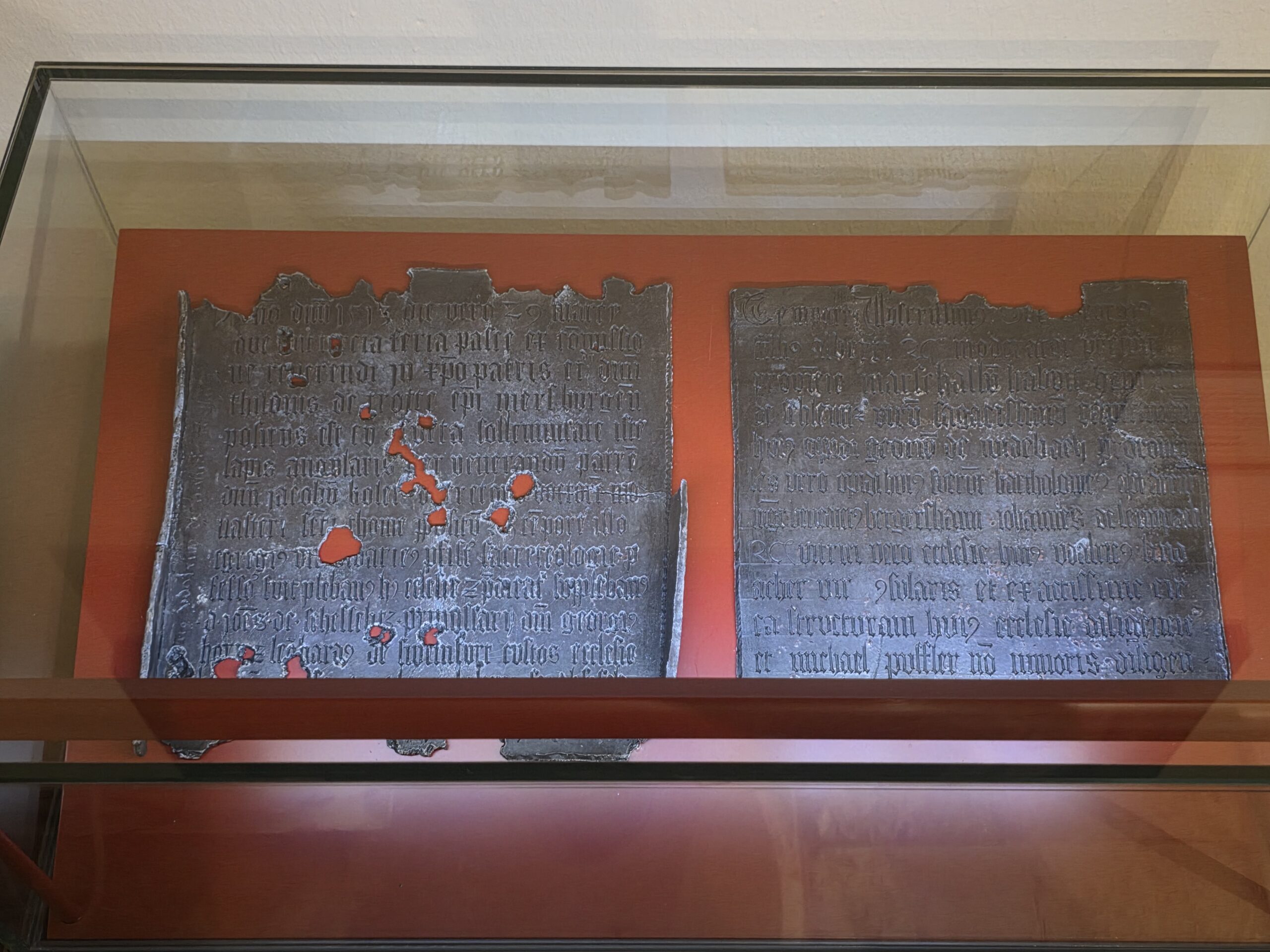
Time capsule probably isn’t the best terminology here as I’m not sure that this is what was originally intended, but it has transpired to be something like that.
These lead plates are written in Latin and they were walled into the foundation stone of St. Nicholas Church (Nikolai) during the Gothic reconstruction which started in 1513 and finished in 1535. At the time, this was a Catholic church, but in 1539 it became a Protestant church as part of the Reformation sweeping Europe and it remains that today.
I’ve had to go to AI to try and give me any indication of what it says on the lead plates and it came up with:
“…in nomine … patris et filii…” (“In the name of the Father and the Son…”) and a section below that seems to mention something like: “…dominus … in … ecclesia…” (“…lord … in the church…”)
And:
“…memoriam … perpetuam…” (“…perpetual memory…”) and “…requiescat in pace…” (“…may he rest in peace…”)
Whatever it said was likely really planned to be known only to God…..
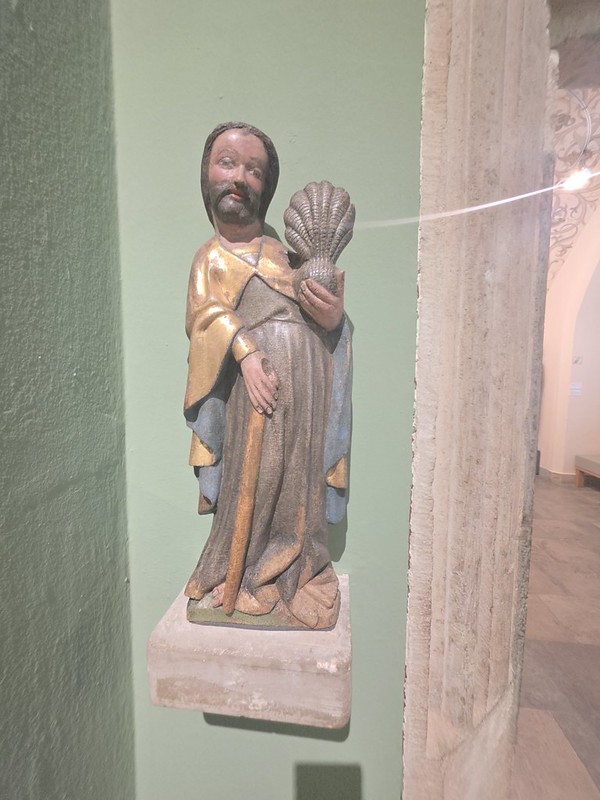
Being slightly odd, I find medieval religious artworks to be intriguing and interesting because of how important they would have likely been to their owners or the congregations of the time. These two polychrome statues, made of linden wood, are in the museum and they think that they date to around 1410.
This is St. Peter with his keys and book with some effort made here to show his dignified drapery and a kindly, albeit now slightly weathered, face.
And here’s St. James the Greater with his scallop shell and walking staff, inspiring countless generations to go on pilgrimages and come back home with a shell. I’m not sure quite what look the sculptor was going for here, James looks like he’s just walked 90 miles of an LDWA 100, but there we go.
Bearing in mind that they’re over 600 years old, they’re still in rather good condition and retain a fair chunk of their original colour. There’s a warmth to these characters, I wouldn’t go quite as far to say that they’re almost cartoony, but they do have a warm and fluffy feel to them. They would have once been part of an altarpiece, but that element has been lost to history.