Blog

  • Cambridge – Pint Shop

    Cambridge – Pint Shop

    There are a surprising number of Good Beer Guide listed pubs in Cambridge which are closed at the moment, a few because they are usually shut on Mondays, the rest still not re-opened after the health issue. So, it seemed a good moment to go with Nathan’s recommendation of the Pint Shop.

    There’s a restaurant area upstairs, this is the ground floor bar area and it’s a comfortable and clean environment. It was surprisingly quiet, especially as it’s ‘eat out to help out’, although I think there were a few people in the restaurant upstairs and they seemed to be taking a fair number of bookings for the evening. The pub is well-reviewed, although I was amused by the negative review they picked up from someone who accused them of using a quail’s egg in their Scotch Egg.

    The beer options in the pub, and I went for number 10, which is the Banana’s, No Pyjama’s from 71 Brewing, although I asked if they’d cut it down to a third, which they willingly did. I did try and set up a tab, and I couldn’t work out whether they weren’t keen or were trying to be helpful to take payment individually, but that messed up an Amex Shop Small offer and so I just had the one drink. Service was though personable and warm, it felt a welcoming environment.

    I spent some time deciding whether or not I liked the beer, and ultimately, I decided I didn’t. The flavours were so subtle as to be nearly impossible to discern, no noticeable banana and the maple syrup was only evident as some slight sweetness in the drink. The drink was served at the appropriate temperature, so I’m not sure why the drink lacked in flavour, although as a stout it was perfectly pleasant. But, it needed some taste of banana given its name and so I’m verging of the opinion that something has gone wrong at the brewery.

    All rather peaceful and the staff seemed genuinely friendly, and I liked the engagement and also thanking customers as they left. They had a suitable range of different beer styles to choose from, including two dark options. As a pub, this is perfectly delightful and I’d merrily come again, although I think I’d choose a different drink next time.

  • Knapton – St. Peter and St. Paul’s Church (James Riesbrow)

    Knapton – St. Peter and St. Paul’s Church (James Riesbrow)

    It took me a little while to work out this name, but it’s the grave of James Riesbrow, located in Knapton’s church. It’s such a rare name that this is the only person I can find in the country over the last few centuries with that name, which makes tracking him down that bit easier.

    James was married to Mary Means at the church on 14 October 1759 and the ceremony was witnessed by Charles Coleby and James Downing. It’s clear the clerk was confused by the name as well, trying to originally spell it as Riesborough. James died at the age of 48 on 7 June 1778 and I note that someone with the same surname was buried at the church in 2018, so the name has continued on.

    There aren’t that many graves from the late 1700s that remain in Norfolk’s churchyards, particularly not in this good a condition.

  • London – Westminster – Tate Britain (Lady Elizabeth Grey by Paul Van Somer)

    London – Westminster – Tate Britain (Lady Elizabeth Grey by Paul Van Somer)

    Lady Elizabeth Grey, the Countess of Kent (1582–1651), looks a formidable character in this painting by Paul Van Somer (1578-1621). She was married to Henry Grey, the 8th Earl of Kent, a land-owner and MP, but they didn’t have children to pass their wealth onto. Grey’s interesting, er, display in her painting wasn’t unusual for a mature woman of the time, but only one from the middle or upper classes would get away with that.

    The artwork was painted in around 1619, but what is perhaps the most notable about this is that it became part of the art collection of King Charles I. It was later acquired by Friends of the Tate Gallery in 1961, although there’s no other provenance listed on the gallery’s web-site, so goodness knows where it has been for the last few centuries…..

  • National Express : Norwich to Cambridge

    National Express : Norwich to Cambridge

    One of the very exciting things that Jamie Burles has done in his tenure of Greater Anglia is to oversee a near-doubling of the price of the rail rover ticket in just a few years. I’ve never understood this and the Greater Anglia press office admitted he had no answer or comment, because that rover ticket can helpfully fill trains up a bit during quieter periods of the day. As it stands now, Greater Anglia need people on the trains during the quieter periods of the day, but I’m sure Burles knows what he’s doing so I’ll stay positive. But, it has meant that the cost of an open return ticket to Cambridge has reached such levels as to make it much cheaper by coach.

    So, here’s the National Express coach from Norwich bus station, moved over to its new boarding location by the YMCA. The driver was jovial and welcoming, but it wasn’t a particularly packed service with only four of us boarding. The driver measured the temperature of each customer’s wrist, which I didn’t know was a thing. Anyway, he seemed happy with the results, so that made me happy.

    A packed service. The automated announcement went wrong and so the driver did his own version, still in his friendly style. All very welcoming.

    The coach was spotlessly clean and there were hand dispensers on board, all pointed out by the driver. The temperature on the coach was also just as I would want it, slightly chilled, although I note that the seat-back tables have all been removed. A customer was complaining on the coach before ours, which went to London, that he wanted to sit next to his wife but the seating didn’t allow. The driver was helpful, as apparently people can’t manage to sit on their own for more than three minutes.

    Megabus have taken out a lot of their seats, on the grounds of they can’t use a lot of them, so they might as well make customers feel more comfortable. National Express haven’t done this. The leg-room on these coaches really isn’t very good and it would be unbearable for many if sitting behind someone who reclined. Fortunately, this isn’t a problem on a service with four customers.

    And safely into Cambridge, all on time. It’s not the faster service as we went through Thetford, Mildenhall, Newmarket and some random stops along the way, but it all took less than two hours. The fare was £10, which seems reasonable to me, although I’d still preferred to have got the train as it’s infinitely more comfortable. The bus was the NX727 service which went to the airports and I was a little jealous of the customers going there….

  • Knapton – St. Peter and St. Paul’s Church

    Knapton – St. Peter and St. Paul’s Church

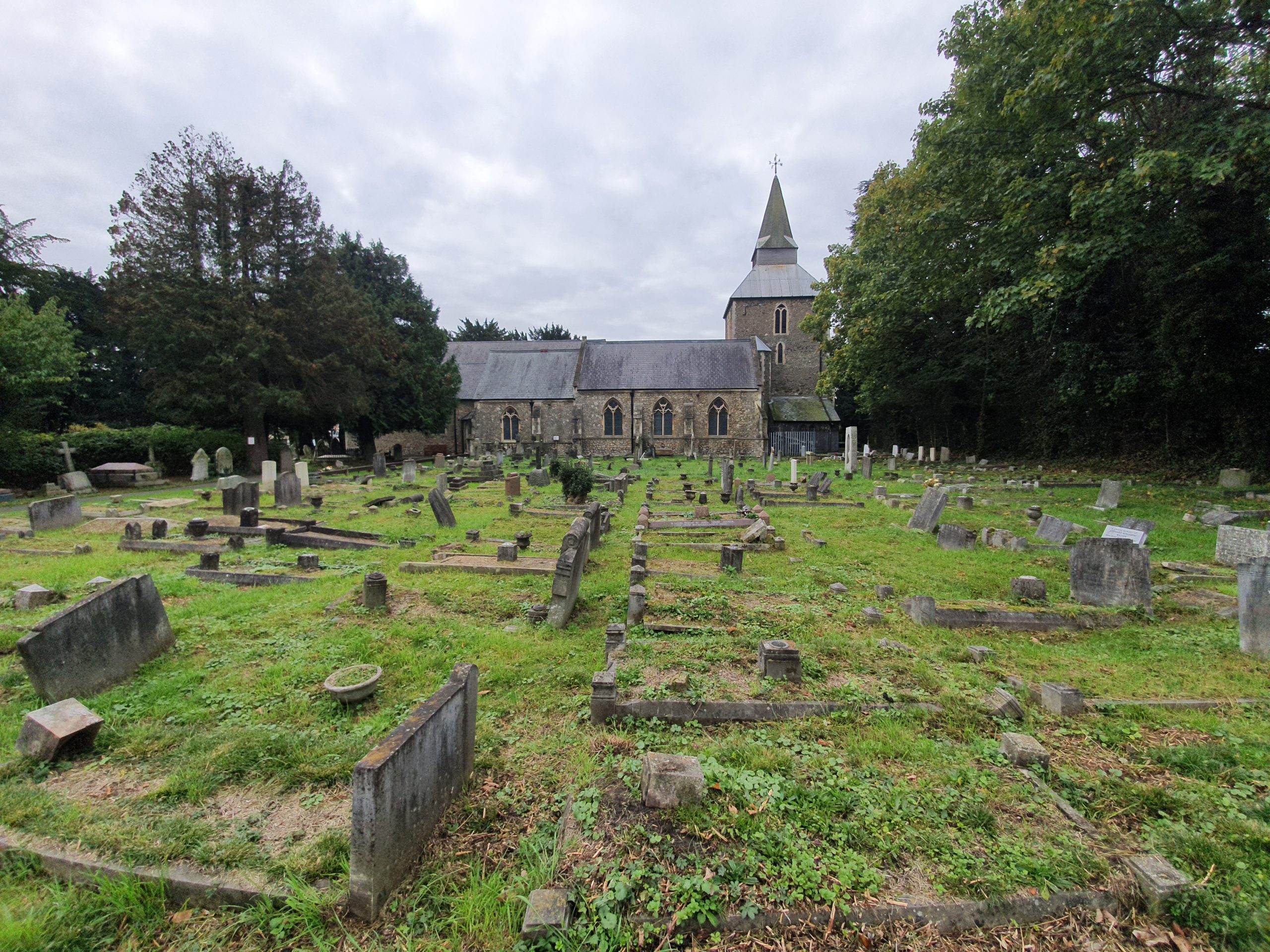
    As part of our church spotting evening (yes, I know, churches aren’t that hard to spot in the scheme of things), Richard noted this one which is St. Peter and St. Paul’s Church in Knapton.

    The current building (including the tower) primarily dates to the early fourteenth century, although there was likely a church on the same site before this. As an aside, apparently the tower’s weather-vane was designed by John Sell Cotman.

    I don’t know why the Priest’s door has its own little porch and I’m not sure that picket gate arrangement does much for it either. I have no idea how old it is, but it looks like something that the Victorians would have done. The church was modernised by the Victorians (overseen by George Gilbert Scott) and there was a re-opening ceremony on 7 September 1883, with an advert in the Eastern Daily Press providing details of what trains or omnibuses people could catch.

    Visible here is that the church tower is off-centre, which isn’t a usual arrangement. But, I’ve learned something new by reading the description of this church at Norfolk Heritage, which notes:

    “The odd position of the tower was not the result of a change of plan but clearly deliberate from the first as demonstrated by the straight joint on the north wall close to the tower showing that provision for the tower was made. The slightly later building of the tower was separated from the nave at first – a practice commonly observed in other medieval churches where towers took long to build and tended to settle at a different rate from the nave.”

    I hadn’t realised that this was a thing, but building the tower and nave separately does make sense, although I’m still unsure quite why it’s off-centre.

    The porch, so near to the treasures within and one of the most important roofs in the country apparently, dating to the beginning of the sixteenth century.

    Alas, the church seems to be rather nervous about opening up for 72 hours before a service and 72 hours after a service. Seems a bit much to me, but there we go, there’s always another day to see what is apparently a glorious interior. The roof has been a problem in recent decades, with an expensive restoration having just been completed at the church. The church authorities have had problems with death-watch beetles throughout much of the early twentieth century as well, proving to be an expensive pest to remove.

    The churchyard is curious, there are a couple of eighteenth-century graves in noticeably good condition, which I assume is simply because a different stone was used, but nonetheless. There are also large gaps in the churchyard where graves must have been, but there is an absence of gravestones in some areas.

    Back to this photo again, we deliberately tried to find the spot where George Plunkett stood to take his photo (in 1993, so this was a later one). His photo is here, so I think that our effort was creditable…..

  • London – Westminster – Tate Britain (Wire and Demolition by Prunella Clough)

    London – Westminster – Tate Britain (Wire and Demolition by Prunella Clough)

    I’m still working with my theme that it’s lazy to generalise all modern art as difficult and pointless, when much of it has meaning and depth. But, along with that, I’m suspecting that when a gallery has nothing to say on it either, then it probably doesn’t have a great deal of meaning. It might still have value, but if no-one can offer any perceptive comment on it other than just a guess, then you could just have a drawing by a child on the wall.

    This painting, or whatever it is, is by the esteemed artist Prunella Clough (1919-1999) and the gallery has decided not to put anything in its summary of the artwork. So, the entirety of what the gallery has to offer here is:

    “Clough’s paintings of urban and industrial scenes were often inspired by objects the artist noticed during walks around sites of interest. Here Clough references a piece of old wire discovered on a building site.”

    But, yet, there are many artists who have reflected on the urban theme and have given something a little more defined whether it be in photographs, drawings, paintings or sculpture. Each to their own though, the gallery acquired this in 1982 and so its been shoved on the wall now for the best part of 40 years.


  • Dictionary of the Vulgar Tongue – Day 157

    Dictionary of the Vulgar Tongue – Day 157

    The Dictionary of the Vulgar Tongue was first published at the end of the eighteenth century, and given that the current health crisis is giving too much time to read books, I thought I’d pick a daily word from it until I got bored….

    Hodmandods

    How beautiful, this is defined simply as “snails in their shells”, although to make matters more complex, this is also a term in Norfolk for a hedgehog. This is likely from the word ‘dodman’, meaning an animal with a hill on its back, from the words ‘dod’ meaning hill and ‘man’ in this instance just meaning an animal. It was being used from as early as the sixteenth century and was most commonly used in East Anglia.

    The words stayed in use until the beginning of the twentieth century, but has now faded into obscurity.

  • London – Still Quiet on the Underground

    London – Still Quiet on the Underground

    I won’t keep posting “it’s quiet on the Underground” as that’s annoying, even for me. But, I was surprised just how quiet it was just after 09:00 on Thursday, not so much at Gloucester Road which isn’t ever the busiest station, but certainly at Victoria. Making for some peaceful journeys though.

  • London – Westminster – Tate Britain (Karl Lagerfeld Bean Counter by Anthea Hamilton)

    London – Westminster – Tate Britain (Karl Lagerfeld Bean Counter by Anthea Hamilton)

    Tate Britain acquired this artwork in 2019 and the artist is Anthea Hamilton (1978-). I’m not entirely sure I understand it, but I think it’s trying to raise a debate about the essence of how an individual is viewed by society and the processes involved with that. Karl Lagerfeld has quite a defined image today, but this is him when younger as part of some fashion shoot. I don’t understand the potatoes and buckwheat, but perhaps that it’s just to create an informal and humorous foreground to the imagery.

    The Guardian said “there are plenty of cues but you have to keep improvising the lines” with regards to works by Hamilton, which seems a suitable comment. Some modern art annoys me when it seems pointless, but when it provides cues, it gives it some relevance. Anyway, it’s clear that I don’t know what I’m writing about, but I like that the artwork isn’t pretentious.

  • London – Westminster – Tate Britain (Horizontal Stripe Painting by Patrick Heron)

    London – Westminster – Tate Britain (Horizontal Stripe Painting by Patrick Heron)

    I don’t understand great swathes of modern art, but there’s becoming an easy way to see if the art gallery that the artwork is located in has a clue either. Sometimes, the gallery can produce detailed information about the thought processes behind a painting, and that can give me an understanding of what is happening.

    It’s clear that the Tate Britain has absolutely no idea here with this artwork by Patrick Heron (1920-1999). They haven’t even bothered to fill in the artwork summary, as I’m not sure that they have anything to say. Their entire comment on this (bearing in mind a lot of their paintings get paragraphs of text) is:

    “Heron resisted the total abandoning of subject matter and even such works as this have been seen in relation to landscape, the horizontal bands and colours perhaps suggesting the horizon at sunset.”

    The gallery acquired this artwork in 1972, so after nearly fifty years, they’ve found nearly nothing to say on it. It was designed for an office (Lund Humphries), where they needed to change it for another of Heron’s works, and Heron himself noted:

    “I believe that the actual spatial sequences of the room which has been designed at Lund Humphries are in a sort of contrapuntal relationship with the illusions of space which my canvas creates from its floating position on one of the walls in that room. Actual space is chopped up, marshalled, articulated and as it were modelled by the screens and counter and the hanging slatted ceiling, and this is done in such a way that this actual space marries with the illusionistic space in the stratified spatial bars which ascend in chords of different reds, lemon-yellow, violet and white up the length of my vertical canvas. As your eye climbs the “steps” of differentiated colour in my canvas, so you yourself may step back into the actual spatial areas of the room. Seen from straight in front, the bars of colour in the canvas ascend directly into the parallel bars of the slats overhead, which advance not only towards the bars of the painting, but into them—or so it seems, since the slats are brought right up against the surface of the canvas at a point 3 ft. below the top of it. The top yard of the canvas is thus designed to be read through the slats of the hanging ceiling. There is, therefore, a continuous progression of horizontal parallels right from the foot of the painting in front of you, up the canvas, and then backwards, right over your head, along the hanging grid of slats under which you are standing or sitting. And not one of these parallel horizontals is equal to another, either in colour, breadth, or in the interval of its placing. The colour bands on the canvas are obviously dissimilar in every respect; but that the double row of slats overhead should also be uneven in appearance is due partly to perspective and partly to the different spacing of the upper and lower rows of slats.”

    Crystal clear. Anyway, I don’t like it, I think it looks ridiculous. I don’t expect the art world will be too bothered by this announcement of mine…. What I have started to establish here is when galleries don’t seem to have a clue what an artwork is about either.