Blog

  • Cambridge – Fitzwilliam Museum (A Village Festival by Pieter Brueghel the Younger)

    Cambridge – Fitzwilliam Museum (A Village Festival by Pieter Brueghel the Younger)

    This painting by Pieter Brueghel the Younger (1564-1638) is my favourite in the Fitzwilliam Museum, with its full title being “a village festival with a theatrical performance and a procession in honour of St. Hubert and St. Anthony”. It was painted in 1632 and came into the collections of the Fitzwilliam in 1927 when it was donated by the first Viscount Rothermere. Actually, that’s an awkward thing for the museum, as the politics of Rothermere are controversial to say the least, but there’s not much that can perhaps be done by the museum about that now.

    My photo of the painting isn’t great, but there’s so much going on that it’s like some epic by William Hogarth. It looks like a night out in the city centres of today, but then again, that’s often what fairs were like and the authorities were frequently appalled at what people got up to at them.

  • Cambridge – Fitzwilliam Museum

    Cambridge – Fitzwilliam Museum

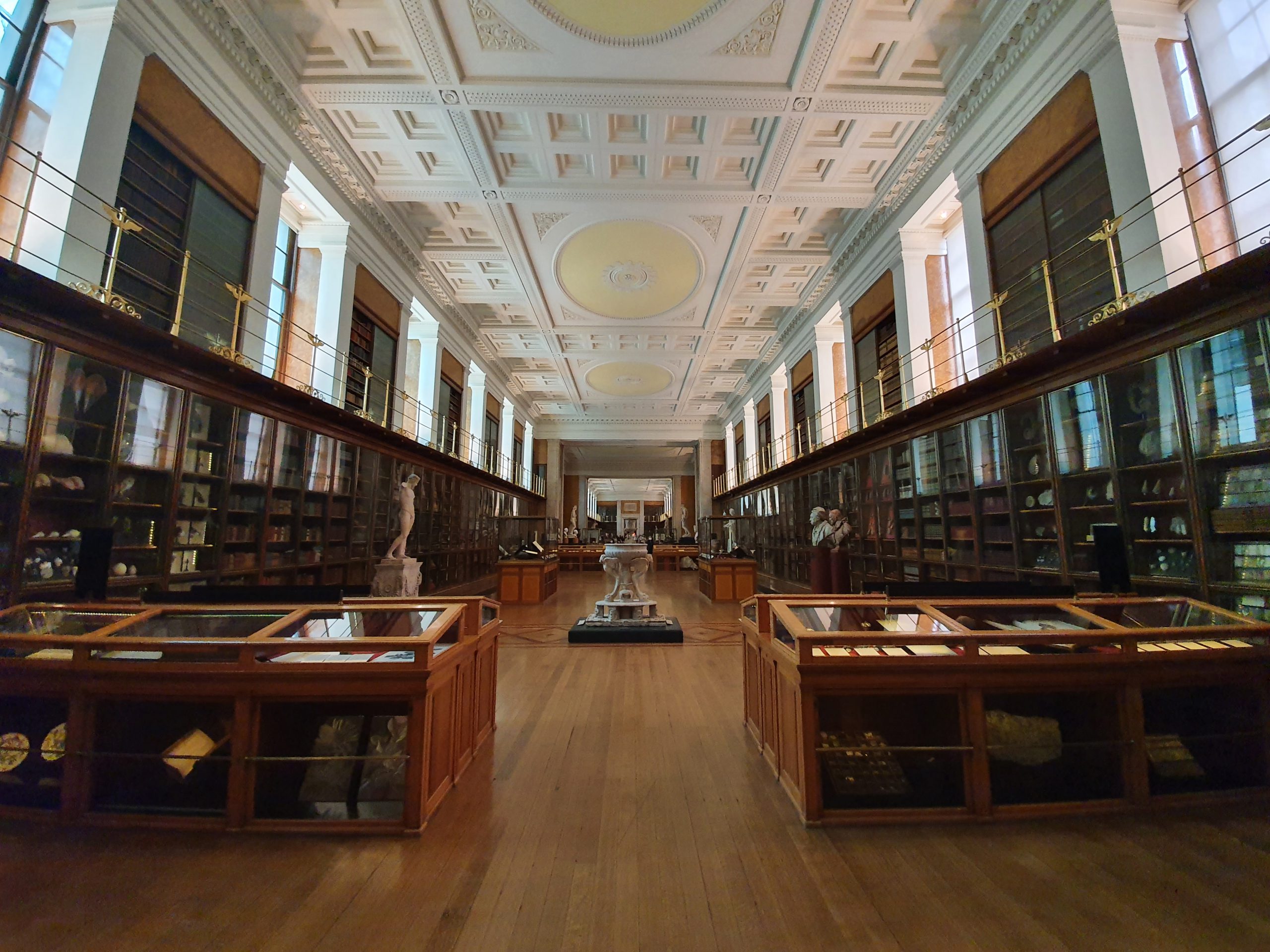
    I’ll write about some individual items in the collection that I think are interesting in separate posts (everyone should contain their excitement….) but it’s fair to say that the Fitzwilliam Museum in Cambridge was as quiet this morning as I’ve ever seen it before.

    I had a ticket, which are free of charge, to get in at 10:00 and the staff here are really very friendly and most welcoming. Some visitors were turned away as they didn’t have tickets and the museum clearly wanted to be very much in control of the numbers. I noted that backpacks had to be carried by hand, which would have been fine, but the most helpful lady near to the entrance was more than happy for me to use their free lockers and that made things much easier.

    I spent a couple of hours in the museum and, certainly, for the first hour, there were more staff members than there were visitors. Everything was spotlessly clean and it’s clear that great efforts have been made to try to work out the visitor flow. It’s not always obvious, but it mostly is, with the entrance being shifted to the courtyard rather than the standard main entrance area.

    Anyway, some photos of how the museum looked……

  • Dictionary of the Vulgar Tongue – Day 160

    Dictionary of the Vulgar Tongue – Day 160

    The Dictionary of the Vulgar Tongue was first published at the end of the eighteenth century, and given that the current health crisis is giving too much time to read books, I thought I’d pick a daily word from it until I got bored….

    Horse Ladder

    There’s something quite brilliant about any dictionary definition which starts “a piece of Wiltshire wit”. It carries on to define the ‘wit’ as “this consists of sending some raw lad, or simpleton, to a neighbouring farm house, to borrow a horse ladder, in order to get up the horses, to finish a hay mow“. No doubt much hilarity ensued….

    Ironically, a horse ladder is very much a thing now, although the rugged types of Wiltshire would have course never needed anything like that. I’m not sure that the term was ever much in common usage, but it’s a lovely little phrase in any event.

  • Imperial War Musuem – British Army Cadets in Cambridge During First World War

    Imperial War Musuem – British Army Cadets in Cambridge During First World War

    Rummaging once again through the photographic collections of the Imperial War Museum, these are some photos of officer cadets in Cambridge during the First World War. The photos were taken by Horace Nicholls, likely taken in late 1917. There’s a timeless feel to the backdrops of the photos, the troops though are the reminder of the tragedy that was taking place elsewhere.

    Cadets of No. 5 Battalion parading in the Great Court, Trinity College, Cambridge, for Divine service.

    Cadets of No. 5 Officer Cadet Battalion entering the chapel at Trinity College, Cambridge.

    Cadets of No. 5 Officer Cadet Battalion in the dining hall of Trinity College, Cambridge.

    Cadets of No. 2 Officer Cadet Battalion halted at the gateway of Jesus College, Cambridge.

    Cadets parading outside Ridley Hall (a theological college), University of Cambridge.

    Cadets parading outside Ridley Hall (a theological college), University of Cambridge. December 1917.

    Cadets of No. 5 Officer Cadet Battalion assembled in Neville Court, Trinity College, Cambridge.

    Cadets seated round the fountain in the Great Court, Trinity College, Cambridge.

    © IWM Q 30318

    © IWM Q 30323

    © IWM Q 30297

    © IWM Q 30298

    © IWM Q 30311

    © IWM Q 30320

    © IWM Q 30312

    © IWM Q 30317

  • Cambridge – Bath House

    Cambridge – Bath House

    This pub is located just a couple of doors down from the Eagle, which is also run by the same company, Greene King. In fairness to Greene King, most of their outlets are open all day, which isn’t the case with many pubs in Cambridge at the moment. And, I like that this has been a licensed premises since the seventeenth century, so I felt the need to visit it as I’ve never been here before.

    The mostly fake interior, but it’s still got some character to it despite being mainly modern. There’s a bar in the middle of the pub and it was all spotlessly clean and tidy. The welcome at the door was friendly and there was a comfortable feel to the whole arrangement. So, there was nothing particularly wrong here, although I’m not sure there was anything to write home about (I’ll ignore that I’m writing here).

    It’s a Greene King pub, so the best drink option is nearly always a soft drink. I’m not sure Greene King would honestly admit their beer choice is anything other than generic and dull. Well, they might not say that I accept, but I’m sure they’ll think it privately.

    The fish and chips and this would have been better if they changed the oil in their fryers. Having said that, the fish they used was of a decent quality and rather tender and delightful. The batter didn’t taste of much and the fish wasn’t drained before dumping it on the chips, so there was a moistness under it. Given that this was purchased under the Government’s ‘eat out to help out’, the cost of £4.55 was hardly unreasonable though but they’re pushing it at its full price.

    The reviews for the pub are pretty poor, I was humoured with the solitary chip reference here:

    “Nice old wood beam decor, drinks were good but the food was awful value and quality. Camden Beer and French white Wine was nice but the small plate fish goujons were awful value. Small plate is an understatement £4.79 for two goujons, each no bigger than two chicken nuggets, battered together with a solitary chip, served with a mushy pea croquette which was an inch long, that was it.”

    And probably the least thought about this review, the better:

    “Visited 14/4 man on next table bare feet which he was fondling while watching his lap top it looked like he was ‘getting off’ on it, complained to bar man 8pm who told me to find another table if I didn’t like it, the most disgusting thing I’ve ever seen in a pub.”

    Dating from the seventeenth century, the building was until recently known as the Bath Hotel, with a rebuild and extension taking place in the eighteenth century. And many restorations and renovations since…. There was a plan in 1973 to turn it into a grand steak restaurant, but this was refused by Corpus Christi College who own the land, with the pub owner at the time complaining (probably rightly):

    “The dons seemed to be examining our plans as a viable place for them to eat instead of examining them in terms of popular catering.”

    So, the pub was all inoffensive, friendly and quite safe, with numerous children seeming quite happy with their food, so it’s family-friendly. There are quite a lot of other pubs in Cambridge though that I think I’d suggest are better bets, such as Brewdog and the Pint Shop, both just a few metres away. And, since everything was half-price, I only spent £6, which was entirely reasonable.

  • London – Westminster – Tate Britain (Portrait of the Artist’s Wife by William Dobson)

    London – Westminster – Tate Britain (Portrait of the Artist’s Wife by William Dobson)

    The gallery note that William Dobson (1611-1646) was “considered to be one of the best English artists of his time” and I have no reason (or knowledge) to argue with that. There’s a watercolour from the 1830s which shows the painting on display at Howsham Hall, a grand house to the north-east of York and not that far from Castle Howard. Dobson was a court painter for King Charles I and was a respected artist of this time. Unfortunately, his allegiance to the Monarchy didn’t end well for him when Parliamentarians started to take power, he fell out of favour and died in poverty at the age of just 35.

    The artwork is of Judith Sanders, Dobson’s second wife, and it was painted in the late 1630s. It’s not known where the painting went until it was noted as being at Howsham Hall, where it remained until the sale in November 1948 when it was purchased by the Rev. Denzil Wright. The Tate acquired the artwork in 1992, although it had gone on display at the National Portrait Gallery in late 1983.

  • Cambridge – Queues for Wagamama

    Cambridge – Queues for Wagamama

    And one of the clear winners in the Government’s ‘eat out to help out’ scheme is wagamama, where I’ve seen queues in numerous places around the country. This is Cambridge, thirty minutes after opening today. Very popular and none of that queue is for Nando’s, which is shut.

  • Cambridge – Mill Road Cemetery

    Cambridge – Mill Road Cemetery

    Across the country, there were problems in the early nineteenth century with churchyards in cities becoming full. The cholera epidemic gave the dual problem of more burials, as well as the risk of spreading disease by burying bodies in city centres. So, in 1844, a decision was wisely made to acquire a site of land where burials could take place and the Mill Road site was secured. There was also the inspired idea that the 13 parishes of All Saints, St Andrew the Great, St Andrew the Less, St Benedict, St Botolph, St Clement, St Edward, St Mary the Great, St Mary the Less, St Michael, St Paul, Holy Sepulchre and Holy Trinity could share the land.

    The information board at the cemetery shows how the churches divided up the land to suit the needs of their own parishes. The land was consecrated in 1848 and then burials were moved to this site, thereby relieving pressure on the existing churchyards.

    The lodge was constructed before the land was consecrated, so that the custodian of the site had accommodation, but the building was also used as offices and as a mortuary chapel. It doesn’t sound the ideal place to live if I’m being honest, but each to their own and there would have been far worse accommodation in Cambridge at the time.

    Money was raised to build a chapel at the centre of the site as the existing lodge wasn’t sufficient in size. Finances were secured to get the services of George Gilbert Scott to design the chapel and it opened on 28 May 1858. The chapel was used until the 1940s, but then it fell out of usage and was badly damaged by a fire. In 1954, it was decided that it would be best to demolish it, something which I think was a palpably bad decision. There was an archaeological investigation in 2009 to map out the foundations of the chapel, and they’ve been marked with stones, a project which I think is a marvellous idea. There are some medium-term plans to do something with this site, although I can’t imagine anything will take place for some time.

    As for the rest of the site, it’s peaceful and calm, but some parts have become quite derelict. Some parishes had filled their land up by the early twentieth century, but a few burials took place until it all came to an end in 1949 when the cemetery was closed. There is some provision for people to be buried alongside loved ones, but today the site is operated by Cambridge City Council.

    Some photos of the cemetery….

  • Cambridge – Old Ticket Office

    Cambridge – Old Ticket Office

    Despite using Cambridge railway station relatively regularly, I’ve managed not to notice that this pub opened in June 2018. Its presence has only become apparent to me since it’s now listed in the Good Beer Guide and it has pleased CAMRA, who have given it numerous awards. The pub is operated by the City Pub Company, who now have fifty or so pubs, and I like what they’ve done with the Bath Brew House (in Bath), the Lion & Lobster (in Brighton) and St. Andrew’s Brew House (in Norwich).

    I’ve had a look through the beers that this pub has been serving and there’s lots of innovation. I wasn’t particularly impressed with the beer selection that was on when I visited, but I imagine that their trade is down and so this is the response that they feel most appropriate at the moment. Having written that, the Norfolk Topper from Barsham Brewery was a locally sourced beer and it was well-kept and quite drinkable.

    The staff here are way above average, really engaging and welcoming. This gave me an excellent first impression and indeed, positive impression throughout my visit. I can see why the pub is doing so well.

    The pub’s web-site doesn’t say much about the history of the building that they’re in, which is a shame as it’s quite glorious. The pub’s name suggests that it’s the station’s former ticket office and the transformation is quite beautiful as it almost looks like this bar was always here. The green is inspired by the colour scheme of LNER, the 1923-1948 one and not the current one.

    For those who like to people watch, the outside terrace is ideal. I sat outside and spent most of my time fending off a wasp, a reminder to myself that it’s safer for people like me to sit inside. Sod the continental approach, it’s rarer to get rain, wind and wasps when sitting inside.

    So, all rather lovely, hopefully their beer selection will be more exciting when things start to return to some form of normality. But, it’s clear that this pub has been doing some great things and it’s become increasingly popular, so this is a useful on-trend addition to the railway station.

  • London – Westminster – Tate Britain (Distant View of York by Alexander Keirincx)

    London – Westminster – Tate Britain (Distant View of York by Alexander Keirincx)

    This isn’t a great photo of this artwork, which is a distant view of the city of York.

    Fortunately, the gallery has released copies of its artworks on-line, so here’s a better one. This painting was one of ten that were commissioned by King Charles I to show some northern and Scottish scenes. It was then housed at Whitehall Palace, before being sold at a sale of Commonwealth assets on 3 May 1650, the second of such disposals (and more were to come) of the Monarch’s property. This painting was purchased at the sale by Remigius van Leemput for his collections and it came to Tate Britain in 1986, so it has been on a long and circuitous journey to end up nearby to Whitehall once again.

    The artwork was painted by Alexander Keirincx (1600-1652), a Flemish landscape painter who specialised in wooded scenes and imagery of English castles and landscapes. He painted this series of artworks in 1639, before moving to Amsterdam in 1641 where he lived until his death.

    Work by the Tate suggests that the painting isn’t entirely historically accurate, so it’s unclear whether or not the artist did visit York or he just shoved something together from existing drawings. Interestingly, six of the paintings from the same series came up in the late twentieth century, two of which ended up at the Scottish National Portrait Gallery in Edinburgh and the other at the Yale Center for British Art in New Haven, Connecticut (which has the largest collection of British paintings in the world outside of the UK). Some of the other paintings that came up for sale didn’t sell, so they could be anywhere at the moment.