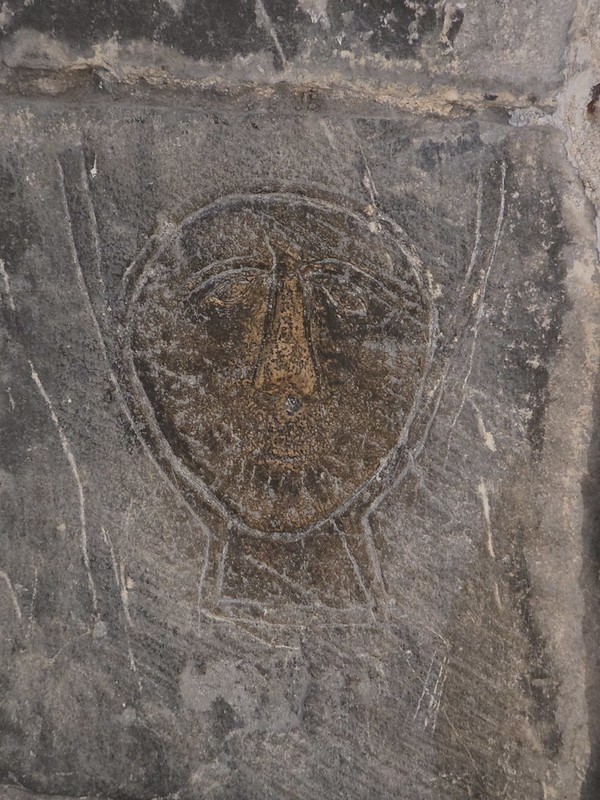
This is a carving in the stone near to the new entrance of Norwich Castle Museum’s redesigned keep. The museum notes that it dates to the thirteenth century and has been retouched many times, so although they don’t know who it was, they suspect it was a revered local religious figure. I assume that there’s a possibility that it’s the Virgin Mary, but it’s quite possible that no-one will ever know. It’s nicely preserved though and very visible to visitors to the museum.
One huge improvement here at Norwich Castle with the extensive works is that the battlements have been opened up permanently, rather than only accessible for certain tours. The lift was already broken, which is entirely sub-optimal for those with accessibility needs, with no indication on when this will be resolved. One thing I find a little odd is that they’ve put glass between the battlements so it’s quite hard to look through clearly unless you’re tall, there’s a fair few negative reviews about that already.
I very much enjoyed looking over Norwich, there’s Rose Lane towards the bottom of the photo on the right, with Norwich railway station in the centre-right.
Norwich railway station.
Rose Lane and this was a useful time to test my phone’s zoom. At maximum zoom, I could read the Hollywood Cinema sign clearly on the soon to be demolished Anglia Square, so it’s fair to note that there were excellent views.
Mousehold Heath towards the rear.
The soon to be demolished Anglia Square at the left on the rear, and the white building is where I was able to zoom in on the cinema sign.
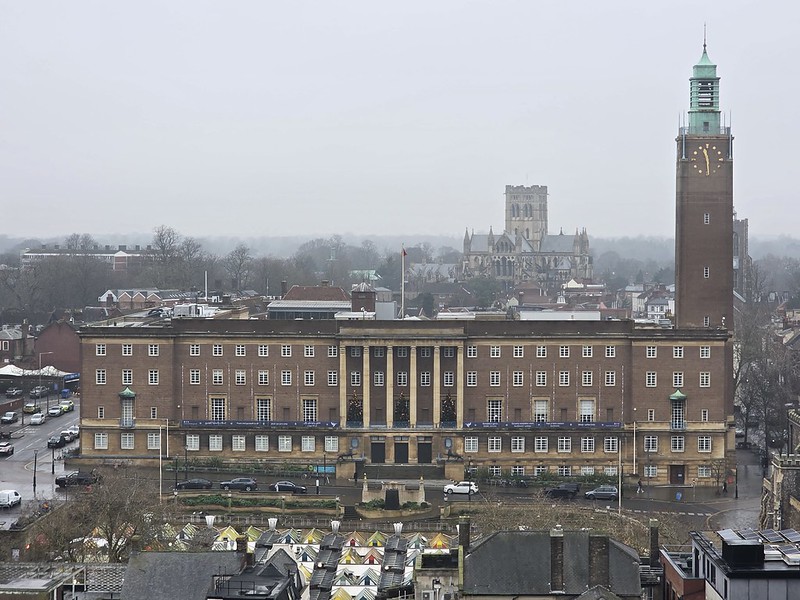
Norwich City Hall.
Looking from Castle Meadow at the front through to Norwich Market.
Norwich Market.
I’ll return to the museum a few more times in the year I imagine, hopefully to get more photos across Norwich when it’s a bit brighter. But, I am impressed at the work they’ve done to open up the battlements, that feels a real positive and I hope they can make it fully accessible again soon.
As I’ve managed to get an Art Fund pass at a discounted price, there will now be a year’s worth of posts about places that I can get in for free. One of them is Norwich Castle, recently re-opened following a substantial refurbishment and renovation. More on this later, but the changes weren’t as bad as I expected and there are some definite positives about the investment that has been made here.
Having noted that, this room seems to me though as something of an incoherent mess in terms of the history, it’s unclear to me what they’re trying to show here. They’ve put a throne into the chapel and the relatively undamaged original sanctuary is in the corner. I’m struggling to believe that the chapel would have once had a large throne looking at the window and no other furniture or religious paraphernalia other than a lectern. I know that we wouldn’t have had rows of pews in here, but the layout seems odd to me.
I’m also unsure why they’re suggesting that the Caen stone was painted white so it would have had the appearance of Victorian toilets. Unless this is their interpretation of what new Caen stone would have looked like, but that seems aspirational in terms of the brightness. In other locations it was just left as it was, it’s an off-white or cream coloured stone anyway and so why would they paint an interior wall with what I assume the castle is suggesting is limewash? They might have wanted to use bright colours in the way that Norwich Cathedral was decorated, but I’m not convinced they chose white. But, I’m sure they’ve done this for a reason, but it’s a shame they haven’t explained anyway (either in the room or online) their logic here.
The museum might have been better trying to use graphics to show what the room might have looked like, I just find it unlikely the Normans made their chapel in Norwich different to everywhere else. AI can be very over-rated, but I ran the images of this room through Gemini and ChatGPT, both of them concluded that this was a medieval function room where visitors would have been welcomed by the gentry. This is what it looks like to me, I’m very much struggling to understand this as a chapel layout.
Anyway, that aside.
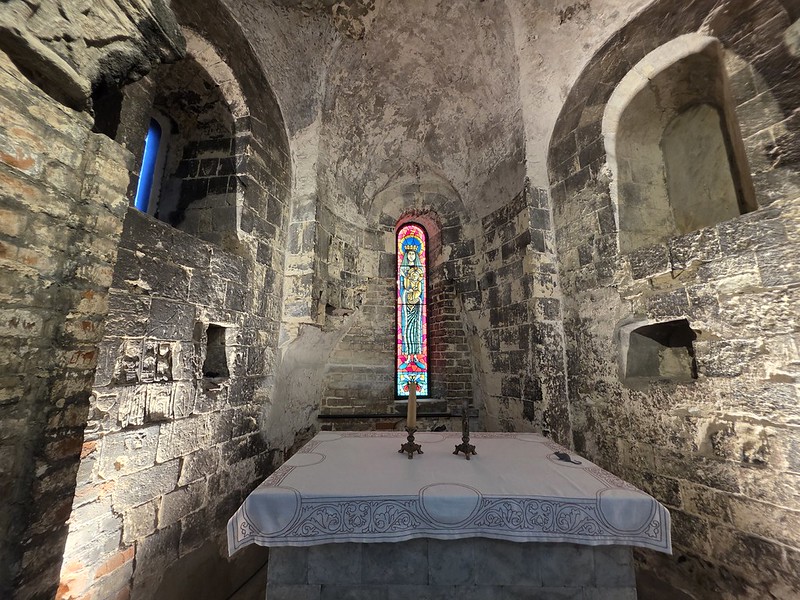
This is the sanctuary, so the original Norman architects were using this as the chapel’s altar although it’s at an odd angle. But, when you’re the King, you have the option to do things as you want.
I can’t find out whether this is entirely new stained glass for the new project, but it’s rather beautiful.
What the project has delivered is some beautiful lighting so that graffiti is easily visible, here’s what I assume is Mary.
There’s certainly a variety of graffiti here, the museum thinks these date from a period of over several hundred years.
Despite not being in a rush, I happened to be the first person through to landside, so with everyone following me I had to concentrate on going the right way so I didn’t get muddled up and look an idiot. My initial intention was to walk the 25 minutes to the hotel, but then I realised from Google Maps that this looked rather more challenging than I had anticipated.
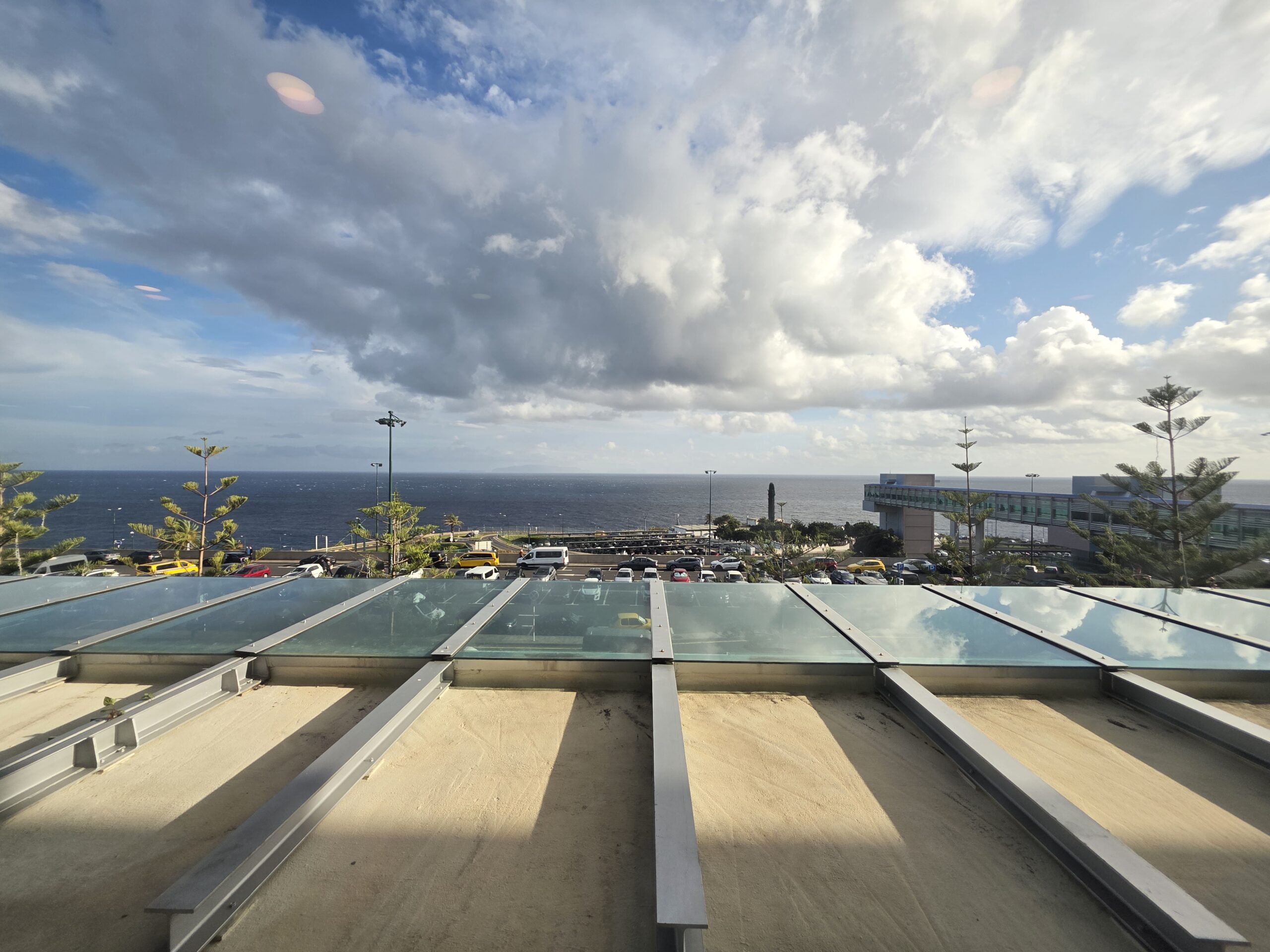
There were nice views of the Atlantic from the airport and I realised that although it was technically possible to walk to the hotel, it would involve some ridiculously complex navigation alongside roads not designed for pedestrians. Some people had walked it, and it is possible, but I decided to see if there was a bus.
It soon transpired that there were no buses, or at least, no sensibly priced ones and just more expensive shuttles. However, I looked at Uber and realised that the taxi fare to the hotel was £3.40 which is what I would have happily paid for the bus. I went down the stairs to brace myself for the whole stress of taxis.
Now, I don’t like taking taxis, they are too decadent for me and have a level of stress that’s too high for me. I like trains, buses, planes and things I don’t have to interact with in this individual way. However, I’m very polite and have a 5 star rating on Uber, unlike my friend Richard who has plummeted to very low levels. I tell Richard that he needs to think from the driver’s perspective, but he’s very demanding.
After some slight faffing whilst the taxi worked out how to park, and me being annoyed as I realised I was charging a waiting fee of 6p when I was in the right place, the friendly driver turned up. The drive took about eight minutes and I apologised for the short journey, but the driver said he preferred them as he could easily return to the airport.
I had by this point calmed down about the 6p surcharge and was safely at the Hotel Solar Bom Jesus, a cheap and clean accommodation option that seemed well reviewed on-line. More on that in another post, as I rather liked the hotel. Incidentally, I found the taxi hunting process so stressful that I didn’t get any photos.
Anyway, my revelation was that for my time on Madeira I was going to have to take taxis everywhere, not something that usually happens on my travels. Actually, it’s so notable, that’s why I’ve given it a post all to itself….
Back on the rail network from Warszawa Śródmieście station and every time I come here I wonder when they’re going to renovate this as it’s getting ever more rickety. The train signage here is a bit basic, but fortunately Google Maps informed me that my train was running eight minutes late.
I’ll just add here that a train ticket to the airport costs about 85p.
Now this was exciting as there was a ticket check, as the inspectors do monitor this line reasonably frequently. To my right were what I think were a Polish mother and daughter, the former was quite elderly. I, as I may have mentioned, cannot speak Polish of any merit, but I was able to understand enough of the conversation to hear what was going on.
It boiled down to this:
ELDERLY WOMAN : “The ticket machine was broken”
INSPECTOR : “So you have no ticket?”
ELDERLY WOMAN : “I’d like to buy a ticket now”
INSPECTOR : “Yes, you can, that will be 580zl [about £120] including the fine”
ELDERLY WOMAN : “But the machine was broken”
INSPECTOR : “You have no ticket”.
This went on until the train pulled into the airport and it was clear that the pair thought they were getting off and the inspector would forget it. No, the doors opened and he locked the one they were standing by.
I sat on those seats to watch the whole affair unfold, as I don’t get out much. And indeed, the two ladies weren’t getting out much, but their card did and they paid the penalty fares. This is why fare evasion on the Polish rail network seems to be so low, the inspectors will enforce those without tickets.
Very Christmassy. Airport security was interesting, the lady in front of me took a ridiculous amount of time to put her things in the bag. Fortunately, Polish airport security is friendly, calm, collected and told her to hurry up. She got annoyed and so she found herself being interrogated for the entire time I was at security. I like a bit of drama.
Anyway, I reached the lounge and got myself a Greek salad, chicken wrap, coffee and an early morning beer which was to fortify myself for the flight which would take over five hours to get to Madeira. This is another one of my favourite lounges, as there are power outlets, unlimited chocolates, unlimited olives and unlimited Feta cheese.
Mine was the 11:20 flight.
Boarding at the gate was uneventful as it was organised, fast flowing and there were plenty of seats around. Fortunately, Madeira is in Schengen, since it’s part of Portugal, so I didn’t have to faff about with any border control.
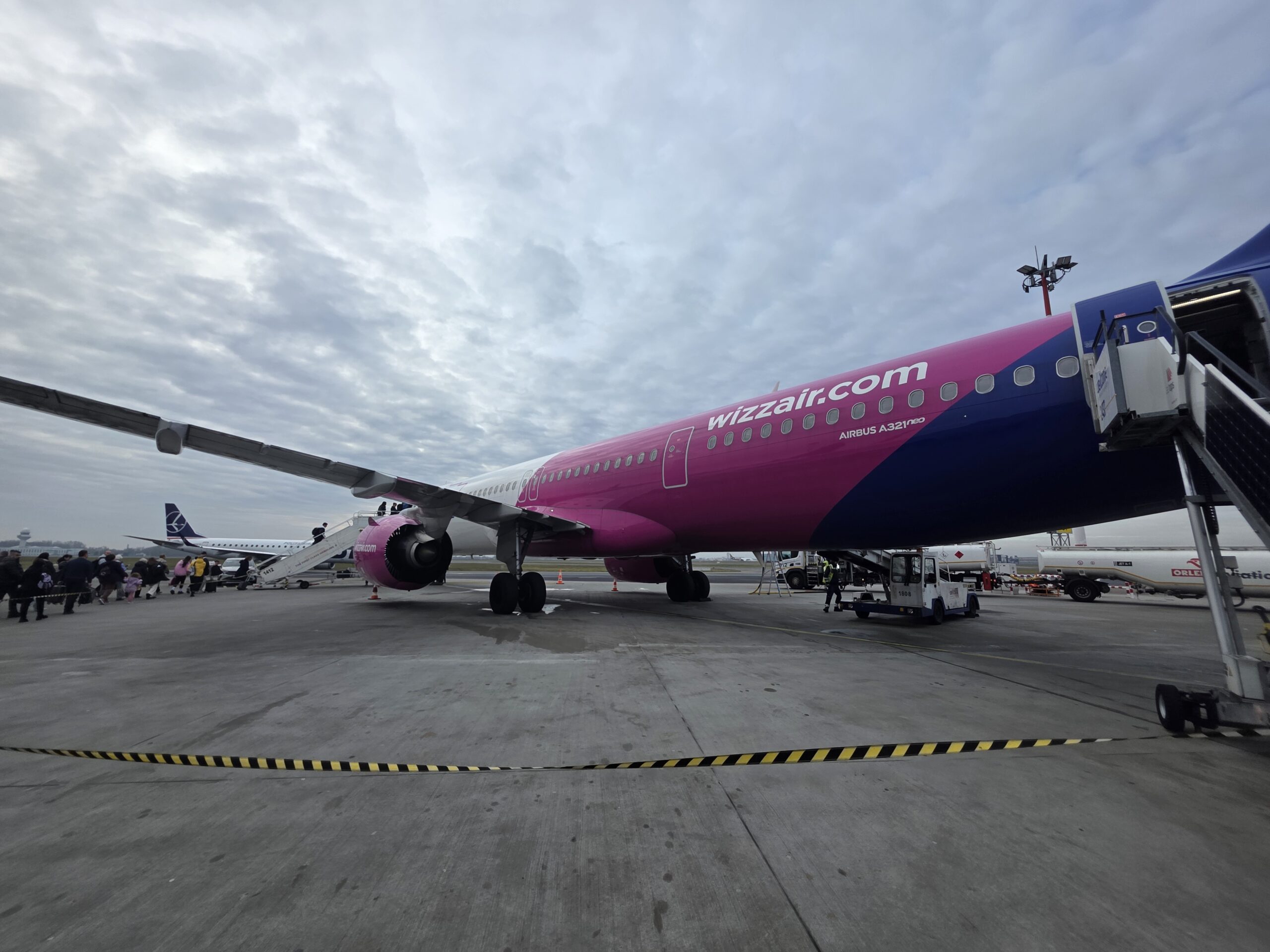
This is aircraft 9H-WNS, yet another one that I haven’t been on before. The flight lasted for five hours and thirty minutes, which is quite a strain on a budget airline if I’m being honest. I normally like having my bag under the seat in front of me, but after five hours I was getting annoyed that it was in the way of my legs that needed stretching.
The seating Gods gave me an aisle seat which was very fortunate for a flight of this length, so that did give a degree of comfort. The couple in the window and middle seat were very agreeable and didn’t barge into my seat space, with the crew merrily plodding up and down with the trolley a few times.
The flight cost me £8.99, so I can’t really complain and I find spending this amount of time without a phone signal to be quite relaxing in many ways. I have rather decided, that despite Wizz Air being a perfectly competent and comfortable airline, that flights of this length are perhaps just a bit much.
Safely in Madeira, which is my first time to the island. I understand that pilots require special training to land at this airport as there are strong winds and there’s not a huge amount of space to work with. The landing was sudden but seemed smooth, although I’ve never doubted the competence of Wizz Air pilots as they always seem professional and calm to me.
The view from the runway and the winds were certainly getting up at this stage. I had intended to walk to the hotel, but events meant that didn’t happen….. But more of that in the next ‘riveting’ post.
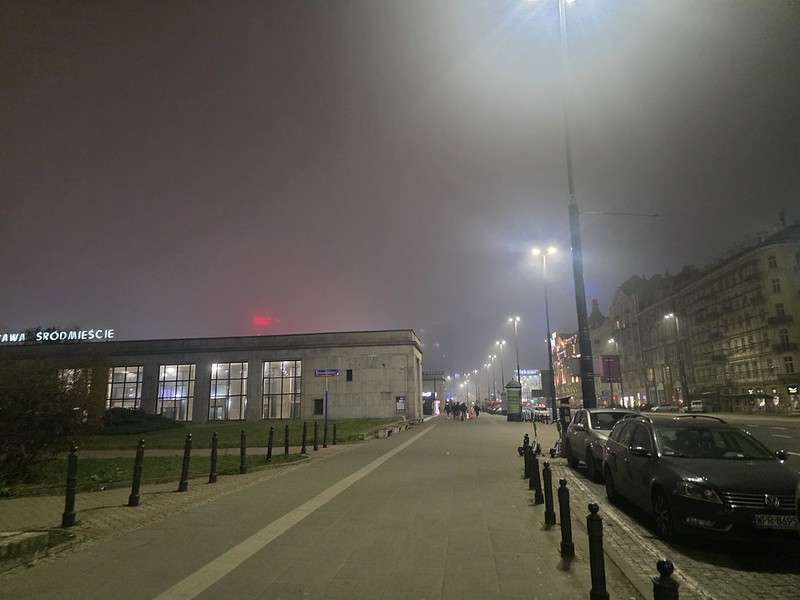
I would show a photo of the clear exterior of the Novotel, but it was too foggy to see it, but it is to the right hand side of the photo.
I’ve written about this hotel numerous times before, it’s one of my favourites. It’s a towering great affair near to the Palace of Science and Culture and a short walk away from the railway station.
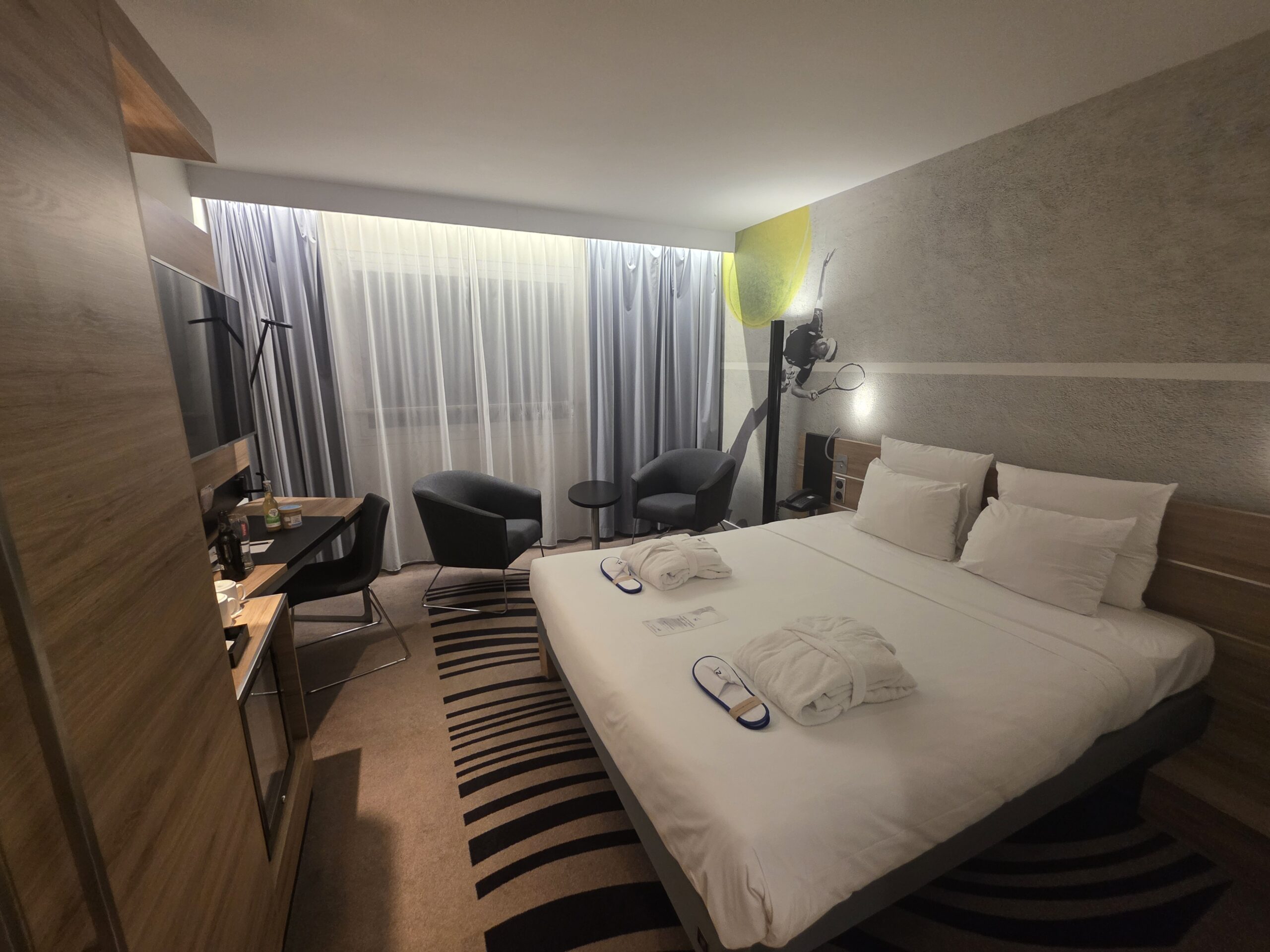
One downside about the incredible growth of Poland’s economy is that hotel prices are routinely much higher than they were, so it’s rare that this hotel is an affordable option now. Luckily, Sunday rates are much lower and there was a friendly welcome at the front desk and they’d kindly upgraded me. They also mentioned it was a while since I’d visited, so I was secretly pleased that their computer hadn’t entirely forgotten about me.
My welcome gifts, local apple juice and chocolate biscuit things.
I arrived at the hotel just five minutes before the bar closed, which had the advantage that I was able to get my welcome drink. Żywiec Porter is always a favourite of mine, malty and rich, certainly good to eat the welcome chocolates with.
The view from the window over Warsaw and the Palace of Science and Culture is sort of visible on the right. I find watching the trams going through the roundabout quite peaceful and relaxing, I always get Sim City vibes sitting up here.
This might not have been the longest of stays, but the room was clean and there were no internal noise issues. I like traffic noise so I opened the window and the sounds of the city didn’t disappoint, Warsaw always feels like a vibrant place. And I use vibrant here in the positive sense, I sometimes refer to pubs as vibrant, by which I mean I feel that they’re close to having a riot.
I had initially intended to stay in Warsaw for a few days, but I accidentally booked a return flight to Madeira. This meant that my intended relaxing stay in the Novotel was rather cut short as I had to leave the hotel at 08:00 to get the train back to the airport. It was foggy, slightly cold and nicely refreshing.
Another day, another trip by train to the airport. I went from Norwich via Cambridge due to work being completed on the Norwich to Ipswich line, with a change at King’s Cross railway station. Surprisingly, the first section of the journey wasn’t that busy, despite it being on a two carriage train that can be really quite packed.
I picked up my free Greggs sausage roll and then boarded the Thameslink train to Luton Airport Parkway.
At Big Smoke, the chicken tenders and freshly squeezed orange juice were a beautifully paired meal. Who needs anything more decadent than this? This is always a handy restaurant as it’s included with Priority Pass and they have plenty of power outlets to charge devices.
Mine was the 19:35 flight to Warsaw, all looking on time. It’s not a bad timed flight, it gets into Warsaw at around 22:30 their time, which is fine as long as I get out of there by the time the last train leaves at 23:45.
A pint of Menabrea and some olives at Nolito.
Some bloody awful non alcoholic Heineken alongside some odd chicken thing at My Lounge. Nice teas though, alongside the usual dirty cutlery. I’ve noticed they’ve had a few negative reviews about the cutlery, it feels odd that they haven’t made any effort to fix this.
Boarding was announced early and then they were swiftly dealing with passengers at the gate. As usual, it was clear where non-priority passengers such as myself needed to go, I like clarity.
Boarding and the seating Gods had given me a middle seat which is never ideal, but wasn’t too problematic on this flight. The aircraft was 9H-WDX, an aircraft that I have been on before when doing this journey the other way around.
The flight was very busy with nearly no free seats. I will write the same as ever about the flight, which is that the crew were friendly, the service was efficient and the pilots made clear and appropriate announcements.
There wasn’t much of a wait at border control at Warsaw airport, so I made good time and was able to get a train to the city centre. It was then just a ten minute walk to the Novotel hotel where I was spending the night, which is one of my favourite accommodation options in Europe.
I had only decided a couple of days before what I’d be doing this week and I ended up on a route that was perhaps not entirely well thought through, but there was adventure and so that’s sufficient to keep me functioning.
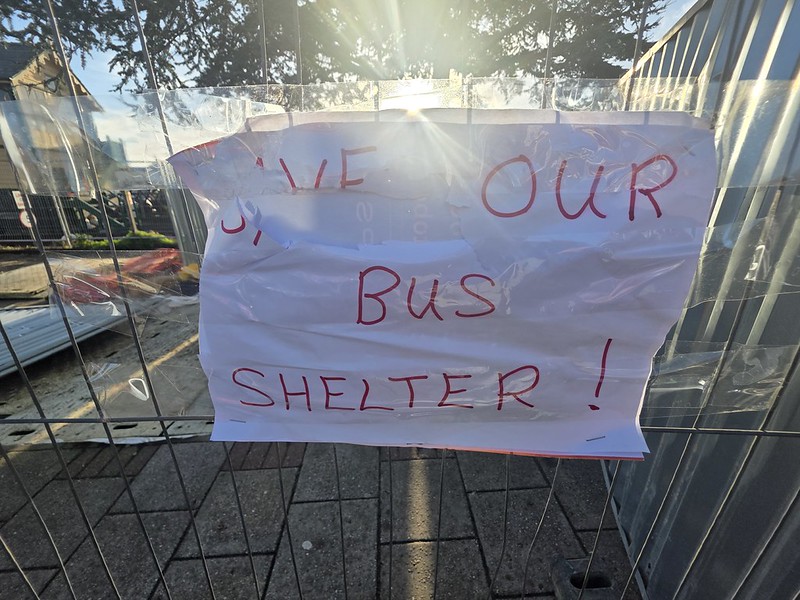
This is a rather nice 1950s bus shelter that has sat next to Sheringham Railway station from when it was actually part of the national network and not a heritage railway. It’s not staggeringly beautiful and its glass has fallen out, but the council decided that it was too near the pavement. I tend to find bus stops near the pavement are helpful, but I don’t suppose I fully understand these modern methods that the council like.
In a botched consultation operated by Norfolk County Council they consulted with the locals about how they were going to do mostly what they wanted anyway. The locals were allowed some minor ideas, but this was not a consultation that was designed to consult, it could be argued that it was solely done to tick some boxes.
Was there an easy solution? Of course, put in a new accessible bus shelter, complete the works and maintain the former bus shelter for some other purpose or use.
Paul, a brave and courageous campaigner.
The council could have responded to local opposition by coming to look at what was happening to try and resolve the issue. Well, they could have done, but they didn’t. They did this.
Here is local money being spent for the people.
Sheer incompetence from the council saw metal barriers put up around the site and putting pedestrians at risk. It was only locals warning the council of the sheer danger that led to the council providing fencing.
The town council, as the owners of the bus shelter, had a vote and told the county council to withdraw their bailiffs. This annoyed the council, so they’ve decided to dump the chaos they’ve caused on the local community and scrap the rest of the project. The cost of this work was scheduled to be £580,000, although much of this was ring-fenced from Government funding for bus improvement schemes.
Brave locals fighting for their community have ensured that the bus shelter has been saved. Keir Starmer, the Prime Minister, has become involved and suggested that perhaps the county council should resolve the mess that now exists. We’ll see what happens now.
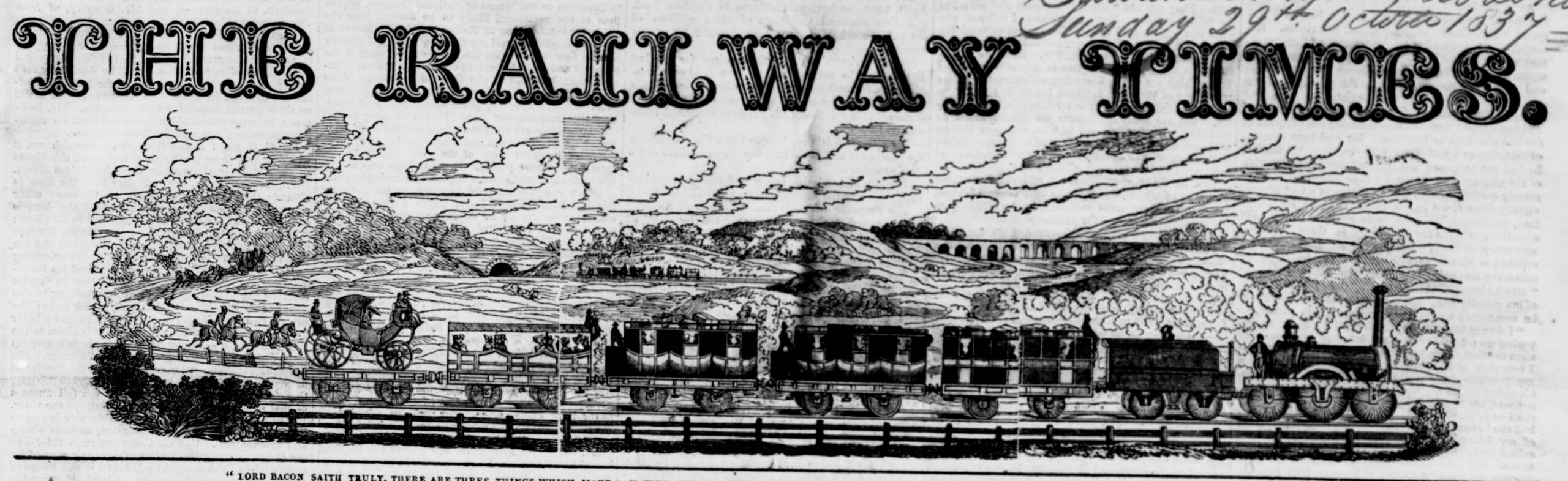
This has nothing whatsoever to do with the railways, but the Railway Times of 1837 certainly found itself with quite a lot to say about the world around them.
It’s some stretch to suggest that Germans speaking German in the United States, at a period of substantial migration, was “evil”, but it clearly concerned those speaking English. It’s also an interesting sign of the times that there was an opinion that it would be English and Spanish that would be the two major global languages.
“The Germans in America.—The German newspapers inform us, that according to the most recent intelligence, “German life and civilization,” develop themselves more and more at Saint Louis in the United States, and apparently will in time predominate in this part of the Union. A German Library is established there, a German Annual published, &c. In two of the German newspapers printed in America, a proposal has recently been made to found a German University in the States, and is said to be likely to meet with support. We hope that the friends of progressive civilization in America will not allow this evil to advance too far before they oppose a check. It has always been considered a cheering point in the future prospects of the world, that, in all probability but two languages, the English and Spanish, would prevail over the vast continent of America, among a population of hundreds of millions, whose influence would be of such weight as to spread those languages pretty generally among the whole human race, every person of education knowing both, and almost every individual knowing one or the other.
The common languages of Europe would then be eclipsed by the superior importance of these two, in the same manner as Welsh or Wallachian now by French or German. All this vast improvement in the condition of mankind will be prevented or obstructed, if another language is suffered to gain ground in America. The Portuguese is there already in Brazil, but that may be considered as hardly more than a dialect of the Spanish; the French is there already in Canada, but on the decline before the advancing influence of the English. Dutch, Russian, &c., are spoken at a few points, but have never attained sufficient importance to excite any apprehension that they will offer resistance to the gradually overpowering march of Spanish and English. But if the practice gain ground for natives of the different nations of Europe to emigrate in bodies, and carry their language and habits with them, we shall have an America as much cut up into small divisions as Europe, and the difference will be a fruitful source of dissensions and wars.
While the future mischief to be apprehended is so gigantic, the present inconvenience is by no means small. Lieber, the editor of the Encyclopædia Americana, himself a German, but who, since his emigration to America, not only speaks but writes in English, complains that the little knots of Germans scattered over the States, are full of ignorance and prejudice; not knowing the language of the country, they are shut out from intercourse with their neighbours.“
As a brief interlude between my posts about Italy and other assorted European countries, back to the Railway Times of 1837.
Firstly, the word superabound is a loss from the English language, no longer in use it meant something in abundance. The newspaper was at this time annoyed at Charles Poulett Thomson, 1st Baron Sydenham, the President of the Board of Trade, who also happened to become the First Governor General of Canada.
I think I’m with Thomson here, as although in 1837 the number of Acts of Parliament to build railways was low, the number soon increased to ridiculous levels. In 1846, there were 263 Acts of Parliament, so more pledges to build railways than could possibly be met.
The result was known as the Panic of 1847 and what became called railway mania, as large sums of money were lost. This is what Thomson had warned about and had prevented whilst he was President of the Board of Trade in the 1830s.
Here’s the long article from the Railway Times.
“We take the earliest opportunity, upon the re-assembling of Parliament, of adverting to the Standing Orders which were passed by the House of Commons in the recent Session, and very shortly before its close, with respect to future Railway Bills. Foremost among those enactments, and the most to be condemned, is that most unjustifiable and oppressive one, by which it is required, not only that “ten per cent. of the estimated capital shall be subscribed and paid,” before the parties promoting any Railway Bill shall be at liberty to proceed with it,—that is, long before it is required for the actual execution of the work,—but that the money so paid shall be lodged in the Bank of England, where it is well-known no interest is allowed on deposits. A greater impediment to the progress of the Railway System could not by possibility have been invented. Indeed, the author of the measure did not hesitate to avow, that it had for its express object “to check speculation” in Railways. The Premier had set the fashion to his colleagues of giving “heavy blows” and “serious discouragements”; and this was the President of the Board of Trade’s heavy blow and serious discouragement to a class of undertakings fraught with greater benefit to those interests, which it is his special duty to protect and promote, than any dozen other improvements or discoveries of modern times.
Now, without entering into the question of the merits or the demerits of many of the lines of Railways which have been projected within the last two or three years, we purpose to dwell in preference upon the right of individuals to judge for themselves as to the propriety of employing their money in any speculation which to themselves may appear good, and upon the fitness of the people of England being no longer treated as children, who have not the capacity to understand their own interests, without the interference of Mr. Poulett Thomson, whom we have never understood to be in any great degree wiser in such matters than other folks. True, it may be, that very grave errors have been committed in some of the projects which have been set on foot; but then it is to be borne in mind, that the Railway system was new in England but a few years back, and that a great deal of experience has since been acquired, which must go far to prevent the repetition of such errors—experience arising undoubtedly from some memorable failures, but from many more instances of the most triumphant success.
Why, moreover, should excess in Railway speculations alone be checked? Why not in other speculations as well? Is it simply because the House of Commons is possessed of no power over other fields of enterprise? And if so, what are we to think of the wisdom of a system of restriction which is necessarily partial in its operation, and has might alone (not right) for its basis! It is clear there is a great mass of superabundant capital in England; that the possessors of this money find it useless, unless invested in some commodity or public work or funds, which will yield an annual return. Although, therefore, Mr. Poulett Thomson be determined that the people shall not speculate in Railways, it is certain that he cannot prevent them from speculating in cotton, corn, wool, tea, silk, indigo, and a thousand other articles, all of which are forced up in consequence, and rendered dearer and less accessible to the great mass of the people. To allow Railways to be constructed, is to allow the agricultural labouring population to be employed; to allow the iron manufacture to flourish; to allow a thousand varieties of artificers to earn a good livelihood, in woodwork, brickwork, steam locomotive-engine building, and the like; whereas, to turn aside the current of capital from these works, is to force it into other and less beneficial, if not decidedly injurious channels of speculation; to raise the prices of cotton, silk, wool, hemp, and other raw materials of manufactures; by which rise the price of the finished article is raised, consumption diminished, and the manufacturing population, in a corresponding degree, left unemployed. This is precisely the present position of affairs. Money superabounds, because the employment of it in public works has been “checked;” and hence the many millions which would otherwise have been giving employment to the population in raising embankments, building bridges, and hammering out rails, is employed in forcing up the Cotton Market of Liverpool, and the Wool Market of Yorkshire, to prices which render the extremest caution necessary on the part of the manufacturer, to protect himself against the chances of a re-action—should spurs instead of checks happen once more to come into vogue.
Again, if Mr. Poulett Thomson be so bent upon checking speculation in Railways in England, how will he check the speculations in similar undertakings in various countries abroad? As he has not the power to prevent the English capitalist from sending over his money for investment in Railroads from Paris to Havre, Brussels, or Rouen,—or in Railways from New York to Philadelphia, Baltimore, or Boston,—it is clear that those places will attract the capital that is denied the opportunity of investment at home; that Railways will, therefore, be constructed with British capital in foreign countries, whilst no more Railways will be constructed in Britain itself; so that, in fact, by “checking speculation” in this country, we are preventing our own population from obtaining employment in preference to foreigners, and are assisting foreigners with our own money to gain the start of us in that which is the greatest of all auxiliaries to commercial and manufacturing industry—cheap and quick communication.
So far from “checking speculation” in Railways, there is no branch of enterprise from which the checks already existing should be so sedulously removed. As it is, they have quite enough to contend against in the high price of land in England, and the exclusive and stand-still spirit of its aristocracy; whereas, in the United States, the comparatively small value of land, and the absence of privileged castes, of legislative difficulties, and of artificial restraints, give that rising Republic advantages of so important a kind, that money alone is there wanted—that capital which Mr. Poulett Thomson is kindly doing his best to drive thither—to enable it to go immensely a-head of this and all other countries in the race of national improvement.
On referring to the Parliamentary Notices, we observe that there is scarcely one new Railway line to come before the House of Commons during the present session of Parliament; and on conversing on the subject with those most intimate with this branch of Parliamentary practice, we find they are unanimously of opinion that the compulsory payment of a large part of the capital—for no purpose whatsoever, save that it may lie dormant in the coffers of the Bank of England—is the principal reason why the progress of the system has been so deadened at the present time. Let us hope, therefore, that this most absurd and impolitic provision may be forthwith rescinded. There is room for the employment of many millions of capital upon new lines of Railway, of the success of which there can exist no reasonable doubt, and only Mr. Poulett Thomson, with his nonsensical checks and crotchets, stands in the way.”