Blog

  • Wizz Air (Dortmund to Katowice)

    Wizz Air (Dortmund to Katowice)

    Dortmund is one of the older airports which is simply too small to deal with the number of passengers it currently has to handle. There are over three million passengers using the airport every year now and they have been creative about using the space that they have.

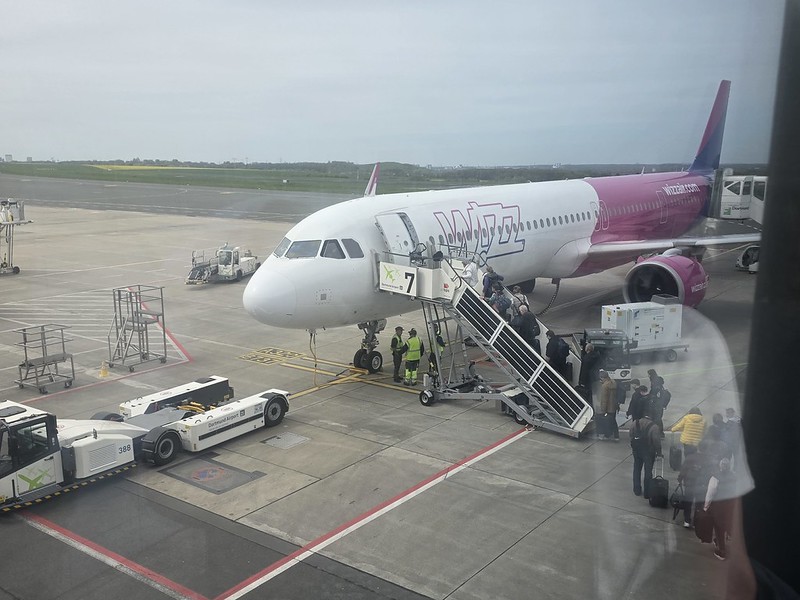
    Mine was the 13:25 flight and I took this photo just after I went through security, showing how perilously close I was. Well, by my standards. The security process was slightly problematic as some drunk, mostly older, Polish football fans barged by a few of us in the security line. I decided to take the opposite security line to them and managed to get through quite a bit quicker, and certainly had a quieter time.

    And the aircraft arrives, albeit a little late. The seating arrangement at the airport wasn’t dreadful, but they do need more seats for passengers as quite a few just opted for the floor. There were no power points and the general facilities at the airport were quite limited, but everything seemed to work efficiently.

    I was slightly nervous of a delay as I had a flight from Katowice four hours after this one arrived, but fortunately, there was no impact of note.

    This is aircraft HA-LVD, yet another one that I haven’t been on before, with this one in operation since 2019. The seating Gods had given me a window seat near the back, which suited my needs entirely for a flight of a little over one hour.

    Somewhere over Dortmund.

    What looks like a pretty town, this is Soest in Germany.

    And safely into Katowice and we we hardly late at all, giving me more than enough time at the airport to sit in the lounge for hours….

    The flight cost £9 with my Multipass and was another competently managed operation, with the aircraft being clean, the crew being friendly and the pilots sounding professional. It’s becoming a bit samey I know with Wizz Air, but routinely good isn’t a bad thing…
  • Dortmund City Centre to Dortmund Airport (with some slight faffing about)

    Dortmund City Centre to Dortmund Airport (with some slight faffing about)

    I left the Ibis hotel in Dortmund just four and a half hours before my flight to Katowice left, so that was positively cutting it fine as far as I’m concerned. I had a vague plan of how to get to the airport and since I’ve done this before, albeit in a different way, I didn’t think much about it. Although therein lies the first problem….

    Dortmund Stadthaus isn’t perhaps likely to win any design awards for the frontage, despite the efforts made with the mural above it. Anyway, my plan was to get a U-Bahn from here to near the airport and walk the 50 minutes to the airport itself.

    I get to the railway station ticket machine and notice that there’s a cheap ticket to the airport as one of the options. I knew that there was a more expensive train to the railway station, but I refused to spend that much and liked the idea of the cheaper ticket that I hadn’t thought about.

    So, I leave the station and walk twenty minutes back to the central station. It was a nice walk, but I’m not entirely sure why I did that. What actually happened here is that this cheap ticket is the combined U-Bahn and bus to get to the airport, I hadn’t realised that’s what they meant, I think I thought there was a cheaper train direct to the airport from Dortmund Hauptbahnhof.

    I got to Hauptbahnhof and downloaded the app to buy a ticket, having by this time worked out how the ticket worked. I missed the train that I needed as apparently they need an address in Germany to buy the ticket. I have no idea why they have this requirement, so I slightly grumpily walked back to the ticket machine to buy it there instead.

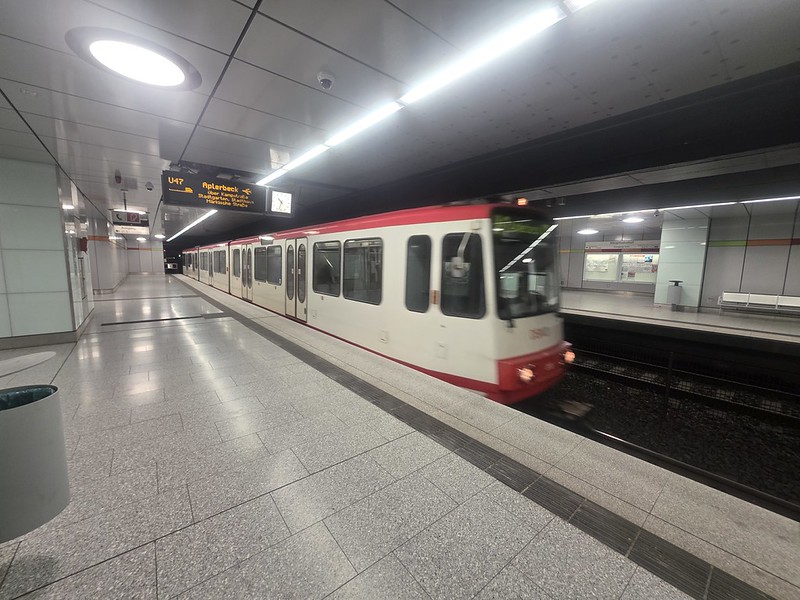
    And here’s the U47 to Aplerbeck. This doesn’t actually go the airport, but they’ve sensibly signed it to make clear that it’s the one to get to be able to connect to a bus that does go there directly.

    Safely on board the U47 and it was only at this point that I realised the train went through Dortmund Stadthaus, where I had been an hour before. This explained why they sold tickets to the airport from there, namely, because the train to the airport went from there. Logical really.

    The U-Bahn stops at Aplerbeck and passengers then get off and walk around 50 metres to the bus stop.

    Rather oddly, the buses were only once every hour, although fortunately, I only had a wait of fifteen minutes. I was there on a Sunday, so perhaps the service is less regular then, but it was a busy bus when I got on.

    On the bus and I was able to get the front seat, I still get a childlike sense of excitement about that.

    I liked that there was a button there which is by the window of the front seat, as often buses don’t have anything nearby (I don’t think many people spend time worrying about things like this). This is a minor design detail, but sometimes the simplest things are the best.

    And safely at the airport with just two hours to go before the flight. Perilously close I tell you… Anyway, everything went smoothly despite my faffing about. The moral of this entire, and slightly dull, story is that the direct train costs nearly €10 whereas the combined train/bus costs around €4, so I liked the latter one best.

  • Cologne to Dortmund with FlixTrain

    Cologne to Dortmund with FlixTrain

    I have a lot more to write about Cologne, as I’m partial to wittering on, but I’d better catch up with the rest of the trip I made last week before I forget the last bit of it. I had spent three nights in Cologne and I was then spending one night in Dortmund before leaving Germany. So, that meant a train journey and I like a train journey.

    Mine was the 12:14 train to Leipzig.

    This is Cologne’s main railway station and it first opened in 1859, replacing the rather awkward and sub-optimal arrangement of separate railway termini that had grown up as different companies did their own thing in the traditional nineteenth century manner. Putting the station beside the cathedral was, on one level, completely logical, because it placed rail travellers right in the middle of the city. On another level, it was a bold little decision to squeeze one of Germany’s key railway hubs next to one of Europe’s great Gothic buildings and simply hope the whole arrangement would somehow look dignified.

    And they’ve failed in my view with the new building, there’s the grand cathedral on the right and the rather dumpy frontage of the railway station. But, it’s rare for a central railway station to be this central, I’m impressed at their forward planning.

    It is an odd mix really, but anyway, back inside.

    The current railway station is largely the result of rebuilding in the late nineteenth century and then, of course, the rather undesirable outcome on the city from the Second World War. After 1945, the station was rebuilt and it remains one of Germany’s most important railway interchanges, at least being quite grand inside.

    I was meant to be getting the train from platform 5, but then the Brussels train was running late, so we were shunted to platform 4. This was not much of an inconvenience, since it’s a walk of around three metres.

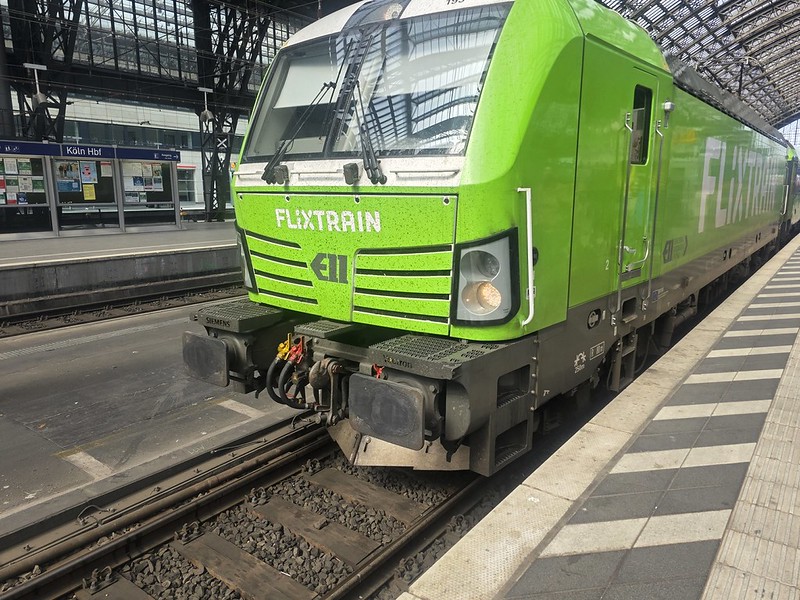
    And here comes the FlixTrain storming into the platform. I’ve taken many FlixBus journeys, but this is the first version by train. I’d note that the prices were low, this journey cost under £10. Trains in Germany are generally cheap as it’s possible to pay £60 a month and then get unlimited free local travel on trains, something I’d love to be introduced in the UK. This FlixTrain isn’t included in that offer as it’s a private operator, but they made lots of clear announcements about that.

    Everyone is given a seat, although passengers can change it on the app, and mine was in the front carriage. Unfortunately, that was quite a way from where I was standing, and there were quite a lot of passengers shuffling along to the appropriate place. I meandered slowly, there were some passengers that seemed entirely panic-stricken by the whole process.

    The interior was spacious and everything was clearly signed.

    The train wasn’t that busy and there was no-one in the window seat for the journey, so it felt spacious. There were no power points, but the seats were comfortable enough.

    I was impressed that there was enough space to use my laptop, it’s often the situation on trains where the tray isn’t wide enough or the seat pitch doesn’t allow it.

    A photo of the carriage with its wavy ceiling.

    We arrived into Dortmund 35 minutes late, but I’m used to lengthy delays on the German rail network.

    And the outside of Dortmund railway station.

    I was impressed at the whole arrangement as the booking process was easy and used the same app as the bus service. It was clear where to get the train from, the seating options were easy to understand and the pricing was firmly towards the lower end of the scale. I’d certainly use this again and I hope that FlixTrain continues to expand their operations.

  • Cologne – Schnütgen Museum (Gravestone of Maria Sophia Bawyr von Frankenberg)

    Cologne – Schnütgen Museum (Gravestone of Maria Sophia Bawyr von Frankenberg)

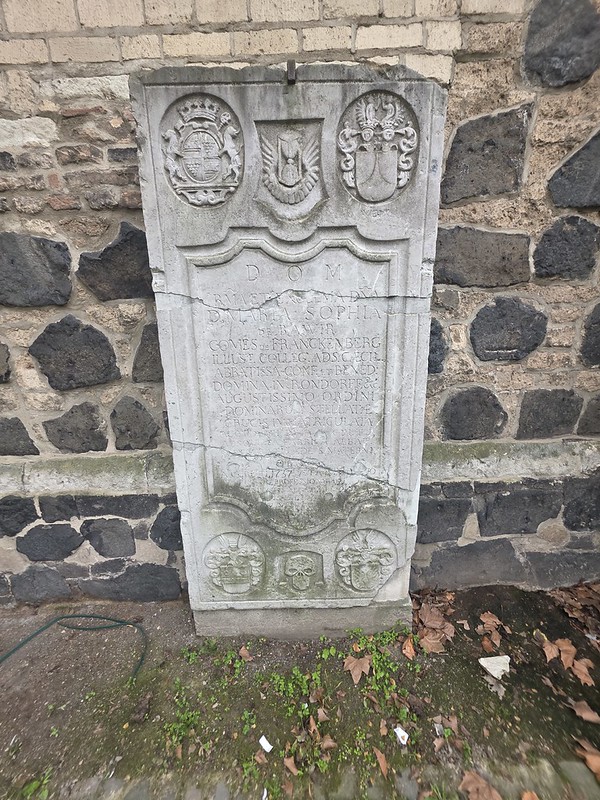
    Located outside of the museum is the gravestone of Maria Sophia Bawyr von Frankenberg (1667-1737). It reads:

    “To God, the Best and Greatest.
    The most reverend and most excellent Lady, Lady Maria Sophia de Bawer, Countess of Frankenberg, confirmed and blessed abbess of the illustrious collegiate church of St Cäcilia, Lady of Rondorf etc., enrolled in the most august Order of the Ladies of the Starry Cross. After increasing divine worship, completing the abbess’s building works, and restoring the church of St Maternus, she died in the year of Christ 1737, aged 70, after 52 years in religion and 24 years in the dignity of abbess. Rest in peace”

    I often take photos of gravestones, as I don’t get out much, to try and understand something about who they commemorate. Usually when I’m overseas it’s something of a forlorn exercise as I can’t work out anything about them. But, this is a little different as she has her own Wikipedia page, albeit only in Germany.

    A countess by birth and abbess of the collegiate church of St Cäcilien in Cologne (which is where this museum now is), she was also Lady of Rondorf and a member of the Order of the Starry Cross. She sounds quite decadent and rich…. She came from a large family, she had five siblings and five half-siblings, with two of her full siblings being military generals, which must help in feeling more safe and secure in life.

    Her memorial inscription makes clear that she took her responsibilities seriously and it credits her with increasing divine worship, completing abbey building works and restoring the church of St Maternus (which still exists), which is a fairly respectable administrative record for anyone. The stone has become a little smashed up over time, but it has been repaired although perhaps the museum could put a little information panel by it.

  • Cologne – Schnütgen Museum (Evolution of Statue Painting)

    Cologne – Schnütgen Museum (Evolution of Statue Painting)

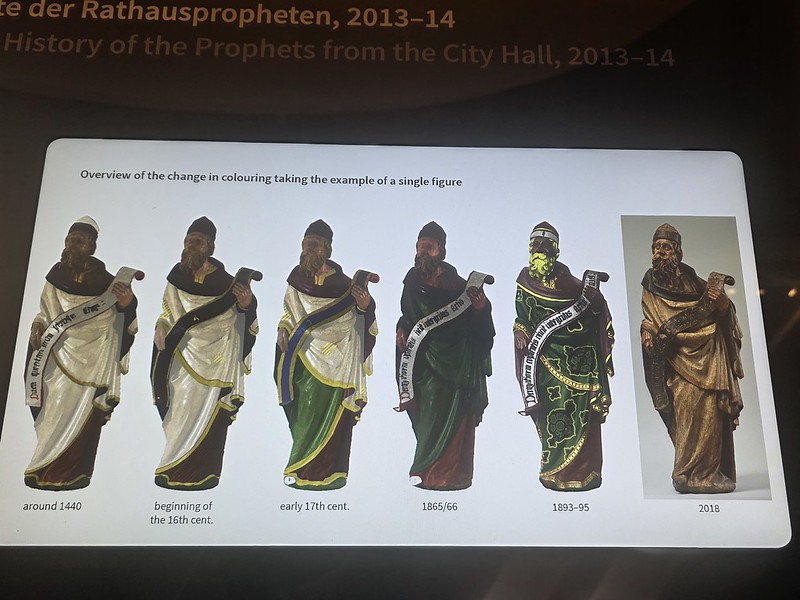
    I’ve used AI in the past to try and add colour to usually wooden statues which have limited evidence of their past polychrome look. It often makes it look colourful and that is in keeping with what I’ve seen in wider imagery.

    This screen in the museum shows the evolution of how the figures in their collection were painted. This shows a much more pure and white look back in the medieval period towards more colour recently, although goodness knows what happened between 1893 and 1895.

  • Cologne – Schnütgen Museum (One of Oldest Church Bells in Germany)

    Cologne – Schnütgen Museum (One of Oldest Church Bells in Germany)

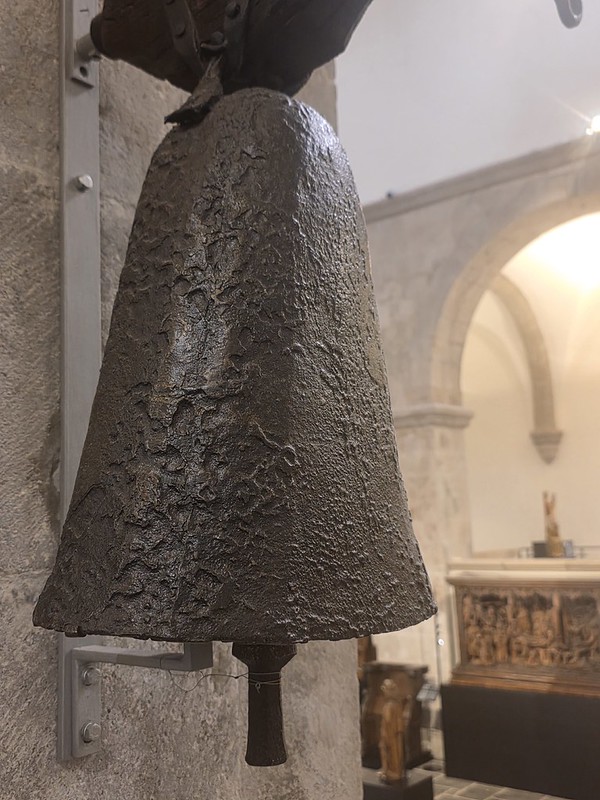
    This is an under-stated little number, it’s a bell which happens to be one of the oldest surviving in any German speaking country. It’s thought to date from around the early part of the ninth century and it’s made from three pieces of forged iron which have been smoothed and then riveted together.

    The bell is nicknamed ‘Saufang’ which means ‘pig’s catch’ as it is rumoured that it got buried in a nearby pond and was discovered by a pig. As with many of these rumours, it’s likely made up, but it’s a nice story.

    However, what I think is the most exciting thing about this bell is that it is from this church (what was then the Convent of St Cecilia which was founded in 888), or at least, the religious building that was here before. It left the church in the nineteenth century, but now the building is used as a museum it has made its way back here indirectly. I very much like this circle of history and there’s no better place for the bell to be today.

  • Cologne – Schnütgen Museum (Hidden Skull in Wall)

    Cologne – Schnütgen Museum (Hidden Skull in Wall)

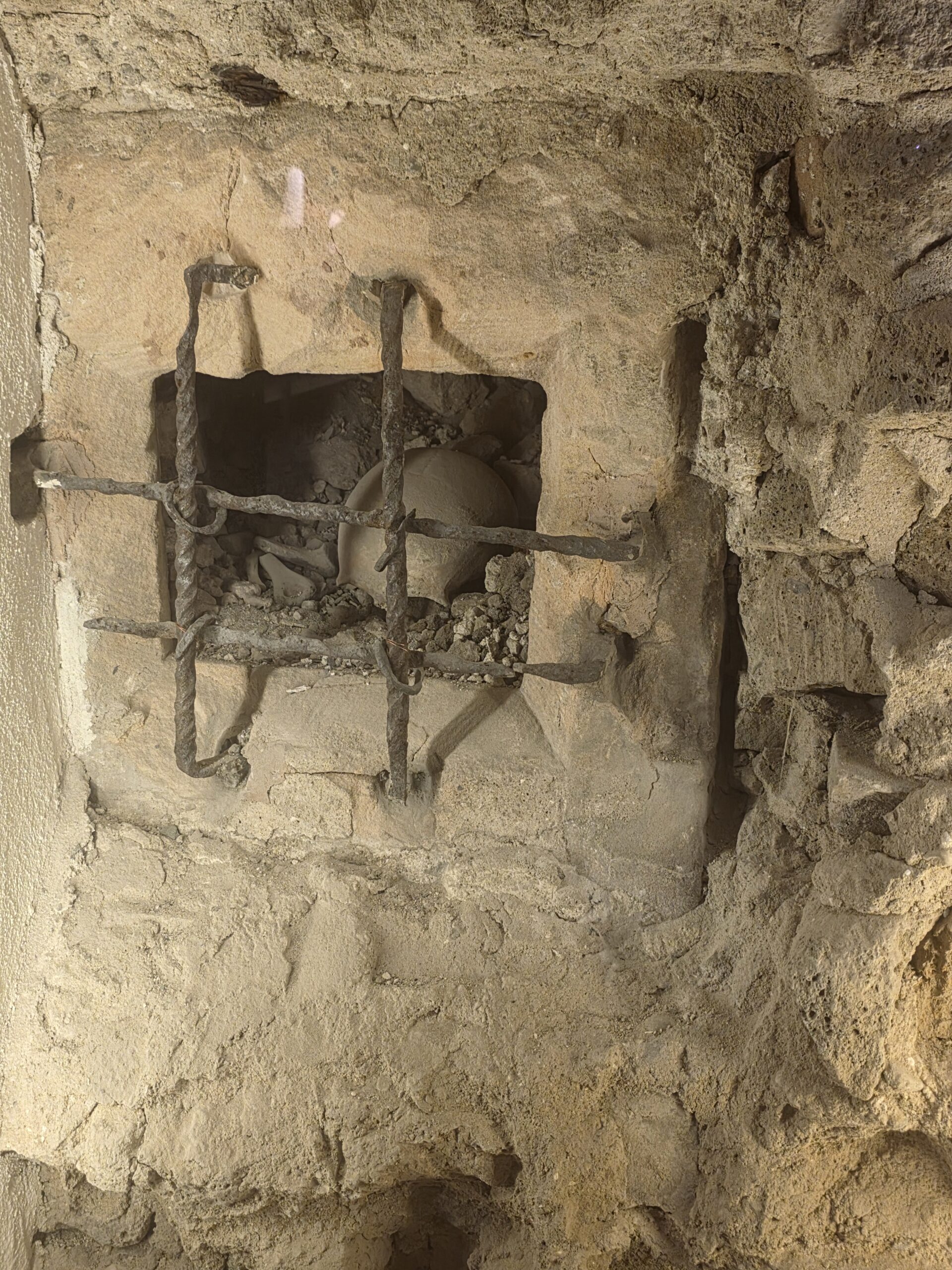
    This felt mildly unsettling when walking by it, namely a skull tucked away in the stonework. According to the museum display, this may originally have formed part of a cell like hermitage. This would have been the home of an anchoress, a female enclosed beside a church in order to renounce the world in a very literal and rather committed way. She would have lived for years in what was usually a single stone room attached to the side of the church, with the shuttered slit allowing her to receive communion and be able to be involved with services. I don’t think I’d like this, it would play havoc with my travel plans.

    The information panel notes that these recluses were normally higher ranking people (as someone who have to be paid to bring them food), and that as many as fourteen such cells are documented in Cologne between the twelfth and fifteenth centuries.

    It was only discovered in 1976 and the skull is likely not linked to the hermitage, this dates to the seventeenth century when the area was reworked to be a burial vault for the Augustinian canonesses who were operating the church.

  • Cologne – Abandoned Car Park

    Cologne – Abandoned Car Park

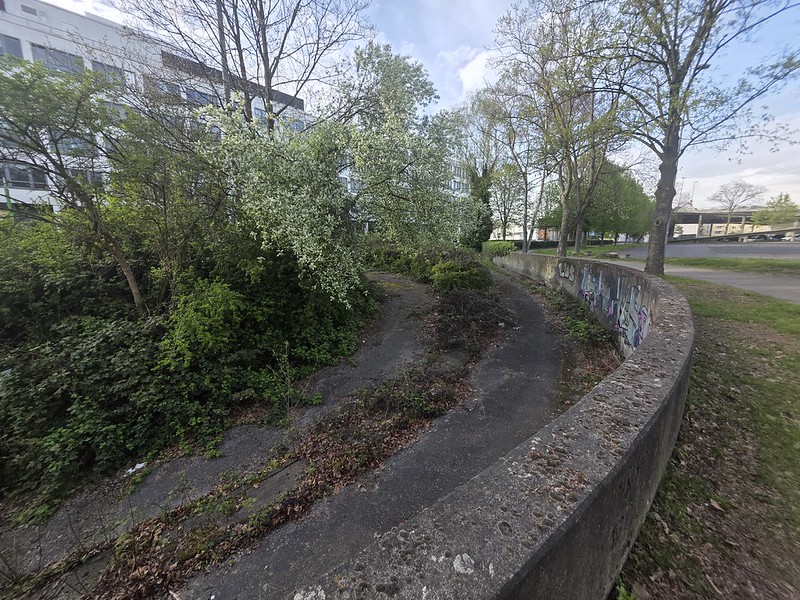
    This is one of my more irrelevant posts, although sometimes I wonder if any are actually relevant, but it’s an abandoned car park in Cologne. I wasn’t brave enough to explore it as I’m hardly going to be an urban explorer, but I like how quickly nature can take over.

    It’s located on Deutz-Mülheimer Strasse and I’m pleased to say that they have closed the entrance from the road off as we all know someone who would otherwise drive down it….

  • Cologne – Ibis Budget Koeln Messe

    Cologne – Ibis Budget Koeln Messe

    My home for three nights was the Accor operated Ibis Budget which was coming in at just over £30 per night which I thought was very reasonable. It’s a short walk from the city centre of around fifteen minutes, so is conveniently located.

    The little shop fridge area near the reception desk. The team member who was checking me in was friendly, although he was chewing gum quite aggressively which added to the whole experience for everyone.

    There’s a bit of an effort to add character to the corridors.

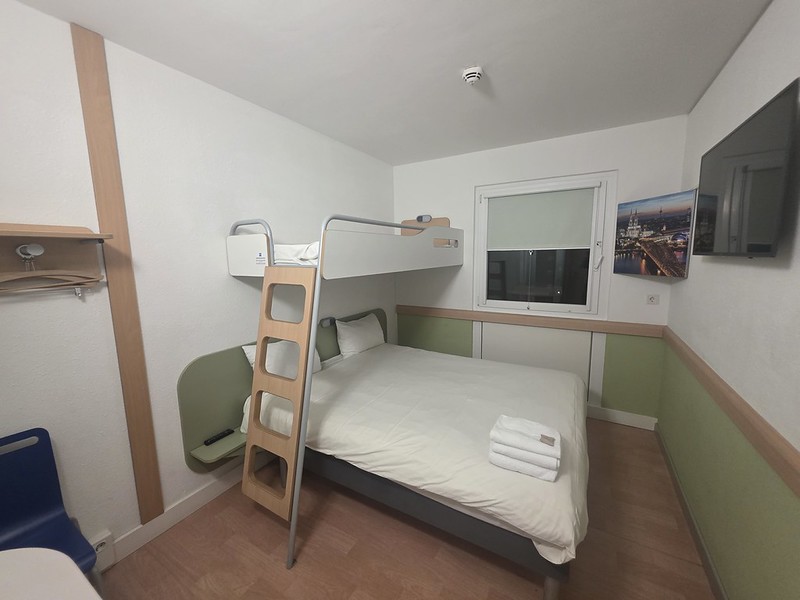
    The room is basic, but it’s cheap, so I’m easily pleased.

    And from the other side of the room. That shower arrangement has been controversial in Ibis Budget hotels for years, but it’s being phased out now and they’re building enclosed bathrooms.

    This is the photo of the city that has been placed over where the television used to be. Not that I ever turn TVs on in a hotel room, but they’ve upgraded the size of the screen.

    Now this I think is brilliant. Very often in Accor hotels they will offer 100 points if you don’t have the room cleaned, which I usually take. However, hotels sometimes forget and have to be reminded and it’s all quite awkward getting the points sometimes.

    Anyway, they take a different approach here, if you don’t have the room cleaned, you get a free drink from the earlier mentioned fridge. I thought this might be a faff to claim, but they pop a little card under the door which is the voucher that guests can claim their drink with. The offer includes all drinks, so I was pleased to get a couple of different beers for free.

    All told, I very much liked this hotel as it felt like decent value for money. There were no noise issues internally or externally, with the team members being friendly and engaging. The online reviews are a little mixed, but they are often people expecting a rather more decadent room than is actually offered. I think the word ‘budget’ might be a clue here…

    One one star review noted:

    “Hardly anyone has a decent level of english…is it because Germany is self-sufficient and is thus not in need of tourists… shame on you”

    Although the team members I encountered here spoke perfect English, there is a level of arrogance in thinking it’s shameful when they don’t.

    “This hotel is right next to another ibis and the staff isn’t trained to guide customers to the right ibis”

    There is a subtle clue that one hotel has an enormous “Ibis” sign and the other one has “Ibis Budget”. It’s not clear how staff are really meant to help customers who go wrong other than point them towards the correct hotel…..

    Anyway, I’d stay here again, although it’s clear that the prices are ramped up considerably when there are trade shows on in the neighbouring buildings and I would be displeased to pay a lot of money to stay here. But when it’s keenly priced, all feels well.

  • Cologne – Rautenstrauch-Joest Museum (Traditional Rooms and General Messaging)

    Cologne – Rautenstrauch-Joest Museum (Traditional Rooms and General Messaging)

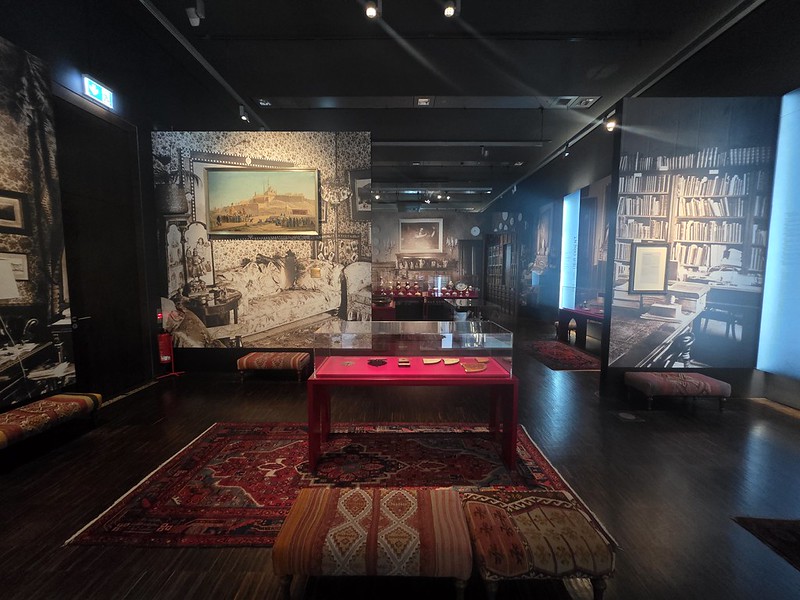
    Without verging too much into the political, the Rautenstrauch-Joest Museum in Cologne is clearly trying to do something serious and in very many ways admirable. It does not want to be an old ethnographic museum that simply places objects in cases and invites visitors to gawp at them as though the wider history of colonialism, collecting and cultural power were of no consequence. That instinct is sensible, and probably necessary. There is a genuine effort to reinterpret the collection, to question how objects arrived in Europe, and to push visitors into thinking about who gets to tell these stories. On paper, that is all rather noble. In practice though the museum perhaps sometimes feels so anxious about the moral framing that it risks becoming slightly stiff and over-managed, as though it no longer quite trusts the objects to speak for themselves.

    For all the language of reinterpretation, there remain plenty of fairly conventional displays of artefacts in cases in the first few rooms, presented in a manner that would not have seemed wildly unfamiliar in a much older museum. That in itself is not a problem and is no doubt deliberate as part of the story that they wish to tell about the evolution of the museum.

    The collection is interesting, although the display labels are not very clear visually, and there is nothing shameful about displaying it properly and giving people the information they came for. But the curatorial voice often seems oddly nervous, almost apologetic, as if the museum is worried that straightforward engagement with the material might be morally suspect unless heavily supervised. The result is perhaps a slightly sub-optimal arrangement in which the institution appears, at moments, to be more comfortable critiquing the existence of its collection than actually helping visitors understand it in a direct and human way.

    Museums do not need to pretend that difficult histories are not difficult, but nor do they perhaps need to turn every gallery into a little seminar in correct opinion. At times it feels less like a place eager to share knowledge and more like one slightly embarrassed by its own holdings.