Just as I thought I had finished my visit to the Royal Air Force museum, I found they had an art gallery section as well. The whole arrangement here is some substantial that I’ll have to visit again to try and see everything that I missed when I visited last week.
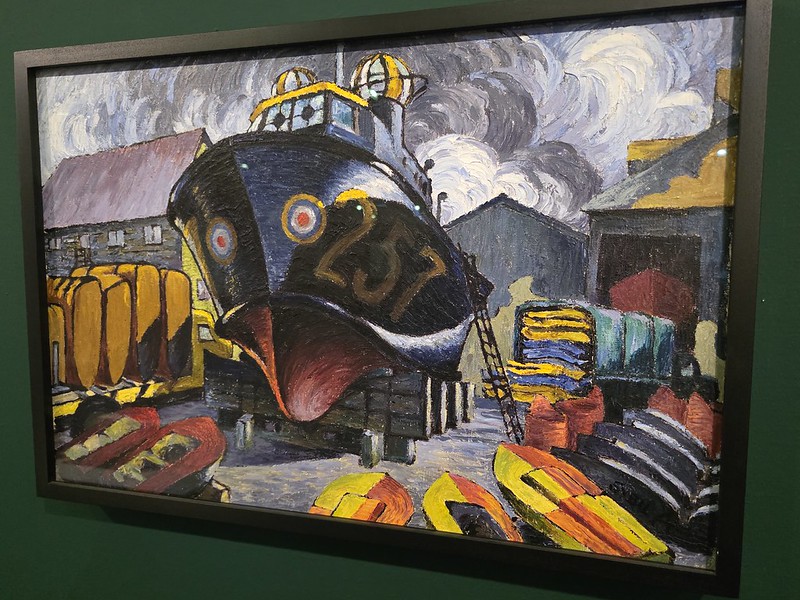
This artwork is by Sybil Andrews (1898-1992) and she painted ‘Air Sea Rescue Launch’ in around 1942, and it is something of a splendid reminder that wartime art was not always interested in giving us handsome fighter pilots staring nobly into the middle distance. There are bold colours and a sense of urgency to the painting, it feels like quite a punchy artwork.
That, really, is the theme that justifies this riveting blog post, which is that the war depended on rescue, repair and the sort of practical work that rarely gets turned into legend. The museum panel notes that this was one of seven paintings Andrews made about boat building while attached to the Camouflage Development and Training Centre at Farnham Castle under the War Artists Advisory Committee, and that she was working for the Royal Air Force as an official war artist. I like it when infrastructure is at the centre, there are enough artworks of moments of great rescue at sea or of battle scenes.
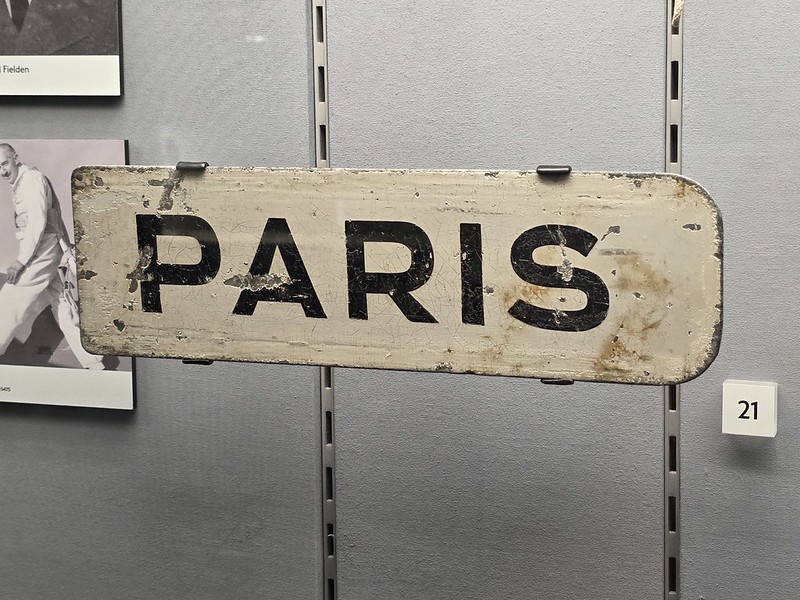
This reversible destination board for Brussels and Paris, dating from around 1937 and once fitted to the steps used for boarding Imperial Airways aircraft at Croydon Airport, is a wonderfully matter of fact relic from the early age of international air travel. That things like this survive at all pleases me greatly, I like the symbolism.
There is something rather pleasing about the simplicity of it with no glowing screens, no urgent gate change announcements, no little electronic dramas and just a solid sign informing passengers that they were off to Paris. Or Brussels. Depending, of course, on which way round somebody had turned it.
I very much like air travel today, but I do wonder just how different it would have been. It would have been a more occasional treat with less security hassle, no worrying about whether bags fitted into the sizer and probably not having to deal with checking in on-line 24 hours before and wondering if the seating Gods had given me a middle seat.
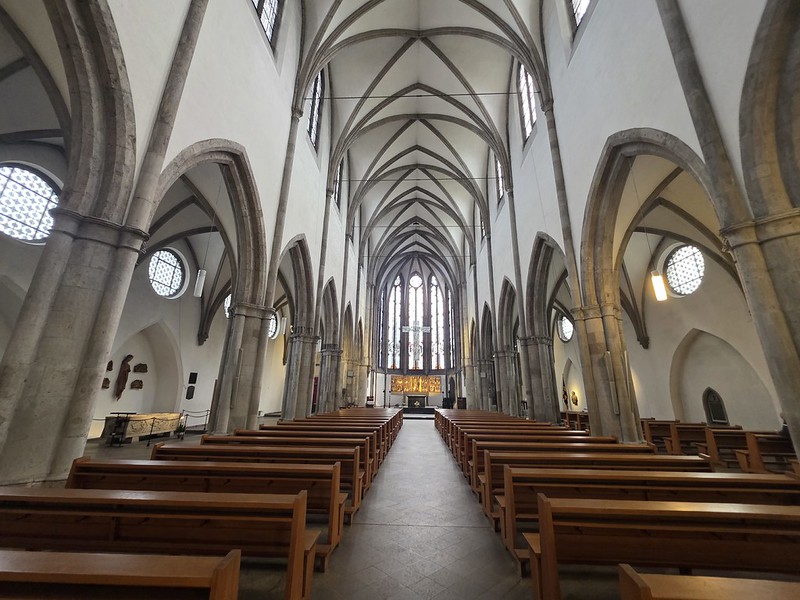
The Minoritekirche in Cologne (St. Mariä Empfängnis in German) might look slightly understated, but it has a long heritage. It was built for the Franciscans, or Minorites, in the thirteenth century which meant some relative architectural restraint, though ‘restraint’ in medieval terms still left room for a very handsome Gothic interior. The Franciscans came to Cologne in the early thirteenth century and their church developed into one of the major mendicant foundations in the city.
After the Franciscans split in 1517, the Cologne house belonged to the Conventual branch and the church was later reshaped in the seventeenth and eighteenth centuries, before suffering badly under French occupation and the secularisation that followed. During this period, the friars were expelled and the building was put to more utilitarian use. It was saved in the 19th century, badly damaged again by bombing in 1942 and then rebuilt after the Second World War.
The nave of the church, which was peaceful and quiet. I had just been to the city’s grand cathedral which was beautiful, but that was anything but quiet. It’s only a short distance away and in 1846, the church was handed over to the cathedral and it was used for confirmations and ordinations.
The chancel and it feels well proportioned and light.
The rather grand altarpiece.
This is the tomb of Duns Scotus (1263-1308), medieval Franciscan philosopher and academic theologian. Known as the “Subtle Doctor”, he specialised in arguments of extraordinary complexity, suggesting a mind that found straightforwardness a rather unappealing little arrangement.
This memorial tablet is an epitaph for Johann Averdunck, a distinguished local legal and administrative figure. The monument is written in Latin and follows the traditional “D.O.M.” (Deo Optimo Maximo) dedication, which translates to ‘To God, the Best and Greatest’.
This is the seventeenth century Latin memorial tablet dedicated to Henricus Francis (Henry Francis), a notable scholar and clergyman.
As a note about just how observant I clearly am, the church also has the tomb of Adolph Kolping (1813-1865) who founded the Kolping Association. He was ordained to the priesthood in this church in 1845, but his father died the previous evening, so that must have been something of an emotional challenge.
I found this to be a rather lovely understated and quiet church, very much a contrast to the cathedral. The building had been knocked about so many times over the centuries that in many ways it feels quite modern, but the heritage is evident in other ways.
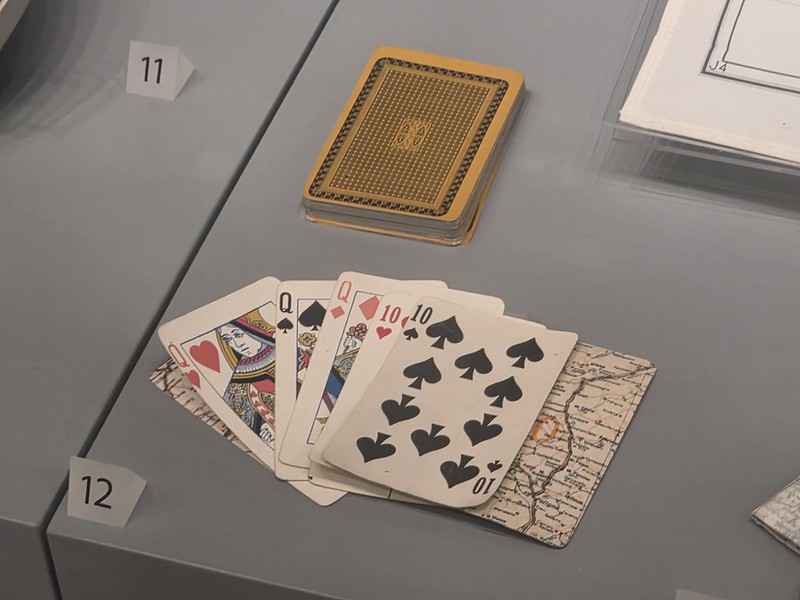
During the Second World War, playing cards were slipped into prisoner of war camps because they looked harmless enough, but hidden inside them were escape maps, allowing captured airmen and soldiers to peel apart the layers and reveal useful geography once the card game was over.
I do wonder how opposing military authorities failed to spot this little arrangement, especially given that wartime censors were not always generally known for their relaxed attitude to suspicious parcels. Perhaps the cards looked too banal to deserve much scrutiny, or perhaps someone simply saw a pack of them and thought that prisoners deserved at least one modest pleasure before returning to the business of attempted escape.
Either way, I like the ingenuity and the museum thinks that these were produced around 1943. The International Spy Museum in the United States notes:
“To date, decks of these cards are said to have helped at least 32 people escape from Colditz Castle and prompted some 316 escape attempts.”
There were some very careless military authorities amongst the German troops letting this lot through.
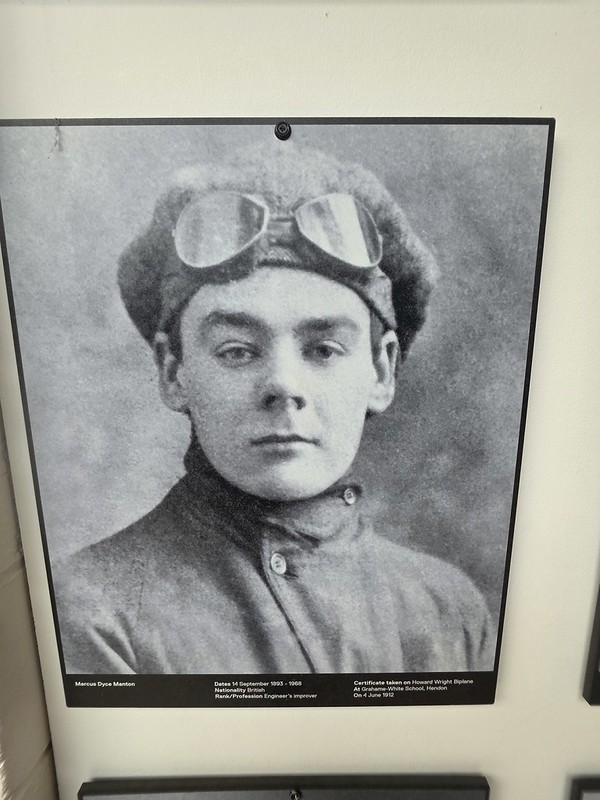
This is one of the photos on display at the Royal Air Force museum and it’s in the section which honours those who received a Royal Aero Club Aviator Certificate. To achieve this, the pilot had to complete two 5km flights and one 50m altitude flight.
In the photo is Marcus Dyce Manton (1893-1968) who was born in Sheffield on 14 September 1893. He obtained his Aviator Certificate on 4 June 1912 and I have to comment on just how brave that must have been. It’s all very easy on a scheduled Wizz Air flight to find flying really quite interesting, it was slightly less decadent in 1912 and the risks were real and high. He obtained the nickname of the ‘Boy Looper’ and completed hundreds of ‘loop the loops’ which excited and delighted many at air shows. This all seems like a rather unusual relationship with danger as early aircraft did have that sub-optimal habit of falling out of the sky.
It was no surprise that Manton was an important part of what was then known as the Royal Naval Air Service, being appointed as the Head Pilot Instructor at Hendon (where the museum is now based) at the start of the First World War. Until 1918, there were separate divisions which were the Royal Naval Air Service, which was the air arm of the Royal Navy, and the Royal Flying Corps, which were part of the Royal Army.
After the end of the First World War, he worked as a test pilot for Samuel White and English Electric, later becoming involved in gliding through the London Gliding Club. During the Second World War he served with Armstrong Whitworth as a Service Liaison Officer, and afterwards worked with Hawker Siddeley. Manton managed to get a fine in 1941 for not having a current driving licence which seems an omission for someone who had a licence to fly aircraft.
Manton died in April 1968 in Dorset, having seen aviation progress from fragile early contraptions to the jet age, something which must have given him endless excitement over the decades. His son, Graham Ashley Leonard Manton (1910-2005), also became something of a hero in the air force during the Second World War.
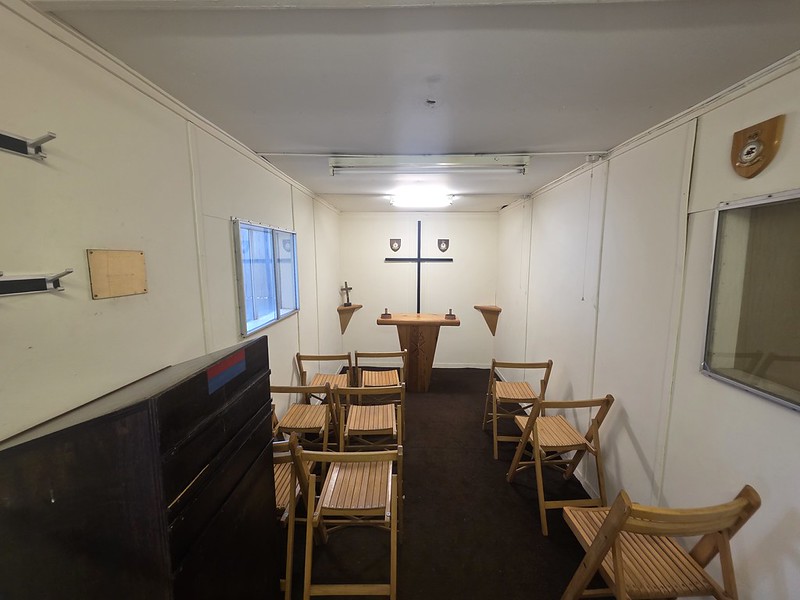
This is quite a powerful exhibit, it’s the chapel that was at RAF Stanley in the Falkland Islands. Initially a tent had been used as the chapel, but the General Engineering Flight converted this shipping container to create something more appropriate by adding a door and two windows.
Inside the chapel, with the altar made out of wood off-cuts and spent shell cases.
Badges.
The chapel was dedicated by the Rev. Philip Sladen (?-2003) on 27 July 1983 and it remained open on the islands until 1986. It was then returned to the UK and has now been moved to this museum.
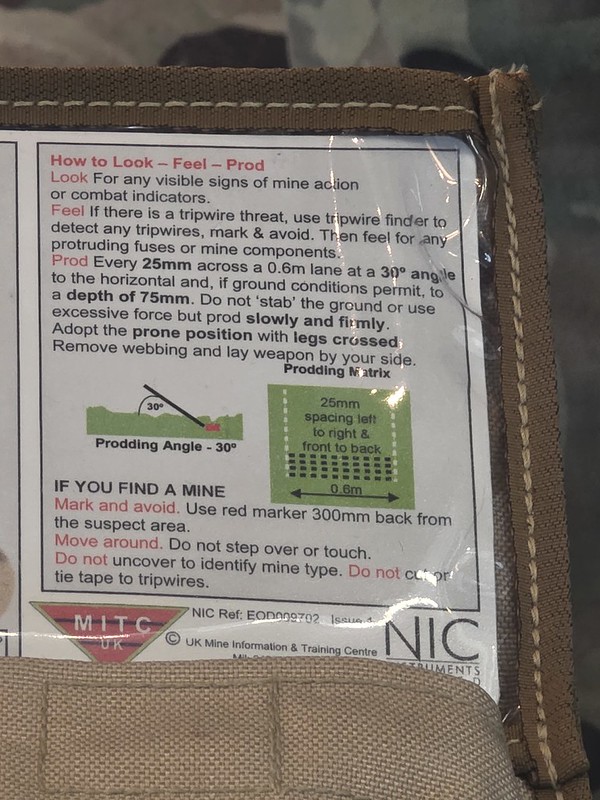
This is what the Royal Air Force museum calls a personal mine extraction kit. It’s a little collection of objects to ensure that lives can be saved by finding landmines, all something of a contrast to the large bits of military aircraft located nearby.
These are the instructions and I have to note that using these little bits of stainless steel prods to try and find land mines sounds like a sub-optimal way to spend an evening. I get annoyed at cryptic crosswords, so I can’t imagine the amount of patience and bravery must be involved to be crawling about in the sand somewhere trying to prod for mines.
I liked that the museum had made these little notes visible that were an aide memoir into the use of the kit, it made it seem really rather more real.
I’ve been meaning to visit this museum for a little while after having seen it from the train when travelling between Luton and London. The museum is free of charge and asks visitors to register online, but I don’t think it’s essential.
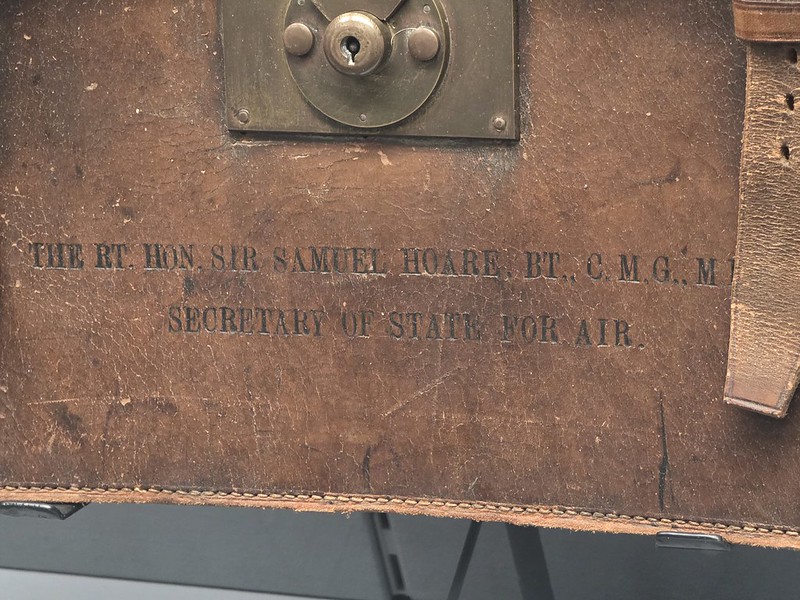
This exhibit is a briefcase from the 1920s that was owned by Sir Samuel Hoare, the 1st Viscount Templewood (1880-1959), who was a pivotal figure in the development of British civil and military aviation during the interwar period. Serving as the Secretary of State for Air on three separate occasions throughout the 1920s, he became a tireless advocate for the ‘imperial air routes’ that sought to connect the distant corners of the British Empire. Hoare was not merely a desk-bound administrator; he famously took to the skies himself, embarking on a landmark 10,000 mile flight to India in 1927 alongside his wife to demonstrate the safety and potential of long-distance air travel. In reality, at this time, air travel wasn’t entirely safe, but it was certainly right to make others aware of the potential.
In a different world, Hoare could have easily become Prime Minister and he remained one of the most important and influential Cabinet Ministers in the late 1930s and early 1940s. Unfortunately for him, Churchill didn’t like him and threw him out of Government when he became the wartime Prime Minister.
Hoare was one of the most important Ministers during the twentieth century in terms of the evolution of air travel. I like exhibits such as this as they’re a personal connection to a very different time during history and it’s something of a contrast to the huge bits of aircraft that are dotted around the rest of the museum.
[Apologies I published this early if anyone saw a half finished post!]
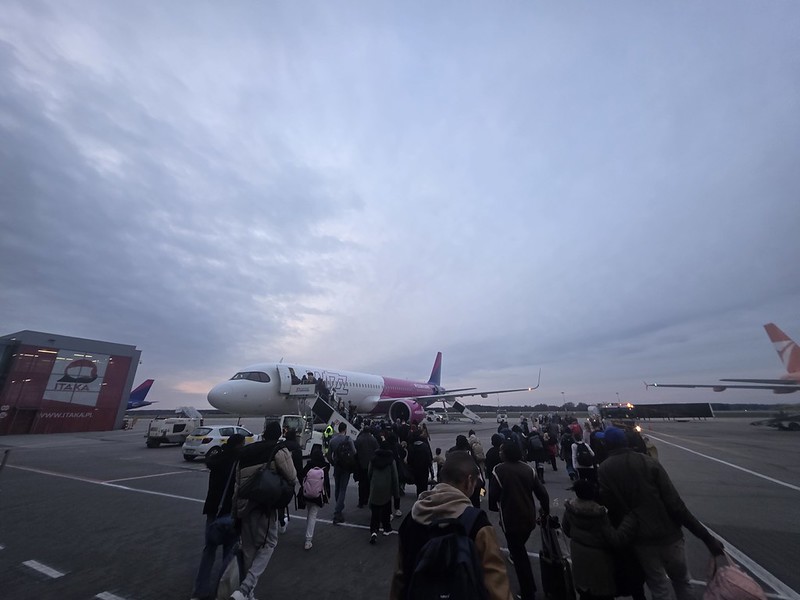
I was connecting at Katowice Airport to fly to London Luton, although there was no airside connection available. I also discovered that the security area at Terminal A wasn’t open for thirty more minutes, so the process was hardly rushed.
Mine was the 19:45 flight and I had the advantage of popping to the airport lounge, but I wrote about that separately.
The boarding process was all efficient, but there was a particular focus on checking bag sizes on this flight. The lady was walking down the queue and she spoke to me briefly before telling me that my bag was fine, but a fair few were being stopped and charged extra money. One guy was charged four times for his family, so around £320, so it was a profitable exercise for Wizz Air. Although, the rules are very clear, so the customers took a risk.
This lady was charged £80, she might have been a little unlucky. It’s fair to say that she wasn’t very pleased and she asked a couple of us whether we’d been charged as well.
The aircraft is 9H-WAD, yet another one that I haven’t been on before and this has been part of the Wizz Air fleet since 2022.
Everything was smooth and well managed yet again, although the seating Gods had given me a middle seat which wasn’t ideal. However, the flight was only two hours so it’s hardly traumatic. The flight cost the usual £8.99 with my Multipass and the aircraft was clean, the crew were friendly and everything worked as it should.
We landed into London Luton on time and I had a hotel just a short walk away from the airport, which is always something that I look forward to. This marked the end of my one week stay in Poland, Romania and Germany, another successful trip that was made a lot easier with my cheap Wizz Air flights.
With around three and a half hours before my flight from Katowice to London Luton, I thought I’d see how busy the lounge was. Fortunately I was flying on a non-Schengen flight departing from Terminal A, as the lounge at Terminal B has now stopped accepting Priority Pass. I hadn’t realised I had been to this lounge before, but it seems that I came here in 2019. I am a creature of habit sometimes.
There was a friendly welcome from the team member at the reception desk and it was evident that there weren’t any capacity issues as I was the only customer in the lounge. Indeed, that was the situation for nearly two more hours. That gave me a choice of seats, so I sat near the runway to look out. I’m easily pleased.
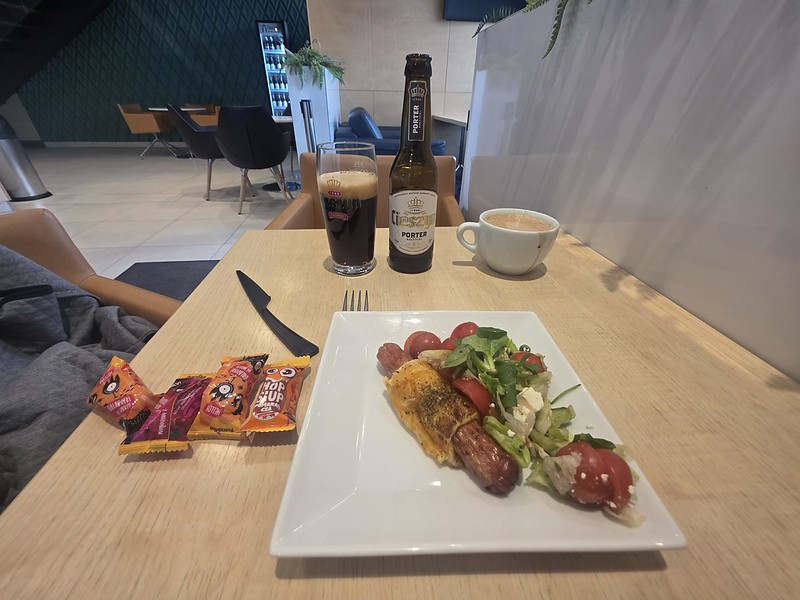
This was the limit of the food (other than for some yoghurts and sausage rolls) and the Caesar salad on the right didn’t look entirely fresh, but the Greek salad was entirely acceptable. And those jelly sweets on the left, let’s just say that the team member in the lounge had to refill those.
I was impressed at the beer fridge with five different local options from the Cieszyn brewery, which is the longest continually operated set-up in the country. I tried a couple of the beers and it’s a shame that more UK airports don’t offer a local beer, even if they can’t manage five of them.
This wasn’t a bad set-up, there was a decadent 9% beer, coffee, salad, sausages with insufficient pastry and jelly sweets. This pleased me…. And there were also plenty of power points in the lounge which was handy.
The facilities were a little limited with just one toilet, but when you’re the only person in the lounge, that proves to be less of a challenge. I’m not sure that it would be worth paying full price for, unless you wanted to drink several beers, but I found it a useful resting and working place for the few hours that I was in there.