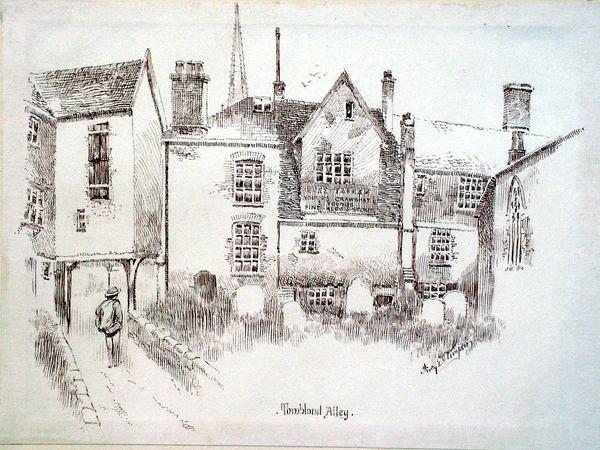
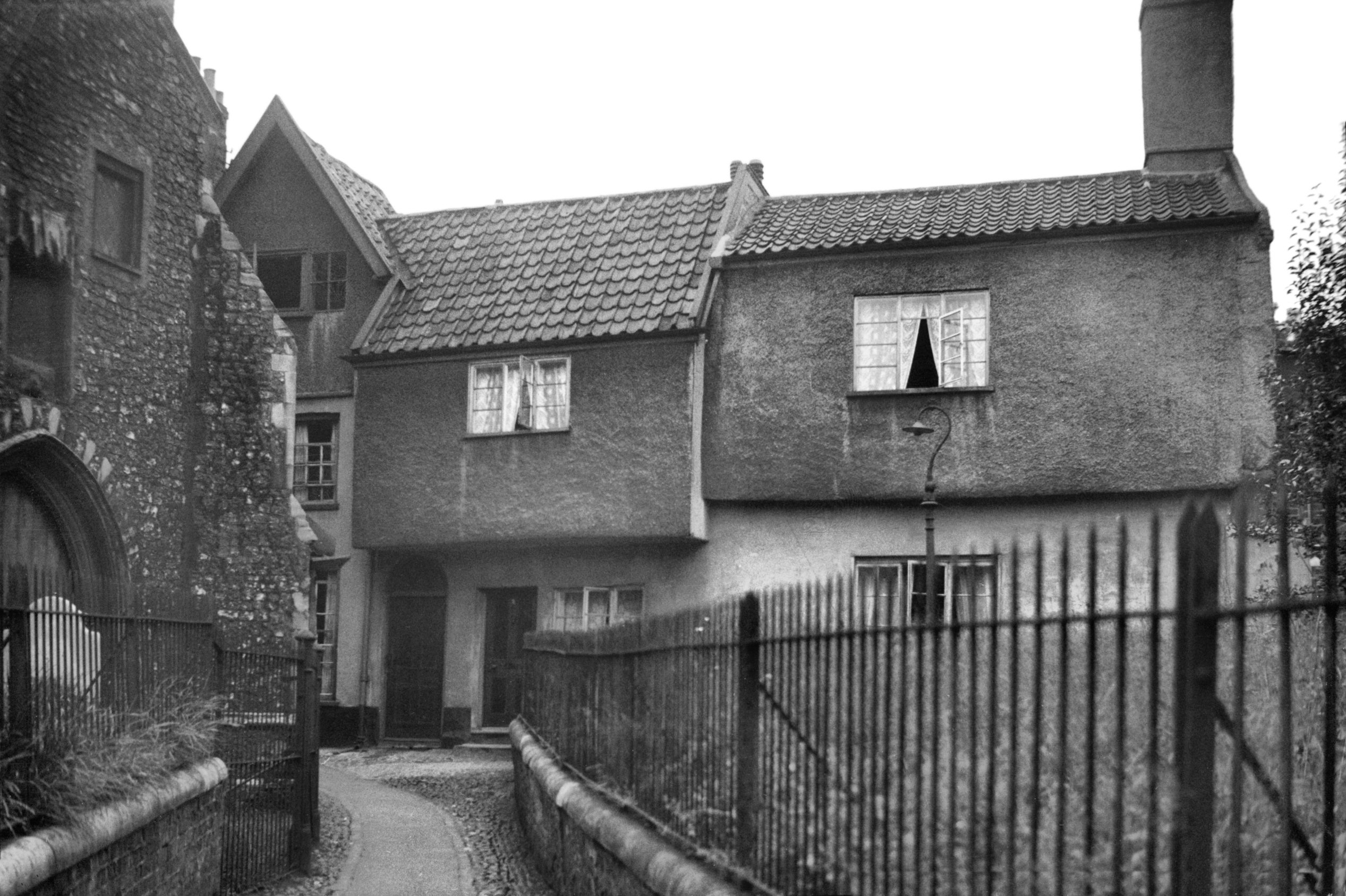
This is how Tombland Alley looks today, an alley that runs behind St. George Tombland and comes out opposite the Erpingham Gate. The areas of raised ground is where the burials took place and they were once more contained than they are now with railings, some evident in the photo taken by the late great George Plunkett in 1936.
This image is from Percy Stimpson (1880-1948) and so would date to around the 1920 or 1930 period. The iron railings that were removed during the Second World War for scrap iron are still visible, and I think interestingly, so are numerous gravestones. It’s not quite clear to me when these might have been removed, but it appears to have been around the 1950s or 1960s.
This post is more about the history of the Louis Marchesi pub, but here’s a photo of a beer that I’ve had at the pub whilst on an ale trail…..
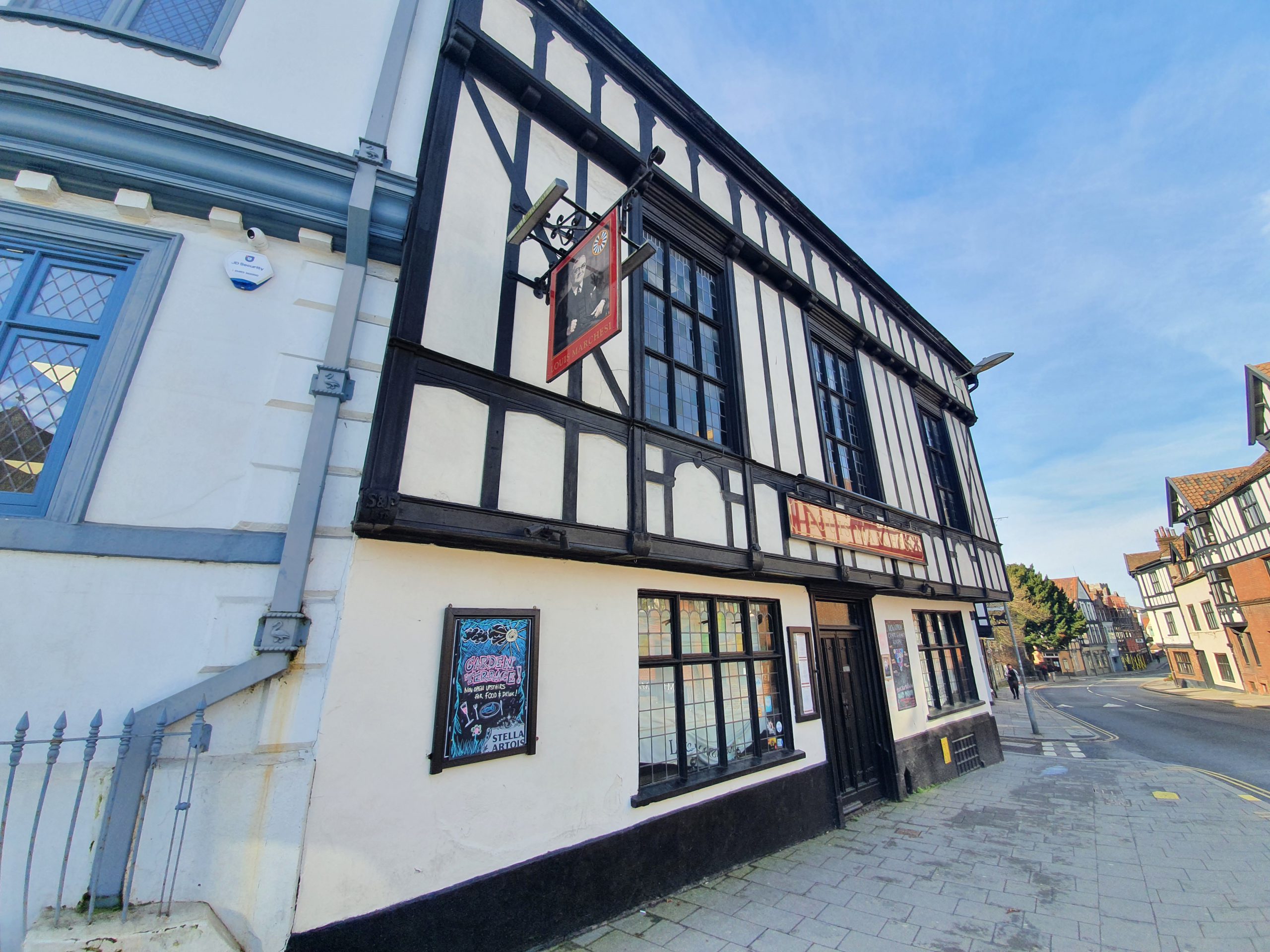
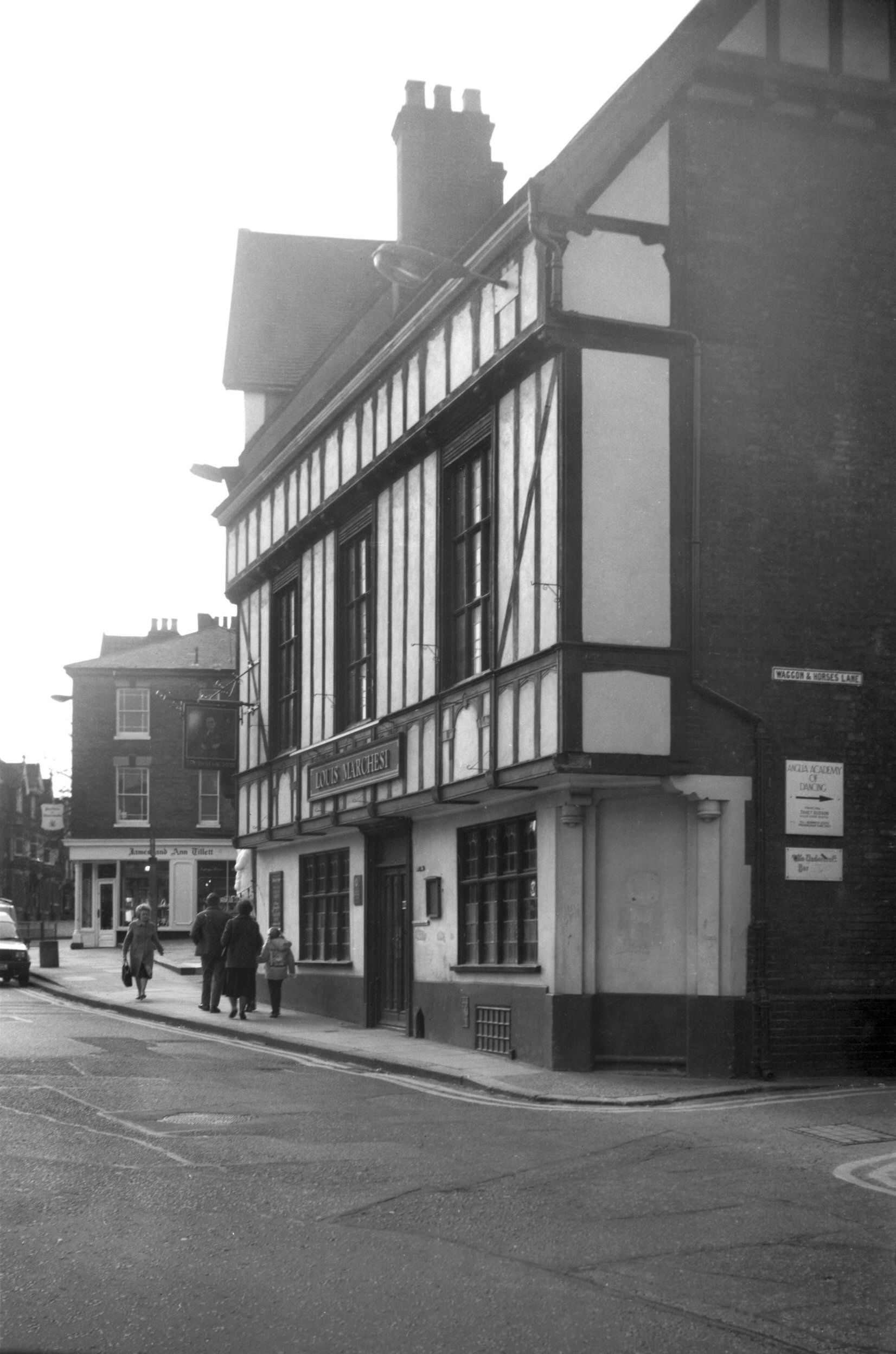
The pub has for most of its licensed life been known as the Waggon and Horses, with the adjoining road still having that name. It became a licensed premises at some point in the early 1780s and became a pub owned by the brewery Steward, Patteson & Steward. The timber frontage is not original, that came at the beginning of the early twentieth century in an attempt to make it look Tudor with a similar thing happening to the Maid’s Head located over the road.
It wasn’t though built to be a licensed premises, there was a fifteenth century residential property here and the undercroft of that building is still present. Although the Tudor frontage and the roof might be twentieth century, the timber frame of the structure is also fifteenth century, although much changed over the centuries.
Although Tombland, which the pub faces onto, might not have changed much, the adjoining Waggon and Horses Lane has a different character today. To the disappointment of the sanitary committee, a second slaughter house licence was granted to a property owner in the late 1880s.
It later became a pub operated by Watney Mann in the 1960s and in 1975 it was renamed as the Louis Marchesi. Erminio William Louis Marchesi (1898-1968) was a local Norwich man who founded the Round Table, designed to be a younger version of the Rotary Club. The late great George Plunkett doesn’t have an older photo of the pub, but he has one from 1989.
Going back to some previous licencees, Daniel Fiddymont was the landlord between 1822 and 1830, but there was a tragedy in 1829 when his wife died. That meant that he was left running a pub with five young children, it’s perhaps not a surprise that he remained at the venue for only a few more months.
There was another tragedy in July 1831, when the new landlord Henry Morris died at the age of 46, leaving a wife and ten children. His widow looked after the pub for a few months until it no doubt became unsustainable and the brewery advertised for a new landlord. Henry had been a brewer for the Steward, Patteson & Steward brewery for over twenty years. Every morning at 06:00 he served purl, which was a warm ale served often mixed with gin and milk, with soups available for lunch.
Taking over in October 1831, John Bushell advertised in the Norwich Mercury that he had taken on the inn, which suggests that it did provide accommodation of some sorts. He noted that he had London porter and fine ales on draught, alongside a similar bottled selection. He remained the landlord of the pub until his death in 1839.
In 1851, the pub was once again advertised to let and in the newspaper the brewery mentioned that it was “doing a good trade and has accommodation for fifty horses” and there remains a large yard at the back of the venue today.
Probably to the annoyance of the landlord, in 1925 the pub was refused a renewal of their Saturday afternoon licence as the police said that they had found that it had been “badly conducted” when they visited. The pub’s representative complained and the magistrate suggested that they seek legal advice, which must have felt sub-optimal to the venue at the time. This meant that they lost their ability to open between 15:00 and 17:30 which were compulsory closing periods at the time.
More recently, in 2004 the pub became more of a cafe bar arrangement and took the name ‘Take Five’ which felt sub-optimal from a historical perspective, but since 2017 it has now once again become a pub and retaken the Louis Marchesi name.
Today, the pub offers around four real ales and from my experience they’re usually from local breweries. The undercroft and private room upstairs can both be booked for private events, but I don’t think that they’re routinely open for the public. I do prefer when pubs keep their original names, but at least it has the Louis Marchesi one back now….
This year, I took considerably more photos than I ever had chance to write about, so to surprise and delight just about no-one other than myself, there will now follow a few end of year things that I feel I should have written about so I don’t forget them.
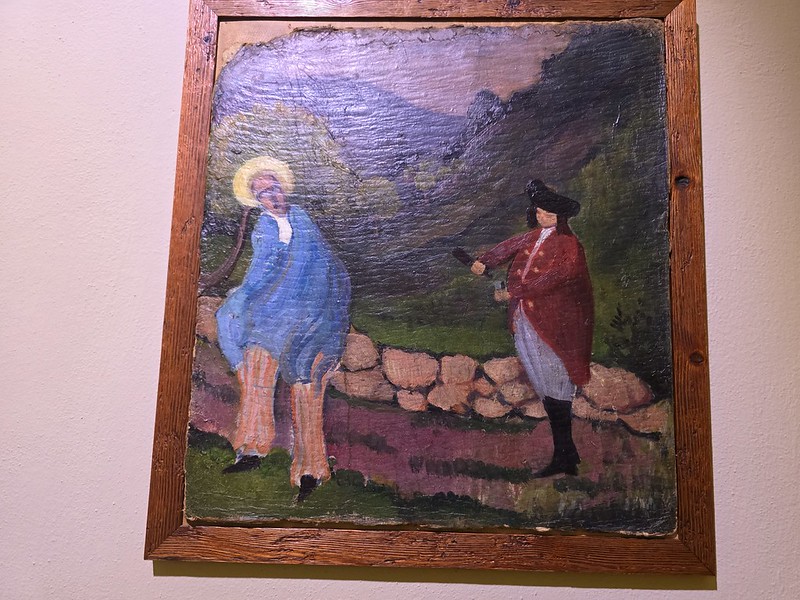
This painting is by Stanisław Ignacy Witkiewicz (1885-1939) who is an intriguing character as he seems to have decided that merely being a painter, playwright, novelist, philosopher and photographer was far too sensible, and so set about turning his entire life into a sort of extended, slightly unhinged performance piece. He ran a formalised “Portrait Painting Firm” with price lists that varied depending on which drugs he was on at the time, annotated his works with cryptic notes about nicotine, peyote or existential despair, and wrote plays so strange that even other avant-gardists occasionally backed away slowly. In the end, he committed suicide shortly after Germany invaded his home country of Poland and it was perhaps fortunate that he didn’t see the destruction of so much of his country.
Back to the artwork, which he painted in 1912, it’s just called “Costume Scene in a Landscape” which doesn’t help with any meaning which the artist intended. I can’t work out what I’m actually looking at, which certainly adds some complexity to arrangements. Is the character on the left wearing an interesting hat or is that a halo? And what is the meaning between the two characters?
But, what reassures me is that the artist was known for trying to engender “the strangeness of existence” in the viewer, where it isn’t possible to establish what reality he was looking for. I’ve decided that’s all the meaning I need…..
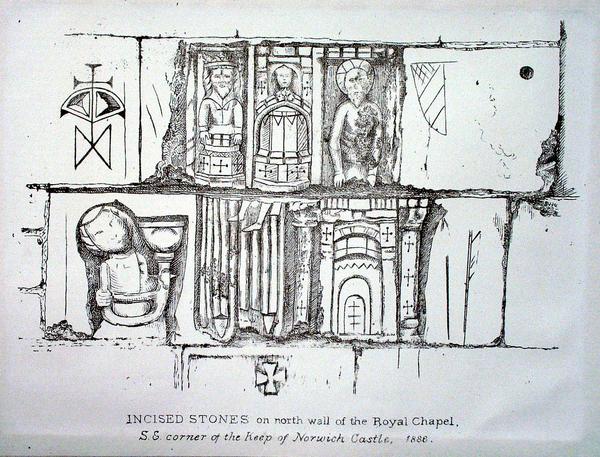
I’m getting a bit niche now, so this is my last post about the Castle for a few days….. I posted about these stone inscriptions a few days ago.
I’ve just found this image drawn by Cornelius Jansson Walter Winter (1817-1891) in 1888. The castle ceased to be the city’s prison in 1887 and this image would have been done as part of the work for the new castle museum.
What I’m impressed by is that nearly 150 years later, the stonework is still in nearly the same condition as it was then. Although, there’s one exception and that’s in the top photo there’s a chunk of ironwork on the right hand side of the image and part of the stone above appears to have been removed. I should probably not be too worried about the removal of a piece of stone, but I’m intrigued.
The layout of the Castle Keep now, with the floor added back in, is pretty much exactly as they had it in this leaflet. This leaflet is slightly less useful as it was as lots has changed, but I think it’s a useful reminder of seeing it as it was.
This is a memorial brass which was on the tomb to John Stalon, a tanner in Norwich, who died on 10 October 1463.
“Orate p aia johis stalon quoda civis norwici barkere qui obiit x die mens october A dm m cccc lxiii ciu Aie ppicient dei”
The museum notes reads the above, which they translate as:
“Pray for the soul of John Stalon, formerly a citizen of Norwich, a tanner, who died on the tenth day of the month of October in the year of our Lord 1463, on whose soul may God look with favour.”
It was formerly in St. Swithin’s Church, which is now redundant. I haven’t written much about this church before, but it’s one of many on St. Benedict’s Street and it was already falling into disrepair in the Victorian period, so its future was never very secure although it did have a new and brief lease of life in the early twentieth century as a church. The Victorians took the tower down before it collapsed of its own accord and here’s what it looked like in the 1880s.
The church is now used by Norwich Arts Centre who mention on their website:
“Happily secure in its new 14th century flint building the venue went from strength to strength pulling in the best new music, comedy and performance names on the scene. Amongst those who have appeared are Nirvana, Oasis, Muse, Coldplay, Kasabian and The Manic Street Preachers during the 80’s and 90’s.”
That’s quite a collection of artists as even I’ve heard of them…. Back to the memorial brass, which came into the collections of Norfolk Museums Service in 1963, handily exactly 500 years after John Stalon’s death. Quite where this memorial brass was over the centuries I don’t know, although it was quite possibly at the church where it avoided being pinched.
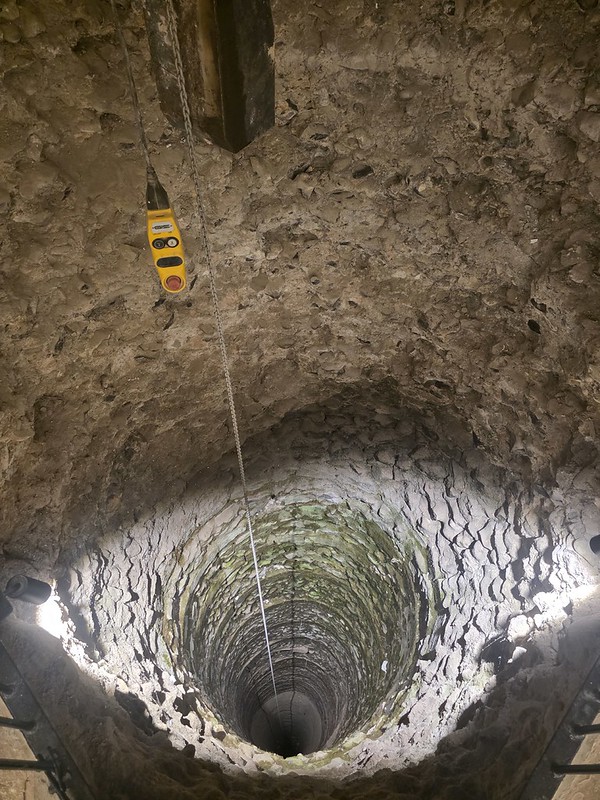
I’ve been to Norwich Castle Museum again and that means I need to correct something…. I mentioned in my post about the well in the castle that it’s now covered and kids (or anyone else for that matter) can’t throw coins down it.
It has transpired that it is still possible to access the well by going to a lower floor, although they don’t seem to encourage anyone to throw things in it, but I think that’s more than understandable. There are though some coins at the bottom, but I decided not to try and take a zoomed in photo of them for fear of dropping my phone. It’s a long way down there and I’m neither sure that my phone would survive the fall, nor that the museum staff would give its retrieval the same priority as I would.
The stonework in the well and there’s an automatic winch thing now, something the medieval workers would have likely quite enjoyed rather than doing all that winding by hand.
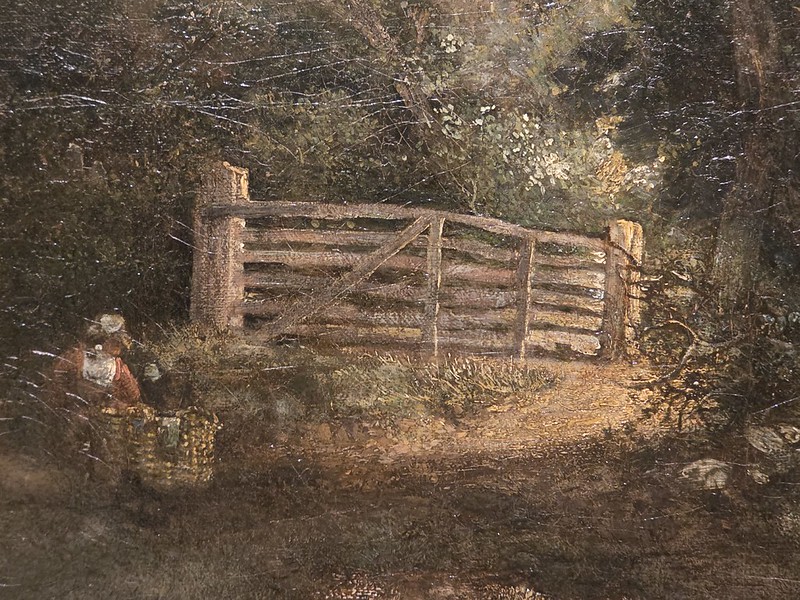
It’s a gate, but this is a rather lovely painting by John Crome (1768-1821) and the museum notes that it’s potentially the “quintessential Crome painting”, with a peaceful feel to the whole arrangement. It dates from around 1810 and it was donated by Russell James Colman (1861–1946) as part of his legacy to the museum. The artwork is known as either ‘The Gate’ or the ‘Norgate Crome’, but I prefer the former as I like simplistic.
As someone who likes walking, there’s a certain charm in paintings of gates, muddy paths, fences, stiles and clumps of trees. There’s a permanence to this, as although the scene could be anywhere, there’s a good chance that it looks pretty similar today. Well, unless Crome has selected a gate that’s now under a housing estate, but I think a more romantic frame of mind is probably useful here.
Artworks of nothing much at all can sometimes be really rather intriguing, the figure in the painting is almost irrelevant and the viewer (perhaps not the most appropriate word there) has no idea what is beyond that gate. But, travel is about never knowing what is around the next corner, so that fits in well.
One real advantage about the traditional elements of the collection at Norwich Castle Museum is that they’ve got an excellent depth of information on their website about the exhibits. All of the new exhibits in the Castle Keep are devoid of reference numbers, which makes matters much more complex in trying to find the item in the online collection. This is an x-ray of the artwork and although it might not tell me very much, I really quite like looking here at the nails at the edge of the painting. I should probably get out more….
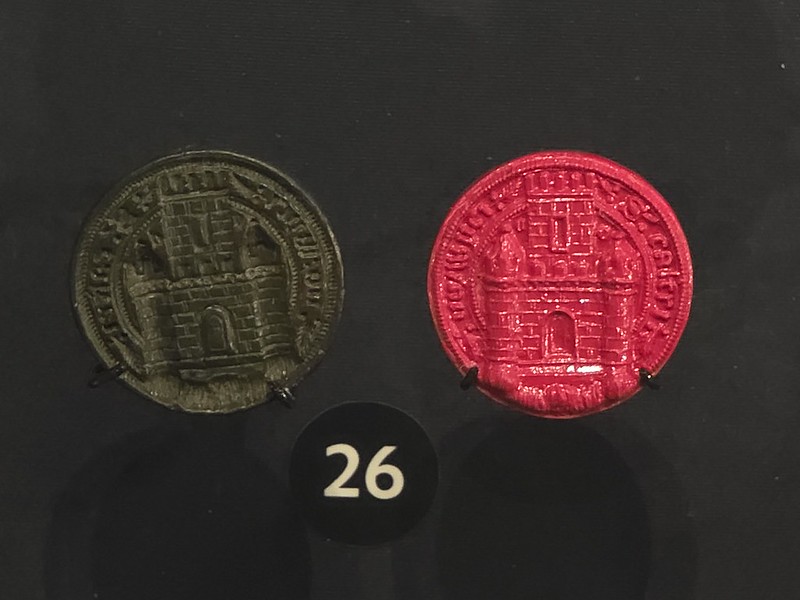
This might only be a very small exhibit, but it’s the seal from Norwich Castle itself. It’s dated from between 1400 and 1500 and was found in the village of Wereham in Norfolk, which is located near to Downham Market. It was discovered in 1952 and was transferred to the collections of Norfolk Museums Service.
Written on the seal is “S’CASTRI NORWYCI” which breaks down to:
S’ is an abbreviation for Sigillum, meaning “seal”
CASTRI means “of the castle”
NORWYCI / NORWICI means “of Norwich”
Quite what this was doing in a field in Wereham is a mystery, one which isn’t likely to ever be solved…. It’s a rather lovely piece of castle history though.
I wrote a couple of weeks ago about the debacle at Sheringham Bus Shelter and the chaos caused by Norfolk County Council. It’s hard not to feel slightly sorry for Graham Plant, the Cabinet member responsible, he didn’t come to Sheringham to explain what had happened, he refused to appear on social media and he refused TV appearances, all leading to international coverage of the situation, including input from Keir Starmer, the Prime Minister, Heidi Alexander, the Secretary of State for Transport, and Have I Got News For You. This was meant to be something that Norfolk County Council could deliver for the people of Sheringham, not find themselves a laughing stock.
In a meeting of Norfolk County Council, he said that the bus stop would now have to be shut as it was too near the pavement. However, he neatly blamed Sanders for this, saying they had said it was dangerous.
The bus shelter is safe, although Norfolk County Council appears to have lost the bench. Well, who needs to sit down anyway?
It’s a nice mural, it’s always positive to have an image of a train in a bus shelter. It’s still not clear to me why this bus shelter needed to be demolished, it could have been decommissioned in favour of the new one that would have likely pleased most people.
There was a nice green area here before with benches, but this is what Norfolk County Council has left. The site for the new bus shelter is visible at the rear on the right.
Some of those are memorial benches that are in memory of local people, they are no doubt important to family members and friends. That Norfolk County Council believes this is entirely acceptable is fairly shameful in my humble opinion. It could be argued by the council that it’s not their fault, but the Prime Minister encouraged them to get on with finishing the project in a way that pleased residents. They’ve decided that they will reject the views of the Prime Minister and the Secretary of State for Transport, which seems brave to say the least.
What a lovely gift to Sheringham Town Council this is.
It would have been relatively easy to complete the project whilst keeping the old bus shelter, but Norfolk County Council decided on this as the resolution. I deliberately don’t engage too openly in politics on this blog, but this might haunt the Conservative Party at future elections.