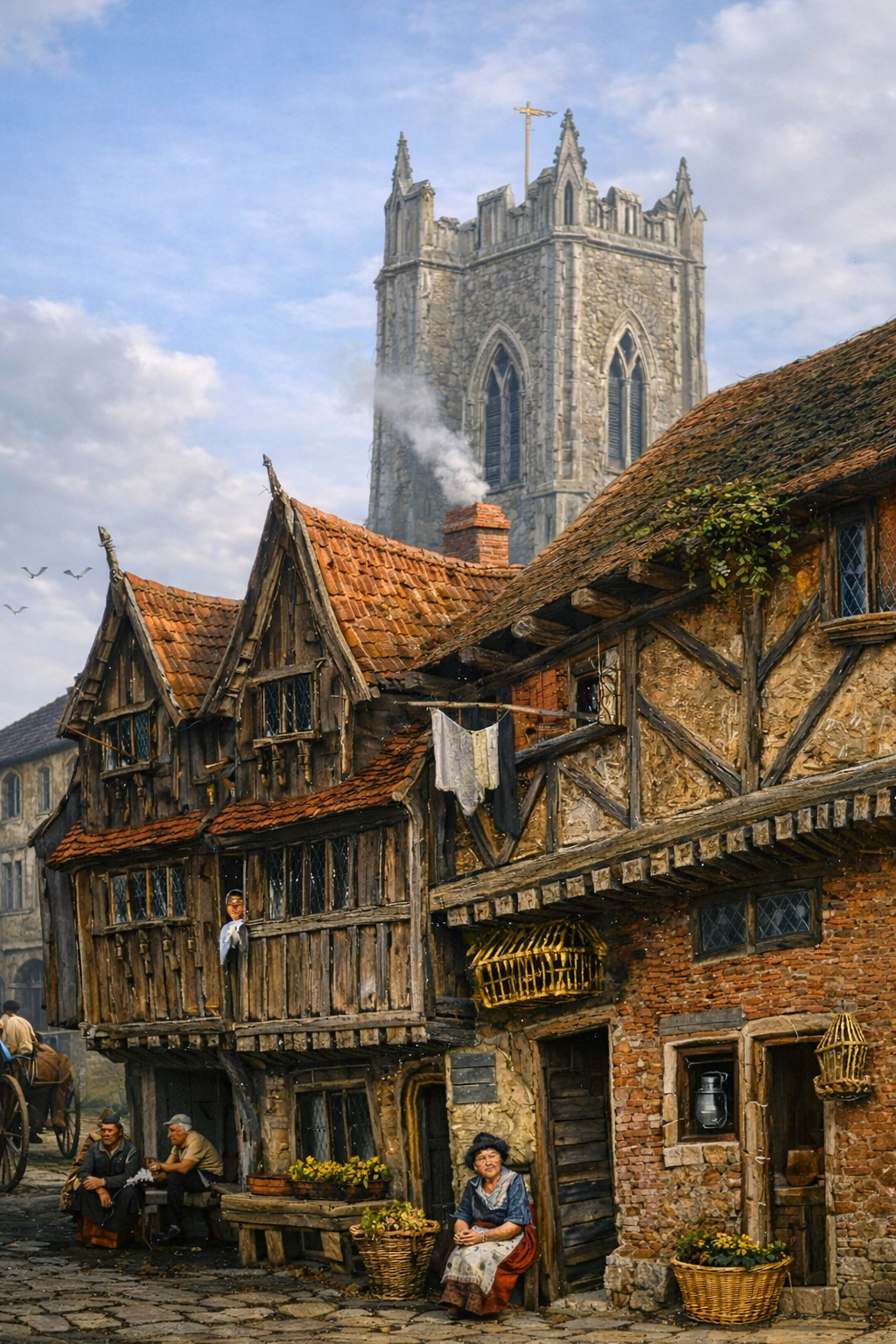
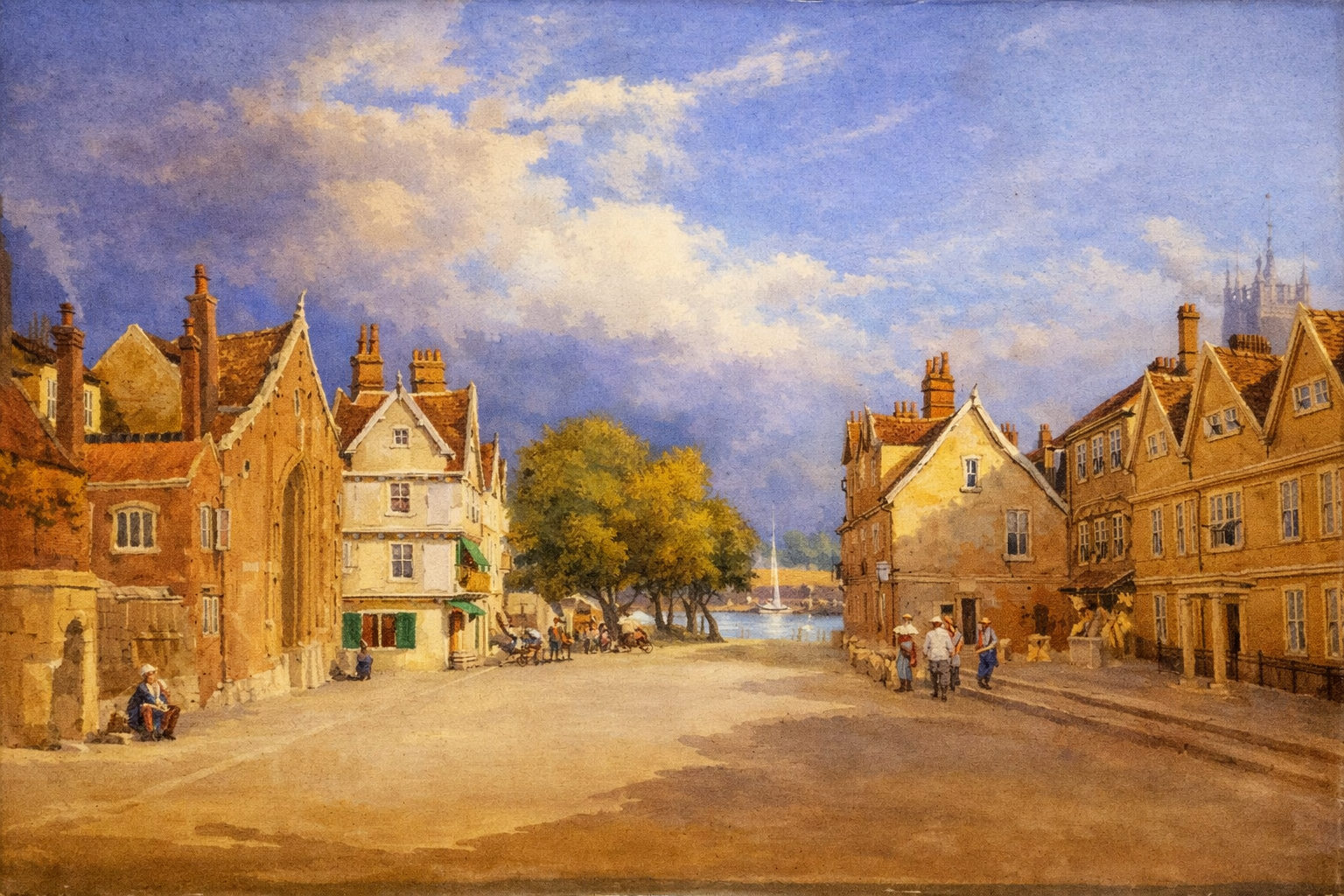
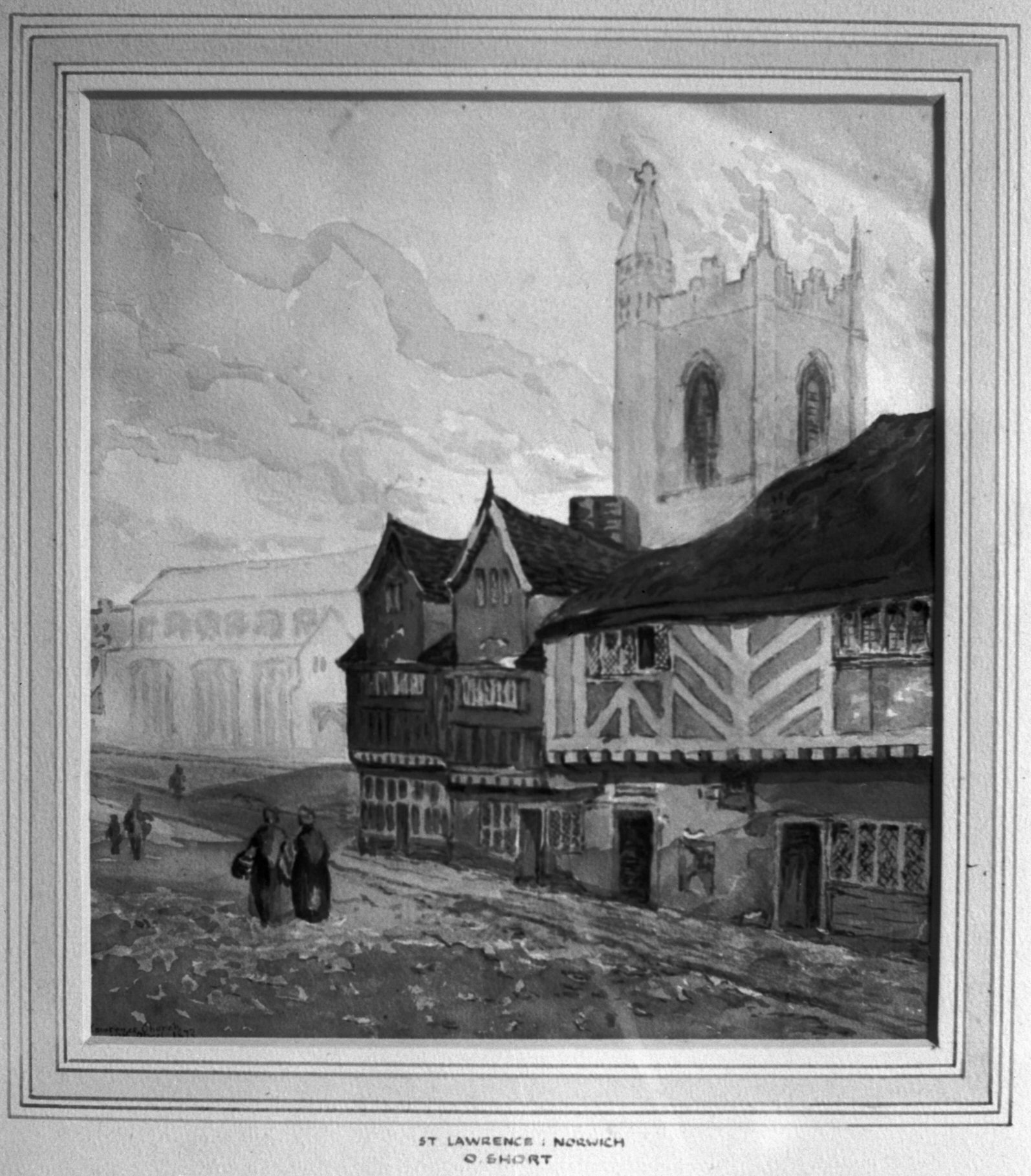
This artwork is of St. Laurence’s Church in Norwich and was painted by David Hodgson (1798-1864) in 1863. This is one of the churches that was nearly demolished in the 1960s and I made reference to that when wittering on about a defaced statue found there. This artwork would have been painted from Westwick Street, but that area has changed too much to be able to put up a before and after photo. George Plunkett does though link to a watercolour which was painted in a similar place.
As usual, I’ve had AI try and bring back some of the original colours to the painting. Quaint as the building might look, it’s not entirely clear to me that it was actually structurally sound and pleasant inside.
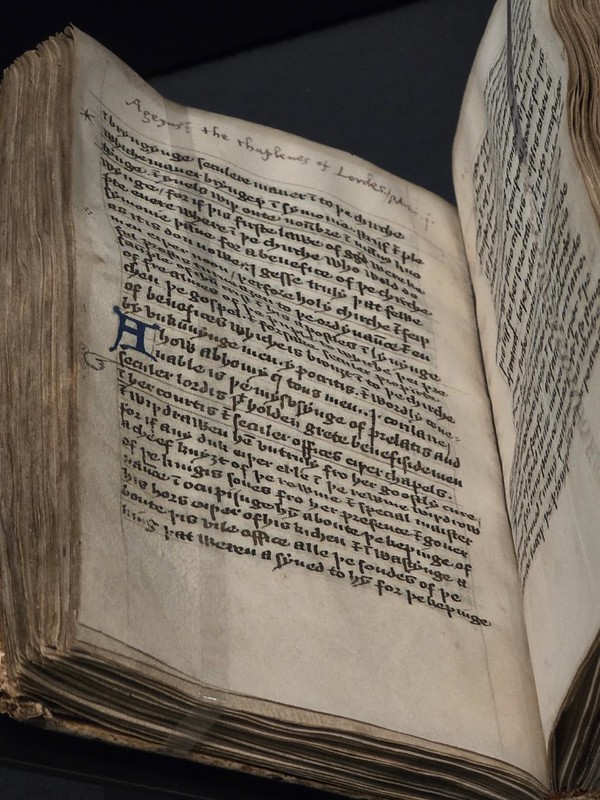
Friends of mine know that I like books, especially when they come in their thousands at a time, but this is a rather special one published at some stage in the 1400s. I say published, but perhaps more written laboriously out might be more appropriate.
I let ChatGPT have a go at transcribing this and it didn’t cope with it. However, Google Gemini had a lovely time with it, describing it as text by John Wycliffe (c.1328-1384) that was likely published in the fifteenth century. I know this is correct as the museum stated that it is a book of tracts by John Wycliffe and was published between 1400 and 1500.
Google Gemini goes further and notes that the general thrust of this is that “it critiques those who hold great benefices and use their positions for worldly gain rather than spiritual care” and this does feel like the sort of text Wycliffe would have written. It’s yet another experiment in the incredible power of AI and I’ve established that it can read Middle English.
Wycliffe wanted a bit of modernisation in the Catholic Church, ending the abuses and bringing the message of the Bible closer to the people. Pope Gregory XI, who was broadly incompetent for various reasons, condemned that arrangement straight away. There’s a relevance to Norfolk with all of this, as Wycliffe stirred up the Peasant’s Revolt, a national uprising which gained traction in the area. And the Lollards were sort of led by Wycliffe and they had a strong presence in East Anglia.
This is the second podcast and there’s more about this series in the text of the first podcast with Simon Hodgin. In short, these are like pilot podcasts to establish how to do the audio better, see what the reaction is like and then we will start to widen the scope of the whole arrangement.
This podcast is with the legend that is David Morgan, the former Chair of the LDWA, who has organised and taken part in many challenge events. The podcast focuses on his experiences of this over the years and also addresses the most important question of what is his favourite food at challenge events. I suspect this might become a running theme (excuse the pun).
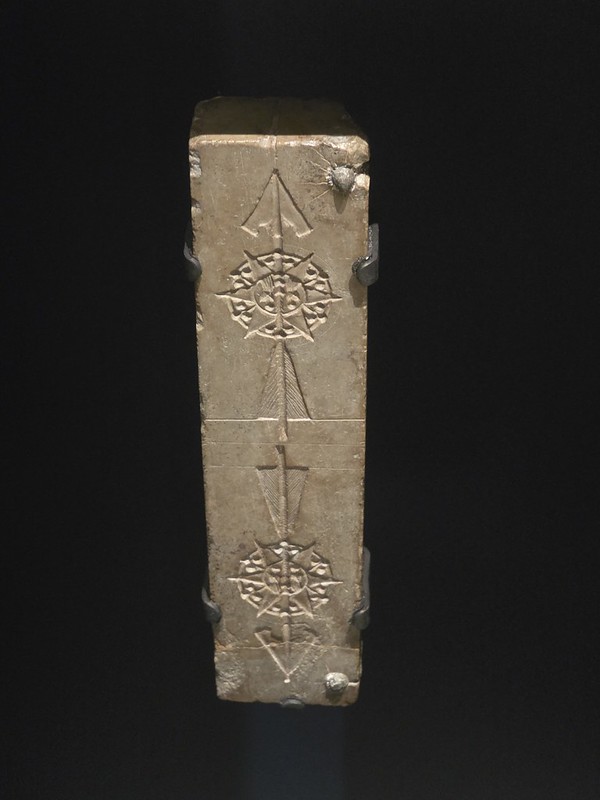
There’s something a little tacky about this fascinating item in the collections of Norwich Castle Museum. It’s a special piece, it’s the pre-cut mould for pilgrim badges that were sold at Walsingham’s shrine before the Reformation.
This is obviously how they were made, but perhaps the pilgrims who went there didn’t realise just how mass produced this whole arrangement was. Or, maybe they did, but even the museum notes that this method was designed to be “quick and cheap” rather than something produced to a high standard. And maybe there was a choice of pilgrim badges, from rather more decadent ones to cheap and cheerful. It seems though that some pilgrimage sites were selling over 100,000 badges a year, this truly was the Great Yarmouth of its day.
King Henry III made a pilgrimage to Walsingham and the shrine of the Virgin Mary in the thirteenth century and then King Edward I, King Edward II, King Henry IV, King Henry VII and King Henry VIII all went afterwards during their reigns. That’s some destination and it’s clear why it also became desirable to pilgrims. King Henry VIII couldn’t have been entirely surprised and delighted by his visit as he later approved it being pulled down during the Reformation.
I haven’t been able to find any badges in museums or for sale that look similar to this, I had hoped to see what one would have looked like.
Something new for 2026 is a series of podcasts that I’m planning for the LDWA. It’s going to take a fair few podcasts to start getting the editing quality sorted, but I have to start somewhere and Simon Hodgin of Norfolk & Suffolk group kindly agreed to help with the first one.
I reference in the podcast that there’s a lot more to the LDWA than just the 100, but I felt the need to ask Simon about some of his challenge event achievements. I’ve recorded a couple more podcasts and they’ll be advertised within the LDWA. After a while, they’ll advertised more widely hopefully when I’m content that I know what I’m doing.
The first few podcasts will be with LDWA members, talking about their volunteering experiences and their walking, but there will be more focused podcasts on how to prepare for any challenge event, what to pack for a 100 mile event, as well as podcasts about specific walking trails. Then there will hopefully follow podcasts featuring other people involved in outdoor adventure activities, as well as those involved working on trails, B&Bs owners used to dealing with walkers and much more besides.
When I’m happy that I’m getting there with the quality, then they might start appearing in the usual places where podcasts are found. So, that’s the background! The podcast download for the first episode is below.
One running theme of the 1830s was the sheer excitement of so many people about the possibilities of the rail network and the amount of time it could save them.
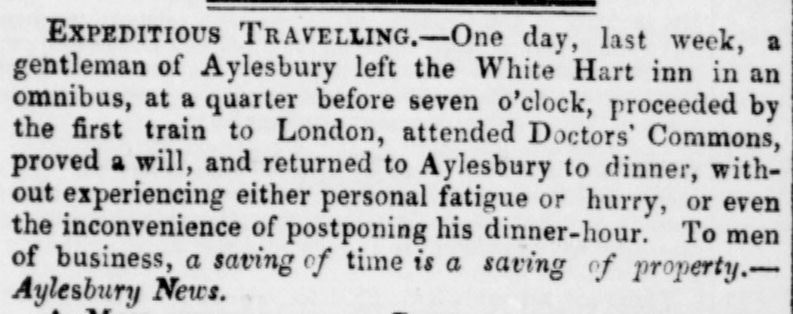
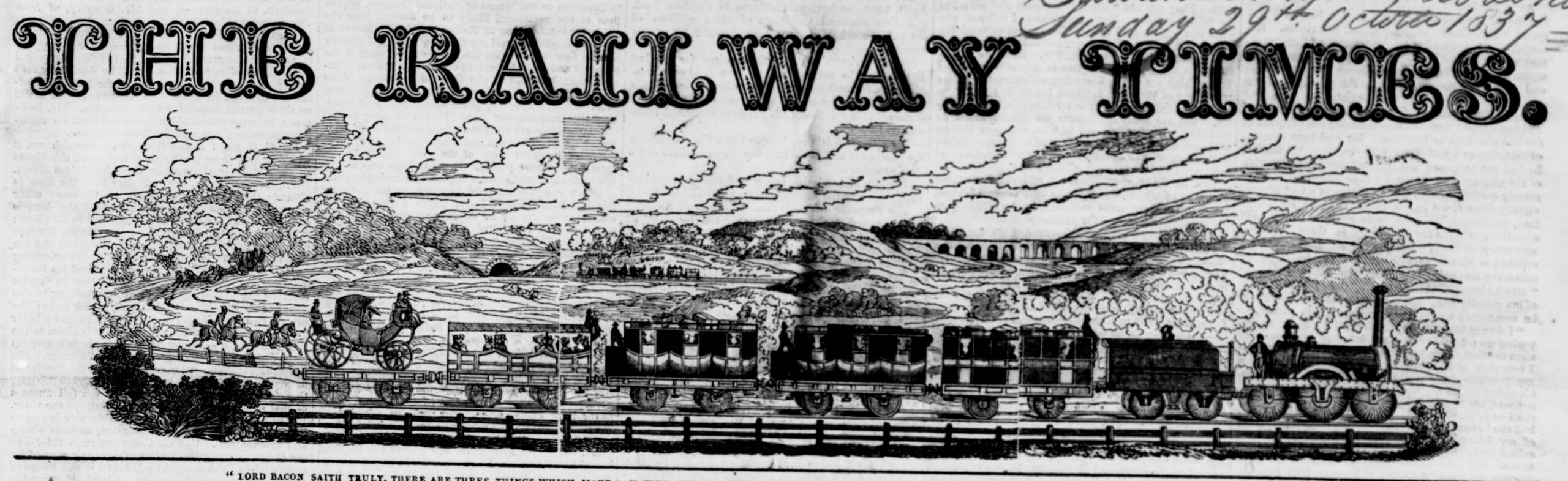
The Railway Times reprinted a news story that had been published in Aylesbury News in November 1837, although they must have got the omnibus to another nearby station (perhaps Tring railway station which had opened in October 1837) as the railway was another eighteen months from opening in Aylesbury.
“One day, last week, a gentleman of Aylesbury left the White Hart inn in an omnibus, at a quarter before seven o’clock, proceeded by the first train to London, attended Doctors’ Commons, proved a will, and returned to Aylesbury to dinner, without experiencing either personal fatigue or hurry, or even the inconvenience of postponing his dinner-hour. To men of business, a saving of time is a saving of property.”
This feels like a perfect example of the sort of thing that would have excited me, to be able to get a lunch in London without any “personal fatigue or hurry” and without having my evening meal late…
As another random aside, back to my reading through old back issues of the Railway Times…. There was an article in December 1837 which gave progress on the line between Birmingham and Gloucester.
“We have much pleasure in being able to inform our readers that considerable activity is displayed on this line. Fourteen contractors are at work—four in the Birmingham division, and ten in the Gloucester—five are engaged in earth-work, one brick-work and masonry, four fencing, and the remainder stone suppliers. Four miles of earth-work, and twenty miles of fencing are in progress.”
What amuses me is reading that the route of the line had been planned by Captain William Scarth Moorsom (1804-1863) who had worked with Robert Stephenson. He delivered a route which was economical, efficient and well planned, but unfortunately, it was economic as he had missed out nearly all the towns en route to save money. This displeased residents of numerous towns, including Cheltenham. The compromise was that Pearson Thompson (1794-1872), a member of a key committee of the railway and resident of Cheltenham, paid for much of it so that was a handy arrangement for the railway.
The whole project was successful, it was decided not to build a new railway station in Birmingham and instead they decided to share Curzon station. This building is interesting, it opened in 1838 but ceased to be used for rail purposes in 1966. It is very visible now amid all the civil engineer works when arriving into Birmingham as it is being integrated into the new Curzon HS2 railway station which should be open in around three to four years.
As for the towns that they missed, the railway network decided to build a series of branch lines, including to locations such as Tewkesbury and Worcester. That seemed to be a very reasonable compromise although Tewkesbury lost its rail connection following the Beeching cuts. Eventually the whole arrangement became part of the Midland Railway which then in turn became the London, Midland and Scottish Railway in 1923.
I didn’t get around at the time to writing about the Mercure Cardiff North hotel where we stayed for my birthday weekend in Cardiff in November. This is an Accor branded hotel and I had booked some time in advance, with the rates being very reasonable.
Firstly, there’s something unusual about their online reviews on Google as nearly every single one mentions a staff member by name. This isn’t usual on Google and doesn’t really help people get a fair understanding of what is happening here. If I read through the verified visits on Accor’s website, the situation is more as I would expect and staff members are rarely named, so that feels more reliable.
Instead of using my normal metric of Google Reviews, I’m going to use the Accor aggregated score, which shows that this hotel has a rating of 3.9 which is towards the lower end of the scale for the chain.
In fairness, the hotel was managing perfectly well at the accommodation element that was offered here. Liam and I had a twin room which was clean, at the appropriate temperature and everything worked as expected. There were no noise issues, either from inside or outside the hotel, so that all felt positive. The interior felt generally modern and so I suspect that there has been a refurbishment here recently.
I think my main negative about this hotel is I don’t know why they’re trying to be part of Accor. The hotel was playing fast and loose with the loyalty scheme offered by Accor and didn’t offer most of the benefits.
The situation with the welcome drink was downright awkward as the member of bar staff said that it was one drink a room. This isn’t right, this has never been right and it’s really not something I want to debate as it’s hard not to sound entitled about the matter. But holding Liam’s drink hostage whilst the staff members blamed each other is entirely sub-optimal. The reception desk resolved the matter, but the concept of the welcome drink was rather lost at this point.
It was partly a shame that the bar service was borderline rude as the drinks selection wasn’t unreasonable and although they’d made no effort getting local drinks in, at least they had a couple of options such as this Singha.
We had breakfast included in our room rates and on the first day it was poor, the second day it was better. it might not be relevant to me personally, but I like that they’re trying to do a gluten free area, but it could perhaps be a little more, er, exciting.
To be fair, I suspect guests would have worked out the labelling error here.
The hot food options, although this isn’t perhaps the best way to keep the food hot. As with the drinks at the bar, there was no effort to source food locally which is a shame as numerous Accor hotels are keen to do at least something.
The first day’s breakfast options were broadly dreadful. The bacon was dripping with grease, the cold cuts were of a very low quality, the cheese was already sweating in the displays and the whole arrangement looked sub-optimal.
I do agree with Richard’s comment that it’s a shame that there isn’t any fresh bread available here. But, to be fair to the hotel, this isn’t as common in the UK as it is on the European mainland.
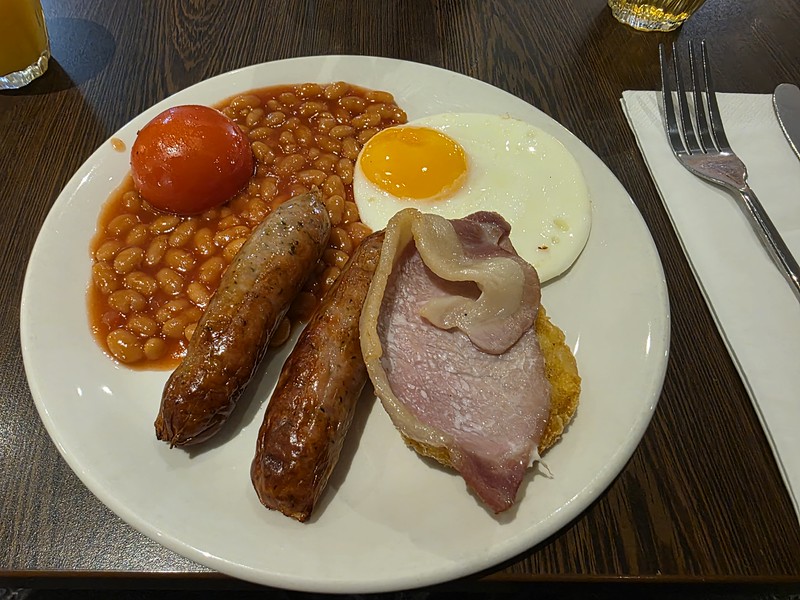
They actually had fried eggs on the second day and the presentation of the food was much better. That bacon isn’t cooked anywhere as much as I’d like it, but I accept that’s a personal preference. The egg was cooked to my tastes and everything tasted as expected.
Overall, I thought that the stay was fine as the room was clean, the team members were generally friendly and there were no noise issues. Certainly breakfast could have been better on the first day, but we got there just as service started and it’s easy to be critical. My main comment about the hotel is that they should perhaps either embrace (or at least accept) the rules that Accor set them, or just go independent and be free of those guardrails.
I’m finding this interesting as it’s a view of Tombland from 1830 which I haven’t seen before. Although in very many ways nothing has really changed here in terms of the Erpingham Gateway, the road layout and the buildings on the right hand side of the road, there are some other changes.
One change is the removal of the buildings to the right hand side of the Erpingham Gateway which is where the statue commemorating the life of Edith Cavell is now located. There’s also a gateway that I hadn’t known existed on the extreme left of the painting, that’s now gone but there is a blue door there today which gives entrance to Norwich School and there is today evidence of the former gateway that surrounded it.
Back to the artist, John Thirtle (1777-1839) who became a key member of the Norwich School group of painters and he became known for his watercolour landscapes. He was also an art framer and print-seller and Norwich Castle Museum, who own this artwork, have several of his paintings in their collections. Some of his artworks have suffered from the fading of the indigo pigment he used on many paintings, something which is a little sub-optimal. He suffered from illness towards the later part of his life, from long-time health issues from tuberculosis reducing his output.
I’ve asked AI to restore the image to how the sky might have looked and I think it’s done a generally decent job here. There’s a mistake that AI thought there was a fountain, and thus water, in the background that isn’t actually there, but the image does feel like it has been brought back to life.
I led a walk, which was well attended which is rather nice, yesterday about the historic parish of St. George at Tombland, so expect a few posts now following my research about that.
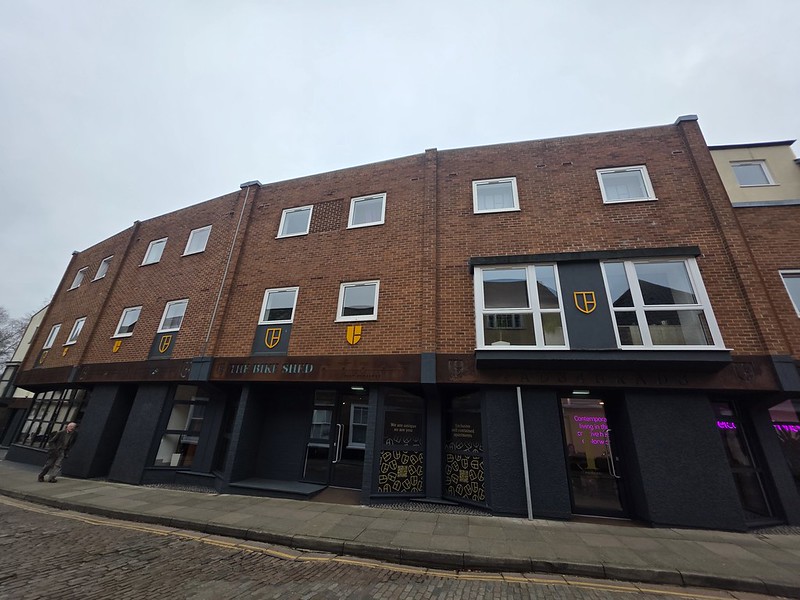
I noted in a post in 2021 that it was really positive that this parish boundary marker had survived a move to a new building. However, it appears that it might have disappeared and the people that I’ve asked have no idea where it has gone. Dating from 1834, the marker is no longer visible following work undertaken on Princes House Residences.
The building with the parish boundary marker now missing…..