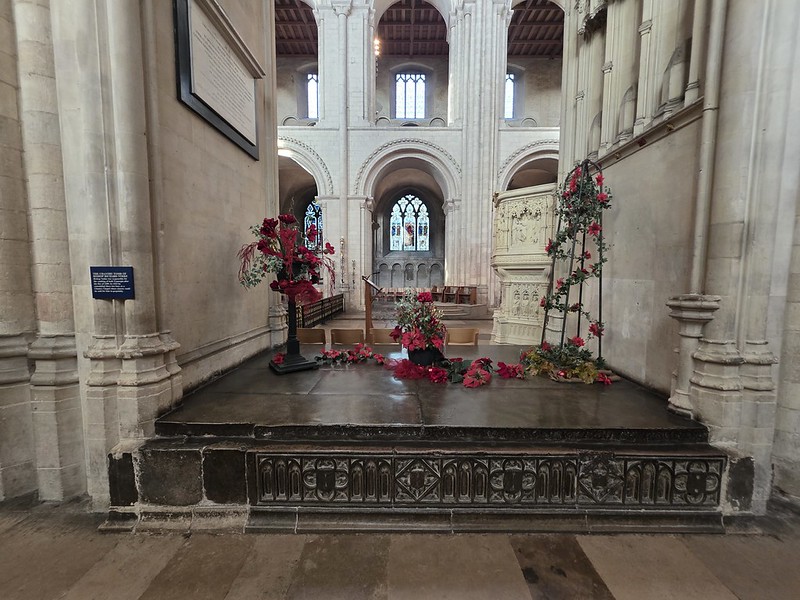
This is a bit niche, although I rarely let that stop me, but I rather liked this niche (I only realised what I’d done there when typing niche for a second time but I’m going to keep it) which is underneath the Bishop’s Throne at Norwich Cathedral.
This recess where the relics would have been piled up, with an information sign by this noting that “it was thought that the essence of these relics could rise up through the flue and give the Bishop divine aid and assistance” and that’s quite a nice thought. If you believed in the power of the relics, then this is a perfectly logical thing to do and I like that this hasn’t all been bricked up. These relics would have pulled out of here following the Reformation, so this has been empty for a long time now.
I understand that this isn’t a normal situation to have survived, not least as the Bishop’s Throne has usually been moved about the place in cathedrals. Although perhaps the ultimate place that this is replicated is the Chair of Saint Peter in St. Peter’s Basilica in Vatican City, where the chair is the actual relic.
I suppose that this is rather a nice place to have a tomb, right by the main pulpit so you’re not missing out on much. I don’t know, but I imagine that there was an iron cage around this, possibly stone, to make it feel a little more private.
It’s the chantry tomb of Bishop Richard Nykke (1447-1535), also known as Bishop Nix, and there would have been a fund for a priest to offer prayer and masses on their behalf, just to speed up the whole process of getting to heaven. This was inevitably just a little ridiculous, people paid a lot of money for positions such as this and the Catholic Church accepted a lot of abuses here for far too long because it was in their financial interests to do so. The Reformation came along and all this chantry tomb stuff came to an end with the Abolition of Chantries Acts.
Bishop Nykke lived through some of the Reformation and he was one of the last Catholic bishops here, although it was Bishop John Hopton (?-1558) that can claim to be the last one. Hopton, a Catholic Bishop, ordered the burning to death in Norwich of tens of Protestants because they disagreed with him. Some of the people Hopton murdered were burned at Lollards Pit, just outside the city walls, where they were walked from the Cathedral.
Back to Bishop Nykke who was present at the murder of Thomas Bilney (1495-1531) who was also executed at Lollards Pit. Nykke was found guilty by Parliament of an abuse of his powers and had property confiscated, but it’s fair to say that politics had rather taken over by then.
This whole situation is a bit unfortunate for Bishop Nykke, forced to remain in a tomb next to generations of those preaching messages which he strongly opposed. This is the slight problem when you get yourself a prime spot in a religious institution, the risk of seeing it handed over to a different denomination. But, maybe over time he’s recanted, like he tried to make the Protestants do.
Of course, I’ve used AI to try and recreate the scene of what it might have looked liked and I’d suggest this feels a very realistic mock-up.
There’s a lot of graffiti here at the side of the tomb…..
Because I don’t have enough series of posts on this blog already, here’s another one. As I’ll be visiting Norwich Castle many times this year, I thought I should make some parallel visits to its Norman counterpart, the city’s cathedral.
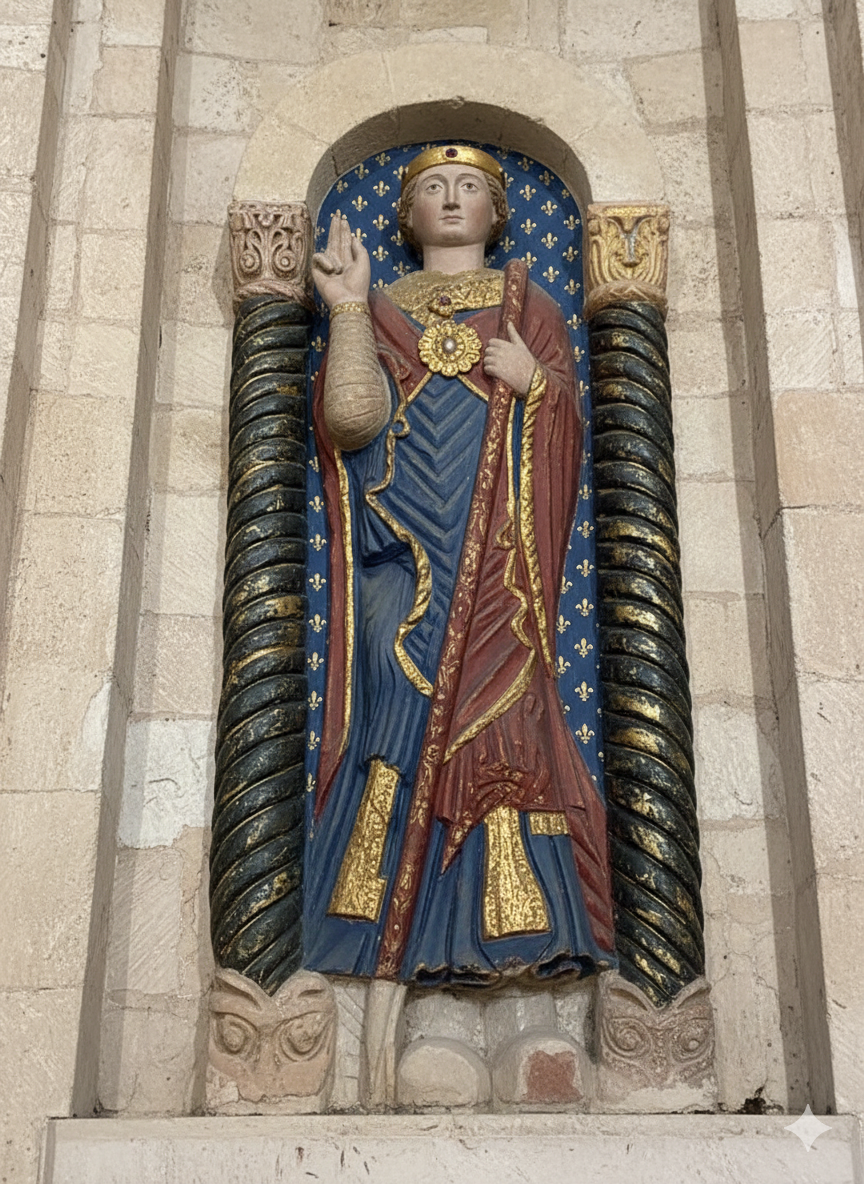
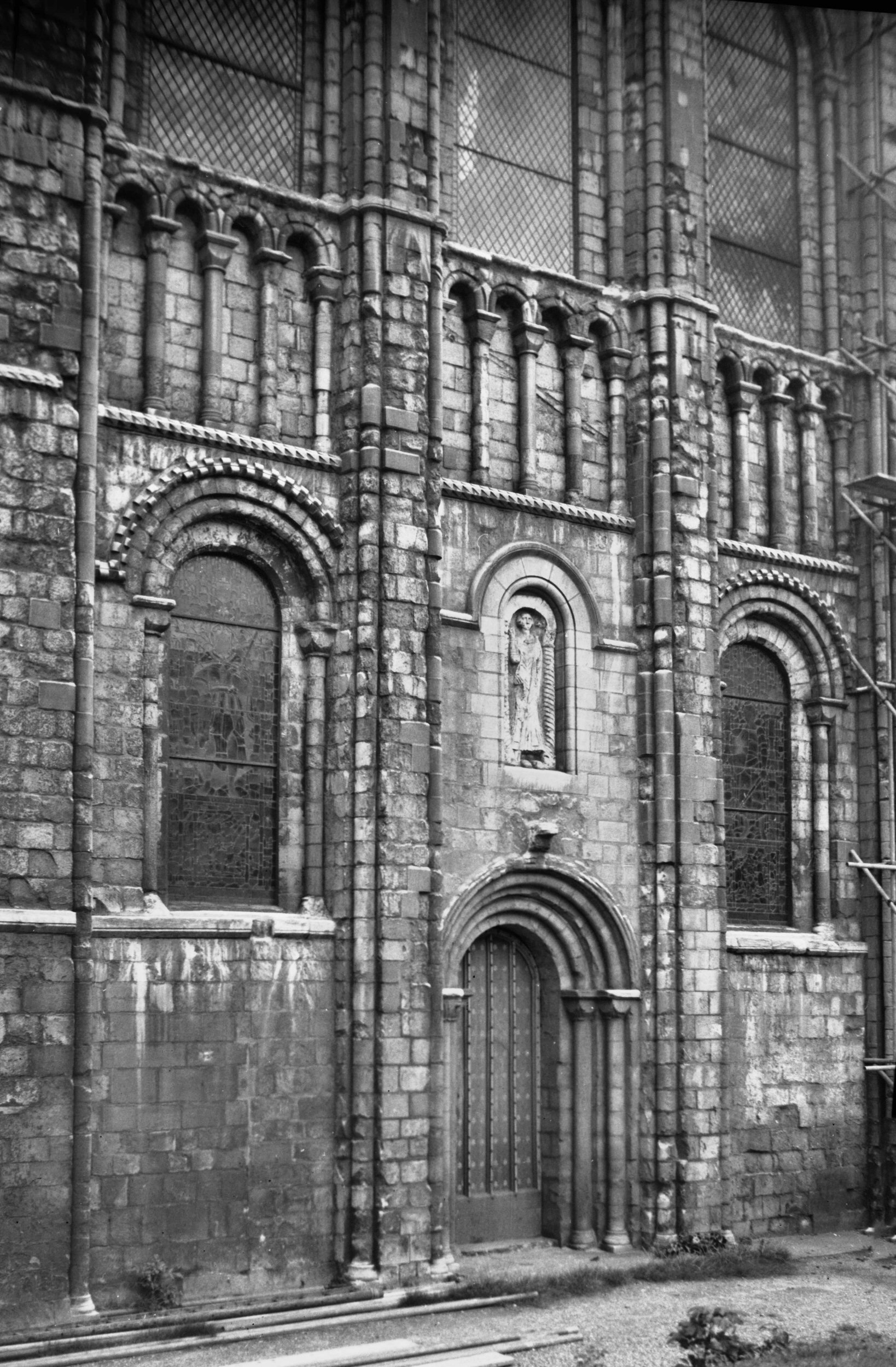
The cathedral notes that this is the effigy of St. Felix, a reminder that the word effigy seems to have mostly been redefined as representations of people who are normally unloved, the whole tomb effigy thing feels much less commonly here now.
Historically, it was thought that this was Herbert de Losinga, the first Bishop of Norwich, before I’m sure great academics decided that it was St. Felix, who is known for bringing Christianity to East Anglia.
This effigy was originally located above the Bishop’s Door in the north transept, before a decision was made to bring it here in 1969. A replacement copy has been made where it used to be located and that’s visible on a George Plunkett photo from 1976. This side of the cathedral can’t be visited, it’s the private access to the Bishop’s Palace (both the new one and it would have been the access from the old one too).
Obviously, I’ve gone to AI to understand what this might have originally looked like.
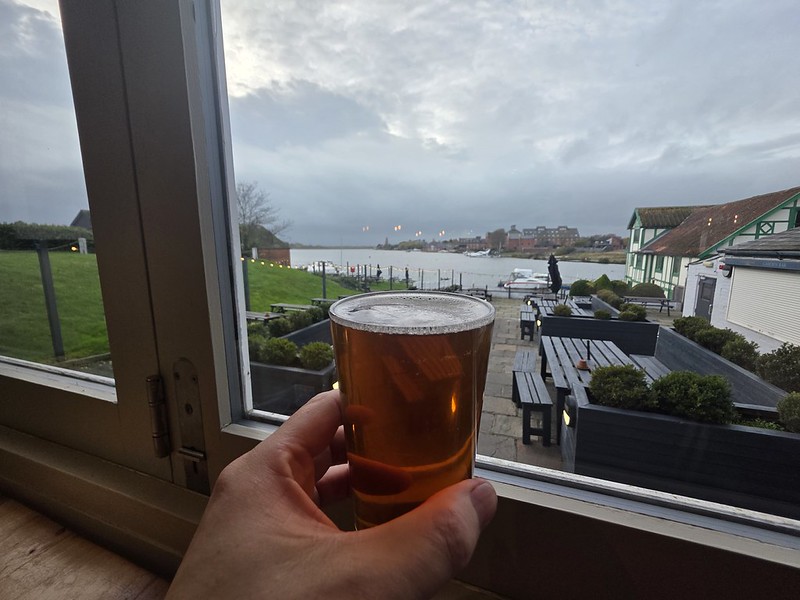
I’d never visited the Commodore before and so I was unaware of the rather lovely views which it has over the lake. Like the Harbour in Lowestoft, it’s operated by Moss & Co who have a number of local venues.
The Commodore has been a licensed premises since at least the mid nineteenth century, previously known as the Commodore Inn when I assume from the name it would have had accommodation available. It was run by the Stebbings family for some time, although there was a tragedy in 1891 when William Edward Adams, aged 20, died when falling through the ice on what they thought was a frozen lake. Quantrell Stebbings, the landlord, shouted a warning to Adams and his friend before they embarked on their expedition, but it was to no avail. It was no surprise Stebbings shouted out a warning, there had been mention in the newspaper the week before that two separate groups had a narrow escape under similar circumstances, with one lad who fell in being looked after in the Commodore.
More recently, this was something of a debacle from the Stonegate pubco who owns the pub and refused to renew the licence of Moss & Co. So they left and Stonegate tried to operate the venue themselves under management, but that situation was evidently sub-optimal as they decided they’d revert to the previous arrangement.
It was relatively quiet inside, but that was not entirely unexpected from an afternoon visit on a slightly wet November afternoon. The service was friendly, prompt and warm, with the venue having something of an inviting atmosphere. It’s clean and well presented internally, although it does have something of a clinical feel to it which I assume is linked to the Stonegate organised £200,000 update.
There was a choice of two real ales, Ghost Ship from Adnams and Encore from Lacons. I understand that they would usually have four real ales during busier periods of the year.
I went for the Ghost Ship and it was well-kept, rounded and at the appropriate temperature. And it came with a rather decent view. Julian went for the Encore and seemed delighted by it.
This must be a profitable exercise when the sun is shining during the summer, there’s no shortage of tables here and further down towards the water. I’m not sure that the venue is food led, but the menus are quite extensive and the online reviews for their meals are positive.
This was a positive first pub on our little Oulton Broad expedition, it seemed like a well-run venue with friendly staff, reasonably priced drinks and real ale that was in good condition. All really rather lovely.
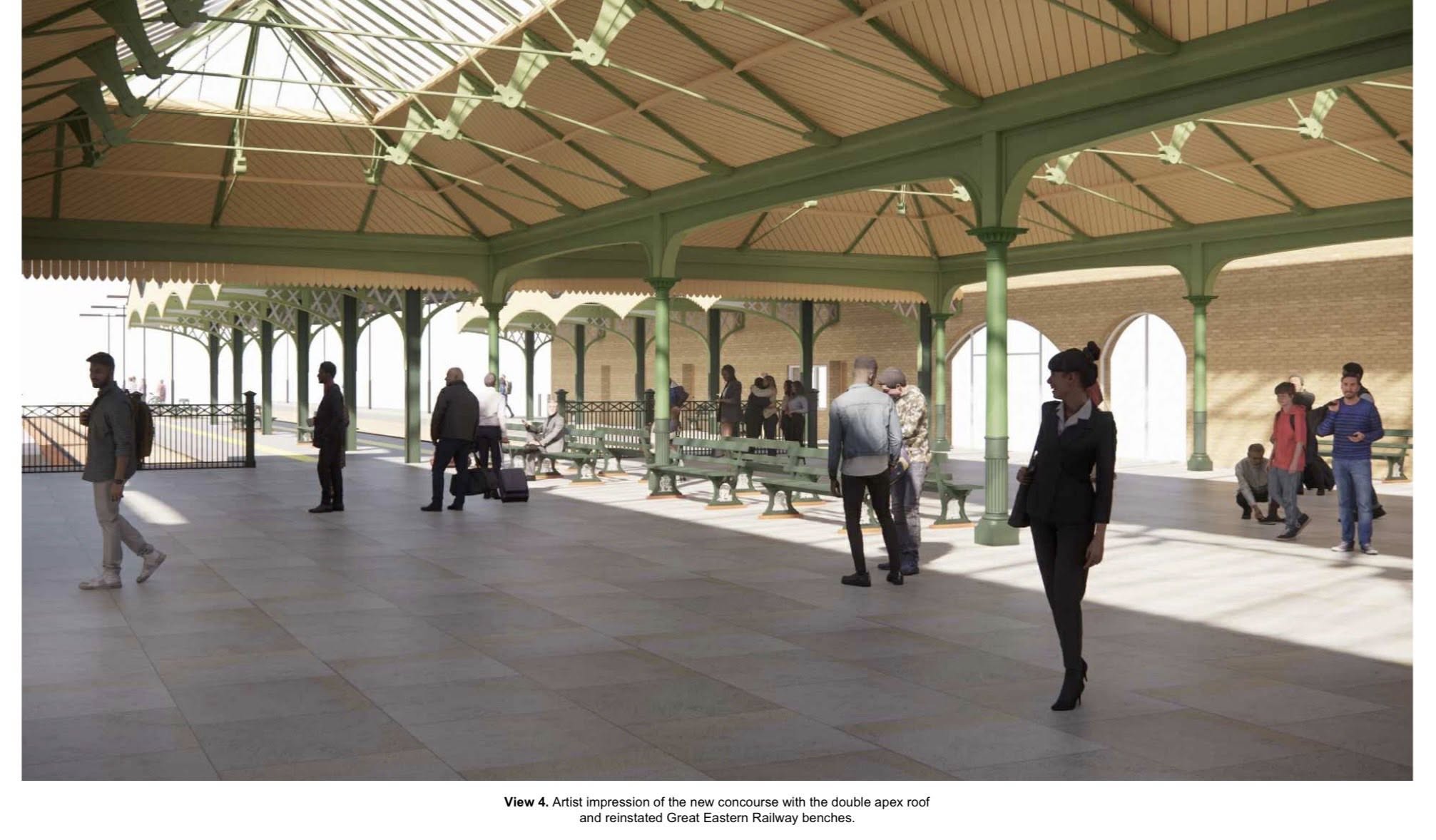
These look rather good, they’re the public consultations for the work that will be done at Lowestoft railway station. To cut a long story short, there used to be a lovely roof on this station but it was in a poor state of repair and British Rail took it down in the early 1990s. There are now plans to put it back which seems a marvellous idea to me.
Screenshot
The railway station has been in danger in the past, there were plans to move the whole lot further down the line which is something that would have been sub-optimal.
Screenshot
All very nice and there are plans to restore some of the station building itself, most of which has been inaccessible for quite some time. This feels like positive progress.
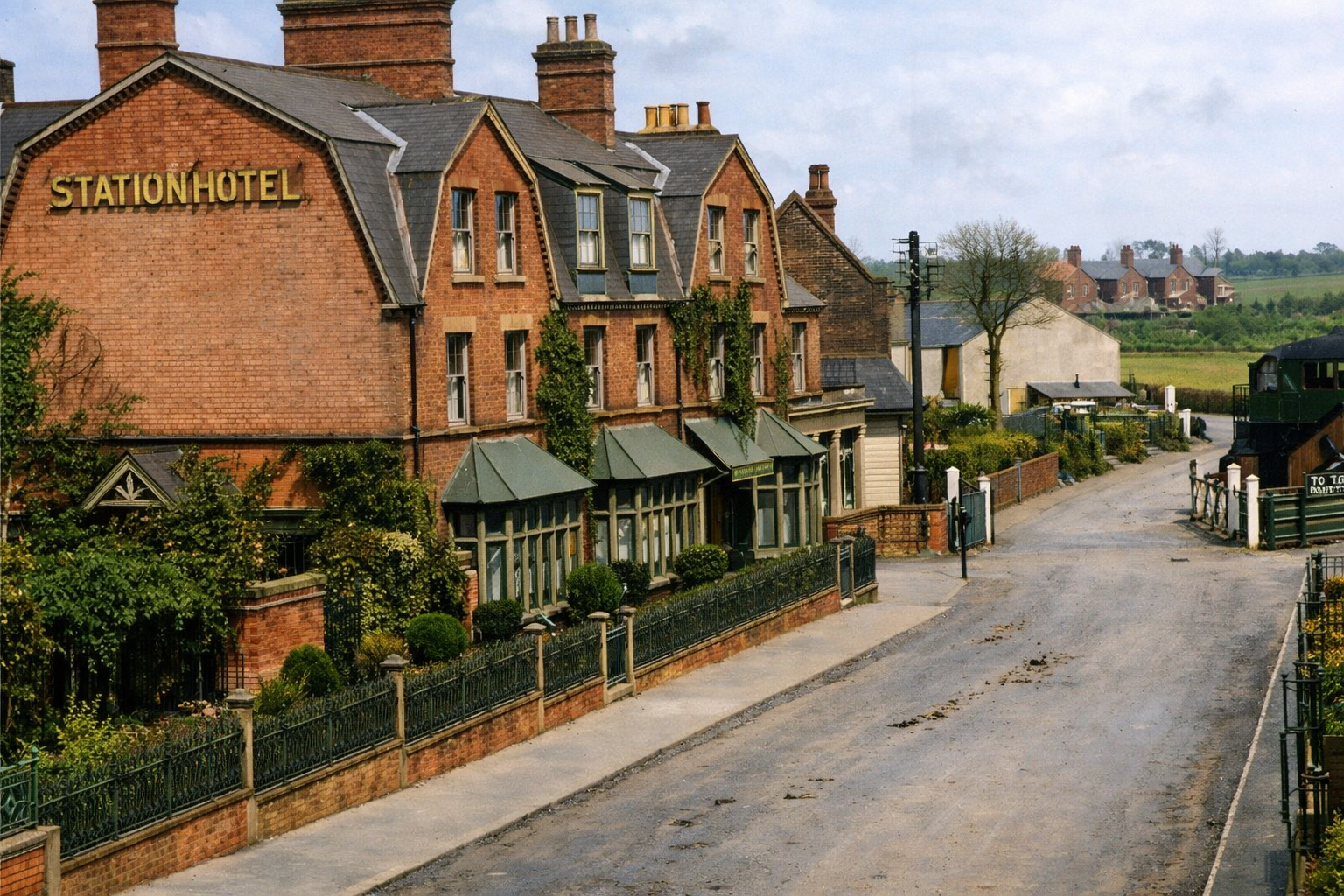
Located opposite Oulton Broad North railway station is the former George Borrow pub. Julian the elder has visited this pub many times in his youth, but it’s not one that I ever went in. The pub takes its name from George Borrow (1803-1881) who was a novelist and early travel writer. He was certainly a controversial author and in a mood, the Norwich subscription library burned one of his books in the 1820s which feels a sub-optimal thing for a library to do.
This is from the early 1900s and Oulton Broad still has something of a village feel.
This is Google Streetview from 2009 and it’s the only photo they have of the pub before it was converted into a residential home. It closed in 2008 having opened as a licensed premises in the 1890s. To add confusion to matters, it seems that the venue has also been known as the Station Hotel and the Railway Hotel.
Here’s the venue on the 1890s Ordnance Survey map. In its day, it was also a 12 bedroom hotel, so would have been a convenient location for any travellers needing to catch a train. The nearby station was known as just Oulton Broad at the time, instead of its current Oulton Broad North, as what is now known as Oulton Broad South was then known as Carlton Colville station.
This is what it looks like today…..
At least the former pub sign holder has remained, even if the pub sign itself has gone.
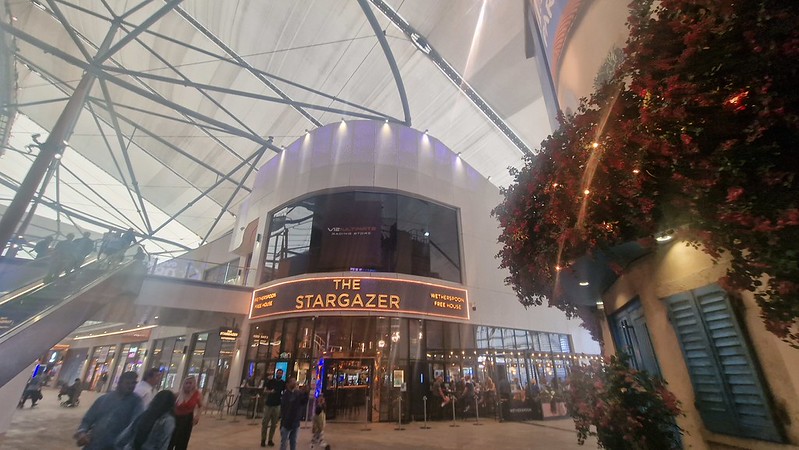
I visited this pub in September 2023, but I don’t appear to have surprised and delighted my two loyal blog readers by ever writing about it. Anyway, the Stargazer is the JD Wetherspoon pub located in the O2. Back when I lived in this area, this pub wasn’t there and it would have been quite handy as my local cinema was literally opposite within the O2.
The chain explains the reason for their pub name:
“Renowned astronomer Sir Edmund Halley established his reputation studying stars. His star catalogue, published in 1678, was the world’s first such work and determined hundreds of southern stars’ locations. Halley was later appointed Astronomer Royal at Greenwich Observatory. He is commemorated by Edmund Halley Way (in front of The O2), leading to the River Thames’ cable car crossing – with its views of the London skyline.”
All under cover and centrally located within the O2, this was at the time the only JD Wetherspoon that I hadn’t visited in London (I define London as zones 1 to 3).
I accept that I’m not going to win any photography awards here.
It’s a sizeable venue and it was all clean and organised. The venue has premium pricing for JD Wetherspoon, but it’s quite competitive compared to all the other dining options at the O2.
Perhaps not the most riveting of real ale selections at the time.
This is the Guardsman from Windsor & Eton Brewery, reasonably malty but not packed with the most decadent of flavours.
As it’s a JD Wetherspoon venue, I feel the need to have a little look at the online reviews. These aren’t very good, it’s one of the lowest rated one of their venues in the country. There seem to be a lot of of issues with slow service when it gets really busy, which is a bit sub-optimal if you’ve got something to see at the O2.
Although there’s a one star review because:
“Meals were on the table before I got back from ordering”
So you can’t please everyone all the time….
“Such a shame as the pub looks nice. However, one of mangers was grumpy when serving at the bar, then said its company policy they don’t accept Scottish notes….well the other weatherspoons in London take Scottish notes.”
The actual chain policy is they take the notes in Scotland, areas where there are a lot of Scottish people and they take £10 Scottish notes. It could probably be a bit clearer to be fair to customers.
“Having a lovely time until a wasp came along and landed on my burger I said to a member of staff oh sorry a wasp is on my burger.”
I like how that’s the fault of the pub and they get a 1 star review as they didn’t offer a new meal.
“We had a very unpleasant experience with a staff member named *******. He was rude, unprofessional, and his behavior came across as discriminatory. As someone with years in hospitality, I was shocked by his attitude, this is not how guests should be treated. Staff like Vaishnav should be given proper training on how to interact respectfully and courteously with guests. It’s disheartening to see such behavior in a customer-facing role, and I sincerely hope the management takes this feedback seriously.”
This is one of the nastiest things that I’ve seen customers do, four different one star reviews all targeting one individual staff member. It’s fairly evident where the problem is here from such actions. It would have been easier to ask for the duty manager than try and make such a personal attack like this.
“No music, slow, bad attitude from staff. The whole environment was boring.”
Always nice to be reminded that there’s no music, this suits me……
“Around midday we walked straight in, got served immediately and went to sit in what is somewhat poorly described as the “beer garden” as one person has already mentioned, it’s more of yard, sandwiched between the service road, the pub and a service tower, and the river views promised, really do fail to deliver.
But all in all its your typical Whetherspoon, and because you’re at the O2, you pay for that in drink prices. Fast forward 6hrs, we return with friends, 4 of us in total, to be refused entry. Reason from the door staff “it’s too busy” when I polity ask what the capacity is, does he have a counter to check, he has no idea what I’m talking about. Whilst this discussion continues, 8 people leave and we still can’t get in, the reason again, “too crowded”. At this point I walk off as I’m bored talking to the cretin on the door. Whilst discussions continue, 2 people walk up to an empty table, sit down and order via the app. That was the last straw.
If you’re going to employ door staff, surely they must be fit for the job, despite being licensed to do so. Customer service costs nothing, manners cost nothing, and before you ask “where you drunk and disorderly?” Far from it, as we had been having lunch and a catch up with friends. Fortunately there are many places to eat and drink in the O2, so I don’t have to go back. Sorry Whetherspoon’s, you just lost a once extremely loyal customer!”
“Cretin”? I suspect the chain will be glad to lose the customer…..
Anyway, I digress. I rather like this venue as I’ve only ever been when it’s peaceful and calm. I can imagine it’s a bit more of a nightmare during busy evening services and I feel sorry for the staff, it must be a permanent nightmare being very busy for relatively short periods.
This is the severed head of John the Baptist, I mean what a lovely thing to pop in your living room. This was a popular image in the medieval period and it’s made of terracotta, dating from around 1380 to 1420.
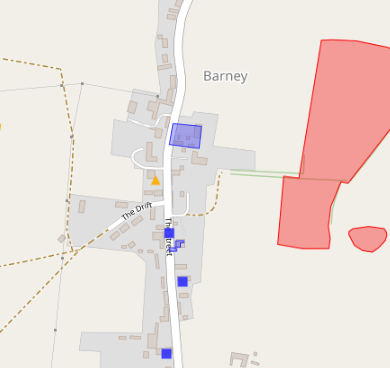
It was probably once in a church at the top of an arch, but it ended up embedded in a cottage wall in the village of Barney, near to Thursford and was found in 1958 when the wall was demolished. I suppose that it’s quite inspirational in its own way.
Thanks to Norfolk Heritage Explorer (which is a really wonderful website) the exact location where it was found is marked accurately on the map (the little yellow triangle in the middle of the image), although they only got confirmation of the location in 1984 because a local man remembered where it was found.
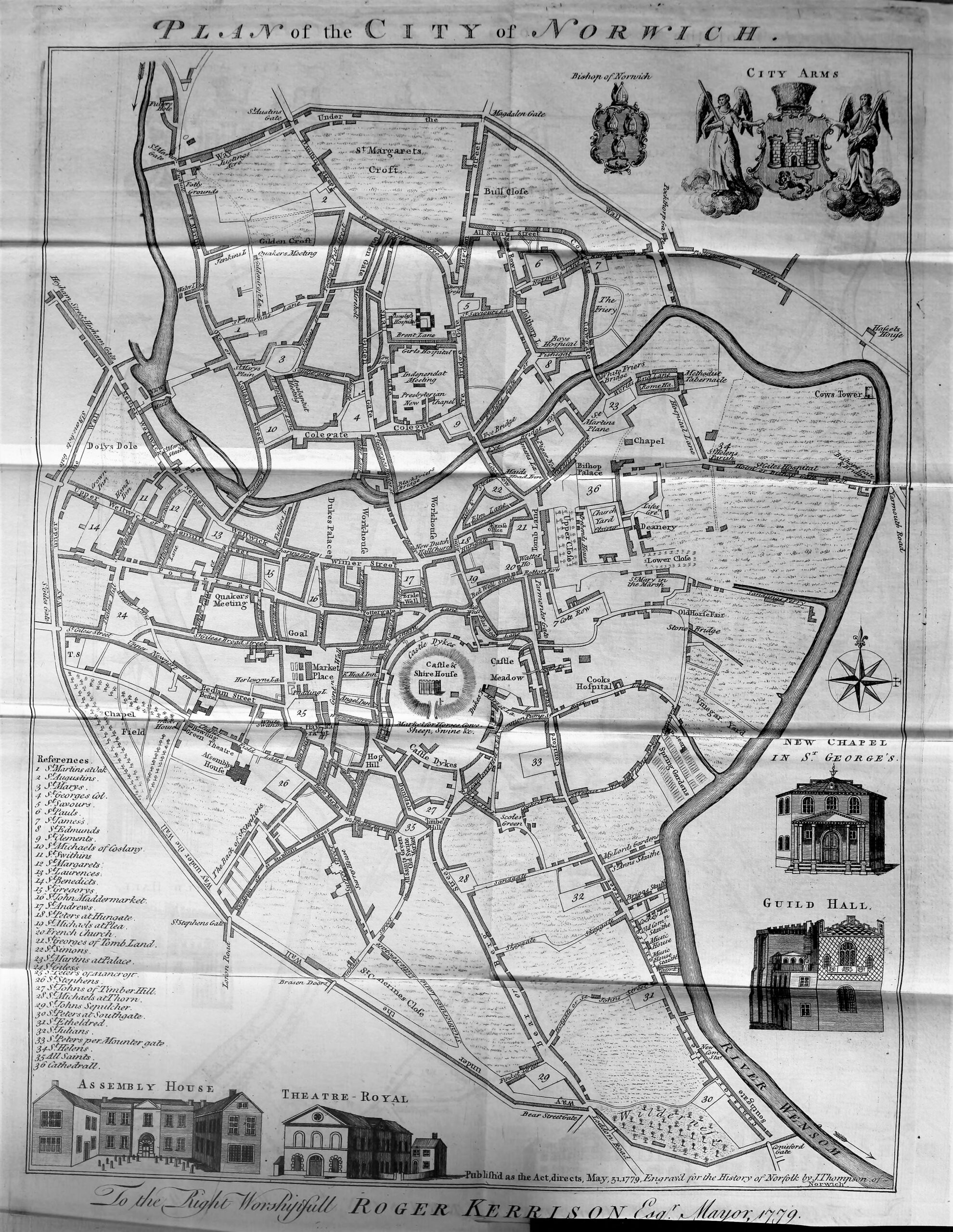
Well, this is nice, it’s a map of Norwich which I haven’t seen before. It is showing me all manner of things that I didn’t expect to be there, so that’s a bit more time I will waste (well, maybe not waste, is any finding out about history a waste?) hours on now…..
This image should show at full resolution by clicking on it and zooming in to see the details.