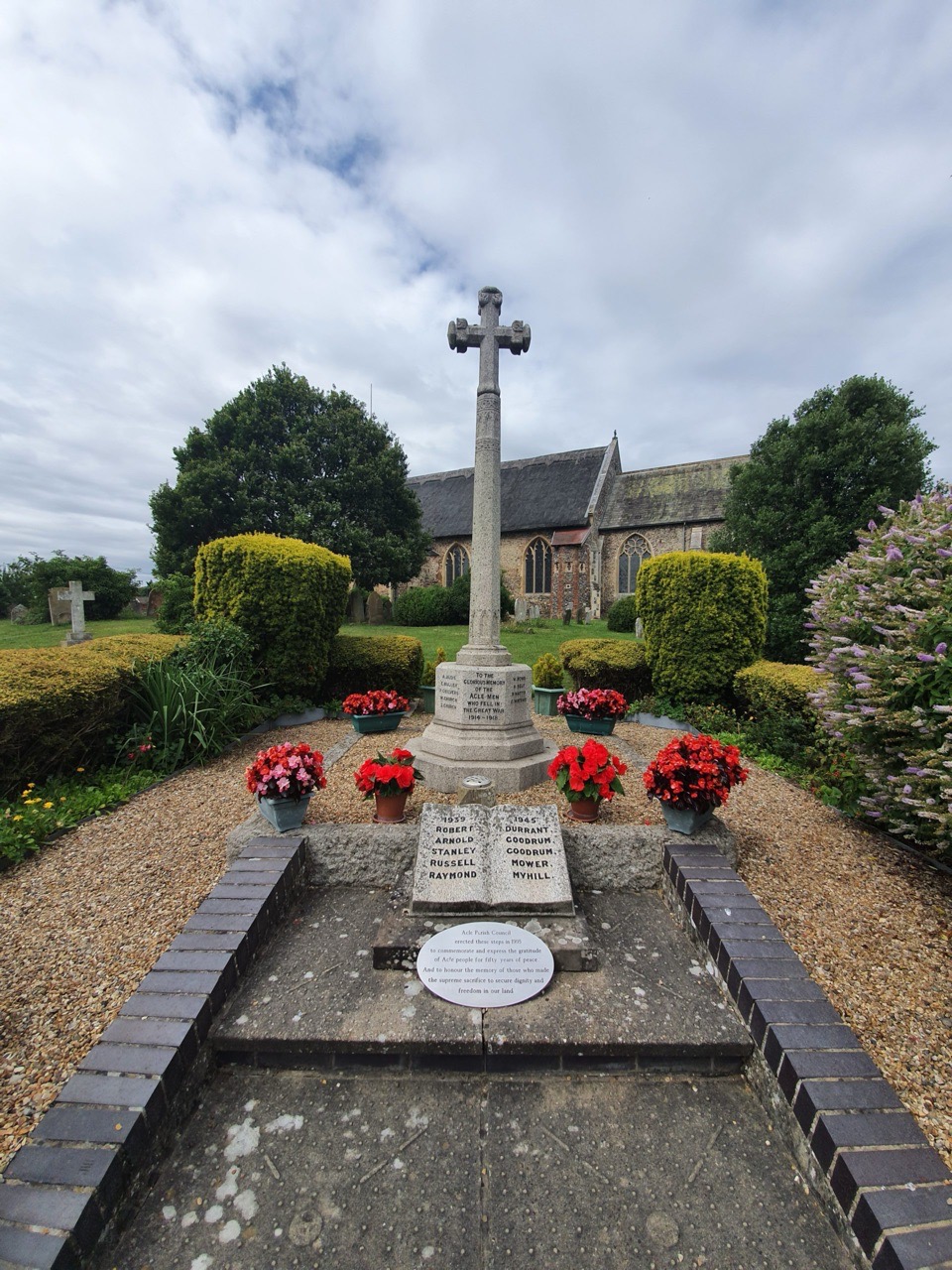
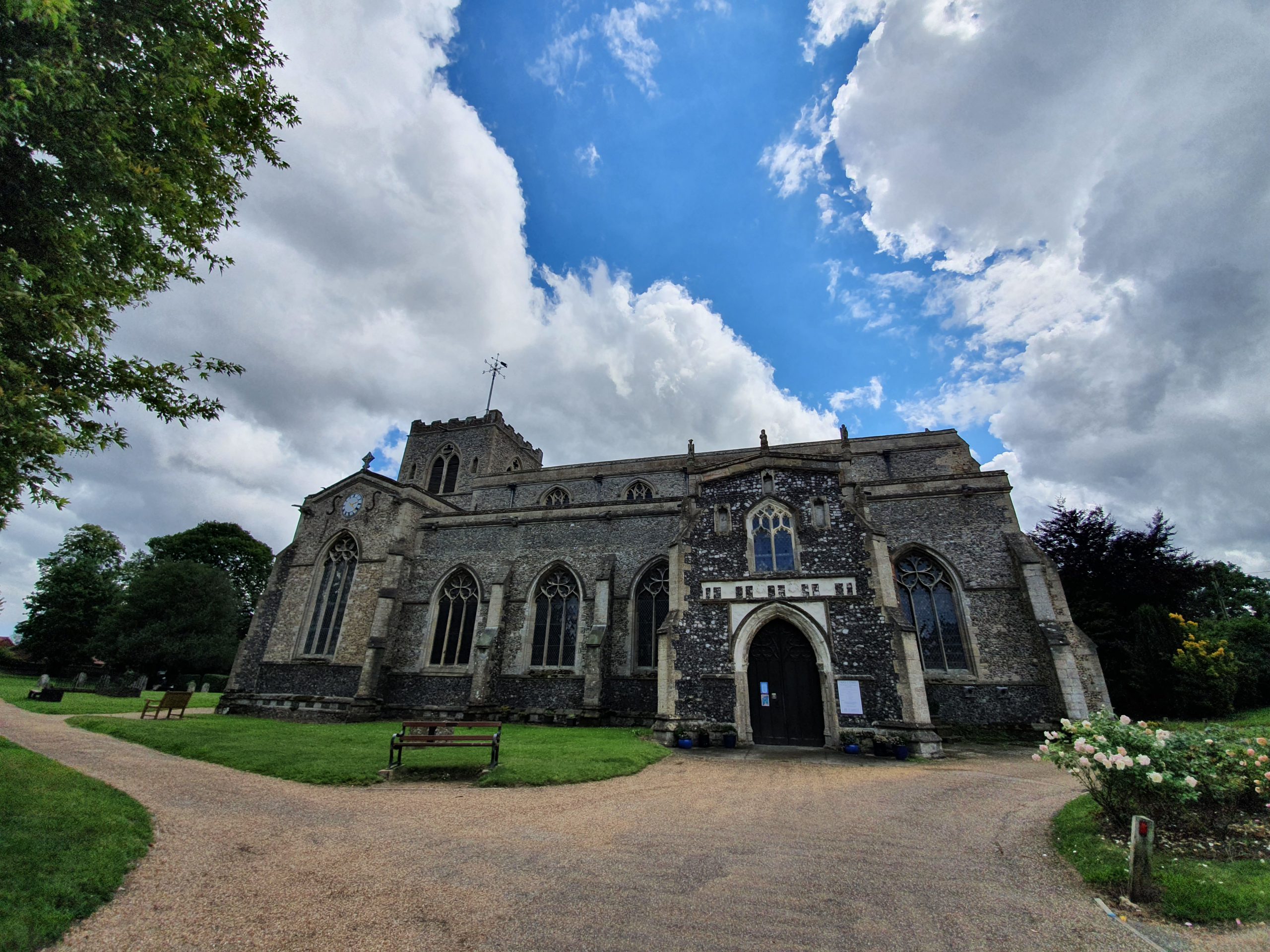
The town’s war memorial is located in the churchyard of St. Edmund’s Church in Acle.
The war memorial was unveiled on 18 December 1921 by the sons of Edward Cushion and Owen Waters, two of the men who died during the First World War.
There are 28 names from the First World War on the memorial, which is made from granite and overlooks the Norwich Road.
An additional five names were added following the end of the Second World War. In 1995, there was a renewal of the area to mark 50 years since the end of the conflict, with steps being added to the war memorial.
As it looked in the 1950s before the building of the steps.
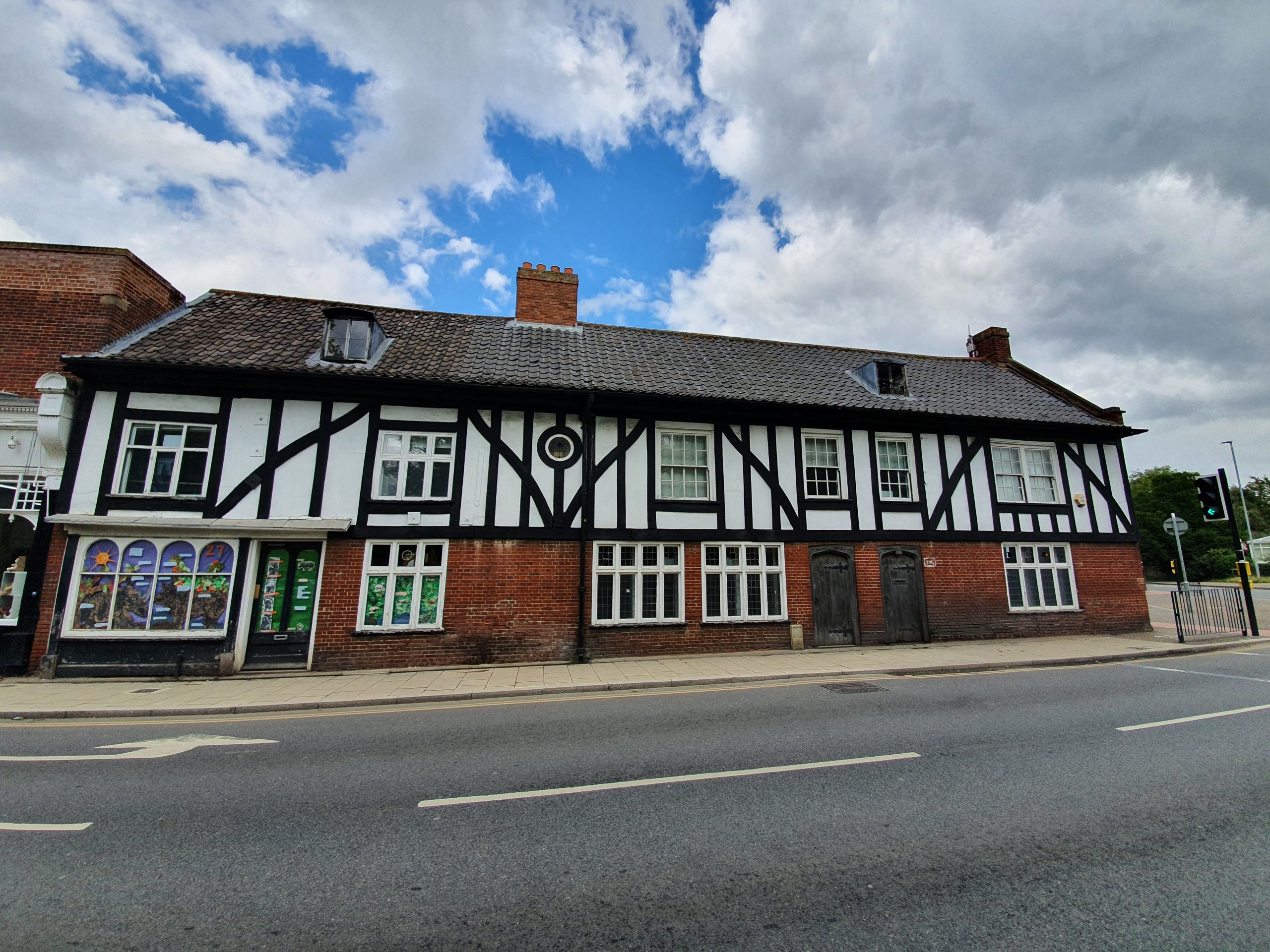
This puzzled me for a while (as many things do), as I took a photo of what looked like a restored building with some interesting period doors. However, it wasn’t on the listed building register, and this is likely because it’s a fake twentieth century Tudor facade. Although, interestingly, the building behind this frontage is from the late sixteenth or early seventeenth century. The structure has been heavily changed and modified, but it’s a shame that more of the original structure can’t be seen. Given this internal heritage, it’s also slightly surprising that the building isn’t listed, as the bar for this is relatively low. Its lack of excitement must have been evident to George Plunkett, the photographic recorder of so much of Norfolk, as he didn’t take a photograph of it, instead focusing on other nearby buildings on this road.
After my expedition to Attleborough last week, this is what The Concise Oxford Dictionary Of English Placenames have to say about the name origin of the town.
Attleborough, Norfolk. Atleburc in Domesday Book and Atleburc in 1194. Aetla’s burg.
The ‘burg’ here means a fortified settlement and it was under the control of Aetla. It was quite a substantial town when the Domesday Book was compiled, with 71 settlements being recorded. There’s something that can be gleaned here from how Atleburc would have been pronounced, as if every syllable in this is spoken, then it does sound similar to today’s spelling (or it does to me anyway, others may differ….).
I’m avoiding politics on this blog, but I’m amused by the Government’s introduction of this scheme. The reporting process is really secure, restaurants just have to tell the Government how many people they’ve given discounts to and they get a large payout. Certainly a brave use of Government funds.
But, my favourite bit is that the Government explains that discounts can only be provided for eat-in meals. This means that takeaways cannot sign up for the scheme. However, this text is in the rules:
“If a customer purchases a meal with the intention of eating it but then takes it away and leaves the premises, you can still apply the discount.”
The Dictionary of the Vulgar Tongue was first published at the end of the eighteenth century, and given that the current health crisis is giving too much time to read books, I thought I’d pick a daily word from it until I got bored….
Fam Lay
Apparently (it says on Google), in 2020, Fam Lay is a famous rapper, but over 200 years ago, the dictionary defined this as “going into a goldsmith’s shop, under pretence of buying a wedding ring, and palming one or two, by daubing the hand with some viscous matter”. The term was used by the criminal fraternity and it seems quite a precise definition, probably never in common usage. The word ‘fam’ could mean the hand, and ‘lay’ in this instance is just a shortened version of layer, so it’s effectively a sleight of hand.
The grave of Theodosia Colman is located on a path, which isn’t really ideal, at St. Mary’s Church in Attleborough.
Theodosia was born in 1752 as Theodosia Howes and she married William Colman on 6 February in 1778 in Besthorpe, a village near to Attleborough. Theodosia died at the age of 76 on 12 October 1828 and was buried on 18 October 1828 at a service overseen by the curate, John Fairfax Francklin.
The Dictionary of the Vulgar Tongue was first published at the end of the eighteenth century, and given that the current health crisis is giving too much time to read books, I thought I’d pick a daily word from it until I got bored….
Fakement
This word is defined by the dictionary as “a counterfeit signature. A forgery. Tell the macers to mind their fakements; desire the swindlers to be careful not to forget another person’s signature”. It’s a word that sounds like it should exist in English (adding ‘ment’ usually means to action the first part of the word), but it also sounds as though it has been recently been made up. It actually though dates back to at least the sixteenth century, although was more commonly used in the nineteenth century.
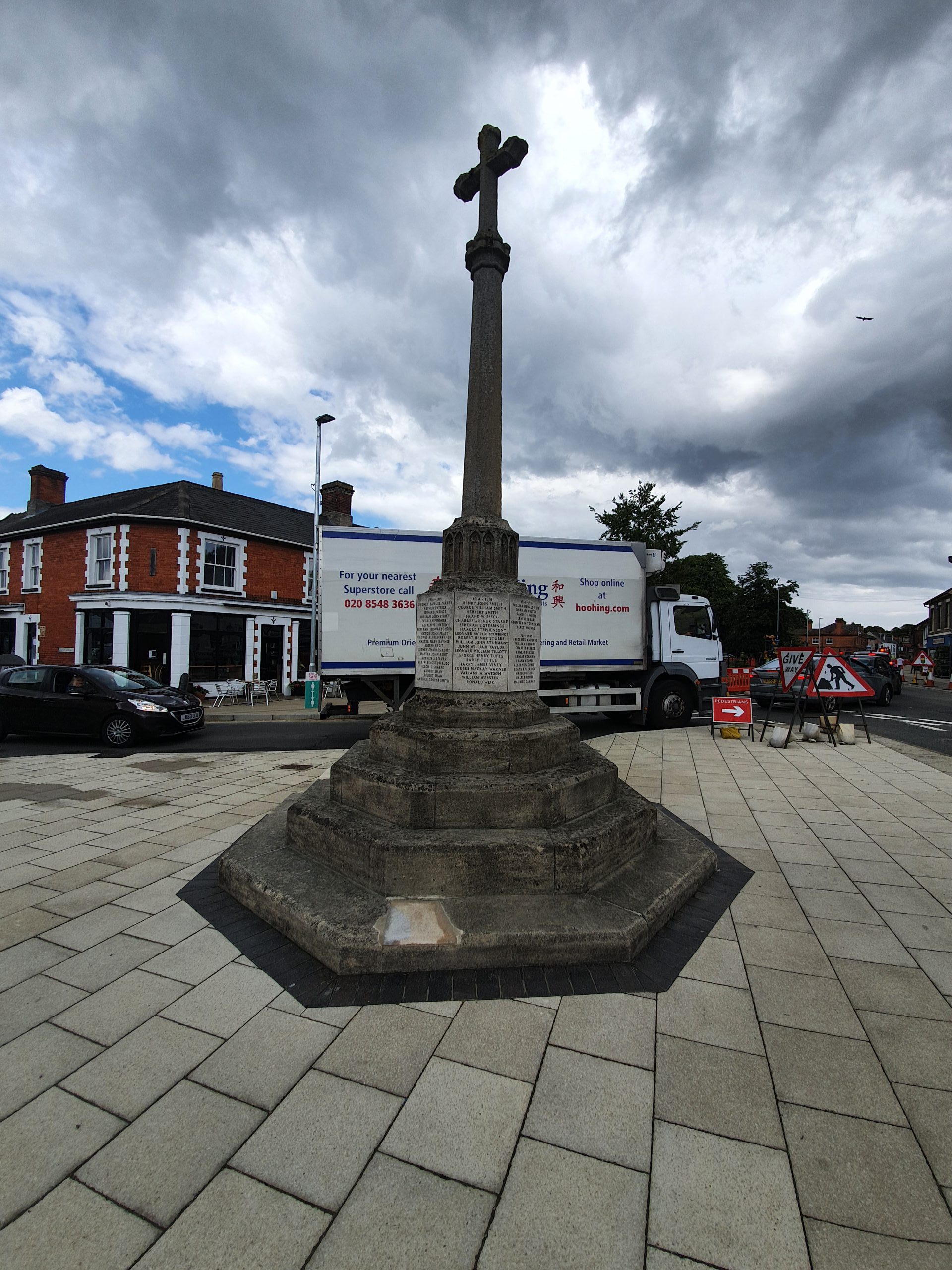
The war memorial in Attleborough, located at the end of Queen’s Road, was designed by local sculptor AJ Harrison at a cost of £350, which was funded by public subscription. The memorial was unveiled on 27 June 1920 by Earl Albemarle at a ceremony attended by the Bishop of Norwich, which followed a service at St. Mary’s Church. Former servicemen and relatives of the dead walked to the memorial from the church whilst the Norfolk Regiment band played Beethoven’s Funeral March. At the end of the service, the Regiment band played Chopins’s Funeral March and finally, a bugler played the Last Post
There are 101 names on the 20-foot high memorial from the First World War, with 24 names added following the Second World War and an additional name from the Korean War. The full list of names of those who died during the First World War is at the base of this post, below the photos of the memorial below.
Barnard, Bertie
Beckett, Leonard
Bishop, Robert Sidney
Blaxall, Ernest William
Briggs, Elijah Samuel
Briggs, Percy William
Britnell, William Edward
Butcher, William Clarence
Chandler, Herbert
Chaplin, Charles Edward
Chapman, Bertie R W
Chapman, George Henry
Clarke, Alfred Bruce
Codling, Sidney F W
Coe, Cornelius Robert
Crummett, Frederick E
Cubitt, Terence A K
Dagless, Alexander
Dagless, Philip
Daynes, Albert
Daynes, Frederick John
Dunnett, Percy A
Dye, John William
Eagling, Arthur Walter
Edwards, Harry Ambrose
Edwards, John
Elvin, Ernest Robert
Elvin, Syndey James
Elvin, Wilfred Harold
Etteridge, Robert W
Fincham, Walter William
Forster, Philip James
Forster, Sidney Percy
Gapp, Sidney Jack
Gooda, Ernest George
Gould, Edward
Griffin, Arthur William
Griffin, William Albert
Halls, Frederick William
Hawes, Albert William
Hillier, Frederick William
Hilton, William Charles
Holman, William James
Howlett, Harry
Hunt, Arthur
Hunt, Ted
Hunt, William
Johnson, Robert Frederick
Lain, Frederick
Lain, John
Large, John Gerald
Laurence, Alfred
Lenney, George J W
Lincoln, Charles
Lincoln, Edward
Orford, Lancelot E
Ottaway, Walter James
Parker, Sydney Samuel
Patrick, Arthur
Patrick, Edward
Piercy, William John
Pinnock, William
Plumpton, Alfred
Ponder, Bertram Thomas
Pratt, Victor John
Rayner, George Alfred
Rayner, Walter Filby
Redit, Joseph
Redit, Sidney Charles
Redit, Walter John
Reeves, Arthur J
Rudd, Henry Reginald Wallace Kingston
Sharpe, Cecil G
Shaw, Albert
Shaw, Robert
Smith, Arthur George
Smith, George William
Smith, Henry John
Smith, Herbert
Speck, Frank W
Starke, Charles Arthur
Stebbings, Bertram E
Stephenson, Harold
Stubbings, Leonard Victor
Stubbs, Robert Henry
Sturman, William John
Taylor, John William
Tillott, Leonard William
Tufts, George Henry
Tuttle, Harry
Viney, Harry James
Warner, Forbes Mackay
Watson, Valiant A
Webster, William
Weir, Ronald
Weir, William Oswald
Welton, Norman
Woods, David E H
Yari, Ernest H
Youngman, Geoffrey W
Youngs, Percy
On this map of Attleborough from the early twentieth century, there’s B Gd. marked, or Burial Garden.
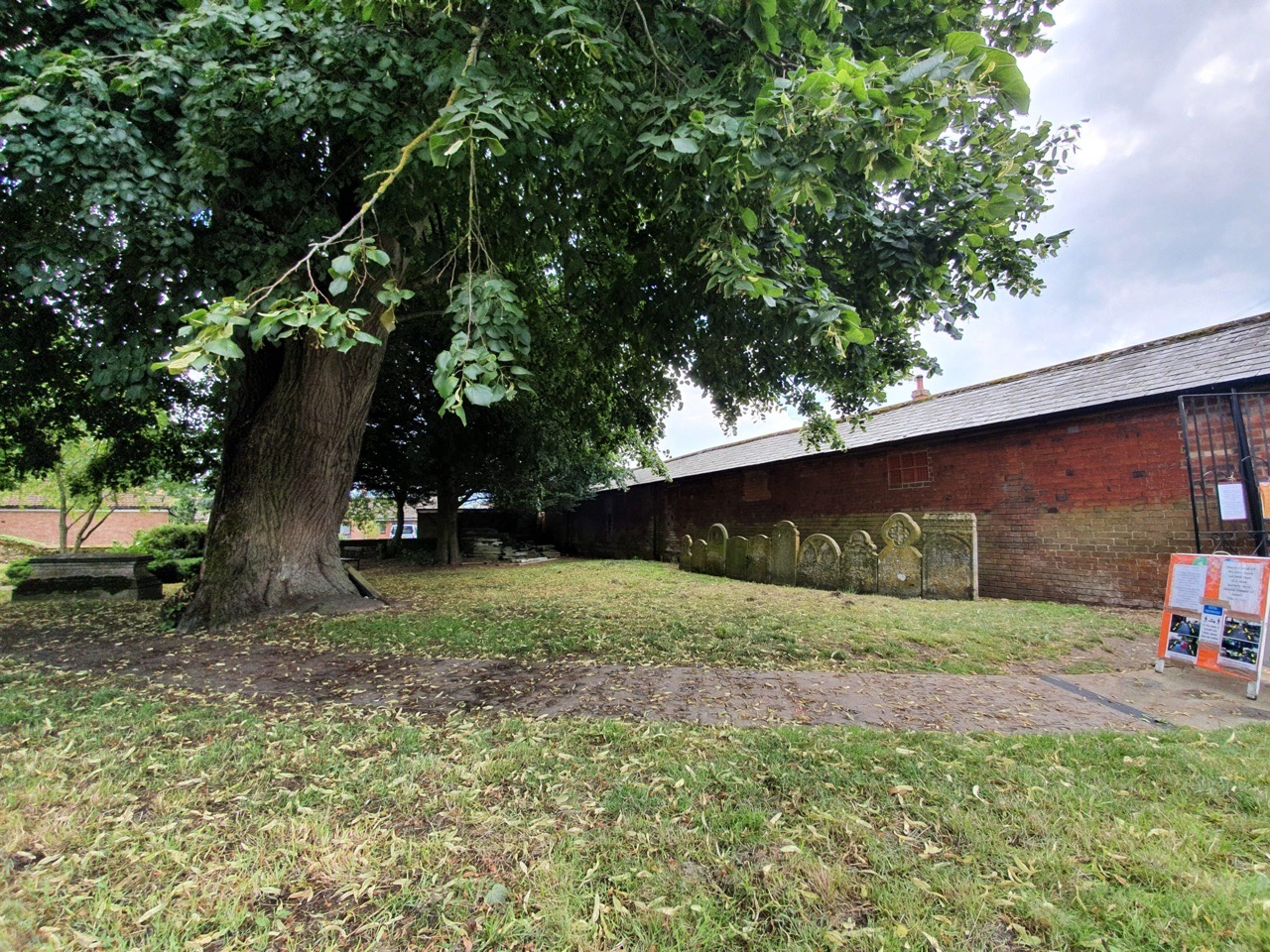
I didn’t add much to the debate on how Thieves Lane got its name, but one legacy that remains along it is the burial garden that remains along the road. The Wesleyan Methodist church opened here in 1809 and in the following year, this graveyard was laid out. The church built new premises nearby in 1872, on Station Road, leaving just the graveyard behind in a similar manner to that in Swaffham.
Today, the graveyard is a public park following its formal closure in 1991 for burials.
Most of the graves have been placed by the wall of the neighbouring building.
I like street names such as this, they sound like they have some interesting heritage. The book “the Newmarket, Bury, Thetford and Cromer Road” from 1904, which is intriguing in its own right, just makes reference to this being where thieves may once have preyed on locals. But, it’s clear the author probably doesn’t know. And, I can’t find anything else about this beyond it probably being an area where some crimes had been committed long ago, giving it a bad reputation.
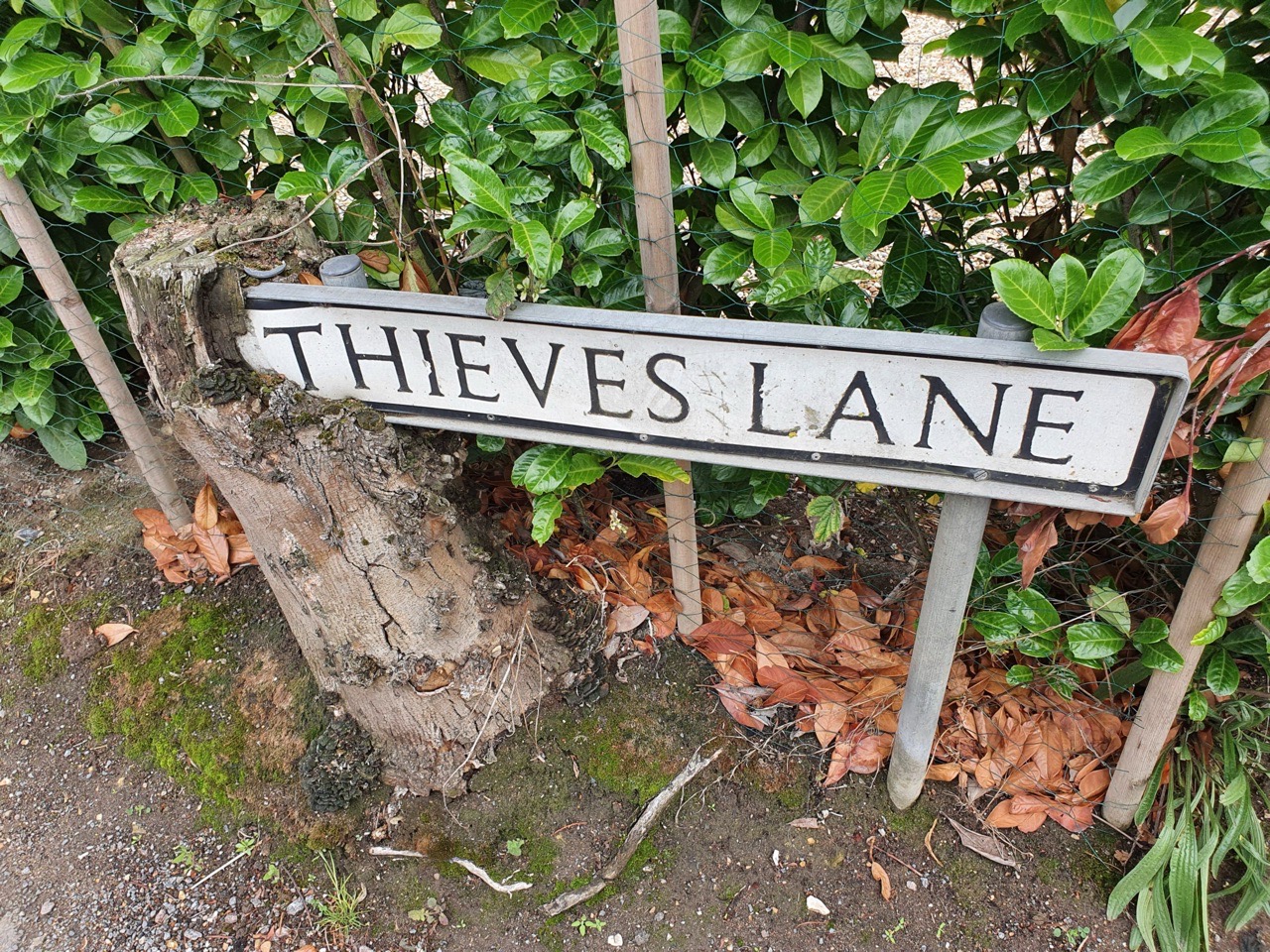
The tree seems to have partly consumed the sign.
And the dangerous lane…. It’s not the most prestigious of road names to live on, but it’s memorable at least.