Author: admin

  • Martham – War Memorial (Beryl Applegate)

    Martham – War Memorial (Beryl Applegate)

    Beryl Applegate was one of ten names added to the village’s war memorial following the end of the Second World War, a twelve-year old girl who was killed during an air-raid. Beryl was injured during an air-raid which took place on 4 September 1940 and she died two days later at the Norfolk & Norwich Hospital. The local press reported the funeral, although noted that Beryl was aged 10, writing that during the service the hymn ‘There’s a friend for little children’ was sung. The funeral was well-attended, including by Beryl’s friends from school and her teacher was also present. Beryl lived at 14 Council Houses (a development of properties on Somerton Road in the village which were built in 1925), and the paper noted that at least one resident from every house on this street was present at the funeral.

    Beryl was the daughter of Charles Applegate (born on 25 September 1898) and Phoebe Applegate (born on 24 October 1900). Charles worked as a farm labourer and Phoebe was a housewife, with the 1939 register noting that they lived with their three children, Frederick (born on 14 June 1924) who was already working as a farm labourer, Beryl (born on 13 March 1928) and Roy (born on  22 February 1930). There are also two other people listed as living with the family, likely two younger children, but these names are redacted from the register as they’re either still alive or were living relatively recently (one of them hasn’t been very well redacted, so I can see it was a male born on 22 June 1932).

  • Dictionary of the Vulgar Tongue – Day 103

    Dictionary of the Vulgar Tongue – Day 103

    The Dictionary of the Vulgar Tongue was first published at the end of the eighteenth century, and given that the current health crisis is giving too much time to read books, I thought I’d pick a daily word from it until I got bored….

    Dewitted

    The dictionary defines this as “torn to pieces by a mob, as that great statesman John de Wit was in Holland, anno 1672”.

    This story has recirculated in recent months and years and the above meme was shared widely on-line. Johan de Witt was the Grand Pensionary of the Dutch Republic between 30 July 1653 and 4 August 1672 and, in effect, he was indeed their Prime Minister. The Dutch had experienced a bad year in terms of international diplomacy and worsening relations with the UK and France meant that the Prime Minister found himself in a weak position. A slightly rigged court case was set up by William of Orange and his supporters, which meant that de Witt was imprisoned and sentenced to exile.

    With the local population upset and ready to attack, De Witt and his brother were assassinated by the mob and their bodies were mutilated and hung up. Their livers were cut out and were then roasted and eaten by some members of the mob, with some suggestion that other parts of their bodies were eaten. So, unbelievably, the story which has circulated on the Internet is effectively true. The word ‘dewitted’ is still used to describe a lynching but, fortunately, most countries have a more democratic system of governance today.

  • British Airways – First 787-10 Arrives

    British Airways – First 787-10 Arrives

    There’s not much exciting news in aviation at the moment, although the arrival of G-ZBLA into London Heathrow from Boeing’s base at Charleston is newsworthy. These aren’t good times for Boeing, and I’m not entirely convinced by their recent aircraft, but this is the belated arrival of BA’s first 787-10. This was meant to be a glorious new aircraft for BA, fitted with their new Club Suites and deliberately with four-cabin service at a time when First is being removed from some destinations, but the whole health situation at the moment means that this is tricky timing.

    There will be twelve of these aircraft to add to BA’s existing 787 fleet, with this first one expected to fly to Atlanta next week as its inaugural passenger flight. There are 256 seats on the aircraft, with 8 in First, 48 in Club World, 35 in World Traveller Plus and 165 in World Traveller. I suspect this configuration might prove to be a little too business heavy given current events, but there might be a sweet spot in terms of pricing for Club World seats to the benefit of passengers (I’ll be happy in economy though, I have cheap tastes).

  • Martham – War Memorial

    Martham – War Memorial

    Martham’s war memorial is located in the churchyard of St. Mary’s Church and was erected here in 1920, designed by F Perfitt of Stalham. It commemorated the 41 people from the area who were killed during the First World War, noting:

    “To the glory of God, the giver of victory and in memory of those of this parish who gave their lives for us in the Great War 1914 to 1919”.

    The 41 names are:

    Allen, Frederick
    Bracey, William
    Brown, Arthur
    Brunson, Frederick
    Brunson, John
    Dyball, Leslie
    Dyball, Lewis
    Futter, Robert
    Garman, Blanche
    Garman, Harry
    Guymer, William
    Hayton, George
    Hodds, John
    Johnson, Leonard
    Johnson, Ralph
    Knights, Harry
    Larter, John
    London, Henry
    London, Leslie
    Long, Elijah
    Mays, James
    Moore, Ernest
    Nichols, Edmond
    Rivett, Robert
    Sale, George
    Sims, Herbert
    Smith, Harry
    Starkings, William
    Turner, Alfred
    Turner, James
    Turner, Redvers
    Utting, Edward
    Utting, George
    Watson, Charles
    Watson, Ernest
    Watson, George
    Watson, Robert
    Wedge, Maurice
    Widdick, Herbert
    Wilkinson, Henry
    Youngs, Charles

    The Yarmouth Independent reported on 24 July 1920:

    “With all fitting circumstance and solemnity, Martham’s War Memorial was dedicated on Sunday afternoon. Glorious summer weather shone upon the ceremony. Remarkably impressive proceedings were heralded by a muffled peal on the church bells. A large number of ex-servicemen paraded on the Green, and marched to church, under the command of QMS Sumser. A troop of Boy Scouts from Winterton, under the lead of Scoutmaster Dyble, attended and assisted the police in keeping the entrance to the church. The beautiful church was crowded, even standing room being unavailable, and many remained in the churchyard.

    The names of the forty brave men and one noble young woman who made the supreme sacrifice were read out by Archdeacon Lisle Carr, vicar of Yarmouth, who also gave a touching and hopeful address, expressing the deep debt of gratitude to those who had fallen in a great cause, and also to those who had returned, and heartfelt sympathy with the relatives and friends of the departed, urging the thought of ‘what they had gone to’ rather than ‘what they had gone from’, and the inspiration to duty and noble sacrifice which the cross in the churchyard should be to both the present and future generations”.

    A further ten names were added to the memorial following the end of the Second World War, the names being:

    Cubit Armes
    Stanley Bean
    Robert Chamberlain
    Robert Durrant
    Reginald Frazer
    Harry Miller
    George Moll
    John Wiseman
    Frederick Woodrow
    Beryl Applegate (a young air-raid victim)

  • Martham – St. Mary’s Church

    Martham – St. Mary’s Church

    There was probably a church on this site in late Saxon times and a recent archaeological dig discovered the foundations of a round tower from the twelfth century. What stands today though is primarily from the late fourteenth and early fifteenth centuries.

    I must admit to being a little unimpressed with the printed ‘NO ENTRY’ paper signs that the church has placed on the locked porch doors. For those who had hoped to see when the church might be once again open for prayer, they weren’t informative nor did they offer any guidance to parishioners. Given that their web-site is telling people that the rector is once again available daily in the church, it all felt a bit unwelcoming.

    Known as “the Cathedral of the Fleggs” as it’s the grandest church in the area, the tower stands over 100 feet in height. The church’s original chancel was completed between 1456 and 1469 by Robert Everard, who also designed the spire of Norwich Cathedral. I would have liked to have seen this, but as it was falling down by the nineteenth century, it was replaced with an entirely new chancel between 1855 and 1861 which was designed by Phillip Boyce. Pevsner was impressed by the quality of the workmanship completed by Boyce, so that’s good enough for me…..

    It’s a slight shame that this red-brick building is stuck here under the tower.

    The tower itself has four stages and the floor was lowered in 1999, which must have been an interesting project and a chance to see the hidden history of the building.

    There’s an interesting article from 1858 about the restoration of the church, which gives a perspective of why the modernisation of the building was seen as important.

    “Martham church was once, many generations ago, a fine, indeed an extraordinary structure even amongst the many noble village churches of Norfolk, but the hand of time, and the still heavier hand of man, did much to impair its beauty, and to render nugatory that which art and taste had constructed. Massive, ill-contrived boxes, gradually usurped the place of seats, simple and light in appearance, and many exquisite productions of art, treasures in tracery, and beautiful specimens of carving, were ruthlessly buried amidst rubbish or covered over with the ‘improvements’ of some modern Goth, and lost, too many of them, for ever.

    Old seats were swept away, and cumbersome and heavy galleries soon disappeared. It was found that the original seats had been built over and upon and fine old relics in carving and tracery were recovered, and no less than fifty ancient and beautiful poppy heads were taken from their hiding places and set in their proper positions.”

    Much as I like seeing box pews, which can add much character and some depth to a church, the argument to remove them is also strong. Some of the poppy heads which had been damaged were altered during their repair process and they’re all still visible in the church today.

    This is another church that I’ll have to come back to in order to see the interior….

  • Dictionary of the Vulgar Tongue – Day 102

    Dictionary of the Vulgar Tongue – Day 102

    The Dictionary of the Vulgar Tongue was first published at the end of the eighteenth century, and given that the current health crisis is giving too much time to read books, I thought I’d pick a daily word from it until I got bored….

    Devil’s Guts

    This is defined by the dictionary as “a surveyor’s chain: so called by farmers, who do not like their land should be measured by their landlords”. The phrase goes back to at least the mid-seventeenth century, although it fell out of common usage in the nineteenth century.

    And it’s easy to see how the phrase evolved….

  • Fleggburgh – St. Mary’s Church Ruins

    Fleggburgh – St. Mary’s Church Ruins

    20200628_191217

    This is the path that goes to the ruined church of St. Mary’s near to the village of Fleggburgh, which is also known as Burgh St. Margaret. It’s common for churches to have public footpath networks around them, as that was a necessity for people to walk to church, but there has been no active church here for around 450 years.

    20200628_191409

    The church, or what’s left of it, was first built in the twelfth century and was remodelled in the fourteenth century.

    20200628_191446

    Inside the tower of what feels a slightly magical place, as although it’s near to a main road, it still feels that little bit desolate.

    20200628_191836

    And the outside of the tower, with a worryingly large crack.

    20200628_191550

    The arch between the tower and the nave.

    20200628_191803

    This is the north of the nave, the only substantial part of the church still standing other than the tower.

    20200628_191636

    The rest of the stonework is heavily covered in ivy.

    20200628_192129

    And photos of the church from the field. The church served the village of Burgh St. Mary, but this settlement became smaller and has mostly now entirely disappeared. The church’s last recorded rector was in 1554 and it’s known that the church was in ruins by the beginning of the seventeenth century. That it’s lasted for 400 more years is quite impressive and although some stone has been robbed, it’s likely that this was some considerable time ago.

  • Dictionary of the Vulgar Tongue – Day 101

    Dictionary of the Vulgar Tongue – Day 101

    The Dictionary of the Vulgar Tongue was first published at the end of the eighteenth century, and given that the Coronavirus crisis is giving too much time to read books, I thought I’d pick a daily word from it until I got bored….

    Dance Upon Nothing

    There are quite a few definitions in this book which aren’t particularly cheery and this is another, being defined as “to be hanged”. This was sometimes used in a precautionary sense, so children might be told to behave, or they’d be doing a ‘dance upon nothing’ later in their life. There are other slightly more colourful phrases with the same meaning, such as the ‘Tyburn Jig’ and the ‘Paddington Frisk’.

  • LDWA 100 – Podcasts

    LDWA 100 – Podcasts

    This is a little bit of a holding page at the moment, but this is where we’ll put links to the podcasts that we’re doing for all of our training walks. The index to our plan to walk the 100 is at https://www.julianwhite.uk/ldwa-100/.

    Before I start, a quick few words of explanation. The production standard on these isn’t great, we don’t know what we’re doing with audio and the content isn’t exactly Terry Wogan quality. We also don’t think our first efforts are really that exciting either, but the only way we can make them a bit better is to start doing them. So this is our best effort  🙂

    There will also likely be a delay between the blog of a walk being posted (that’s much easier) and the podcast. This is primarily as we have to find time to record it and then for our professional sound engineer (Nathan) to publish them.

    Oh, and we don’t have a podcast name yet either. Suggestions welcome, although it’ll be something like from 0 to 100, but perhaps with an edgier tone to it. There’s a limit to how edgy we can make these things though…


    INTRO: https://drive.google.com/file/d/1kSmJWQnbBUf2HxpDO-K0kYzgZeZJi5xC/view?usp=sharing

    An introduction to what we’re doing.

    WALK ONE: https://drive.google.com/file/d/1tBrprrhtnak_nXk00eYwTj65Vbr9iRKO/view?usp=sharing

    The podcast that goes along with training walk one.

  • LDWA 100 – Training Walk 5 (Rockland St. Mary to Norwich Railway Station)

    LDWA 100 – Training Walk 5 (Rockland St. Mary to Norwich Railway Station)

    The main page for this walk is here, this blog post is just the section from Rockland St. Mary to Norwich Railway Station.

    This photo is really just for Leon. DIGGER!

    So, we’d now reached Rockland St. Mary and that’s Rockland Staithe, meaning that we’d completed 28 miles of the walk and it was 19:30.

    From this time of the evening, the lighting started to work well for photos.

    The beer garden of the Surlingham Ferry.

    This was the final stretch of walk along the river and we were a little nervous that it might be just slightly overgrown in places and we could do with being stung by nettles. It actually proved to be fine, but by now, general fatigue was starting to creep in as we went past the 30-mile mark.

    It was true that we were tired, but these were some beautiful views.

    This is the RSPB reserve at Surlingham.

    Saint Mary’s in Surlingham and by this stage, this was as near as I was prepared to go as I didn’t want to add on any extra distance to walk around it taking photos. Interesting round tower church, I’ll go back there at some point.

    This looks narrower in the photo than I remember it.

    Some of the photos as it started to get dark, I’m still very pleased by my new (well, relatively new) phone camera.

    This is Billy Bluelight, the nickname of William Cullum (1859-1949) who here is decked out in his protective equipment. I’ll write more about him another time, as he’s an important local figure, but the salient point here is that he was known for his running. He’d run up and down the riverside path and offer a race to those on boats, claiming he could get there faster. He usually did manage to get there faster and would be rewarded by pennies and beer. And perhaps, this is a new summer job for Nathan. He could sit at the pub and offer to run up and down the path in reward for a pint at Reedham.

    The statue is at Water’s Edge in Bramerton.

    I don’t think Nathan will mind me saying that by this point, he was struggling a little, but his achievements in getting this far were still remarkable for someone who hasn’t done long-distance walking. I didn’t help by telling him there were no more fields, then there was this one that I’d forgotten about. I also made a slight navigational error, although fortunately we worked it out quickly and so only went around 20 metres wrong.

    As can be seen, it was starting to get just very slightly dark. This photo was taken along Whitlingham Lane, which I’ve walked down many times and it just seems to go on and on…..

    By this time, we were well and truly looking forwards to getting back home, this is Riverside in Norwich.

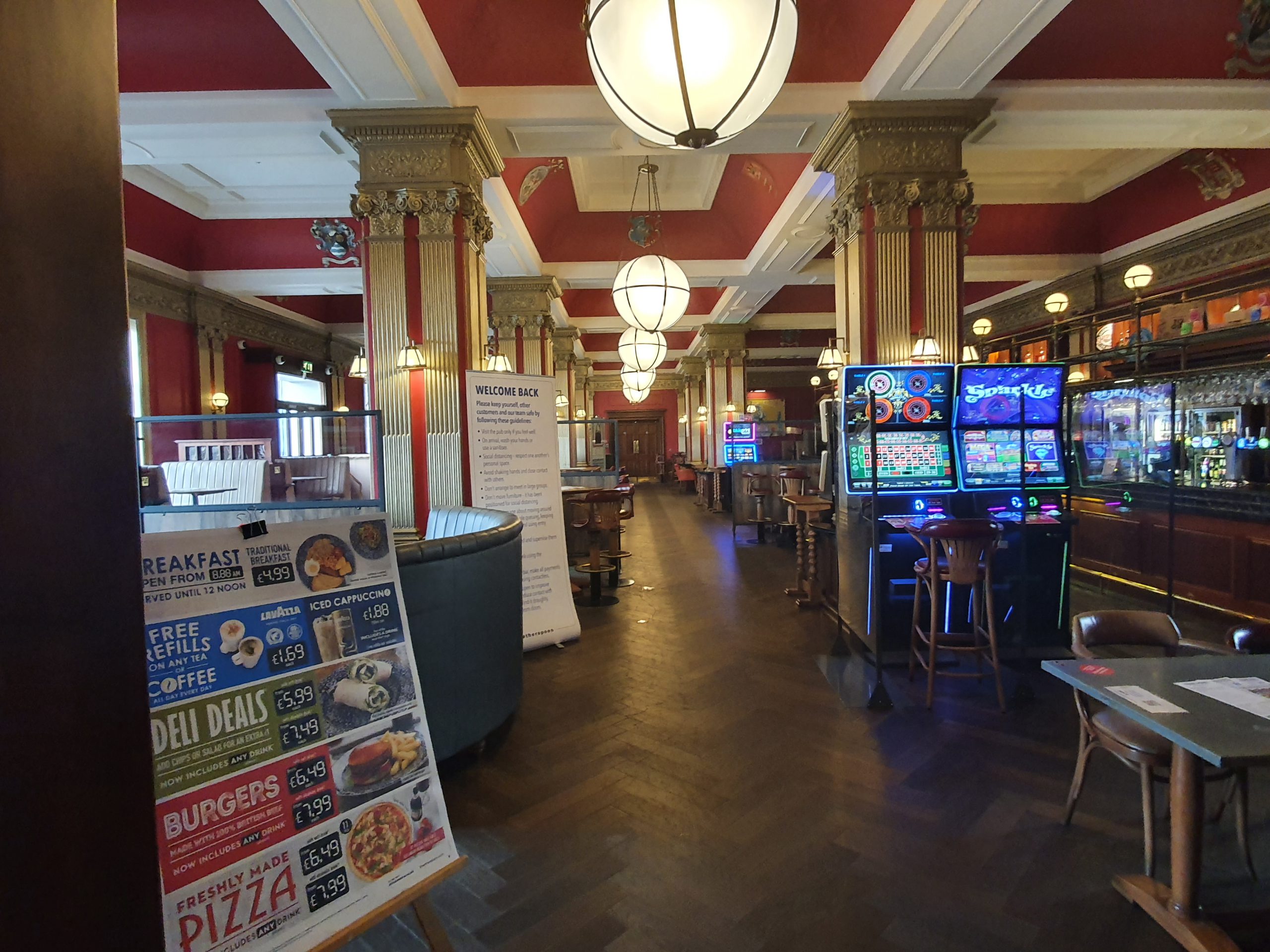
    The Queen of Iceni pub in Norwich, operated by JD Wetherspoon, where the partitioning for their re-opening is already mostly in place.

    And, this was the end, Norwich Railway Station, which we reached at 22:55, so we had beaten our target of 23:00 which we’d set a few hours before. Nathan was only moderately annoyed to see that there were no taxis at the railway station, which meant he had to walk home, adding another mile onto his route. I was pleased to only have a walk of half a mile back home.

    So, did we enjoy it? Speaking for myself, the last ten miles weren’t the easiest, although I was in no pain and had absolutely no feet problems. For someone who gets blisters, this was very important and gives me lots of confidence for the 100. And writing this a couple of days on, and after checking with Nathan, we absolutely did enjoy it and want to do similar distances again. There’s a strange thing about these walks, there are times when they are a nightmare and you ask yourself why you’re not at the pub (well, obviously that’s an easy one to answer at the moment, but my point is more general), but when they’re over and you look back, there’s a certain fondness to the whole arrangement.

    The highlights for me of the day were going on Reedham ferry for the first time, being delighted when sheep moved out of the way early on (thereby not attacking us), as well as having a beer in Loddon/Chedgrave (I get them muddled up). The walk was 37.87 miles (although Nathan and I did around a mile each outside of this to get to and from home) and it took 13 hours, 46 minutes and 32 seconds. That’s an average of 21.49 minutes per mile and a burn of 3,537 calories. The highest elevation during the walk was 50 feet (who says there are no hills in Norfolk?) which was towards Norwich and the lowest elevation was apparently -43 feet a few miles from Norwich. I have no idea how accurate those statistics are.

    Unlike Nathan, I don’t pause Runkeeper when we break, so his time splits are more useful as my timings include breaks. However, we started off doing around 18 minutes per mile, slowed down by vegetation a bit and then we returned to those sort of times. Our fastest mile was thirteen miles in, when we achieved a mile in 16 minutes and 53 seconds.

    Particular credit to Nathan for this, as he was having to power through, but our last three miles were done in an average of 17 minutes and 30 seconds (indeed our second-fastest mile of the day was the 37th mile at 17 minutes and 15 seconds) so we made one hell of a pace towards the end. Of course, we could have speeded this all up by not having as many breaks, but they’re part of the fun of a walk like this and we were never that focused on the time, as long as we were back by midnight. The least exciting part was the problems we had with a rash from the vegetation that we had ploughed through, which wasn’t ideal.

    So, all told, this was a suitably exciting adventure. I think we’ll do this again……