Author: admin

  • Swaffham – Church Rooms

    Swaffham – Church Rooms

    This quite imposing building dates from 1838, when it was built as Swaffham’s national school. It was designed by William Donthorne (1799-1859), a notable Norfolk architect who had been born in Swaffham and he also designed Cromer Hall, elements of Felbrigg Hall and Aylsham Workhouse. The national schools were established by the National Society for Promoting Religious Education, which taught religion along the Church of England lines, and from 1833 the Government provided grants for the running of these schools.

    There was a treat for the children on New Year’s Day 1839, when the new school held a celebration dinner to mark the opening of their new building. The local press reported that there was “an excellent dinner of beef and plumb pudding, provided for them by the inhabitants of the town. It was gratifying to witness the interest taken by the company present on this occasion, and great merit is due to those individuals who so kindly exerted themselves in providing this treat”.

    The building was converted in the twentieth century into church rooms and they remain in use for this purpose today.

  • M&S – Sparks Loyalty Scheme

    M&S – Sparks Loyalty Scheme

    In another of my irrelevant content posts, the new loyalty scheme from M&S was introduced today. The company has been busy trailing the news that shoppers would be given free gifts, and they were specifically mentioning Percy Pigs.

    I got a pastry. No Percy Pigs….. And a free tote bag next time I visit. I’m sure the pastry will be delicious, but it’s not a pack of Percy Pigs.

    On the bright side, they had some of the packs of Percy Pigs reduced to 45p, so I got some anyway. That’s what I call a successful shopping trip. Given that this was the highlight of my afternoon, I’ve decided that I need to get out more……

  • Norwich – Cathedral Gates

    Norwich – Cathedral Gates

    I’m not sure that I can recall a time when the Erpingham and Ethelbert Gates have both been closed in the evening, I wonder whether it’s related to the Nelson statue incident.

  • Swaffham – Whitecross Road Baptist Burial Ground

    Swaffham – Whitecross Road Baptist Burial Ground

    There’s a burial ground, looking a little out of place today, located just to the left of where mortuary chapel is marked on the above map. The first Baptist church in Swaffham was opened in August 1823, with the burial ground next to it. The Baptists outgrew their church relatively quickly, building a new church on Station Street in 1860, which is still in use today.

    The burial ground on Whitecross Road remains, a relatively small affair but it’s organised and tidy, although there haven’t been any new burials here since 1979.

  • Dictionary of the Vulgar Tongue – Day 113

    Dictionary of the Vulgar Tongue – Day 113

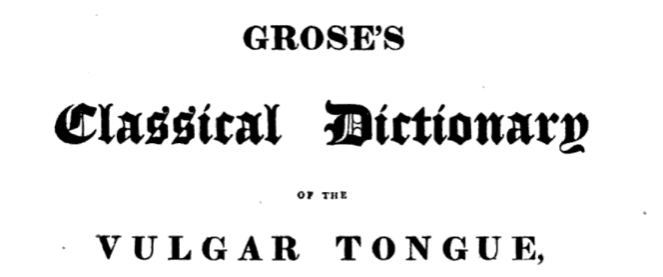
    The Dictionary of the Vulgar Tongue was first published at the end of the eighteenth century, and given that the current health crisis is giving too much time to read books, I thought I’d pick a daily word from it until I got bored…. Incidentally, this word is out of alphabetical order compared to the previous days as that’s where it’s located in the dictionary.

    Die Hard

    Although I’ve heard this phrase often, primarily due to the film name, I’ve never known what it really means. But, the Grose’s dictionary has the answer, it’s defined as “to show no signs of fear or contrition at the gallows; not to whiddle or squeak. This advice is frequently given to felons going to suffer the law, by their old comrades anxious for the honour of the gang”.

    Over time, the word meaning has shifted away from death at the gallows, to mean instead remaining fixed on a viewpoint and not changing. Word origin for this meaning is from the mid-nineteenth century, which flows nicely from the original meaning of the phrase in the eighteenth century.

    The Wikipedia article at https://en.wikipedia.org/wiki/Die_hard_(phrase) is thus partly nonsense, they’ve got the first usage of this word as being after the publication of Grose’s dictionary.

  • Swaffham – Railway Station (Approach from King’s Lynn Direction)

    Swaffham – Railway Station (Approach from King’s Lynn Direction)

    Just photos in this post. I wondered if it was possible to walk from Swaffham railway station towards the former King’s Lynn section of the line. Interestingly, the last section between East Winch and King’s Lynn is still in place for freight, so a line could be restored to Swaffham if there was ever a desire to do so. Unfortunately, the railway station section in Swaffham is built on, meaning any new station would have to be relocated.

    The railway station is just ahead in this photo, but the path stops here and people have to walk to the left back to the nearby road. Below are photos in the other direction, where it’s all clear. With few obstructions, the trackbed is still in place and could be put back to King’s Lynn, but then there’s the problem that it would have to bypass Swaffham if the lines carried on to Dereham. Which would then cause the problem that the last section of the line from Swaffham to Dereham is now buried under the A47. The cost of fixing this, for the volume of rail traffic it would generate, is sadly likely though to be just too high.

  • Swaffham – Railway Station

    Swaffham – Railway Station

    Unfortunately, there’s no railway station left in Swaffham now serving the transport needs of the local population. Going back before the station was closed in 1968, there were services from Swaffham to King’s Lynn (via East Winch, Pentney & Bilney and Narborough & Pentley), from Swaffham to Dereham (via Scarning, Wendling, Fransham, Dunham and Sporle) which in turn connected to Norwich and Wymondham and from Swaffham to Thetford (via Holme Hale, Watton and Stow Bedon). It’s true that the Swaffham to Thetford line wasn’t that busy, but the line through from Norwich to King’s Lynn would have been enormously useful if it had been left open.

    I’d never gone to look to see what remains at the site now, but the railway station is still there and converted into office use today. There are lots more photos of the station over the decades at http://www.disused-stations.org.uk/s/swaffham/.

  • Swaffham – White Hart

    Swaffham – White Hart

    I’ve never been to the White Hart in Swaffham, perhaps I’ll go as part of the Government’s new 50% off meals in August….. Anyway, I like their sign. I’ve seen similar signs on-line and I’m sure someone else probably did it first, but I still like it.


  • Swaffham – Town Sign

    Swaffham – Town Sign

    Swaffham’s town sign features the Pedlar of Swaffham, a story that I wrote briefly about before in my ‘riveting’ post about St. Peter and St. Paul Church. The sign was carved in 1929 by Harry Carter (1907-1983) and it has been repainted in different colours at some point over the last decade, for reasons unknown.

    The text at the base reads “ye pedlar of Swaffham who did by a dream find a great treasure” and on the reverse “ye tinker of Swaffham who by a dream did find a great treasure”.

    Sam Knox at en.wikipedia

    This is the same town sign that was amended to be used in the television programme Kingdom, based around the fictional location of Market Shipborough.

  • King’s Lynn – War Memorial (Harry Leonard Aldren)

    King’s Lynn – War Memorial (Harry Leonard Aldren)

    Harry Leonard Aldren is one of the names on the war memorial in King’s Lynn.

    Born Henry Leonard Aldren on Saturday 18 December 1897, he was the son of Robert Aldren who worked as a carman and Mary Aldren. He was baptised on Thursday 13 January 1898 at All Saints church in South Lynn and the family lived in Gaywood.

    The school log exists of when Harry went to school at St Michael’s Church Of England School in South Lynn, which was on 3 October 1904. His family lived at the time at 10 Southgate Street and he remained at the school until 8 December 1905 when the records appear to suggest he went to school in Hunstanton. The school’s records are also a little wrong, they have him born on 18 December 1898.

    Any record from Hunstanton doesn’t seem to exist on-line, but the school log of Harry’s next school also exists, when on 22 October 1906 he went to St. Margaret’s National/Church Of England School in King’s Lynn. At that time, Harry and his family were living at 24 Albert Street and he remained at the school until 30 November 1911 when it was noted that he had left having found work.

    At the 1911 census, Harry was living at 8 Harrod’s Place, Providence Street in King’s Lynn with his mother Mary, who was listed as a widow. He was also living with his siblings Margaret (born in 1887, worked as a cook), Robert (born in 1889, worked as a farm labourer), Isabelle (born in 1891, worked as a general servant), John (born in 1896, worked as an errand boy), Edith (born in 1900, still at school), Bessie (born in 1903, still at school) and James (born in 1908).

    Harry joined the Norfolk Regiment to fight in the war, with service number 203713. He became a private in the 10th battalion of the Essex Regiment and changed to service number 203034, but he was sadly killed on 31 July 1917. His body was never found, but this was the first day of the Battle of Passchendaele, one of the bloodiest battles in history. Harry likely died at the Battle of Pilckem Ridge, the first stage of Passchendaele, which was where the 10th battalion was present.

    Harry is commemorated on panel 39 of the Menin Gate war memorial, a location I’ve been when they play the last post every evening, a haunting reminder of what happened in this area. He is listed as being 18 when he died, although he would have been 19. There are so many little bits of information wrong with regards to his service that I started to think there were two people of the same name, but I can’t imagine that’s likely. Harry’s service records also aren’t available, likely in the vast number that were burned following an air raid in the Second World War.

    Something appears to have also gone wrong though with the information provided by the Commonwealth War Graves, who list his next of kin as Robert and Hilary Aldren of 8 Harrod’s Place in King’s Lynn. I’m assuming that Hilary is just a mis-spelling of what was meant to be Mary. On a side note, and for a separate story, Harry’s brother John was also killed during the First World War.