Author: admin

  • British Airways – Buy Aircraft Stuff

    British Airways – Buy Aircraft Stuff

    I quite like this press release that British Airways have just sent:

    “For the first time in its history, British Airways has decided to unlock the doors to its warehouse this Christmas to give customers and aviation fans the unique opportunity to get their hands on items from British Airways aircraft which have circled the globe hundreds of times. Although an at-home experience is no match for the real thing, customers and collectors can order bespoke British Airways inflight dining items such as William Edwards plates, soup bowls, cups, saucers and even a butter dish for reasonable prices, allowing them to create an authentic First Class flying experience at home over the festive period.

    Those who want to take it a step further can pick up bread baskets, hot towels (which naturally arrive cold), hot towel plates, champagne flutes, coasters and even the Club World casserole dish. After they’ve dined in style, customers can relax in slippers and a day blanket which are also on sale, as they settle down to watch their favourite film or TV show on their at-home inflight entertainment system (their TV).

    And for anybody looking for the ultimate Christmas gift, for a limited time there is the opportunity to purchase a piece of history with items such as aircraft trolleys and canisters taken from the Boeing 747, which British Airways has now fully retired.”

    I quite like the idea of having an aircraft trolley, although it’s not really an ideal purchase in terms of the space and I can’t say that it’s an essential buy. I suspect that this will be a popular idea and lots of items seem to have already sold. Not sure on who will buy the hot towels, but there we go….

    For anyone who wants to buy BA stuff, the web-site is at www.whatabuy.co.uk/british-airways…..

  • Dictionary of the Vulgar Tongue – Day 226

    Dictionary of the Vulgar Tongue – Day 226

    The Dictionary of the Vulgar Tongue was first published at the end of the eighteenth century, and given that the current health crisis is giving too much time to read books, I thought I’d pick a daily word from it until I got bored….

    Nokes

    This is one of Grose’s more verbose definitions, which is “a ninny, or fool. John-a-Nokes and Tom-a-Stiles; two honest peaceable gentlemen, repeatedly set together by the ears by lawyers of different denominations: two fictitious names formerly used in law proceedings, but now very seldom, having for several years past been supplanted by two other honest peaceable gentlemen, namely, John Doe and Richard Roe”.

    The interesting element here (and, yet again, I know that I need to get out more….) is the use of these names in the legal system. John Doe is used extensively in the US today, Richard Roe as well but much less frequently, whilst Nokes and Stiles seem rarely used anywhere.

    Google Ngram shows the more recent regular use of John Doe, with the Nokes and Stiles names not even registering at all, which isn’t surprising, as they were more used in the seventeenth and eighteenth centuries. Such is history though….

  • Hainford – All Saints Church (the old one)

    Hainford – All Saints Church (the old one)

    This is the old All Saints church in Hainford, with a replacement new building having opened in 1840 about half a mile away, nearer to where the new community was located. There was a fear that congregations might flock to alternative Christian churches and indeed, near to the new church the Wesleyan Methodist Chapel was being built. So, this old church was abandoned.

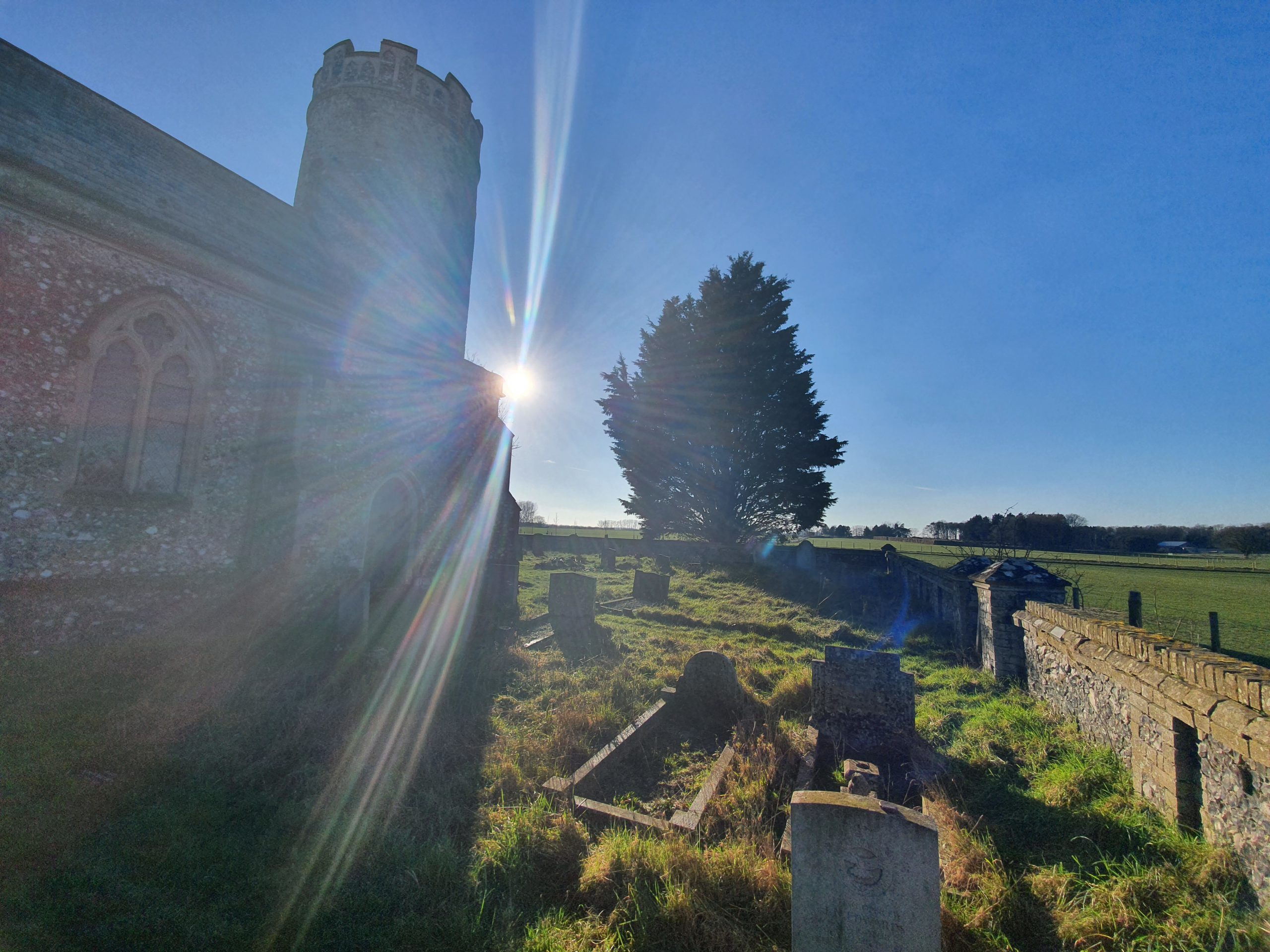
    This ivy and tree foliage means that this glorious church is likely now in its death throes, it’ll last for some time yet, but the damage being done here will eventually be fatal for the structure of the tower.

    The damage being done to the building is evident, with missing stones and foliage which is firmly attached to the church.

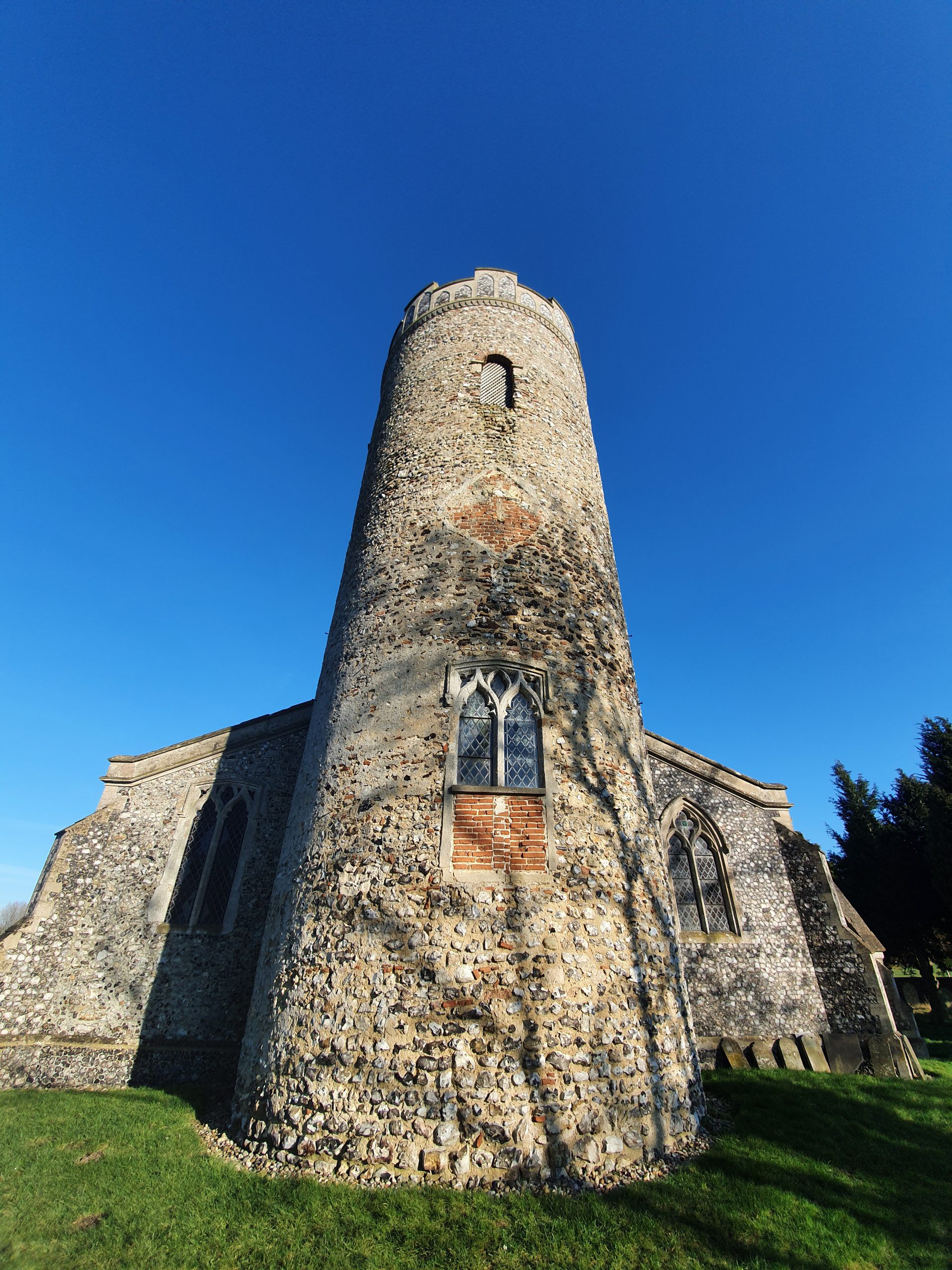
    And the tower, which dates to the late fifteenth century, is also slowly starting to fall down. The old line of the nave roof is still visible and underneath that is where the Victorian mortuary chapel was added after the former section of nave was removed.

    This tombstone is from the seventeenth century and this is an incredibly rare sight in a Norfolk graveyard, as even eighteenth century gravestones are relatively rare. But, this stone was once inside the church and is lined up with where the nave of the church once stood. I’m not sure what William would have thought of this, he was likely a rich benefactor who thought his body would remain inside the church forever, not end up like this.
    All around the tower is foliage, it hides the mortuary chapel which John Brown added here. It’s not clear exactly when the nave and chancel were removed, but I imagine that it was removed around 1840 under the supervision of Brown, if it’s correct that he was in charge of adding the mortuary chapel. It also seems that some nearby buildings use stone from the old church, so this must have been flogged off at the time (or recycled, whichever word you prefer).

    This church remained in use until the new one was opened in 1840 and the graveyard here is still in situ. There’s a better photo of the mortuary chapel, by the wonderful George Plunkett, which was taken in 1965.

    The comments from the internal report by the Church of England, noting Brown’s mortuary chapel which was added on to where the nave once stood. This internal note also mentions something else interesting, relating to the foundations of St. Mary’s Church in Hainford, which was once in the same location. At a quick glance, I can’t find out anything about this (and the old tithe maps give no clues), but it might solve a mystery about why the churchyard is so large.

    I usually like the idea of restoring churches, although the Church of England seems to have muddled views on this. It’ll spend a fortune fiddling about with using the exact stones on a window repair, but then abandon a building a few years later if it suits them to do so. I’m thinking about Bixley Church here….. The collapse of churches such as Bixley and Sco Ruston is recent though, the damage done at Hainford is getting on for two centuries ago. It would be ludicrously expensive for this church to be repaired, even restored to the basic tower that there is at Panxworth, so this will always be a ruin. But, it’s still beautiful and I very much like it, and although it’s not ideal that nature is overtaking the structure, it does give it even more character.

  • Hainford – All Saints Church (the new one)

    Hainford – All Saints Church (the new one)

    On the church spotting mission that Richard and I are undertaking, this looked confusing to me as it was clearly Victorian and almost felt like a Catholic church. It is though one of the early Victorian churches, designed by John Brown (there’s a plan from 1837 of this church here) built between 1838 and 1840. The old church is around half a mile down the road, but more on that in another post.

    The intention of building this church was to have one nearer to where people actually lived in Hainford, as the older church had become a little detached from the community that it served. And, it was also falling down and that’s not ideal.

    One thing that I’d like to know is what the parishioners thought at the time. I can’t engage with this building, even though it’s 180 years old and is perfectly well-built, it lacks character to me. There are no burials in the churchyard, as they’re still at the old church, so it’s more of a chapel at ease in many ways. A correspondent to the Norfolk Chronicle wrote in 1908 about some churches in the area, adding about this one:

    “There is not much of interest at Hainford, the church only dating from 1840, when it was erected at a cost of £1,200 in place of an older building of which only a part now remains”.

    Most of the money for the building of the new church was funded by the Incorporated Church Building Society, but other contributors included the Norwich Diocesan Church Building Association, the Rev. WAW Keppel (the rector) and the Rev. J L’Oste. Indeed, the rector donated a large sum of money, suggesting he was very much in favour of the plan.

    This is from the files of the Church of England, from the 1960s, giving information about the two churches. I’m not sure that the author was that engaged with the new church either, it’s a very technical description of the church. More on what was written about the old church in another post though.

    One element I find slightly strange is that I can’t find much (indeed, I can’t find anything) in the newspapers of the time that is particularly excited about the new church. There’s no mention of fund-raisers, bazaars and the like, which I’d usually expect, it’s just lists of who donated money to fund it.

    Anyway, the new church is no doubt very much part of the community and much loved, but perhaps it will architecturally much more interesting to future generations…..

  • Dictionary of the Vulgar Tongue – Day 225

    Dictionary of the Vulgar Tongue – Day 225

    The Dictionary of the Vulgar Tongue was first published at the end of the eighteenth century, and given that the current health crisis is giving too much time to read books, I thought I’d pick a daily word from it until I got bored….

    Noisy Dog Racket

    I can’t add anything at all to this definition by Grose, other than I think it’s interesting enough to worth noting. He defines it as “stealing brass knockers from doors”, a nod to his own sense of humour and the long-standing problem of brass being stolen.

  • Athelington – Name Origin

    Athelington – Name Origin

    I was quite intrigued by this village’s name and this is what The Concise Oxford Dictionary of English Placenames has to say about it….

    Athelington, Suffolk. Alinggeton in 1219, Athelinton in 1234 and Athelington in 1254.

    That’s a surprising consistent village name given the centuries which have passed. The dictionary then notes that the word origin is the same as the village of Allington in Derbyshire, which is “the tun of the Aelle’s people”. The ‘tun’ is an enclosure or farmstead and Aelle was an Anglo-Saxon leader from the fifth century, noted to be the first English king of lands south of the Humber.

    And, St. Peter’s Church at Athelington.

  • Athelington – St. Peter’s Church

    Athelington – St. Peter’s Church

    This church dates from around the late thirteenth or early fourteenth centuries, although was faffed around with a fair amount during the Victorian period. There was an article in the Ipswich Journal in September 1873 which noted that the restoration had meant that “the building looks like a new church with an old tower” and added “the building had been in a horrible condition, but is now one of the prettiest churches in the county”. As an aside, the author of that article (an Ipswich man it seems) struggled to find the village and reported that he got lost, adding that “the village cannot boast of having a public house or a beer house”, which must have been quite unusual at the time.

    The west tower with its external staircase visible and there were also some older gravestones in the churchyard, some from the eighteenth century.

    There’s no separate chancel, it’s all a continuous structure with the nave.

    The tower, which is mostly fifteenth century, was likely once taller and the top section has been knocked off, with a nineteenth century pyramid thing stuck on top. One improvement which was made, in my view, during the Victorian restoration was that this doorway was opened up again, as a previous generation had bricked it up.

    The listed building record notes that these corbel heads are nineteenth century, although I thought that they looked a little older.

    This flint porch addition is though more obviously from the nineteenth century and it replaced a wooden porch which it was thought at the time was contemporary to when the church opened. It’s a shame that such an historic structure has been lost for something that I think looks rather generic.

    The interior of the church was shut when we visited, although there are apparently some intriguing fifteenth century bench-ends still on the pews. The fourteenth century structure of the original roof is also still in place and the whole building seems to my very untrained eye in reasonably good condition. The Victorians tossed away the “dilapidated pulpit” for a new one made of oak, with the floor also being ripped out. I can’t help but feel the Victorian restoration didn’t much improve matters here in terms of the historic integrity of the church, but, perhaps without their intervention the building may have deteriorated and not survived.

  • Dictionary of the Vulgar Tongue – Day 224

    Dictionary of the Vulgar Tongue – Day 224

    The Dictionary of the Vulgar Tongue was first published at the end of the eighteenth century, and given that the current health crisis is giving too much time to read books, I thought I’d pick a daily word from it until I got bored….

    Noddle

    This word is defined by Grose as meaning “the head” and it’s still in use today in the form of phrases such as “use your noddle” and also with a financial company recently taking the name.

    Still in use, but it has been declining over the last century. As for the word origin, it’s known that it was used during the later Middle English period, but none of the dictionaries have found where it came from…..

  • Redlingfield – Redlingfield Memorial

    Redlingfield – Redlingfield Memorial

    This memorial was placed here in 2010, commemorating the ten crew who lost their lives on 19 November 1943, when the B-17G aircraft (registration 42-31123) they were in crashed at this site.

    This is the land behind the memorial, by the village green in Redlingfield. The aircraft had taken off from nearby RAF Horham and failed to reach the flying speed that it needed, so the pilot attempted to bank the plane to return to the airfield and it then stalled and lost power.

    There’s a memorial sign nearby which gives some information about the ten men who died:

    Pilot 2nd Lt Kenneth B Rongstad (born in 1922, single and worked as a photographer in Montana)

    Co-Pilot 2nd Lt Warren Franklin Mansfield Strawn (born in 1919, single and worked as a doorman in Missouri)

    Navigator 2nd Lt Richard E Diete (born in 1920, single and worked as a photo engraver in Illinois)

    Bombardier 2nd Lt Joseph F Spicer (born in 1920, single and worked as a printer in Illinois)

    Flight Engineer Staff Sgt Gail A Richmond Jr (born in 1924, single and worked as a tool worker from Pennsylvania)

    Radio Operator Staff Sgt Gordon V Sorensen (born in 1919, married and worked as a chauffeur and driver in Michigan)

    Tail Gunner Staff Sgt Kenneth Cosby (born in 1921, single and worked as a clerk in Ohio)

    Turret Gunner Sgt Ball Charles E Phinney (born in 1915, single and worked as a driver in New York)

    Waist Gunner Sgt Right Julius W Torok (born in 1919, divorced and worked as an aviation worker in Connecticut)

    Waist Gunner Sgt Left Louis M Mirabel (no details known)

    Which is certainly a wide spread of jobs and places of origin from across the United States, united only really by relative youth.

    (Copyright American Air Museum / Imperial War Museum, UPL 14979)

    BACK ROW

    S/Sgt Gordon V.Sorensen (radio), Sgt Julius W.Torok (right waist gunner),
    Sgt Charles E. Phinney (ball turret),Sgt Louis M. Mirabel (left waist gunner),
    Sgt Aloysious L. Godek, S/Sgt Agnew R. Eckert

    FRONT ROW

    2nd Lt Kenneth B. Rongstadt (pilot), 2nd Lt Strawn (co-pilot),
    2nd Lt Richard E. Diete (navigator), 2nd Lt Joseph M. Spicer (bombardier)

    Eckert and Godek weren’t in the crew when the aircraft crashed and the photo doesn’t include Cosby and Richmond.

    There’s more information at http://redlingfield.onesuffolk.net/home/local-history/the-second-world-war-2/b-17-crash-view-from-the-village/.

  • 27 Mile Walk from Eye

    27 Mile Walk from Eye

    I’ll write up separately some other interesting elements from this walk, but this was a rather lovely 27-mile walk today, starting from Eye.

    So, some photos from a day where we were fortunate with the weather. I haven’t turned some of the photos from portrait to landscape, so it might be necessary for anyone reading to turn their phone or computer…..