Author: admin

  • Yaxham – Yaxham Railway Station

    Yaxham – Yaxham Railway Station

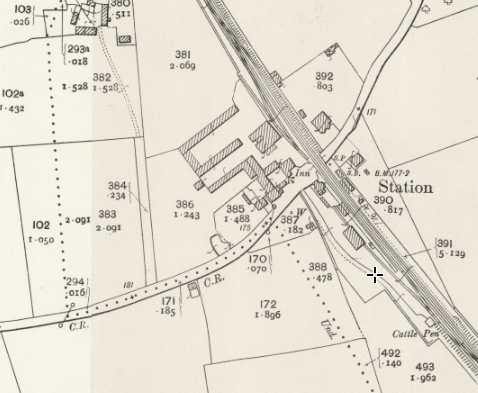
    Yaxham railway station opened on 15 February 1847 and was located on the Wymondham to Dereham branch line and remained in use for passengers until 6 October 1969. It’s now in use by the Mid-Norfolk Railway as a heritage line, although there is the possibility that this could at some stage in the future be brought back into usage by the rail network. This is a marvellous thought, although I’m a little sceptical about whether funding will ever be raised for such a project. For a while, the centre of the heritage’s lines efforts were run from Yaxham, although the re-opening of Dereham railway station has meant they’ve moved back.

    The whole complex was quite extensive and some of the station buildings still stand, including the signal box, although they’re in private ownership. The inn marked on the map was the Bush, which was closed in the 1960s and is now a residential property. Nearby Dereham railway station once had a staff of ninety people and Yaxham had several full-time staff of its own, with the line being a busy one for freight. Its demise was far from ideal….

  • Yaxham – St. Peter’s Church

    Yaxham – St. Peter’s Church

    The entrance to St. Peter’s church in Yaxham is up a quiet little road and it doesn’t take much imagination to think of generations gone by meandering up here to attend a service.

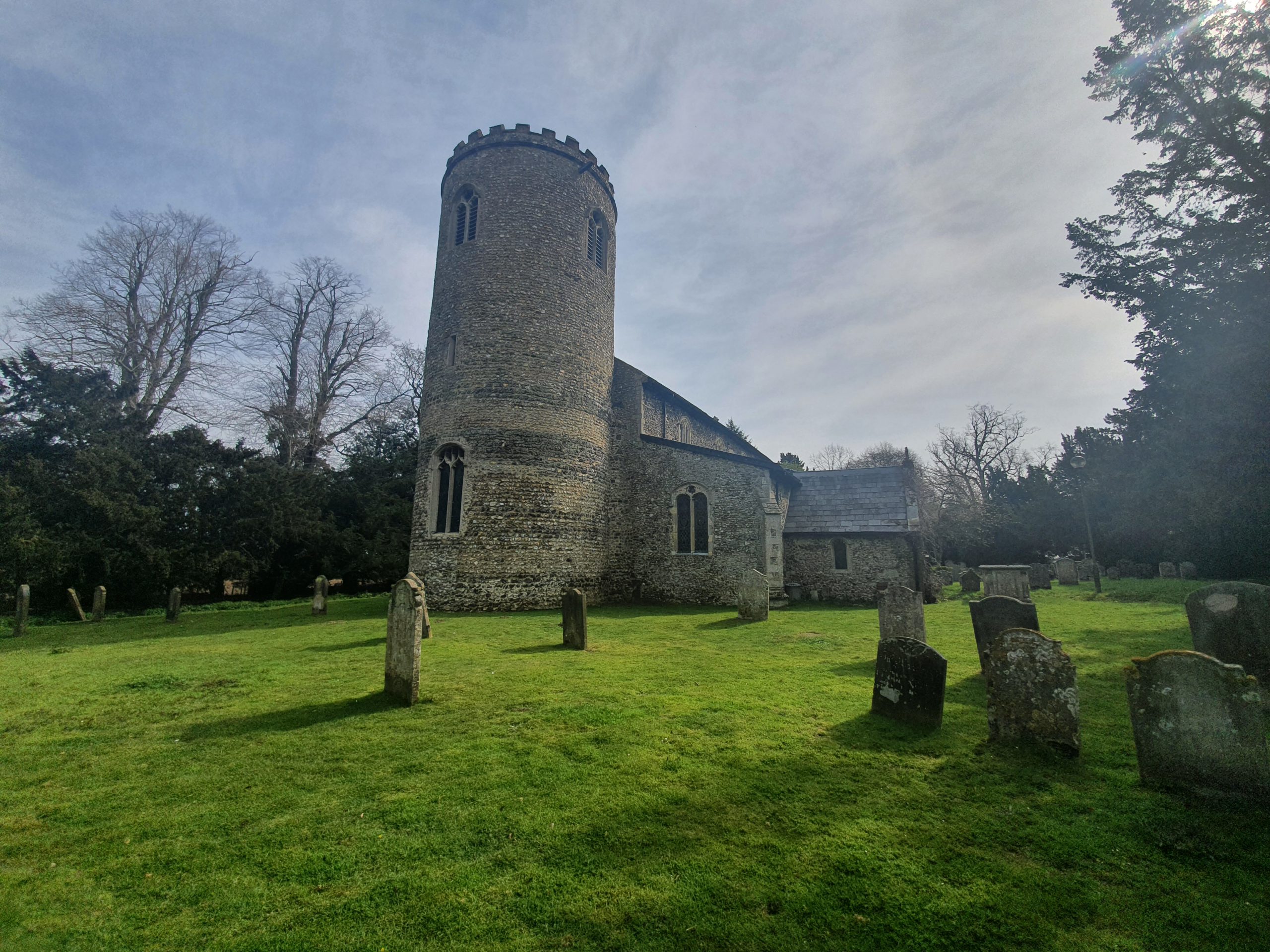
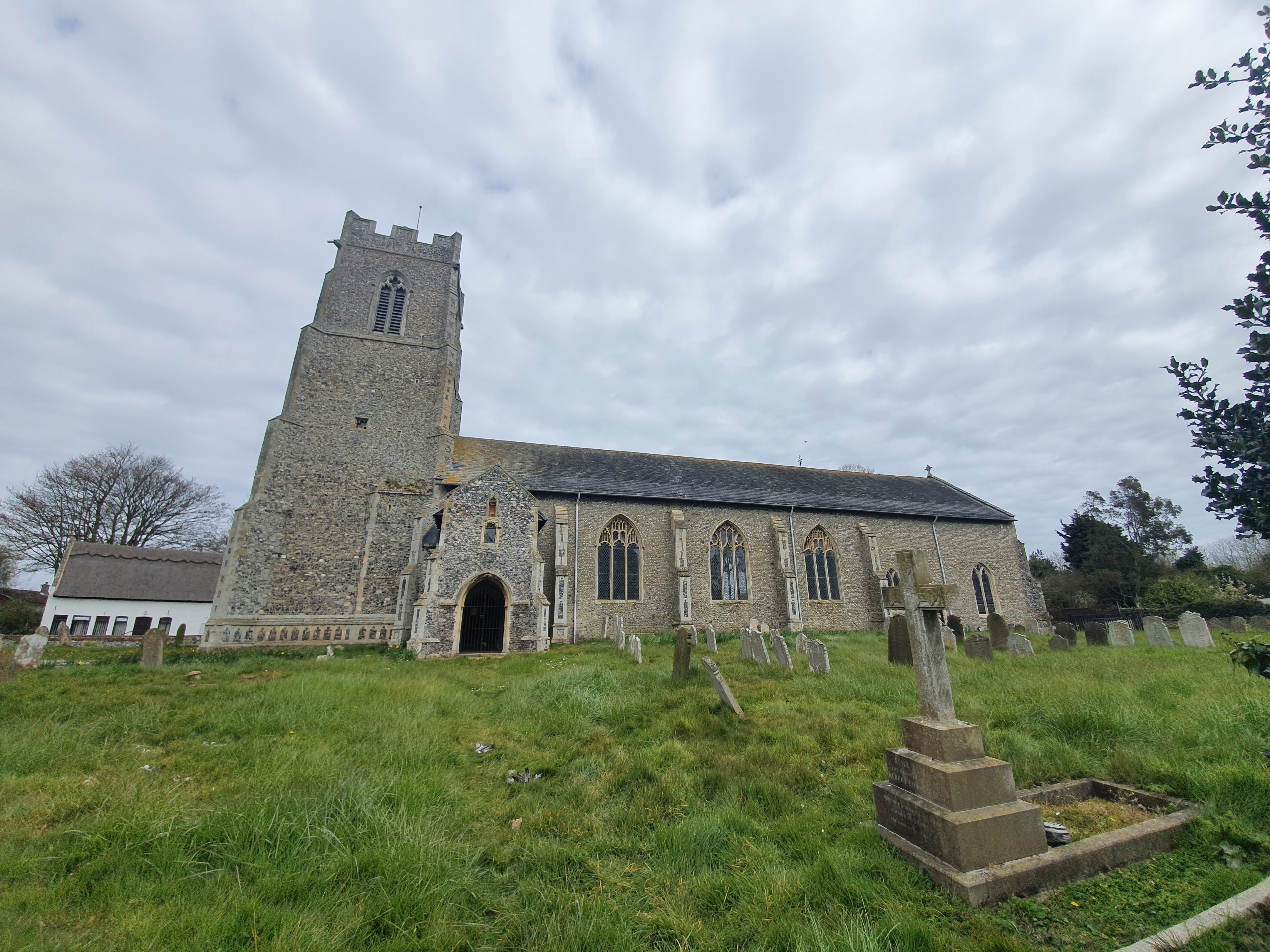
    Norfolk Heritage Explorer tells me that the banding on the church tower shows that it’s constructed of carstone and this helps date that part of the building to the late Saxon period. I’m still always impressed when reading dates like that, it means that the bottom of the tower was standing when William the Conqueror invaded England. The upper part of the tower is from the fourteenth century, with the bulk of the rest of the church being from the fourteenth and fifteenth centuries. Later that might be, but the vast majority of this church was standing when King Henry VIII decided that the Dissolution of the Monasteries was a good idea.

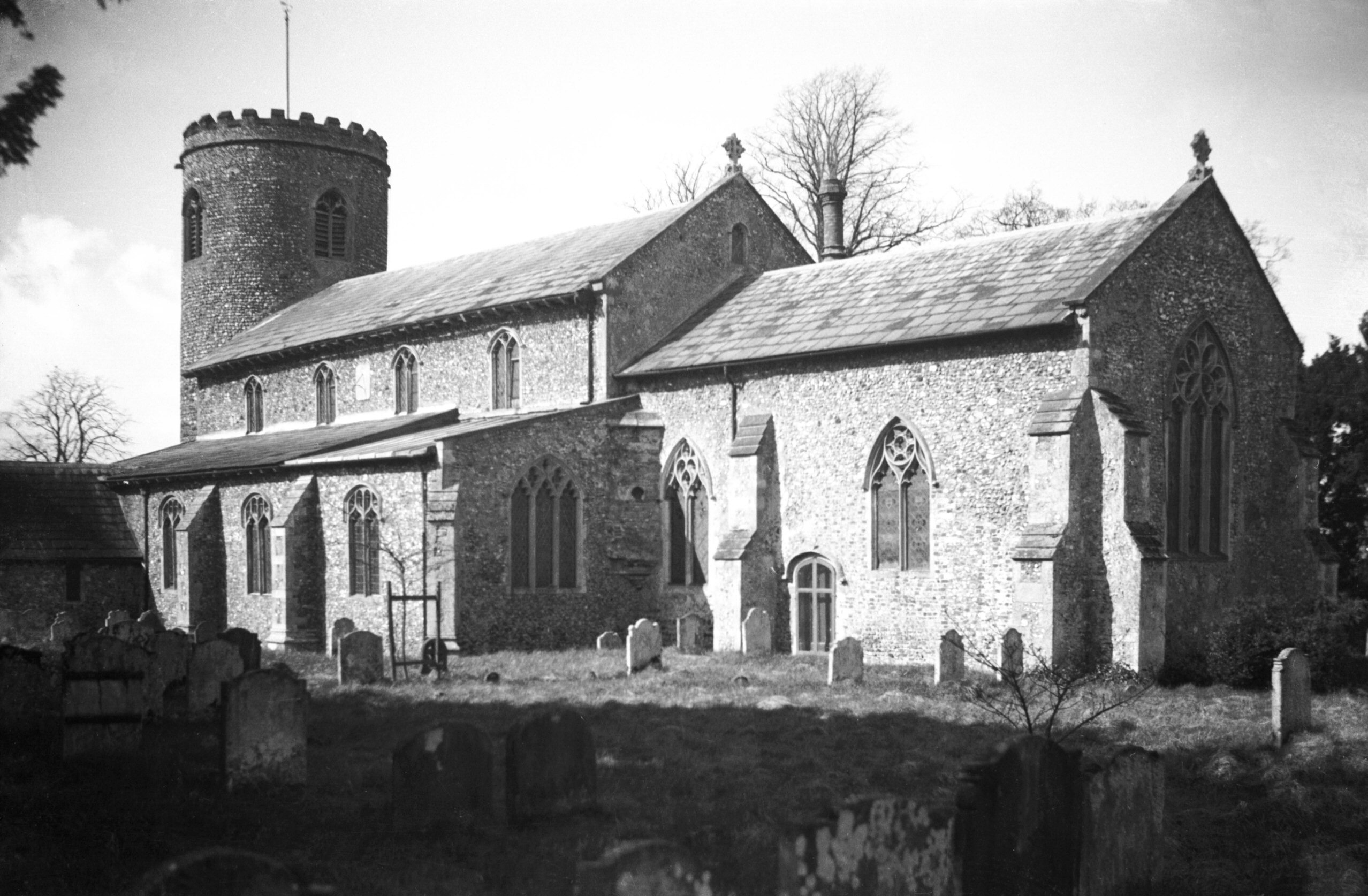
    The church viewed from the south east and it looks like the rood stairs have been added to the exterior where the nave and chancel meet. George Plunkett took a photo from near enough the same spot in 1937 and little has changed, with all the gravestones appearing to still be there. One change is that a small tree in the 1937 photo has now gone and it’s a reminder to myself that, although in a small way, the landscape can change over time even within a graveyard.

    Robert Ladbrooke’s illustration of the church from the mid-nineteenth century.

    The church viewed from the north east.

    The chancel end of the church, with this section, amongst others, being subject to Victorian restoration.

    Unfortunately, the church wasn’t open on the Saturday morning that I visited, although I had rather hoped it would be. There’s sometimes the misapprehension that damage to religious buildings is a recent thing, but in 1908 a number of local churches were smashed into and their collections stolen. The culprits were found, but Yaxham lost its money and its door was forced open.

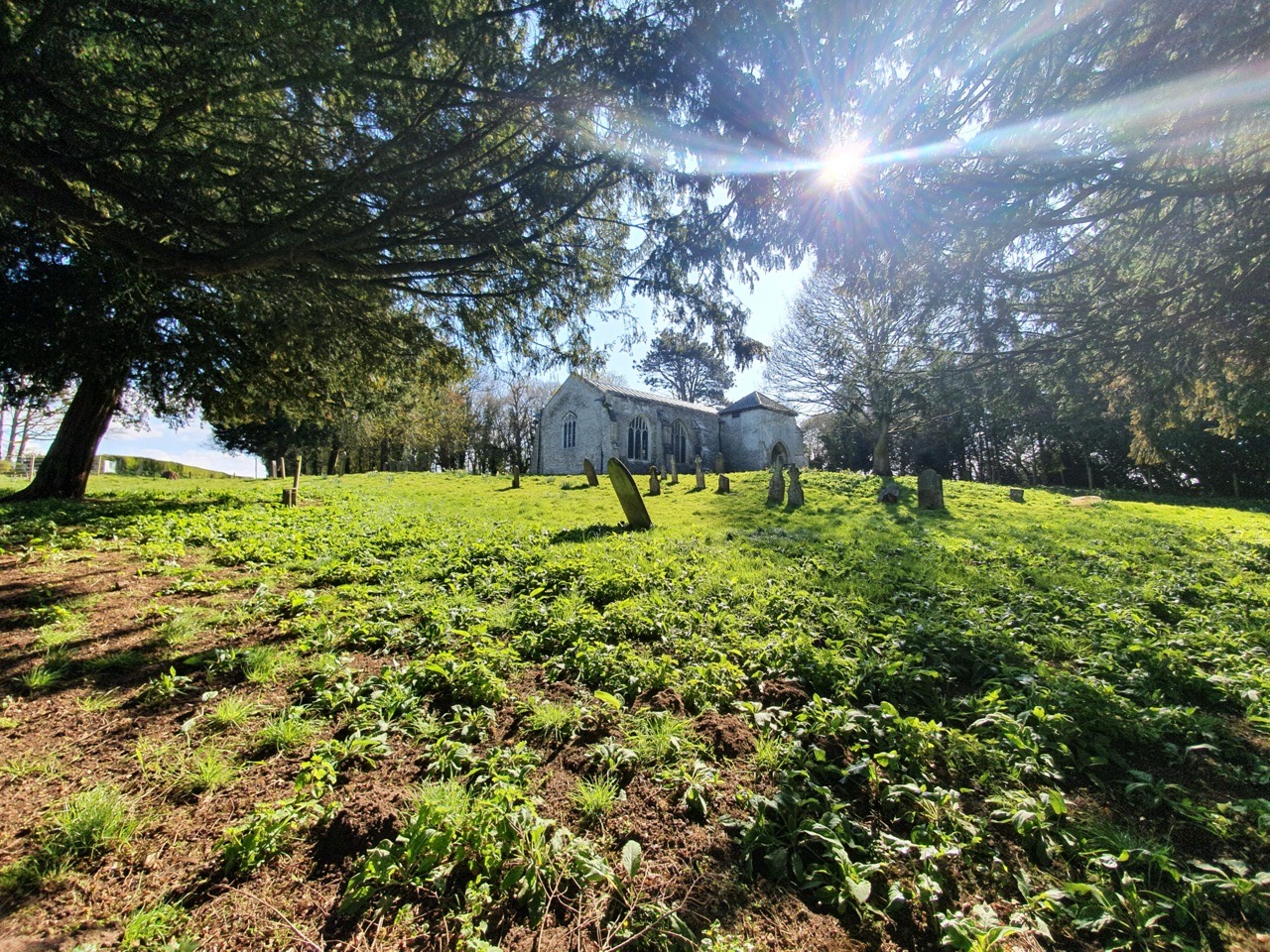
    The graveyard is relatively large and it’s all well-kept, with a little woodland path through the trees. Although Yaxham is just a short distance from Dereham, it felt remote and peaceful and I suspect that little will change here in the next couple of hundred years.

  • Blickling – Blickling Hall Gardens

    Blickling – Blickling Hall Gardens

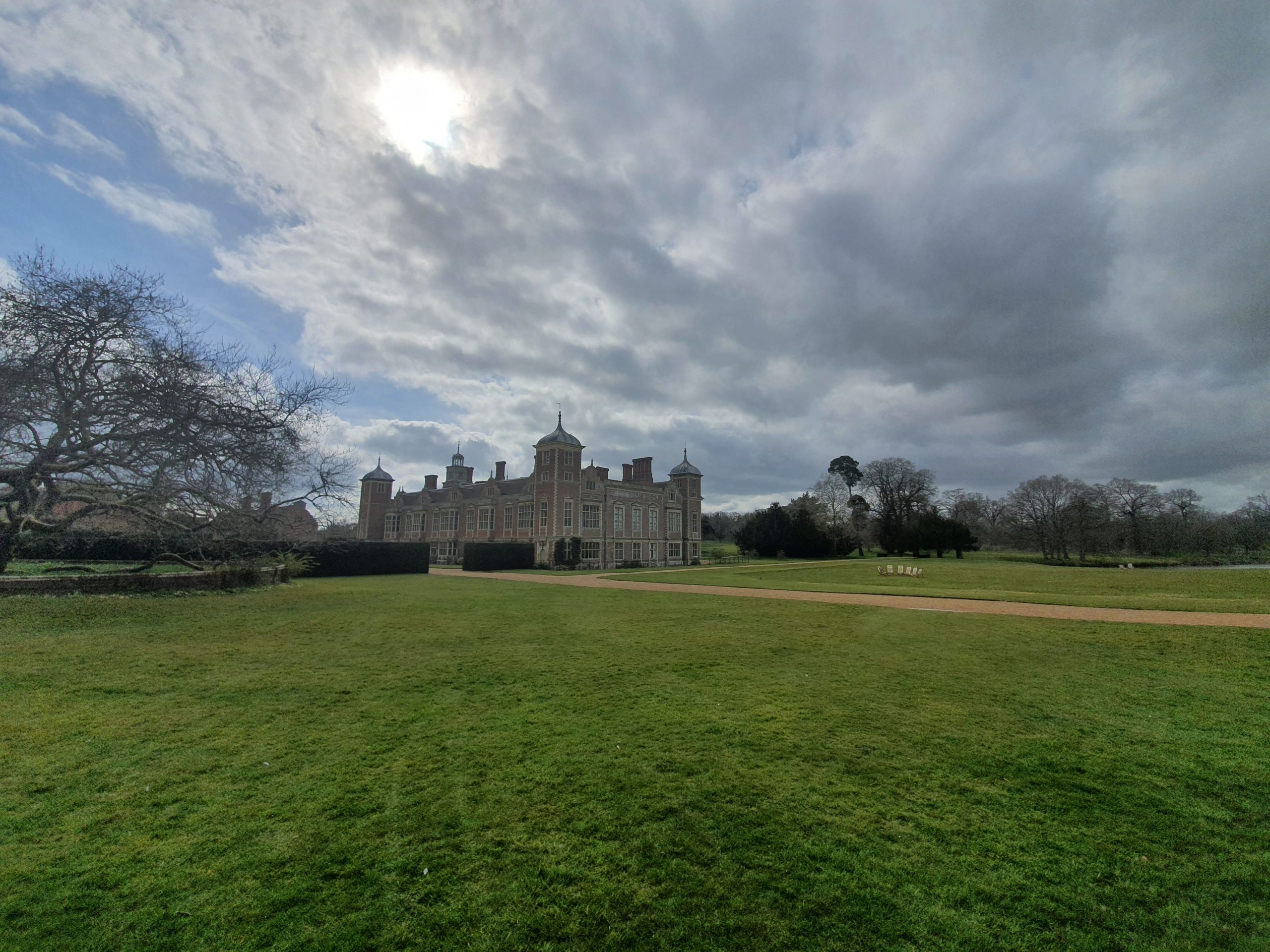
    This post is mainly photos of the gardens of Blickling Hall. I booked via the National Trust’s on-line reservation system a few days ago and although there was plenty of availability, it was busy when we arrived. The car park system was easy to navigate and there were no shortage of volunteers helping visitors find where to go. The volunteers also seemed to be knowledgeable and genuinely keen to help, which is all rather lovely.

    As a quick background, this property is often known as the birthplace of Anne Boleyn, and the location for her headless ghost. The property today isn’t contemporary to that period, it’s from the late sixteenth century and was extensively remodelled in the late eighteenth century. It came into the hands of the National Trust in 1940 following the death of the owner Philip Kerr, 11th Marquess of Lothian, who served as the British Ambassador to the United States until his death.

    There’s a basic map provided free of charge and some useful signage throughout the gardens. It’s possible to walk around the wider estate free of charge and the house is currently closed, but I understand that it will open again in a few weeks.

  • Norwich – The Garden House

    Norwich – The Garden House

    Before going in, we had decided that we would pre-judge the Garden House, which had been a marvellous pub and then Craft Union took it over. I haven’t been since that takeover, but Craft Union have in my experience been reliably terrible with clunky makeovers and a poor range of drinks. I’ve never been quite sure what the word Craft is doing in their name, trying to cash in on craft beer when that’s not something they have any focus on. So, my expectations really weren’t very high and I’m used to Craft Union not even offering real ale, so we were wondering whether we’d have to fall back on something like Guinness.

    The welcome offered at the entrance was excellent and verging on exceptional and I understand it was the landlord standing there taking charge of that. That was a positive first sign, as being made to feel welcome really is a skill that some pubs struggle to get right and it shouldn’t be that much of a challenge. The second positive sign was that list of real ales, as Theakston’s Old Peculier is what I consider to be a very good option to have, as is Timothy Taylor Landlord. It’s also really useful when pubs write down the beers that they have, as staff trying to remember what they have is not an ideal situation as it’s often poorly communicated. But here, there was clarity, friendliness and a self-assured service style all as part of the initial greeting, which is rather lovely.

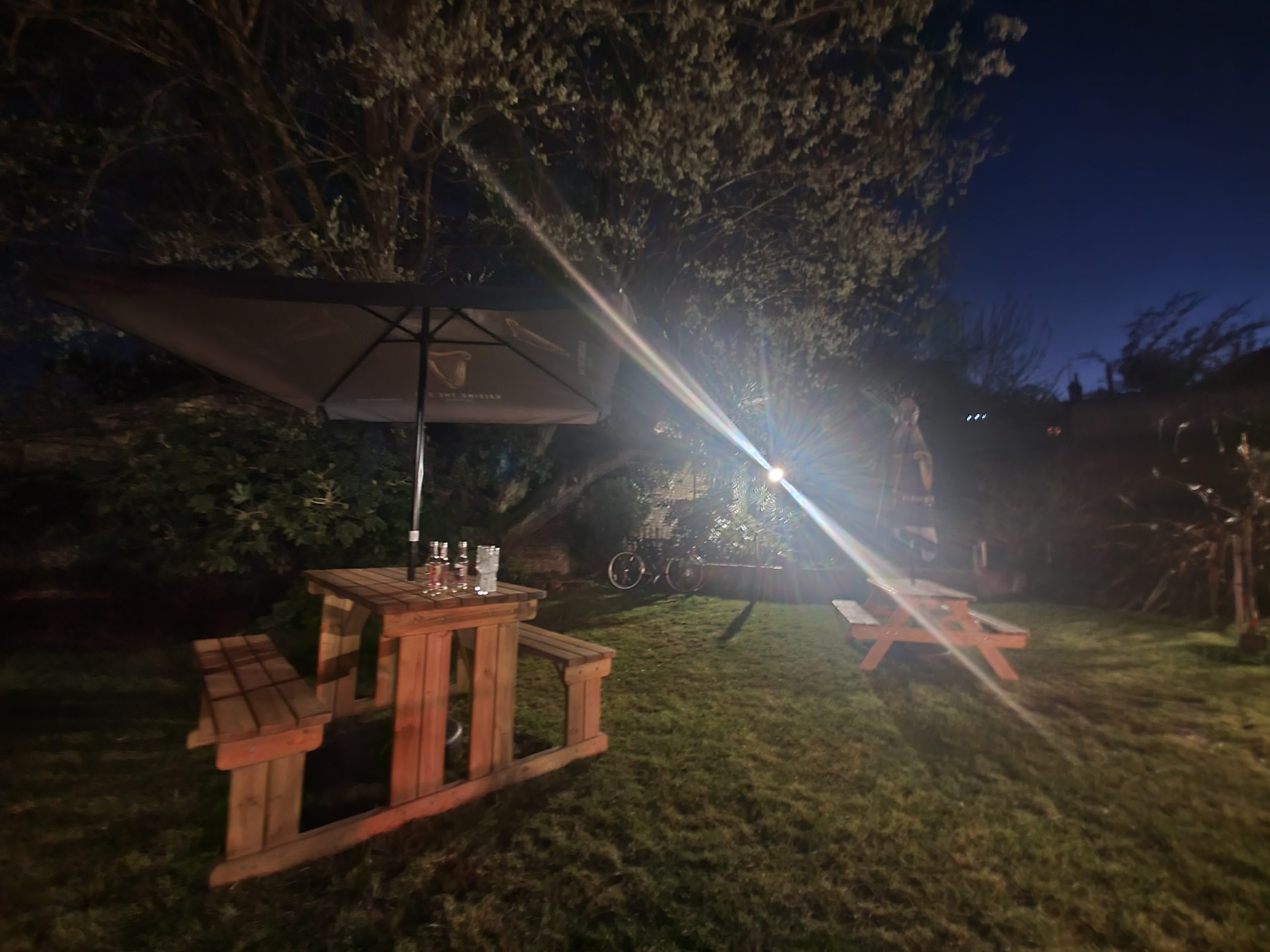
    There’s a large beer garden and that is apparently the reason the pub was named the Garden House because of that rather useful feature, although for reasons unknown, the pub name was changed for a short period in the 1980s to ‘Fridays’. Today, the garden area is all organised and there’s an area with an external television and seating area. That the pub can show live sports is not much interest to me, but I can see that it’s a very useful thing to have to help them serve the community. The pub is using a clunky app provided by Craft Union, which reminds me of the Greene King app which really isn’t very focused on proper beer, as neither can cope very well with real ales. This wasn’t a problem here, a staff member was able to take our order as she confirmed real ale can’t be ordered using the app. As another little bonus, the prices charged for the ales, and indeed most drinks that I saw, was towards the lower end of the scale.

    This is my problem with the Craft Union name, it implies to new customers that they focus on craft beer. Their advertising is actually more focused on drinks such as this, which is entirely fine (and, a bit secretly, I wouldn’t turn any of those down…..) but not keep in fitting with their name. Craft Union is now part of Stonegate, who are probably going to do a better job than the complete disaster that Enterprise Inns made of most things when they operated it.

    Anyway, my issues with the national brand aside, this pub was very well run and the customer service was faultless. The beer was well kept, the choice was better than my expectations and the environment was comfortable. It’ll take me a while yet to be convinced about Craft Union, but this was a rather positive experience. It does show though that when they find an excellent operator that the concept they use (where the operator is self-employed but gets 18% of the take for themselves and to pay their staff) is one that can work.

    It’s a reminder also to us that we shouldn’t really pre-judge pubs as often they can surprise and delight.

  • Norwich – The York Pub

    Norwich – The York Pub

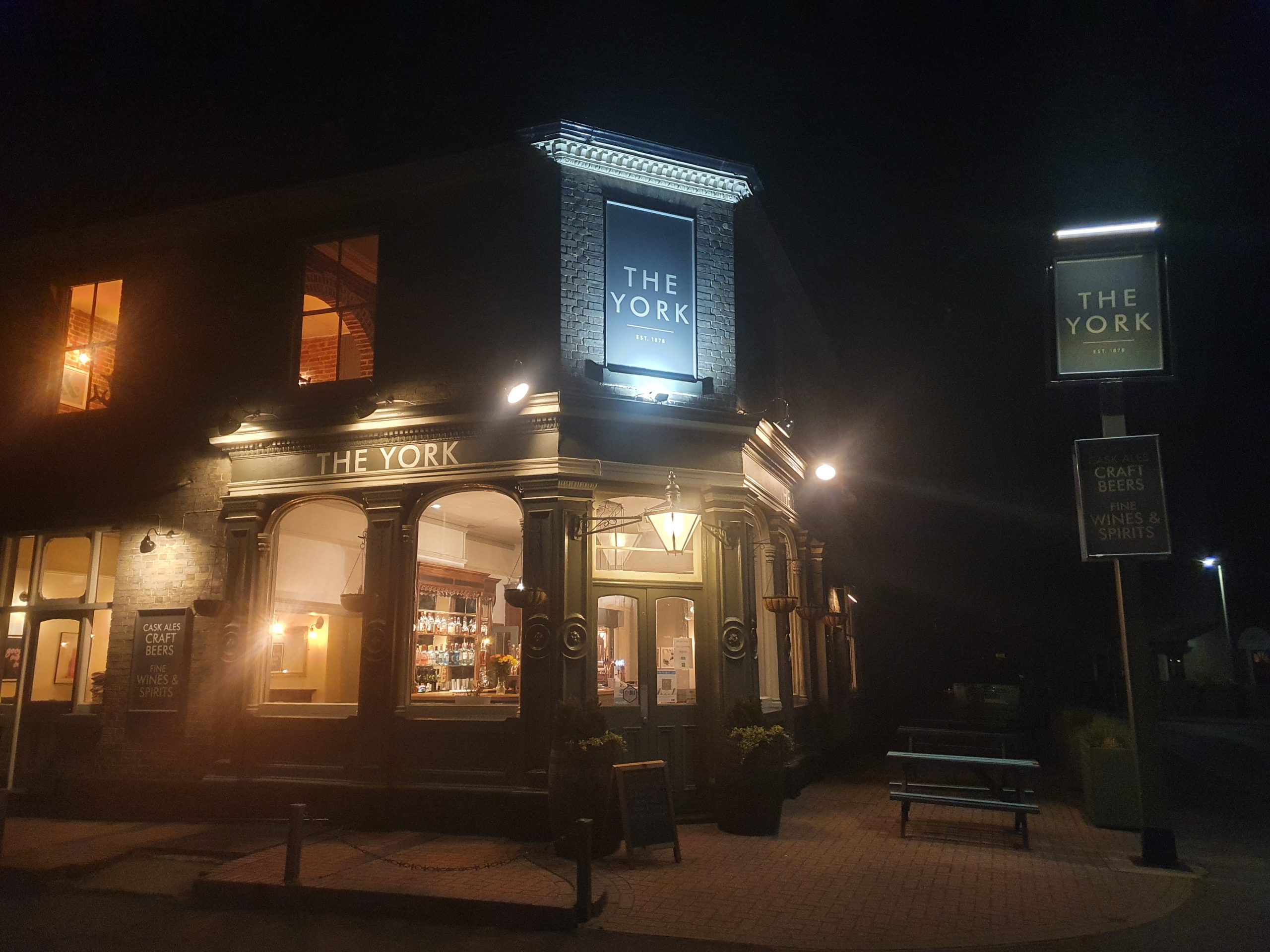
    This whole drinking outside only thing does rather reduce the quality of the photographs (it is a bit easier to take photos inside where there’s actually some light), but this is The York pub on Leicester Street in Norwich. I’m not sure why the owners have lost the Tavern bit from the name, but this was until recently known as the York Tavern. Customers enter via the front door (that sounds obvious, but often at the moment customers can get into pubs through some random side gates) and the process was all well managed for us. We had to provide details for the NHS app and then separately to the pub, which was slightly convoluted, but best for the pub to be careful.

    This is the pub’s sizeable beer garden, which used to be a bowling green. I wouldn’t have noticed that if I hadn’t been told, although the defined shape is a slight giveaway. An article in the Norfolk Chronicle in 1902 mentioned that the bowling club had been open for 27 years and that it was one of the oldest in the city. Today, there’s a large marquee on part of the lawn and then some picnic benches dotted about. And all credit to the pub owners over the years for not trying to sell this land off for housing, as it’d be possible to cram a new house in there.

    The clues to it being a former bowling green are though more evident with the structures at the side (I mean the club house thing, not Nathan). Norfolk Pubs notes that the pub opened in 1878 (which suggests that the bowling club was already there if the dates in the Norfolk Chronicle are to believed) and also that the landlord Albert Plane had been found dead at the bottom of the stairs in 1922 having gone to get his family all a cup of tea, which isn’t an ideal situation. This was the same landlord who refused to admit the police into his pub in 1916, a rather brave thing to do. The reasons for the police visit aren’t known to me, but Plane was involved in black market activities, so perhaps it was in relation to that.

    There wasn’t a particularly exciting range of real ales or craft beers, but there was Gamma Ray from Beavertown which was satisfactory. I wouldn’t go further than satisfactory, but it’s a reliable pale ale. I’m still vaguely on the lookout for Spresso, which is Beavertown’s imperial stout, although they might not even make it any more. The ordering is done on-line, and Nathan managed this without too many issues on his Nokia 3310 (or whatever it is that he has).

    Anyway, the pub’s garden is spacious and so the tables were suitably far apart from each other, and there was a one-way system in place inside to get to the toilets. That went via the pub’s internal stairs, which wasn’t entirely ideal now that I knew a previous landlord had died there. Although we arrived too late for it, the pub is doing food and the reviews for that seem positive and their chicken wings sound quite delicious.

  • Southwold – The Little Fish and Chip Shop

    Southwold – The Little Fish and Chip Shop

    This looked to me like the best reviewed chip shop in Southwold and apparently there’s nearly always a queue. A queue is usually a positive sign (although occasionally a sign of complete incompetence of course), but it all looked tempting enough for me to visit.

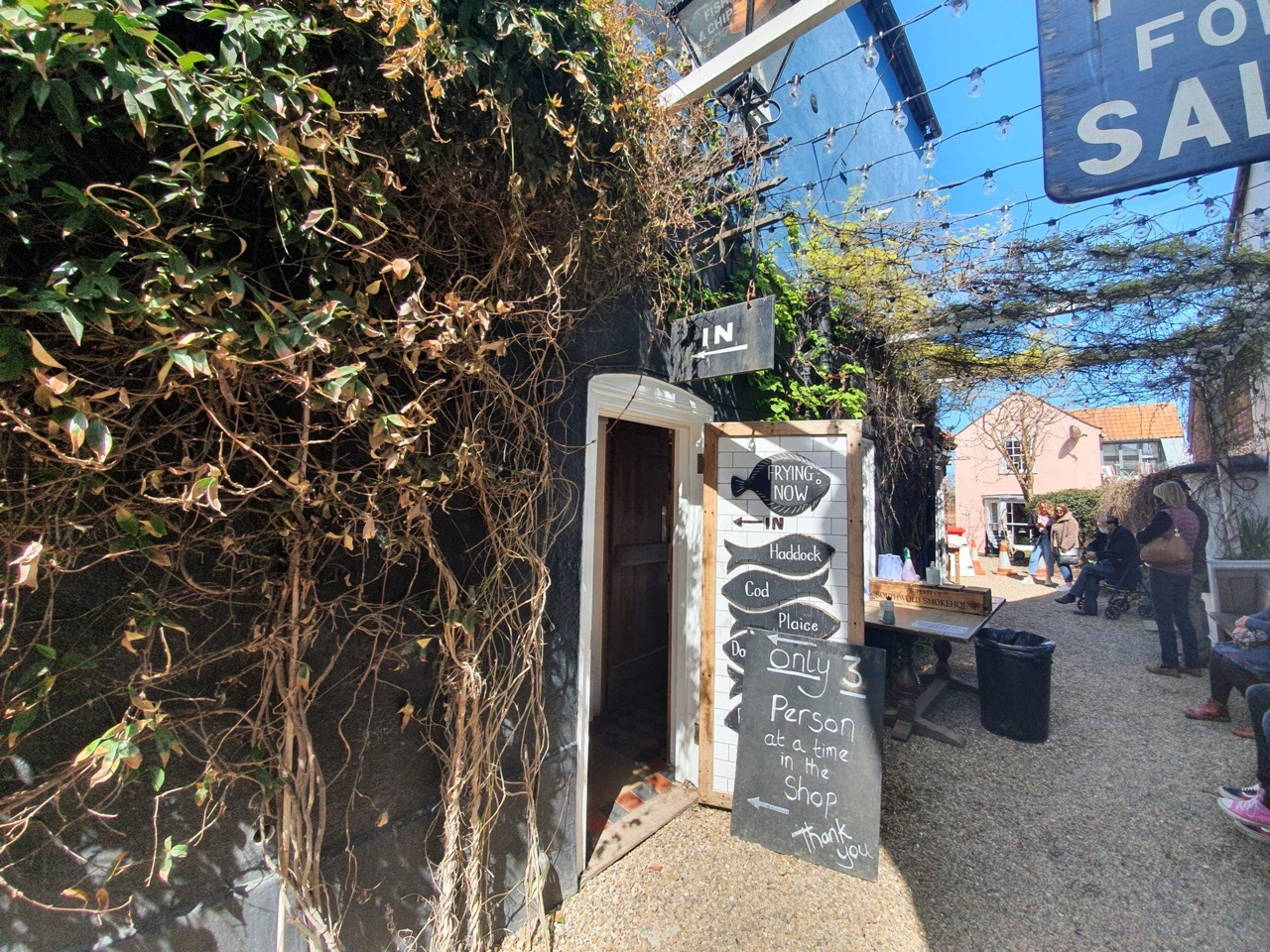
    What I like about this is that they’ve made it idiot proof, so that not even I could get confused where to go. Customers go in the door marked ‘in’ when there’s space, they then order and then wait outside. The customer in front of me ordered what I think was four lobsters and chips, which is very much a Southwold thing to do I think, I doubt that happens much in somewhere like Long Stratton. Since that came to over £80, I was starting to be slightly nervous about how much my order of just chips would come to and even whether you’re supposed to just order chips at a decadent place like this.

    I nervously ordered just chips and was pleased when the server didn’t say “yes, and?” and he was polite and helpful. Fortunately, my portion of chips came to what I felt was a reasonable £2.50 and I didn’t have to wait, they served my order immediately. All very efficient, friendly and I thought really quite organised.

    This photo doesn’t do the portion of chips much justice, and I’m not sure I’ve had chips presented like this recently in a bag. In reality, the portion size was nearly too much for me, although I bravely did finish them as I’m very much against food wastage. The chips were chunky and were fluffy on the interior and firm on the exterior, and they’re cooked in beef dripping, which is the only option. I don’t have any issues with this, but it will of course restrict vegetarians from going. I thought they tasted fine (the chips, not vegetarians) and they were quite moreish, complemented by the sachets of ketchup I had brought with me (the pots of ketchup at the shop were at decadent prices).

    That’s Southwold beach in the background of the photo, it was a pleasant day and reasonably warm with not much breeze. Fortunately, there are lots of benches along the seafront as many other visitors were enjoying fish and chips, and some had acquired beer from the pub. All rather lovely.

  • Southwold – Lord Nelson

    Southwold – Lord Nelson

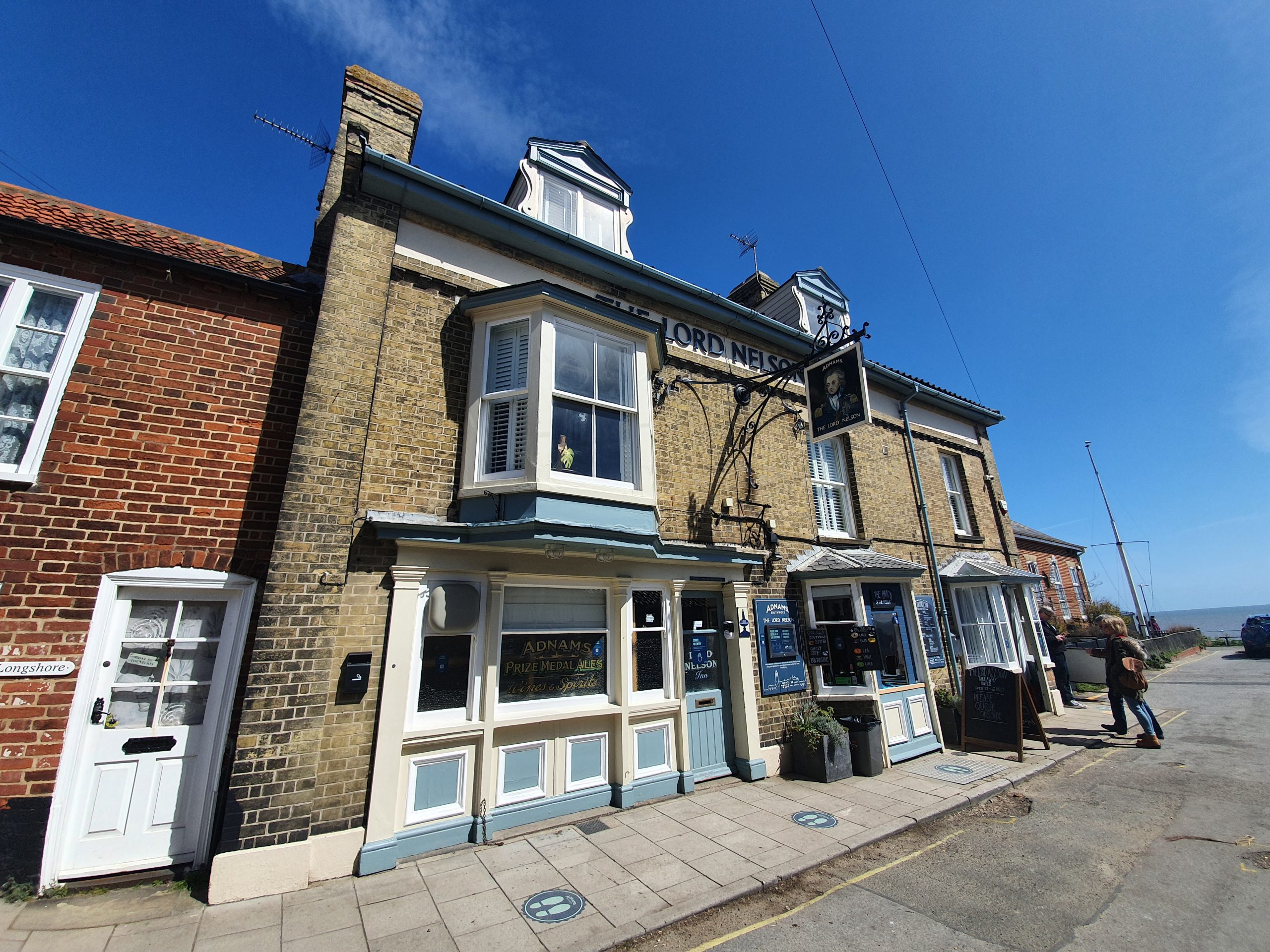
    I wanted to visit the Lord Nelson in Southwold as it’s the only pub in the town which is listed in the Good Beer Guide. I had half suspected a queue, as it was around 12:15, but I loitered outside the pub and a staff member came to welcome me in. For the first time, my phone really didn’t like the QR code for the NHS login, and despite some considerable efforts on my behalf to get it to work, we resorted to pen and paper in the end. I then nearly broke the hand sanitiser as it was a bit complex, so I concluded the pub must be used to more decadent and intellectual guests.

    The drinks menu, inevitably biased towards Adnams as they own the pub and their brewery is around the corner. The service was all timely and friendly, with the order taken at the table and there was an option to set up a tab.

    There are only six tables outside in the pub’s beer garden and I managed to get the second, meaning that there were four free. I decided, to be fair to the pub, that I’d leave when the tables all got filled, as they all seated four people and the pub might lose four lunches if I blocked their table. I liked that they never rushed me, never made me feel unwelcome and it all worked out perfectly timewise. I left after around 45 minutes and a couple tried to get a table for food just as I left, so everyone was a winner there.

    The Blackshore Stout from Adnams, which I rate reasonably highly as it’s creamy and chocolatey. And, just so Nathan is pleased, it was served at the appropriate slightly chilled temperature.

    The pub is well reviewed and the pricing is a little towards the higher end for food, but nothing dramatic. As Basil Fawlty says, “you’re a bit stuck if you don’t like Adnams” (well, he said duck, but Adnams fits better here) on the beer front, but there was a range of different styles of beer and cider. It’s got a bit of atmosphere to it, even when empty, and the service was all sufficiently engaging. Quite a decent place, and certainly not a bad recommendation from the Good Beer Guide.

  • Hemsby – St Mary the Virgin Church

    Hemsby – St Mary the Virgin Church

    There was a sign outside the church saying that St Mary the Virgin in Hemsby was open. Although that wasn’t entirely true. Indeed, it wasn’t true at all, it was shut. The church was built in the early fourteenth century by the monks of Norwich Cathedral (and apparently some of the tracery is the same as in the north cloister of the cathedral) although it’s all a little utilitarian for my taste. I couldn’t see inside, but George Plunkett has a photo of the interior from 1932. Other than the changed roofline, which was likely just a switch from the former thatched roofing, there are no blocked doors, moved windows or the like.

    I liked the porch, this had some more decorative elements and was executed to a relatively grand standard.

    The church has remained relatively untouched over the centuries, although the Victorians did restore it in 1867, and there was also some work on the tower in 1974. There was a tour of St. Mary’s in 1867 by those interested in church history, and it was pointed out there was an hourglass on display which had once been attached to the pulpit. This had been introduced in accordance with the wishes of Queen Elizabeth, who wanted to discourage the rather more prolix of preachers. I’m not sure that the church still has this, but I have to say that it’s a good idea.

    The chancel window and there are apparently two thirteenth century coffin slabs in the churchyard, which I managed to entirely miss. There likely wasn’t a Saxon church at this site as is common in many areas, and it’s not entirely clear if there was anything here before the current early fourteenth century building. This was though an area that was visited frequently by the Vikings and they kept raiding the coastline on a regular basis, which I’m sure considerably annoyed the locals.

  • Max Hawkins and Living Randomly

    Max Hawkins and Living Randomly

    This is Max Hawkins, a programmer who spoke at a TedX event. I’ll use the text they provided as it sums his talk up as well as I can:

    “For two years Max let a randomized computer program determine the course of his life. Everything from what he ate and the music he played to the city where he lived was determined by the whim of the computer. The randomizer sent him everywhere from a shopping mall in Japan to a goat farm in rural Slovenia. He tells the story of his randomly generated life: how he stumbled upon the concept of chance, why it became an obsession, and how he discovered that refusing to choose can be a radical act.”

    I’m very engaged with this whole random thing, which is partly something that I’ve been doing with GeoGuessr in selecting random locations to visit. Max has a web-site at https://maxhawkins.me/ and he has randomized huge sections of his life in what I consider to be an inspirational manner. He started by writing software to pick him up in an Uber taxi and be dropped off at a random food venue, which even he himself didn’t know the location of until he arrived. He then chose to live in random places, go to random Meetup events and listen to random music. Having the opportunity to live in different places around the world for a month or so brought him so many new perspectives and life experiences.

    And there’s something in this. I followed Max’s Spotify playlist, which is 30 random songs generated every day. I found more stuff that I liked on that playlist than I did on Spotify’s own algorithm of recommended music. When I’ve used GeoGuessr locally, going to random places is like a chain reaction of finding other things I never knew existed and then felt the need to investigate. And it creates adventures, such as the national GeoGuessr challenges that Nathan and I have done. On a simple level, just going to read random Wikipedia articles can be an interesting way to pass the time, so many new things to learn and become intrigued by.

    I’m not sure that I’ll take the element of the random as far as Max has, but he has managed to be taken out of his comfort zone to try almost endless new experiences. Algorithms can perhaps limit our lives, we follow the recommendations of Google or whoever, but they are really just keeping us within our comfort zones and never showing us anything really new. Often, we might think that our experiences are new because we’ve visited a new pub down the road, but is that enough for a meaningful life?

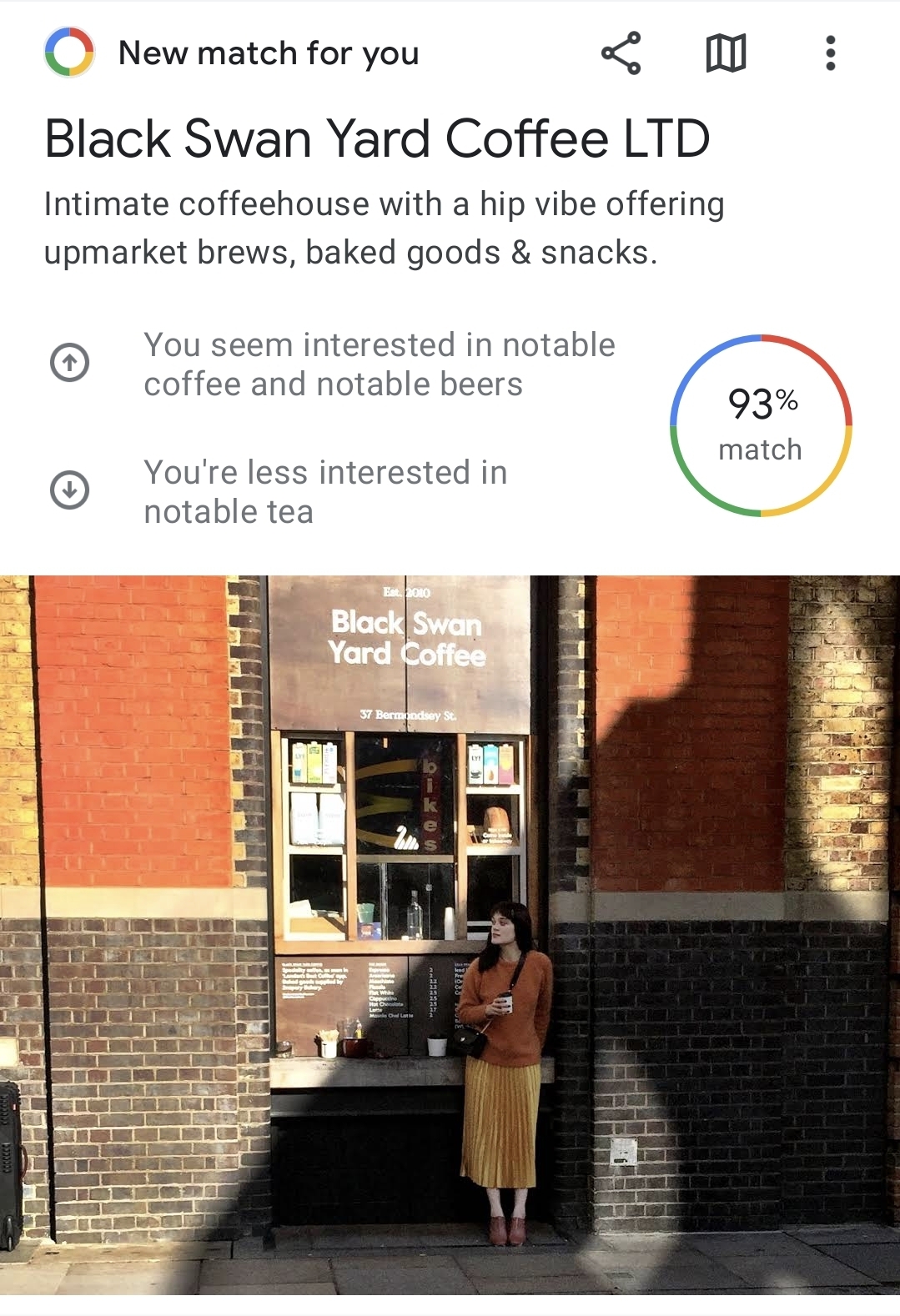
    This was an alert I received from Google a couple of hours ago, they’ve decided that I like notable coffee and notable beers, so they’ve suggested this location. It actually looks pretty decent, but Google has also decided that I don’t seem interested in notable tea (which is probably true to be fair). And this is the danger, it’s sending me to what look like new and interesting locations, but they’re the same sort of places. I will visit, as I see no need to not go to places that I like, but the joy of the random is going somewhere I wasn’t sure I’d like, then discovering it offered something very new and exciting. And, I can quite like innovative teas, so I shouldn’t rule those out.

    For my friends, expect a wave of things being done randomly in the future. I don’t think that many of my friends find me particularly predictable anyway (I have a lot of “good ideas”), so they might not be too surprised. Without getting too deep, there’s some sort of order in the chaos as well, so many coincidences and things which felt inevitable. Meeting people and having experiences which were random, but which seemed to be destined to be, as if the universe meant for that to happen.

    So, here’s to the random. It’s the future.

  • LDWA 100 – Training Walk 15 (Wells and Fakenham Railway and Shut Pubs Meander)

    LDWA 100 – Training Walk 15 (Wells and Fakenham Railway and Shut Pubs Meander)

    This was our fifteenth walk in preparation for the 2021 LDWA 100.


    WALK NUMBER: 15 (Wells and Fakenham Railway and Shut Pubs Meander)

    DISTANCE COVERED: 19 miles

    NUMBER OF NATHAN’S FRIENDS WE “ACCIDENTALLY” BUMP INTO: 0

    SUFFICIENT BEER CONSUMED: No (but better than previous visits)

    PUBS VISITED: 2 that were open, 3 that were closed

    WEATHER CONDITIONS: Warm and too sunny

    ATTACKED BY ANIMALS: No

    NUMBER OF SNAKES SEEN: 0


    This was our last longer walk before the LDWA 100, we’ve got just one short walk to recce part of our 100 route left now. It’s getting really quite close, but more about that on this progress update of LDWA entrants.

    I arrived at the bus stop at Anglia Square nice and early, giving me chance to have a Greggs, have a little sit down and then calmly wait for the bus. Nathan turned up about eight seconds before the bus arrived. I don’t know how people don’t get stressed doing that, my friend Liam is the same.

    We had decided that we’d have a Wetherspoons meal to start the day off, which is a traditional breakfast and refillable coffee in The Limes in Fakenham. I was very annoyed that the egg wasn’t particularly good on my breakfast, primarily as Nathan’s egg was far better. But, life’s too short to dwell on such things and I’d calmed down within three hours which shows just how I’m able to put these things into perspective (although I’ve got post-annoyed now writing about it).

    Nathan was keen to get going after we’d finished our meals (his with a delicious egg and mine with a less delicious egg) so I didn’t even get a second coffee, but I didn’t say anything. Nathan of course had more energy than I did as he had been given a very delicious egg for breakfast. Incidentally, and of relevance to nearly no-one, you don’t get a tomato (or half a tomato as Dave Morgan would point out) on the traditional breakfasts anymore, unless you order the vegetarian option.

    The walk started by going through Fakenham and this little arrangement didn’t seem ideal near to the church.

    Robins, which I decided were a sign of something. I was hoping they were a sign at the spirit world’s annoyance that Nathan got a better egg than me at breakfast, but I think they were guiding us in a different way. Nathan mentioned that ideally I’d only take five photographs, and I thought he meant in any one spot. But he meant all day. Anyway, I ignored that as I’ve got a blog to write.

    I’m not entirely sure what delights this once held.

    We had some good fortune here, and perhaps that’s related to the robins. Komoot had failed us and tried to send us down some paths that weren’t public rights of way, and indeed, which had big signs saying that they were private. We wondered whether we could sneak through this gate, but thought we probably shouldn’t as it appeared it might be the garden of this former railway crossing building. By good fortune though, the property owner shouted over that we could walk down there, which meant that we got to see the delights of the former Wells to Fakenham railway line.

    And here it is, the track has been lifted, but the route is clear.

    This is a map from the 1920s (ignore the cursor) and Fakenham is in the south and Wighton (where we were heading) is towards the top of the map. Wells is just to the north and that stretch of the line is still in place to Walsingham, which is used by a heritage railway. The line had opened in 1857 and was closed to passenger traffic in 1964, although remained open to freight until the 1980s. If it had remained open as freight just a few years longer, then it might perhaps have had a chance of being returned to passenger usage, but that ship has most definitely sailed now.

    Some rather major construction work has taken place here to plough the line through one of Norfolk’s hills, I have a lot of respect for the speed in which the Victorians built these lines.

    The line carried on and we saw pretty much no-one all day walking down here. I can’t think that this line would ever be reinstated, but there are very few technical obstructions that would prevent it.

    This is the ford that crosses over to North Barsham, fortunately with a little footbridge option. There’s a short stretch of railway line that is inaccessible here, as Nathan discovered on the way back when he tried to walk down it. I didn’t bother trying, it looked too thorny for me.

    All Saints Church at North Barsham, which I wrote about separately.

    Some of the bridges along the former railway line were still in place, but this one has been removed.

    The Catholic Basilica of Our Lady of Walsingham.

    As noted on this sign, part of the former railway line has now been turned into the Pilgrim Way, a permissive footpath.

    This is the location of Walsingham railway station, which was in use between 1857 and 1964. There’s another railway station in Walsingham now, used by the heritage railway.

    The railway station was purchased by the Russian Orthodox Church in the 1960s and they still use it today for services.

    I had hoped that we could walk down a footpath by the side of this narrow gauge heritage railway, but there isn’t a footpath and the railway has locked the gate. But, this is the start of the heritage line that goes from Walsingham to Wells. That meant the section of the walk to Wighton was on the road, which wasn’t the most exciting stretch of the expedition. We had anticipated that the walk might be a little colder as there would be some wind from the North Sea, but there wasn’t and I thought it was too hot.

    Nathan had planned our walk to end at Wighton, and although we had wanted to walk further, we were confined by the times of the buses. This gave us time to look at All Saints Church in the village, which I’ll write about separately as there’s a lot I want to say. There was a little incident here when the tower fell down in 1965 and collapsing towers seemed a common theme of the churches we saw on this walk. The cost of repair was simply too high for the church, so the tower (or what was left of it) was made safe and normally that would have been that. However, a man named Leeds Richardson in Canada noticed what had happened as he had traced his ancestors to the church, and he decided (with ridiculous generosity) to fund the repairs.

    The interior of the church.

    We then popped into the Carpenters Arms in Wighton, where the service was friendly and the beer was refreshing. There’s perhaps more that can be done with the beer options, but they proved sufficient for our purposes. We were tempted by the food options, as they looked delicious judging from other tables, but we decided we’d see what was available in other pubs. That wasn’t perhaps our greatest ever choice.

    This is something of a remarkable survivor as a pub, so many are lost because they’re turned into residential properties. Even more surprisingly, the village had three pubs in 1910, but for a period in the early 1980s it didn’t have any. The Carpenters Arms then re-opened in the mid 1980s as the Sandpiper, but was renamed back again in 1997. The pub has shut for another two periods since then, but has been transferred from being an Adnams pub to being free trade.

    We then walked back along the road and I’m not sure when I last visited Walsingham, but it’s not in recent years, and it’s an attractive place. It’s a place of pilgrimage and I can imagine that it gets much busier in the summer months.

    The well at the The Shrine of Our Lady of Walsingham. I hadn’t particularly planned to go in here and I mentioned this to Nathan, who a little too sardonically for my liking said “but yet, here we are”. This doesn’t translate to text very well, but it was one of his better quotes if I’m being honest.

    The Bull Inn in Walsingham, which was closed.

    This was listed on the town’s map as a pump. It might well be a pump, but that’s a clearly lock-up for raucous locals (in the past, I think Walsingham is a bit too salubrious for that today).

    The Black Lion Hotel in Walsingham, which was closed.

    I didn’t say anything about Nathan’s sun protection device.

    This is the rather delightful, and entirely not understated, East Barsham Hall which is a Tudor mansion house that was ruined by the nineteenth century. Against the grain, as this was a period when country houses were being knocked down at a rate of one per week, this hall was fixed up again in the 1920s and has remained as a substantial residence since then. David Mitchell wrote a Guardian article about it, I can imagine it’s not the worst place to live, but the upkeep isn’t going to come cheap.

    This is the former Primitive Methodist chapel in East Barsham which opened in 1887 and I struggle to see how they managed to get enough people to attend given the limited number of people who lived in the village. The history of the Primitive Methodists, which I’ll drone on about another time, is intriguing and they did attract many agricultural workers, which is perhaps how this worked. Anyway, this chapel didn’t last into the second half of the twentieth century and it is being heavily reconstructed into what I assume is a residential property.

    The Barsham Arms, who decided not to open, but not update their web-site or correct their hours on Google as most other pubs have managed to do. I consider this a little unfortunate, it makes it hard for people to support the pub trade. Anyway, this caused a problem for our plans, although it gave us more time in Fakenham.

    The closure of the Barsham Arms also gave us more time to look around All Saints church in East Barsham, but more about that in another post as this was another church with some considerable history.

    Retracing our route along the former railway line, that meant we arrived back into Fakenham with a couple of hours to spare, and we wondered how busy the Wetherspoons would be on a Friday evening. Quite busy was the answer, but there were tables spare, so we decided that this was our best option. The fish & chips with a pint came in at £8 each, a price point that it’s hard to complain about and the food was perfectly acceptable. All rather lovely.

    Brewdog Punk IPA and this is quite a suitable drink after having walked 20 miles or so, refreshing and with some tropical fruit tastes.

    On another matter, there was then the exciting bus debacle on the way back, but I’m satisfied with First’s response on that so we won’t dwell on that.
    As mentioned earlier, this is the last long walk that Nathan and I are doing before our LDWA 100 effort on the first weekend in May. We’re trying not to think about it too much, but I wouldn’t say that we’re particularly excited about walking the bloody thing. We haven’t done any very long distances as training, as the lockdown made that too difficult to organise, so whether we can make the step up to 100 (excuse the pun) is perhaps unlikely. But we’ll try our best…..