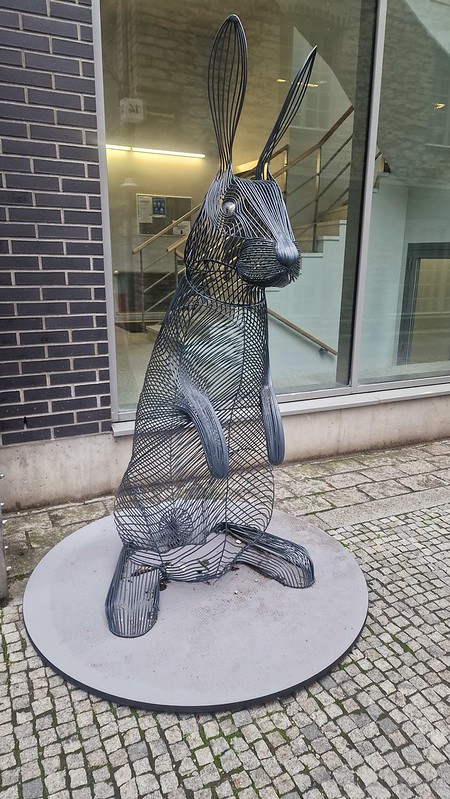
Just like the bovine sculpture, I can’t find out much about this rather unconventional imagery of a hare seemingly randomly placed in Tallinn. The skeletal frame probably has a meaning, but I don’t know what it is, but I like a little bit of whimsy every now and then. Maybe it’s a commentary on the fragility of life, or a hair-raising (see what I did there?) whimsical creation from the artist who likes hares. On the bright side, at least no pesky kids have been popping litter into the frame or some other such vandalism. It’s located near ton the PoCo Pop And Contemporary Art Museum, but I can’t establish whether it’s linked to them or not. And I hope it is a hare and not a rabbit.
And apologies to my two loyal blog readers that I have no idea on who sculpted this, but I doubt it’ll keep either of them awake at night worrying.
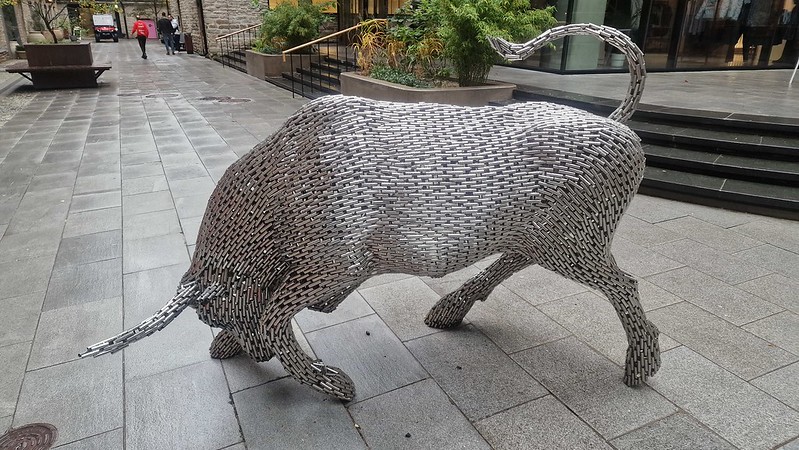
This magnificent metal beast, gracing the streets of Tallinn with its imposing presence, is all about raw power. He’s like the Gordon (a mutual friend who didn’t come on this trip) of the animal kingdom, sculpted entirely out of bicycle chains or something similar. I’m not sure what the locals think, but who needs a Lamborghini when you can have this bad boy parked outside your office?
But perhaps the most exciting aspect of this sculpture is its placement in the heart of Tallinn. Amidst the cobblestone streets and medieval architecture, this metallic bull stands as a symbol of… well, I’m not quite sure what. Financial markets? Industrial strength? The Estonian dairy industry? Probably more likely that it is linked to the nearby art museum, but I like the whimsical addition to the area. I like it, even though I don’t know who sculpted it, nor indeed anything more about it but it shows there’s more to Tallinn than medieval spires and cobblestones.
The evening meal of choice was Beer and Barrel, selected as part of my usual kind “I’ll provide three restaurants that I like the sound of, but you lot can pick which one” offer. I managed to get us to the venue without any issues, which is fortunate because it was pouring with rain and I don’t think there would have been much tolerance for any incompetence on my behalf.
Thinking about the menu options, although I had obviously decided what I was having from the on-line menus before leaving the hotel. Bev prefers to wait until we get there and then ask 28 questions about the menu, but Steve and I rarely mention how she’s holding us up.
My first beer was the Reloaded from Tanker Brewery, taste of stonefruit and it was hoppy and rich.
My starter of the boar jerky, not the most exciting of dishes to be fair in terms of the taste and we thought that Ross had gone for the best option with the calamari.
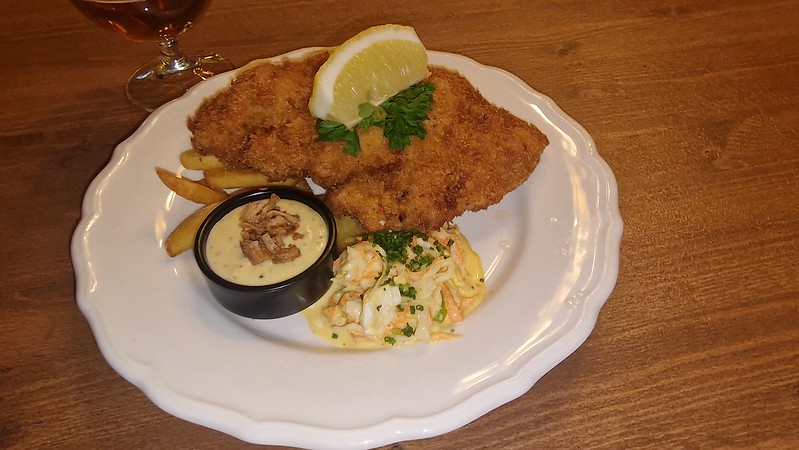
The main course of chicken schnitzel with coleslaw salad, fries and a honey mustard mayonnaise was much better, with tender chicken and creamy coleslaw. It’s had to go wrong with breaded chicken, or at least, not without a degree of incompetence. This was a filling dish and I liked the crispiness of the coating.
The dessert of apple pie with ice cream and a caramel sauce was also suitably delicious with the crumble element giving some extra texture.
My second beer was the 10.5% ABV Black Pearl Tatakoto Bourbon Barrel Aged Black Barleywine which was boozy, chocolatey, Bourbony, rich and delicious. It’s not the lightest of beers of course, but it proved a rather lovely sipping drink.
It’s not the largest of venues, but the staff member was kind enough to give us the large central table which was handy for our group size. The service was attentive and polite, with the ladies in a group being delighted that they were served first. They’re like ravenous pigeons those two and, fortunately, Bev didn’t dither too much with the ordering on this occasion. The prices were reasonable and I liked the selection of craft beers which were available, something which had drawn me to the venue in the first place. It’s no real surprise that this establishment basks in a constellation of five-star online reviews, I’d merrily go back here again.
I’ve finished my series of artwork posts for the moment, so just one to tie them all together and bring this exploration of the visual realm to a temporary end. We got in this art gallery free of charge because we had the Tallinn Card, something that proved to be excellent value during our few days in the city.
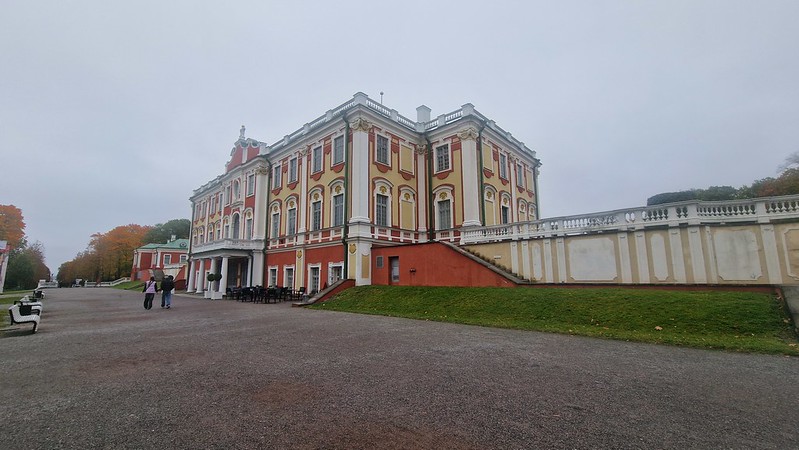
The Kadriorg Art Museum, a rather lovely specimen of Baroque architecture nestled within Tallinn’s equally splendid Kadriorg Park. Although an art gallery now, it was originally a palace built for a Tsar, Peter the Great, to be precise, a man not known for his minimalist tastes. Peter the Great believed that Russia’s future lay as a European country, but I’d better not get further entangled with that little debate.
Constructed in the early 18th century, this palace is something of a delightful confection of pastel colours, ornate details, and enough columns to satisfy even the most ardent Greco-Roman enthusiast. It boasts a rather impressive collection of European and Russian art, spanning from the 16th to the 20th century, including Flemish masters, Italian virtuosos and some Russian talent as well.
Designed by the renowned architect Nicola Michetti, the palace is certainly opulent, but the Russian Royal family showed little interest in it after Peter the Great had died. Its façade is grand and adorned with intricate stuccowork, whilst the palace’s interior is equally impressive, featuring a grand hall with soaring ceilings, ornate plasterwork and allegorical paintings inspired by the French court of Louis XIV. It’s not really the sort of place that I’d fancy living in, those high ceilings would be a bit much for me I think. I can imagine that Richard, who I don’t think is reading this, would rather fancy himself in here though holding his soirees. As a gallery, I thought it was a useful place to meander around.
As for our little group, Steve and I walked to get the bus back to the hotel, whilst Bev and Susanna spent more hours than are healthy meandering around it for a little longer before they powered up CityMapper and wandered around a bit lost. Ross had long since gone back to the hotel, his interest in galleries had waned much earlier on. Anyway, that’s my series of artworks posts finished (treat them as something of a palate cleanser), at least for the moment. I think this blog needs a bit more food, so that can be the next post. Always willing to put in a bit of anticipation for my two loyal blog followers.
Definitely nearly there with these artwork posts…..
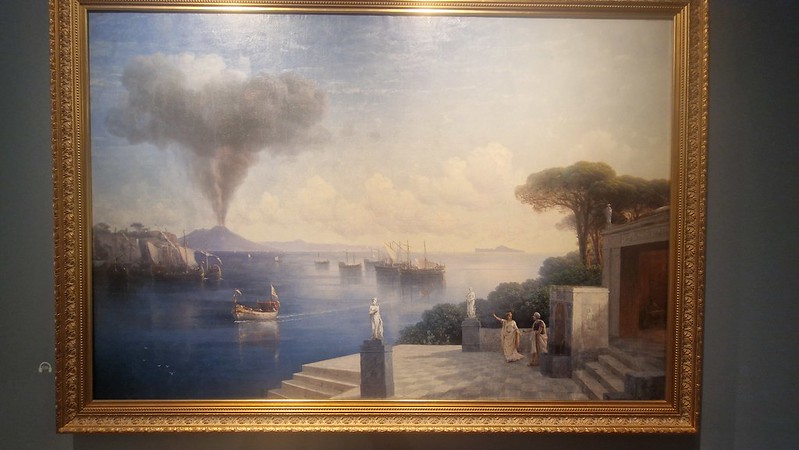
I puzzled over the concept of this artwork, there are beautiful hues of the sky, a finely painted seascape, a rather nice statue and then a bloody great volcano erupting. Maybe it’s a profound statement about finding inner peace amidst the chaos of existence, or maybe Aivazovsky (1817-1900) just had a surplus of grey paint. But, I wouldn’t want to put an artwork up on my wall which foretold a great disaster where thousands of people died.
The artist, Ivan Aivazovksy, is something of an icon in Russia to this day, he painted numerous battle scenes as well as seascapes. Perhaps he just likes a bit of disaster, who knows. He’s become rather controversial recently, some people and institutions (including the Metropolitan Museum of Art) called him a Ukrainian painter and some cities in the country have removed street names he was honoured with. And the Russian army have stolen some of his artworks from Ukrainian institutions. Controversy continues on the matter as can be seen at https://artlyst.com/art_market_news/looted-ukrainian-painting-sells-1-million-russian-auction-house/.
I really will get bored of writing about artworks soon, I’ve got a whole trip about Tallinn to finish, let alone my riveting thoughts about other places I’ve since visited. I’m currently in Faro, it’s confusing my mind just a little to be thinking about Portugal, Tallinn and Norwich all at the same time. But, I will persist with my ‘profound’ insights whilst trying to calm my wanderlust which has been a little out of control recently, although I think it’s probably good for my soul.
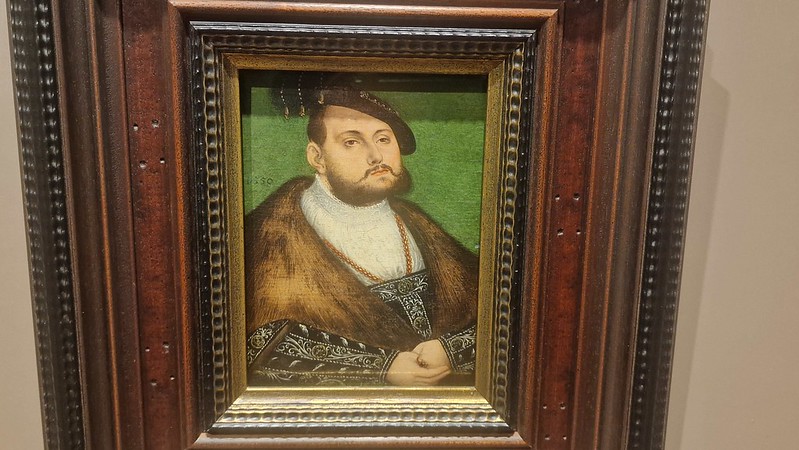
Our star player here, looking all regal and whatnot, is Johann Friedrich the Magnanimous, Elector of Saxony. I’d like to be called the Julian the Magnanimous I think, although it’s not a word that my friends have used before about me, so it’s not looking likely at the current rate. Let’s not forget the fashion statement. Johann’s rocking that velvet robe like it’s nobody’s business. It’s so richly detailed, you can practically hear the artist complaining about carpal tunnel. But hey, when you’re an Elector, comfort comes second to looking fabulous. It was painted in around 1550 by the workshop of Lucas Cranach the Elder (1472-1553). There must be some political intrigue here as to why this was painted, but I don’t want to go down the rabbit hole of trying to understand Saxony politics in the mid-sixteenth century but he clearly wanted to look like a man of status.
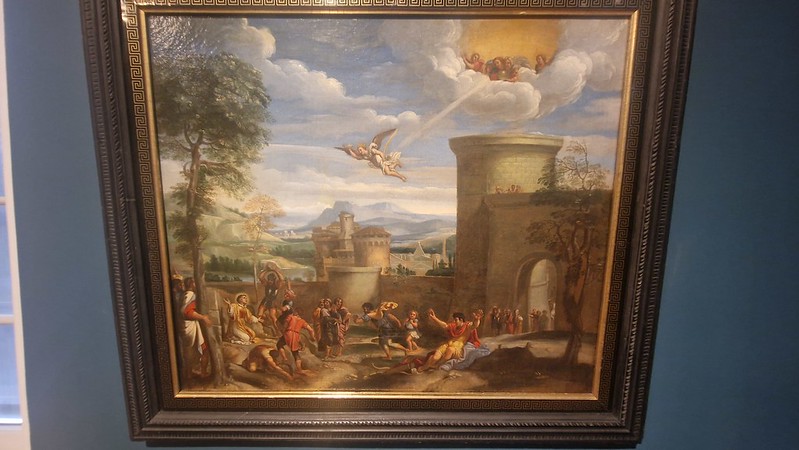
More art commentary, not that I know what I’m talking about, but I do like a bit of old religious art. I don’t really fully comprehend why people used to like this imagery, you’re got the thoughtful St. Stephen being martyred here in some form of biblical game of dodgeball but with rocks being used as projectiles. And the angel has arrived a bit late in proceedings to be of much use here, a bit like some buses that I’ve tried to catch. But, I digress once again. There are a lot of rocks everywhere, but I suppose when you want to do some throwing it’s always handy to have them available.
St. Stephen was the first martyr in Christianity, that’s quite a claim to fame. Many others followed in his somewhat rocky footsteps, but it’s a hefty price to pay for beliefs at what was quite early on in the whole religious movement. The artwork was painted in the studio of Annibale Carracci (1560-1609) and I have no idea whether it was for a church or a private household, but I can’t imagine it came cheap. It’s not that I dislike the artwork or the style, it’s just that I can’t see myself being cheered up by this stoning.
On a different matter, he perhaps watches from his celestial perch with bemused amusement as the denizens of Norwich queue up for their steak bakes and sausage rolls, blissfully unaware of the saintly connection in the Greggs that lies on St. Stephen’s Street which is effectively named after him. I’d like a street named after me with a Greggs on I think. Right, I really am digressing now and perhaps regressing if I’m being honest at this rate.
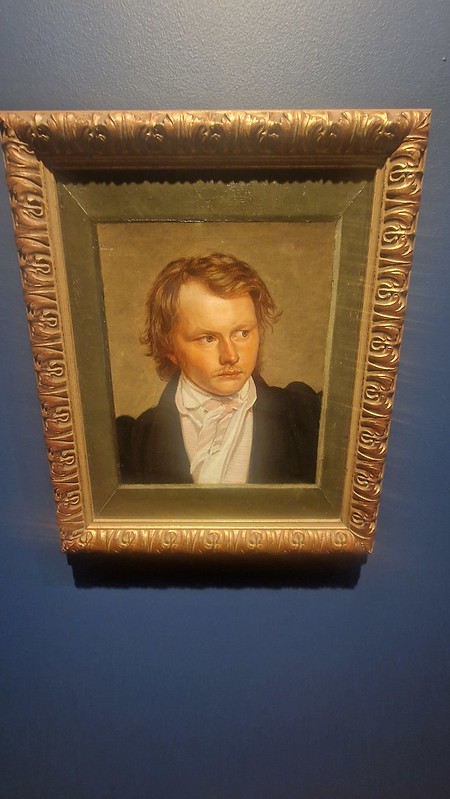
Firstly, Google AI is on top form in describing artworks, simply uploading this image produced the result:
“Freidrich Ludwig von Maydell, the subject of the portrait, exudes an aura of quiet contemplation. His piercing blue eyes, framed by a cascade of silver hair, seem to hold a lifetime of stories and experiences. The gentle lines etched upon his face speak of wisdom and resilience, while the hint of a smile suggests a depth of kindness and compassion. He is adorned in a simple yet elegant attire, a dark suit and tie complementing his distinguished demeanour. The backdrop of the portrait is a blurred tapestry of warm colours, hinting at a life richly woven with diverse experiences and emotions.”
I couldn’t have put it any better myself. The information board at the gallery notes that:
“The portrait belonged to the collection of Freidrich Ludwig von Maydell’s grandson. At the outbreak of the Second World War, Eveline, donated the painting along with several other works and family archives to the Art Museum of Estonia on condition that if the works were not reclaimed within 35 years, or 10 years after her death, they would remain with the museum. In 1946, the museum gave the documents and family photographs accompanying the works, as well as many of Eveline von Maydell’s own works, to the National Archives”.
Maydell (1795-1846) joined the Russian army before realising that he was better at art than being a soldier (and the tumult of the Napoleonic Wars likely didn’t make for a peaceful period in the armed forces compared to the potential excitement of self-expression away from the front line), learning new artistic skills in Germany and Italy before returning to Estonia. He died in Tallinn in 1846 of cholera, part of numerous epidemics of the disease which were sweeping across Europe at that time.
Back to Eveline von Maydell (1890-1962), she was a silhouette artist and clearly feared the implications of the Second World War not just from a human perspective but also fearing for fragility of civilisation on a wider level. She was fortunate to be a US citizen, it meant that she was able to leave Estonia for safety in the United States before the Soviet occupation began in 1940. I mention all this as there’s something about the enduring power of the artworks of the Maydell family to survive the darkest of times which Estonia has faced.
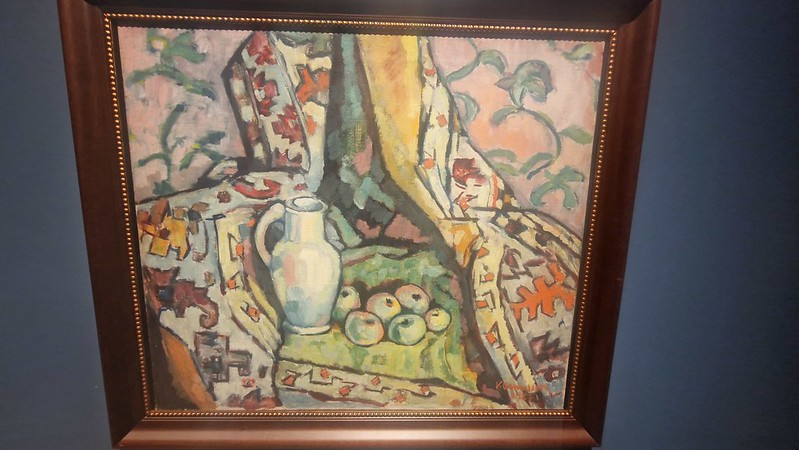
I don’t really understand artworks like this, although it’s from 1927 and is something of its time. However, I asked Google AI what it thought of the painting and it had quite a lot to say about it.
The Cloth: A cascading Morning Glory vine, symbolising affection and the ephemeral nature of beauty, entwines with bold Sunflowers, representing adoration and longevity. These blossoms dance against a backdrop of Pink Roses, whispering gratitude and grace.
The Apples: Scattered like fallen fruit, Yellow Apples convey success and good health, while hints of Green Apples symbolize new beginnings and harmony.
The Pitcher: A vessel of purity, the White Pitcher echoes the innocence of Lily of the Valley, promising a return to happiness.
The artwork’s overall message is one of hopeful abundance, with a touch of melancholy for the fleeting nature of beauty. It’s a reminder to cherish the present moment, like a bouquet that blooms only briefly.
I’m not sure there’s much hopeful abundance here, it’s some apples on a rug and that’s the name of the artwork. Google AI really has been outstretching itself here to come up with terminology and thoughts such as this and the technology behind it is fascinating to me. The arguments it’s making are coherent and sophisticated, although have little resemblance to reality.
The artwork is by Villem Ormisson (1892-1941) and I wanted to mention him as he committed suicide in 1941 as he was so distraught about the Second World War. The Soviets hated him and posthumous exhibitions of his works were banned following the Second World War, he was seen as a dissident. Much as still life artworks don’t do much for me, it shows how much the Soviets hated anything vaguely artistic as it hardly seems revolutionary…..
And another one in my series of irrelevant art posts.
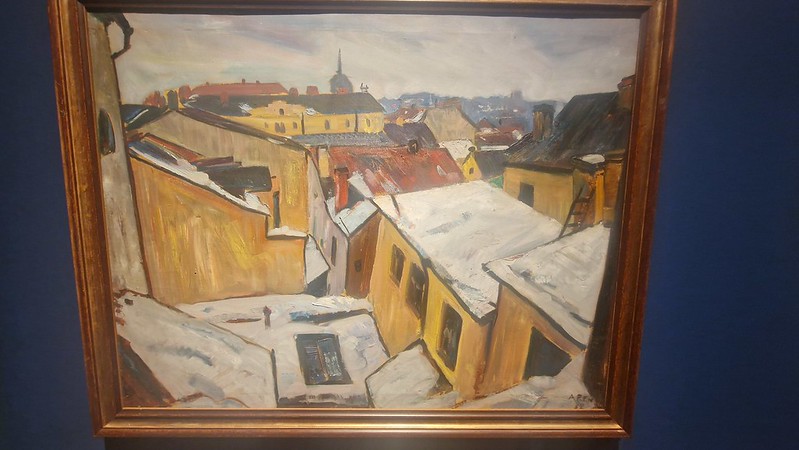
I’d like to visit Tartu, the second largest city in Estonia which has a mostly derelict cathedral and is the home of Pühaste Brewery (I mean Tartu, not the derelict cathedral). Peet Aren (1889-1970) painted this in 1928 and the Tallinn City Government, in a fit of either foresight or impulsive bidding, snagged it a few years later. There’s a wintry atmosphere and loose brushwork, I thought it was quite evocative of an early twentieth century European city.
Lovely oil painting as it is, it feels intriguing that this must have felt such a different time for Aren, as he fled Estonia in 1944 and lived the rest of his life in New York. The element that is perhaps unusual is that there is a lot of information on-line about his pre-war paintings, but nearly nothing about after he arrived in New York although he did keep painting. Whilst in the big city, he did seem to do a few street scenes but I can’t see any evidence that he captured the essence of the city, namely hot dogs. This whole thing about just how many people had their place of residence permanently changed because of the outcome of the Second World War interests me as I wonder how individuals coped with it, suddenly scattered around the world in a location they might never have imagined and then trying to lead a new life.