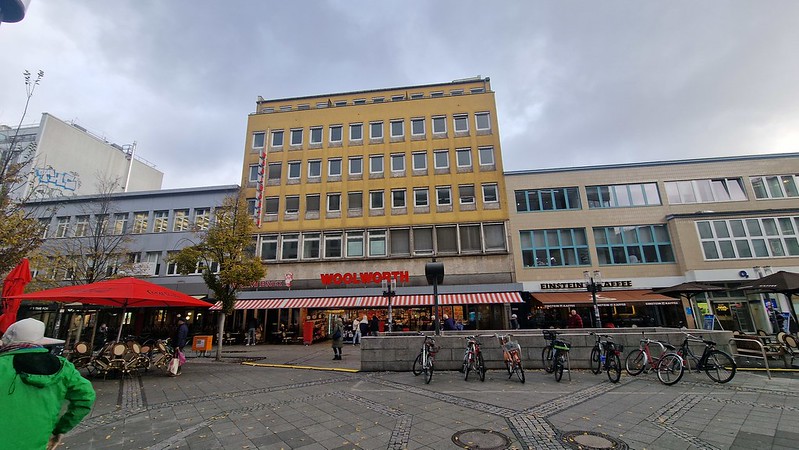
You learn something every day…. I didn’t realise that Woolworth, although I find it hard not to write Woolworths, has such a large presence in Germany. Although I associate the name with a failed UK retailer, it seems to be a thriving and expanding discount retailer in Germany. The story of this whole arrangement begins with Frank Winfield Woolworth, who pioneered the ‘five-and-dime’ concept in the late nineteenth century in the United States. This success crossed the Atlantic in 1926, with the first German Woolworth store opening in Bremen and the chain grew rapidly, becoming a familiar presence in German towns and cities. However, the German arm diverged from its American parent company in 1998, becoming an independent entity following a management buyout. This move proved crucial to its survival, as the original F.W. Woolworth Company declared bankruptcy in 1997 and things all became a bit sub-optimal everywhere for them.
Despite this newfound and exciting independence, Woolworth Germany faced its own challenges. In 2009, the company filed for insolvency, burdened by debt and increased competition. Since then, it’s had a series of buy-outs, financial issues and corporate investors, but it has pulled through and they now have over 700 stores in Germany and are aiming for over 1,000. Since 2021, they also own the rights to the Woolworth name in the UK and Ireland, although they don’t seem particularly engaged with opening stores at the moment although they haven’t ruled it out. They are though looking to increase the number of stores in Poland, so maybe there will be a revival of the brand in the UK at some point…
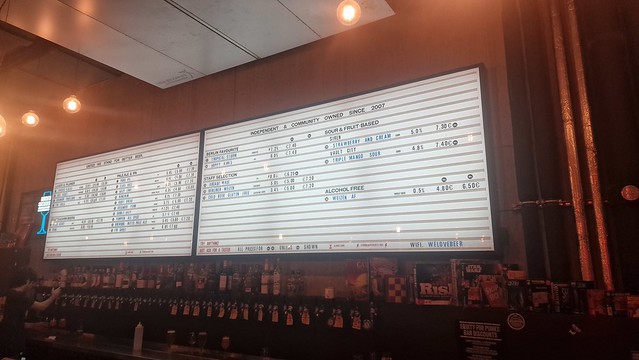
I’m still making my way around all the Brewdog bars I can find and I thought I’d pop in for a quick drink at this large venue in the centre of the German capital. The service was a little sluggish, but it was polite and friendly so that did for me. There’s plenty of seating downstairs, but there’s also an upstairs area as well so there should usually be plenty of space. The pub, or at least one of the staff, also seems to own a large fluffy dog which I thought looked rather sweet meandering around the place. The beer menu was pretty extensive, although I had already had most of their guest beers, but I’d add that’s not a complaint about the bar…..
I tried the Hoppy Xmas that Brewdog themselves brew, but I wasn’t getting much Christmas from it, although it had a hoppy front and a bitter back. The beer that I did go for was the Arcade Made, also brewed by Brewdog, which was punchy, hoppy, foggy and a bit dank, very much a decent fruity one.
I did consider getting a pizza, but I thought with the number of restaurants in the area that I’d find something a bit more local and I was pleased with my choice. It’s well reviewed on-line with most customers happy with the operation, but there are a limited number of craft beer options in the city and so there’s a different dynamic here compared to some other Brewdog locations around the world. Nice set-up, I can see why this bar is popular and I suspect that it will continue to be busy.
For reasons I can’t recall as it’s nearly a month ago, I didn’t take a photo of the outside of this restaurant, so here’s an inside one. It’s a very well reviewed Vietnamese restaurant and I thought it would provide a suitable evening meal for me.
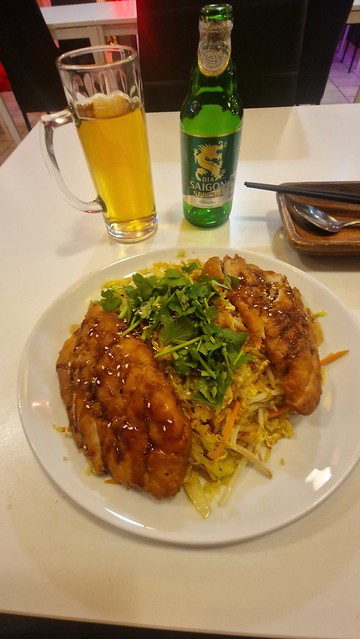
I ordered the Saigon Special beer as I hadn’t had it before and it was clean and easy going. I mean, it’s not a Goose Island Bourbon County Stout, but it went well with the food.
The chicken skewers in a satay sauce, with the meat being tender and the sauce being flavourful.
This main course was a little ridiculous, although it’s not really entirely evident from the photo. However, there are two large pieces of battered chicken there and a massive mound of noodles, with the whole arrangement taking me nearly half an hour to get through. The food was delicious though, the chicken was tender, the batter was crispy and the noodles had a depth of taste. I did feel for a while like it was a BeardMeatsFood type challenge, but I ploughed on through.
The cost of the whole meal came to something like £15, which I thought was excellent value. The reviews are very positive, although a few people actually complain that there’s too much food, but there’s no pleasing everyone I guess. It felt like a family run operation and the atmosphere was very laid-back, but it felt a welcoming location and everyone was polite and personable. The food has a depth of flavour so it’s recommended anyway in my view, but the size of the meal certainly makes it even better value. All really rather lovely.
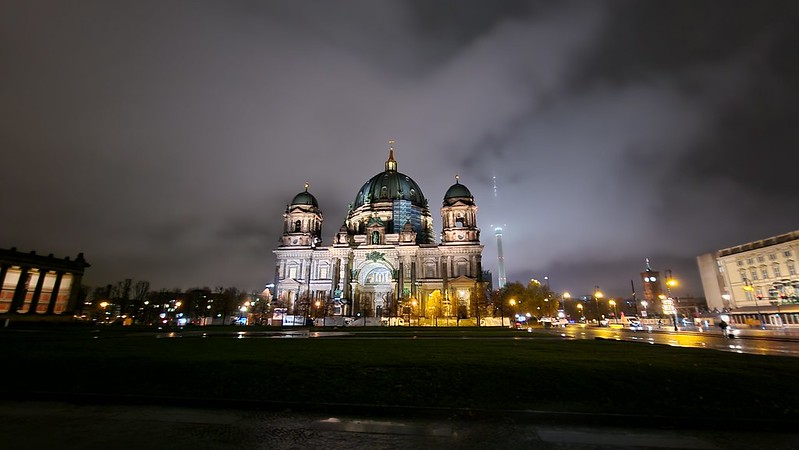
This reminds of something that happened when I last visited this building, something like eight years ago now. I remember there was a young girl, probably aged about 12, who wanted to use the toilets. She was sent away by the staff member for not having any money and she was visibly upset. I have remembered that and have remembered just about nothing else about the cathedral. There is an argument that a religious building should prioritise compassion and hospitality, but certainly it was a moment of unkindness that overshadowed my memory of the rest of the building.
I’ve been meaning to visit here for a while and it’s a substantial museum which is free of charge and seems very well financed. I must admit, I thought it was a pretty dreadful museum, but perhaps I was expecting something similar to the POLIN Museum of Jewish History in Warsaw, an incredible institution. This is one of few museums that I’ve left absolutely none the wiser on anything than when I went in (with one exception), which seems a sub-optimal situation, but I understand that many people have different experiences. Actually, I can’t think of any museum where I’ve been where I’ve left thinking I have no story to tell at all of my visit. This is particularly unfortunate as I try and find Jewish museums of varying sizes around the world and they’re often really impressive places. It takes around 10 minutes to get in because of the security processes that unfortunately are needed because of the nature of the museum, something which is a sad indictment of our times in itself.
The corridors were designed to give a feeling of “unease and disorientation”. Yes, that worked, it made me dislike the museum. Which struck me as the problem, for me, of the museum which is that it seemed to want to tell me things rather than show me them. I rarely knew where I was in the museum.
Some steps which are meant to cause unease I suppose. The museum refers to it as “our impressive staircase”, but it just seemed steep to me.
And a “voided void”.
There’s wasted space all over the place, but then there are pinch-points where visitors can’t see anything because people are clustered together.
I don’t really understand why a museum is built with so many unuseable areas and odd angles.
I like when museums display paintings like this so that the back can be seen, so I had a moment of thinking the curators had been careful with the design. But, no, they’d just put artworks on the back of each other, so they might as well have just put them on the wall. I’m not entirely sure why they’ve put the description of the artworks so near to the ground either.
The exception I mentioned earlier on is that I hadn’t seen much before in museums on how Jewish people lost their possessions during the war in terms of the actual sale of them. There were some interesting documents on this, showing how they were forced sales of possessions but very little money was gained.
The museum’s cafe. To add to my “unease and disorientation” I couldn’t work out how to get out as the exit door was marked as closed, so a helpful staff member showed me a rear exit so I could return to the street. I wasn’t the only one who couldn’t work out how to get out, which seems something of a basic function of any building. To be honest, this museum seemed to be a prime example of what happens when something is over-financed and has too much money. It becomes style over substance. It’s not as well reviewed as the POLIN Museum in Warsaw, but that is one of the greatest museums in the world and does an incredible job of explaining Jewish history, culture and doesn’t try and make people feel uneasy by making the building feel inaccessible. I also remember my visit to the United States Holocaust Memorial Museum in Washington, which I accept is telling just a certain part of the story of what Jews have faced (although obviously a big bit), but I remember the care taken into making that museum accessible, engaging and the displays made it emotive. Similarly, the Joods Historisch Museum in Amsterdam which told the story in a powerful and coherent way, although I know their positioning within a former Synagogue added somewhat to the atmosphere.
Anyway, having noted my numerous whinges, the museum is still well reviewed and although there are plenty of people who agreed with my assessment, there are far more who like what has been done here. There are hundreds of reviews which like the design and how it makes people feel uneasy, but everyone is different I suppose. I think I’m just an advocate of “show, don’t tell” and so I couldn’t connect to this museum at all and I was disappointed by the disjointed nature of the whole place. But, having noted that, it was free and so I can’t much complain. Although I evidently just have. For me, I wanted to see more about Jewish culture, community and how they had lived in Germany over the centuries, but there was very little about that in the bits of the museum I went to (which may or may not have been a comprehensive visit as I couldn’t work out where I was some of the time).
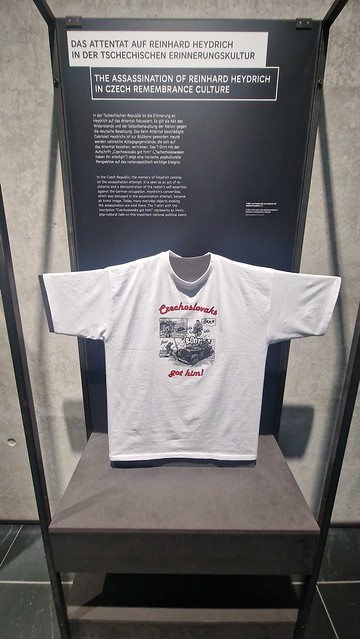
I read quite a lot about Reinhard Heydrich during my time in Berlin, not least because later on in my trip I went to the House of the Wannsee Conference. He’s obviously come up many times before in my trips to museums and concentration camps (yeah, keep it upbeat….) but this museum has a particularly big display about him. More on that later, but this T-Shirt caught my eye. It has the title of “Czechoslovaks Got Him” and his assassination is seen as something of a national achievement and items are still sold today mocking his death. What a legacy for him to have….. But, Heydrich was one of the most evil of all the Nazis, and there were a fair few dotted around to set that bar very high.
Heydrich was the Reich Protector of Bohemia and Moravia, but he was effectively in charge of delivering the Holocaust. His execution was demanded and two very brave men, Jozef Gabčík and Jan Kubiš, were parachuted into Czechoslovakia in December 1941 to plan his assassination. On the morning of 27 May 1942, Heydrich was being driven to Prague Castle in an open-top car when Gabčík and Kubiš attacked him with a Sten submachine gun and a grenade. The grenade exploded,injuring Heydrich, who died from his wounds a week later. The Nazi response was obscene, but more on that later. The order to kill Heydrich came from the Czechoslovak government-in-exile, led by President Edvard Beneš, with the support and training provided by the British Special Operations Executive (SOE). Every year on the anniversary of his death there’s a large group who gather at the site of where he died, as a memorial to the bravery of Jozef Gabčík and Jan Kubiš.
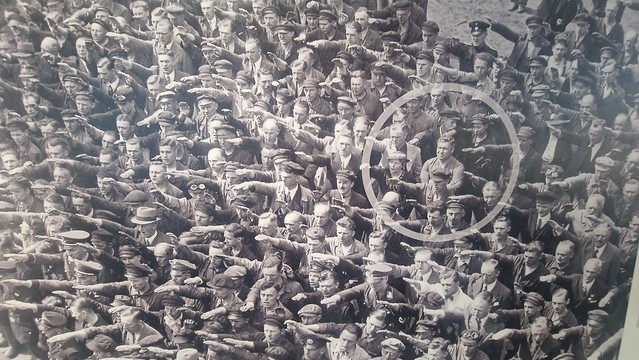
I’ve never seen this photo before, but it’s of a brave man who decided that he wouldn’t do the Nazi salute despite everyone around him doing so. The crowd were workers at the Blohm & Voss shipyards during the singing of the national anthem which followed the Fuhrer’s address on 13 June 1936 in Hamburg. There was for some time a dispute about who this person was, but the museum seems pretty certain that it was August Landmesser. Landmesser’s defiance stemmed from his relationship with Irma Eckler, a Jewish woman, who he married in 1935 in spite of the Nazi regime’s strict laws against these relationships.
The situation is more interesting though, as Landmesser had joined the Nazi party in 1931, alarmed by the economic situation in the country and perhaps, like many, wanting to enhance his own employment prospects. His relationship with a Jewish woman started in 1933 and he was promptly expelled from the party, with this being at a time when from 1934 it was possible to charge people who failed to perform the Nazi salute. August and Irma tried to flee Germany to reach Denmark in 1937, but they were arrested before they crossed the border and returned back, with the legal case against their marriage being dropped in 1938 due to a lack of evidence. It was effectively a warning to the couple that they should end this relationship, but they weren’t going to do that.
Since the couple stayed together, the lack of evidence didn’t prove a problem though and August was arrested later in 1938 and sentenced to two and a half years in the Börgermoor concentration camp. Irma had two children with August, which led to her being sent to Bernburg Euthanasia Centre, where she died in 1942. August was released from imprisonment in January 1941 and worked as a foreman for a haulage company for a while, before being enlisted. He was killed in action on 17 October 1944 in Croatia and he was buried in a mass grave near Hodilje, located near Dubrovnik. In 1951, their marriage was declared legal following the restoration of some sort of normality in Germany and although they had both died, it must have been some sort of comfort to their two children who had already been put into the care of a guardian. One of the children, Irene, wrote a book about her parents with the title “A Family Torn Apart by Rassenschande: A Document of the Persecution of the Landmesser Family”.
It’s rare that you can really guess at what someone was thinking just by looking at an historic photo, but I imagine that August had just heard a load of anti-Semitic piffle (or at least some hate directed at some group) and was hardly in a mood to cheer on the Nazi leadership. It must have been very difficult to stand alone at this time and Nazi officials often watched over a crowd to look for any dissension. Above is a photo of the same event but with Hitler in the photo.
I have a radical view, although it’s not really radical, but if you have a crowd chanting at the end of a speech (and particularly one which has been directed at some target group) then there might well be a problem ahead….
I rarely get cold, but after standing at the Berlin War Memorial in the snow, rain and wind for an hour, I must admit that even I decided that two thin layers wasn’t really enough. My friend Łukasz had kindly acquired me a Titanic Brewery cap as a birthday present which kept my head dry which was handy. Since the Berlin trip, I have now switched to what I refer to my ‘big coat’ but which a friend commented was just a hoodie and not really a big coat. But, I don’t want to be doing that overheating lark, it’s bad for my skin. Anyway, I’ve digressed here because I thought I’d better pop to a cafe to dry out. It was busy when I got there, although it transpired to be one big group getting a takeaway so all was well with finding a seat and a place to drip onto the floor.
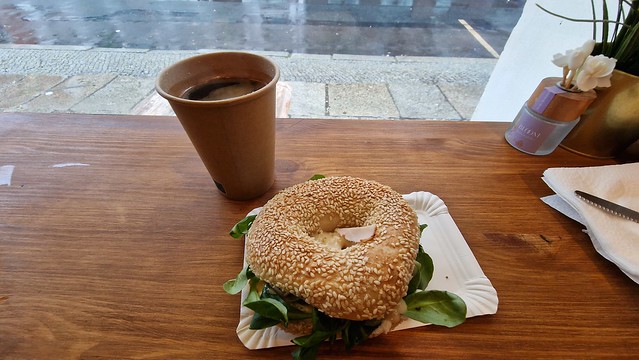
I love a bagel and am still just a little annoyed that JD Wetherspoon ditched the pastrami bagel, but I suppose I should get over that since they scrapped it about six years ago. But, back to the matter at hand. There was a warming coffee and the chicken filled bagel was delicious, lots of flavour and with just the right amount of crispiness to the bagel. There was a slight muddle as the staff member thought I was part of the big group, which is why I’ve been served it in a takeaway container and I heard her trying to say in German to the group that someone had definitely ordered a chicken bagel. Matter resolved I was dry after around thirty minutes, so this was a handy lunch stop. I had intended to walk around Berlin, but I ditched that plan and bought a 24 hour public transport pass instead.
Anyway, it’s a cosy little place with high tables and more traditional seating, with the service being prompt and efficient especially as there was only one person taking the orders and making the food. The prices were moderate and there was an inviting and relaxed atmosphere. There’s a toilet in the cafe which is handy, as not all Berlin locations seem to have some decadent facilities, and it was warm which was quite important when trying to dry off. I think they also serve waffles, although I never tend to eat those, but they had some cakes to choose from as well.
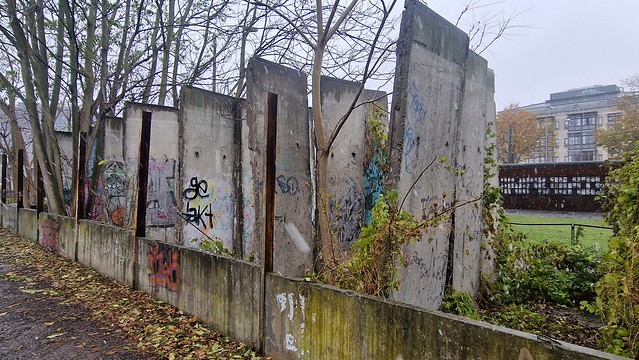
Some of the remaining sections of the wall, which once stretched for 27 miles, at the Memorial.
More wall. It’s hard to believe that they built a wall around half a city.
Visible on the left, they’ve taken a section of the wall away.
And placed it here.
There is a visitor centre but it’s really only for groups and it’s something of a badly designed mess. I did though get a leaflet about the history of the wall which was quite useful. Anyway, I think that’ll conclude my little series of witterings about this memorial, but I appreciate the efforts that have been made to explain the site and to preserve what they could.