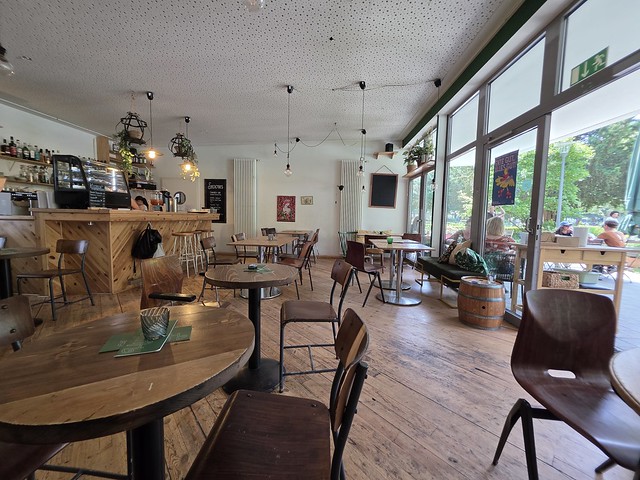
I’m the last person to complain about the heat of course, but it has been stupidly hot today, reaching 33°C earlier on which is way above my comfort levels (which are around 7°C to what I consider a balmy 10°C if I’m being honest). That meant I felt the need to pop into this pleasant little bar which is located in a park. There was outside seating, but I wasn’t going anywhere near the sun. The park is actually Nordmarkt, which seems to have a fascinating history of its own, but the heat (which I might have mentioned) did distract me from being too engaged about that.
It was generally busier than this, but I try and avoid getting photos with people in them and it was busier outside. The service was friendly and welcoming, it was a rather laid-back and comfortable little place. There were around five or six beers to choose from, the prices were all moderate and under £5 for a half litre of beer. They do food as well, but I was too hot to think about that.
I went for half a litre of the Allgaüer Büble Bier Edelweissbier as I rather fancied a refreshing Weissbier with that tropical touch of banana flavour. It was refreshing certainly, slightly sweet and didn’t make much difference to cooling me down since the temperatures were so extreme that I don’t think anything short of sitting in a freezer would have helped me earlier. But, I’m not one to complain, but let’s just note that my thermal recalibration was sub-optimal today.
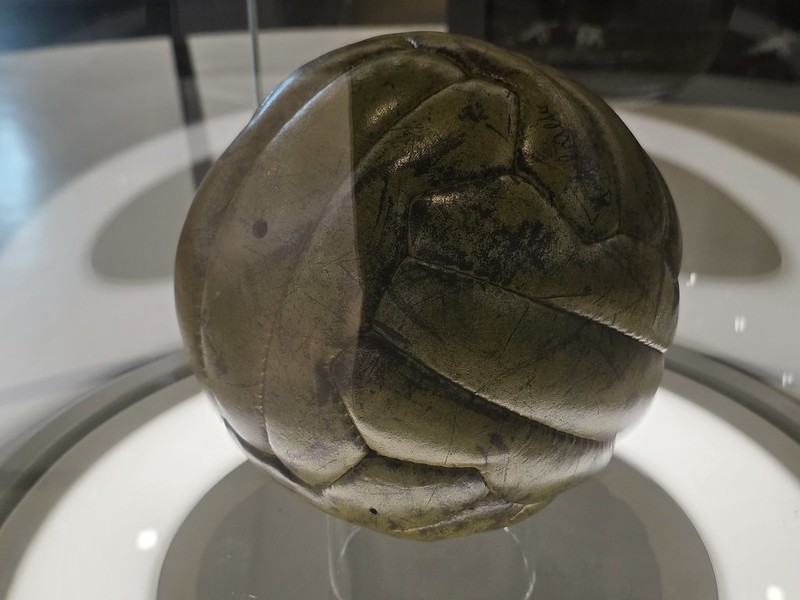
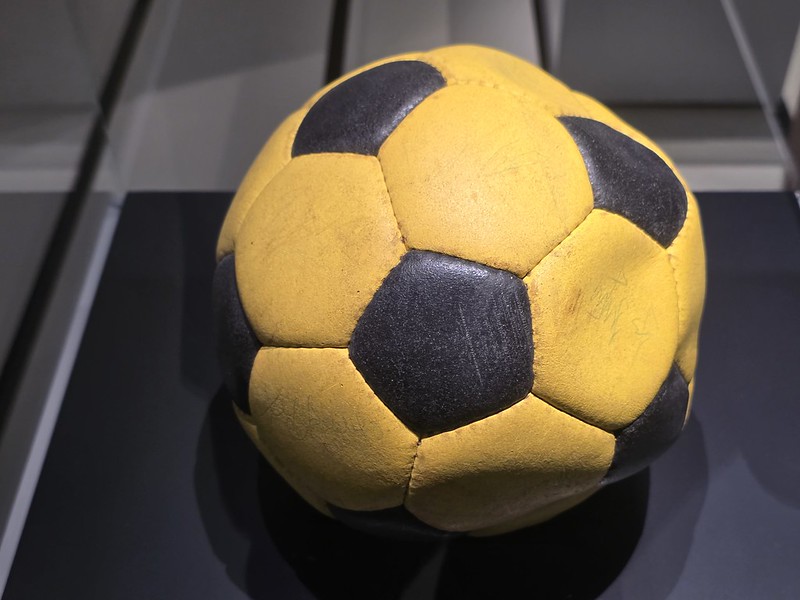
This is one of the star exhibits in the German Football Museum, a football which was used in the 1954 World Cup Final and it has also been signed by members of the winning team. I’ve already mentioned about the ‘Miracle of Bern’ in my excitement over a brick, but this really surpasses that. ‘Rahn schiesst!’ and all that, one of the most enthusiastic commentaries that I’ve heard. The ball was made by Basel based company Kost Sports and FIFA at the time insisted that there was no branding on the ball. This was the ball used in the game and it marks the winning of the first German major football trophy. They’ve won the World Cup three more times since then, which is better than England have managed, but there we go. A piece of German heritage.
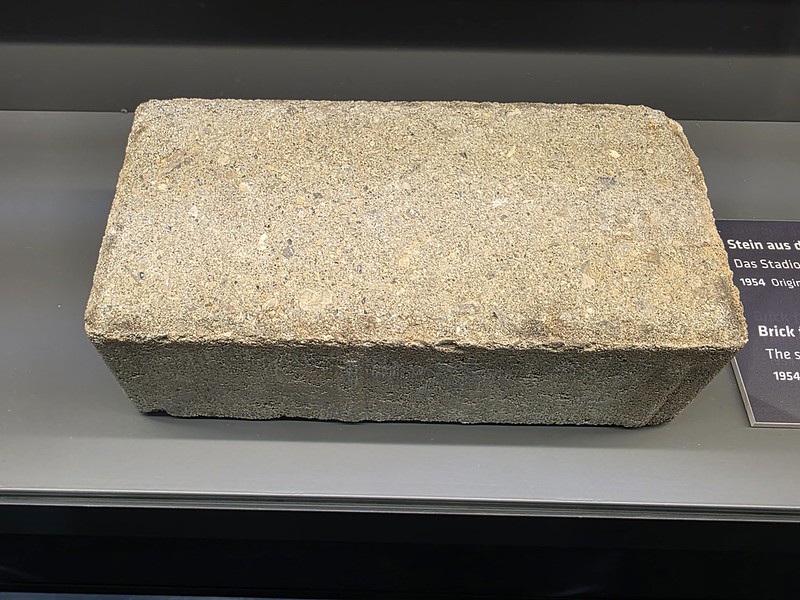
I had to discreetly take this photo as I didn’t want other visitors thinking that I was taking a photo of a brick from the Wankdorf Stadium. But, I think these things are interesting, a small reminder of what once was. It’s located in Switzerland (well, it was) but it’s relevant here as it’s where the ‘Miracle of Bern’ took place, a match where Germany won the 1954 World Cup against Hungary in what was something of a shock result. This game is an important part of German football history and it was also emotional as they were banned from taking part in the 1950 World Cup due to the Second World War situation, so it was something of a comeback. The stadium had been built in 1925, it was for a long time the largest stadium in Switzerland and it remained until 2001 when it was demolished and replaced with the Stade de Suisse. Who knew a bit of masonry could be so poignant?
And this post is more exciting as it might have first appeared as there’s more, here’s a seatback as well from the same stadium. I should probably get out more…. Although this isn’t exciting enough, my next post is a bit more mainstream and likely more interesting to German football fans….
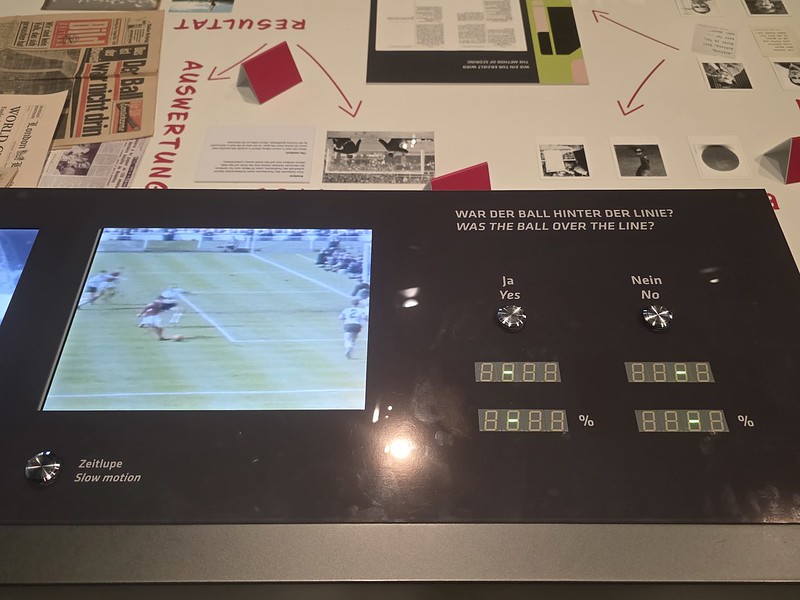
I think that this might still be a live issue amongst German football fans…. The controversial goal scored by England in the World Cup Final in 1966 and whether the third goal for England actually crossed the line.
Of course it was a goal. I’m slightly surprised that I was one of 41%, I thought that there might be some bias creeping in here amongst German football fans.
Although I’ve to AI to ask what Google Gemini and ChatGPT thought….
Google Gemini said:
“So, the official answer from the time is “yes,” it was a goal, because the linesman said so. But if you’re asking about the scientific, pixel-by-pixel reality of it, most modern analyses say “no,” it wasn’t.”
ChatGPT said:
“Most likely, no, the ball didn’t fully cross the line—but it was given, and history was made.”
This exhibit at the German Football Museum is the original football (or one of them, I imagine they had hundreds) from the 1972 Olympic Games, the ones which were meant to be known as the ‘cheerful games’ until there was a terrorist attack on the Israeli team which rather deflated matters to say the least. The great country of Poland won those Olympic Games, the only time that they’ve won the football tournament. British players don’t take part due to a panic amongst the FA that it might jeopardise the situation that Wales, England, Scotland and Northern Ireland all play as independent teams in European and World competitions, whereas we’d have to submit a British team for the Olympics. The FA do somewhat panic, they did manage to submit a team for the 2012 Olympics Games when they were in London, I’m sure that they could cobble something together. If not, perhaps we should just enter some random players from the lower leagues, give them a nice kick about.
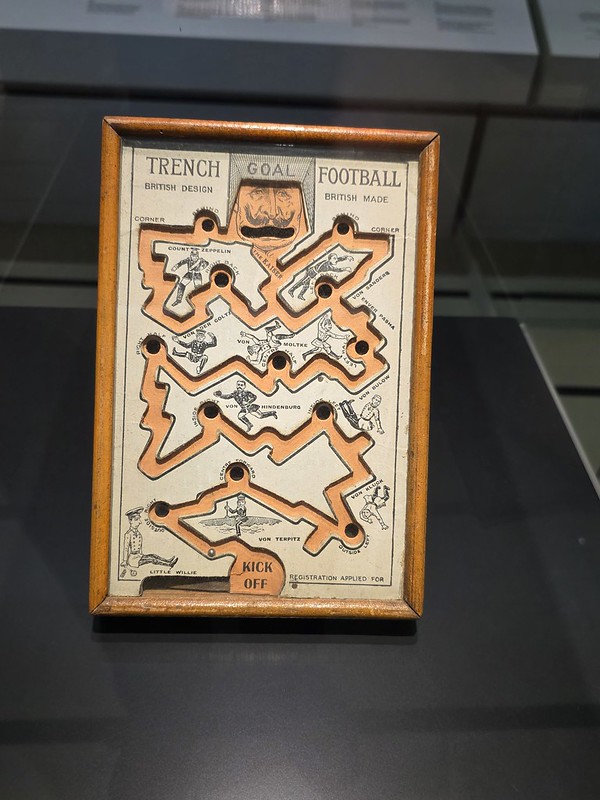
In the first of (yet) another series, I’ve been to the German Football Museum today and there were many exhibits that I thought were noteworthy. This one is British from 1917 and it was designed to mock the Germans during the First World War, with ten enemy soldiers forming obstacles for the ball which has to be guided into the mouth of Kaiser Wilhelm II. Mimicking the western front, the obstacles included von Hindenburg at Inside Right, von der Goltz at Right Half and Count Zeppelin at Right Back. I rather like the ‘British Design’ and it’s a quirky little item to have in a German football museum.
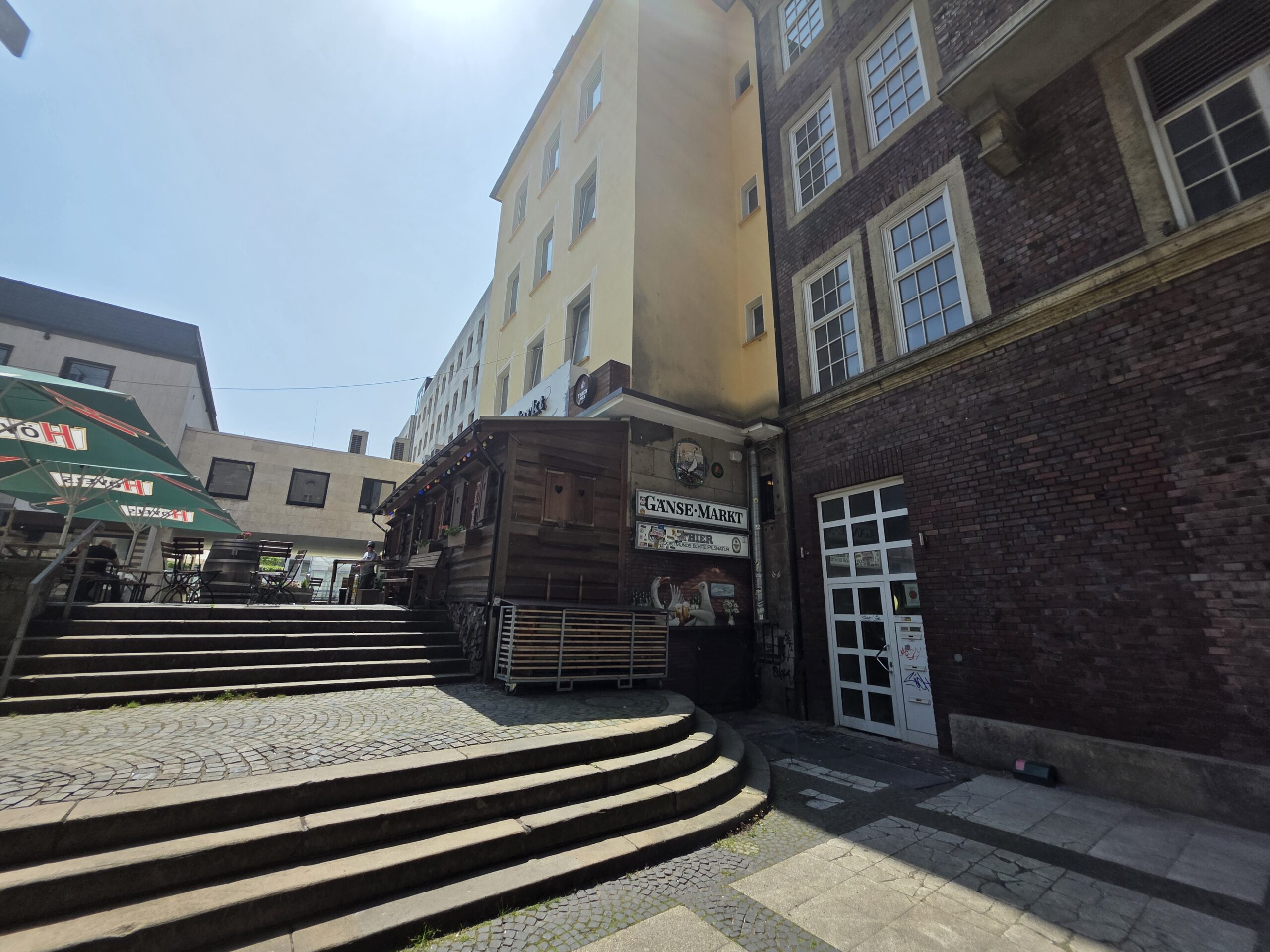
This historic bar is located in the Gänsemarkt, formerly the Goose Market, and it’s a Kneipe or a bar which doesn’t serve hot food. There was a spacious outdoor drinking area which I ignored as I made my way inside and it’s relatively small inside, but it felt like it had some character.
It had a traditional and authentic feel to it, but I just needed somewhere to visit that wasn’t insanely hot. I couldn’t be dealing with Germany’s backwards approach to cards, so I had got some cash out to make matters easier for me. The welcome at the bar was friendly, but there were no beer pumps or signage visible, but my request for a beer was accepted readily with no further questions. Well, there was a question of small or large, but I could deal with that one. I think it usually attracts some of the local sporting crowd who watch football, but that seemed to be true for nearly every bar that I’ve seen so far. I’m guessing that football is very important around here.
The beer here is the local Thier Pils from Dortmunder Actien-Brauerei. It’s a traditional local Pils and Dortmund beers have something of a unique taste and it was refreshing if not particularly innovative. But, if I’m being honest, German beer is usually not burdened by the need to be innovative, it’s meant to be robust and consistent I think.
It’s a handy little location and I liked the distinction between bar and restaurant, which I often find is a little blurred. This place was primarily about the beer, although other drinks are available, and that made matters much easier. The service was friendly and I thought that the price of €4.60 for the beer was reasonable, so just over £4. I didn’t try to pay by card, but that seems a good call as I’ve noticed that some reviews mutter on that they accept cash only.
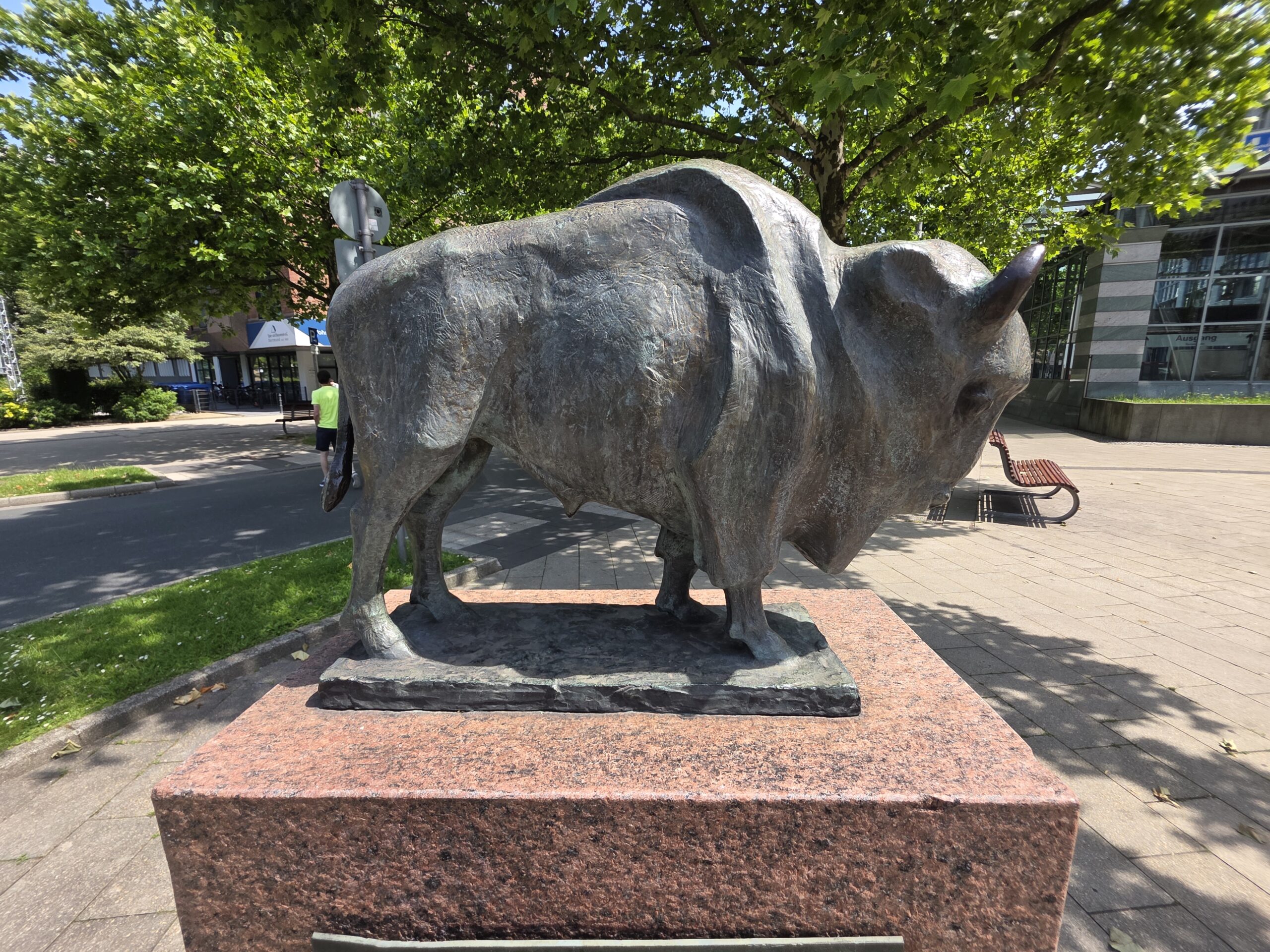
I wondered about this buffalo which looked a little lost when I saw it earlier, but Dortmund is twinned with Buffalo, New York (and indeed also with Leeds and some other cities around the world) and to mark 1,100 years of Dortmund the American city sent them this bronze bison.
It was installed here in 1982 and was meant to reflect the partnership between the two cities. The date of 882 is when the city was first mentioned and that is when it was referenced in the documents of Werden Abbey, although it’s thought that it had been going for longer than that. But, sometimes a line just has to be drawn in the sand.
The text reads:
“The Buffalo Bison. A gift from the citizens of the City of Buffalo for the 1100th anniversary of the City of Dortmund”
Incidentally, I note that Leeds didn’t send a statue of a Yorkshire terrier.
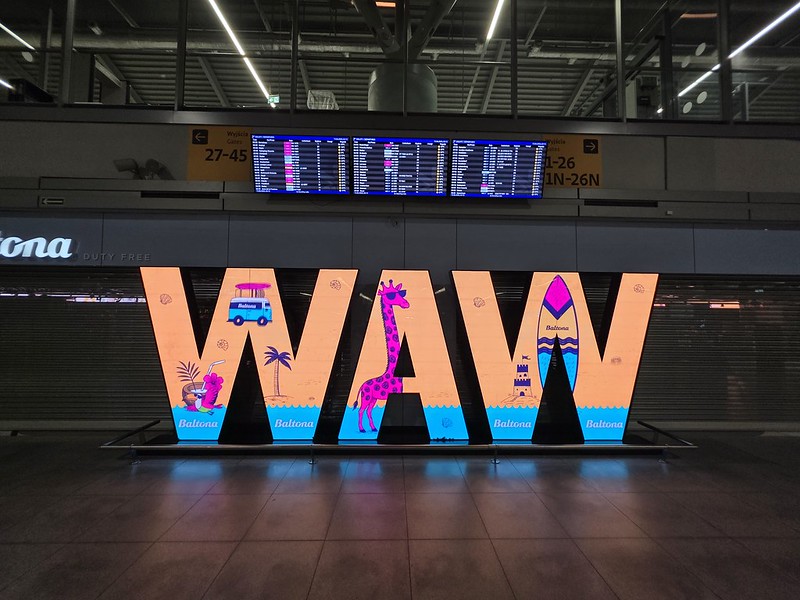
Today’s early morning flight was from Warsaw Chopin to Dortmund and since I was at the airport soon after the security area opened, it was certainly a quiet airside. Although I accept that’s because normal people don’t arrive at airports as early as I do……
The corridors weren’t yet bustling.
The restaurants not yet packed.
I went to inspect the gate for my flight, which was scheduled to leave at 06:05. I realised that this meant I had time for a flying lounge visit, although it only opened at 05:00 so it wasn’t going to be a lingering one.
A little queue had formed for the lounge.
The excitement of it all….
As usual, I was eyeing up the chocolates (in that basket on the right of the photo).
And a breakfast of a Greek salad, blackcurrant juice, Fanta and a hot chocolate. I soon added chocolate, a banana and two shots of espresso. It transpired that I had twenty minutes in the lounge until they called customers to go to the gate, but that was sufficient time to get enough food and drink. Fortunately, my lounge pass is unlimited as I wouldn’t have paid for such a short visit.
The boarding process was efficient, although it was a bus gate which is never entirely ideal. The seating Gods had given me a middle seat, but it’s only a short flight and I was asleep for nearly all of it anyway. The route from Warsaw to Dortmund (and back again) has only just been launched but it was a nearly full flight. This is the exciting thing for airlines such as Wizz Air and Ryanair, they can open new routes and have a near guarantee that people will want to travel between the two locations.
The aircraft was 9H-WBZ, an Airbus A321 which has been in the fleet since October 2022, which I don’t think that I’ve been on before.
Safely into Dortmund and it was a little warmer than Warsaw.
Dortmund Airport is, if I’m being honest, bloody awful. The terminal was built in 2000 and designed for many fewer passengers, so it’s struggling to cope with the current higher volumes. There aren’t enough toilets, it’s not clean and it didn’t feel very well maintained. There was limited seating, the signage was confused and the on-line reviews are appalling, they desperately need an entirely new terminal. I can’t say that I’m looking forward to flying out of the airport in a couple of days.
Anyway, it was in my eyes a successful flight as it cost me under £9, it was on time and everything seemed well managed and organised.
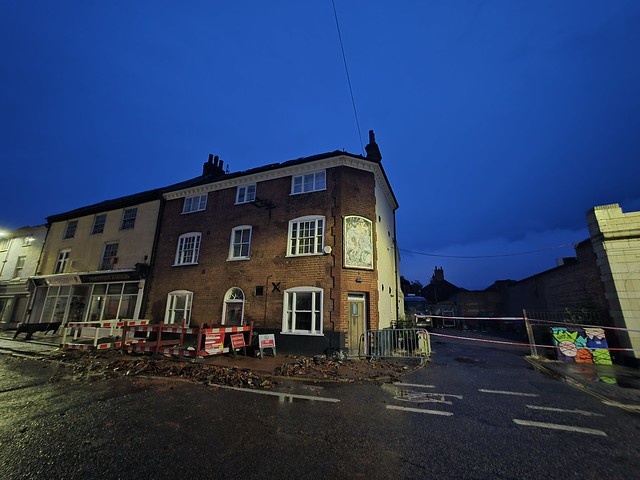
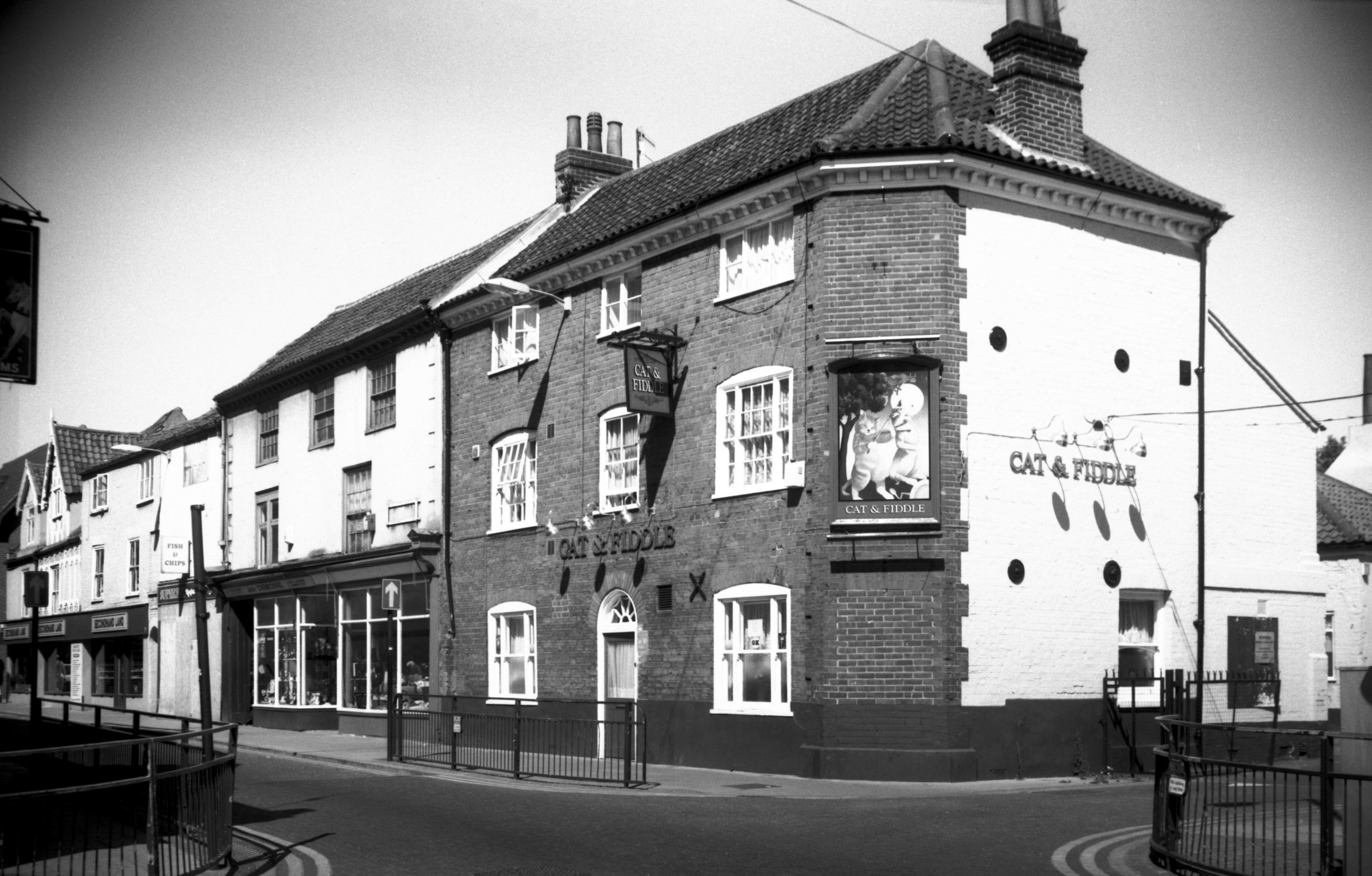
The scene at the Cat & Fiddle last week after a fire, caused by a cannabis farm getting a little over-heated on the top floor, caused significant damage to the former pub which had closed in 2011. It had been a pub since 1760 and, a little ironically perhaps, a few years after closing it found itself in the craft beer quarter along with the Malt & Mardle, the Artichoke, the Leopard, the Plasterers and the King’s Head. George Plunkett has a photo of the pub as it looked in 1997.
In terms of the pub name, there was a letter in 1902 sent to the media regarding the pub’s name.
“THE CAT AND FIDDLE.
Sir,—In “The History of Signboards,” by Larwood and Hotter, the following account is given: ” . . . The only connection between the animal and the instrument being that the strings are made from the cat’s entrails, and that a small fiddle is called a kit and a small cat a kitten. Besides, they have been united from time immemorial in the nursery rhyme,
Heigh diddle diddle, The cat and the fiddle.
Amongst other explanations offered is the one that it may have originated with the sign of a certain Caton Fidèle, a staunch Protestant in the reign of Queen Mary, and only have been changed into the cat and fiddle by corruption; but, if so, it must have lost its original appellation very soon, for as early as 1589 we find, ‘Henry Carr, Signe of the Catte and Fidle, in the Old Chaunge.’ Formerly there was a ‘Cat and Fiddle’ at Norwich, the cat being represented playing upon a fiddle, and a number of mice dancing round her.”
—Yours, etc., J. C. BURLEIGH. 13, Plynlimmon-terrace, West-hill, Hastings, Nov. 30.”
Well, there are some views on the history and it must be noted that the pub had a rather impressive sign, still visible in my photo at the top. There have historically been four pubs with the name Cat & Fiddle in Norwich (although nearly nothing is known about two of them), including one on Botolph Street which lasted until 1867, but the Cat & Fiddle Yard lasted until 1967. This map from the 1880s shows the confusion here that there must have been and indeed still us in trying to identify which pub is which when they’re referred to in the media.
Towards the bottom centre-left is the Cat & Fiddle Yard, although the pub here had closed a few years before. The pub on Magdalen Street is visible towards the centre-top of the map, with the Phoenix Brewery visible located opposite. Anyway, back to the Cat & Fiddle on Magdalen Street which is what I should be focusing on here.
The building doesn’t look it from the exterior, but it was likely built as a residential property in the early eighteenth century and was then used as a pub from around 1760. The rear range of the pub is older though, perhaps as early as 1600. Until the early twentieth century the pub was often referred to as the Cat & Fiddle Inn, because accommodation was available on the two upper floors. In the early nineteenth century, the pub advertised itself as a postal house, meaning that they kept horses that could be rented out, which transpired to be the forerunner of Post Offices. The pub was also the location for the annual meeting of the Taverham Association for Prosecuting Felons in the early 1830s and that sounds like an interesting little arrangement.
In 1859, there was an auction in the pub for the Phoenix Brewery which was located pretty much over the road, although the brewers didn’t own the pub itself. The brewery continued to trade for some time, before the building became the Phoenix Shoe Factory and was then knocked down when they decided to build Anglia Square. In 1886, the pub was something of a hub for the Conservative Party at an election with numerous posters up, something the other Julian would no doubt be thrilled about. There were numerous allegations of treating voters and the whole matter came to the attention of the courts.
The pub landlord between 1882 and 1900 was James Alfred Morris, with his son, Leonard James Morris, taking over and announcing in the local press that the pub was under new management. The advert adds:
“The Cat & Fiddle Inn, livery and bait stables, with ample accommodation for horses and traps, wagonettes and brakes. Traps of every description available for hire, special attention given to all orders for cabs and weddings.”
Alfred Morris was though summoned to court for driving a horse and cab on St. Benedict’s in May 1904 without using a light, for which he was fined 2s 6d and warned never to do it again. The pub does appear in the media as something of a taxi company, including doing the transport for the Whippet and Terrier Coursing Club when it met out at the Blue Boar in Sprowston. In the 1930s, the pub was used as the headquarters of the Norwich Excelsior Cage Bird Society and earlier in the century, it was the home of the Piscatorial Society (I had to look that up, it’s a thing for fishermen). In 1932, George William Penny of Blackpool, using the pub as his home address, attempted to hold a fair on the street which would include a cake walk and music, but the magistrates were having none of it as the previous time bits of coconut ended up in someone’s garden and the local headteacher was most upset at the whole arrangement with kids running amok.
There’s a problem today in many hotels where tradespeople leave their van outside whilst they stay overnight, only to find that their tools have been pinched when they get back to go to work. There seems to have been an equivalent in 1912, when it was reported in the Cromer & North Norfolk Post that the warehouse of R Clarke who was the Hickling Carrier based at the pub, found that he had been broken into. He lost linen drapery, handkerchiefs, stockings and a firkin of butter. I was quite intrigued by butter being stored in the firkin, but this is a separate term for a small container of butter rather than my thought that they were using firkins of beer to shove butter in. That did sound like a lot of butter.
For most of its history, the Cat & Fiddle was owned by Steward & Co or later on Stewart & Patterson, before it was all purchased by Watney Mann. There were once numerous rooms internally, including a snug, but in 1983 these were all ripped out to create one large open space and a bar at the centre. I recall Julian telling me before that this arrangement was required by the magistrates, keen to ensure that the person behind the bar could see all of the premises from where they were standing. Convenient most certainly, but it must have significantly altered the character of the pub. It seems that at this time they changed the door from the corner of the building to something more central, along with some covering up of the fireplaces.
In 1997, the pub received national attention when Roger James Foster died of injuries which he received whilst in the pub. The pub landlord was arrested and charged with his murder along with a customer, but as they were found not guilty due to insufficient evidence I won’t name them. In the years after that, Tager Inns took the building over and I’ve noted before what happened to this company. In short, they built themselves up as an operator and they were then purchased by London Inn Group, who got themselves into trouble soon afterwards and went bust in some spectacular fashion with the administrators struggling to even work out what pubs they owned. Sub-optimal really.
Julian has likely visited many times as he’s spent a lot of his many years in pubs, but I visited it just once with my friend Ross, likely nearly around twenty years ago now. I recall that it had something of a reputation for being a vibrant venue and we were offered drugs, but that sort of thing is wasted on me, unless someone comes up with a load of Mullermilch and then I’m the buyer, although that isn’t really a drug and I’m not sure that a flavoured milk based drink from central Europe is usually pushed and touted around Norwich pubs. In June 2011, the pub shut its doors for the final time, by then the building was in need of substantial repair internally and the reputation really wasn’t the best.
Anyway, I digress. This was a sad loss as a pub, not least because of how the area has since improved and had it stayed open there would have been an opportunity for more custom when the new residential properties open at whatever replaces Anglia Square. I imagine that if it was still trading, this might have become something of a craft beer bar, all rather on-trend. I assume that they will be rebuilding the structure soon enough, but I can’t imagine that it will have a pub on the ground floor again, although I think it’d be rather nice if they did.