Author: admin

  • 200 Years Ago in Norwich : Murder by Blackfriars Bridge

    200 Years Ago in Norwich : Murder by Blackfriars Bridge

    Back to my series of posts about what was happening in Norwich 200 years ago this week. And, it’s yet another reminder of just how dangerous a city it was at that time, crime seemed to be rocketing and this is another example of the problems that were faced. The Norwich Mercury reported:

    “On Sunday last an inquisition was held at the Workhouse, in the parish of St. Andrew, before Mr William Bell, coroner, on the body of Elizabeth Chaney, aged 19 years, who was picked up in the River Wensum, near Blackfriars Bridge. Septimus Sterey and John Plummer deposed, that they took the body out of the water that morning about 9 o’clock; marks of violence appeared on her face and blood on her cap. Jane Nixon, of the parish of St. Andrew, stated that she has known the deceased upwards of seven months, who, occasionally, came to her house to clean; that deceased was a very steady girl, and was a good character; had in her pocket, when she left witness’s house, one shilling in silver, which she had not had when found; deceased left between 10 and 11 o’clock on Saturday night.

    John Cook, living in the Water Lane, in the parish of St. George’s Colegate, said he heard a scuffle in the lane about 11 o’clock on Saturday evening; went to the door, and saw a man and woman (cannot say that she was the deceased). The man appeared to use violence, and the woman ran away; the man followed her. The man had on a dark coloured coat and light trowsers [I like this old style of spelling trousers]. Jeremiah Sexton stated he lived in Water Lane; on the Saturday morning, sweeping there, found a pair of pattens near the staithe, and by the water side saw foot steps. Sarah Nixon deposed, that the deceased lodged at her father’s, and slept with her; knew the pattens to belong to the deceased by the strings, for she gave them to her.

    The Coroner said, as there was no evidence adduced to prove how or by what means the poor girl came into the water, the Jury could return no other verdict than found drowned under very suspicious circumstances.”

    As the Coroner hinted, this was a murder, but with no evidence to ever prove anything, but it seems to me to the worst of domestic abuse. I didn’t know what a ‘patten’ was, but it’s a clog or sandal. St. Andrew’s Workhouse, housed in St. Andrew’s Hall, was in operation between 1712 and the 1850s, before larger premises were constructed in Dereham Road. Also, Water Lane is now known as Hansard Lane. These were certainly challenging times for the city.
  • Streets of Norwich – Hansard Lane

    Streets of Norwich – Hansard Lane

    And another from my Streets of Norwich project….. [updated in January 2024]

    1260365

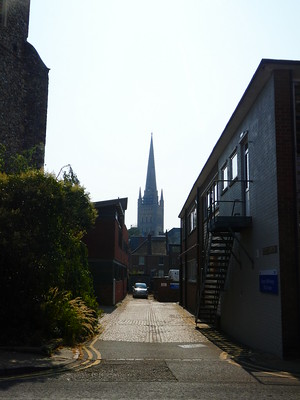
    This small lane off of Fishergate goes down to the River Wensum and it separates the Church of Saint Edmund from what is today an NHS building, but was once a large sawmill site.

    1260366

    There’s a rather nice view of Norwich Cathedral when looking down Hansard Lane. Before it was renamed in honour of local Norwich man Luke Hansard (of Parliamentary printing fame) in around 1890, this street was more simply known as Water Lane. Here’s an article about what was likely a murder near Water Lane that was reported in January 1824.

  • 200 Years Ago in Norwich : Papered Pane Cut on Magdalen Street

    200 Years Ago in Norwich : Papered Pane Cut on Magdalen Street

    In the latest in my riveting series of posts from 200 years ago, this was published in the Norwich Mercury in January 1824.

    “On Monday evening some person or persons cut a hole in a papered pane of the shop window of Mr Steward’s repository, in Magdalen Street, and took through the same three bottles in japan ink. A similar trick was played a week or two since at the window of Mr Brown, baker, of the same street.”

    I hadn’t heard of papered panes before, although having thoroughly researched the matter (looked briefly on Google), they seem to have been relatively common and were also a feature in the early United States (https://en.wikipedia.org/wiki/Greased_paper_window) for those who couldn’t afford glass or weren’t able to have anyone nearby who had the skills to make it. Indeed, glass windows in residential properties wasn’t much of a thing for the poorer classes until the early seventeenth century. Having paper windows certainly feels rather sub-optimal though, not least because some pesky people cut through them to steal stuff.

    Anyway, I digress, more interesting posts to come.

  • Random Beer Post – Verdant Cheeky DIPA

    Random Beer Post – Verdant Cheeky DIPA

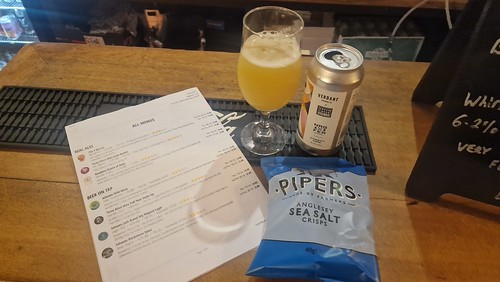
    20231218_204532

    I haven’t had a beer post for a while, so here’s one for a bit of variety. I want to keep my two loyal readers entertained and fulfilled.

    This is the Verdant Brewing Cheeky DIPA, a collaboration with Green Cheek Beer Co. Note the beautiful food pairing that I arranged, but more importantly, this 8.4% Double IPA really is quite decadent. Dank, rich, packed with fruity flavour, hoppy, clean, smooth, subtle, full bodied and really quite elegant, this is Verdant (and Green Cheek from the United States) at their best. Green Cheek are in Orange County in California, so next time I visit my friend Alexis in that grand state, then maybe I can pop along there to check matters out.

    Anyway, I thought I’d record just how good this IPA was. Not cheap, but worth it and it’s no surprise that it’s so well rated on Untappd. Back to my usual posts now….

  • 200 Years Ago in Norwich : Sam Garwood Steals Piece of Wood

    200 Years Ago in Norwich : Sam Garwood Steals Piece of Wood

    The latest in my series of articles from the Norwich Mercury of 200 years ago this week. It’s crime related and just a short note that:

    “Sam Garwood was sentenced at Norfolk Adjourned Sessions for stealing a piece of wood. He was sent to Walsingham Bridewell for three months.”

    Interestingly, the courtroom is still there in what is a museum in Walsingham, although not one that I’ve visited. The Petty Sessions for the area were held there until 1974 and it’s one of those perhaps mistaken attempts by Government to try and centralise everything. The Bridewell was a separate building, constructed in 1787 and built along the lines of John Howard’s vision for a modern and reforming prison. It was built on the site of the former leper hospital and it was expanded in 1822 to add 16 more cells. In the year that Garwood was sentenced, five tread wheels for grinding corn were added and I assume that he was forced to use them. The Bridewell closed in 1861, but it’s still there and nearly untouched with access possible by getting the key from the Shirehall Museum. Indeed, I now want to go as I last went to Walsingham during partial lockdown and most things were shut.

    As for poor Sam, it seems a harsh punishment, but he had been imprisoned the year before and perhaps the court took that into account. Indeed, there was a Sam Garwood who was imprisoned in the same area on 31 July 1843, so this whole prison thing didn’t seem to work (unless it was a different Sam Garwood). Unfortunately, there are a few Samuel Garwoods who were in Norfolk at the time, so I can’t work out which one it was.

  • 200 Years Ago in Norwich : State of the City

    200 Years Ago in Norwich : State of the City

    And another in my series of posts from the Norwich Mercury of 200 years ago, this one was published on 13 December 1823, and it relates to the condition of the streets of Norwich. I rather like the picture that this article conjures up of the state of Norwich streets at the time, albeit clearly greatly improved in the years that preceded this article.

    “The inhabitants and the visitors of Norwich must have (for some time past) regarded with no slight satisfaction the attractions which have been going on in various parts of the city. We well remember the anticipations of the friends of the act for watching, paving, lighting and cleansing our streets, and it appears to us the time is now come when the realisation of so much of what they prophesied is come to pass, that they have cause for triumph. Certain it is that many of the streets of the city are greatly improved: the shops are in themselves more elegant as well as more convenient, and the display of goods of all sorts is more varied and tasteful. The progress of things has, without doubt, effected many of these desirable changes, but no little is owing to the spirit of improvement, which, when once excited into action, is unlimited in its operation.

    One present purpose however is not so much to speak of general as of a local alteration, which appears to be to be amongst the most beneficial the city has yet undergone. We allude to the striking improvement in the market and the streets adjoining. Never, we will venture to assert, has any thing been done since the passing of the Act (near seventeen years) more worthy of public regard and approbation, than this will be when its completion, which is nigh approaching, is effectuated. In tracing its progress, we observe that a sewer of considerable length and capacity has been made sufficient to receive the filthy tide of waters which formerly flowed on the surface from offensive private drains and channels, to the great annoyance and inconvenience of the inhabitants, and the utility of common sewers was never made more perceptible.

    The pavement between White Lion Lane and Brigg’s Lane, which was of late absolutely unsafe for carriages, from its irregular surface, broken into deep ruts and holes, is now brought to a smooth and commodious level, with a spacious foot-way on its sides, and is indeed in no respect inferior to the best-paved streets of the metropolis. The Hay Hill, from its rude, mis-shapen and irregular form, intersected as it was by channels in all directions, and almost impassable, is now made of easy ascent, and perfectly safe both as a carriage-way and to foot passengers.

    These improvements are continuing to Bethel Street. And here we are most forcibly struck with the metamorphosis which the public spirit of a single gentleman has wrought. It is within every one’s remembrance, that this street was amongst the vilest in the whole city – the houses dirty and squalid, the pavement all but impassable, while the wretched inhabitants of the adjacent yards and thoroughfares were of a description to reduce and almost annihilate the value of the few decent habitations the street contained. Since Mr Hawkes came to live in it, he has gradually removed every one of these objections; and while he has advantaged his own property, he has ornamented the whole length of the street, and set a noble example of what may be effected by a spirited individual. For the other improvements, the city is indebted to the contribution of £300 from the Corporation and the liberal subscription of £200 from the inhabitants of St. Peter’s Mancroft, which have enabled the Commissioners, who are always anxious to do their utmost, to effect the work.

    Nor can we conclude our article without paying to Mr Rooks, the surveyor, the tribute that is due to his talent and attention. This gentleman has been resident here during a long and active life, and he has been employed in great public works and in many private undertakings, which, if less conspicuous, are scarcely less ornamental or less useful according to their degree. It is therefore with particular pleasure that we offer our best acknowledgements to him for he combines zeal with judgement and both with the feelings and the manners of a man of taste and talent.

    This subject matter naturally leads us to something further. One of the most narrow and dangerous avenues to the market is the confined street called Brigg’s Lane. St. Stephen’s Street is greatly bettered, and wants but little to render it a good and open approach. Rampant Horse Street is still more spaciou, but those advantages are incalculably lessened by the existence of the insufficient passage which Brigg’s Lane presents. If we remember rightly, the Rev. Henry D’Oyley, a Clergyman of Hempnall, devoted some of the last years of his life to soliciting from parish to parish and from house to house a subscription for the purpose of enlarging this avenue.”

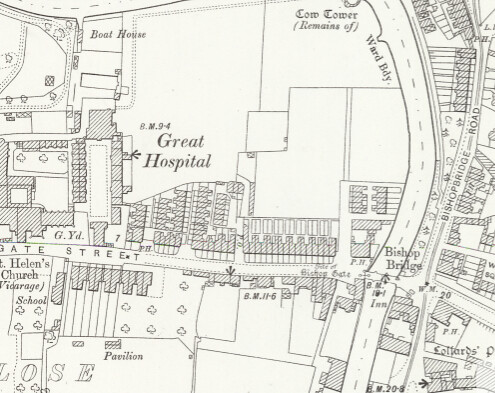
  • Streets of Norwich – Bishopgate and Norwich Lower School Gone By

    Streets of Norwich – Bishopgate and Norwich Lower School Gone By

    Screenshot-2020-05-15-at-12.08.12

    Linked to my Streets of Norwich – Goldsworths Buildings post…..

    John kindly got in touch regarding Norwich Lower School, which is a little further down Bishopgate. This is relevant as pupils had to walk by the former Goldsworths Buildings to get to the football pitch near to the river.

    There will be a longer interview in the new year on this, but John mentioned:

    “The Lower School was built in the old fashioned style common to state schools in the late 19th and early 20th centuries, with high windows and a pitched roof. Think of it as an elongated rectangle divided laterally into three classrooms. The room nearest Bishopgate was the 2 J classroom (Mr Christopher Smith, known by us as Smithy), then Form 2 (Mrs Edith Stephenson, the headmaster’s stepmother, who we referred to as Ma Stevo) and furthest back was Form 1 (Mrs Spruce, known irreverently as Fanny – we had no concept of the more slangy meaning of this word as it is often used nowadays, it was just a female name as used by Jane Austen for Fanny Price). We were turned out at break times on to the School Field. The loos were also outside and froze up in the cold spells which happened every winter in those days, accompanied by snow and ice. The whole setup would have failed a modern school buildings inspection and the place was demolished after the next Lower School was built in (I think) the mid 1960s.”

    I hadn’t known much about the old Lower School, which was replaced in either the late 1970s or early 1980s with the current building. There was an arson attack in something like 1989 which caused significant damage, but the general structure of the building was restored, although extended.

    Unfortunately, the late and great George Plunkett doesn’t have any photos of the school in its current or former incarnation, so I’ll go on the hunt elsewhere for those.

  • And a Little Thanks…..

    And a Little Thanks…..

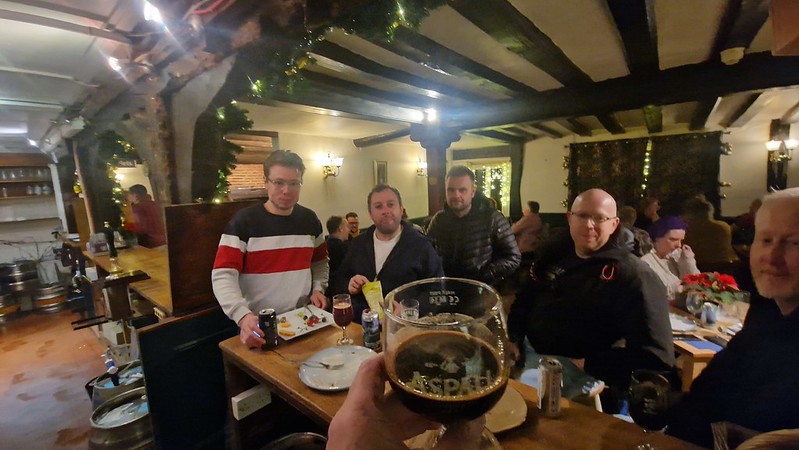
    More on the big project that I’m engaged with at the moment at a future point. But, a lot of friends came to support the project last night and I must admit to feeling really quite emotional about how many people came and the number surprised me.

    So, thanks to Adrian, Robert, Jade, Susan, Danny, Susanna, Dave, Simon, Jonathan, Steve, Andy, Clive, Michael, Julie, Thim, Roy, Jen, Leandros and Sarah for being there.

    But huge special thanks to Liam (for always being there as the chief engineer to all projects), Scott (for spending so much), Ross (for being there at the last project as well), Emma (for support over the last year with so much), James (for helping with Norwich market food shops), Zak (for being my bar billiards trainer which helped the Serengeti top division 2, which I might have mentioned) and Bev (for being so supportive throughout). Marvellous to see them all last night as well.

    And also thanks Lisa and Eric for on the spot support, as well to the CAMRA team of Laura and Matt for assisting  🙂  Then thanks to the people about to offer support, not least Oscar who has provided so much help despite so often leading me astray……..


  • Bucharest Trip – Day 4 : Tour of Bucharest Parliament

    Bucharest Trip – Day 4 : Tour of Bucharest Parliament

    20231114_102320

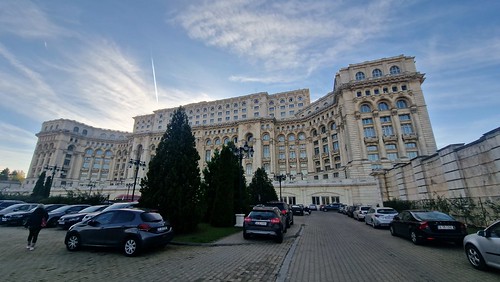
    I don’t want to get too political on this blog, but it’s fair to say that I’m not a fan of the governance of Nicolae Ceaușescu. And this building is one of the reasons for that dislike, as whilst he presided over a political system that had tens of thousands of children in orphanages and a country that didn’t have enough electricity, he decided to build one of the largest, and heaviest, buildings in the world, the Palace of the Parliament. He destroyed a huge chunk of the city to build it, he ploughed through history and constructed a building that remains 70% unused. Hundreds of people died during the construction, 40,000 people lost their homes and Romania couldn’t afford the extreme costs of this building. Look at the size of the building as it is, but there are also eight underground levels. This is a building meant to be part of the Ceaușescu personality cult, but it’s fair to say that it didn’t turn out as he intended.

    20231114_102717

    Anyway, politics aside, I was pleased to be going on a tour of the building as I didn’t get chance to do that last time I came to the city. Visitors have to phone up to make a reservation, and as Susanna is the most social of the group, she did that.

    20231114_103228

    There’s a free art installation on the ground floor for visitors to look at and, let’s be honest, it’s not like they’re short of space as there’s a total of 4 million square feet in the building.

    20231114_111810

    There was tight security, but this is the working Parliament of the country, so that’s to be expected. Here’s my visitor’s pass and they carefully checked IDs before allowing entry. Our tour didn’t visit some of the rooms as Parliament was sitting, although the tour remained at an hour or so in length.

    20231114_111949

    There were a lot of long corridors such as this.

    20231114_112315

    A theatre, which is still used, with what I think is the biggest chandelier in the building.

    20231114_112623

    A carpet designed to fit into the flooring. Just imagine the cost of all this.

    20231114_113028

    Media rooms.

    20231114_113028

    Interviewing of what I assume to be Romanian politicians.

    20231114_113339

    This would have been the grand entrance for international dignitaries and Nicolae Ceaușescu would have walked down those stairs whilst his wife, Elena Ceaușescu, would have walked down stairs that were located opposite.

    20231114_113556

    The curtains are so large that they’re dry cleaned in situ.

    20231114_113749

    The first of three rooms all next to each other.

    20231114_114108

    The second room.

    20231114_114516

    And the third room. These are huge rooms, do they really need three of the things? There are 1,100 rooms in total and just under 3,000 chandeliers.

    20231114_115001

    The building is so heavy that it’s sinking, which is causing cracks throughout the structure.

    20231114_115325

    Another function room.

    20231114_115808

    It was a fascinating tour, although I struggled to hear the guide for quite a bit of the walk around. The group size was large, perhaps just a little too large, but we saw a fair amount of the building. At the end the guide said we had only seen 2% or 3% of the interior, a reminder of how large the structure is. I’d recommend the tour to others, it’s a way of seeing inside this enormous building which they clearly still don’t know what to do with. There’s a temptation to use it commercially, but it is the Parliament building and they don’t want to Disneyfy it. There’s an interesting Guardian article on the whole arrangement.

  • Bucharest Trip – Day 3 : Bucharest Metro

    Bucharest Trip – Day 3 : Bucharest Metro

    20231113_154702

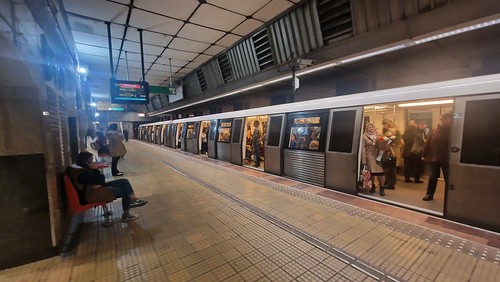
    I didn’t really need to buy a Metro pass for the time that I was in Bucharest, but I love underground systems and I make the most of them whenever I can. OK, it’s geeky, but there we go, it’s all about the travel adventure and I’m very much into that. The purchase process was simple enough as there’s a vending machine which sells Metro tickets and there’s an English option available.

    As some background, there are currently five Metro lines in the city and the first one opened on 19 November 1979, so much later than in some other European capital cities. The network is publicly owned but is separately managed from the rest of the city’s public transport system, so there’s no integration of tickets. There’s a new sixth line being planned to the city’s airport and that seems a most sensible idea. The prices are cheap, so a weekly ticket is something like £6, with the services running from 05:00 until 23:00. On the times that I used the network, there were regular services and it’s easy to understand how to change lines at the interchanges.  The network, along with all public transport in Bucharest, is currently subsidised by the Government in an attempt to reduce the volume of traffic on the city’s heavily congested roads.

    20231113_154025

    I got a bit muddled up with how to put the ticket in the machine, so being rather sociable I went and asked one of the staff at the gate line. The helpful staff member showed me which way to put the ticket in, which was inevitably not the way that I had been doing it. Handily, the system is like New York and Warsaw (amongst many others) which is that there’s no need to put a ticket in when leaving the network because all journeys are the same price.

    I’m not sure that either of my two loyal readers will be that excited about my photos of some signs that I took during the time I was there, but here they are anyway. Sometimes this blog is just about me and not anyone else  🙂

    20231115_102005

    20231115_102011

    20231115_102016

    20231115_102039

    20231115_104233