And another Wizz Air flight, this time from Wrocław to Gatwick Airport once again. It’s a handy flight time this as it’s in the early afternoon, making it much easier to get back to Norwich without having to rush for trains.
There’s my flight, the 14:45 to Gatwick Airport South. This is a spacious and well organised airport, with the security process only taking a few minutes.
A quick visit to the lounge. They have a decent choice of craft beer, a rather good Greek salad and lots of meat products.
I didn’t experience any issues with my new passport, so that’s one less burden to have to deal with when arriving or departing from a Polish airport. They haven’t introduced the new entry and exit system yet, but I don’t think it’s long away from introduction and the kiosks are already set-up and just roped off.
The boarding process was efficient and easy, another smooth Wizz Air operation here, although we had a wait of around fifteen minutes on the air bridge.
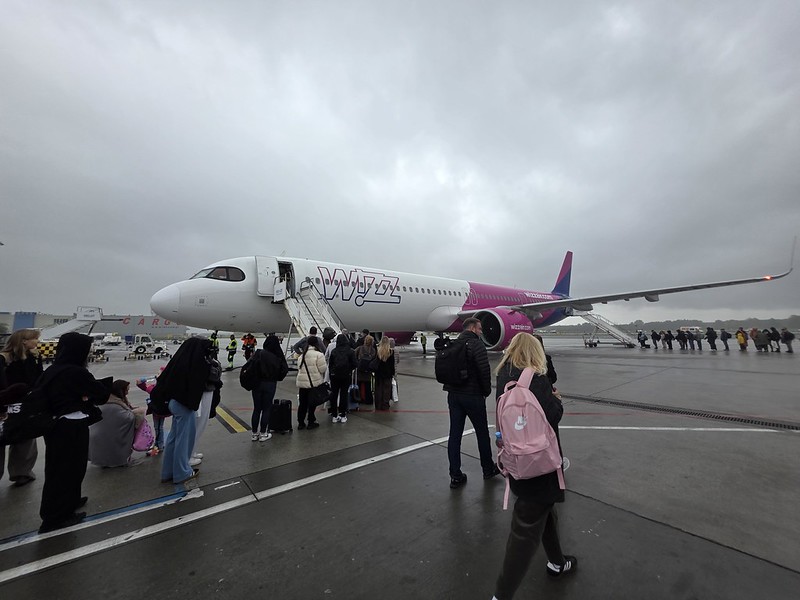
We then had a nice wait in the rain. The aircraft was G-WUKV, it’s the third time that I’ve flown on this plane in case anyone wanted to know that.
The seating Gods had allocated me a window seat, so that was a positive for the journey, giving me a lovely view of the now rainy Wrocław. The flight was only around 75% full which meant that passengers could move themselves around a bit, so I probably wouldn’t have been stuck on a middle seat.
Some clouds. This was taken near Gatwick Airport, but we were caught on yet another series of loops as we waited for our landing slot. The flight was quiet and the crew members were efficient and polite, the whole arrangement as once again well managed. There was no queue at the border control at Gatwick Airport, so I was able to get straight through the kiosks there.
The flight cost £8.99 which is quite clearly excellent value, with the aircraft landing on time and there were no eventful moments during the flight. I had a quick nap during the two hour flight and I’ve again been surprised and delighted by Wizz Air.
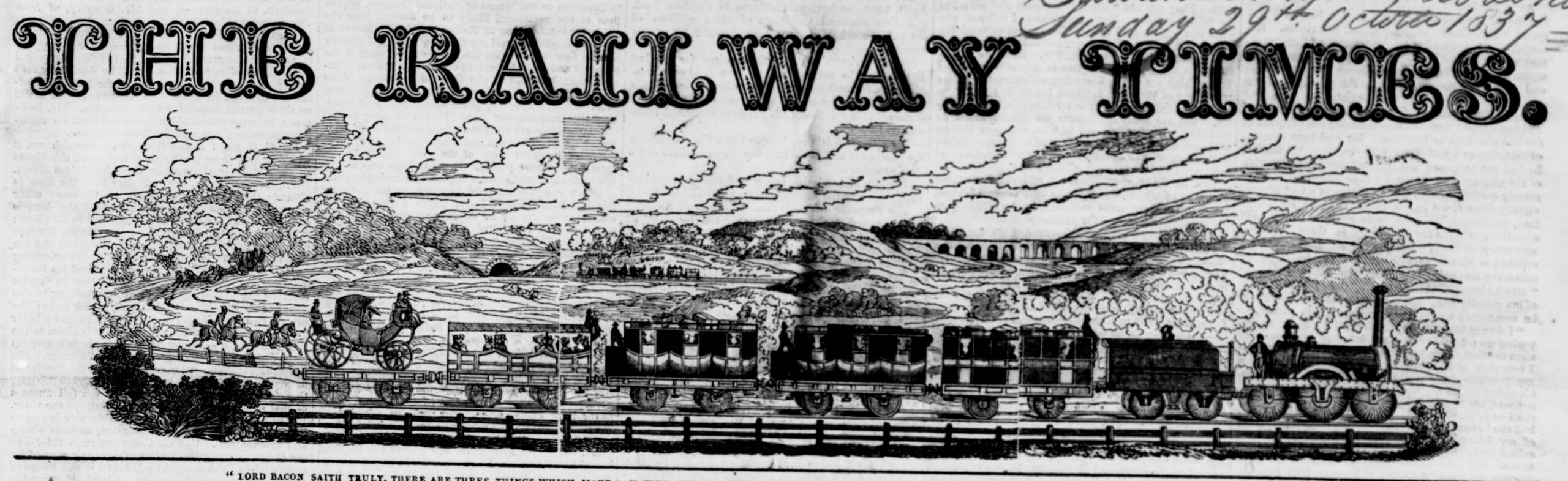
Back to the Railway Times (I like to mix things up on this ‘riveting’ blog….) and this is an article that they’ve republished from the Wilts and Gloucestershire Standard of November 1837.
I rather like that it summarises the debate of this exciting new form of transport which was still not winning everyone over. The article title was “The Importance of the Railways” and they still referred to the rail project as a “great experiment” which isn’t an unreasonable summary of the arrangement at the time.
As an aside, I like the use of the word “ebriety”, which I rarely see used now, it just means drunk although the word sobriety has continued in use. And there’s another interesting use of the word “characterizing” with a ‘z’ which was the frequently used spelling of the time before we’ve diverged off to prioritise our ‘s’ usage….
Most of all, it captures a snapshot of British life at the time, changing quickly and just as the population is getting used to the industrial revolution. It’s not just us today who live in interesting times.
“We beg to direct the attention of our readers to the subject of Railroads, as one destined, ere long, to produce a considerable revolution in the internal economy of this country. Some months ago the public mind was in such a ferment on this subject, and John Bull was so running riot, as he is wont to do on any matter affording scope for speculation, that the attempt to get at any sound notions, or information that could be depended upon, seemed hopeless. Now that this ebriety seems to have produced a complete lethargy, there is a chance of obtaining facts that may be relied on, and of arriving at just deductions from them.
This has become a subject of great national importance, as regards the commercial and manufacturing interests of the country. We have, hitherto, maintained a preference in the foreign markets by the comparative excellence and cheapness of our manufactures. It must be borne in mind that carriage, both of the raw material, and of the manufactured article, is, in many cases, a very important item in the cost of the latter, and that if we allow foreign countries to get the start of us, in modes of conveyance which very materially diminish expense, we shall give them a very serious advantage. It is not perhaps generally known what is going on in this way on the continents of Europe and America. In France, the following lines have been undertaken, some by the government and others by public companies: From Paris to Havre, by Rouen, 55 leagues; from Paris to Calais, 53 leagues; from Paris to Lisle, 53 leagues; from Paris to Lyons and Marseilles, 219 leagues; from Paris to Strasburg, 116 leagues; and from Paris to Bordeaux, 154 leagues. These communications are again carrying on from the Belgian frontier, as appears by the report of M. Nothcomb, the minister of public works, wherein it is stated that the Government has taken in hand an extent of 115 leagues; that the works were commenced in March, 1834, and have continued in progress, and that three sections are already open to the public. These traverse the country from the borders of France to those of Prussia. The Prussian government has fixed a line with various branches from the Belgian Railways by Aix-la-Chapelle to Cologne. In America there are upwards of 1500 miles of Railways completed, and 3000 miles reported to be in various stages of progress.
It is difficult to foresee the effect these wondrous means of communication will produce upon the value of property within their influence, upon the conveyance of commodities in different districts; on the localities of markets, and the modes of dealing, and even on the habits and manners of the people, by the great extension of intercourse which will necessarily result.
Though we are at present hardly justified in characterizing this bold and novel mode of conveyance, otherwise than as a great experiment, sufficient has been practically achieved, in particular cases, to render it morally certain that Railways will very soon entirely supersede the existing means of travelling, on all the great thoroughfares of the kingdom. It has been clearly established in practice, that, on a well-appointed Railroad, passengers can be conveyed in one-third of the time at two-thirds of the cost, with greater punctuality, with infinitely greater safety, and with much less fatigue than by the best appointed coaches now in use, excellent as they have become.
The general establishment of Railways, therefore, throughout the kingdom, is as certain as the return of the seasons. In this great commercial and manufacturing country, in which 9-10ths of the population are busily occupied a great proportion of the 24 hours, economy of time is of more consequence than economy of money; and the public will never submit to any system of transit, while another can be devised at once saving of time and money. Experience has shown us, that if coaches between two places, say 100 miles distant, have performed the journey in 12 hours, and a new coach starts and performs the same journey in eleven hours, the former must quicken their speed, or they will be driven off the road. The same result happens, if one coach conveys passengers for a few shillings less fare than those previously established. It having been demonstrated that the means exist of conveying passengers the 100 miles in four hours, at two-thirds of the cost, and with much less bodily fatigue, no man can doubt that the public will yield them.
Railways are so expensive in their construction, that they cannot be multiplied like ordinary roads. Their course and position, therefore, become a matter of the deepest interest to all persons of property, or who are engaged in trade, commerce, or manufacture, as there can be no question, but that the districts traversed by these lines, or in close communication with them, will derive advantages which will greatly enhance the value of property, as compared with that which is more remote. We entertain no doubt that, ere long, in advertisements for the sale of property, the advantage most prominently put forth will be, that it is within a certain distance of this or that Railway. It behoves, therefore, all those interested in any particular district, to bear an eye in time to this subject, and not allow their more foresighted neighbours to steal a march upon them.”
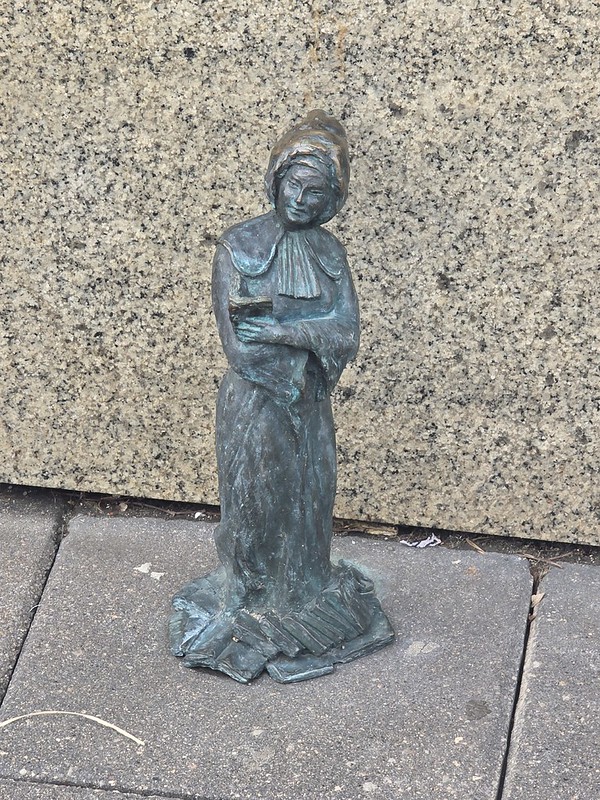
Although most of the famous Wrocław gnomes are male, there are also representations of females and this is the Advocate, or Attorney, gnome. It’s located at Bolesława Prusa 1/50 and it’s hear because there is a legal office (or advocate office) inside the building.
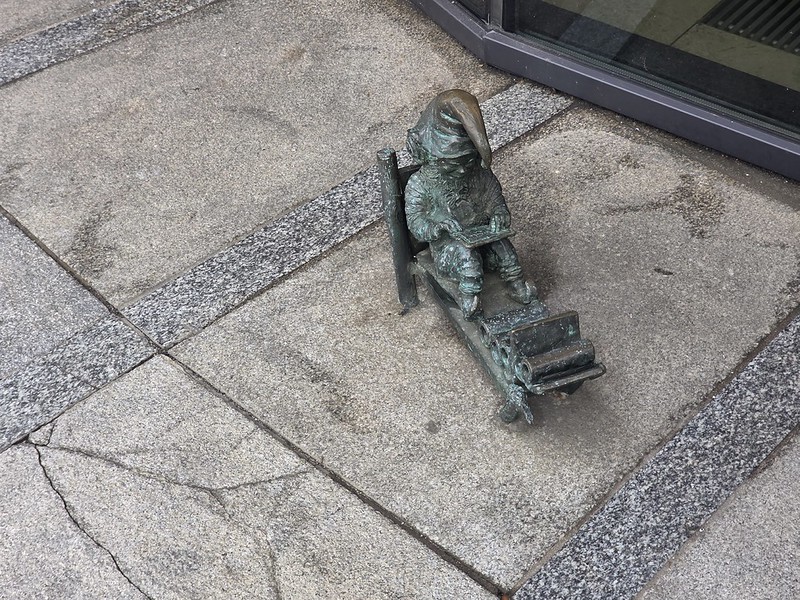
This little gnome is located outside of the Google building in Wrocław and I initially didn’t realise that the word ‘Google’ is spelled out in the rolls by his feet. I rather like this one, a combination of traditional and modern all at once, I suppose that fits what Google were looking for here.
I am slowly working my way around finding the gnomes in the city, although I’ve now forgotten which ones I’ve found which is making things a little more disorganised. Luckily I have this blog to try and restore order.
The last time that I was in Wrocław I visited the Browar Stu Mostów bistro in the city centre. This time I headed out on the tram to visit their taproom and brewery, located to the north of the city.
The taproom offers views over their brewery and it all feels modern and organised.
I was the only customer throughout the entirety of my visit and I thought it might be slightly busier on an evening, but at least that meant it was peaceful. Well, peaceful in the tap room, they were busy in the brewery itself which was quite loud, but that adds to the authenticity.
The beer list is on Untappd and it’s also displayed here behind the bar, although I found it easier to just look at the online list. It’s a very competent brewery and I’ve had their beers many times in Poland and the UK, although I confess that I only relatively recently realised that they were based in Wrocław.
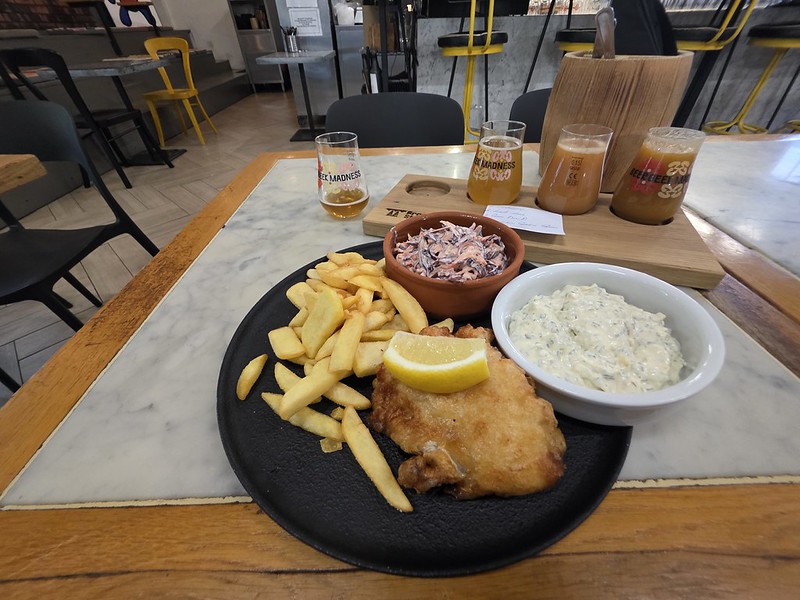
I ordered a flight of beers from the brewery and these were from left to right:
WRCLW Schops which was an intriguing beer as it had caramel and banana notes, but was a wheat beer with hints of being a brown beer. It’s not a beer style that I’ve tried before, but that’s not entirely surprising as this is an historical recipe which the brewery are using, bringing back something from the past and I found it very agreeable.
Lush Lime which was a nicely balanced pastry sour with a lot of gentle lime flavour, even pushing towards being decadent.
Coco Drift which was my favourite of the four, it was thick like a smoothie with tropical fruit flavours, it was quite a robust pastry sour with just a little tartness.
The Pumpkin Spice Sour tasted of cinnamon and apricots to ne, it was smooth, rich and pleasant.
The four beers were excellent, all of them of a high standard and I was impressed at the broad range of beer styles that the brewery was producing.
I very much like tartare sauce, so this was an agreeable amount to serve with the fish and chips I ordered. The meal was fine, I’m not sure what kind of fish it was and it was a little bland, but the batter had a depth of flavour, the chips were fluffy inside and the coleslaw added texture. It went well with the beers and the pricing for the whole arrangement was reasonable.
It’s worth the trip out to visit this brewery, it’s a clean and comfortable little taproom and the staff were friendly and engaging. I thought that it would be busier, but I’m sure that it gets quite packed on weekend evenings as it isn’t that large. They also have Concept Stu Mostów next door which is open from 08:00 until 21:00 every day of the week and is more of a restaurant. I think they offer the same beers there, so this is another option for those who don’t want to visit the taproom.
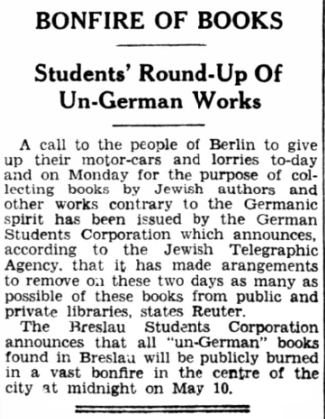
This is from the British press in May 1933, so early on in the Nazi party’s attack on freedoms. Breslau was then part of Germany, but is now Polish Wrocław, and the warning signs of the terror are apparent very early on. The burnings were organised by Deutsche Studentenschaft, a Nazi controlled umbrella organisation for students, and there were around 34 of them across the country on the same evening.
The book burnings were attended by an alarming number of younger people, this wasn’t just a stage managed event, with the whole process being turned into something of an evening out with procession and nationalism along the way.
The Nazi Alfred Rosenberg apparently tried to save sections of Jewish libraries. He didn’t have motives of tolerance and understanding though, he wanted to seize them so that he could use them as research material for his ideological “studies” into why the Jews needed to be destroyed.
Rosenberg was executed by the allies after the Nuremberg trials, but there’s one interesting story relating to him which also took place in May 1933. Rosenberg came to the UK and tried to show that the Nazis weren’t a threat and he laid a wreath at the cenotaph with a swastika on it. James Edmond Sears, a Labour Party candidate for South West St. Pancras, cut it up and had it chucked in the River Thames. He was fined and Sears was widely condemned in the media for his actions. History perhaps now shows that he was one of the forward thinking heroes, one of the few to call Rosenberg and the Nazi regime out so early.
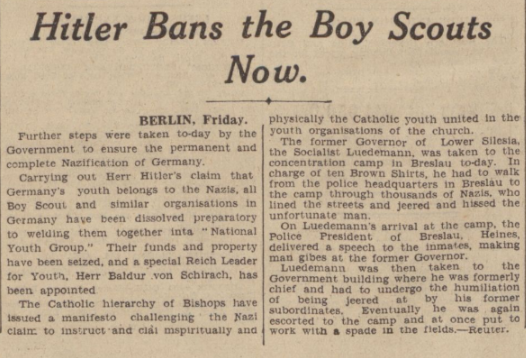
This article is from June 1933 and it’s a warning from history about how dictators begin their work. Putting to one side the suppression of the boy scouts into what became the Hitler Youth, there’s a story here about Hermann Lüdemann (1880-1959).
He was arrested in June 1933 and sent to Breslau (now Wrocław in Poland) concentration camp, but the process was designed to be humiliating because he was a socialist and so somehow an enemy of the people in Hitler’s eyes. Lüdemann was ‘greeted’ at the concentration camp by the new Nazi chief of police for Breslau, Edmund Heines, who had formerly spent time in prison for murder. Heines was a thug by any measure and his political career was brought to an end by Hitler, who had him arrested and assassinated in 1934.
Lüdemann was ultimately treated very badly during the war, although perhaps on balance he was fortunate to survive it at all. His bravery and strength was rewarded after the end of the Second World War by political promotion and in 1947 he became the Minister-President of Schleswig-Holstein.
But, it’s evidence that the actions of dictators shouldn’t be ignored early on. The marching through the city of men such as Lüdemann was part of a general policy of intimidation, attempting to intimidate the population and limit the opposition to the Government. He remained a stoic hero, many others sadly lost their lives. Perhaps the world should have done much more in 1933….
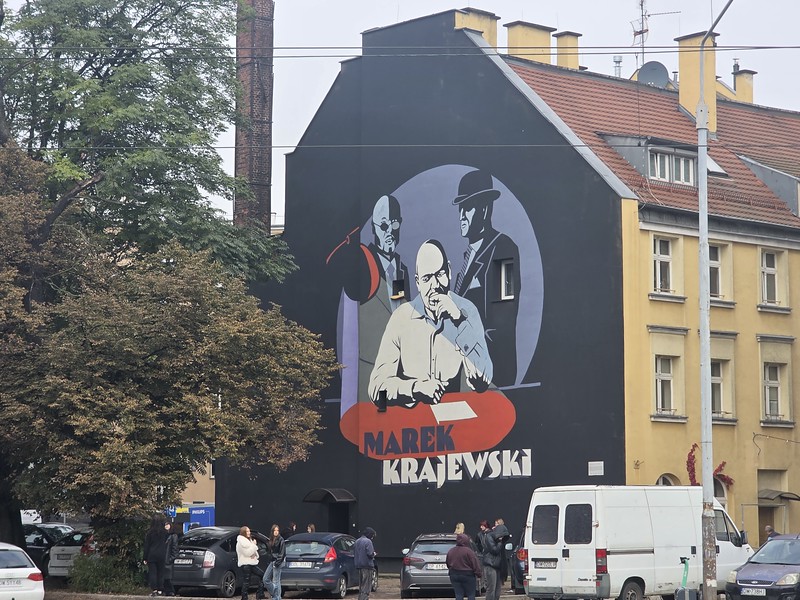
There’s something wonderfully noir about this mural in Wrocław, which celebrates the crime novelist Marek Krajewski (1966-). It’s painted on the side of an otherwise unassuming yellow building, yet it completely transforms the place into something atmospheric, cinematic and indeed distinctly Wrocławian.
Krajewski’s novels are largely set in Breslau, the old German incarnation of Wrocław. His detective, Eberhard Mock, apparently prowls through a 1930s world of corruption, decadence and decaying grandeur, although it’s not a series of books that I’ve yet read. The city is though evidently very proud of their crime novelist who was born in the city as he was given the title of an honorary citizen of Wrocław in 2023. I will try and get hold of one of his books now…..
This is the building that Ibis and Novotel share in Wrocław and I’ve stayed at the former before (it seems that’s something else that I have to write up). The standards here are high, there’s an efficiency with Accor Hotels in Poland that simply isn’t matched by great swathes of the rest of the chain.
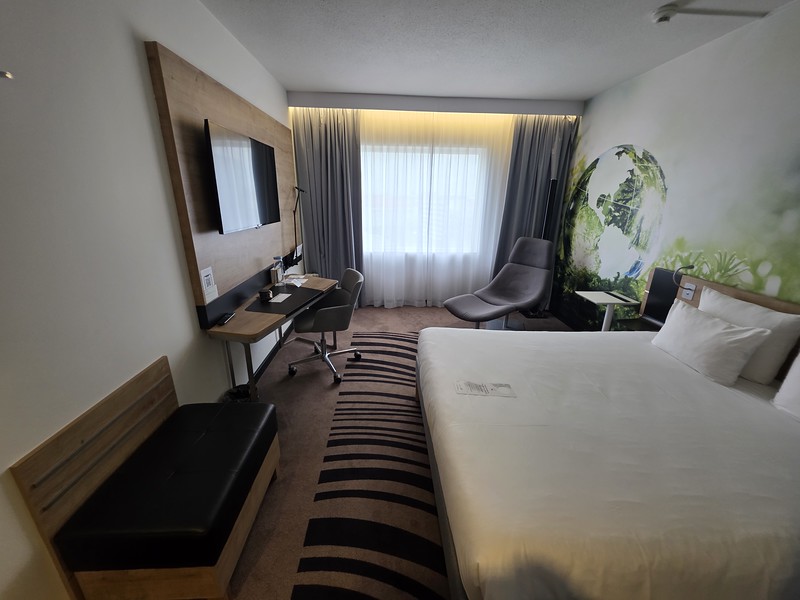
The view from the hotel room overlooking central Wrocław and some construction work, although that didn’t cause any noise issues. The reception desk here is always full of enthusiasm, it’s a lovely first impression. I was upgraded as well which I decided not to turn down.
I had stayed at the Ibis a few weeks ago and there’s a shared bar, so I was aware of the rather excellent choice of welcome drinks from a local brewery. The team member was also knowledgeable about them all, this was a very good tropical tasting slightly sour wheat beer from Browar Prost.
The welcome gift which came with another free beer. Those are chocolates and they’re very moreish.
And the mini-bar was free, fortunately there was a sign on it stating that. This was very generous, part of the free room upgrade that they offered.
The hot drinks arrangement.
The room was light, spacious and comfortable. And spotlessly clean.
I didn’t get breakfast as I was going to the airport relatively early, but this was a quite lovely stay. The room has blackout curtains which are very effective, there were no noise issues internally or externally and everything just worked.
I keep writing this, but it’s true and so I will keep on doing it, but Accor hotels in Poland are run as well as any other chain that I can think of. They continue to surprise and delight. The hotel is a ten to fifteen minute walk from the city centre, but there is a tram stop outside which whisks passengers to the heart of Wrocław in just a few minutes.
This Indian restaurant on Wyspa Piasek in central Wrocław was very well reviewed online and it seemed a suitable lunch stop whilst it poured down with rain.
It would be wrong of me to suggest that the restaurant was packed, but there were a couple more customers who came in and a couple of delivery orders went out as well. It’s a functional and clean interior, I thought it was rather understated and pleasant. I do know from the reviews that advance reservations are recommended here in the evening and it’s quite a small set-up, so I imagine it can fill quickly.
The chicken dishes and these all came with free rice.
It’s not a very good photo, but there were seven different beers available including some craft beer selections. Indian restaurants in Poland offer this with much more regularity than Indian restaurants in the UK, as well as actually opening at lunchtime which isn’t very common here.
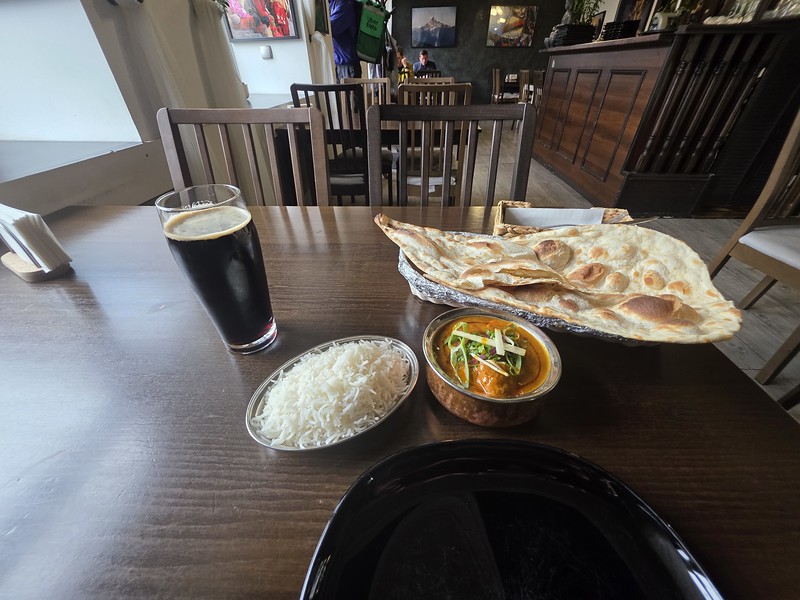
Firstly, the beer is the Okocim Porter from Browar Okocim, this was a really quite decent beer which was smooth with a bit of liquorice, bit of tree (or whatever that flavour was) and some maltiness. At 8.3% it was a robust beer to go with the curry.
I went for the Nepali chicken curry and this transpired to be a delight, with tender pieces of chicken in a creamy sauce which had some spice to it. The days when Indian restaurants in Poland catered for a less spice craving palate seem to have gone, with the result here having a depth of taste and flavour. There was some what I think was lemongrass added which possibly overpowered things slightly, but I like strong flavours.
The naan was sizeable, as is evident from the photo, with a crispiness and decadence that went really well with the curry. The rice was also cooked well, with the whole arrangement being a sufficiently large portion and everything was at the appropriate hot temperature.
The service was timely and friendly, I never felt rushed and the environment was relaxed. Customers seemed to just go to the counter when they wanted to pay, so I did that and found the whole set-up really quite agreeable. This was a really positive experience, with the bill coming to around £15 which for a top-rated restaurant in the city centre with such a decent beer seemed very reasonable to me.