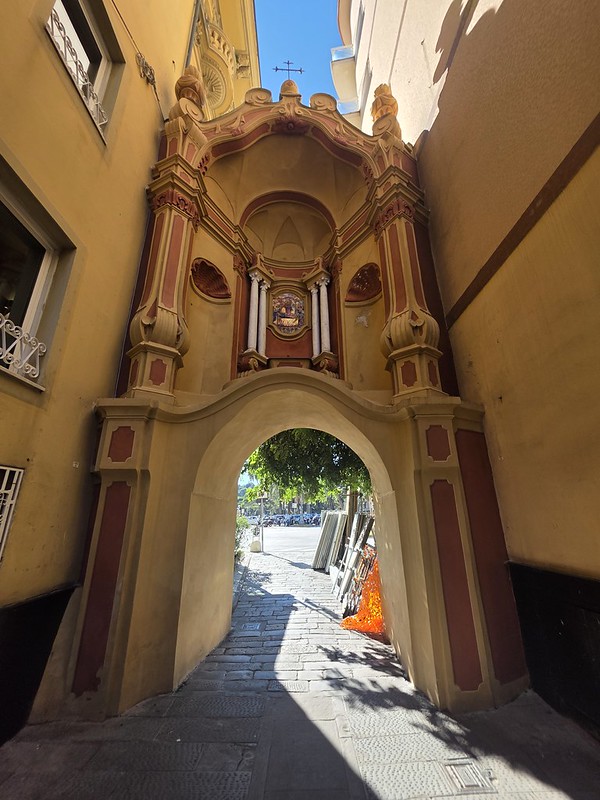
This pretty little gate is the only surviving one of the five that once circled the town of Rapallo. The gate was constructed in the early seventeenth century, although the rather decadent Baroque style is more recent. I imagine that the town authorities had a bit of money one year and fancied tarting it up, perhaps because they’d already knocked the other four down. The destruction of the gates started early, as one was taken down in 1702 to improve access to the town.
The name, Porta delle Saline, comes from the nearby salt pans where seawater was once evaporated to produce salt. Today the gate is now doorless and it marks the pedestrian area of the town from the more car heavy outskirts.
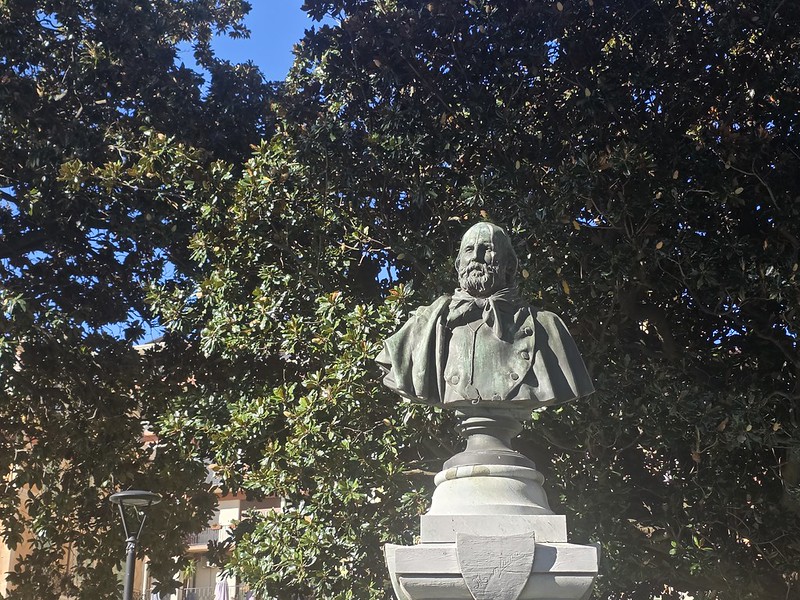
I like a sculpture (I don’t get out much) as its reason for being is often more intriguing than the person who is represented. This one is Giuseppe Garibaldi who is best known for having a biscuit named after him, but he is also known as the Father of the Italian nation. And there are hundreds of these sculptures across Italy for that reason, although perhaps there are more than are really needed.
The sculpture is located in Piazza IV Novembre, the national Italian day which marked Italian victory (well, of sorts) in the First World War and securing the future of the nation.
Incidentally, one of my favourite facts about Garibaldi is that when he was creating the Redshirts to follow his radical political agenda, they weren’t named in some revolutionary fervour. It was rather more because he had got a job load of red shirts meant for slaughterhouse workers in Argentina.
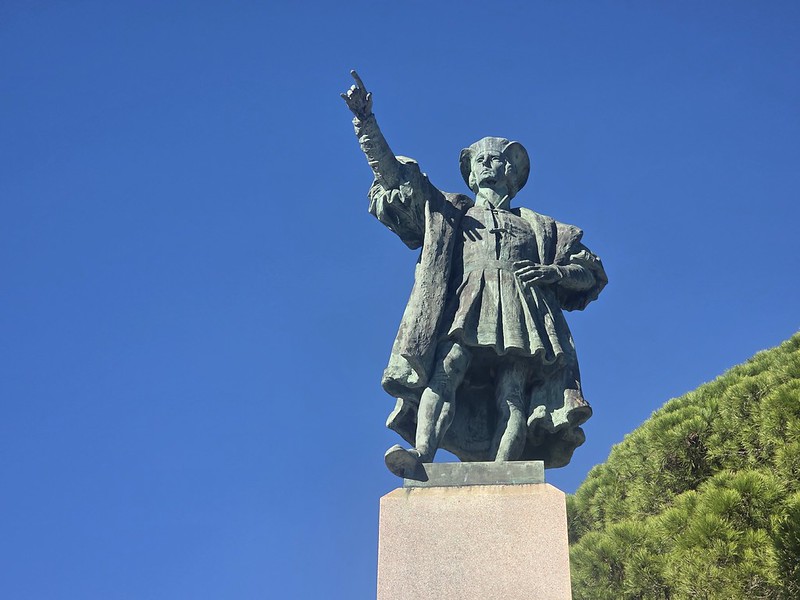
Here’s the local hero Christopher Columbus (1451-1506) doing some more pointing towards his discoveries in the New World. The sculptor was Arturo Dresco and this was another little addition to the town which was paid for by those who had left it to go to the Americas.
The statue was unveiled on 21 May 1914 and it’s quite a substantial little arrangement with two groups of bronze figures as well.
And the main man and local hero…. I couldn’t find any actual link between Rapallo and Columbus, I think they just wanted to show their appreciation for their hero from Genoa. Which reminds me that one day I’d like to visit Columbus in Ohio, although that’s more because it’s the capital of the state rather than me going to places named after Columbus…..
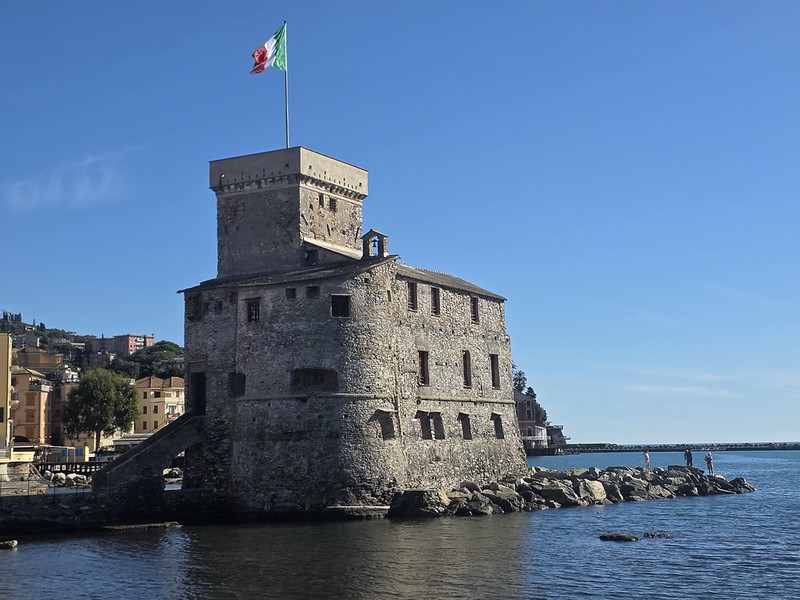
Sitting overlooking the harbour is Rapallo Castle which was first built in around 1551. Its construction was linked to a rather lively visit from the Barbary corsairs, or pirates, who managed to raid and pillage the town. The Republic of Genoa, embarrassed by its earlier lack of foresight, promptly decided a castle might help deter further unscheduled visits from Dragut, who was effectively the pirate King although I don’t suspect that Disney will be making any movies about him in the near future.
And so here is the fortress that they plonked on the shoreline in an attempt to reassure the locals. The Barbary slave trade was more than just a few adventurous lads in ships. It was a devastating business, stretching from North Africa across the Mediterranean and deep into the European coasts. For centuries, these pirates, often with official backing from the Ottoman authorities, raided towns like Rapallo, scooping up men, women and children to be sold in slave markets from Algiers to Tunis. This was a huge problem and it decimated some Italian coastal villages and even impacted countries as far away as Ireland.
The view out from the castle and it reminds me of my visits to Malta which is where Dragut was killed in 1565. Dragut is revered by some for his naval talents, but he was also one of the largest slave traders and he attacked the poorest in society and caused terror amongst the weakest. His legacy isn’t forgotten in many coastal areas around Italy and other parts of the Mediterranean. It was all a grimly efficient enterprise and it must have made many reconsider their decision to live by the sea.
After the threat of piracy diminished, the building was used as a prison as it was just as effective at keeping in as it had been keeping them out. It further lost relevance after 1797 when Napoleon took control of the wider region. The building was restored in the 1920s and it was used by freedom fighters during the Second World War who wanted to overthrow the Mussolini regime.
There didn’t seem to be a huge number of food options in the town on a lunchtime in November. There were a few tourist looking places, a few takeaways and quite a lot of venues that were closed up.
This one looked nice, some tables in the shade as I didn’t want to get sun-burnt.
In true aperitivo tradition, a selection of snacks were brought out to the table.
The beer options didn’t surprise and delight me, so I decided instead to have a Aperol Spritz which is not really my usual drink of choice. However, variety is good for the soul, with the taste being rather agreeable. It was also quite a handy place for people watching and because I chose to sit out of the sun I didn’t have any problem with people smoking away outside.
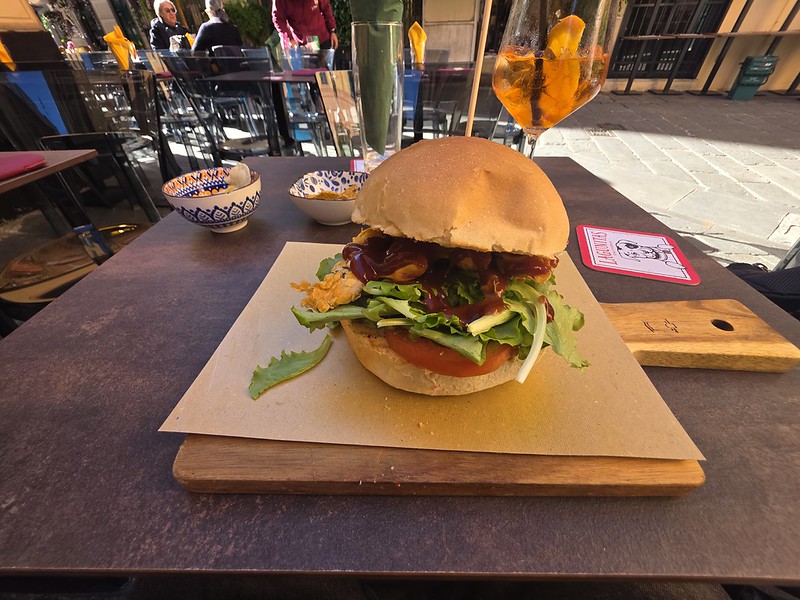
I ordered a chicken burger and this was rather lovely, a soft bun, flaked coated chicken which was tender alongside some salad elements to add texture. This whole arrangement felt really rather continental and the service was friendly, timely and helpful.
Customers go inside to pay and the server quickly dealt with the transaction. She was conversational and personable, this felt like a genuinely friendly venue. The cost of the drink, burger and coperto (the service charge for the snacks) was around £12 which I thought was entirely agreeable.
The online reviews for this venue are positive, which is primarily why I tried it. It seems to have quite a lively atmosphere in the evening, although it’s relatively small inside, but they have plenty of outside tables to boost matters. All really rather lovely.
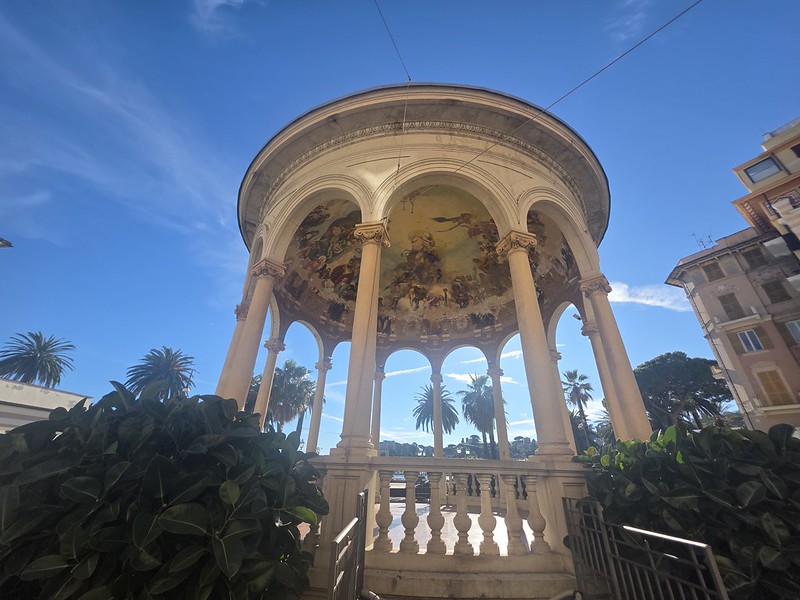
This rather attractive little music kiosk is situated near the waterfront and it was paid for by former residents who had left Rapallo. Millions of Italians left their country in the late nineteenth and early twentieth centuries to settle in South America, mostly Argentina and Brazil.
Unveiled in 1929, it was designed by the architect Luigi Devoto and painted by Giovanni Grifo.
The underneath of the kiosk and it depicts the faces of some of the great composers, including Verdi, Mozart and Beethoven. Given its coastal location, it’s had to be repaired and restored numerous times but it looks in decent shape at the moment.
It’s really quite beautiful, this is the sort of thing that somewhere like Las Vegas, Warsaw, Shenzhen or Dereham should have.
I like travelling on rail networks overseas and I haven’t been on the Italian system much, so I thought that I’d have a little day trip from Genoa to Rapallo. It probably wasn’t the best idea to be taking the train for an hour in the opposite direction to the airport where I was getting an evening flight from, but I like a bit of drama.
This is Genova Brignole, the second largest station in the city and it opened here in 1868 although the current building dates to 1905. It’s spacious, grand and functional, with a ticket office and more helpfully to me, numerous ticket kiosks.
Mine was the 11:24 train to Sestri Levante. The eagle eyed one of my two readers will note that there’s an earlier train, but long experience has cautioned me against rushing for these things and making a mistake.
I went to the platform and realised that the ticket validators were all downstairs, so if I had rushed for my train I wouldn’t have possibly realised this.
My now validated ticket.
The station sign and there was an absence of staff anywhere, the only one that I saw was in the ticket office.
It was too hot, but I don’t like to go on about these things.
And here comes the Caravaggio train built by Hitachi, but better known as the Rock. They’re two tier trains and they look shiny and exciting.
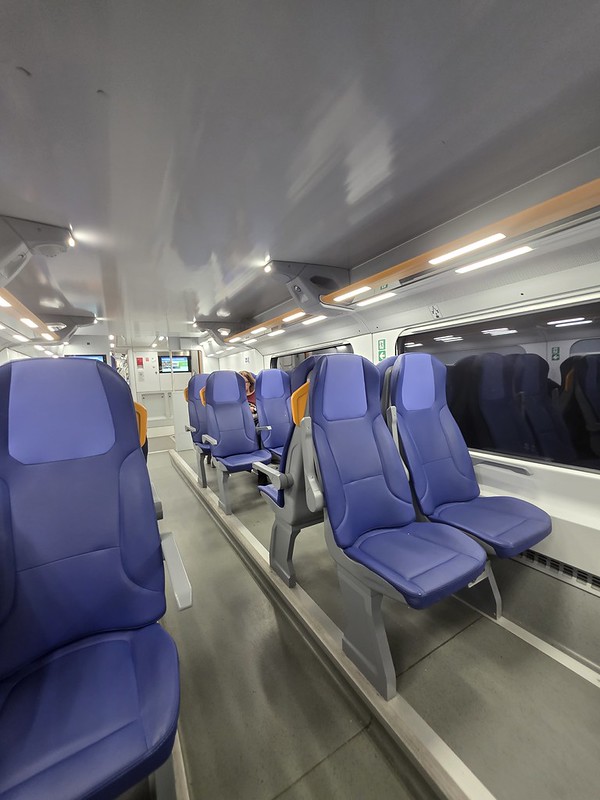
Most of the power sockets were broken, but fortunately I found a working one so that I was charged up for the day. The train was clean, there were no visible guards, but the information screens were clear and informative. There were also some pleasant views along the coast as we swept along what is apparently known as the Italian Riviera.
And safely into Rapallo railway station, with the ticket costing around £4. I thought that this was reasonable and the train was on time, with the whole arrangement being easy and efficient. The return journey wasn’t, but more on that later.
My second night in Genoa was at the keenly priced and centrally located Hotel Acquario. It wasn’t very well reviewed, but the problems seemed to relate to a previous owner, so it seemed a reasonable place to book. After I had worked out how to open the door to reception, there was a prompt and personable welcome.
There are steps to get to the lift, so accessibility options aren’t really great here. The lift also stopped working overnight, but I bravely managed to walk up a few flights of stairs.
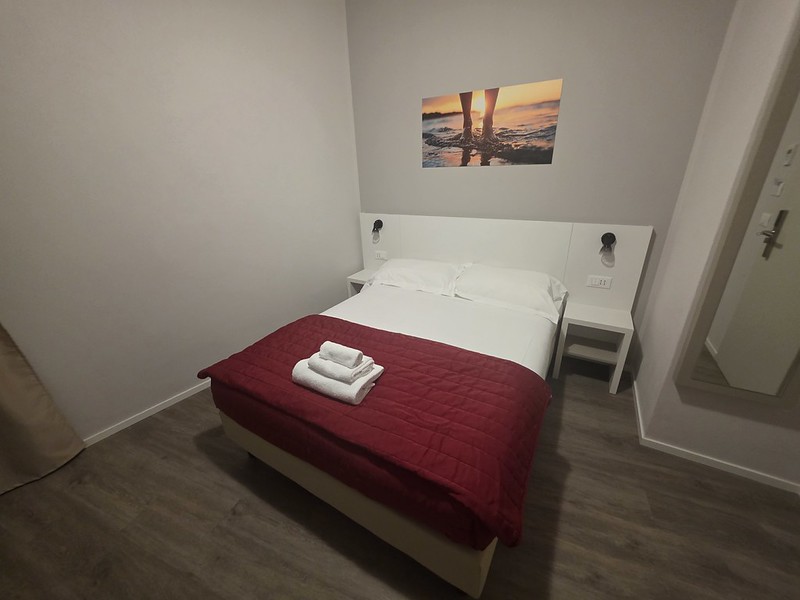
The room was clean, functional and the air conditioning worked. I didn’t hear any guests during my stay, so I’m not sure that it was very busy. Given that there were no guests evident, there were also no internal noise issues.
The bathroom with shower was also clean, functional and everything worked as expected. There has been something of a renovation earlier this year, so everything feels modern and well looked after.
I did debate having the very cheap breakfast, but it required pre-booking and so I decided against it as I couldn’t be making big decisions like that so early on the day before. But, there is a small breakfast room and a basic breakfast provided for a charge of around £5.
I left the window open as I like street noise, although there was excellent double glazing so if anyone wanted it closed they probably wouldn’t hear anything. I was careful taking the photo out of the window in case I plummeted out or dropped my phone…..
Overall, I was pleased with the stay, I thought it represented value for money and is one of those occasions where online reviews aren’t always what they might appear at first sight.
My first night in Genoa was at the keenly priced Novotel, around a twenty minute bus journey away from the airport (well, after a twenty minute walk as well).
I popped to the bar to get my welcome drink.
And after eight minutes I went back to reception as there were no bar staff. Incidentally, the reception desk were friendly and engaging, it was a very welcoming hotel.
The matter was promptly addressed and I got my Peroni, which tasted of metal and disappointment.
The bedroom. I didn’t turn either of them on, but this is the smaller of the two televisions in the apartment.
And the lounge area as well as the hotel had kindly upgraded me to their apartment suite. I did like having that desk and I had more than enough power points to plug devices into.
I didn’t really need a kitchen as well. The free welcome drinks were handy though.
Nor two huge drawers of plates, glasses and other assorted items.
The Nespresso machine with a kettle for teas.
And a microwave.
I had an entire room for a closet as well, I nearly put my one shirt up in the wardrobe to make the most of it.
The view from the room. The air conditioning in the rooms worked well, but I like having a bit of city noise and the windows opened wide which also helped fresh air get in as well.
Breakfast was suitably quiet at 07:15.
Croissants.
I usually skip hot items at breakfast, but the bacon was suitably burnt for my tastes and so I had some of that.
Hams and other items. Unfortunately, the allergens situation here was poorly handled, they were using shared tongs for cheeses, meats and olives. That meant that they had meat, dairy and all other allergens on numerous items, so I’m not sure that anyone with dietary issues would be entirely content here.
Very lovely.
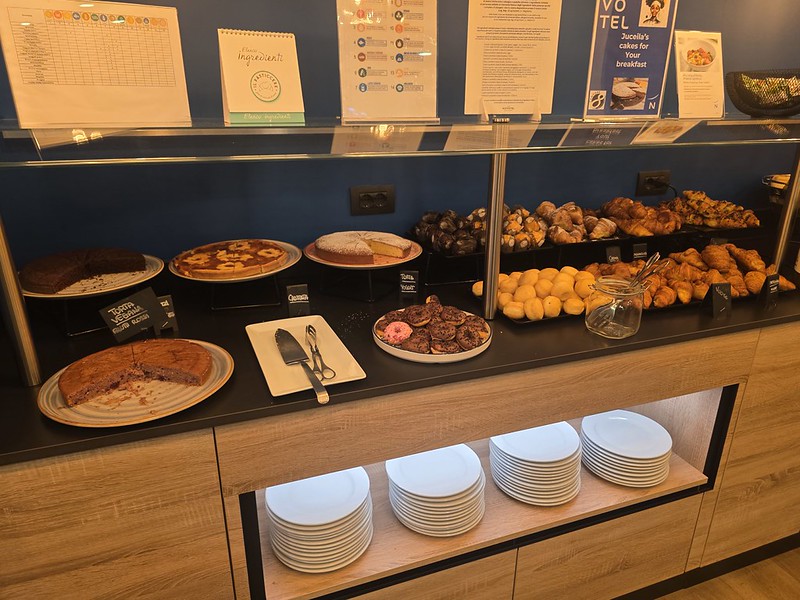
And cake for breakfast is always lovely.
The online reviews for the hotel aren’t entirely positive, but I was pleased with everything. I think the car park charges are a bit high, but that’s hardly something that I need to bother myself with. I suspect that some elements of the hotel are due a refurbishment judging from the reviews, although the public areas looked shiny.
This hotel was very cheap as I was using rewards night, with the size of the upgrade being something of a pleasant surprise. There were a few minor cleanliness issues, but nothing of any concern, with the staff members always being friendly and helpful. I would stay here again if I was visiting Genoa again (well, obviously I won’t stay here if I don’t visit the city, but I digress).
Just as a slightly random post, I had a little meander around one of the Carrefour Express supermarkets in the centre of Genoa. And meander is the appropriate word, they struggle for space and so the selection was wrapped around inside looking more like a miniature Ikea, there’s no Tesco Express blandness here.
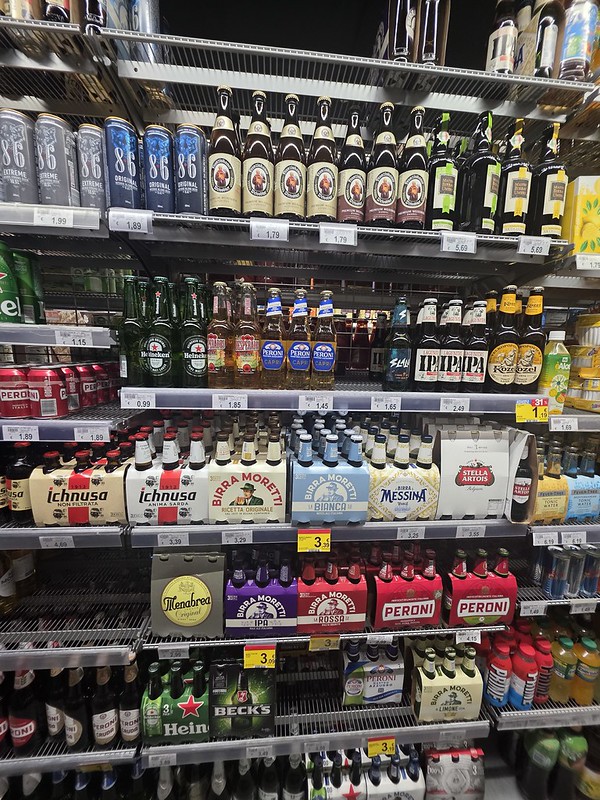
Anyway, here’s the beer range which felt reasonable for a little city centre shop as there’s quite a broad selection of styles. There are some strong beers and in the top right of the photo below, a couple of slightly more decadent beers from the Mastri Birrai Umbri brewery in Perugia. That the first Italian city that I visited and that was over fifteen years ago, so I must pop back there.
The prices didn’t seem bad either.
Alongside the Nutella, strawberry yoghurt and liquer chocolates, I went for the Raffo Lavorazione Grezza. It’s quite a malty lager and I must admit that I didn’t hate it, especially at the low price that they were charging.