Tag: Padua

  • Padua to Venice Mestre – Rail Journey

    Padua to Venice Mestre – Rail Journey

    20251202_130607

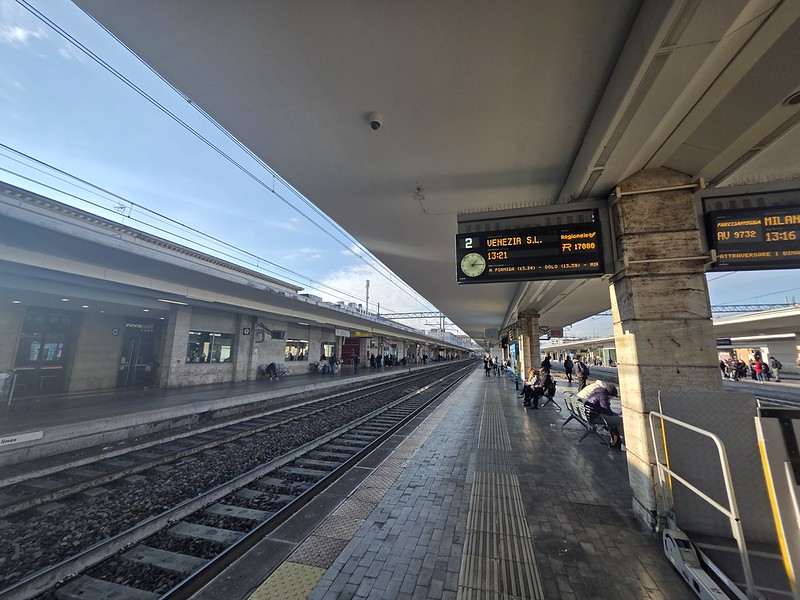
    After a lovely few hours in Padua, it was time to get the train back to Venice. The city’s railway station opened in 1842 and around 450 trains stop here every day. The bit in the above photo is the post-war extension.

    20251202_130646

    The departures hall.

    20251202_130648

    This is all in the more modern extension that has been added to the station. There are plenty of ticket machines available, but there’s a customer service desk for anyone who is still confused.

    20251202_131410

    I bought my ticket using the rail company’s app which saves all that faffing about validating it. I found that the platform numbering was a little confusing as they have a sensible system of I to X (well, there’s no number IV, but that’s a different matter) and they also have 2M and 3M for some Venice services. My train was scheduled to depart from platform II, so I just had to guess that they meant the usual platform numbering and, fortunately, that worked out.

    20251202_131450

    The platform floor has numerous little trip hazards along it.

    20251202_131553

    I was pleased to see my Venice train appear on the signage.

    20251202_132431

    Back on the Hitachi Rock train…..

    20251202_131839

    The Vivalto train which is a rather decent arrangement for long-distance services.

    The train got very busy towards Venice, not least because a group of what appeared to be Chinese people boarded. When I say a group, I mean around 80 people, but they were going to the old city and I was getting back off at Venice Mestre.

    I think that’s the last Italian train that I’ll take for a while, having used them around fifteen times over just a few weeks. I’ve been very impressed, they’ve been reliable in terms of operation, they’ve been clean, comfortable and I don’t have to mess about with seat reservations.
  • Padua – Other Photos

    Padua – Other Photos

    And some other photos from my meanderings around Padua…..

    20251202_110547
    20251202_110138
    20251202_111807
    20251202_112017
    20251202_112351
    20251202_112338
    20251202_112709
    20251202_112736
    20251202_113026
    20251202_113452
    20251202_120054
    20251202_125506
    20251202_125849
    20251202_125856
  • Padua – “Lo Specchio dell’Assoluto” by Gianfranco Meggiato

    Padua – “Lo Specchio dell’Assoluto” by Gianfranco Meggiato

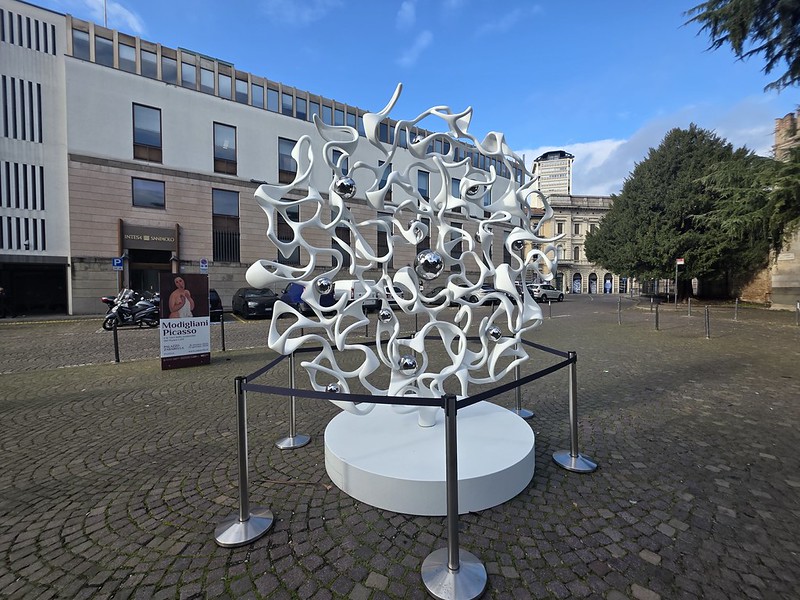
    There are a lot of artworks in Padua, but this one caught my eye and it’s part of the Kiss of Judas series of installations which are on show across the city between 2 October 2025 and 31 March 2026. This one is the ‘Lo Specchio dell’Assoluto’ by Gianfranco Meggiato (1963 – ) who is a Venice based sculptor. And I have absolutely no clue what it represents, which is perhaps a slightly sub-optimal position. I’ll just content myself with admiring it, blissfully untroubled by any deeper meaning that it might have.

  • Padua – Giardini dell’Arena Arch

    Padua – Giardini dell’Arena Arch

    20251202_111005

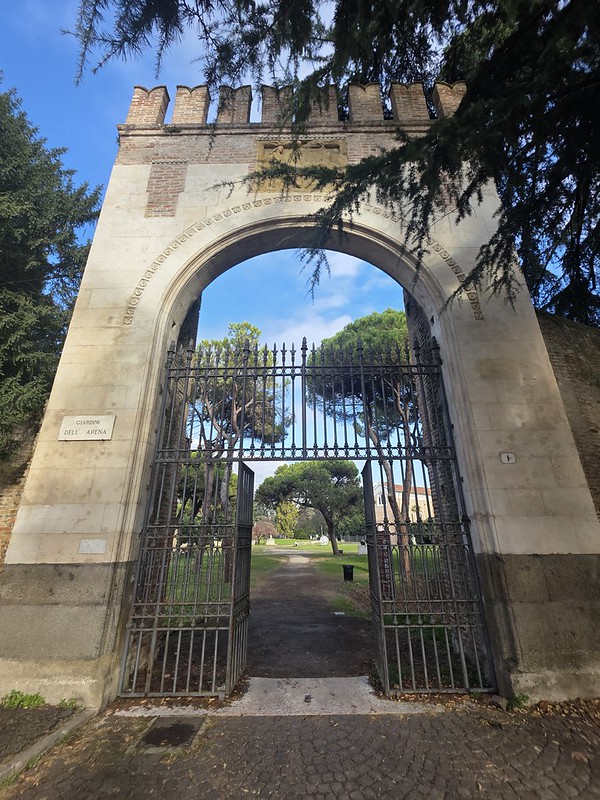
    I know that it’s just a gateway to a park, but I rather liked this as it’s next to the remains of the city’s amphitheatre and this whole arrangement adds to the impact of what was previously also the Scrovegni Palace grounds following the demolition of the Roman entertainment centre.

    20251202_111018

    The archway was added in the nineteenth century and this is looking into the park and the remains of the old amphitheatre. There’s an old stone visible at the top of the arch, which has come from the earlier fourteenth century gateway that was located here and which was demolished in 1827.

    20251202_110719

    And a view looking into the park.

  • Padua – Padua Cathedral

    Padua – Padua Cathedral

    20251202_113924

    The rather beautiful Padua Cathedral and this is the third one on this same site, as the first one fell down in an earthquake and the second one wasn’t thought to be decadent enough. On the right of the photo is the Padua Baptistery, but that was closed when I visited. Michelangelo had a hand in the design of the third and current cathedral, although little from his plans was actually constructed.

    20251202_113946

    Welcome to another one of my lop-sided photos (the Baptistry looks worse than the leaning Tower of Pisa), but this is the unfinished facade of the cathedral. The rose window at the top is also only there as it was added during repairs and restorations caused by a First World War bomb.

    As an aside, I think it’s interesting that so many Italian churches have unfinished facades, the reality seems to me to be that they had such great plans and then rather ran out of money. There were extensive plans for the exterior here, but as it’s been like this for nearly 500 years, they might as well just leave it now.

    20251202_114040

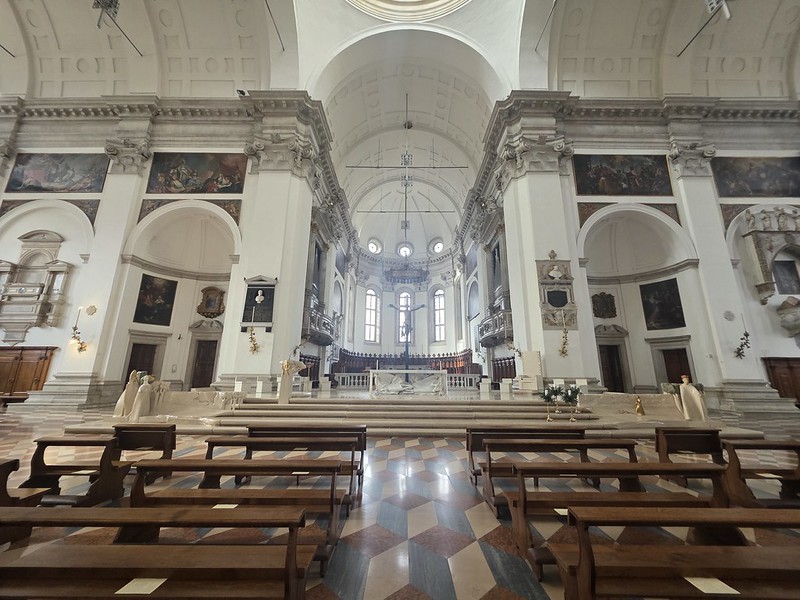
    I found this interior to be genuinely spectacular.

    20251202_114116

    I also really liked the design of the flooring.

    20251202_114214

    The light streaming in made it difficult to take a photo of the pulpit, but it’s of a ridiculous size and I’m not sure what they planned to go on up there. It was commissioned by Canon Selvatico and designed by Filippo Parodi (1630-1702).

    20251202_114234

    There might be Baroque elements, but the whole cathedral is just so large it all feels rather moderate and calm.

    20251202_114256
    20251202_114326

    Some interesting designs by the altar.

    20251202_114145

    The central dome.

    20251202_114512

    One of the side chapels.

    I was very much impressed with this cathedral, it was bright, welcoming and felt religious which seems to me to be quite important. The design has ensured that it’s open, grand and decadent, without being overly-decorative. And I rather hope that they don’t finish the facade now, I quite like the rough and ready exterior.

  • Padua – Miscusi Restaurant

    Padua – Miscusi Restaurant

    20251202_124755

    There were numerous locations that I looked at for lunch in the city, but they were mostly small and full. But, I discovered Miscusi which is an on-trend small chain focusing on its freshly made pasta and its eco-friendly credentials.

    20251202_120828

    They have a shop on the ground floor and their restaurant area is on the first floor. I arrived just after they opened and so although it looks quiet, they were at capacity after around fifteen minutes.

    20251202_120830

    All very nice and there was a friendly welcome from the team members, who helpfully spoke perfect English. The ordering system is digital, which entirely suits my needs, with customers scanning a QR code and then ordering whatever takes their fancy.

    20251202_120847

    There was a rather pleasant view from the window.

    20251202_121446

    This was genuinely excellent as burrata is one of my favourite things, but I want it to ooze out and not just be all firm and stubborn. This was oozed beautifully, with the Sicilian tomato sauce at the base adding juiciness, with the pistachios on the top adding texture. This was really rather lovely, one of the best burrata that I’ve had.

    The beer is the Birra Messina Vicace, which is unfortunately a Heineken product, but it was light and refreshing, albeit also thin and generic. I would have rather have had a decadent craft beer to go with this, but this wasn’t a bad little arrangement.

    20251202_121834

    Customers are able to entirely customise their pasta dish and this is rigatoni with a beef ragu and it was another delightful dish. Apparently the pasta is made with ancient grains, but it was light, retained some bite and the ragu had firmly embedded itself in the tubes. I also heaped on a load of black pepper as I seem to have some sort of addiction to this now.

    I very much enjoyed this restaurant, the food had a real depth of taste, it felt authentic and the service was friendly. The atmosphere was upbeat and on-trend, I liked the ordering system and there was very much a younger crowd here. I’ve noticed they have venues in a few other Italian cities and I’d certainly pop in to visit another one.

  • Padua – Pink Fiat Topolino

    Padua – Pink Fiat Topolino

    This is most definitely not a car blog as I have little knowledge about anything relating to cars. But, as my friend Richard is in the market for a new car to match Liam’s decadent one (the one which cools the seats and gives massages) I did wonder whether this one might interest him. Apparently it’s a Fiat Topolino (a word in Italian which means little mouse), which is a modern electric version of an Italian classic car.

  • Padua – Padua Ampitheatre Stone

    Padua – Padua Ampitheatre Stone

    I hadn’t been able to understand this stone when I was at the amphitheatre site in Padua, but fortunately, ChatGPT can read Italian.

    “Here were discovered in 1881 the foundations and structures of the ancient Roman amphitheatre, which could hold about 5,000 spectators. Thick masonry walls, reinforced with iron clamps, supported the tiers of seating which once rose above. After centuries of burial and oblivion, the elliptical plan of the arena re-emerges here in the place where it once stood.”

    Perhaps it was rather fitting for a site that’s spent most of its life hidden under the soil that even the signage prefers to reveal its secrets to me only after I’ve left, but at least I’ve now discovered when the foundations were discovered.

  • Padua – Padua Ampitheatre

    Padua – Padua Ampitheatre

    20251202_110648

    These are the remains of the amphitheatre in Padua, there’s not much surviving other than this external wall but at least it gives an impression of the scale although quite a lot of imagination is needed to picture what this might have once looked like.

    20251202_110644

    The amphitheatre survived in some form until the Middle Ages, when they promptly demolished it as they wanted the marble. That left them with a big pit and some lovely shiny new buildings at least.

    20251202_110543

    When the Romans built this amphitheatre to entertain the locals, the city was known as Patavium. The construction started in around 70 AD and this entertainment centre was used by gladiators to prance about in, and often dying for their art. It was of an elliptical shape and would have been able to hold several thousand spectators.

    I asked AI to create an image of what the amphitheatre might have looked like and this doesn’t feel unreasonable, although I’m not sure that it was quite as substantial as this. What’s left can be seen in Giardini dell’Arena, an area which was purchased by the Scrovegni family in the fourteenth century and they built quite a decadent chapel on the site.

    Unfortunately, there’s not much Roman left in Padua, as the remains of this building and some bridge foundations are all that are left in terms of Roman monuments.

  • Padua – Statue of Giuseppe Garibaldi

    Padua – Statue of Giuseppe Garibaldi

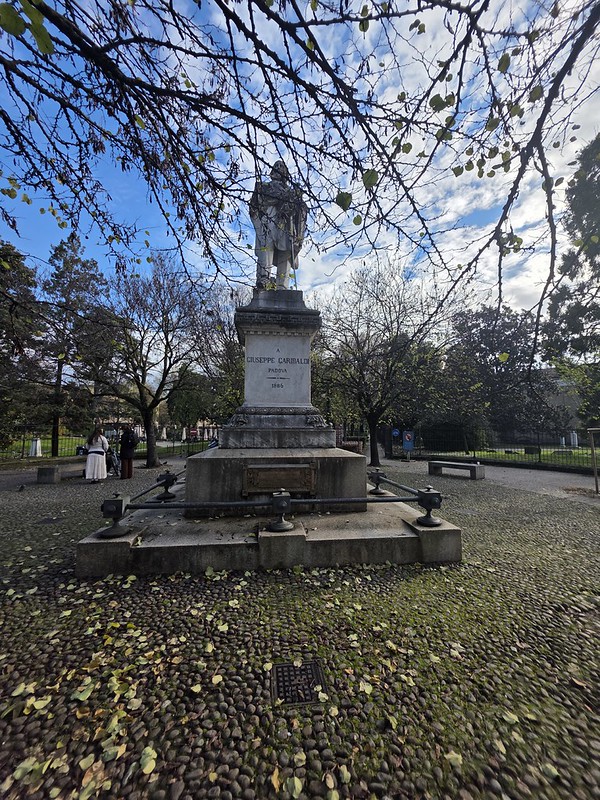
    Just about every Italian city has a statue of Giuseppe Garibaldi (1807-1882) and this one is located at Giardini dell’Arena. It’s not going to appear in any guidebooks as a site of some interest, but it’s an important reminder as to who was seen as worth remembering in late nineteenth century Italy.

    The statue was placed here in 1886, a few years after the death of Garibaldi, famous for his biscuits and unification of a country. The marble statue was designed by Ambrogio Borghi (1848-1887) and it was originally placed in perhaps the more appropriately named Piazza Garibaldi, before the statue was moved here instead in the twentieth century.

    As for why I’ve granted this statue the honour of an entire blog post which barely registers on the scale of global importance (that’s relevant to the statue and this blog actually), but these faintly trivial moments often linger far longer in the memory than the supposedly big ones, so that’s why it’s here.