Tag: LDWA

  • LDWA 100 – Training Walk 5 (Reedham Ferry to Chedgrave/Loddon)

    LDWA 100 – Training Walk 5 (Reedham Ferry to Chedgrave/Loddon)

    The main page for this walk is here, this blog post is just the section from Reedham Ferry to Chedgrave/Loddon.

    In my last blog post, I mentioned that it was just a short walk along the river towards Reedham Ferry. This transpired to be untrue, as the river section is closed and it required a diversion up via the village’s railway station. We tutted silently at this additional length (although to be fair, it wasn’t much), but it was a handy opportunity to take a quick look at the railway station.

    Reedham railway station was built in 1844 on what was the county’s first railway line, the Yarmouth and Norwich Railway. Today, the line serves both the Lowestoft and Great Yarmouth branches.

    More on this railway station in another post, but we meandered off the path to have a quick look at it.

    Looking back to Reedham on the road which leads to the ferry.

    In the background of this photo is Cantley sugar factory, more on which later.

    This looks an old sign….

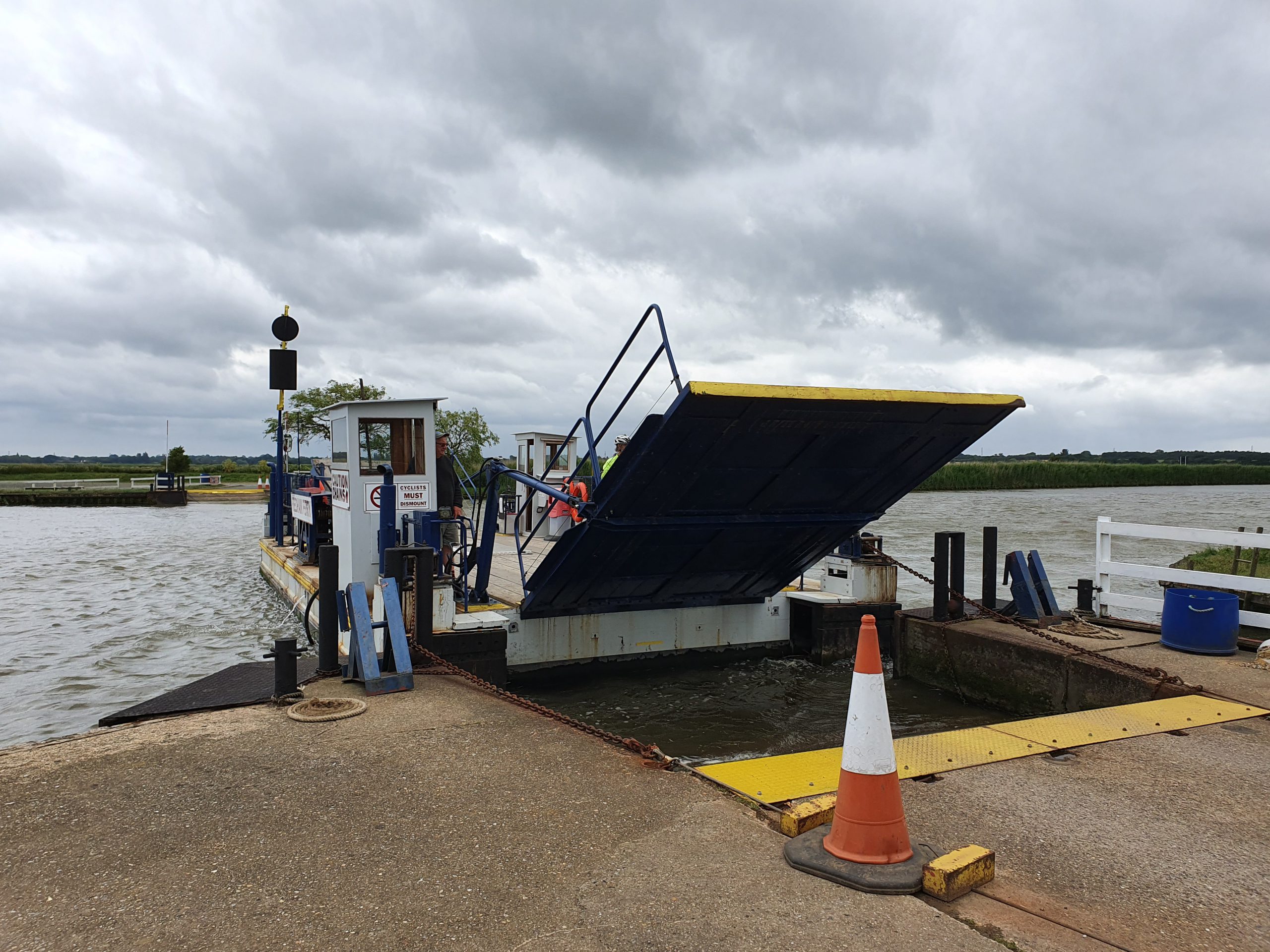
    And we waited at the appropriate spot for our ferry journey across the river, this is the only river crossing for cars and pedestrians anywhere between Norwich and Great Yarmouth. I’ve never made this crossing before and I think it was a little bit of a highlight for us, although perhaps that just means we need to get out more….

    There wasn’t a long wait for the chain ferry to return from the other side to pick us up.

    The fare is 50p per pedestrian to cross the river and it can also carry up to three cars.

    Nathan looking excited on the ferry.

    The view from the ferry, with the current chain ferry dating to 1984, but there’s been a ferry crossing here since the seventeenth century.

    Departing the ferry journey and we very much enjoyed our 60-second cruise. We chose not to upgrade to first class.

    The spot by Reedham ferry is a nuisance in many ways, as there’s no way of crossing the next section of river to the next stretch of path, which means a long diversion round to Loddon and Chedgrave. So, contemplating this state of affairs, we had a rest and I had the remainder of my meal deal.

    This is St. Gregory’s Church in Heckingham, more on which in another post, but it’s a twelfth-century redundant church (I mean it’s redundant now, it wasn’t redundant when they built it) which is now in the care of the Churches Conservation Trust.

    Although we didn’t much mind that a couple of dogs came over to play, I do wonder whether perhaps owners should be more careful as for all they knew Nathan might have dognapped their pet. I hear this is a big thing in Suffolk…..

    Holy Trinity Church in Loddon, which again I’ll come back to in a future post.

    We had always intended for Loddon to be where we restocked, but since our water levels were high not much more was needed. As it was now quite warm, I decided that an ice cream would be my decadent treat (I say decadent, it was £1). We looked at the Magnums but thought they were too decadent at nearly £2 each, Nathan went with a Feast for £1. No expense spared….

    One issue was that the shop took longer than we had anticipated as two elderly ladies were ahead of us in the aisle and were looking at nearly every item in great detail. A queue was forming behind and I really wanted Nathan to go and say something, but he was too polite. So we did the very British thing of staring at the back of their heads with a grumpy look, as this made us feel better.

    A few weeks ago, I popped into the Premier store and obtained some banana bread beer from Eagle, which I rather liked. Unfortunately, they’d run out today, so Nathan opted for a Newcastle Brown Ale and I went for an Adnams Broadside (I say I went for, Nathan chose for me as I was outside finishing my ice cream and getting the best value from my £1 possible). That was the best choice of a bad lot, but they went down surprisingly well. It was just a little hard to entirely enjoy them to their fullest extent though as something akin to a tornado and Biblical flood hit the village during this moment.

    On that note, we then left the metropolis of Loddon and Chedgrave, often referred to as the Las Vegas of Broadland, moving on to the next part of the walk.

  • LDWA 100 – Training Walk 5 (Berney Arms to Reedham)

    LDWA 100 – Training Walk 5 (Berney Arms to Reedham)

    The main page for this walk is here, this blog post is just the section from Berney Arms to Reedham.

    This is the second part of our Wherryman’s Way walk, following on from the section from Great Yarmouth to Berney Arms. We had hoped we had gone through the worst of the overgrown section, but this section after Berney Arms was the worst. This was primarily as the track by the verge disappeared, so we had to wade through waist-height foliage and again worry about standing on a snake. I don’t care what anyone says, as far as I’m concerned, this area of the county is chockablock with snakes, so goodness knows how we didn’t see one.

    The weather had been variable so far in the morning, but there was a period of rain which wasn’t entirely ideal.

    And more heavy foliage, which significantly slowed down our speed. I was fearful that this section would go on for miles, but fortunately, it was only part of the way. Something gave Nathan and me a rash on our legs, yarrow has been suggested as a possible cause and it certainly wasn’t pleasant.

    Nathan discovered a touch of blood on his leg and so assumed he had been attacked by a rattlesnake. I wouldn’t be surprised to be honest, goodness knows what was in that foliage.

    Cadge’s Mill, built during the late 1870s and the early 1880s.

    Some rather lovely poppies.

    There’s no shortage of windmills on the horizon.

    We had mixed emotions about this as it can be seen that the path is suddenly clear and easily walkable, which was a relief after what we’d gone through. But then we saw a flock of sheep and not being very brave, we were concerned that they might attack us.

    Mostly the sheep moved out of the way, but sometimes they faffed about on the path and looked menacing.

    Hoards of sheep. There was one which followed us from a distance, which seemed a stupid thing to do for an animal that likes being in a flock with others. We were frankly concerned about this sheep and it looked aggressive and so we had to keep looking behind us to see if it was charging after us. Fortunately, it didn’t….

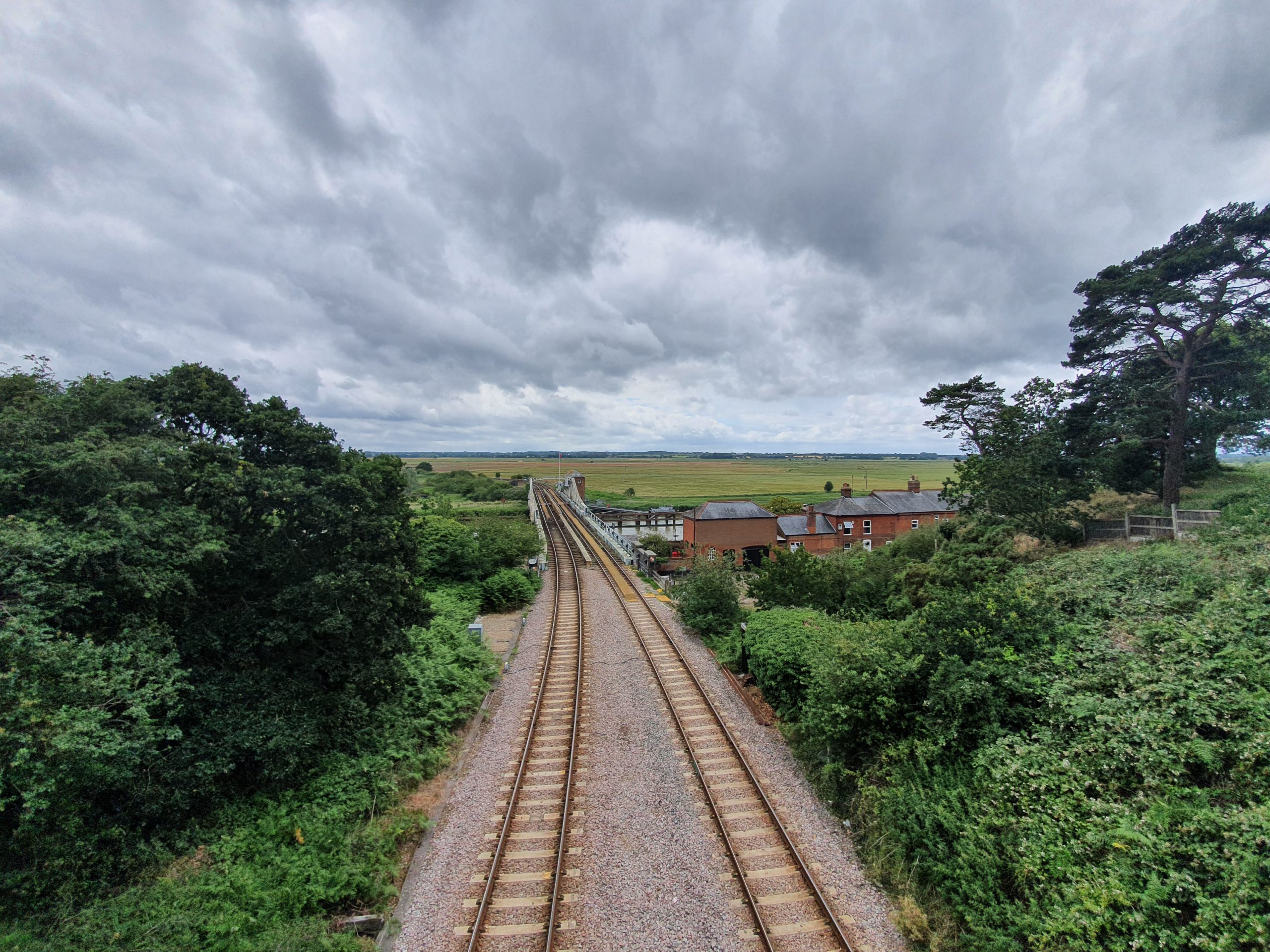
    And we had now arrived in Reedham, this is the railway bridge over the river. There’s no footbridge or bridge for vehicles here, everything has to go over Reedham ferry. More on that later though.

    How lovely, I like historic churches and I like breweries.

    The Ship pub, which has been trading since the 1820s.

    The riverside street in Reedham, which is a village that I’ll write about more in separate posts.

    The war memorial in the village.

    We felt that we had made good progress by this point, with the village marking the 10-mile mark, and we were in Reedham by 13:00 which was sort of what we had expected. Unfortunately, the overgrown areas had put some extra time on as we couldn’t walk with any speed there. The weather had brightened up and was warm, but with a pleasant breeze to ensure that we didn’t over-heat. We weren’t particularly tired and everything seemed to be going to plan, so we were quite confident in the next stage of our plan, which was to explore Reedham briefly and then head off on the Reedham Ferry.

  • LDWA 100 – Training Walk 5 (Great Yarmouth Railway Station to Berney Arms)

    LDWA 100 – Training Walk 5 (Great Yarmouth Railway Station to Berney Arms)

    The main page for this walk is here, this blog post is just the section from Great Yarmouth Railway Station to Berney Arms.

    Liam dropped us off at Great Yarmouth railway station and the weather was, well, slightly wet. If I’m being honest, this isn’t the most glamorous part of Great Yarmouth and it’s quite a walk from the town’s Greggs. Quick bit of information about the railway station, it was built in 1844 and for much of its life it was known as Yarmouth Vauxhall station to differentiate it from the now-closed Yarmouth Beach and Yarmouth South Town railway stations.

    We had just a little problem in finding the start of the walk, which wasn’t ideal. But soon enough we were walking alongside Breydon Water, admiring just how much litter the people of Great Yarmouth have dropped over the last few months.

    This bird hide is near to the A47 and Liam’s boy saw us from the road as I was taking photos of it.

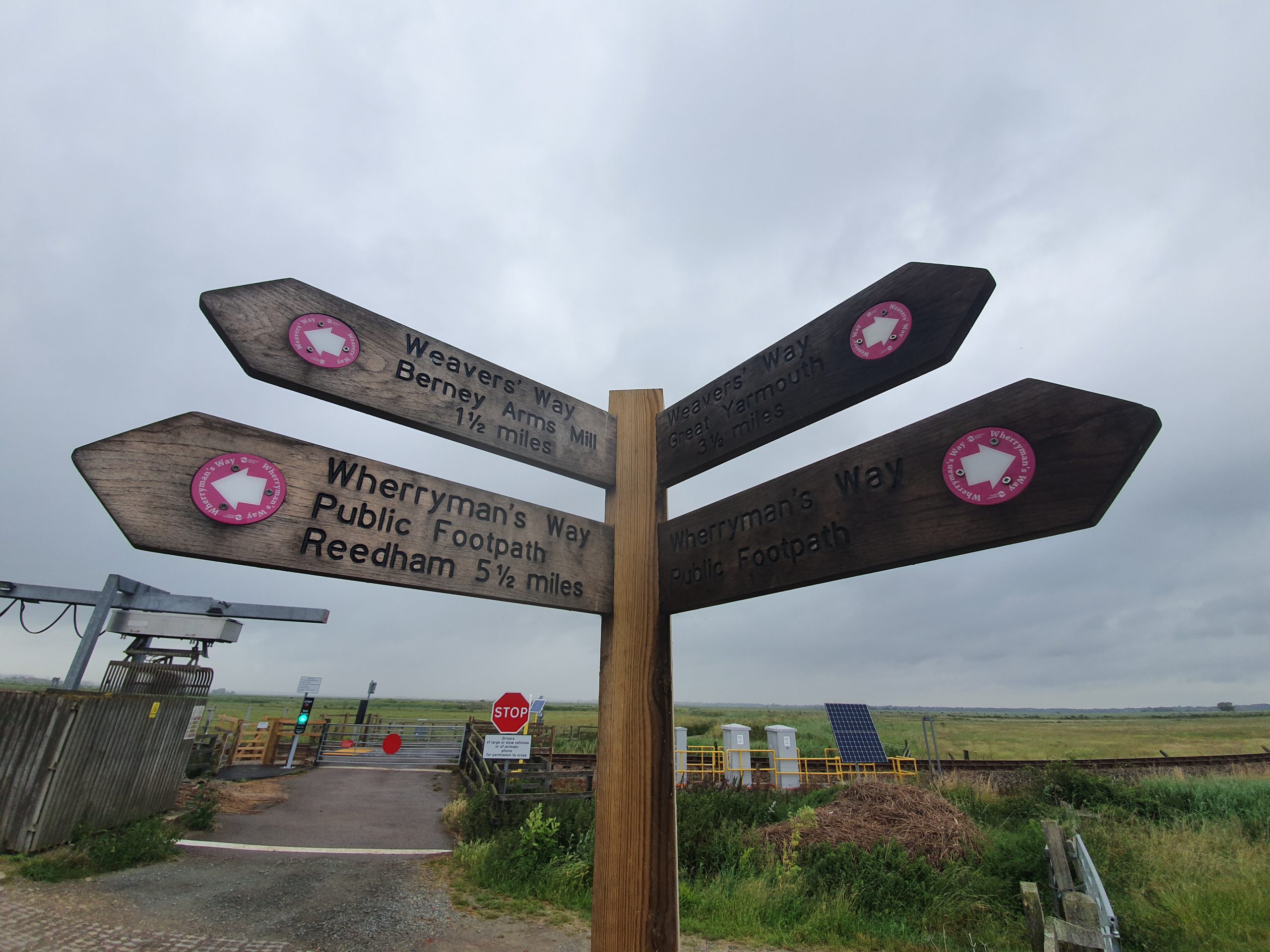
    Taken from near the entrance to Vauxhall Holiday Park, this is a photo of the Greater Anglia train going from Great Yarmouth to Norwich, in front of a directional finger-post for the Wherryman’s Way.

    A snail. I didn’t take many photos of wildlife on this walk, but the snail seemed happy and it seemed useful to record that moment. OK, I accept the snail might not have been happy, but that made me wonder what really makes a snail happy. Do they feel sad? Anyway, I digress.

    This is when we ran into problems, around a mile out of Great Yarmouth, the actual path of the Wherryman’s Way is on the top of that bank to the left. But, it was too overgrown to walk and I was moderately worried about standing on a snake. For a chunk of a way we were able to drop down to this farmer’s track at the base of the bank, but it wasn’t ideal. Norfolk Trails have a real challenge during these difficult times, but the problem is that the path has got so bad that it’s not really walkable. That means that no-one at all is trampling on the path at all and foliage has just totally taken over. I’ve alerted Norfolk Trails, although I’m sure they were already aware (they’re replied really promptly, they are aware and they’re on it so the foliage should be cleared in the next few weeks).

    Located by the Fleet section of the water, this windmill isn’t named on the map.

    Signage where the path meets the railway track once more.

    This is the section of road which drops into the Berney Arms pub, although I have to admit that we didn’t see the turning to go and look at the pub. The pub is usually closed at the best of times and has been for some years, its rural location means that it’s accessible only really from the river. I have to say that a pub with no road access, just accessible from a boat or after a long-walk or cycle, is going to struggle to survive. There were plans a couple of years ago to turn the pub into a residential property, but the council refused.

    This is Berney Arms windmill, which has the difficulty that like the pub, it can’t be accessed from the road. It was first constructed in 1865 for the Reedham Cement Company who used it until 1880 when it was converted into use as a drainage mill in 1883. It remained in use until 1948 and has since been restored and is occasionally opened to the public.

    This was our first stop of the day, I sat down to eat my sandwich acquired as part of the Co-op meal deal, whilst Nathan gorged on the delicacies that his wife had packed for him. After I had carefully removed the fat from the bacon of the BLT sandwich, I was relaxed and sufficiently well-fed for the next part of the expedition. At this stage, we were satisfied with our progress, although moderately worried about the state of the path. Ron from Norfolk & Suffolk LDWA group had warned of us about the state of the path, but we were hoping that the problem bit was the section at the start that we had already reached by the time that we were at Berney Arms.

    How bloody wrong we were.

  • LDWA 100 – Training Walk 5 (Wherryman’s Way)

    LDWA 100 – Training Walk 5 (Wherryman’s Way)

    This walk was socially distanced….. And is the fifth walk in preparation for the 2021 LDWA 100.


    WALK NUMBER: 5 (Great Yarmouth to Norwich – the complete Wherryman’s Way)

    DISTANCE COVERED: 38 miles

    NUMBER OF NATHAN’S FRIENDS WE “ACCIDENTALLY” BUMP INTO: 0

    SUFFICIENT BEER CONSUMED: Yes

    PUBS VISITED: 0

    WEATHER CONDITIONS: All over the show.

    ATTACKED BY ANIMALS: Nearly.

    NUMBER OF SNAKES SEEN: 0 (but they were a constant threat)


    I’m going to split this blog post up into numerous parts to try and make it manageable to write and read. But, this was a giant leap in terms of walk distance, particularly for Nathan, and we completed it rather tired but still in one piece. Although it wasn’t ideal to finish the walk at 23:00.

    SECTIONS

    Great Yarmouth Railway Station to Berney Arms

    Berney Arms to Reedham

    Reedham Ferry to Chedgrave/Loddon

    Chedgrave/Loddon to Rockland St. Mary

    Rockland St. Mary to Norwich Railway Station


  • LDWA 100 – Q & As with Chelle Armour

    LDWA 100 – Q & As with Chelle Armour

    This page is all part of my effort to walk the 2021 LDWA 100.

    The latest in my series of Q&As is Chelle Armour from Norfolk & Suffolk group, someone who I must confess seemed to have a walking ability beyond anything that I could ever imagine achieving back when I joined in 2011. And I look back and think how bloody right I was. Chelle just sails through walks, with an elegance to walking that I don’t have. I’m not sure that much fazes Chelle, whether it’s walking related, cooking things up in the kitchen when marshalling or dealing with her dog Fred when he sees a stile he doesn’t like.

    And, can I say, I very much like this line – “towards the end there is always some ache or blister to moan about”, Nathan and I were planning for something like this, as we both like others to know we might be slightly suffering. This will likely cheer us up, being able to moan about aches and blisters for miles. And, I hope to put weight on during the event too!

    On another point, I fully agree with Chelle about marshalling, it’s great fun to get involved and we welcome anyone who wants to come and help.

    Q. When was your first 100?

    2005, The Chiltern landmarks. I’d joined the LDWA in the November before and got a late entry to the Woldsman the month before for a qualifier and had no idea what I was getting myself into really….. I raised £1000 for arthritis research and finished hand in hand with a stranger who I’ve never seen again and 3 members of Norfolk and Suffolk group !!  🙂

    Q. When you finished your first 100, did you think you’d do another?

    I didn’t want to do another that’s for sure but as soon as the pain had gone (it took a while, i had blisters between every toe!) I found myself thinking about training for the next years and thinking of all the nice places I’d see !!

    Q. So, you’re 60 miles in, you’re tired, it’s wet, your foot feels like it might fall off. How do you keep going?

    I never think of the whole distance. It’s always one checkpoint at a time. Even at the beginning I think, it’s just 15 or 17 short walks… When you get to a checkpoint, it raises your mood…. you get fed, watered and looked after and then it’s off to the next one for more of the same………

    Q. What would you pick at a checkpoint, two vegan sausage rolls or one vegan steak bake?

    2 vegan sausages rolls and I would be ecstatic if there was brown sauce!!

    Q. You walked 50 marathon-length walks to mark your 50th birthday. What would you say to anyone thinking of doing the same?

    Go for it, its time consuming and hard work but its also brilliant fun, you meet some great people n see some beautiful things….. (I will add that I only walked in the rain twice and not for long… )

    Q. How important are the marshals to you at checkpoints on longer challenge events?

    Essential, I look forward to every cp, knowing that the marshals will give me some tlc and do their utmost to provide me with anything I need and then get me on my way again. They want me to finish as much as I do……

    I have marshalled on the hundred and other events too and it’s often as much as a challenge as doing the event!! I urge anyone to volunteer if they can. Events wouldn’t happen without the army of volunteers!

    Q. Have you hallucinated towards the end of a walk?

    Yes, on the Valleys 100 I saw baby dinosaurs ( I’ve since been told they were more likely to be baby dragons-as in Wales!) and also a giant football mascot swaying in the darkness. On Surrey Tops, I once had a soldier in full regalia and pointy hat on a horse next to me for what seemed like miles. Every time I looked left he was there….

    Q. Other than the Cheesy Feet you’re famous for making, what’s your favourite food at a checkpoint?

    It depends on the weather. I ate rather a lot of cucumber on the cinque ports but to be honest I just eat a lot on long events. I figure you need fuel but am probably one of the few that puts on weight during a hundred. I sometimes have 3or 4 sugars in my tea on the last quarter and I’m partial to a small beer (purely medicinal, helps the pain…. ) anything that slides down is good, rice pudding, tinned fruit, jacket spud. I had cheese, blackcurrant jam n jelly beans in between jacobs crackers once, that was lovely!!

    Q. If you walk with the same person for what is nearly 48 hours, what do you talk about? Is there lots of stunned silence when tiredness kicks in?

    There are silences, but towards the end there is always some ache or blister to moan about. Worst bit is in between about 60-80miles when I usually lose my sense of humour for a bit and struggle to think of anything to talk about. We talk a lot of rubbish, and play the A to Z of stupid subjects such as ailments you get on hundreds…. Aches, blisters, chaffing, dry lips, elephantitus, fat fingers……… or food you fancy avocado, bananas, chocolate, date balls, ecclescake…….

    Q. What one word or short phrase would you use to describe the LDWA chair, David Morgan?

    Committed!

    Q. What one word or short phrase would you use to describe the inspirational and vibrant Norfolk & Suffolk chair?

    Excitably enthusiastic…. 🙂

    Q. To those people who are thinking about taking part in their first challenge event, maybe just 18 miles, what advice would you give them?

    Enjoy yourselves….. 🙂

  • LDWA 100 – Recommended Kit Suggestions

    LDWA 100 – Recommended Kit Suggestions

    This page is all part of my effort to walk the 2021 LDWA 100.

    This list of suggestions is from Mike, who wrote more about his 100 experiences. Every 100 has a minimum kit list, and there are checks that entrants are carrying these items, but advice on what to take is really useful. I’ll try and collect more of these, they’re a really practical list that entrants can use.

    100 EQUIPMENT CHECKLIST

    TO WEAR :

    Tracksters / underwear / t shirt / trainers / wool mix socks

    TO CARRY IN BACKPACK – all spare clothing in plastic or dribag

    Route description / map / compass
    Survival bag
    Whistle
    Headtorch+ spare batteries
    Small led hand torch + spare batteries
    500 ml water bottle + isotonic powder or tablets
    mug
    lightweight waterproof jacket
    lightweight waterproof overtrousers
    ultra lightweight windproof jacket
    gloves
    buff
    hat
    cotton scarf / hanky
    3 pairs of spare socks
    Long sleeve thermal base layer or microfleece
    Travel wipes
    Footcream
    Travel tooth brush and small amount of toothpaste
    Spare food
    Walking poles (if used)
    Emergency food (bars and dried fruit)
    First aid kit = paracetamol + compeed + precut plasters+ micropore tape + zinc oxide strapping + small scissors + tweezers + needle for blister + antihistamine tablets + antiseptic wipes / bum butter

    BREAKFAST BAG

    Wash kit and travel towel
    Spare headtorch + batteries
    5 spare pairs of socks
    Spare underwear
    Tracksters
    Spare bra (if female)
    Spare pair of trainers
    Hairbrush
    Thermal base layer
    Spare cotton scarf or hanky
    Spare Fleece
    Heavyweight waterproof top (if very bad weather)
    Spare emergency food
    Small pack of travel wipes
    First aid kit
    Spare spectacles

    NOTE. List can be personalised. It anticipates the possibility of bad weather

  • LDWA 100 – Advice from Mike (entered 26 Hundreds)

    LDWA 100 – Advice from Mike (entered 26 Hundreds)

    This page is all part of my effort to walk the 2021 LDWA 100.

    Below is some wonderful advice from Mike, who is one of the most experienced 100ers, which is practical and informative. One thing has become clear to me in my planned attempt is that completing the event is, as Mike puts it, “a unique personal experience”. I’ll also be pleased to get Mike’s support on my attempt next year, as it’s the marshal’s walk that Nathan and I are going to have a go at completing.

    As well as this interesting advice, Mike has also put together a suggested kit list.

    So, in Mike’s words:

    MIKE

    From 1991 to 2019 I entered 26 LDWA Hundreds. (In 2015 – 2016 I was suddenly hit with a series of illnesses, and it took me a while to recover and get the confidence to try again. I think my recovery was helped by having a target, and I have since completed the Cinque Ports 100 (hot) and Hadrian Hundred (not easy) I realise that in future I shall necessarily be one of the backmarkers, and that does not trouble me at all. I know many of the other people who will also be at the back and it is quite a nice friendly little community. Before each hundred, I draw up a “walk plan” on a simple spreadsheet which uses my estimated walking speed (variable) between CPs, time spent in checkpoints and breakfast. It also takes into account the difficulty of the terrain. I try to allow for really bad weather, the need to concentrate on navigation at night and for the occasional 30 minute nap at a checkpoint (rest works wonders) The walk plan is customised by experience. On the Hadrian Hundred, my estimate was 47 hours, and it took me 47.13.

    In parallel with taking part in the actual event as walkers, my partner and I have been marshals at a number of 100 checkpoints. We also have graduated to supporting the 100 “Marshals’ Walk” – this is a wonderfully engaging task, which we look forward to enormously. I think that running a CP on the Marshals’ Walk is a real pleasure. A LDWA 100 is always interesting, but the Marshals’ Walk is an extraordinary event in its own right, and not just an afterthought to the main event. OK, so why does an average walker (like me) come back year after year?

    It is sociable, life enhancing and interesting. Each Hundred is a unique personal experience. I like the non-competitive ethic. It is irrelevant what someone else can do, or even how I did last time. It is what my physical and mental resources allow on this particular event. It is best treated as an individual expedition. I don’t start full of confidence. By the time I have got to the breakfast point (If I get there and assuming that I have developed no serious physical problems) I begin to think I might be able to do it. Psychologically, it is the first 40 miles that I really struggle with. That is the bit I find hard. I try to concentrate on just getting to the breakfast stop. For me that is a target. Pack your breakfast bag carefully, and think what you are going to need. Don’t skimp on kit, particularly spare socks. Once I have washed, changed into clean dry clothes, and had breakfast, I know I will feel better. The next task is to leave the breakfast stop and keep walking. Don’t retire at the breakfast stop unless you have to. It gets easier after that point.

    When I get to 70 miles, I tell myself it is just a long day’s walk to the finish.. I am encouraged by people who I may be walking with, by the support at checkpoints, and by my interest in the landscape. I also try to encourage and support other people. Finding a couple of walking companions for the second night is a good idea. Other people have different strengths, and a bit of team effort is really helpful when you are tired. I change socks often, particularly in wet conditions. We got through 10 pairs each on the very wet 1996 Yorkshire Dales Hundred. I don’t usually have trouble with blisters, but that is because I have experimented a lot and found out what works for me.

    I love the unique quality of the route, and the fact that each one takes place somewhere in Britain that I may never ordinarily visit. (I never do a recce) You meet extraordinary people. The LDWA has a truly diverse membership. For 48 hours, I am completely out of my usual comfort zone. Other problems and issues of life are set aside. I concentrate on walking, navigation, getting to the next checkpoint and wondering what the food will be like there. Did someone say there would be scones? The support is wonderful. Walking through the night and out into the dawn is transformational. You cannot “buy” an experience like that, you have make it for yourself.

    Each year, from February onwards, I start preparing physically and mentally. The effort is as much part of the event as the actual 100. Perhaps I should not invest so much emotional and physical energy in one event, but I do enjoy the training, and it gives me focus and a target. One day, I will get too old. I hope that I will realise that, and go out gracefully. Until then…

  • LDWA 100 – Q & As with Alan Warrington

    LDWA 100 – Q & As with Alan Warrington

    This page is all part of my effort to walk the 2021 LDWA 100.

    This is part of my series of asking some experienced 100ers about their past walks and I am honoured to feature today the LDWA 100s co-ordinator, Alan Warrington. Another calm, cool and collected member of the NEC, I’m impressed how many times he mentions Greggs at meetings, he is a true inspiration to me. You can follow Alan at https://twitter.com/100scoordinator.

    Alan had some excitement last year with his health and few at this year’s LDWA AGM will forget the appearance of jump leads…… Alan has started six 100 events, completing four of them, and will be helping out on many future events. I must admit, Alan’s answer on the GPX question is impressive, the idea of reading a route description in the dark fills me with dread.

    Q. When was your first 100?

    First attempt in 1979 Dartmoor Hundred. It rained. Second attempt and first completion – Games Hundred in 2012. It really rained!!

    Q. When you finished your first 100, did you think you’d do another?

    No. (Ignoring the fact that both my feet had swollen and looked like they belonged to a Hobbit for about a week after the event). I genuinely had such a laugh and great time throughout the event I felt that there was no need to enter anymore. How could I ever beat the whole experience?

    Needless to say I got talked into another and another. A bit like you and Greggs Chicken bakes just can’t give them up.

    Q. As the 100s co-ordinator, what are your top tips for those taking part in the 100 event for the first time? And if it’s just as much a mental challenge as a physical challenge, how should entrants approach the event?

    Maintain a positive attitude throughout that you want to do the event, are definitely going to finish and walk at your own pace. Accept that you will get tired and are likely to go through incredible highs and lows, might even go astray. You may even get the odd ache or pain, even the odd blister.

    Most of all don’t think of the total distance. Relax it’s just a lot of short walks between a large number of checkpoints. Don’t blast around you have up to 48 hours to complete, although manage your time wisely at the checkpoints. Many misjudge and are then under lots of pressure to get around before checkpoint closure. Savour the sights, sounds and smells, oh and don’t forget to read the route description!

    Q. What would you pick at a checkpoint, two sausage rolls, one chicken bake or one steak bake?

    Steak bake. (Although I have become addicted to Cornish Pasties on these long events and have learned that it’s wise to eat little and often).

    Q. How important are the marshals to you at checkpoints on longer challenge events?

    Critical. These events just would not occur if it wasn’t for the time and energy of these volunteers who provide incredible physical and mental support. I’ve seen many participants want to call it a day. After some refreshments a little rest and some words of encouragement they go on, many to successfully finish. I always thank the volunteers at every checkpoint as a matter of courtesy.

    Q. Is there any area of the country where you’d personally like to see a 100 event take place?

    Anywhere the association has never been before, irrespective of the terrain. We haven’t been to East Anglia yet!

    Q. There has been feedback from some entrants of the 100 next year that they’d like chicken bakes at checkpoints. Something for the future that can be considered?

    Definitely something for the catering team. However, the chicken population may have other ideas!

    Q. Many people (well, one which is primarily me) wonder why there have to be such big mountains on the 100 to climb up?

    Even the smallest mole hill looks like the North face of the Eiger or K2 towards the end of a Hundred. The good news is you often have to go down the other side!

    Q. Have you hallucinated towards the end of a walk?

    Yes only the once during the Games Hundred. Crossing Chobham Common early on the second night during a torrential downpour. Did I tell you it rained A LOT? A long stretch of about one mile which didn’t require much navigation so brain relaxed. Leapt out of my skin as this Giant Spider appeared on the side of the path. I laughed so much when I saw it was just a huge tree trunk with massive roots coming out the side.

    Q. Will it rain in Wales on the 2021 100?

    Can you ask me one on nuclear physics please? I think Wales has run out of rain after the amount that fell during the Valley’s Hundred in 2014 but don’t quote me on that!

    Q. When walking events, do you rely more on the route description or the GPX file?

    Absolutely route description every time. Keeps the mind active and is always primary source of information. I’ve completed many events without even looking at GPX.

    I managed one event which was a figure of eight. Laughed my head off when I received a call from 3 entrants who had started the second loop only to realise half way around they were walking in the wrong direction. That’s what happens if you don’t read the route description. Doh!!

    Q. Have you been scared of a sheep / cow / snake / pig / seagull or similar on a challenge walk?

    No, although the seagulls along the Moray coastline during the Laich O’Moray 50 were huge!

    Q. To those people who are thinking about taking part in their first challenge event, maybe just 18 miles, what advice would you give them to get them started?

    Take your time and enjoy it.

  • LDWA 100 – Q & As with Simon Hodgin

    LDWA 100 – Q & As with Simon Hodgin

    This page is all part of my effort to walk the 2021 LDWA 100.

    My latest series of posts is asking some more professional walkers who have actually completed the walk about how they have got on. And today’s journalistic triumph of writing is Simon Hodgin, a member from Norfolk & Suffolk who makes walking these things look just a bit too easy. Although, he’s also sponsoring a large shipment of craft beer to me if I can complete the 100 next year, which is a quite marvellous idea.

    Simon, inspired by Jane who has helped with his training, seems to positively enjoy the 100s and I think his competitive instinct from being a footballer has helped with this. There’s more about Simon here, which is another page on this web-site about walking the 100, not some Google link to help stalk him.

    Q. When was your first 100?

    2018. I’m a relative newcomer to the LDWA and 100s

    Q. When you finished your first 100, did you think you’d do another?

    Yes. I was ‘hooked’!

    Q. What would you pick at a checkpoint, two sausage rolls, one chicken bake or one steak bake?

    One steak bake

    Q. How important are the marshals to you at checkpoints on longer challenge events?

    A. Very important. I’ve witnessed them play a key part in encouraging a colleague of mine not to give in during a 100 and help get him back ‘in the zone’ to continue. I have always been impressed with the support of the marshals in every LDWA event I have done over the last five years.

    Q. Your dog has become the unofficial Norfolk & Suffolk group mascot for his bravery, single-mindedness and courage. How proud has this made you?

    He is also obsessed by food, so with those ‘qualities’ we are thinking of changing his name from Bailey to Julian….

    Q. Have you hallucinated towards the end of a walk?

    I have, very slightly. I have seen small images in the road looking back at me. The fact that it is expected makes the experience amusing.

    Q. You’ve told me that I shouldn’t over-train for the 100. Is this advice because you’re worried that I’ll become such a honed athlete I’ll get a faster time than you? And what is your training schedule for the next 100?

    Funnily enough, no. To become a honed athlete you would need to give up Greggs and craft beer, and I don’t see that happening any time soon. Like most LDWA members we walk all year, so we are constantly ‘in training’. You need to rest as well as participate! My ‘focus’ for the 100 starts in early January, with the Stansted Stagger

    Q. Other than your current area of Norfolk & Suffolk, where would you most like to walk a 100 event in the UK?

    There are many places I would like to experience a 100, but I guess The Peak District is my personal favourite.

    Q. Are you more reliant on the route description or the GPX file?

    The LDWA route description with GPX as a back-up.

    Q. What are your top tips for footcare on the 100?

    Footcare is a personal choice. Walking a lot toughens the feet, but for longer events, I use micro tape on my smaller toes and change into fresh, dry socks regularly (every 25 miles on a 100). Above all else, wear comfortable and ‘tried and tested’ walking shoes!

    Q. You have a reputation for teamwork and helping others through whilst always remaining positive. How do you maintain this when at 70 miles and feeling tired?

    I’ve been lucky to walk with great people on the 100. It’s easy to stay positive when you are also being supported by likeminded people. The 100 isn’t just about fitness and physical stamina, it is also about mental stamina. The more you embrace it, the less pain & tiredness you feel.

    Q. Have you been scared of a sheep / cow / snake / pig / seagull or similar on a challenge walk?

    No.

    Q. To those people who are thinking about taking part in their first challenge event, maybe just 18 miles, what advice would you give them?

    Give it a go. Whether it’s for the physical fitness, fresh air, great countryside or even greater company & support, you’ll get something positive from it!

  • LDWA 100 – Q & As with Rob Newell

    LDWA 100 – Q & As with Rob Newell

    This page is all part of my effort to walk the 2021 LDWA 100.

    My latest series of posts is asking some more professional walkers who have actually completed the walk about how they have got on. And today’s beautifully crafted questions have been answered by Rob Newell, from Norfolk & Suffolk group, who has completed two 100 events and has a Twitter account at https://twitter.com/RobMarlinsUK. A fan of David Morgan, I’ve always thought that Rob has a huge advantage with his height and this is why he can complete events faster than me. But, as he himself says, it’s not about the time and it’s not a race. Although secretly, if I’m near to the end of an event I try and rush myself past anyone I possibly can who is ahead in the hope of moving a few places up the results table…..

    Anyway, I digress. Back to Rob.

    Q. When was your first 100?

    The Cinque Ports 100 in 2018

    Q. When you finished your first 100, did you think you’d do another?

    Yes, definitely. The experience of the Cinque Ports 100 was so amazing I knew I had to do more.

    Q. You once nearly retired on a 100, but carried on to finish. How did you get the mental strength to carry on?

    On the Hadrian Hvndred I got a chill going over the top of Cross Fell in some of the most atrocious stormy weather I have ever walked in. The conditions over the next climb at High Cup Nick just compounded the problem. I came off the mountain shivering and walking very, very slowly. Morale hit rock bottom and I knew it was all over. I approached the checkpoint, a draughty barn and was welcomed by Graham Smith and the Kent LDWA. He asked me how I was and I said not good, but rather than take my tally card he comforted me in the fact I had loads of time. But as soon as I sat down I couldn’t stop shivering, the feeling that I had failed took over and I burst into tears. I was wrapped in blankets and a hot water bottle but after several cups of hot soup and tea later I felt better and was encouraged to keep going.

    Mentally I overcame the remaining distance by determination to finish and by splitting the remaining distance in my head. I had 7 miles to think about to the next checkpoint, not the 30 miles I had left. This is essential at the start of the 100, don’t think about the distance or it will become overwhelming. Instead split it up between checkpoints and the notable areas on the challenge, it’s not as daunting

    Q. What would you pick at a checkpoint, two sausage rolls, one chicken bake or one steak bake?

    Ideally would alternate between each checkpoint but if I had to choose one it would be the Chicken Bake

    Q. How important are the marshals to you at checkpoints on longer challenge events?

    The marshals are vital, welcoming you in, checking that you are ok and making sure you have enough food and water before setting off again. Later on in the events they really care for the bewildered walkers as they stumble into the checkpoint, getting drink and food for you and offering some friendly encouragement

    Q. Do you recommend others consider using walking poles?

    I personally like poles on longer events as they take pressure off my legs and knees plus helps me straighten my back. I think this along with the right hydration helps prevent strain on the legs. I use Pacer Poles as the get me into a rhythm. However they can be annoying as they are unwieldy when trying to read the route description! So I now only use on long events.

    Q. Have you hallucinated towards the end of a walk?

    Yes, a Roman chariot but with 4 people with Georgian style wigs at the end of the Cinque Ports (it was actually a bush) and there were people standing by the trees in the woods near Hexham racecourse on the Hadrian Hvndred who were actually not there. I said hello to a few of them!

    Q. Other than your area of Norfolk & Suffolk, where would you most like to walk a 100 event in the UK?

    Scottish Highlands or the Isle of Wight

    Q. Are you more reliant on the route description or the GPX file?

    GPX file, however I do try to follow the description and then use GPX as a back up

    Q. Have you been scared of a sheep / cow / snake / pig / seagull or similar on a challenge walk?

    On the Wye Valley 50 during the night I looked down a valley to see thousands of little lights shining back at me, I then realised they were sheep! Also on The Harvest Hobble in Lincolnshire a farmer opened a gate to let a herd of cows out as I walked past, about 50 cows then followed me for half a mile.

    Q. What’s the snack of choice that you take with you on the 100?

    Fredos!

    Q. Do you think you’ll keep on doing the LDWA 100 every year?

    Yes!

    Q. Is your 100 certificate proudly displayed on the wall at home?

    Yes!

    Q. To those people who are thinking about taking part in their first challenge event, maybe just 18 miles, what advice would you give them?

    Do a few warm up walks slowly building up the distance, experiment with socks and footwear to find the most comfortable solution for your feet. On the day keep hydrated and don’t worry about the speed of others, it’s not a race.