Tag: Fleet Street

  • London – Central London – Punch Tavern

    London – Central London – Punch Tavern

    This is some frontage for a pub and it’s the Punch Tavern located on Fleet Street, operated by Urban Pubs and Bars. I’m trying to visit some of the pubs in London city centre that I haven’t been to before, traditionally because they’re too busy.

    Once a gin palace, and it still has plenty of gins to choose from, it took its current name not from the dreadful Pubco, but from when Punch Magazine staff used to drink here. Every newspaper and major magazine on Fleet Street had its own pub their staff used and they must have drunk a lot at Punch as they had only been publishing for a couple of years when the pub named themselves after them.

    CAMRA have added it to their list of historic pub interiors, noting:

    “Rebuilt in two phases by Saville and Martin, first the main part of the pub and the Fleet Street frontage in 1894-5 and then the Bride Lane frontage with a Luncheon Bar behind in 1896-7.”

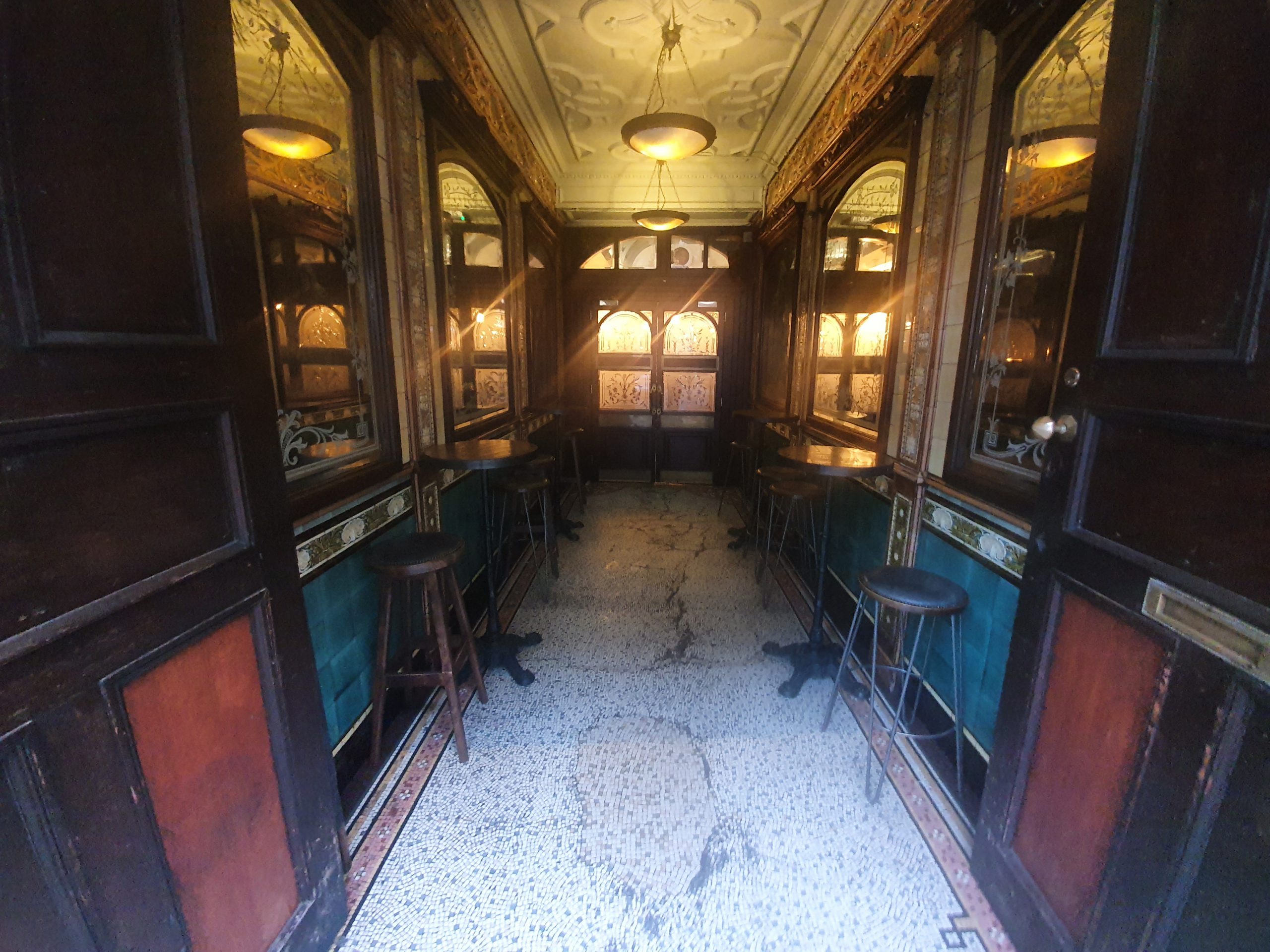
    A nicely decorated corridor into the pub, necessitated by the shopfronts on either side of this narrow entrance.

    It wasn’t packed with the customers in the pub, although a group on some sort of tour did pop in later on.

    The Hophead from Dark Star Brewing, which is a perfectly acceptable beer and it was well kept here, and at the appropriate temperature. It was also the only real ale available, so it was fortunate that they had a reasonable one and not Greene King IPA or similar. When things return to some form of normality a pub like this is going to need more choice than this though, it’s not ideal at the moment.

    This pub has a much stronger selection of gins, but there are some bottled beers (clicking on the image makes it bigger).

    The service in the pub was friendly and engaging, so it felt like a welcoming and comfortable place to visit. It’s also a very large venue, there’s a room at the back and additional space for private groups. The reviews are generally positive on-line and the manager answers them politely and professionally, which is usually a good sign. Anyway, everything felt well managed enough, but the beer options aren’t sufficient to want to tempt me back, even though I liked the environment.
  • London – Central London – Ye Olde Cock Tavern

    London – Central London – Ye Olde Cock Tavern

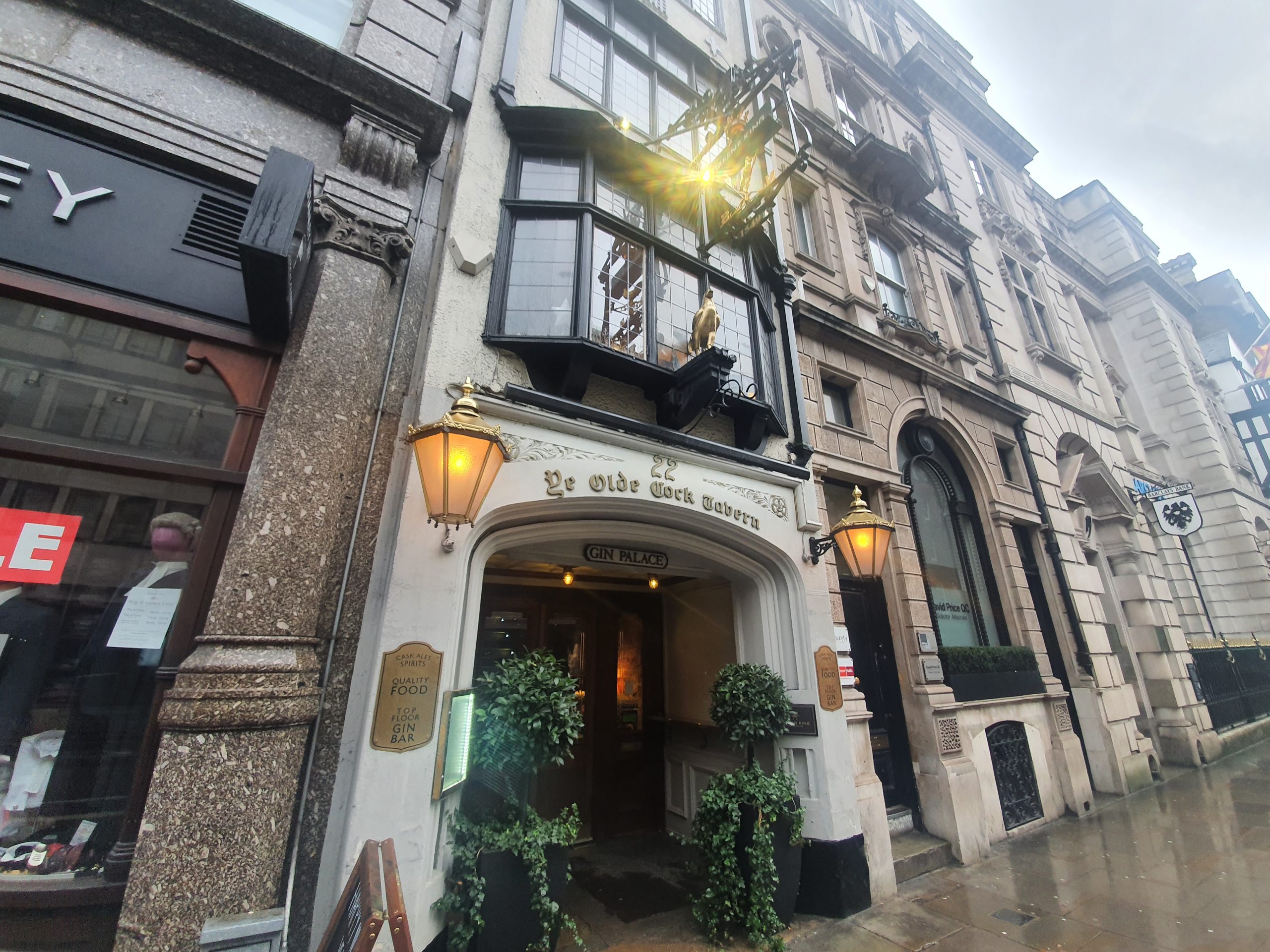
    I’ve meant to visit this historic pub on Fleet Street on numerous occasions in the past, but it’s operated by Greene King and that’s always put me off. However, it’s important to support the hospitality industry and so I thought I’d have a little visit since I was walking by.

    Indeed inspirational, but a slightly odd quote for a family pub, but there we go. Although to be fair, they can hardly advertise their beers given the choice they have inside.

    Slightly hard to read from this angle (I was avoiding my reflection being in the photo) but it reads:

    “The Cock was opened in 1888 with the original fittings from the original tavern on the site of the branch of the Bank of England opposite. The records of the tavern go back to the early seventeenth century. Pepys says “April 23 1668, to the Cock Alehouse and drink and eat a lobster, and sand and…. and then Knipp and I to the Temple again, and took boat, it being darkish. And to Foxhall, alas there are now no Vauxhall Gardens where we can take our Knipp but there is still the Cock.”

    The pub was visited by men like Pepys, Samuel Johnson and Charles Dickens, but they visited the pub that had stood since 1546 on the other side of the road. And the historic fittings brought across in the late nineteenth century were mostly destroyed by a fire in 1990. There’s still a depth of heritage here, but it’s a bit tenuous in places.

    Another history of the pub.

    As for the pub itself, this is a mess. The toilets had no hand-dryer, just a sign saying it was broken, but there was no thought to an alternative provision of hand towels or the like. There was no acknowledgement at the bar which didn’t concern me, but is unusual at the moment given how quiet pubs are. However, it was seeing the ‘exciting’ beer selection of Greene King IPA and bloody Rocking Rudolph which they were trying to discount at £2.50 per pint (I added the bloody BTW, that isn’t the beer name) that made me give up. These are not interesting beers (to me at least, and indeed to few people judging by their Untappd scores) and although there are some generic cask options, I lost heart at this effort from Greene King. There are so many good beers in the world, why do Greene King keep insisting on shying away from quality?

    Anyway, if Greene King don’t care about their pub, then nor do I, so I went to find another venue for a quick drink. I will say that there was a wide selection of gins, which would have once been one of their staple products so there’s some continuation of history there. Greene King make little effort to explain the history of the pub on their web-site and it’s a shame that another operator isn’t in control here. Mainstream as Nicholson’s might be, they’d put a touch of elegance into proceedings, and even JD Wetherspoon would do a far better job although the venue is a little too small for them. Maybe one day a pub like this will be independent and have owners that it deserves given its heritage, even if that heritage is a bit loosely defined.

    Moan over for the day.

  • LDWA – Fleet Street History Walk

    LDWA – Fleet Street History Walk

    This is the first walk I’ve been on that was listed in the new national LDWA history group and although it went from Kensington High Street to Canary Wharf, it was centred on the Fleet Street theme. The walk was led by Dame Julie Welch who worked in Fleet Street as, amongst other things, a sports journalist. She has written a book about women in Fleet Street, which is well worth a look and I’ve linked to it at the bottom of this post. There were fifteen or so people on the walk and it was interesting to meet LDWA members from other parts of the country.

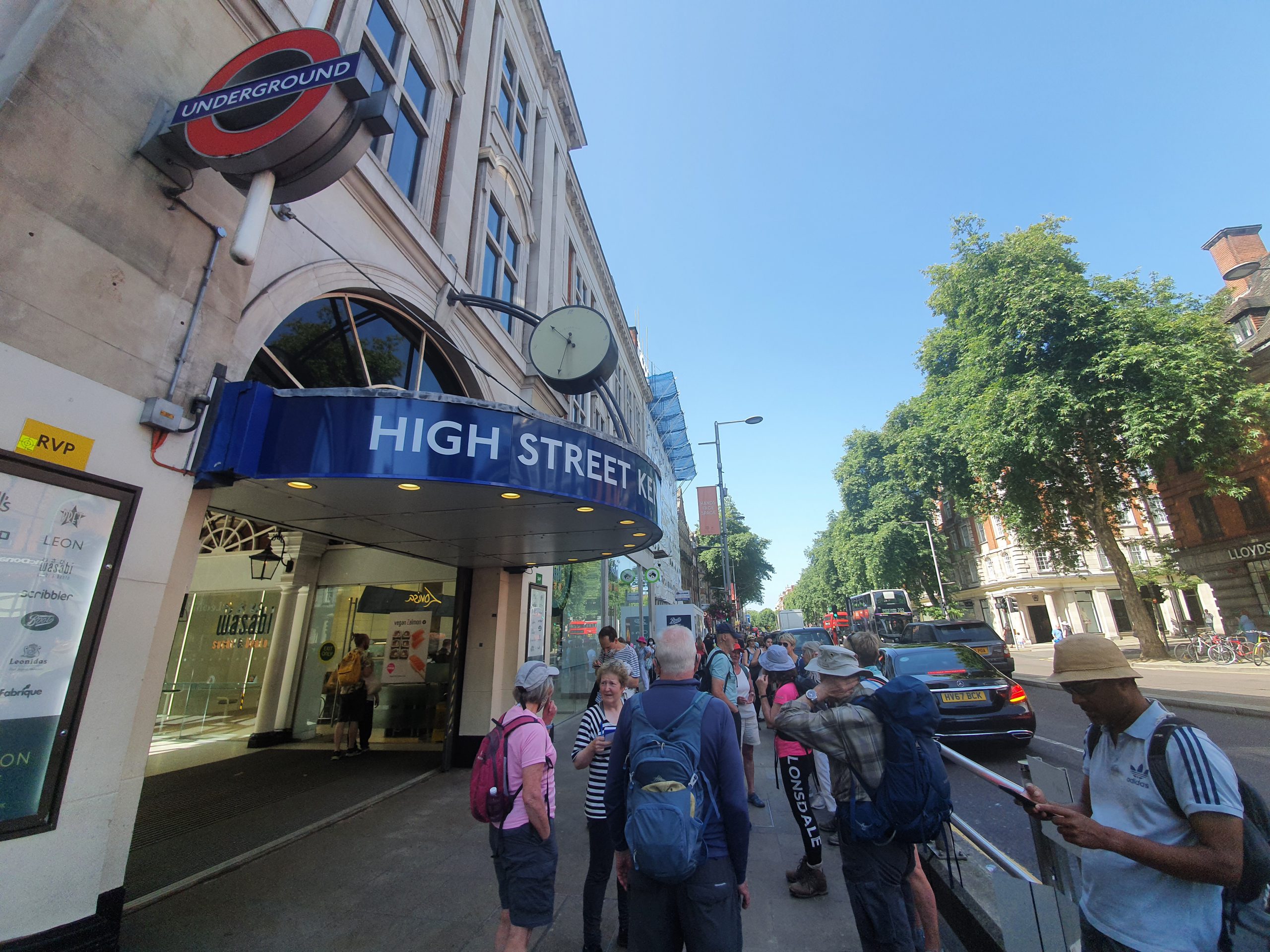
    The walk started outside High Street Kensington underground station.

    This is Northcliffe House in Kensington, current home of the Daily Mail.

    It’s fair to say that the weather was hot and there were plenty of people in Kensington Gardens and Hyde Park. We bravely kept up quite a pace to cross the park.

    Buckingham Palace.

    The Royal Courts of Justice, which are on the Strand, which is at the end of Fleet Street. Incidentally Fleet Street is named after the river, a walk I went on a few weeks ago led by Des.

    The former Strand underground station, which closed in 1994 as usage was low and the cost of repairing the lifts would have been too expensive. It’s today used for filming and there’s an underground train down there which can be used if required. There’s a connection to the Piccadilly line should there ever be a need to bring the station back into usage, although that’s not very likely.

    The former Wig & Pen club, more about this at https://www.theguardian.com/media/2003/nov/29/pressandpublishing.uknews.

    It was interesting to hear about what Fleet Street was like in the 1970s and 1980s. A male dominated environment where drinking and smoking was commonplace, but Julie also explained just how vibrant and exciting a place it was to be. They would hear the news first and it felt like a separate town within London, with the clattering of the print presses and the smell of printers ink in the air. I must admit, it sounds a working environment that must have been challenging (especially for women), but endlessly exciting.

    One of the locations that Julie showed us was El Vino (more at https://en.wikipedia.org/wiki/El_Vino) which for a long time required men to wear ties and didn’t allow women to order at the bar. This was only overturned in 1982 when the matter went to court, with the bar fighting hard to maintain their right not to serve women. There was work going on at El Vino, so no photo of the frontage, but instead I took a photo of the tempting doughnuts in the shop next door.

    We had time for a drink at Black Friar pub which is located at the end of Fleet Street and Julie pointed out some other pubs that I’ll visit on Fleet Street during the week. Many of them are now closed on the weekends, but back in the day when Fleet Street was in its prime, they’d be open every day.

    Julie mentioned that every newspaper would have its own pub where journalists and workers would go. It was possible for anyone to go to any pub, but people just tended to stick with the pub that their newspaper most commonly used. Above is the White Swan (also known as the Mucky Duck) on Fetter Lane, just behind Fleet Street, which I think Julie said was used by the Daily Mirror.

    Nothing to do with the walk itself, I just liked the Poland Consulate building with its Polish and EU flags when walking by.

    I left the walk at Wapping as I had to go and have my second jab at Guy’s Hospital (I was very brave), but Julie led the others on to Canary Wharf. Wapping was an essential part of the walk as the opening of the printing presses there by Murdoch in the 1980s saw an effective end to Fleet Street as the heart of the newspaper industry in London.

    A few minutes before a group photo was taken. Thanks again to Julie for leading this walk, something very different.

    Julie hopes to lead the walk again, so look out for it in the LDWA history group and LDWA London programmes. Julie also wrote the book below which was published by Trapeze last year.

  • London – City of London – St. Dunstan’s Court

    London – City of London – St. Dunstan’s Court

    Like the yards of Norwich, I rather expected the series of courts off Fleet Street to have some kind of long heritage.

    But, at first this didn’t seem to be the case. The red cursor on the above map from 1920 shows where the court goes through the building today. Indeed, on late nineteenth century maps, it shows that this was the site of a pub rather than a court. The court takes its name from the nearby medieval church of St Dunstan in the West (this makes sense as there’s another one in the East, albeit mostly destroyed during the Second World War, which isn’t too far from the Tower of London).

    However, the 1886 Insurance Plan of London shows that the court was there and this tallies up with 160 Fleet Street being the Hole in the Wall pub. The court doesn’t really go anywhere, it just reaches what was a playground in 1886 and then joins onto Bolt Court, which is as it is today (although the playground has gone). Also visible in this map is an electrotype facility, a useful and quite modern publishing device at the time. There’s a photo on Wikipedia of a set-up in 1902 that was used at the New York Herald, and I imagine that it was equally cramped.

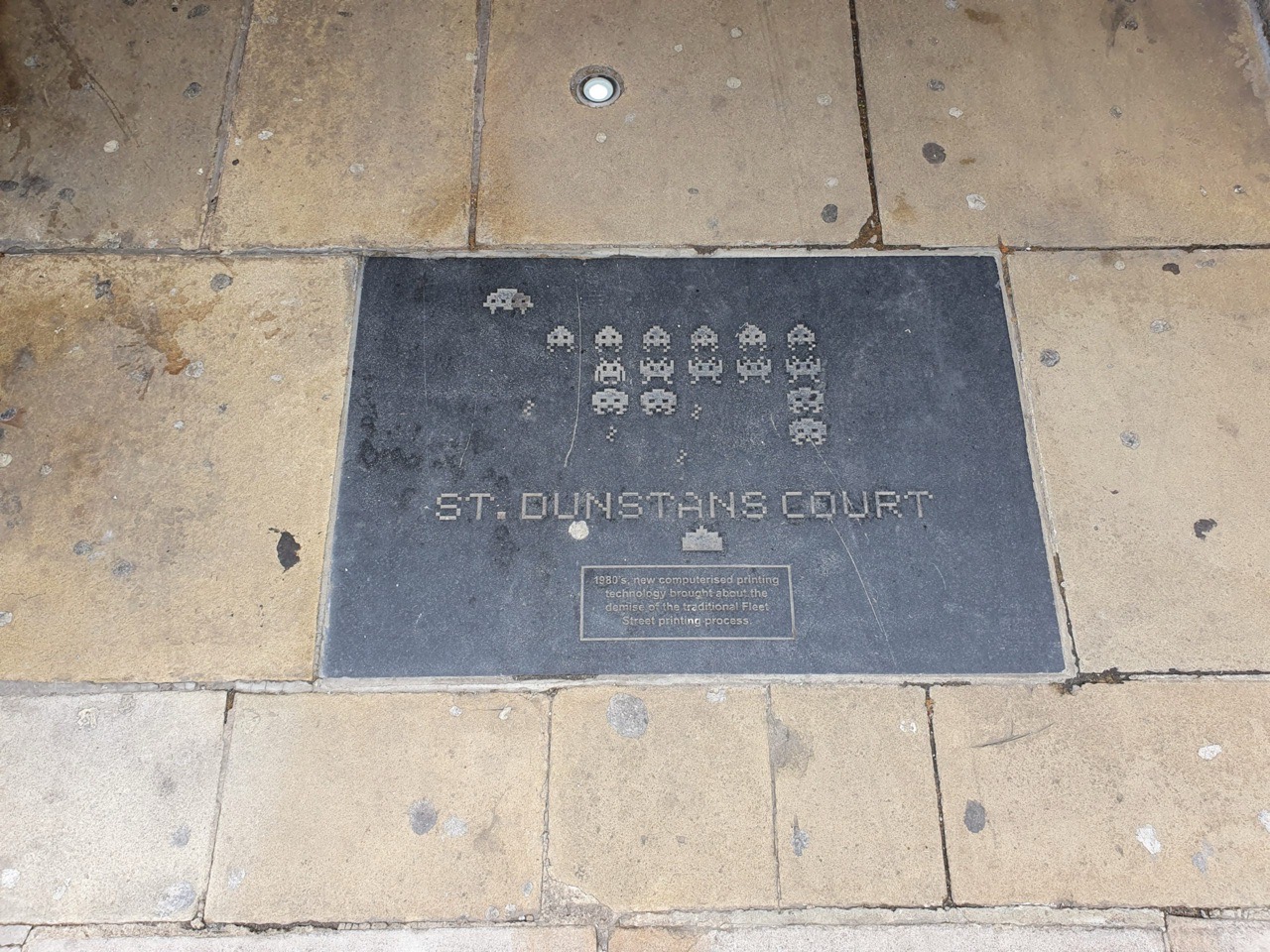
    Each of the courts off Fleet Street on the north side of the road has tablets which show the heritage of the newspaper industry, which is what this area was once known for. This one shows the 1980s computerised printing technology that was introduced, that brought about the demise of the traditional printed processes. The usage of the Space Invaders as an example of something from the 1980s is perhaps a little obscure, but it stands out on the pavement.

    There was a court case heard at the Mansion House in September 1896 when a Mr Charles Pensotti was accused of stealing letters from a post box on St. Dunstan’s Court. He had been interfering with letters placed there by Dean & Son, a publisher of some note, who wondered why cheques and postal orders had been going missing. When arrested, Pensotti was found to have a number of blank cheque books and six picklock keys, but he said to the police that it was a big mistake.