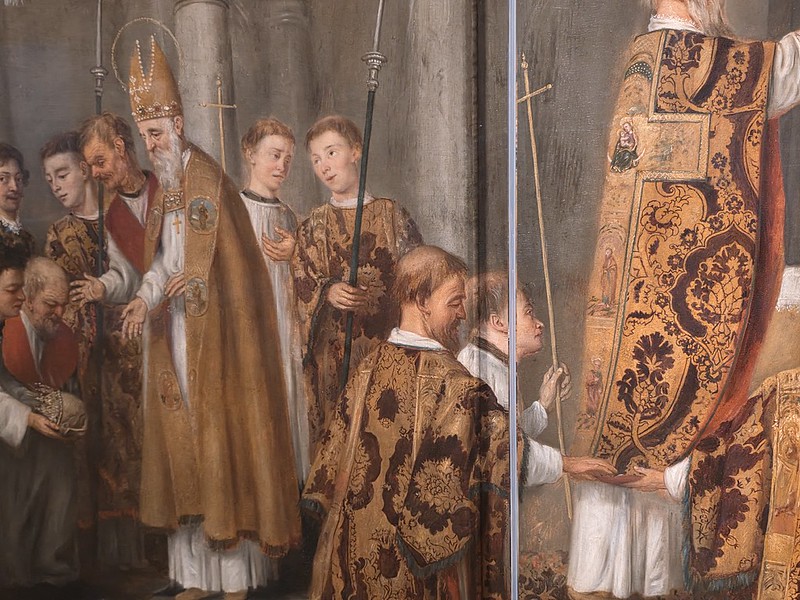
In the centre of this painting is Cunibert, or Saint Kunibert, who was a seventh century bishop of Cologne and one of the more important church figures in the Frankish Rhineland. He was bishop from roughly the early 620s until his death, usually dated to around 663, and he also seems to have played a political role at the Merovingian court. That was seemingly quite common for senior bishops of the period across Europe, who were expected not merely to pray and look solemn, but also to help hold together the fragile early systems of governance.
I was a bit muddled up at the museum as I couldn’t work out which one was Cunibert, but the artist has done a bit of a job lot of Cuniberts here, so he’s in the artwork twice. This time he’s looking pleased having discovered the tomb of St. Ursula in the church of the same name, which is where this painting is on loan from. There was a medieval story that Ursula walked about with 11,000 companions, but this story isn’t taken particularly seriously by anyone today. I can’t imagine why…. The artwork was painted for the church in around 1640 and perhaps it is the skull of Ursula that has been discovered which is exciting and delighting them.
That seemed to me to be the most interesting thing about this arrangement, a reminder of two of the most important saints in the city, asserting the power of the church and its reason for existence. And this was at a time when work had been stopped on Cologne Cathedral, religious continuity was not guaranteed…..
The collapse of the Cologne City Archive in March 2009 was let’s just say, sub-optimal. The building full of the archives came down during construction work on the city’s north south light rail tunnel, killing two people in the neighbouring houses and burying one of Europe’s most important municipal archives under rubble and mud. This was not some little local records office containing a few damp parish newsletters, but a vast collection preserving nearly a thousand years of Cologne’s documentary memory, including medieval charters, manuscripts, personal papers and administrative records of extraordinary value. Few cities manage to mislay their own past quite so dramatically and this was especially unfortunate given that it had survived the ravages of the Second World War.
What followed was a long and expensive salvage operation, with archivists, conservators and volunteers working to recover, freeze, clean and identify damaged material piece by piece, which is in my humble opinion very much heroic work. Millions of items were rescued, though often in fragmentary or filthy condition, and the restoration effort has taken years, with the city slowly rebuilding both the archive and its reputation after a catastrophe that became a byword for civic embarrassment.
The work to fix the archives is not yet complete, over €400 million has already been spent and restoration and the rebuilding of the collection will take decades more yet. However, all of the most important pieces of the archive have been saved and the losses have been minimised, but it’s not really an ideal situation.
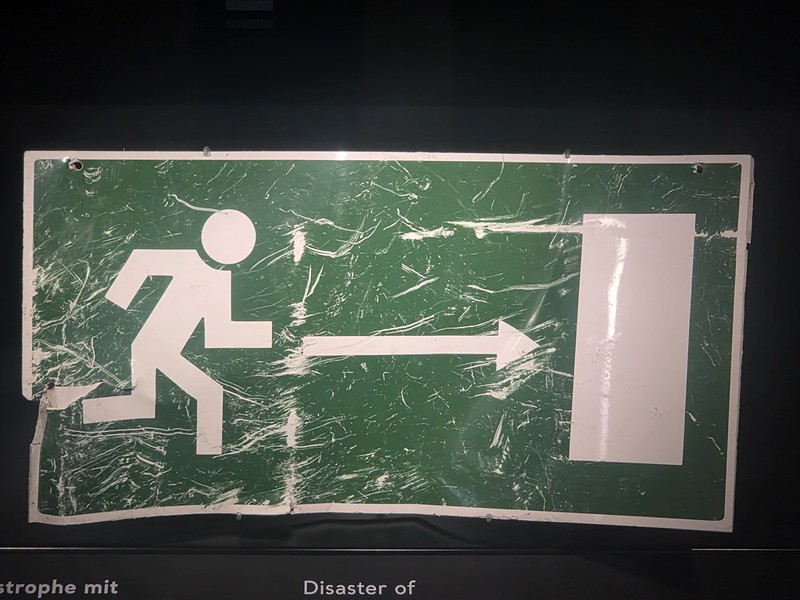
I like the museum’s exhibit on this, it’s a fire exit sign from around 2000 which was salvaged from the collapsed building. It is beautifully understated as a representation of the disaster that took place here.
The first bridge on this site was the Dombrücke, opened in 1859, a two track bridge built at a time when railways were transforming the city and when placing major infrastructure beside the cathedral was apparently considered an entirely reasonable little arrangement. By the start of the twentieth century the Dombrücke could no longer cope with growing traffic, and plans were drawn up for something larger, more decadent and more in keeping with Cologne’s enthusiasm for doing importance at scale. The present bridge was built between 1907 and 1911 and opened by Kaiser Wilhelm II, replacing the earlier crossing at essentially the same location and preserving that dramatic line towards the cathedral.
When the Hohenzollern Bridge opened in 1911 it carried not only railway traffic but also a road, with three adjoining bridge sections and an arrangement that tried to reconcile engineering necessity, imperial grandeur and Cologne’s urban awkwardness in one steel composition. It was named for the Hohenzollern dynasty, because the German Empire rather liked putting ruling family’s name on prominent things. This section here is part of the old infrastructure of the bridge, which is no longer used.
And the same section on the other side of the bridge, which now also goes nowhere.
The Second World War, in the usual considerate manner, interrupted all this rather badly. The bridge was blown up by the Germans in 1945, but it was rebuilt after the war, first reopening for rail traffic in 1948, with later rebuilding and widening phases in 1959 and 1987 helping to create the six track railway bridge seen today. The road element never returned, leaving the structure as a railway and pedestrian bridge instead, with 1,200 trains going over the bridge every day. The bridge is something of a tourist destination now and it’s likely for the best that the number of cars ploughing straight through the middle of the city has been reduced somewhat.
Incidentally, there is also, on the Deutz side, a public climbing facility maintained by the German Alpine Association, which is perhaps something that my friend Richard might want to have a go at now that he’s a climbing professional.
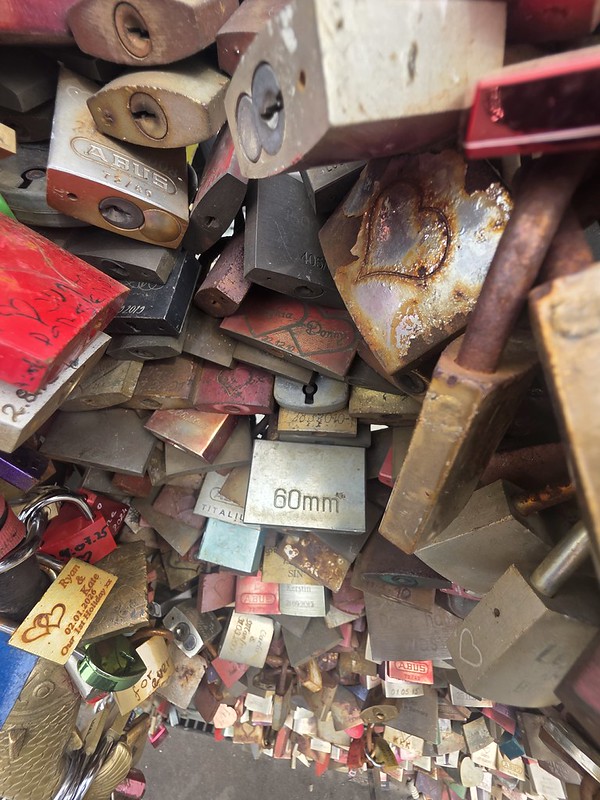
And then there are the love locks, which have turned the bridge into a giant metal archive of optimism since the custom took hold in 2008. The authorities don’t know how many there are now, but it’s likely around 700,000 sort of number. Counting each one individually would be a deeply unfortunate and sub-optimal way to spend an afternoon, so it’s unlikely the total number will ever be known. Deutsche Bahn has said the locks do not threaten the bridge’s structural safety, which is reassuring, because it would be a grim little twist if the bridge fell down because of them.
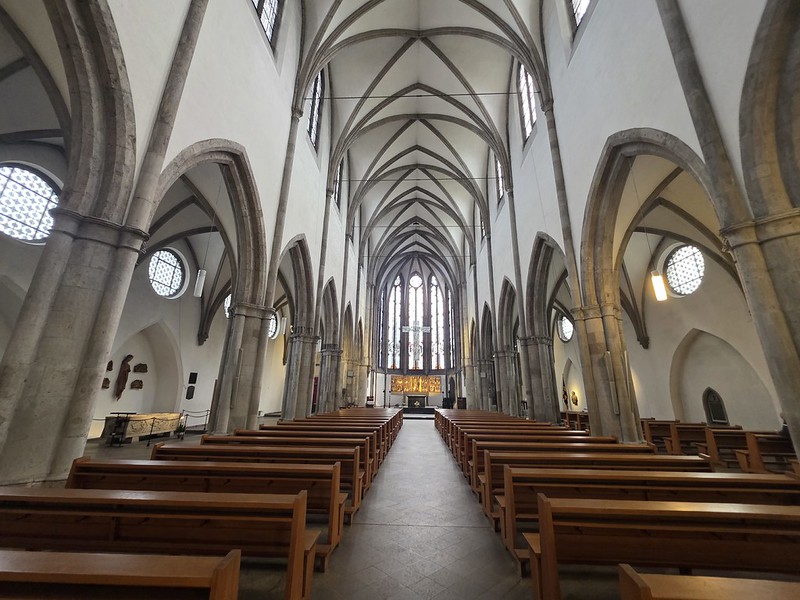
The Minoritekirche in Cologne (St. Mariä Empfängnis in German) might look slightly understated, but it has a long heritage. It was built for the Franciscans, or Minorites, in the thirteenth century which meant some relative architectural restraint, though ‘restraint’ in medieval terms still left room for a very handsome Gothic interior. The Franciscans came to Cologne in the early thirteenth century and their church developed into one of the major mendicant foundations in the city.
After the Franciscans split in 1517, the Cologne house belonged to the Conventual branch and the church was later reshaped in the seventeenth and eighteenth centuries, before suffering badly under French occupation and the secularisation that followed. During this period, the friars were expelled and the building was put to more utilitarian use. It was saved in the 19th century, badly damaged again by bombing in 1942 and then rebuilt after the Second World War.
The nave of the church, which was peaceful and quiet. I had just been to the city’s grand cathedral which was beautiful, but that was anything but quiet. It’s only a short distance away and in 1846, the church was handed over to the cathedral and it was used for confirmations and ordinations.
The chancel and it feels well proportioned and light.
The rather grand altarpiece.
This is the tomb of Duns Scotus (1263-1308), medieval Franciscan philosopher and academic theologian. Known as the “Subtle Doctor”, he specialised in arguments of extraordinary complexity, suggesting a mind that found straightforwardness a rather unappealing little arrangement.
This memorial tablet is an epitaph for Johann Averdunck, a distinguished local legal and administrative figure. The monument is written in Latin and follows the traditional “D.O.M.” (Deo Optimo Maximo) dedication, which translates to ‘To God, the Best and Greatest’.
This is the seventeenth century Latin memorial tablet dedicated to Henricus Francis (Henry Francis), a notable scholar and clergyman.
As a note about just how observant I clearly am, the church also has the tomb of Adolph Kolping (1813-1865) who founded the Kolping Association. He was ordained to the priesthood in this church in 1845, but his father died the previous evening, so that must have been something of an emotional challenge.
I found this to be a rather lovely understated and quiet church, very much a contrast to the cathedral. The building had been knocked about so many times over the centuries that in many ways it feels quite modern, but the heritage is evident in other ways.
I have a lot more to write about Cologne, as I’m partial to wittering on, but I’d better catch up with the rest of the trip I made last week before I forget the last bit of it. I had spent three nights in Cologne and I was then spending one night in Dortmund before leaving Germany. So, that meant a train journey and I like a train journey.
Mine was the 12:14 train to Leipzig.
This is Cologne’s main railway station and it first opened in 1859, replacing the rather awkward and sub-optimal arrangement of separate railway termini that had grown up as different companies did their own thing in the traditional nineteenth century manner. Putting the station beside the cathedral was, on one level, completely logical, because it placed rail travellers right in the middle of the city. On another level, it was a bold little decision to squeeze one of Germany’s key railway hubs next to one of Europe’s great Gothic buildings and simply hope the whole arrangement would somehow look dignified.
And they’ve failed in my view with the new building, there’s the grand cathedral on the right and the rather dumpy frontage of the railway station. But, it’s rare for a central railway station to be this central, I’m impressed at their forward planning.
It is an odd mix really, but anyway, back inside.
The current railway station is largely the result of rebuilding in the late nineteenth century and then, of course, the rather undesirable outcome on the city from the Second World War. After 1945, the station was rebuilt and it remains one of Germany’s most important railway interchanges, at least being quite grand inside.
I was meant to be getting the train from platform 5, but then the Brussels train was running late, so we were shunted to platform 4. This was not much of an inconvenience, since it’s a walk of around three metres.
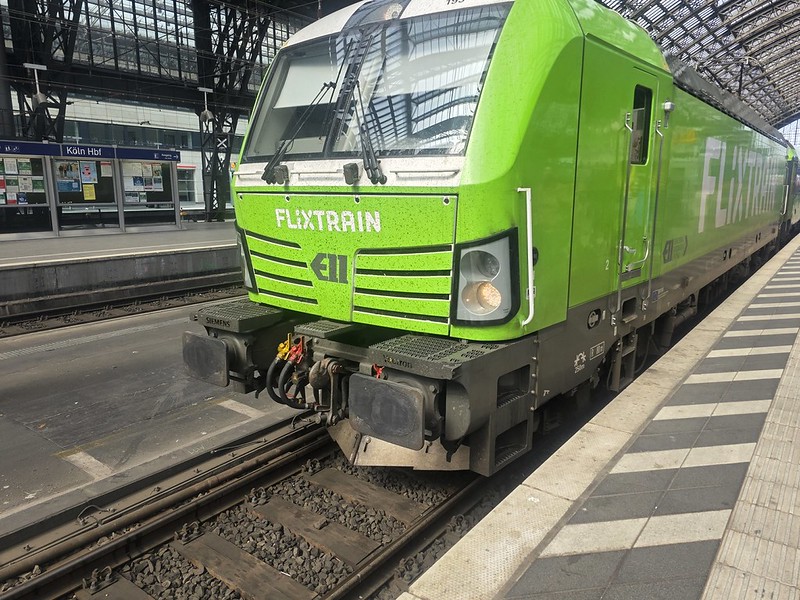
And here comes the FlixTrain storming into the platform. I’ve taken many FlixBus journeys, but this is the first version by train. I’d note that the prices were low, this journey cost under £10. Trains in Germany are generally cheap as it’s possible to pay £60 a month and then get unlimited free local travel on trains, something I’d love to be introduced in the UK. This FlixTrain isn’t included in that offer as it’s a private operator, but they made lots of clear announcements about that.
Everyone is given a seat, although passengers can change it on the app, and mine was in the front carriage. Unfortunately, that was quite a way from where I was standing, and there were quite a lot of passengers shuffling along to the appropriate place. I meandered slowly, there were some passengers that seemed entirely panic-stricken by the whole process.
The interior was spacious and everything was clearly signed.
The train wasn’t that busy and there was no-one in the window seat for the journey, so it felt spacious. There were no power points, but the seats were comfortable enough.
I was impressed that there was enough space to use my laptop, it’s often the situation on trains where the tray isn’t wide enough or the seat pitch doesn’t allow it.
A photo of the carriage with its wavy ceiling.
We arrived into Dortmund 35 minutes late, but I’m used to lengthy delays on the German rail network.
And the outside of Dortmund railway station.
I was impressed at the whole arrangement as the booking process was easy and used the same app as the bus service. It was clear where to get the train from, the seating options were easy to understand and the pricing was firmly towards the lower end of the scale. I’d certainly use this again and I hope that FlixTrain continues to expand their operations.
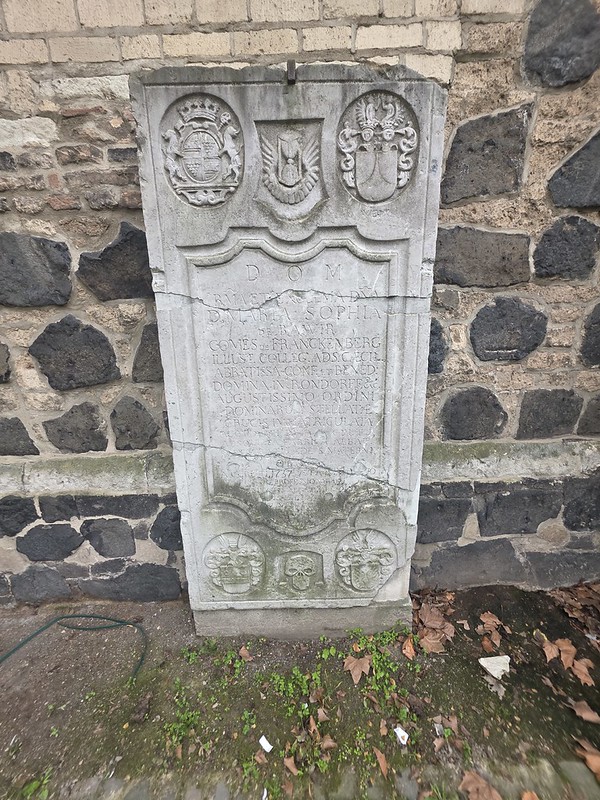
Located outside of the museum is the gravestone of Maria Sophia Bawyr von Frankenberg (1667-1737). It reads:
“To God, the Best and Greatest. The most reverend and most excellent Lady, Lady Maria Sophia de Bawer, Countess of Frankenberg, confirmed and blessed abbess of the illustrious collegiate church of St Cäcilia, Lady of Rondorf etc., enrolled in the most august Order of the Ladies of the Starry Cross. After increasing divine worship, completing the abbess’s building works, and restoring the church of St Maternus, she died in the year of Christ 1737, aged 70, after 52 years in religion and 24 years in the dignity of abbess. Rest in peace”
I often take photos of gravestones, as I don’t get out much, to try and understand something about who they commemorate. Usually when I’m overseas it’s something of a forlorn exercise as I can’t work out anything about them. But, this is a little different as she has her own Wikipedia page, albeit only in Germany.
A countess by birth and abbess of the collegiate church of St Cäcilien in Cologne (which is where this museum now is), she was also Lady of Rondorf and a member of the Order of the Starry Cross. She sounds quite decadent and rich…. She came from a large family, she had five siblings and five half-siblings, with two of her full siblings being military generals, which must help in feeling more safe and secure in life.
Her memorial inscription makes clear that she took her responsibilities seriously and it credits her with increasing divine worship, completing abbey building works and restoring the church of St Maternus (which still exists), which is a fairly respectable administrative record for anyone. The stone has become a little smashed up over time, but it has been repaired although perhaps the museum could put a little information panel by it.
I’ve used AI in the past to try and add colour to usually wooden statues which have limited evidence of their past polychrome look. It often makes it look colourful and that is in keeping with what I’ve seen in wider imagery.
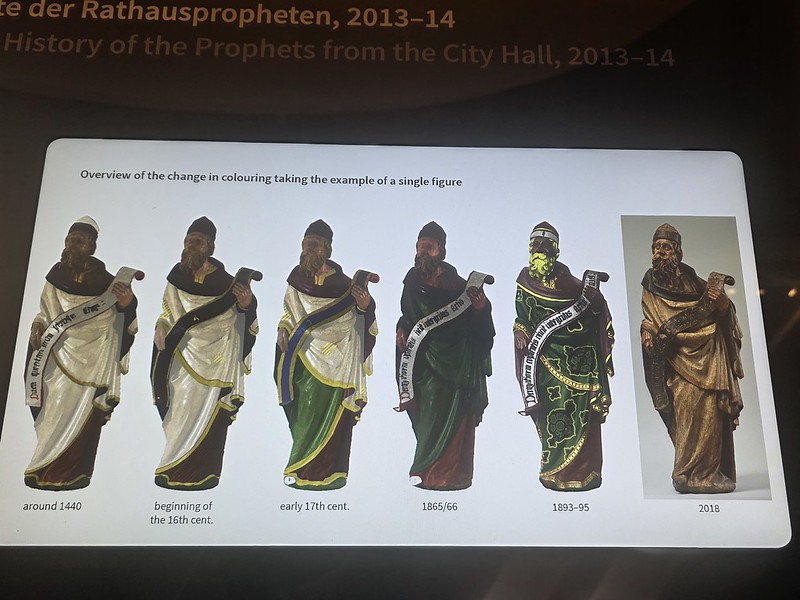
This screen in the museum shows the evolution of how the figures in their collection were painted. This shows a much more pure and white look back in the medieval period towards more colour recently, although goodness knows what happened between 1893 and 1895.
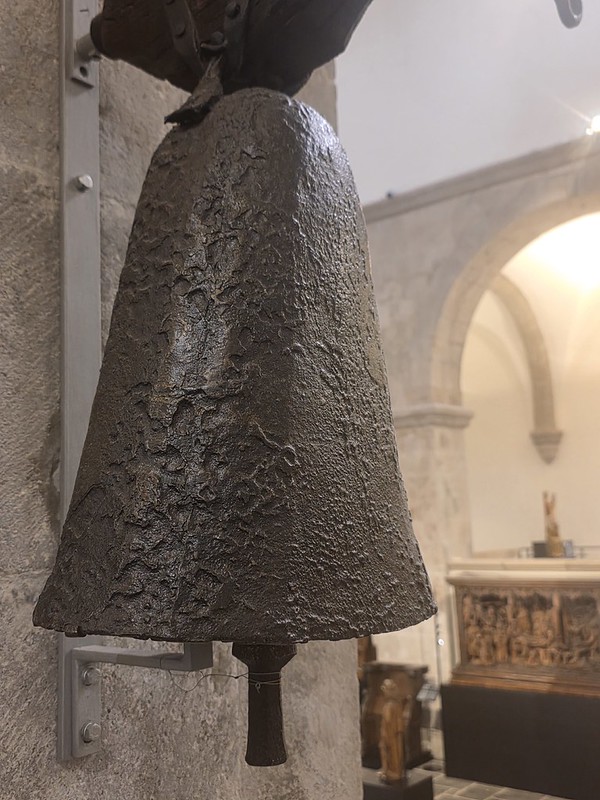
This is an under-stated little number, it’s a bell which happens to be one of the oldest surviving in any German speaking country. It’s thought to date from around the early part of the ninth century and it’s made from three pieces of forged iron which have been smoothed and then riveted together.
The bell is nicknamed ‘Saufang’ which means ‘pig’s catch’ as it is rumoured that it got buried in a nearby pond and was discovered by a pig. As with many of these rumours, it’s likely made up, but it’s a nice story.
However, what I think is the most exciting thing about this bell is that it is from this church (what was then the Convent of St Cecilia which was founded in 888), or at least, the religious building that was here before. It left the church in the nineteenth century, but now the building is used as a museum it has made its way back here indirectly. I very much like this circle of history and there’s no better place for the bell to be today.
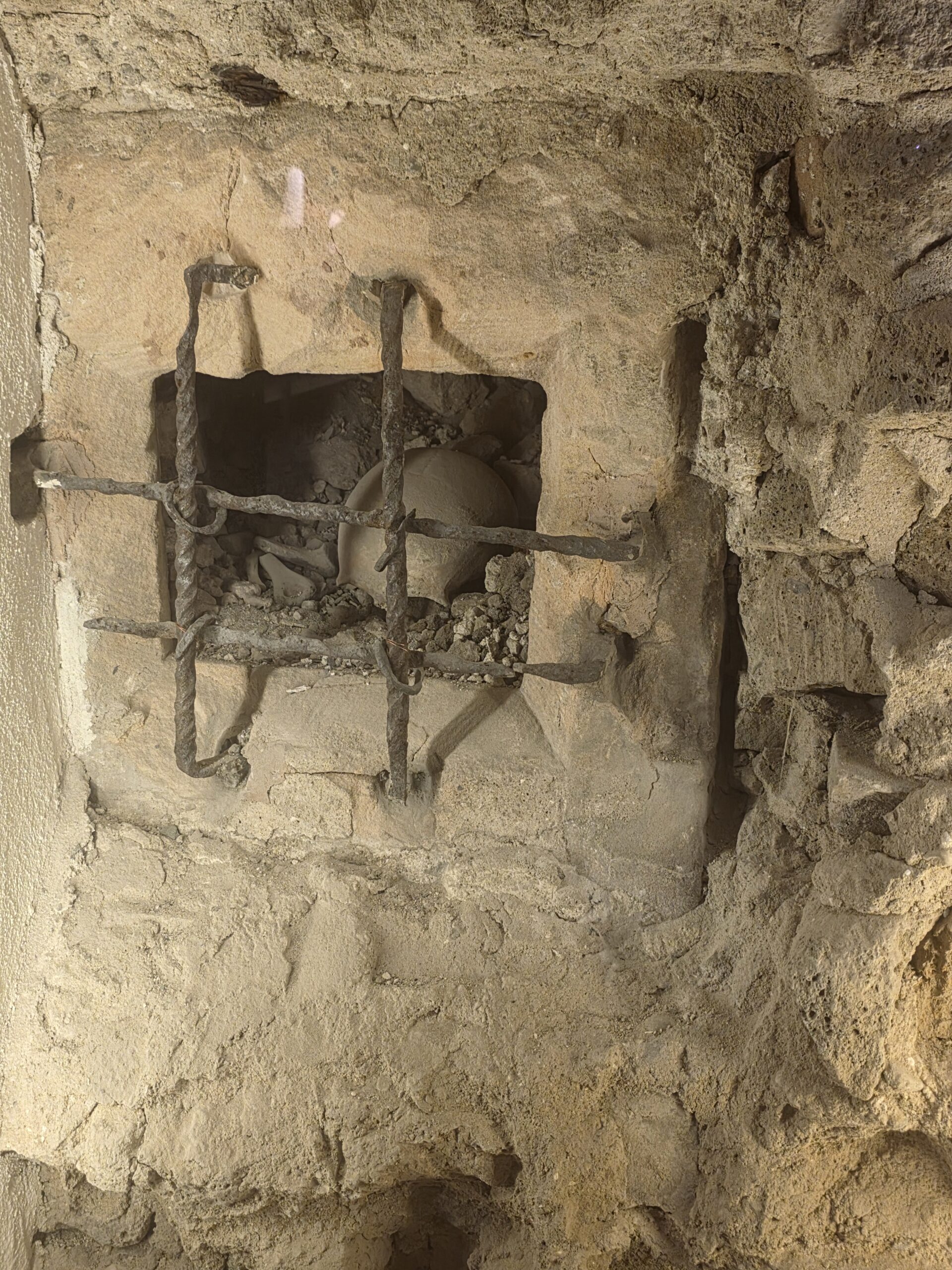
This felt mildly unsettling when walking by it, namely a skull tucked away in the stonework. According to the museum display, this may originally have formed part of a cell like hermitage. This would have been the home of an anchoress, a female enclosed beside a church in order to renounce the world in a very literal and rather committed way. She would have lived for years in what was usually a single stone room attached to the side of the church, with the shuttered slit allowing her to receive communion and be able to be involved with services. I don’t think I’d like this, it would play havoc with my travel plans.
The information panel notes that these recluses were normally higher ranking people (as someone who have to be paid to bring them food), and that as many as fourteen such cells are documented in Cologne between the twelfth and fifteenth centuries.
It was only discovered in 1976 and the skull is likely not linked to the hermitage, this dates to the seventeenth century when the area was reworked to be a burial vault for the Augustinian canonesses who were operating the church.
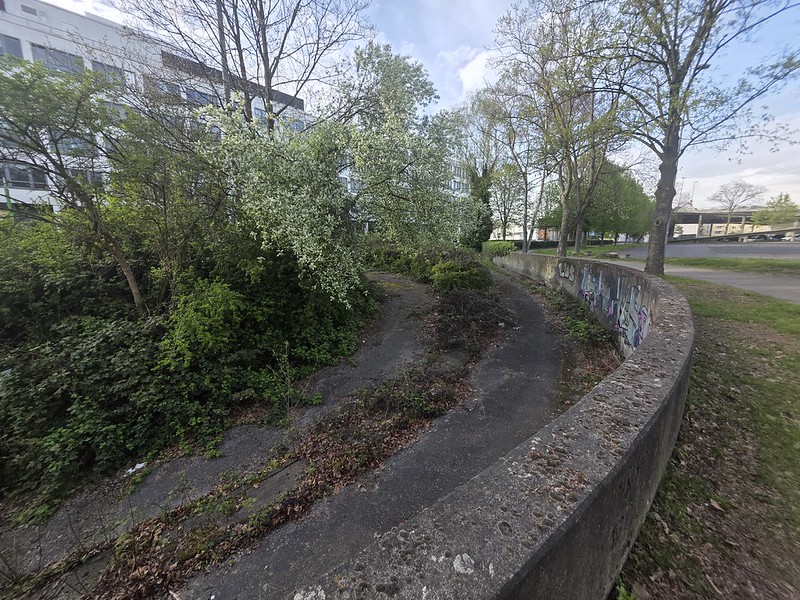
This is one of my more irrelevant posts, although sometimes I wonder if any are actually relevant, but it’s an abandoned car park in Cologne. I wasn’t brave enough to explore it as I’m hardly going to be an urban explorer, but I like how quickly nature can take over.
It’s located on Deutz-Mülheimer Strasse and I’m pleased to say that they have closed the entrance from the road off as we all know someone who would otherwise drive down it….