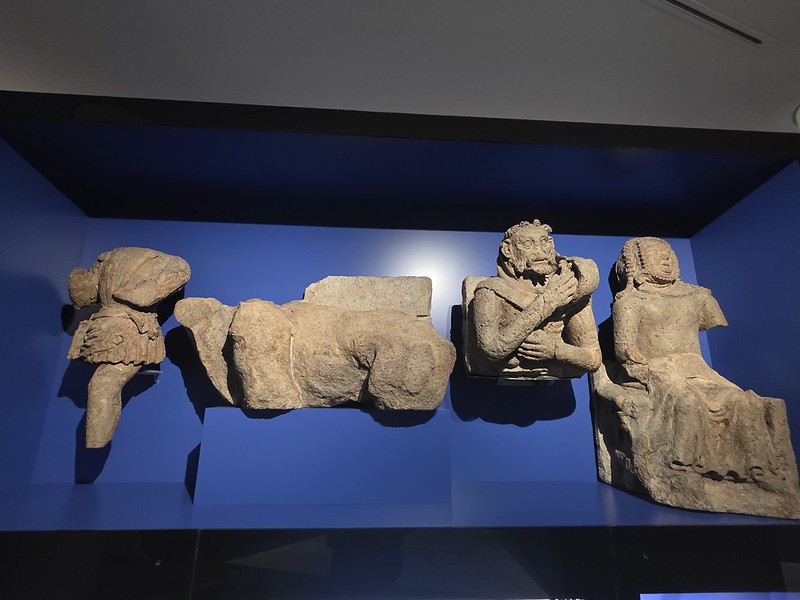
The museum noted that the butchers in Cologne were quite rebellious during the Middle Ages. They refused to sell meat by the weight and ignored many of the demands placed upon them by the authorities. The butchers held some significant power in the city, being one of the early guilds.
The set of sculptures in the above photo are from the city’s former meat hall. They were made after 1372 and there is a butcher on the left, then an ox led by a farmhand, a farmer and then the farmer’s wife dealing with the money. The Fleischhalle in which they were located was demolished in the early twentieth century, so that’s at least one building that the British didn’t bomb.
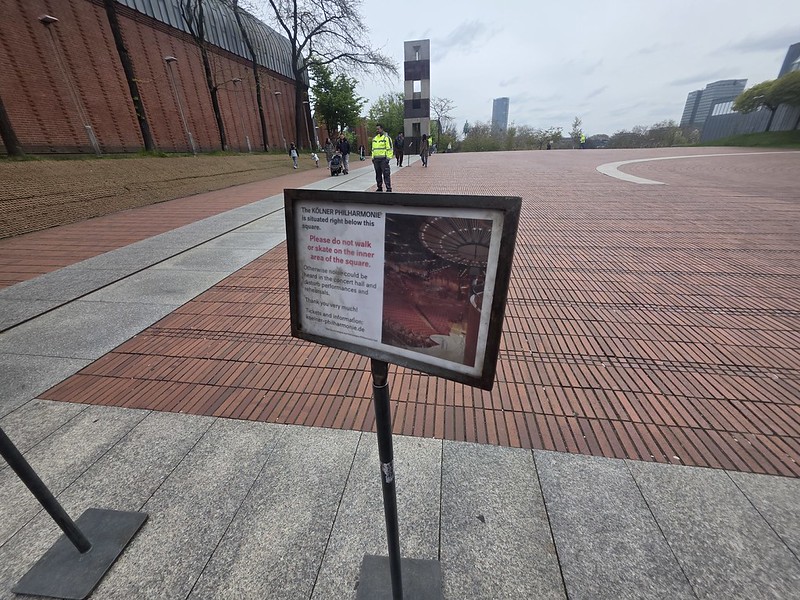
This is the public square above the Kölner Philharmonie, a concert hall that was opened in 1986. The design was apparently revolutionary, the hall has no columns, the sound is meant to be perfect and it has a near perfect room acoustic.
It all looks quite a nice place to stand, but there are security guards standing around it to keep people off it.
Those security guards are there to keep people off the square as anyone walking on it can cause noise disturbances for those in the concert hall. So, when performances are taking place, which seemed to be every time that I walked by, they have to pay staff to keep people away. Was this really the best way to design this?
The story of Brauhaus FRÜH am Dom begins in 1904, when Peter Josef Früh established a brewery and tavern in the shadows of the city’s cathedral. It has since become something of a tourist destination and it’s one of the largest brewery taps in the country. The buildings were badly damaged during the Second World War, but the cellars remained and they were able to rebuild relatively quickly.
I’d add now that this isn’t really entirely my thing, it’s a beer style that I don’t much rate in what feels like a pile it high sell it cheap type approach. That’s great and I wanted to experience it, but I was never sold on it. There were countless rooms leading off from each other, some looked like larger dining rooms but I was seated in this section which had a bit of character to it. Well, it was a bit dark anyway and I like that.
The place is huge and I was directed to a table by a slightly gruff, but not unfriendly, server. He took my order and only looked slightly annoyed that I checked in advance if I could pay by card. More on how the cash only model is falling away in Cologne in another post though, I won’t get distracted with that here.
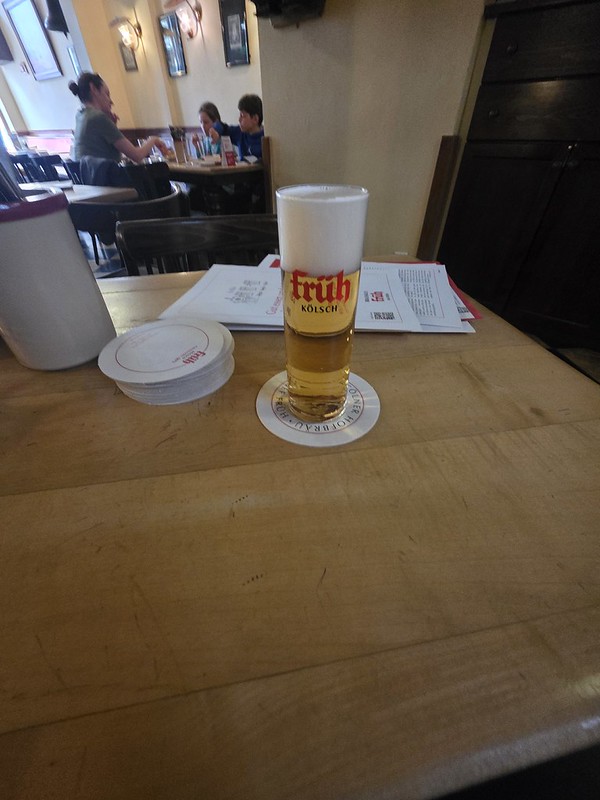
The local beer style is Kölsch, a top-fermented ale that is finished with cold maturation like a lager. I was amused that the city’s museum states that the glasses are like this as the beer gets stale very quickly otherwise, which doesn’t really excite me in a drink. As a beer, it hasn’t burdened itself with flavour, taste or depth. But it’s cold and crisp.
The beer is served as 0.3 litres per glass as standard, they then mark off on the beermat how many drinks have been consumed. I went for two, even though that breaks my Untappd rule of rarely having the same beer twice in one place, just to add some excitement to the proceedings. I did the thing of putting the beermat on the top of the glass when I was finished.
The service was efficient and routine, I was quite content with the value of the whole arrangement. But, the service for others seemed a little more brusque, the server managed to have a slight argument with two of the four tables that he was serving. One of the tables was a group of American tourists who said they wanted to sit by the window and the server didn’t want them sitting by the window, but I quite enjoyed watching the awkward manner when he took the order with everyone being a bit annoyed.
The general reviews for the place are decent, although the service element gets just a 2/5 on Google which is really quite low. But it’s just such a high turnover place that I can see that the servers just want customers served quickly rather than have endless conversations with what mostly seemed like tourists.
The food was quite expensive so I limited myself to the beers and they have kept the price of those moderate. The cost of the two beers was €5 and the server didn’t try and charge a tip, which seemed a little unusual but perhaps he thought I looked grumpy. Numerous reviews mention that the servers have to give some of their tips to the kitchen, but perhaps they focus on those eating food rather than having two beers. I didn’t try and visit the toilet facilities, but it seems that the attendant expects payment for using them. Imagine JD Wetherspoon trying that….
It was an interesting place to visit, but it felt like a bit of a tourist trap to me rather than being anything authentic. For anyone serious about beer, there’s the relatively nearby Tipsy Monk bar which was operating to a very high standard of customer service and they also had the same Früh Kölsch beer on draft for those who want to try it.
The city’s history museum is located over four floors and I thought it was able to present Cologne’s heritage in an interesting manner. And that included the period in time when Cologne was under French occupation between 1794 and 1814. Although it might now have always felt inevitable that this period would come to an end, that’s a lengthy period when much about the city was changed. That included the introduction of waste collection, street lighting, religious freedom and also house numbers. There’s certainly something to be said for the Napoleonic code….
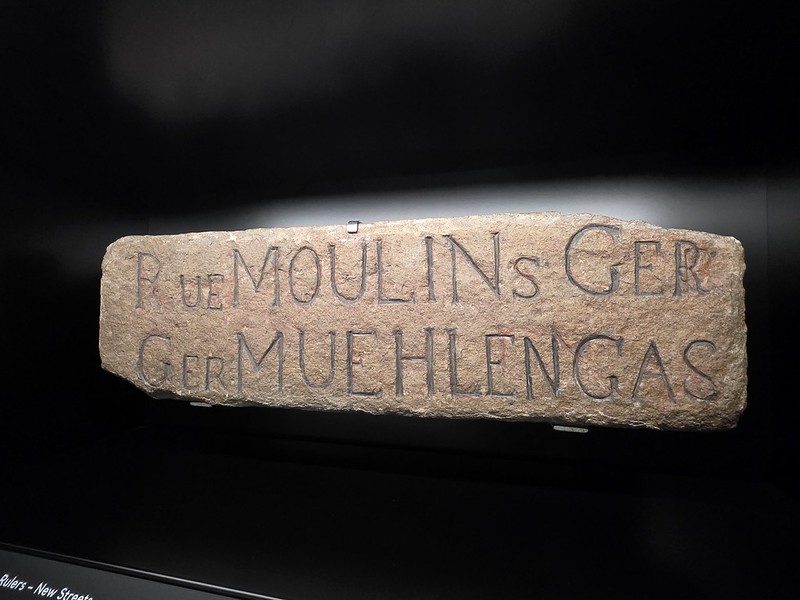
This street sign was from that period of French occupation and it dates to 1813. What was Gereonsmühlengasse became Rue Moulins Gereon, so no change of meaning, it meant something like St Gereon’s Mills in both languages. The street is still there today, although evidently the damage caused during the Second World War has given it something of a different look.
The city’s history museum was comprehensive and interesting, so there will be plenty of posts about this. Once again, the anticipation…..
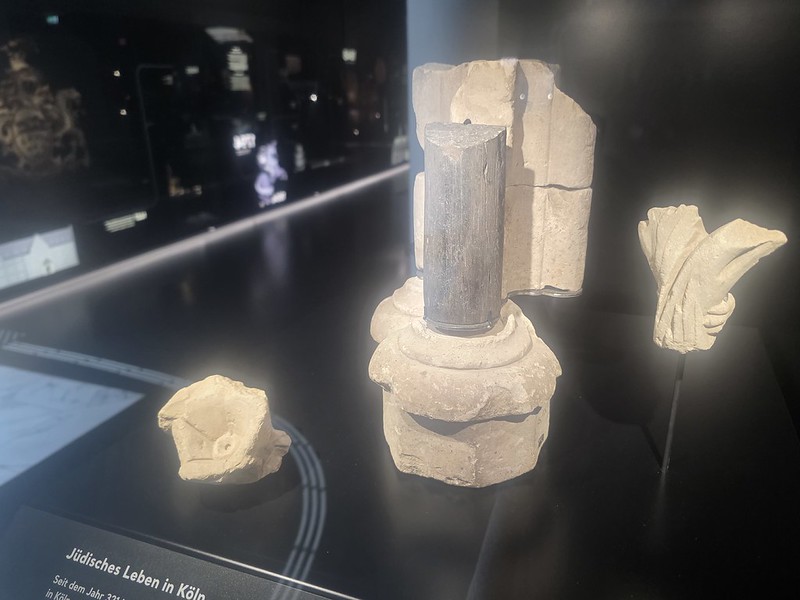
These are remnants of the synagogue that was built in the city in around 1280. The Jewish community was first recorded in Cologne as early as 321, so this wasn’t some group of people who randomly turned up in the city.
The synagogue that was constructed was decorative and there was some sharing of stonemasons with Cologne Cathedral, an early inter-faith project going on. However, the Black Death took hold and in 1349, the citizens decided that this must have been the fault of the Jews, so they smashed up their synagogue. The city authorities were powerless to stop the violence, with many kills and tens of residential properties destroyed.
A small Jewish community reformed in 1369, and they must have been quite brave, but in 1424, the Council of Cologne expelled them permanently. It wasn’t until the end of the eighteenth century that the Jews were allowed to return once again.
The bits of stone that have been recovered during an archaeological dig are quite powerful in that sense that the Jewish community were likely quite positive when building the synagogue in 1280. But, the persecution of the Jews has been quite relentless in Cologne, not just with the Second World War, but also attacks on the newly reopened synagogue in 1959 and at the Jewish cemetery in 1983.
I’ve visited a fair number of museums during my time in Cologne (I’m writing this on my last night here and once again this bloody blog is behind) and I spent some considerable time in the cathedral, so I have several things to witter on about.
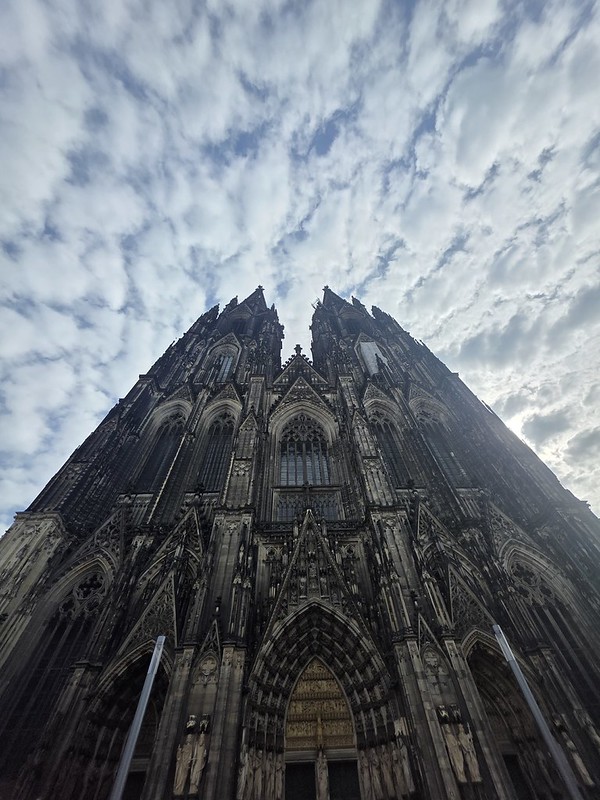
This cathedral has a complex history, although that is just about always the way with structures such as this. I found an online book about the history of the cathedral, so I have read in huge detail now about how the building came together. Hence why I mentioned the wittering that is to come.
Condensing that detail down, there has been a church of some sort here for centuries. Then, as is usual, there were substantial construction efforts and expansions during the medieval period when the finances were very favourable. Then, in 1528, construction work came to an end as the money ran out.
This little stop in construction work was not just for a brief moment, work was not started again to complete the building until the nineteenth century. Chunks of the religious infrastructure were destroyed over the centuries and when, in 1794, the French revolutionary troops reached the city, they burnt all the wood in the nave and turned the building into a grain storehouse.
The Prussians took over Cologne in 1815 and they wanted the cathedral finished. They didn’t take long to start planning and the funds were ready by 1823, although it took until 1840 for the work to actually start. There were no medieval plans remaining, so they had to start reworking what they had into a finished product.
And, in 1880, the work was completed and Cologne had its finished cathedral. Work was needed in the early twentieth century as the stone weathered so quickly, but all was well. Until there was a little issue with the Second World War. Although much of the city was destroyed, and the cathedral was damaged, the bulk of the building survived unharmed.
There is constant work going on to repair past damage and ongoing efforts to deal with the weathering of the stone. There’s a stone workshop on site and it’s said by the cathedral that the scaffolding will remain up somewhere on the site as there is constant work to do. One of the sayings in the city is “when Cologne cathedral is finished, the world ends”…. And that would be just typical for the cathedral authorities if they did ever finally complete the work and that happened.
The signage at Cologne Bonn airport was broadly pretty poor and the only other airport that I’ve experienced this is at Berlin Brandenburg. Between the plane and arrivals, I was following other passengers and they, including different people, went wrong on three occasions. Now, I go wrong a lot when I get muddled up, but there was mass confusion here. Well, maybe I exaggerate mass, but it adds to the drama. I suspect that people don’t tend to much think about good signage that’s been well thought out, because they just naturally follow it and get to where they want.
Either way, things didn’t much improve after getting into the arrivals area. In the above photo, there is a very difficult to see sign for the S-Bahn but you’d never walk down that bit as there are barriers, the passenger route is to the right where there is no signage. But, I’m an experienced walking route navigator, so I had a plan to just keep going and I was confident I’d end up somewhere. Maybe not where I wanted, but I’d end up somewhere.
Fortunately, I managed to find the railway station without going wrong, although it was further away than I had anticipated.
And finally nearly there….
There’s the one that I want, the 22:54.
The platforms were longer than I had anticipated when I saw the trains in the distance.
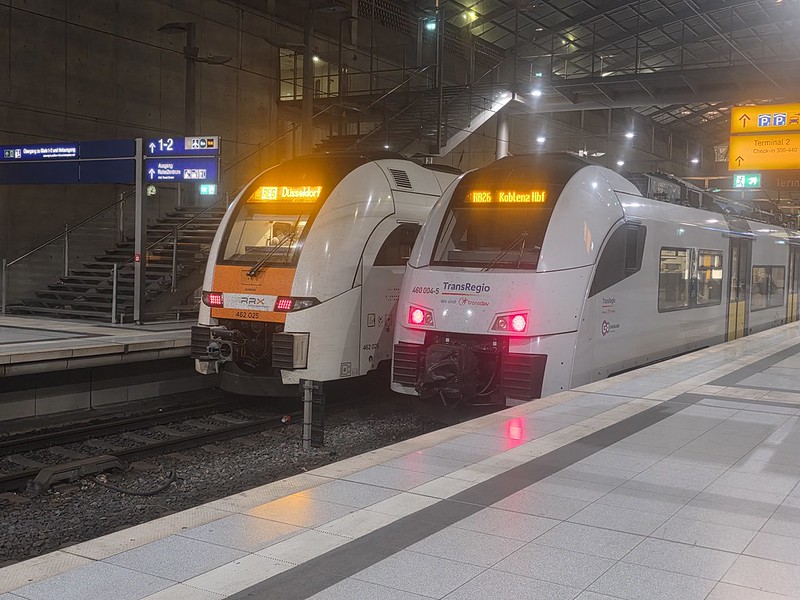
That’s the 22:32 train to Koblenz on the right and by this time, it was 22:39. I realised I could get that delayed train, so I decided to get on it.
It all looked mostly clean, there were power points and I thought this was working out. The train evidently wasn’t going anywhere fast, but I am a very patient person. For two or three minutes anyway. Then there was an announcement at 22:54, some angry faces and 90% of people got off and boarded another train.
They boarded this train, the one I was originally meant to be on originally, so I joined them as part of the passenger stampede. Of course, the train we were all on then promptly left and there were some angry German words used by a few passengers that I didn’t entirely understand.
I can’t remember the last time I saw anyone with their feet on the seats in Poland. In the UK and Germany, it’s a different matter. Not that I go on about these things.
For added excitement for passengers, some of the doors didn’t work. But, all was well, I was able to get off at Köln Messe/Deutz railway station and walk to the hotel.
In terms of the ticket, there were two ticket machines at the airport railway station that I saw, but both were in use. That didn’t impact me as I had decided to buy my ticket online as there was a small discount, so I paid €3.68 on the KVB app. It was relatively easy to purchase as most sections of the process, although not all, were in English.
I had taken the train earlier on in the day to get to the centre of Bucharest, but I decided to get the 100 bus back again to the airport. It costs around 60p and it’s easy to pay as it’s contactless. There’s my bag, looking nearly new.
I think what this sign was saying was:
“100 years since the presentation on 16 October 1910 at the Aeronautical Salon held at the Grand Palais in Paris of the Coandă-1910, the world’s first jet aircraft, without a propeller, powered by reactive propulsion, invented and built by the Romanian engineer Henri Coandă (1886–1972).”
Rather splendidly, the snack sign has managed to obscure the key bit, which is perhaps not quite what memorial plaques dream of when they imagine posterity.
I waited landside for a little while and there was minimal seating available, but they had a restaurant area that was not proving popular judging by the lack of customers. I’m not entirely sure they’re made clear what the offering is here, other than some generic beer.
It was time to head to security and I was through in a few minutes. The passenger in front of me had a two litre bottle of water in the side of their bag, I’m pleased to say that this was noticed and removed from them.
Mine was the 20:25 flight. There are no Priority Pass lounges in Bucharest, but I found a quiet spot to sit and treated myself to a £1.60 bottle of Fanta from the vending machine. Well, once I had worked it out, I find vending machines often quite complex and I rarely use them.
A view out of the window of the terminal. I had some time to do this whilst meandering around.
Safely at the gate. I decided to break my usual norm of boarding early to board towards the end, not least as I was sitting by a power socket and wanted my phone fully charged. Boarding towards the end feels a little more exciting, there was some tension from angry customers who couldn’t get their bags to fit in the sizer. One customer pushed his bag in so hard that he couldn’t get it out, but the friendly gate agent helped him, although the wheel from his bag went flying.
The seating Gods had given me a middle seat and I thought that I was lucky as no-one sat in the window seat by the time that the aircraft doors were shut. Then someone comes and takes the seat, but he asks me if I would move back ten rows and swap with his brother who had the window seat.
I said that it was a bit late, as we were about to start taxiing down the runway, but I would move after take-off. As the man in the aisle seat was annoying me by stretching his elbows and I have limited patience, I suggested moving immediately after the seatbelt lights were turned off. The guy in the window seat seemed pleased and he went with me to where his brother was sitting.
I sort of got the impression that this was like me moving my friend Liam from his window seat to sit with me in the middle seat. The brother didn’t look thrilled to move from a window to a middle seat, he left his water and he looked confused. Whether or not the two brothers were happy, I don’t know, but I didn’t care, I had a nice window seat. And that’s Budapest in the photo.
The aircraft was HA-LXW and we didn’t just fly over Budapest, we also flew over Bratislava. This is yet another aircraft that I haven’t been on before, although it has been in service since 2017.
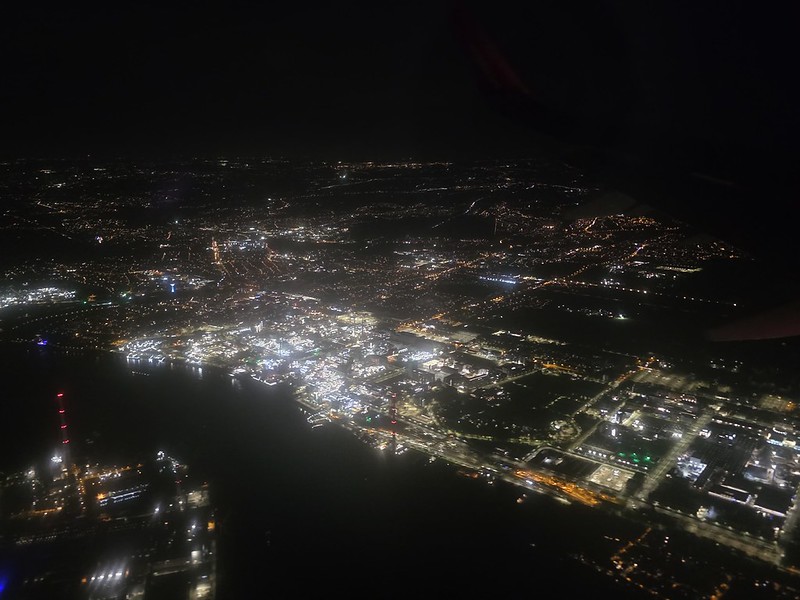
We flew over Cologne before landing so I got to see the city from the air and it’s the first time that I’ve been here.
And safely into Cologne. We were on time and I was once again pleased with the flight, which had cost me £9. The crew were personable, the service was efficient and the aircraft was clean. The consistency really does impress me with Wizz Air and it won’t surprise anyone (not that anyone is likely to much care) that I intend to fly with them again.
[I originally posted this in July 2018, but have reposted it to fix the broken image links]
Needing to get from Gdansk to Luxembourg in just over a day didn’t give me many affordable options. I tried to get a Ryanair flight, but there were no direct flights anywhere near, but there was the option of getting a Wizzair flight from Gdansk to Cologne and then a Flixbus from Cologne to Luxembourg. So it was a first experience of both Wizzair and Flixbus for me….
The booking process was easy to manage and surprisingly efficient, which is always reassuring. So reassuring was the process that I decided to join the Wizz Air Discount Club, which for an annual fee gives extra reductions off the price of every flight.
Quite understandably, there are strict rules about not taking photos of cabin crew on most airlines, and I noticed Wizz Air point that out in their literature. Hence why this photo is side-on of the nearby seats, rather than of the entire cabin. The seat design doesn’t feel very modern, but the cabin was clean and tidy, with the seats being sufficiently comfortable.
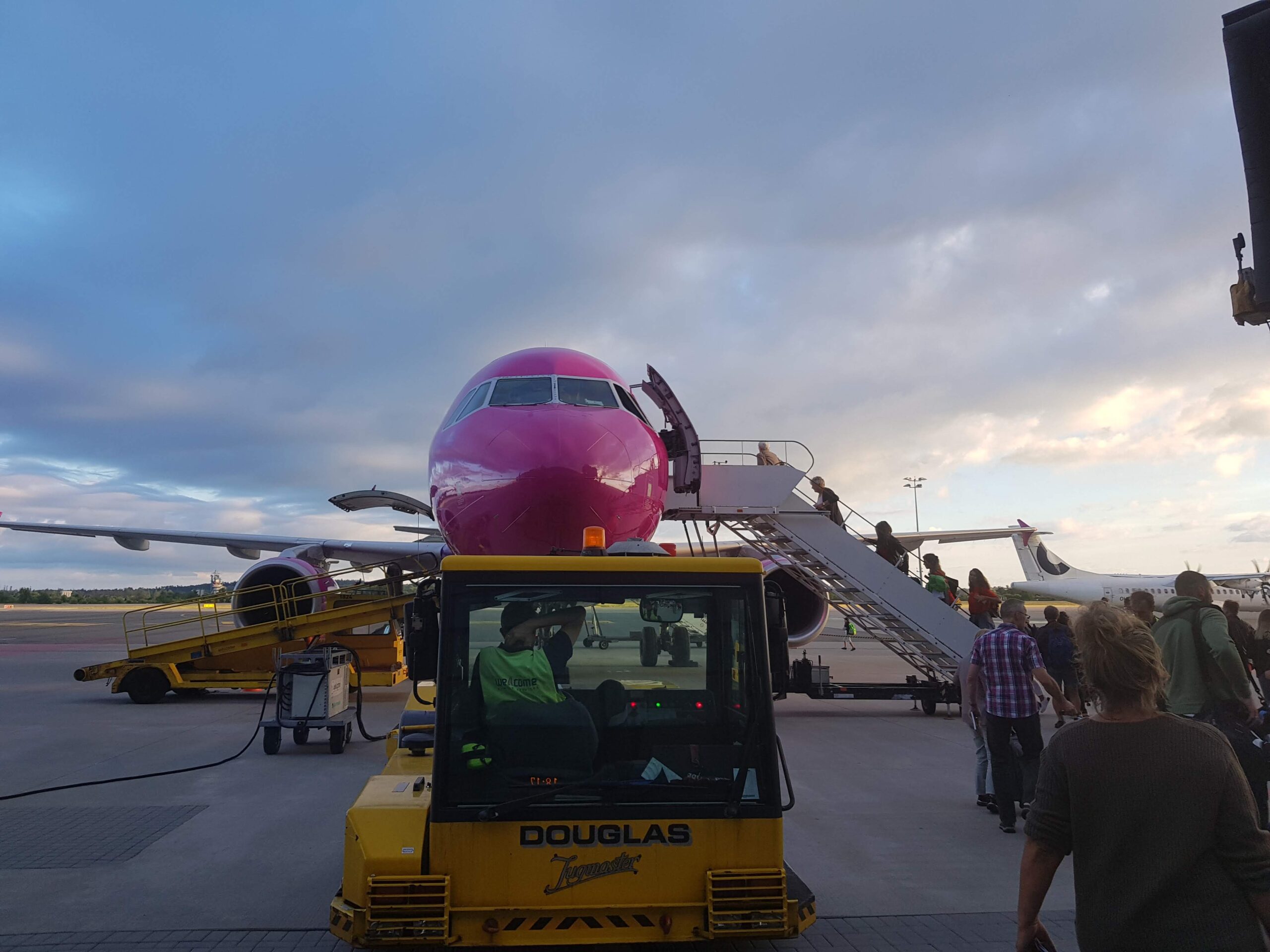
The boarding arrangement is very much like Ryanair, so it’s efficient, via steps and involves standing on the steps down to the tarmac for ages. But, the efficiency pleased me, everyone knew where they should be and when.
The food and drink was all reasonably priced, and approximately 25% of customers ordered at least something. The price of noodles is the same as coffee, and I thought that this would be more filling. It’s what I like getting on Amtrak in the US, and they were perfectly acceptable at €3 (around £2.60).
The selling frenzy from the cabin crew wasn’t quite as bad as Ryanair, with fewer passes down the cabin and that made it feel slightly more relaxing. However, there were still numerous different items for sale, so it wasn’t entirely peaceful.
Overall, I felt that the entire operation seemed efficient and the staff were all polite and helpful. The flight was pretty much punctual and although the surroundings weren’t exactly luxurious, they did represent excellent value for money on this occasion. I’m sure that I’ll fly with Wizz Air again soon based on this experience.