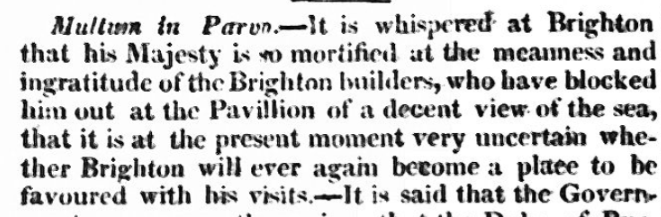
Another article in the Norwich Mercury of 200 years ago this week. Now, I accept this has little to do with Norwich, but it’s some early form of royal gossip of which there has been plenty more over the last 200 years. The story is likely true, as King George IV made only one more visit to Brighton following this story and he had made huge efforts to make the Brighton Pavilion a decadent and suitable home.
Its future as a residence for the Monarch was already reaching its end. King William IV did use it, but Queen Victoria wasn’t that surprised and delighted with it, so she sold it to the City of Brighton in 1850.
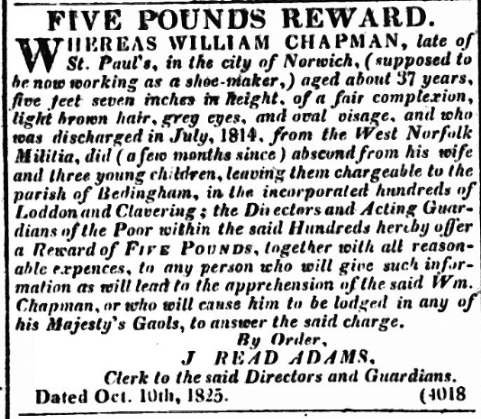
And another in my series of articles in the Norwich Mercury of 200 years ago this week. Back in 1825, if a man abandoned his wife and children without paying any support then he would face consequences from the local parish. Under the Poor Laws and Vagrancy Acts, if his deserted family became chargeable to the parish, local overseers could apply for his arrest and he could be punished as a rogue and vagabond, facing imprisonment or hard labour. The law’s primary concern was protecting the parish purse, not enforcing domestic responsibility, so prosecution generally occurred only when abandonment led to public expense as was the case here.
The £5 reward was a generous one, that’s worth over £250 in today’s money. The village of Beddingham is around ten miles south of Norwich and it’s clear that they were displeased that they were left funding William’s wife and children. It’s an interesting snapshot of the benefits system of the time, which did ensure at least that women and children were looked after.
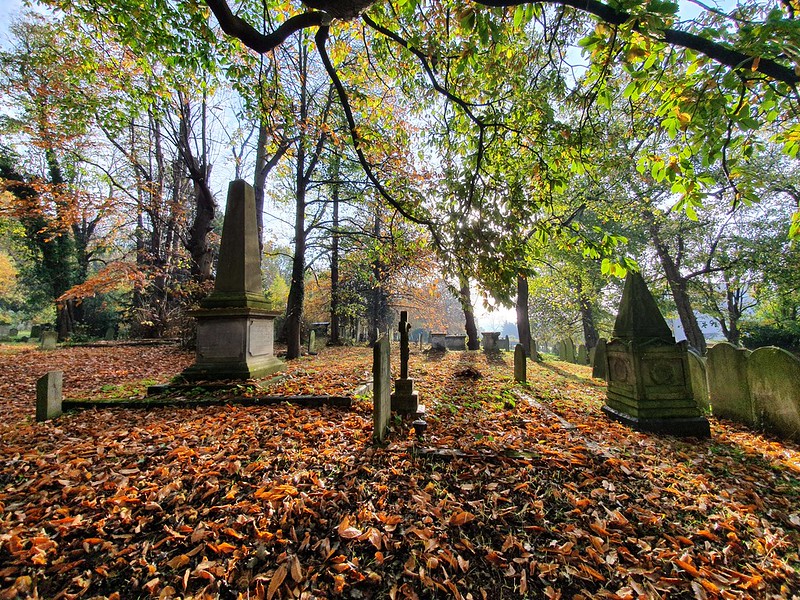
And in my continuing series of posts from the Norwich Mercury of 200 years ago this week, there was an announcement about the extension of Rosary Cemetery. The cemetery was the first non-denominational one to have opened in the UK, with the first burial taking place in 1821.
The shareholders had met at the Old Library Room at St. Andrew’s (now demolished) and they were pleased at the progress made in the first few years of the cemetery’s operation. The first few years hadn’t really stressed the gravediggers (although it made it easier to guard against body-snatchers), as there was one burial in 1821, two burials in 1822 and three burials in 1824 (goodness knows what happened in 1823).
The decision made 200 years ago was very sensible as although their priority was actually keeping the church out of their affairs, there was to be a cholera epidemic in 1831 and the land at Rosary Cemetery was a useful overflow to church graveyards. And, in 1855, after a major national cholera epidemic, all new burials in churchyards were banned. The original five acres were filled by the end of the nineteenth century, so the additional land they had already acquired proved to be very useful.
“ROSARY BURIAL GROUND, NEAR THE FOUNDRY BRIDGE ROAD.
At a MEETING of the Shareholders, held at the Old Library Room, St. Andrew’s, Norwich, on the 22nd of September, 1825:
MR. THOMAS MARTINEAU in the Chair, Statements of the number of Interments since the appropriation of the Ground as a Public Burial Ground, and of the number of Shares engaged by individuals, having been read by the Registrar,
IT WAS RESOLVED, That the Rosary, from its situation and the extent of ground belonging to it, is admitted to be well calculated for a permanent Cemetery, for persons of all denominations, and will be found of great benefit and utility.
That from the number of Interments which have already taken place, and the number of Shares engaged, it is expedient the proper measures should be adopted for permanently establishing and securing the whole of the ground originally proposed for a Cemetery, without further delay.
That the Solicitors be instructed to prepare forthwith the requisite deed or deeds, to be enrolled in Chancery, for vesting the Rosary Burial Ground in Trustees, to be held as a Public Place of Interment for ever, subject to the management of Directors, to be chosen from among the Shareholders.
That notice be given, that applications for Shares remaining undisposed of must be made on or before the 27th day of October instant, on which day the list shall be closed.
That applications for Shares be made to the undermentioned Shareholders: to Mr. Drummond, at the Rosary; or to the Solicitors, Messrs. Parkinson and Staff, St. Andrew’s, Norwich, of whom prospectuses of the plan may be obtained gratis.
Mr. Thomas Martineau John Taylor Joseph Geldart Wm. Davey Thomas Hitchen John Athow Robert Blake, jun. Wm. Wilde J. Darken R. Miller Samuel Wiseman J. Mottram, sen. E. Cotman J. H. Balls G. Sothern Wm. Newson Thomas Hawkins Henry Bolingbroke George Kitton
Mr. Isaac Wiseman J. Mottram, jun. Wm. Busley Manning E. Martin Hewett Rev. F. Tagart Mr. Wm Chapman W. Stark G. Grout C. Geldart Wigham E. Brown Carter Bluth R. Morgan Joseph Geldart, jun. N. Rue”
In my erratic series of posts from Norfolk newspapers 200 years ago this week, I noticed that the King’s Arms in Great Yarmouth was being advertised for sale in the Norwich Mercury. The text reads:
“KING’S ARMS INN, Great Yarmouth.
To be Sold by Private Contract,
All that Old-established and well-known INN, called the KING’S ARMS INN, with 3 Cottages adjoining, situate near the North Gates, in Great Yarmouth, in Norfolk, now in the occupation of Mrs. Mayhew, with good arched Wine and Beer Cellars, extensive Yards, Stabling, Standing for Carriages, &c. &c.
The above Property has long been distinguished as being one of the best situations for an Inn in the borough of Great Yarmouth.
The Estate is all Freehold, and the only out-going is an annual Land-tax of £2.
N. B. — An excellent Weighing Machine for Hay is attached to the Premises.
For price and further particulars apply (if by letter post-paid) to Mr. Samuel Sherrington, Priory, Great Yarmouth, or Mr. Miller, Union Office, Norwich.”
I rather like that this pub is still there, although it was mostly rebuilt in the early twentieth century and then had to be repaired after extensive damage during the Second World War. To this day, the pub retains its large beer garden and I visited it a few times during the partial lockdown a few years ago.
Here’s what it looked like at the turn of the last century, the area to the left has nearly all been lost, but the area around the pub remains looking pretty similar. Mrs Mayhew, who was mentioned as the landlady in the advert, remained running the pub until 1830 and it was up for sale a couple of times in the years that followed so it’s possible that it never actually sold.
In a newspaper article in the Norwich Mercury from 200 years ago this week, it’s mentioned that the death of Joseph Christmas, aged 17, was confirmed. The news had come from Port-au-Prince, which is today one of the most dangerous cities in the world and nearly entirely controlled by gangs. This likely wasn’t his destination, he was on a merchant ship where he died during the travels.
Joseph Harmer Christmas was born on 19 May 1809 in Great Yarmouth and was baptised the following day, which seems to be rather efficient. He was the son of John and Honor Harmer Christmas and here’s the will of John. On the surname, it’s relatively rare and its origins are unclear although there’s more on a Wikipedia page about the matter. What intrigues me more is what the 16 year old (the newspaper article got his age wrong) was doing off in the then British West Indies, his family didn’t appear to be wealthy enough to be involved in owning plantations, although they did seem reasonably well connected. Yet another mystery that maybe one day I’ll be able to solve to my complete satisfaction….
In another of my exciting (or something like that) posts about articles in the newspaper from 200 years ago this week, this is the court record of when John Atkins went to court.
“John Atkins, for breaking into the dwelling-house of John Seaman, of Tasburgh, and stealing a gold ring and about 40s. in cash. – This case was very similar to those already given: The prosecutor having left his house safe when he went out; on returning found it broken open, and suspecting the prisoner, caused him to be apprehended, who (when taken before a magistrate) confessed the charge. Guilty-sentence of death recorded.”
Even the article notes that this is just one in a series of judgements from the same court which routinely led to the execution of the prisoner. It’s really quite evident that these death sentences weren’t much of a deterrent and that crime was running at high levels. It seems that John Seaman likely already knew Atkins, given that he suspected him of the crime. John was though in luck, as on 31 August 1825, it was decided that he would be pardoned and his sentence commuted to transportation to what was referred to as “the new colony” of Australia. However, I can’t find any mention of his transportation record, so his ultimate fate remains a mystery to me at least.
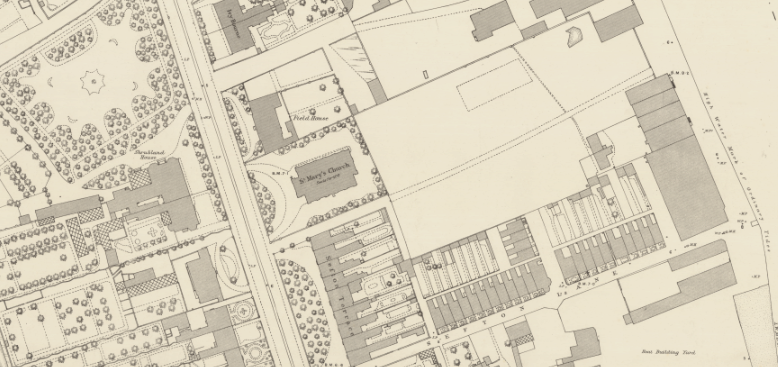
The below article is from the Norwich Mercury 200 years ago this week and it notes those people who donated money towards the construction of a new church. This was a little rare for the time in terms of the Anglican Church, although it was to become much more common later on during the nineteenth century. The money was being collected to fund what became St. Mary’s Church in Southtown, which opened in 1831. I rather like that it’s still there, as it seems to be a little sad that so many people donated for a project which ultimately didn’t survive in the long-term. The article is also an interesting list of the generous nature of various people and institutions of the time.
“Subscriptions:
The Corporation of Great Yarmouth: £500 0s. 0d. The Hon. G. Anson, M.P.: £100 0s. 0d. C. E. Rumbold, Esq. M.P.: £100 0s. 0d. Lord Viscount Siduey: £50 0s. 0d. Aldred Mr. S. H.: £2 2s. 0d. Atkinson Mr. J.: £2 0s. 0d. Baker Rev. T.: £20 0s. 0d. Baldry Miss: £1 0s. 0d. Barchard Mr.: £1 0s. 0d. Barmby Mr. W. H.: £5 0s. 0d. Barber Mr.: £0 5s. 0d. Beckett Mr. John: £1 0s. 0d. Beckett Mr. G. W.: £1 0s. 0d. Bell J. M. Esq.: £10 0s. 0d. Blomfield Mr.: £1 0s. 0d. Blomfield Mr. H.: £2 0s. 0d. Bolton Mr. G.: £2 0s. 0d. Bracey Mr. John: £1 0s. 0d. Brand Mr. W.: £1 0s. 0d. Breeze Mr. Jas.: £1 0s. 0d. Broadbank Mrs.: £10 0s. 0d. Brown Mr. John: £1 0s. 0d. Bunn Mr. James: £10 0s. 0d. Burton C. F. Esq.: £20 0s. 0d. Burton T. Esq.: £10 0s. 0d. Burton Mr. S.: £10 0s. 0d. Chambers Mr. W.: £5 0s. 0d. Child Mr. John: £0 2s. 6d. Christmas Mr. J.: £5 0s. 0d. Christmas Mr. S.: £2 0s. 0d. Clark Mr. Jas.: £50 0s. 0d. Clarke Mr. F.: £10 0s. 0d. Clowes Mr. T.: £2 0s. 0d. Cole Mr. R.: £1 0s. 0d. Cory R. Jun. Esq.: £21 0s. 0d. Costerton C. Esq.: £15 0s. 0d. Cox Miss: £1 0s. 0d. Cracknell Mrs.: £1 0s. 0d. Crisp Mr. F.: £1 0s. 0d. Crovitlier Mr. S.: £5 0s. 0d. Cubitt Mr. R.: £5 0s. 0d. Diver Mr. W. H.: £2 0s. 0d. Diver Mr. R.: £2 0s. 0d. Docking Mr. G.: £1 0s. 0d. Douglas Mr. T.: £1 0s. 0d. Dowson B. Esq.: £21 0s. 0d. Drake Mr. Jas.: £1 0s. 0d. Draper Mr. J. sen.: £10 0s. 0d. Draper Mr. J. jun.: £0 10s. 0d. Duncan Mr. A.: £0 10s. 0d. Ellis Mr. C. T.: £2 2s. 0d. English Mrs.: £2 0s. 0d. Fear Mr. John: £10 0s. 0d. Ferrier Mr. R.: £10 0s. 0d. Fielding B. Esq.: £21 0s. 0d. Fiddis Mr. T.: £10 0s. 0d. Fisher W. Esq.: £50 0s. 0d. Fisher Jas Esq.: £25 0s. 0d. Fisher J. G. Esq.: £25 0s. 0d. Fisher Mr. T.: £2 0s. 0d. Friend, by Mr. Glasspoole: £5 5s. 0d. Friend at the Bath House: £1 0s. 0d. Gamble Mr. Win.: £1 0s. 0d. Garwood Mr. T.: £5 0s. 0d. Gill Mr. W.: £1 0s. 0d. Giles Mr. Charles: £1 0s. 0d. Glasspoole Mr. H.: £10 10s. 0d. Gooding Mr. J.: £1 10s. 0d. Gourlay Mr. D.: £1 0s. 0d. Green Mr. J.: £1 0s. 0d. Greenwood Mr. E.: £1 0s. 0d. Groome Mr. E.: £1 0s. 0d. Grout, Baylis and Co.: £20 0s. 0d. Gunthorpe Matthew, Esq.: £50 0s. 0d. Hallmark Mrs.: £50 0s. 0d. Hamment Mr. R.: £1 0s. 0d. Harmant Mr. Jes.: £10 0s. 0d. Harley Mr. Geo.: £0 10s. 0d. Hart Mr. Wm.: £0 10s. 0d. Haynes Mr. Wm.: £1 0s. 0d. Hook Mr. Dan.: £10 0s. 0d. Hume Mr. Wm.: £0 5s. 0d. Hunt Mr. A.: £1 0s. 0d. Jefferies Capt.: £5 0s. 0d. Johnson Mr. C.: £5 0s. 0d. Johnson Mr. J.: £1 0s. 0d. Johnson Mr. Wm. J.: £1 0s. 0d. Kenworthy Mr. J.: £1 0s. 0d. Kelly Rev. S.: £5 0s. 0d. Lacon, Youell, and Co.: £100 0s. 0d. Lahy Mr. James: £1 0s. 0d. Lane Mr. J.: £0 10s. 0d. Libbis Mr. R.: £0 7s. 0d. Lott Mr. J. H.: £1 0s. 0d. Lubbock Mr. R.: £1 0s. 0d. Lubbock Mr. C.: £1 0s. 0d. Lucas Rev. G.: £15 0s. 0d. Luson Miss: £1 0s. 0d. Mann Mr. R.: £1 0s. 0d. Mackland Mr. E.: £5 0s. 0d. Mason Mr. J.: £2 0s. 0d. Meggy Mr. Wm.: £1 0s. 0d. Meyrick Mr. Wm.: £1 0s. 0d. Minter Mr. John: £2 0s. 0d. Miller Mr. Wm.: £1 0s. 0d. Miller Mr. Step.: £2 0s. 0d. Moore Mr. P.: £1 0s. 0d. Moon Mr. S.: £2 0s. 0d. Morgan Mr. E. W.: £10 0s. 0d. Moxon Mr. John: £5 0s. 0d. Moyse Mrs. Jane: £10 0s. 0d. Nicholls Mr. C.: £10 0s. 0d. Nolloth Mr. Jas.: £1 0s. 0d. Norman Mr. Jas.: £2 0s. 0d. Nuthall Mr. P.: £2 0s. 0d. Offord Mr. D.: £1 0s. 0d. Paget S. Esq.: £25 0s. 0d. Palmer W. D. Esq.: £100 0s. 0d. Palmer G. D. Esq.: £21 0s. 0d. Palgrave W. E. Q.: £21 0s. 0d. Pope Mr. J.: £1 0s. 0d. Poppy Mr. J.: £0 10s. 0d. Powell Mr. J.: £0 5s. 0d. Preston J. Esq.: £20 0s. 0d. Preston I. Esq.: £25 0s. 0d. Preston E. Esq.: £25 0s. 0d. Preston J. Esq.: £10 0s. 0d. Preston Mr. J. K.: £3 3s. 0d. Preston Mr. A.: £3 0s. 0d. Preston Mr. G.: £2 0s. 0d. Pulford Mr. G.: £2 0s. 0d. Ranney J. Esq.: £15 15s. 0d. Reeve Mr. W.: £1 0s. 0d. Reynolds F. R. Esq.: £50 0s. 0d. Robinson J. J. Esq.: £10 0s. 0d. Roe Mr. T.: £2 2s. 0d. Ruzby Mrs.: £1 0s. 0d. Saunders Mr. W.: £25 0s. 0d. Sayers and Son: £20 0s. 0d. Seaman Mr. F.: £2 0s. 0d. Searum Mr. R.: £1 1s. 0d. Sharman Mr. E.: £10 0s. 0d. Sherrington Mr. S.: £10 0s. 0d. Short Mr. J.: £1 0s. 0d. Shreeve Mr. H.: £2 0s. 0d. Sloman Mr. Chas.: £1 0s. 0d. Smith Mr. R. C.: £1 0s. 0d. Smith Mr. J.: £2 2s. 0d. Smith Mr. R.: £1 0s. 0d. Springall Mr. T.: £0 10s. 0d. Steele Miss: £0 5s. 0d. Stevenson Mr. J.: £5 0s. 0d. Sutton Mr. S.: £0 10s. 0d. Swirles Mr. D.: £1 0s. 0d. Thacker Mrs.: £0 10s. 0d. Thompson Mrs.: £5 5s. 0d. Thompson E. Esq.: £20 0s. 0d. Thrower Mr. A.: £1 0s. 0d. Toluer & Preston: £25 0s. 0d. Townshend Mr. R.: £1 0s. 0d. Turner Rev. R.: £50 0s. 0d. Turner D. Esq.: £25 0s. 0d. Turner Mrs. M.: £0 10s. 0d. Veal Mr. R.: £1 0s. 0d. Vardon Mr. John: £0 5s. 0d. Warren Mr.: £1 0s. 0d. Watling Mr. F.: £3 3s. 0d. Watson J. Esq.: £20 0s. 0d. Watson Mr. T.: £5 5s. 0d. Watson R.: £1 0s. 0d. Williams J. H. Esq.: £25 0s. 0d. Wright Mr. E.: £1 0s. 0d. Yette Win. Esq.: £20 0s. 0d. Youngman Mr. T.: £1 0s. 0d.
And a Site of Ground on which to erect a Building, Subscriptions are received at the Town Hall, the Banks, the Subscription-Room, and at the Bath Rooms, in this Town.
I’ve touched on this issue before, but the newspapers from 200 years ago are littered with suicides and this often seems to be underplayed throughout history. This article in the Norwich Mercury from 200 years ago this week noted:
“And the same day, at the Workhouse, in the parish of St. Andrew, on the body of John Gowing, aged 35 years, who, in a fit of insanity, threw himself from his bed-room window into the stone yard of the said Workhouse. Verdict accordingly.”
The reason that it mentions “the same day” is that there was another suicide reported in the weekly newspaper.
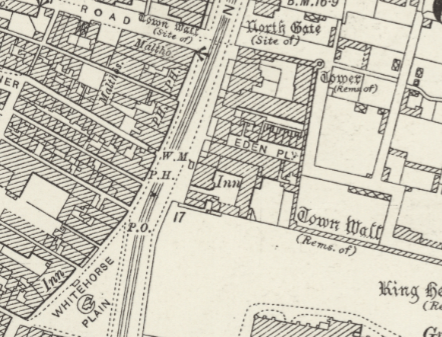
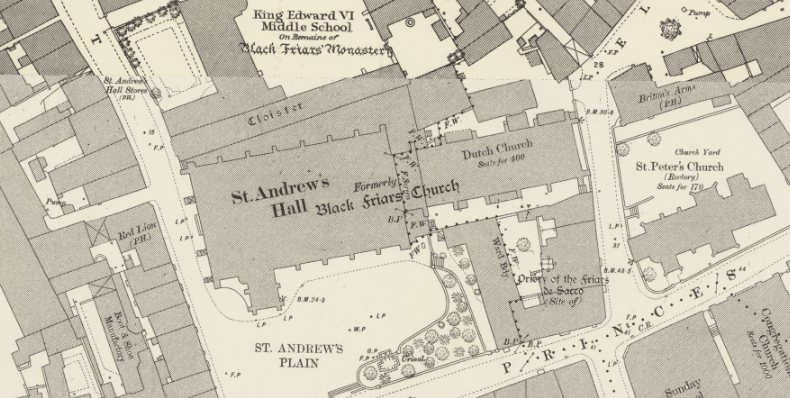
The workhouse in question here is in St. Andrew’s and it was located in the cloisters of St. Andrew’s Hall, best known today perhaps as the home of Norwich Beer Festival. In the above map from the 1880s, the site of the workhouse was the King Edward VI Middle School.
John Gowing was baptised on 29 December 1793, the son of Robert Gowing and Martha Tutthil, and it appears that the age in the newspaper article was wrong, he died at the age of just 31. I can’t be sure that this is the same John Gowing who committed an appalling crime in 1817, but the details provided do fit although I can’t find the transportation record.
“John Gowing and Daniel Thorpe, the latter only 13 years of age, were indicted for feloniously stealing and carrying away out of the house of Wm. Thorpe, linen-draper at Langley, a quantity of gold and silver coin, his property, on the 10th of April last. This case excited considerable interest. The youngest prisoner, who was admitted King’s evidence, was the orphan nephew of the prosecutor, and had been brought up and educated at his expense; the other prisoner was his servant; and, from the testimony of the child, corroborated by other evidence, it appeared that Gowing had for some time past been urging the boy to rob his uncle, and that he had frequently done it, giving what he had got to Gowing, and receiving, as his portion, whatever part he was pleased to give him. The prosecutor was in the habit of keeping a quantity of guineas and other gold coin by him in a small spice box, which had a lock and key to it. Gowing had procured a key which fitted it, and repeated visits had been made to the old gentleman’s magazine without his suspicion being excited, as whenever his nephew made his attacks, Gowing stood sentinel to prevent a surprise. At length the key accidentally breaking in the lock, Gowing persuaded him to take away box and all. This was done, and the whole booty was delivered to Gowing. The box was broke open, and the contents shared between them in such proportion as Gowing thought fit. These facts being fully proved, the Jury found the prisoner, Gowing—Guilty.—Mr. Justice Abbott, in pronouncing sentence, animadverted in severe terms on the prisoner’s conduct: first, in having seduced a child of the tender age of Thorpe to rob his benefactor; and next, in having himself become a party to rob his employer, who had placed a confidence in him. The humanity of the prosecutor had induced him to prefer this indictment in such a form as did away the capital part of the offence. The Court, however, felt itself bound to inflict the severest punishment in its power upon him. That punishment was, that he should be transported beyond sea for the term of seven years.”
John was buried at St. George Colegate on 23 July 1825, which is a church that I walk by frequently. I can’t find him listed in any family trees or referred to online, which made me wonder how many people have thought about him over the last 200 years. Either which way, it’s all really rather sad.
And in my series of random posts from newspapers of 200 years ago this week. This is the court report of the Norwich Mercury and the punishments issued.
“George Thurlow, convicted of stealing a quantity of lead from Rev. W. Manning, of Diss—2 years’ hard labour in the Castle. George Archer, convicted of receiving the same—14 years’ transportation. Wm. Bayes, convicted of fowl-stealing—2 years’ hard labour in the Castle. Robt. Dawes, an old offender—7 years’ transportation. Thomas Norgate, convicted of pig-stealing—18 calendar months’ hard labour in the Castle; and Robt. Pawley, convicted of receiving two of the same pigs—14 years’ transportation. Jonathan Forder, convicted of a violent assault on a child at Langley, pleaded guilty—to be imprisoned 6 calendar months. Chas. Dunham, convicted of stealing a quantity of butter from his master—2 years’ hard labour in the Castle.”
Note that the violent assault on a child received only six months in prison, whereas someone who received stolen lead was transported for fourteen years, although he stole it from a reverend which probably made matters worse in terms of his sentence.
With regards to George Archer who received this stolen lead, he was sent to New South Wales on the Sesostris, which had been launched in Hull in 1818. The ship set off on 23 November 1825 and arrived in Australia on 21 March 1826, but George had died en route on 11 December 1825.
From the Norwich Mercury 200 years ago this week was an article about Ivy Hall being for sale. The article read:
“TO BE SOLD BY AUCTION, BY WM. SPELMAN,
At the Greyhound Inn, Surry-street, Norwich, on Wednesday, the 20th day of July, 1825, at Four o’clock in the afternoon, in one Lot,
A Desirable ESTATE, called Ivy Hall; consisting of five dwelling-houses, fronting King-street, in the parish of St. Julian, Norwich, with gardens, privy, wash-house, and pump at the back thereof, in the several occupations of Messrs. Baldwin, Sainty, Haverstone, Mason, and Sheene.
The above Premises are Leasehold of the Dean and Chapter of Norwich for a term of 40 years, from the 7th day of June, 1825, renewable every 14 years, at the rent of 1s. per annum.
For particulars and conditions of sale apply to Mr. Alfred Barnard, solicitor, St. Andrew’s, or the Auctioneer, Duke’s Palace, Norwich.”
I hadn’t heard of this building, but after some checking it was previously the Hildebrands Hospital located on what is now Argyle Street, located just off King Street. The hospital had been founded in around 1200 and adjoined St. Edward Chapel, with the institution welcoming the poor, aged, travellers and pilgrims. It was passed to the Dean and Chapter of Norwich Cathedral after 1497 and as the advertisement above shows, they still owned it in 1825, although the church element was pulled down in 1547. There are, unfortunately, no traces of it remaining today, but it’s not a building that I had previously known about.