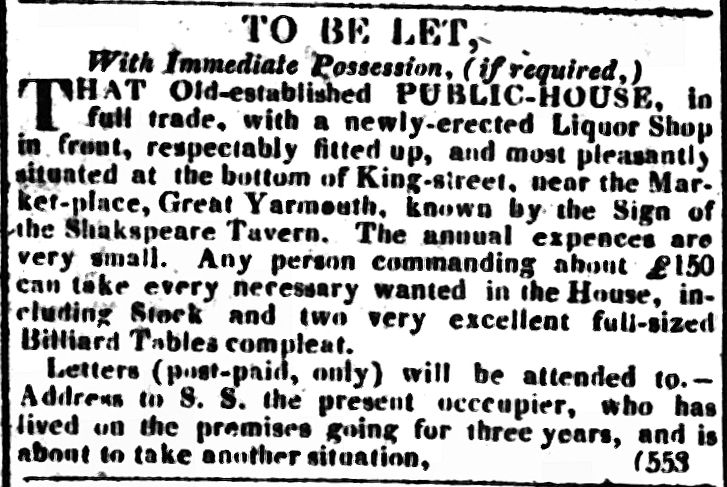
In the Norwich Mercury 200 years ago this week, it was advertised that the Shakespeare Tavern in Great Yarmouth was for let.
The advert read:
“THAT Old-established PUBLIC-HOUSE, in full trade, with a newly-erected Liquor Shop in front, respectably fitted up, and most pleasantly situated at the bottom of King-street, near the Market-place, Great Yarmouth, known by the Sign of the Shakspeare Tavern. The annual expences are very small. Any person commanding about £150 can take every necessary wanted in the House, including Stock and two very excellent full-sized Billiard Tables complete.
Letters (post-paid, only) will be attended to.— Address to S. S. the present occupier, who has lived on the premises going for three years, and is about to take another situation”
The SS referred to here was Samuel Smith, although I don’t know where he went from here. The pub had opened in around 1800, but it closed in the mid 1860s and was turned into a shop.
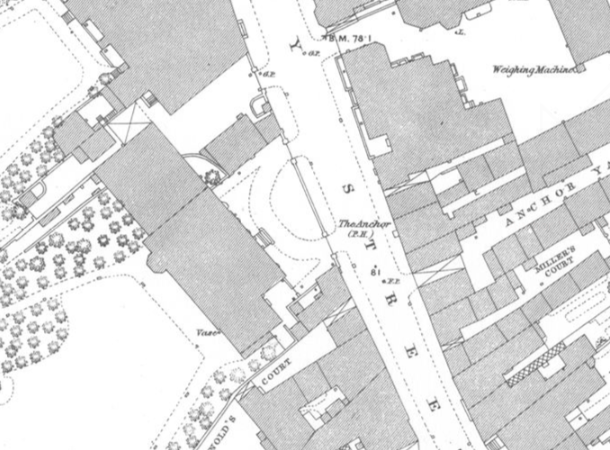
And another in my meanderings into newspapers from 200 years ago…. In February 1826, the Anchor Inn on Surrey Street was for sale at a public auction held at the Swan Inn in the city.
The auction listing said:
“An excellent freehold public house called the Anchor, with a cottage adjoining, in the parish of St. Stephen in Norwich with a frontage of thirty feet on the best side of Surrey Street. At the back of the house is a wash-house and a large yard and garden, well adapted for building.
This is now in the occupation of Messrs. Finch, Brewers and their under-tenant Robert Ramsey, and the Widow Tee. Land tax £2 2s. 0d.”
There’s the Anchor, although all of this on the north of Surrey Street has been trashed by the generic buildings (this one now known as Rosso) put up by Norwich Union and so nothing remains. It was located pretty much opposite the current entrance to the bus station.
The pub itself continued trading until 1913, having later been taken over by Steward & Patteson Brewery, although the building itself survived until after the Second World War. I think there’s only one photo surviving of the entrance to Anchor Yard, named after the pub, which is at http://georgeplunkett.co.uk/Norwich/S/Surrey%20St%2018%20to%2020%20[1027]%201936-06-14.jpg. I assume that’s the former pub building in the photo, although this photo is from 1936, so twenty years after the pub closed.
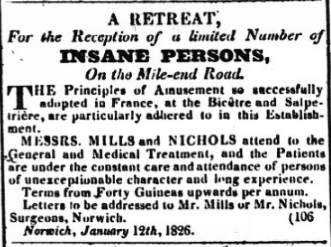
On my series of articles from Norwich newspapers of 200 years ago, there was an advertisement posted by two surgeons, Mills and Nichols, in the Norwich Mercury in February 1825. They were planning to open an asylum for “insane people” on Mile End Road, which is just off Newmarket Road in the city. They were intending to charge 40 guineas a year for treatment based on that from the Pitié-Salpêtrière Hospital in France.
What interests me about this pair, and this is another rabbit hole I’ll likely get lost in at some point, is that later in 1826 they opened their dissecting rooms in what I assume were premises nearby. This is in the period before bodies could legally be acquired in any number, so until the 1832 Anatomy Act, they were mainly sourced by body-snatchers. And on this, I can only suspect that Mills and Nichols were sourcing bodies in such a fashion. I will endeavour to find out more…..
Back to 200 years ago, as I’ve been neglecting this series of posts….
This is an article about the “State of the City” from the Norwich Mercury from February 1825, which I’ve pasted below. It shows just how tense matters were in the city, as the weavers in Norwich were upset by work being sent out to countryside where they suspected it was being completed for lower wages.
The manufacturer on Elm Hill found that their stock was destroyed, their premises smashed up and the rioters then ran amok damaging other locations in the city. The authorities acted in a robust manner to try and take back control, but manufacturers also decided to make a promise not to send any more work outside the city to try and calm the situation.
The magistrates took action anyway, they didn’t want a repeat of such occurrences in the city and they promised to take the firmest action possible against the rioters. And they were right to be concerned, the weaving trade was in a state of continued decline in Norwich and ultimately much work ended up being shipped out to Yorkshire in the 1830s. The 12,000 or so looms in Norwich in 1800 fell to under half that level by 1830, it was the beginning of the end of the trade that had led to so much wealth in the city.
“During the last few years, while the manufactures of the city have been in great and constantly increasing demand, the masters have been necessitated, notwithstanding the vast emigrations that have taken place from the country to the city, to send a large quantity of work into the country, where it has been manufactured. Great jealousy has existed for some time past between the city and country weavers, not only on this account, but because it was generally reported and as generally believed, that the wages were much less. The almost entire want of employment pervading the weaving population has turned the attention of the weavers to this point. The consequence has been, that on Tuesday evening about seven o’clock, having some suspicion, from seeing the Forncett carrier’s cart standing against the warehouse of Mr. Wright, a manufacturer, on Elm-hill, that he was about to send some work off to the country, the carrier was watched and seen to enter the warehouse with goods, but on his coming out, it was discovered that he was about to carry away a quantity of work. The weavers, who were assembled in a large body near the spot, drove away the cart, and after taking out the horse, completely destroyed it. They then as directly broke the windows in Mr. Wright’s factory.
Almost at the termination of these proceedings, Mr. Ald. Francis (the Deputy Mayor), Sheriff Brooks, J. J. Gurney, Esq. and several other gentlemen, came down to the spot, when Mr. Francis addressed the persons assembled, saying that every thing should be done for the purpose of relieving them, and requested their immediate and peaceable return to their homes. This address was received by them with loud shouts, and they quietly dispersed. On Wednesday morning a large body of weavers proceeded to almost all the public-houses from whence the carriers set out, and searched the carts. Some materials for work were found, and directly deposited in the Sword-bearer’s office, in the Hall—but we have not heard of any damage having been sustained either by carriers or innkeepers. The principal part of the day was thus passed, until between six and seven o’clock, when a large body of men came from Eaton, near this city, where they had seized some yarn. This they carried to the Hall, from whence they proceeded to Messrs. Willett’s factory, in Pottergate-street, where (these gentlemen being suspected of sending work out of the city) they demolished not only the windows, but the frames of the lower rooms.
Messrs. Bullamore and Hawkins’ warehouse, in Magdalen-street, Messrs. Bolingbroke’s, Brownfield’s, Willement’s, Herring’s, and several other houses, were visited, at each of which the proprietors were called for and questioned, both as to the quantity of work each had in the country, and as to whether they intended to send any more into the country while the citizens were unemployed. Answers to these questions having been satisfactorily given, no violence was offered. Mr. Purdy’s warehouse, in Peacock-street, was also very seriously damaged.
After the populace had been to the warehouses of the gentlemen we have mentioned, they proceeded to Mr. A. Beloe’s factory, St. John’s Timberhill, where, unfortunately Mr. Beloe being absent in London, and no person being present to address them, they immediately broke nearly all the windows of this extensive building, which is four stories high. The Deputy Mayor came about this time to the scene of tumult, where he immediately read the Riot Act. The market place then became thronged with people, where the Riot Act was again read by Mr. Francis, and a number of special constables sworn on. It was then deemed necessary to send to the barracks for the Scots Greys. Col. J. Harvey addressed the persons assembled upon the impropriety of their conduct, both at Mr. Beloe’s, in the Market, and on the Castle Ditches, and recommended their immediate return to their homes. At the Hall great discussion among the Magistrates took place upon the propriety of the Dragoons being sent for; fortunately there was no necessity to employ them. A party of special constables were sent to each of the manufactories, and the rest of the night was passed in quietude.
In the early part of the day, while very many weavers were assembled in the Market-place, they were addressed by Mr. Alderman Francis, who promised that he would call a meeting of the manufacturers, and urge the necessity of their not sending any more work out of the city while it was in its present state. Pursuant to this promise, many of the principal manufacturers met at the Hall—J. Harvey, Esq. the High Sheriff, (the chairman of the committee of manufacturers in this city) in the chair, and it was unanimously agreed that they would send no more work out of the city, and a paper was sent round for the signature of such manufacturers as were not present. After this was agreed upon, a deputation of the weavers were called in and acquainted with the fact.
The city on Thursday morning exhibited an unsettled and stormy appearance, and in the streets during the whole day were to be seen numbers of idle hands. In the morning the magistrates sent officers to summon every respectable inhabitant to the Hall for the purpose of swearing them on as special constables. A very large number were sworn in during the afternoon, and at half-past five they assembled, in case any fresh disturbance should take place. About four o’clock a part of Colonel Harvey’s Yeomanry Cavalry marched up to the Hall, where they received orders to proceed to Mulbarton, and put themselves under the direction of Dr. Beevor, the magistrate at that place, as it was surmised by the magistrates that Mr. Beloe’s factory there might be attempted. Shortly afterwards the Mayor issued the following bill:
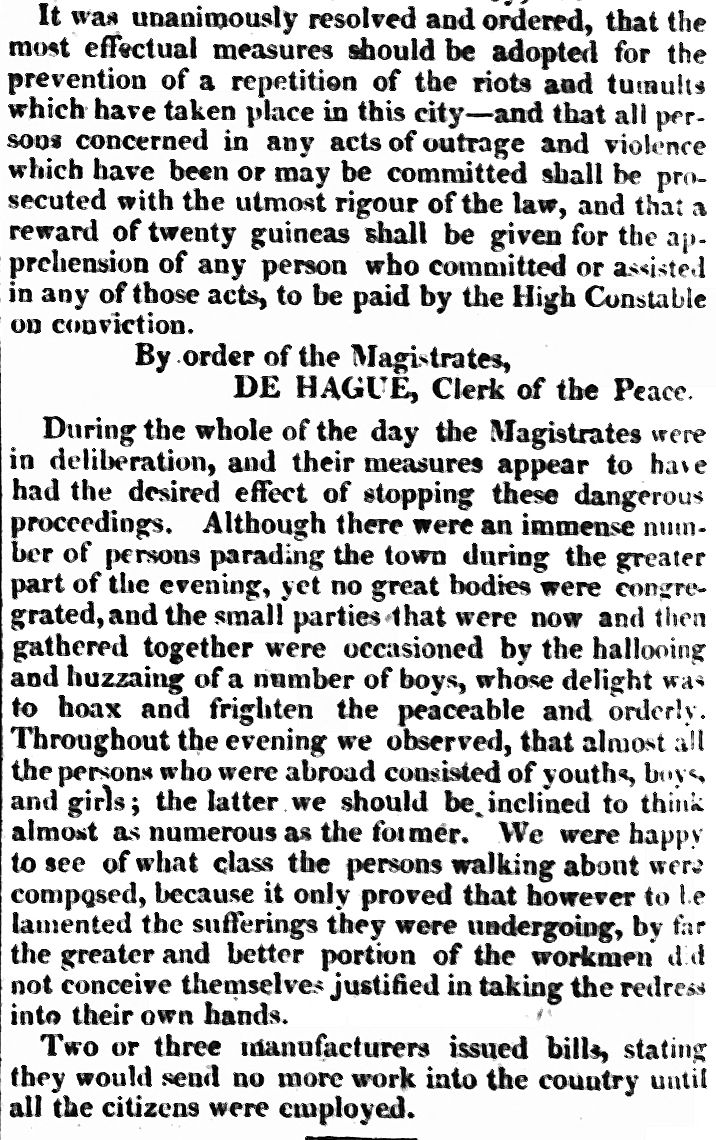
Twenty Guineas Reward.—At a meeting of the Magistrates for the city and county of Norwich, held at the Guildhall on the 2d of February, 1826— It was unanimously resolved and ordered, that the most effectual measures should be adopted for the prevention of a repetition of the riots and tumults which have taken place in this city—and that all persons concerned in any acts of outrage and violence which have been or may be committed shall be prosecuted with the utmost rigour of the law, and that a reward of twenty guineas shall be given for the apprehension of any person who committed or assisted in any of those acts, to be paid by the High Constable on conviction.
By order of the Magistrates, DE HAGUE, Clerk of the Peace.
During the whole of the day the Magistrates were in deliberation, and their measures appear to have had the desired effect of stopping these dangerous proceedings. Although there were an immense number of persons parading the town during the greater part of the evening, yet no great bodies were congregated, and the small parties that were now and then gathered together were occasioned by the hallooing and huzzaing of a number of boys, whose delight was to hoax and frighten the peaceable and orderly. Throughout the evening we observed, that almost all the persons who were abroad consisted of youths, boys, and girls; the latter we should be inclined to think almost as numerous as the former. We were happy to see of what class the persons walking about were composed, because it only proved that however to be lamented the sufferings they were undergoing, by far the greater and better portion of the workmen did not conceive themselves justified in taking the redress into their own hands.
Two or three manufacturers issued bills, stating they would send no more work into the country until all the citizens were employed.”
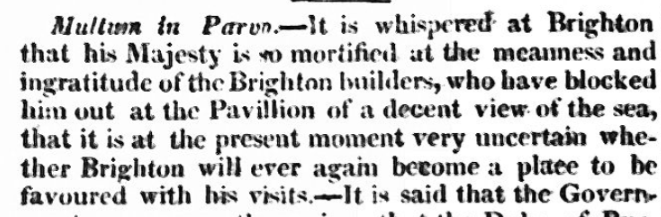
Another article in the Norwich Mercury of 200 years ago this week. Now, I accept this has little to do with Norwich, but it’s some early form of royal gossip of which there has been plenty more over the last 200 years. The story is likely true, as King George IV made only one more visit to Brighton following this story and he had made huge efforts to make the Brighton Pavilion a decadent and suitable home.
Its future as a residence for the Monarch was already reaching its end. King William IV did use it, but Queen Victoria wasn’t that surprised and delighted with it, so she sold it to the City of Brighton in 1850.
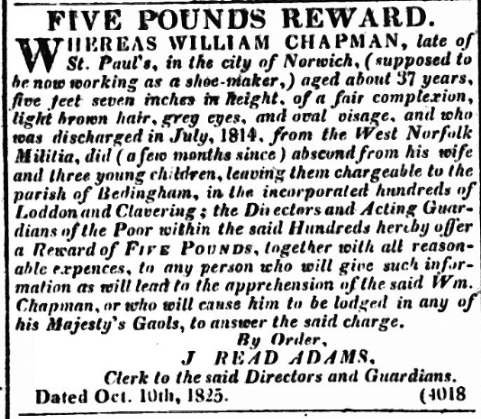
And another in my series of articles in the Norwich Mercury of 200 years ago this week. Back in 1825, if a man abandoned his wife and children without paying any support then he would face consequences from the local parish. Under the Poor Laws and Vagrancy Acts, if his deserted family became chargeable to the parish, local overseers could apply for his arrest and he could be punished as a rogue and vagabond, facing imprisonment or hard labour. The law’s primary concern was protecting the parish purse, not enforcing domestic responsibility, so prosecution generally occurred only when abandonment led to public expense as was the case here.
The £5 reward was a generous one, that’s worth over £250 in today’s money. The village of Beddingham is around ten miles south of Norwich and it’s clear that they were displeased that they were left funding William’s wife and children. It’s an interesting snapshot of the benefits system of the time, which did ensure at least that women and children were looked after.
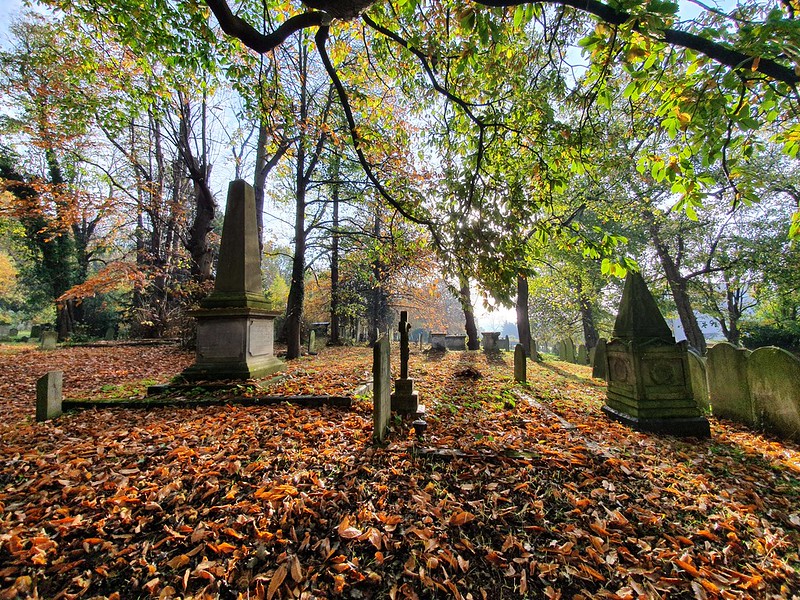
And in my continuing series of posts from the Norwich Mercury of 200 years ago this week, there was an announcement about the extension of Rosary Cemetery. The cemetery was the first non-denominational one to have opened in the UK, with the first burial taking place in 1821.
The shareholders had met at the Old Library Room at St. Andrew’s (now demolished) and they were pleased at the progress made in the first few years of the cemetery’s operation. The first few years hadn’t really stressed the gravediggers (although it made it easier to guard against body-snatchers), as there was one burial in 1821, two burials in 1822 and three burials in 1824 (goodness knows what happened in 1823).
The decision made 200 years ago was very sensible as although their priority was actually keeping the church out of their affairs, there was to be a cholera epidemic in 1831 and the land at Rosary Cemetery was a useful overflow to church graveyards. And, in 1855, after a major national cholera epidemic, all new burials in churchyards were banned. The original five acres were filled by the end of the nineteenth century, so the additional land they had already acquired proved to be very useful.
“ROSARY BURIAL GROUND, NEAR THE FOUNDRY BRIDGE ROAD.
At a MEETING of the Shareholders, held at the Old Library Room, St. Andrew’s, Norwich, on the 22nd of September, 1825:
MR. THOMAS MARTINEAU in the Chair, Statements of the number of Interments since the appropriation of the Ground as a Public Burial Ground, and of the number of Shares engaged by individuals, having been read by the Registrar,
IT WAS RESOLVED, That the Rosary, from its situation and the extent of ground belonging to it, is admitted to be well calculated for a permanent Cemetery, for persons of all denominations, and will be found of great benefit and utility.
That from the number of Interments which have already taken place, and the number of Shares engaged, it is expedient the proper measures should be adopted for permanently establishing and securing the whole of the ground originally proposed for a Cemetery, without further delay.
That the Solicitors be instructed to prepare forthwith the requisite deed or deeds, to be enrolled in Chancery, for vesting the Rosary Burial Ground in Trustees, to be held as a Public Place of Interment for ever, subject to the management of Directors, to be chosen from among the Shareholders.
That notice be given, that applications for Shares remaining undisposed of must be made on or before the 27th day of October instant, on which day the list shall be closed.
That applications for Shares be made to the undermentioned Shareholders: to Mr. Drummond, at the Rosary; or to the Solicitors, Messrs. Parkinson and Staff, St. Andrew’s, Norwich, of whom prospectuses of the plan may be obtained gratis.
Mr. Thomas Martineau John Taylor Joseph Geldart Wm. Davey Thomas Hitchen John Athow Robert Blake, jun. Wm. Wilde J. Darken R. Miller Samuel Wiseman J. Mottram, sen. E. Cotman J. H. Balls G. Sothern Wm. Newson Thomas Hawkins Henry Bolingbroke George Kitton
Mr. Isaac Wiseman J. Mottram, jun. Wm. Busley Manning E. Martin Hewett Rev. F. Tagart Mr. Wm Chapman W. Stark G. Grout C. Geldart Wigham E. Brown Carter Bluth R. Morgan Joseph Geldart, jun. N. Rue”
In my erratic series of posts from Norfolk newspapers 200 years ago this week, I noticed that the King’s Arms in Great Yarmouth was being advertised for sale in the Norwich Mercury. The text reads:
“KING’S ARMS INN, Great Yarmouth.
To be Sold by Private Contract,
All that Old-established and well-known INN, called the KING’S ARMS INN, with 3 Cottages adjoining, situate near the North Gates, in Great Yarmouth, in Norfolk, now in the occupation of Mrs. Mayhew, with good arched Wine and Beer Cellars, extensive Yards, Stabling, Standing for Carriages, &c. &c.
The above Property has long been distinguished as being one of the best situations for an Inn in the borough of Great Yarmouth.
The Estate is all Freehold, and the only out-going is an annual Land-tax of £2.
N. B. — An excellent Weighing Machine for Hay is attached to the Premises.
For price and further particulars apply (if by letter post-paid) to Mr. Samuel Sherrington, Priory, Great Yarmouth, or Mr. Miller, Union Office, Norwich.”
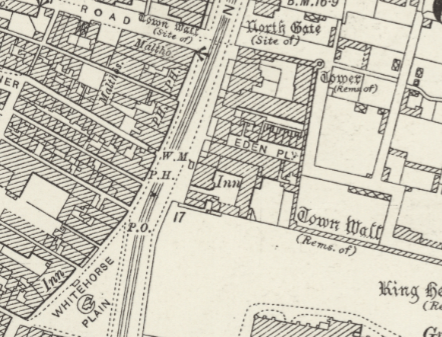
I rather like that this pub is still there, although it was mostly rebuilt in the early twentieth century and then had to be repaired after extensive damage during the Second World War. To this day, the pub retains its large beer garden and I visited it a few times during the partial lockdown a few years ago.
Here’s what it looked like at the turn of the last century, the area to the left has nearly all been lost, but the area around the pub remains looking pretty similar. Mrs Mayhew, who was mentioned as the landlady in the advert, remained running the pub until 1830 and it was up for sale a couple of times in the years that followed so it’s possible that it never actually sold.
In a newspaper article in the Norwich Mercury from 200 years ago this week, it’s mentioned that the death of Joseph Christmas, aged 17, was confirmed. The news had come from Port-au-Prince, which is today one of the most dangerous cities in the world and nearly entirely controlled by gangs. This likely wasn’t his destination, he was on a merchant ship where he died during the travels.
Joseph Harmer Christmas was born on 19 May 1809 in Great Yarmouth and was baptised the following day, which seems to be rather efficient. He was the son of John and Honor Harmer Christmas and here’s the will of John. On the surname, it’s relatively rare and its origins are unclear although there’s more on a Wikipedia page about the matter. What intrigues me more is what the 16 year old (the newspaper article got his age wrong) was doing off in the then British West Indies, his family didn’t appear to be wealthy enough to be involved in owning plantations, although they did seem reasonably well connected. Yet another mystery that maybe one day I’ll be able to solve to my complete satisfaction….
In another of my exciting (or something like that) posts about articles in the newspaper from 200 years ago this week, this is the court record of when John Atkins went to court.
“John Atkins, for breaking into the dwelling-house of John Seaman, of Tasburgh, and stealing a gold ring and about 40s. in cash. – This case was very similar to those already given: The prosecutor having left his house safe when he went out; on returning found it broken open, and suspecting the prisoner, caused him to be apprehended, who (when taken before a magistrate) confessed the charge. Guilty-sentence of death recorded.”
Even the article notes that this is just one in a series of judgements from the same court which routinely led to the execution of the prisoner. It’s really quite evident that these death sentences weren’t much of a deterrent and that crime was running at high levels. It seems that John Seaman likely already knew Atkins, given that he suspected him of the crime. John was though in luck, as on 31 August 1825, it was decided that he would be pardoned and his sentence commuted to transportation to what was referred to as “the new colony” of Australia. However, I can’t find any mention of his transportation record, so his ultimate fate remains a mystery to me at least.









![http://georgeplunkett.co.uk/Norwich/S/Surrey%20St%2018%20to%2020%20[1027]%201936-06-14.jpg](http://georgeplunkett.co.uk/Norwich/S/Surrey%20St%2018%20to%2020%20[1027]%201936-06-14.jpg)