And (yet) another post in my series of things that I thought intriguing from the Norwich Mercury of 200 years ago this week. The article reads:
“On Thursday night, or early on Friday morning, some persons broke into the bar of Mr. Blackley, at the Castle Inn, by breaking the window over the porter-room door, and slipping the bar lock, and stole from thence a musical snuff-box, a silver snuff-box, four pictures, double-bitted bridle, pair of shoes, boots, silver wine strainer, and several other articles. The pictures are portraits of Mr. Blackley and some of his family. A person sleeping near the room imagined that he heard their attempt, but did not rise to ascertain the fact.”
It’s the last line that I thought of note and I can almost imagine the annoyance of William Henry Redhead Blackley, who was the landlord of the pub between 1823 and 1833, that the person mentioned didn’t attempt to stop what was going on. This was also a large venue (known over the time as the Castle Inn, the Castle Hotel, the Castle & Lion and just the Castle), it had been trading since the mid seventeenth century and it remained open until 1989, which seems like quite a decent run to me. Unfortunately, the building was lost in the 1990s as part of the Castle Mall development, but it had been a sizeable building.
As some other asides, it was quite a little haul that the thieves got away with, taking horse related kit, shoes and photos of the landlord. I had to look up what a porter room was and it’s apparently a Norfolk thing, it’s a reference to the posh bar or I suppose the lounge bar of its day.
As for the landlord, William died on 1 March 1833 and is buried at the Rosary Cemetery, although I’m not sure if his gravestone is still there.
And another in my series of posts that caught my eye from the Norwich Mercury of 200 years ago.
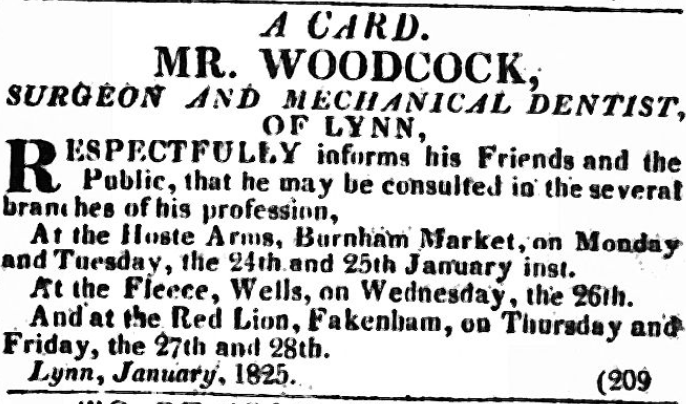
“MR. WOODCOCK, SURGEON AND MECHANICAL DENTIST, OF LYNN,
RESPECTFULLY informs his Friends and the Public, that he may be consulted in the several branches of his profession,
At the Hoste Arms, Burnham Market, on Monday and Tuesday, the 24th and 25th January inst.
At the Fleece, Wells, on Wednesday, the 26th.
And at the Red Lion, Fakenham, on Thursday and Friday, the 27th and 28th.
Lynn, January, 1825.”
A mechanical dentist is a phrase that was used for over 100 years and this is someone who made dentures and other dental appliances. But, what I rather like is that he wasn’t operating from a dental office, but was instead travelling to different towns and meeting patients in various pubs. I rather like this glimpse into what healthcare looked like in rural England in the early nineteenth century, for those with at least a little money at least. And meeting patients in a pub seems a quite marvellous idea to me.
What is also rather positive is that the three pubs mentioned are all still operating 200 years on. The Fleece is better known now as the Golden Fleece and the Red Lion closed in 1974 and was turned into council offices, but then reopened as a bar around twenty-five years ago. There’s something reassuring knowing that 200 years on, these pubs are all still there (although the Red Lion seems to be a little tentative at the moment) although I don’t think that they have anyone going around offering tooth repair.
200 years ago this week in the Norwich Mercury is this advert placed by John Sell Cotman. This wasn’t a new thing for him, he had been doing it for many years and so it must have been successful in getting work in.
John Sell Cotman (1782-1842) was a prominent English landscape painter and etcher, particularly recognised as a leading figure of the Norwich School of painters. Born in Norwich, he displayed an early inclination towards art, diverging from the path of his father’s business. Cotman’s artistic journey began in London, where he immersed himself in the art scene, encountering notable figures like J.M.W. Turner and Thomas Girtin. He became part of their sketching club, embarking on expeditions to Wales and Surrey, which significantly influenced his artistic development. By 1800, he was exhibiting at the Royal Academy, showcasing his captivating landscapes.
“MR. J. S. COTMAN RE-COMMENCES his Course of Teaching in the departments of DRAWING, PAINTING in OIL and WATER COLOURS, on the 24th in NORWICH, and at YARMOUTH on the 21st instant. St. Martin’s at Palace.”
Hindsight is a marvellous thing, and also a bit pointless as this was 200 years ago, but what an opportunity this would have been. Cotman on the other hand often had financial difficulties, as being an artist wasn’t always hugely profitable, so this sort of thing would have bought in extra revenue.
And another in my series of posts from 200 years ago this week (well, actually next week, but the crime was this week).
“£30 REWARD.
WHEREAS on Friday night last some Persons entered a Turnip Field, in Swardeston, Norfolk, and there STOLE TWO FAT SHEEP, the property of Mr. William Smith, of Swardeston Hall, the Skins, Heads, and Entrails of which have since been found hidden among the Furze Bushes on the Hall Green, at Swardeston.
NOTICE IS HEREBY GIVEN, That whoever will give information which may lead to the apprehension of the persons concerned in the above felony, so as they be thereof convicted, shall be paid the Sum of TWENTY POUNDS out of the Fund of the Association for the Prosecution of Felons within the Hundred of Taverham and adjoining Hundreds and Towns, in the county of Norfolk, and the further Sum of TEN POUNDS by the said Wm. Smith.
J. S. PARKINSON, Treasurer to the said Association.
Norwich, Jan. 10th, 1825.”
This caught my eye because this is a huge reward for the theft of two sheep, the equivalent of nearly £2,000 in today’s money. The level of this must have been intended to be a deterrent and the farmer must have had some considerable wealth and influence. The farm is there today, known as Swardeston Hall Farm, with the hall itself still standing. I couldn’t find any later reference to this case, so the perpetrators might well have got away with it. As a slight aside, Swardeston is where Edith Cavell was born in 1865.
I also think it’s interesting that this is the period when attitudes were changing towards crime. The Bloody Code which had increased the number of capital crimes had been pretty much phased out in 1823 and I wonder whether some landowners were nervous that crime might rise as a result of that.
I spend too long reading old newspapers and one thing is timeless, which is the worry that the local healthcare provision isn’t sufficient. This letter to the Norwich Mercury in January 1825 spells out the problems which the correspondent thought needed to be dealt with.
“It now becomes a matter of serious and important consideration, in what way the funds are to be employed, which have been liberally afforded to the Hospital during the present year; and as much advantage will be derived from having the public attention directed to this point, I beg leave to offer, through your means, to the attention of the Governors, a few remarks on the subject.
The clear profits of the last Festival having been from £2400 to £2500, we must consider £300 of this sum, to defray the preparatory expences of the next Festival. The balance is therefore £2100; and to this may be added the late very munificent donation of £533, which increases the funds of the present year to the extent of £2633, beyond the average income.
With regard to the appropriation of this balance, I presume that the first consideration will necessarily be, whether the establishment, on its present scale, admit of any improvements. This is a circumstance of which the gentlemen who are most conversant in the details of hospital management are the most competent judges, and I would only observe upon it, that as there are no wards but such as are in constant use, the operations of cleansing, whitewashing, and painting, must occasionally diminish, for many weeks, and even some months, the accommodation of the patients: and that an additional ward would therefore be very important, in order to give full effect to those which the Hospital possesses.
Such an extra accommodation would likewise permit a ward to be employed for males or females, as an occasional overflow of the one description of patients or the other, might render necessary.
This goes upon the presumption, that the Hospital does not require any permanent magnification; but when the increased and increasing population of the city of Norwich and the county of Norfolk are taken into account, it will hardly be considered, that an establishment, which was intended for 80 or 90 patients half a century ago, when the population was near 10,000 less than it now is, could not, at the present time, be advantageously enlarged.
By the printed report it appears, that during the last twelve years, the average annual admissions have increased about a fourth; viz. from about 500 to 600; but it has very frequently happened, as is well known, that for many weeks together several of the applicants have not been admitted, though some of them have come from a considerable distance, and at great fatigue, expence, and inconvenience. This is an evil which can only be supplied by a permanent addition of beds to the Hospital.
The necessity for more room was felt even during the life-time of Dr. Alderson, who died in 1821; and plans and estimates were in his time obtained, as to the mode of enlarging the Hospital, by the erection of two new wards at the North-west corner of it. The state of the finances might at that time prevent the measure from being carried into effect, but the friends of the Hospital may now congratulate themselves, that there are the means of accomplishing this, or any other plan for increasing the utility of the establishment, which may be deemed necessary.
The erection of two new wards, similar in size to the present, and the addition of one of them to the regular establishment of the Hospital, may be easily provided for. By the printed accounts it appears that the housekeeping expences amount to about £16 or £17 per patient: that is, supposing 90 persons, including the officers, to be always on the diet tables of the Hospital. An addition of 15 patients, including nurses, &c. would not exceed, at £20 per annum per patient, £300. If the erection of two new wards amounts to £1000, there will still remain to be disposed of £1500, of the balance above mentioned. Suppose one of the new wards to be considered as independent on the Festival for its support, £900 or £1000, of this money will be required to keep it open till the next festival, when a similar sum may be appropriated to the same object.
Thus will the benefits of a Festival be immediately felt, in the increased relief afforded to the poorer orders of society, and at the same time a fair prospect afforded of keeping up the advantages of the augmented accommodation in future. The experiment would not hazard at all the safety of the establishment: for a ward which is meant to depend on a Festival for its support, might cease to be employed, if the funds intended to keep it open should fail. But when it is considered that the expences of future Festivals will be less than those of the last, and that none of their receipts will be necessary in new erections, there will be every prospect afforded, of not only keeping up, permanently, an augmented number of patients, but of likewise preventing the necessity of appropriating, in the regular support of the charity, those donations and legacies which, without aiming at making it independent of the continued protection of the public, should provide for its permanent and increasing utility.
I remain, Sir,
Your obedient servant,
A SUBSCRIBER.”
The hospital had been built in 1771 as a charitable institute and it was for a long time unable to cope with the demand placed upon it. A new hospital was built on the same site in 1883 and free healthcare was out of reach for many, but letters such as this seem to have a reassuring presence that the health service will probably never really be able to cope with the demands placed upon it.
As another aside (I have a lot of those), I personally prefer the archaic spelling of ‘expences’, although the origins are from the French word ‘espense’, so the current spelling does have historic integrity….
Just as a random article from 200 years ago. There’s sometimes a feeling that the past is some sort of halcyon place full of happiness and glee with a rural and traditional way of life.
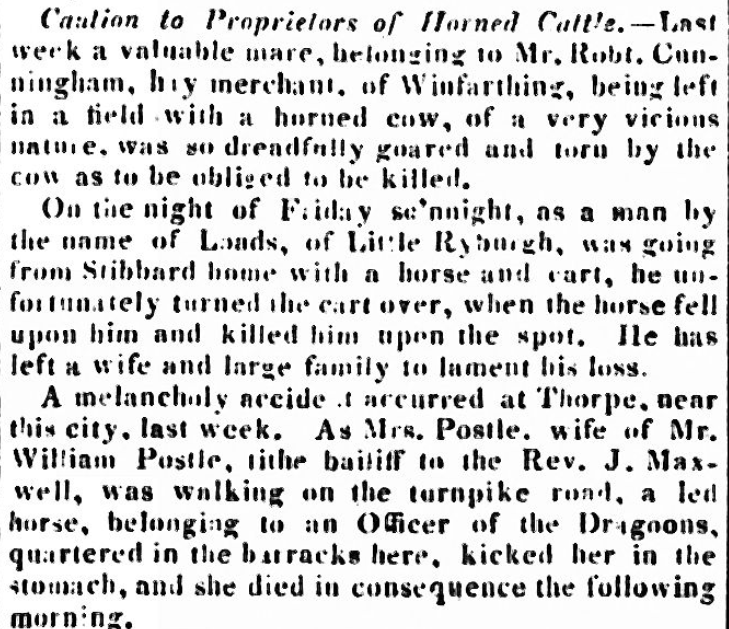
“Caution to Proprietors of Horned Cattle. – Last week a valuable mare, belonging to Mr. Robt. Cunningham, hay merchant, of Winfarthing, being left in a field with a horned cow, of a very vicious nature, was so dreadfully gored and torn by the cow as to be obliged to be killed.
On the night of Friday se’nnight, as a man by the name of Loads, of Little Ryburgh, was going from Stibbard home with a horse and cart, he unfortunately turned the cart over, when the horse fell upon him and killed him upon the spot. He has left a wife and large family to lament his loss.
A melancholy accident occurred at Thorpe, near this city, last week. As Mrs. Postle, wife of Mr. William Postle, tithe bailiff to the Rev. J. Maxwell, was walking on the turnpike road, a led horse, belonging to an Officer of the Dragoons, quartered in the barracks here, kicked her in the stomach, and she died in consequence the following morning.”
But then you get news articles like this, which are commonplace in newspapers of the time. Norwich, and other parts of Norfolk, at this point were also crime ridden and dangerous, even though a lot of people had little worth stealing. The past isn’t always so magical, especially for the families left to deal with the consequences of disasters such as this.
As a random aside, the history of the word ‘melancholy’ is intriguing (or it is to me):
“Middle English: from Old French melancolie, via late Latin from Greek melankholia, from melas, melan- ‘black’ + kholē ‘bile’, an excess of which was formerly believed to cause depression.”
Back to my occasional series of posts of news from 200 years ago, as reported by the Norwich Mercury. It’s just a line in the deaths section which says:
“On Christmas Day, Mr John Fitt, the master of the Shoulder of Mutton pub, St. Augustine’s , died in the 66th year of his age”.
I’m always a little intrigued by the location of pubs, but this one seems to be a mystery and it’s not clear to me from maps or on-line research exactly where it was. It was a Morgan’s Brewery pub which closed in 1870, likely on the Botolph Street end of St. Augustine’s Street. The last reference I can find is someone found drunk in Shoulder of Mutton Yard on St. Augustine’s in 1868 and the location of that yard is apparently lost as well. With more time I’m sure I could find it, but for the moment, it’s proving elusive.
John Fitt was buried in St. Augustine’s Church on 30 December 1824, although if there was a gravestone it’s no longer standing. The service record from his funeral notes correctly that he was 62 years old rather than what was reported in the Norwich Mercury, but journalists being wrong is hardly a new thing. John had been baptised on 30 October 1762, the son of William and Sarah Fitt.
BTW, happy new year to everyone, perhaps I might remember to have a look for where this pub was located at some point in 2025.
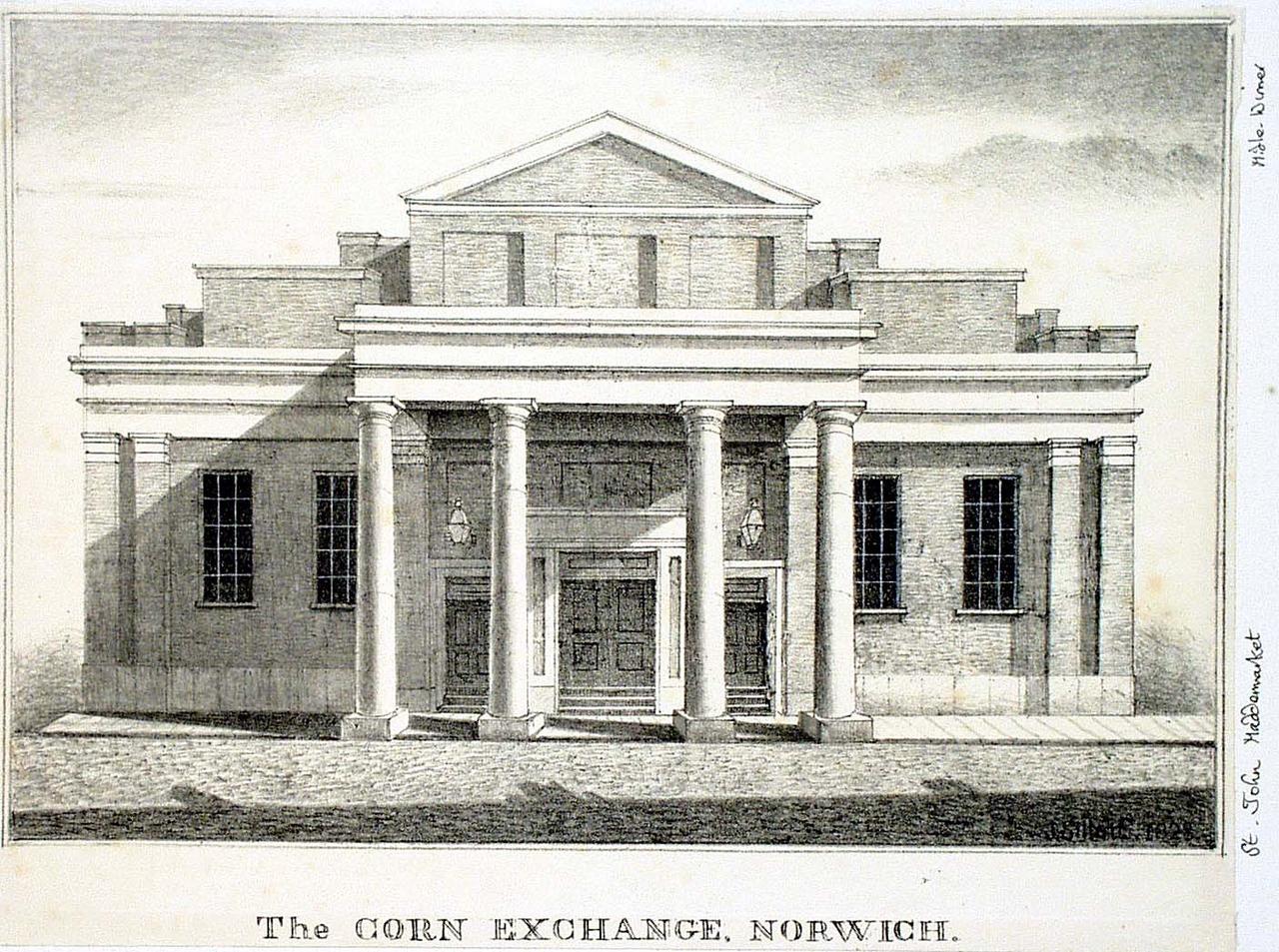
Back to my posts about what was happening in Norwich 200 years ago as I needed another break from Soviet statues in Estonia. Something reported in the Norfolk Chronicle newspaper in November 1824 was interesting to me as I hadn’t much thought about it, which is that was there a corn exchange in Norwich? Well, there was, originally it was located at St. Andrew’s Hall, but by the early 1820s planning was starting for a dedicated building. In the newspaper it noted the discussions that were being had and there was a meeting where they were considering whether to accept a generous offer from the Norwich Corporation of land on Castle Meadow to build a new Corn Exchange. There were lots of arguments about what documents should and shouldn’t have been brought to the attention of the meeting, showing that not much really changes in this sort of thing. I also liked how the Chronicle reported the later part of the discussion, which they referred to as “a desultory conversation”.
Not much was really agreed at the meeting either way, but there was progress as the above building opened in 1828. It was located in what is now Exchange Street and it’s not entirely hard to work out how that street obtained its name. It was a success as they decided to build a bigger corn exchange and that opened further down the same street, but this was demolished in 1964 as Jarrolds wanted to extend their store.
But, going back to December 1828 when the corn exchange opened, I rather liked the reporting at the time of this:
“A dinner was given to celebrate the opening of the New Corn Exchange, when a scheme presented itself seldom witnessed in Norwich: not less than 450 of the most respectable yeomanry in the county of Norfolk were assembled on the occasion, and they might with pride and satisfaction look round upon this noble building, which had been erected for the accommodation of the county almost entirely by their own voluntary contributions. The hall was beautifully and tastefully lighted up, partly by gas, and by or-molu lamps, hung from the ceiling and placed along the whole range of tables. The dinner, dessert and wines were excellent. The only drawback was the length of time it unavoidably took to ‘furnish forth’ the tables. There being no accommodation for cooking on the premises, the dishes were obliged to be brought a considerable distance. With the exception of Mr Coke, there was a most lamentable deficiency in the attendance of the aristocracy.”
So their dinner was late and there were no really posh people there, but otherwise it was obviously a rather pleasant evening. BTW, I had to Google what or-molu lamps were, apparently “Ormolu is the technique of applying finely ground, high-carat gold–mercury amalgam to an object of bronze”. So there we go.
This article was published in the Norfolk Chronicle and Norwich Gazette 200 years ago, in late July 1824. The text reads:
“The Sessions for this borough commenced on Monday last, before J. M. ALLEN, Esq. Mayor, M. J. WEST, Esq. Recorder, and other Justices. Anthony Blackster was indicted for maliciously destroying two vines in the hot-house, and several shrubs and trees in the garden, of Edm. Elsden, Esq. during the night of Wednesday, the 7th inst. The prisoner had entered the garden by scaling a wall which separated it from a yard at the back of Mr. Elsden’s premises. The vines had been trained with much care, and were loaded with the finest fruit, but the prisoner had broken and destroyed them so effectually as to prevent the possibility of their ever being restored to their previously flourishing state. He was sentenced to seven years’ transportation. There was no other business of public interest.”
It’s not clear to me whether this destruction was wanton vandalism, which wasn’t rare at the time, or whether it was someone so hungry that they were seeking food. The punishment was a sign of the times though, a seven year transportation sentence, it’s just a little fierce. Despite these sentences being handed out regularly, they didn’t seem to be much of a deterrent to people.
One benefit about being a criminal in the early nineteenth century, or at least if you could call it a benefit, is that you continue to exist in records. So many people lived a quiet life and they have entirely disappeared from the record, nothing known about their lives. It’s known that Anthony Blackster was held at the ship Justilla moored at Woolwich until he could be sent to Australia. The transportation record remains for Anthony, who had been born in King’s Lynn in 1797, he was put on the Royal Charlotte which sailed to New South Wales and which arrived on 29 April 1825. As an aside, the Royal Charlotte had been used from 1819 for transportation and it ran aground in Frederick Reefs, near to Australia, on 11 June 1825. Around ten years ago, the wreck was found, so the ship that transported Anthony is still in existence, albeit slightly wet and dented.
He remained in Australia when his sentence had been completed, he married and had one child, Marian Blackster. Unfortunately, what else happened to Anthony I don’t know, that information will be held by Australian archives and I’m not particularly well versed in their archive history. But, it’s a moment of interest to me that someone’s life could change so much just because of the vandalism that they did one night back on 7 July 1824…..
And the next in my series of posts from the Norfolk Chronicle of 200 years ago this week is all about walking…..
“Monday last, Townshend, the pedestrian, undertook to pick up with his mouth from the ground, in Finch’s gardens, 300 stones, placed one yard apart, and to deposit the same in a basket, in 11 successive hours, being a distance of 51 miles and 540 yards. In this undertaking, the pedestrian put his mouth to the ground 300 times, turned 600 times and stopped 600 times. The feat was performed 16 minutes within the time allowed. We understand that Townshend has undertaken to walk 40 miles backwards in 10 hours, on the same ground, on Monday next”.
This is the time to say that I’ve walked 100 miles, I might not have mentioned that…. Actually, I’d rather repeat that than walk over 50 miles and pick up stones with my mouth. This is certainly a challenge that I’m not sure would take off today, even with the TikTok generation demanding new content styles. The walker in question is, I think, John Phipps Townshend, who wasn’t a local man as he was born in Lewes, but he did do these pedestrian events around the country. He referred to himself as the “The Champion of Living Pedestrians”, although I would humbly suggest that David Morgan of the LDWA would be a contender for that title today….. There are adverts from the time relating to Finch’s Ranelagh Gardens, so I’m guessing that this was the location of Townshend’s exertions, more of which at https://colonelunthanksnorwich.com/tag/ranelagh-gardens-norwich/.